
Judge, 1889-03-09 · page 8 of 20
Judge — March 9, 1889 — page 8: what you’re looking at
What you’re looking at
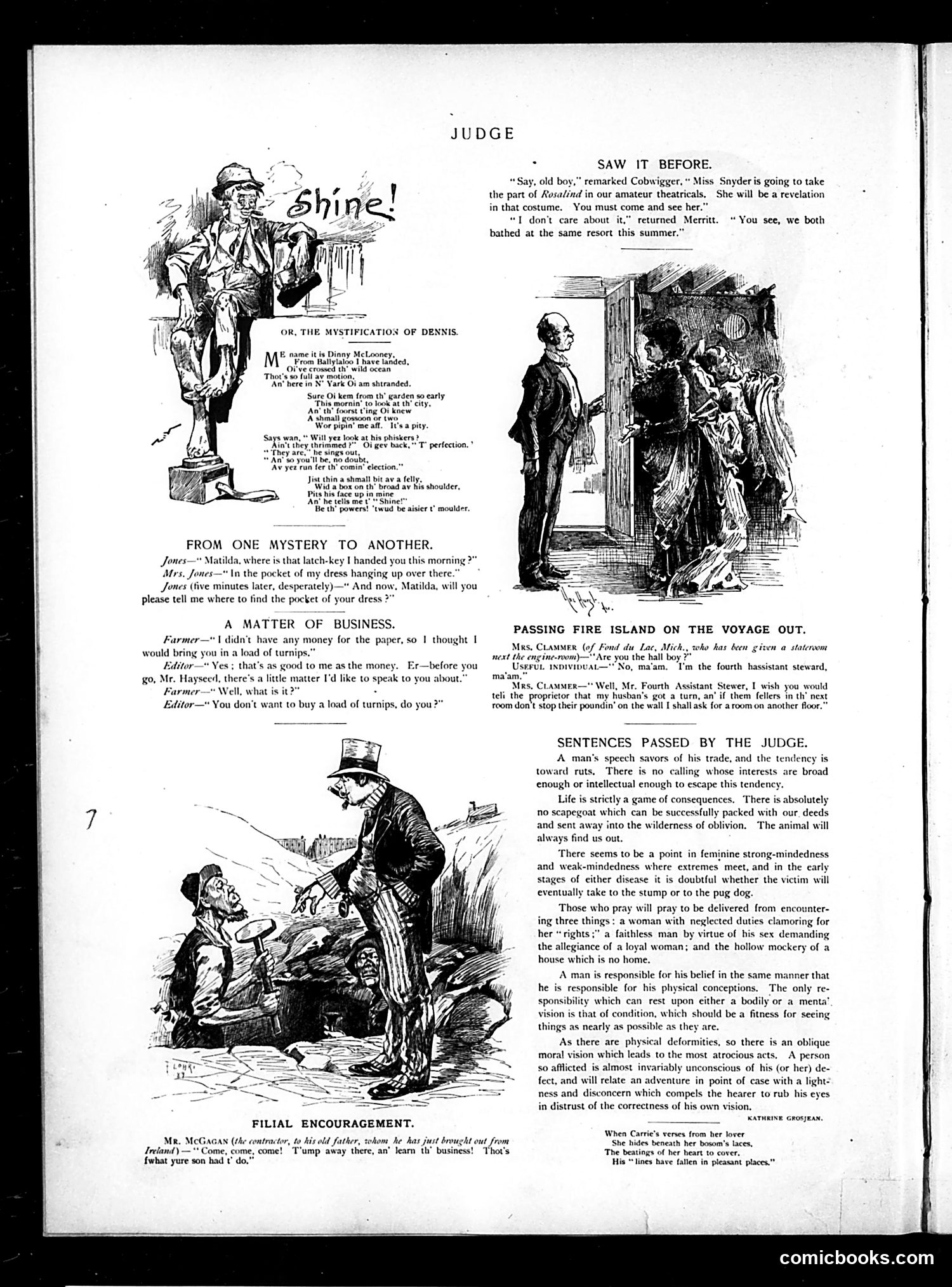
This page from the satirical magazine *Judge* contains multiple short humorous pieces mocking everyday social situations and character types. The cartoons ridicule: 1. **"Shine!"** - A street urchin shoe-shiner, depicted with exaggerated features typical of period working-class stereotypes. 2. **"The Mystification of Dennis"** - A comic poem about an Irish immigrant ("Dinny McLooney") confused by American city life and street children, using heavy Irish dialect for comedic effect—reflecting contemporary immigrant humor common in American magazines. 3. **Various brief comedic scenarios** including domestic mishaps (lost pocket in dress), class awkwardness (a Midwestern passenger annoying ship staff), and business transactions. 4. **"Sentences Passed by the Judge"** - Philosophical observations on human nature, morality, and social pretense, written in Judge's characteristic moralizing tone. The humor relies on contemporary social anxieties: marital confusion, class differences, immigrant confusion, and urbanization. The Irish dialect humor particularly reflects late 19th/early 20th-century American attitudes toward Irish immigrants.
📄 Transcribed text from this page (OCR, searchable)
Machine-transcribed from the original scan — historical spelling and the odd misread are preserved.
JUDGE * SAW IT BEFORE. “Say, old boy,” remarked Cobwigger, “ Miss Snyder is going to take the part of Rosalind in our amateur theatricals, She will be a revelation in that costume. You must come and see her.” “1 don't care about it,” returned Merritt. “ You see, we both bathed at the same resort this summer.” OR, THE MYSTIFICATION OF DENNIS. E name it is Dinny McLooney, ‘From Ballylalgo I have landed, i've crossed th’ wild ocean Thor's s0 full ay motion, ‘An’ here in N° Vari Oi am shtranded. Sure Oi kem from th’ garden so early “This,mornin’ to loow at th’ city, i) ‘A hmall gossoon or two, Wor pipin' me afl. It's a pity. his phiskers ? i gev back," T* perfection. * hey are," she sings out, * An’ to you'll be, no doubt, ‘Av yee run fer th’ comin’ election.” Jist thin a shmall bit av a felly. ‘Wid a box on th’ broad ay his shoulder, Pits his face up in mine An’ he tells me ine! Be th’ powers! ‘twud be aisier t* moulder. ONE MYSTERY TO ANOTHER. Jones—* Matilda, where is that latch-key I handed you this morning?” Mrs. Jones—" In the pocket of my dress hanging up over there.” Jones (tive minutes later, desperately) —" And now, Matilda, will you A, ‘i = please tell me where to find the pocket of your dress ? Vachon Wy. PASSING FIRE ISLAND ON THE VOYAGE OUT. Mrs, CLammer (of Fond du Lac, Mich., roho hat been given a stateroom next the engine-room)—"' Are you the hall bo} Editor —* Ves; that’s as good to me as the money. Er—before you Userut. ispivinvat—*'No, ma‘am, I'm the fourth hassistant steward, feo fies ako you show Mrs, CLAMMER—" Well, Mr. Fourth Assistant Stewer, I wish you would 1, what is it? 7 teli the proprietor that my husban’s got a turn, an’ if them fellers in th’ next ‘ou don't want to buy a load of turnips, do you?" room don't stop their poundin’ on the wall I shall ask for aroom on another flor.” A MATTER OF BUSINESS. Farmer—"\ didn’t have any money for the paper, so I thought | would bring you in a load of turnips.” SENTENCES PASSED BY THE JUDGE. A man’s specch savors of his trade, and the tendency is toward ruts. There is no calling whose interests are broad enough or intellectual enough to escape this tendency. Life is strictly a game of consequences. There is absolutely ho scapegoat which can be successfully packed with our deeds and sent away into the wilderness of oblivion. The animal will always find us out. There seems to be a point in feminine strong-mindedness and weak-mindedness where extremes meet, and in the early stages of either disease it is doubtful whether the victim will eventually take to the stump or to the pug dog. Those who pray will pray to be delivered from encounter- ing three things: a woman with neglected duties clamoring for her “rights ;" a faithless man by virtue of his sex demanding the allegiance of a loyal woman; and the hollow mockery of a house which is no home. A man is responsible for his belief in the same manner that he is responsible for his physical conceptions. The only re- sponsibility which can rest upon either a bodily or a menta’ vision is that of condition, which should be a fitness for seeing things as nearly as possible as they are. As there are physical deformities, so there is an oblique moral vision which leads to the most atrocious acts, A person so afflicted is almost invariably unconscious of his (or her) de- fect, and will relate an adventure in point of case with a light: ness and disconcern which compels the hearer to rub his eyes in distrust of the correctness of his own vision, FILIAL ENCOURAGEMENT. =e fe aes 2 When Carrie’s verses from her lover Mr. McGacan (the contractor, to his old father, whom he has just brought out from She hides beneath her bosom’s laces, Ireland) —"* Come, come, come! ' T’ump away there, an’ learn th’ business! ‘Thor's The beatings of her heart to cover, {what yure son had t’ do, His “lines have fallen in pleasant places.” comicbooks.com