
Judge, 1889-03-09 · page 2 of 20
Judge — March 9, 1889 — page 2: what you’re looking at
What you’re looking at
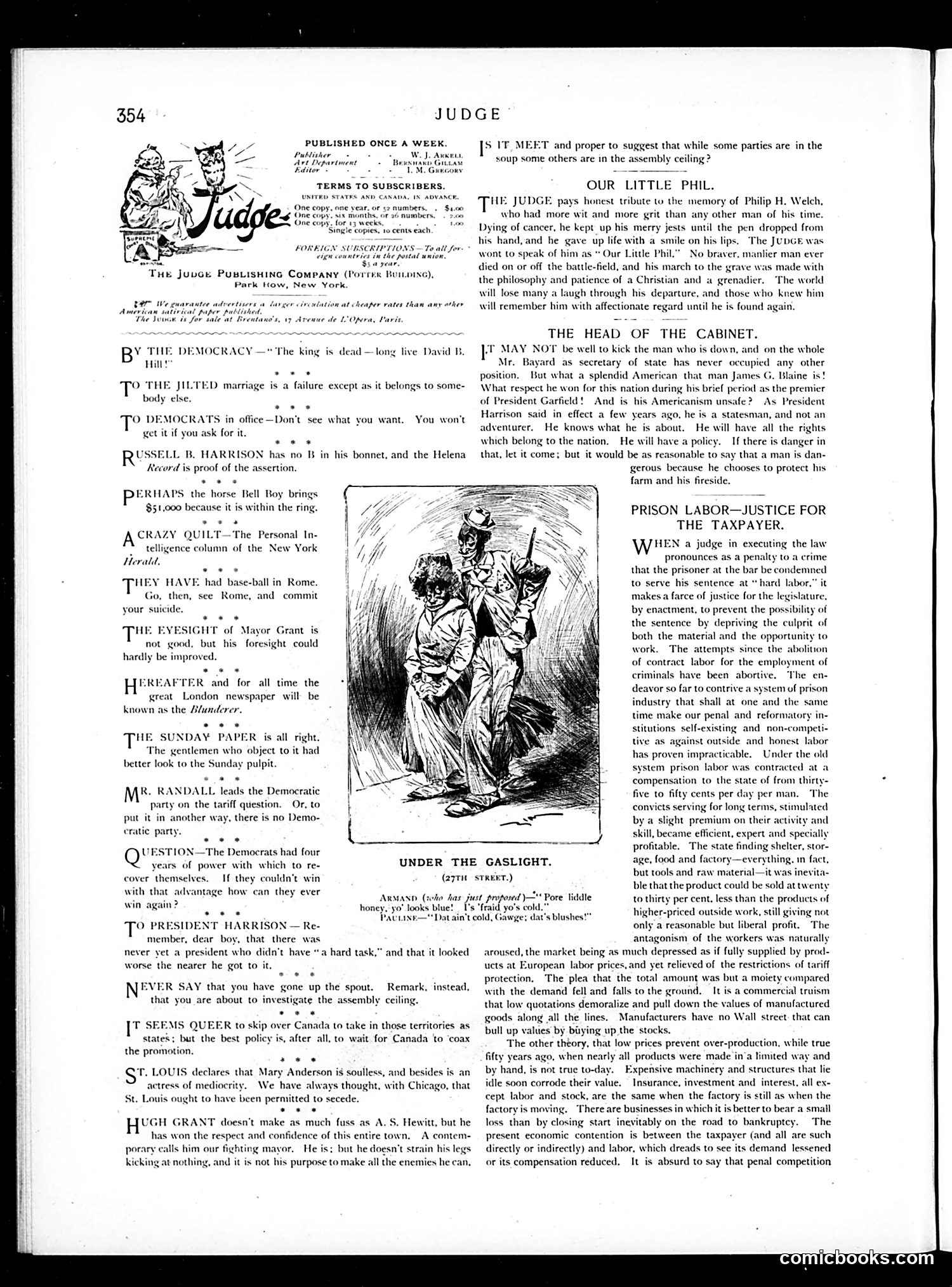
The main illustration depicts a dramatic scene titled "Under the Gaslight" (27th Street), showing figures in distress beneath a street lamp. The woman appears to be in danger while a man intervenes—likely referencing the popular 1867 melodrama "Under the Gaslight" by Augustin Daly, which featured a famous scene of a woman tied to railroad tracks. The cartoon likely satirizes contemporary urban danger or crime in New York City's 27th Street area. By evoking this famous theatrical scene, Judge magazine uses the melodramatic reference to comment on real-world urban perils—possibly commentary on crime, poverty, or public safety issues of the era. The surrounding editorial text discusses labor conditions and economic policy, suggesting the cartoon may relate to working-class vulnerability in industrial America.
📄 Transcribed text from this page (OCR, searchable)
Machine-transcribed from the original scan — historical spelling and the odd misread are preserved.
JUDGE PUBLISHED ONCE A WEEK. Publisher» + Wi. Aww. Art Department Brannan ‘Eaito 2. TMG TERMS TO SUBSCRIBERS. One copy, one year, oF 5 + S400 ‘One cops six months, or 26 numbers. . 2.0 umbers. ingle copies, to cents each. “an = FOREIGN SUBSCRIPTIONS —To alt for Tue JuvGt PuBLisHiING Company (Porrek Bur.pixc), Park Kow, New York B40 We guarantee a paper f tale at Brew civcutation at cheaper rates Uh venue de L’Opera, BY THE DEMOCRACY —" The king is dead —long live I Hill 0 THE JILT body else. 2D mari ‘O DEMOCRATS in office—Don't see what you want. You won't get it if you ask for it. USSELL B. HARRISON has no B in his bonnet, and the Helena -cord is proof of the assertion. ERHAPS the horse Bell Boy brings $51,000 because it is within the ring. CRAZY QUILT—The Personal In- + telligence column of the New York Herald. THE ’ HAVE had base-ball in Rome. Go, then, see Rome, and commit your suicide. HE IGHT of Mayor Grant is not good, but his foresight could hardly be improved. HEREAFTER and for all time the great London newspaper will be known as the Bdunderer. SUNDAY PAPER is all rig HE ™ he gentlemen who object to it had better look to the Sunday pulpit. MB. RANDALL leads the Democratic party on the tariff question. Or, to put it in another way, there is no Demo- cratic party. S IT_MEET and proper to suggest that while some parties are in the soup some others are in the assembly ceiling ? OUR LITTLE PHIL. HE JUDGE. pays honest tribute to the memory of Philip H. Welch, who had more wit and more grit than any other man of his time. Dying of cancer, he kept up his merry jests until the pen dropped from his hand, and he gave up life with a smile on his lips. The JUDGE was wont to speak of him as“ Our Little Phil” No braver, manlier man ever died on or off the battle-field, and his march to the grave was made with the philosophy and patience of a Christian and a grenadier. The world will lose many a laugh through his departure, and those who knew him will remember him with affectionate regard until he is found again. THE HEAD OF THE CABINET. [P MAY NOT be well to kick the man who is down, and on the whole Mr. Bayard as secretary of state has never occupied any other position, But what a splendid American that man James G. Blaine is! What respect he won for this nation during his brief period as the premier of President Garfield! And is his Americanism unsafe? As President Harrison said in effect a few years ago, he is a statesman, and not an adventurer. He knows what he is about. He will have all the rights which belong to the nation. He will have a policy. If there is danger i that, let it come; but it would be as r y that a man gerous because he chooses to protect his farm and his fireside. sonable to sa PRISON LABOR—JUSTICE FOR THE TAXPAYER. WHEN a judge in executing the law pronounces as a penalty to a crime that the prisoner at the bar be condemned to serve his sentence at “hard labor,” it makesa farce of justice for the legislature, by enactment, to prevent the possibility of the sentence by depriving the culprit of both the material and the opportunity to work. The attempts since the abolition of contract labor for the employment of criminals have been abortive. deavor so far to contrive a system of prison industry that shall at one and the same time make our penal and reformatory stitutions self-existing and non-competi- tive as against outside and honest labor has proven impracticable. Under the old system prison labor was contracted at a compensation to the state of from thirty- five to fifty cents per day per man. ‘The convicts serving for long terms, stimulated slight premium on their activity and skill, became efficient, expert and specially The en- Qv TION —The Democrats had four years Of power with which to re cover themselves. If they couldn't win with that advantage how can they ever " ARMAND we yo" looks blue! 'O PRESIDENT HARRISON — Re- member, dear boy, that there was never yet a president who didn’t have “a hard task, y and that it looked worse the nearer he got to EVER SAY that you have gone up the spout. Remark, instead, that you are about to investigate the assembly ceiling. cee T SEEMS QUEER to skip over Canada to take in those territories as states; but the best policy is, after all, to wait for Canada to ‘coax the promotion. T. LOUIS declares that Mary Anderson is soulless, and besides is an actress of mediocrity. We have always thought, with Chicago, that St. Louis ought to have been permitted to secede. UGH GRANT doesn’t make as much fuss as A. S. Hewitt, but he has won the respect and confidence of this entire town, A contem- porary calls him our fighting mayor, He is: but he doesn’t strain his leg kicking at nothing, and it is not his purpose to make all the enemies he can, UNDER THE GASLIGHT. (a7rit_ stREET.) who has just proposed ) I's ‘feaid yo" AULINE—"Dat ain't cold, Gaw profitable. The state finding shelter, stor- food and factory—everything. in fact, but tools and raw material—it was inevita ble that the product could be sold at twenty to thirty per cent, less than the products of higher-priced outside work, still giving not only a reasonable but liberal profit. ‘The antagonism of the workers was naturally aroused, the market being as much depressed as if fully supplied by prod ucts at European labor prices,and yet relieved of the restrictions of tariff protection. The plea that the total amount was but a moiety compared with the demand fell and falls to the ground, It is a commercial truism that low quotations demoralize and pull down the values of manufactured goods along all the lines. Manufacturers have no Wall street: that can bull up values by baying up the stocks. ‘The other theory, that low prices prevent over-production, while true fifty years ago, when nearly all products were made in’a limited way and by hand, is not true to-day. Expensive machinery and structures that lie idle soon corrode their value. Insurance, investment and interest, all ex cept labor and stock, are the same when the factory is still as when the factory is moving, There are businesses in which it is better to bear a small loss than by closing start inevitably on the road to bankruptcy. ‘The present economic contention is between the taxpayer (and all are such directly or indirectly) and labor, which dreads to see its demand lessened or its compensation reduced. It is absurd to say that penal competition Pore liddle cold. dat's blushes!