
Judge, 1889-03-09 · page 3 of 20
Judge — March 9, 1889 — page 3: what you’re looking at
What you’re looking at
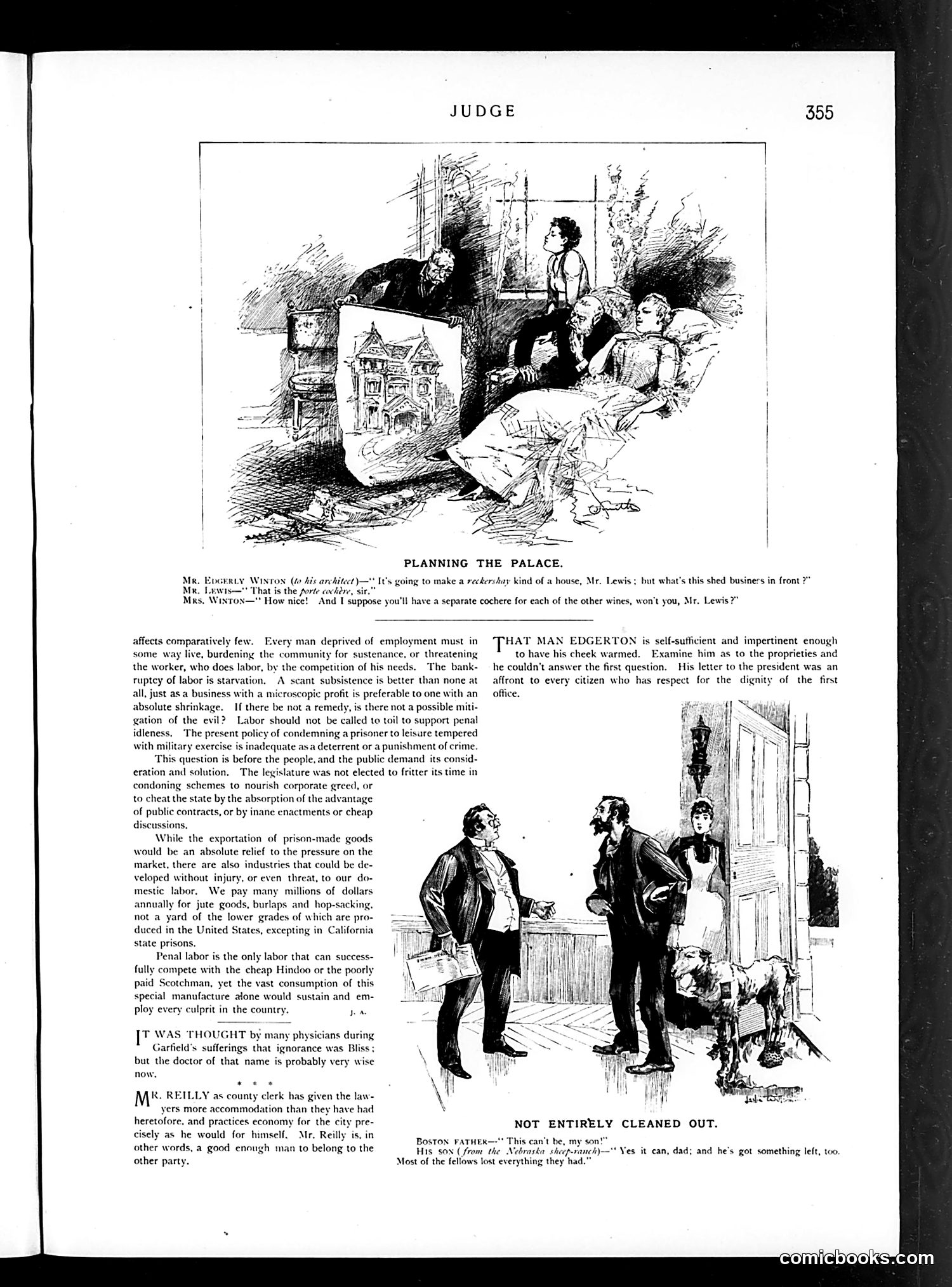
**"Planning the Palace"** satirizes wealthy nouveau riche pretension. Mr. and Mrs. Beverly Winton consult an architect about building an ostentatiously grand house, complete with separate carriage houses ("cocheres") for each of their wine collections. The joke mocks their absurd materialism and the architect's obsequious pandering to such excess. **"Not Entirely Cleaned Out"** depicts a Boston father confronting his son, recently returned from a Nebraska sheep ranch venture that failed catastrophically—the son lost everything like his peers. The humor lies in the son's shameless admission he still has "something left"—implying either hidden reserves or shameful conduct the father suspects. Together, these cartoons reflect *Judge*'s satirical targets: wealthy pretension and get-rich-quick schemes of the Gilded Age. The page also includes substantial editorial text criticizing prison labor policy and corrupt government contracting—typical *Judge* social commentary alongside visual satire.
📄 Transcribed text from this page (OCR, searchable)
Machine-transcribed from the original scan — historical spelling and the odd misread are preserved.
PLANNING THE PALACE. Mr. RLY WINTON (lo his archi Mx. Lewis—" That is the forte covhére, sir. Mrs. Wixtox—"* How nice! =" I's going to make a reckershay kind of a house, Mr. Lewis; but what's this shed businers in front ?” And T suppose you'll have a separate cochere for each of the other wines, won't you, Mr. Lewis?" affects comparatively few. some way live, burdening the ry man deprived of employment must in community for sustenance, or threatening the worker, who does labor, by the competition of his needs. The bank- ruptey of labor is starvation. A. scant subsistence is better than none at all, just as.a business with a microscopic profit is preferable to one with an absolute shrinkage, If there be not a remedy, is there not a possible miti- gation of the evil? Labor should not be called to toil to support penal idleness, ‘The present policy of condemning a prisoner to leisure tempered with military exercise is inadequate asa deterrent or a punishment of crime. This question is before the people, and the public demand its consid- eration and solution. The legislature was not elected to fritter its time in condoning schemes to nourish corporate greed, or to cheat the state by the absorption of the advantage of public contracts, or by inane enactments or cheap discussions, While the exportation of prison-made goods would be an absolute relief to the pressure on the market, there are also industries that could be de- veloped without injury, or even threat, to our do- mestic labor, We pay many millions of dollars annually for jute goods, burlaps and hop-sacking, not a yard of the lower grades of which are pro- duced in the United States, excepting in state prisons. Penal labor is the only labor that can success- fully compete with the cheap Hindoo or the poorly paid Scotchman, yet the vast consumption of this special manufacture alone would sustain and em- ploy every culprit in the country. fornia HT by many phys [7 Was THOU! Garfield's sufferings that ignorance was Blis: but the doctor of that name is probably very wise now. ME: REILLY as county clerk has given the law- yers more accommodation than they have had heretofore, and practices economy for the city pre- cisely as he would for himself, Mr. Reilly is, in other words, a good enough man to belong to the other party. THAT MAN EDGERTON is self-sufficient and impertinent enough to have his cheek warmed. Examine him as to the proprieties and he couldn't answer the first question. His letter to the president was an affront to every citizen who has respect for the dignity of the first office, NOT ENTIRELY CLEANED OUT. Boston FATHER—-** This can’t be, my son!” His sox (from the ¢ Most of the fellows lost everything they had.” ‘ebraska sheep-ranch)—" Ves it can, dad; and he’s got something left, too.