
A complete issue · 16 pages · 1886
Judge — August 14, 1886
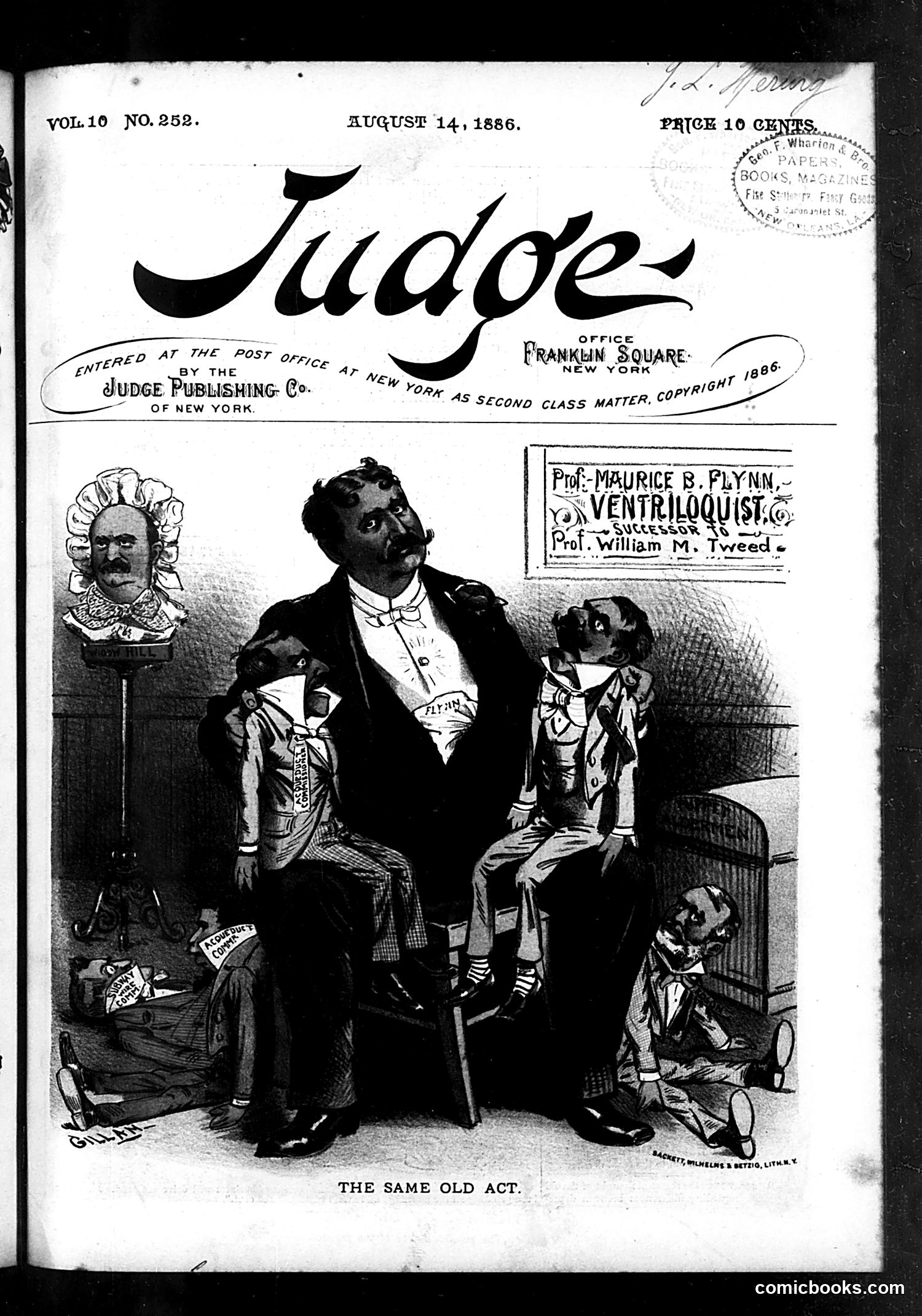
This satirical cartoon titled "The Same Old Act" depicts a ventriloquist (Prof. Maurice B. Flynn) manipulating three child-sized dummy figures while a bust of an older figure looms in the background. The ventriloquist's prominent nose and exaggerated features suggest caricature of a specific public figure, though identity requires additional context. The "act" likely critiques political manipulation—the recurring theme that politicians or public figures are mere puppets controlled by unseen forces or establishment interests. The comparison to ventriloquism implies inauthenticity and suggests the three figures represent different political positions or personalities all controlled by the same operator, reinforcing a satirical point about the illusion of choice or independence in public discourse.
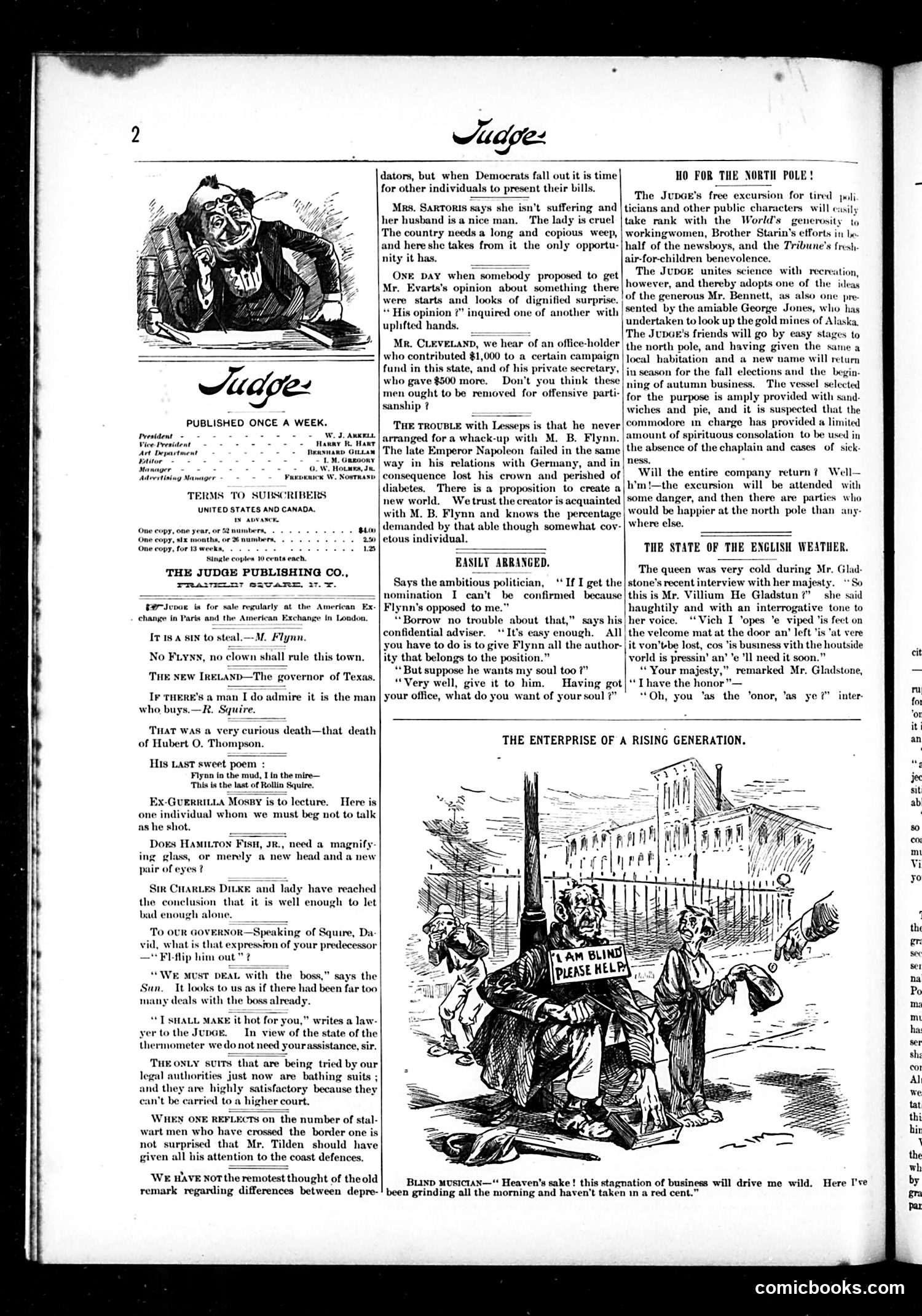
This page contains satirical commentary rather than a single unified cartoon. The "Judge" column critiques contemporary political figures and issues: **Key targets include:** - **M.B. Flynn** — appears to be a political figure criticized for manipulating nominations - **Mrs. Sartoris** — criticized for claiming she's not suffering while her husband faces financial pressure - **Mr. Cleveland** — referenced regarding an office-holder's campaign contribution **The main cartoon** ("The Enterprise of a Rising Generation") shows a blind musician playing while industrial buildings burn, captioned "I AM BLIND PLEASE HELP." This appears to satirize either exploitation of sympathy or indifference to urban/industrial problems during the Gilded Age. The satire targets political corruption, hypocrisy among elites, and social inequalities—common Judge magazine themes of the era.
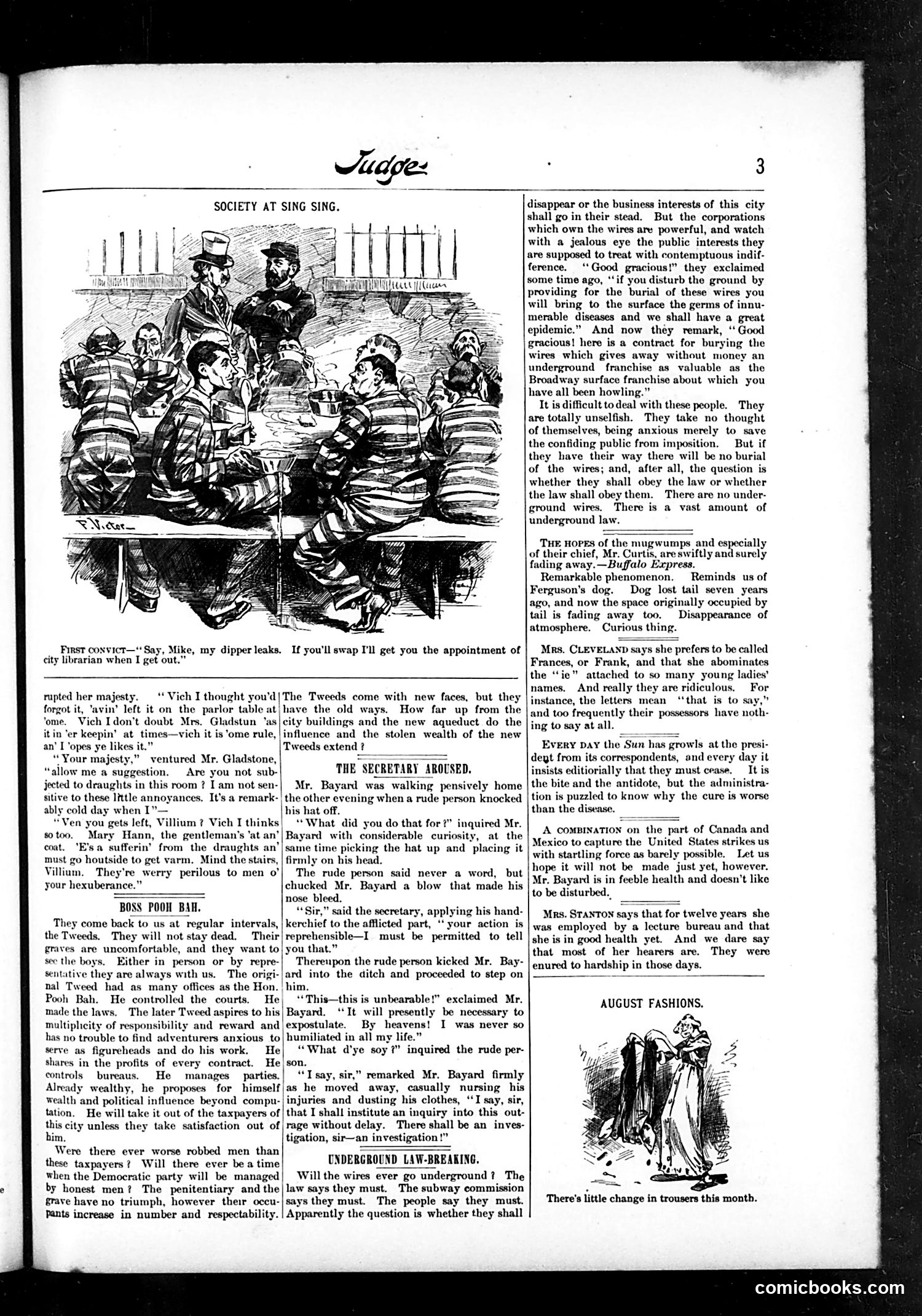
This page contains three separate satirical pieces mocking American politics and corruption circa the 1880s-90s. **"Society at Sing Sing"** (top cartoon): A crude joke where imprisoned politicians trade favors—one offers another "the appointment of city librarian when I get out," implying that corrupt machine politicians routinely secure cushy government jobs upon release. **"Boss Pooh Bah"**: Attacks the persistence of Tammany Hall-style corruption. References to "the Tweeds" invoke William "Boss" Tweed, the infamous NYC political boss. The piece satirizes how new corrupt politicians continuously replace old ones with identical methods, exploiting taxpayer money through contracts and bureau control. **"The Secretary Aroused"**: Mocks Secretary of State Thomas F. Bayard's passive response to physical assault. Rather than fighting back, he responds with formal threats of "investigation"—satirizing ineffectual government officials who substitute stern words for actual action. **"Underground Law-Breaking"**: Criticizes utility corporations' resistance to burying electrical wires underground despite public safety laws, showing how business interests override civic welfare. Overall: scathing critique of corruption, political cowardice, and corporate power.
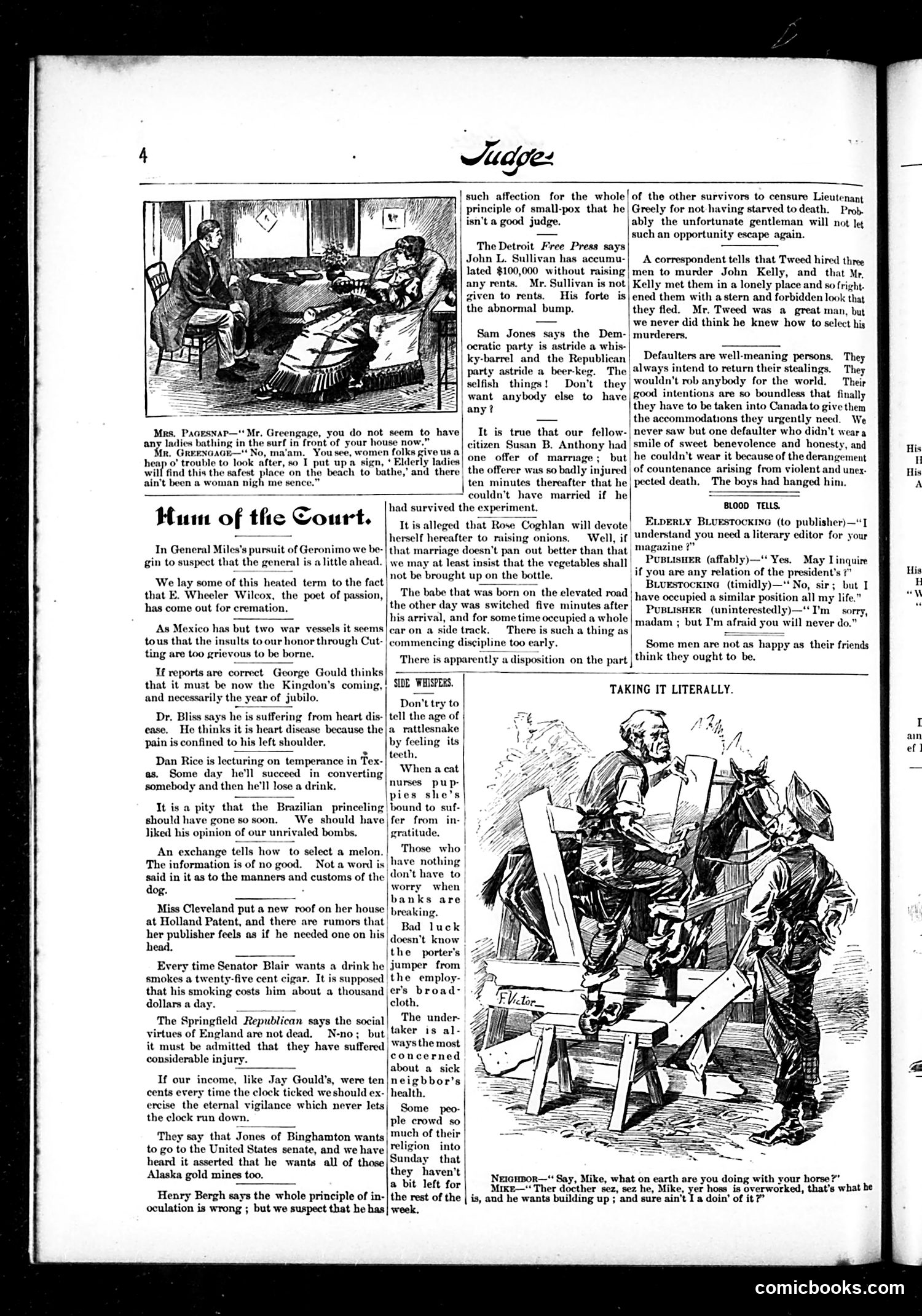
This page from *Judge* contains brief satirical quips targeting contemporary public figures and social issues circa 1880s-90s. **Key references:** - **John L. Sullivan**: The famous boxer, mocked for accumulating wealth without raising rents; "abnormal bump" is slang for his fighting prowess. - **Susan B. Anthony**: Mentioned sarcastically as having received a marriage proposal, with the joke being the proposer was injured and couldn't marry her afterward. - **Sam Jones**: A temperance lecturer being satirized for complaining both Democrats (whisky) and Republicans (beer) monopolize vices while excluding others. - **Rose Coghlan**: An actress reportedly abandoning her career to farm onions—presented as a dubious life choice. - **Lieutenant Greely**: Referenced regarding survivors criticizing him for not starving to death (likely referencing the 1881-84 Arctic expedition disaster). The humor relies on contemporary celebrity gossip, political party stereotyping, and mocking failed ambitions—typical of *Judge's* satirical approach.
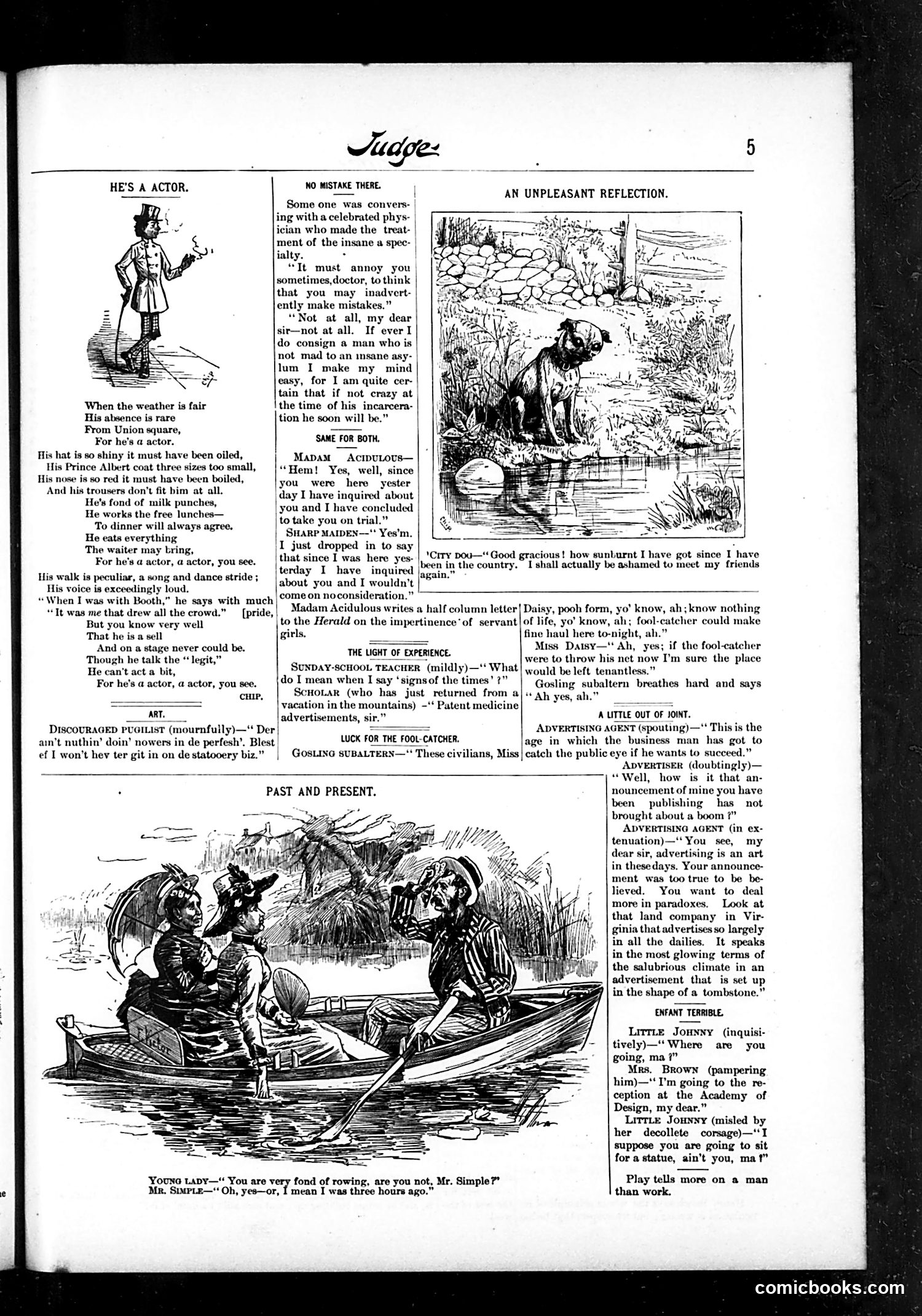
This page contains multiple satirical vignettes typical of late 19th-century American humor: **"He's a Actor"** mocks struggling theater performers who frequent Union Square (NYC's entertainment district), adopting affected mannerisms, loud voices, and pretentious references to famous actors like Booth, while cadging free meals and lacking actual stage talent. **"No Mistake There"** satirizes a psychiatrist's circular logic: he admits he might institutionalize sane people, but claims they'll *become* insane from confinement—so no error occurs. **"Same for Both"** presents a servant and employer mutually interviewing each other, both discovering reasons to reject the arrangement. Other brief comedic exchanges mock sunburned city-dwellers, patent medicine advertisements, and advertising agents defending ineffective campaigns through paradox and flowery language. The page reflects Judge's consistent targets: pretension, incompetence, professional charlatans, and social climbing—delivered through caricature and dialogue-based humor.
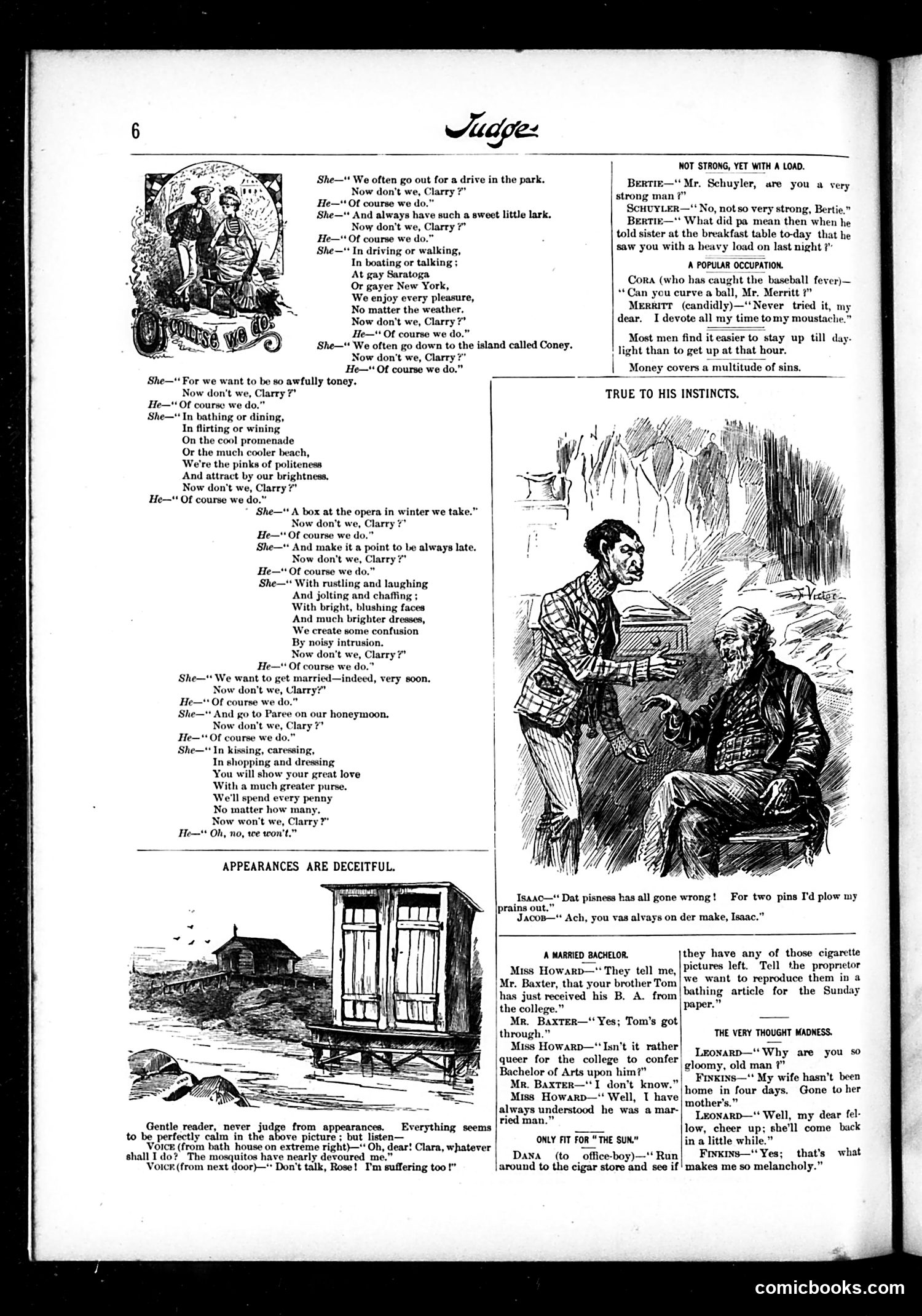
This page contains several short satirical pieces typical of Judge's humor: **"Not Strong, Yet with a Load"** mocks a young man (Bertie) whose father made an innuendo about him carrying a "heavy load" the previous night—implying drunkenness. The joke plays on the double meaning of "load." **"A Popular Occupation"** satirizes a vain man (Merritt) who devotes all his time to grooming his moustache rather than developing actual skills, making him useless at sports. **The long dialogue between "She" and "Clarry"** is a relentless satire of an obnoxious engaged couple who constantly seek validation ("Now don't we, Clarry?"). The punchline comes when she assumes he'll spend lavishly on their honeymoon—and he definitively refuses. **"Appearances Are Deceitful"** presents Jewish immigrant characters (Isaac and Jacob, indicated by dialect) discussing failed business ventures, stereotyping them as scheming. The remaining pieces are brief jokes about marriage and vanity. The overall tone reflects period attitudes toward courtship, social climbing, and ethnic caricature.
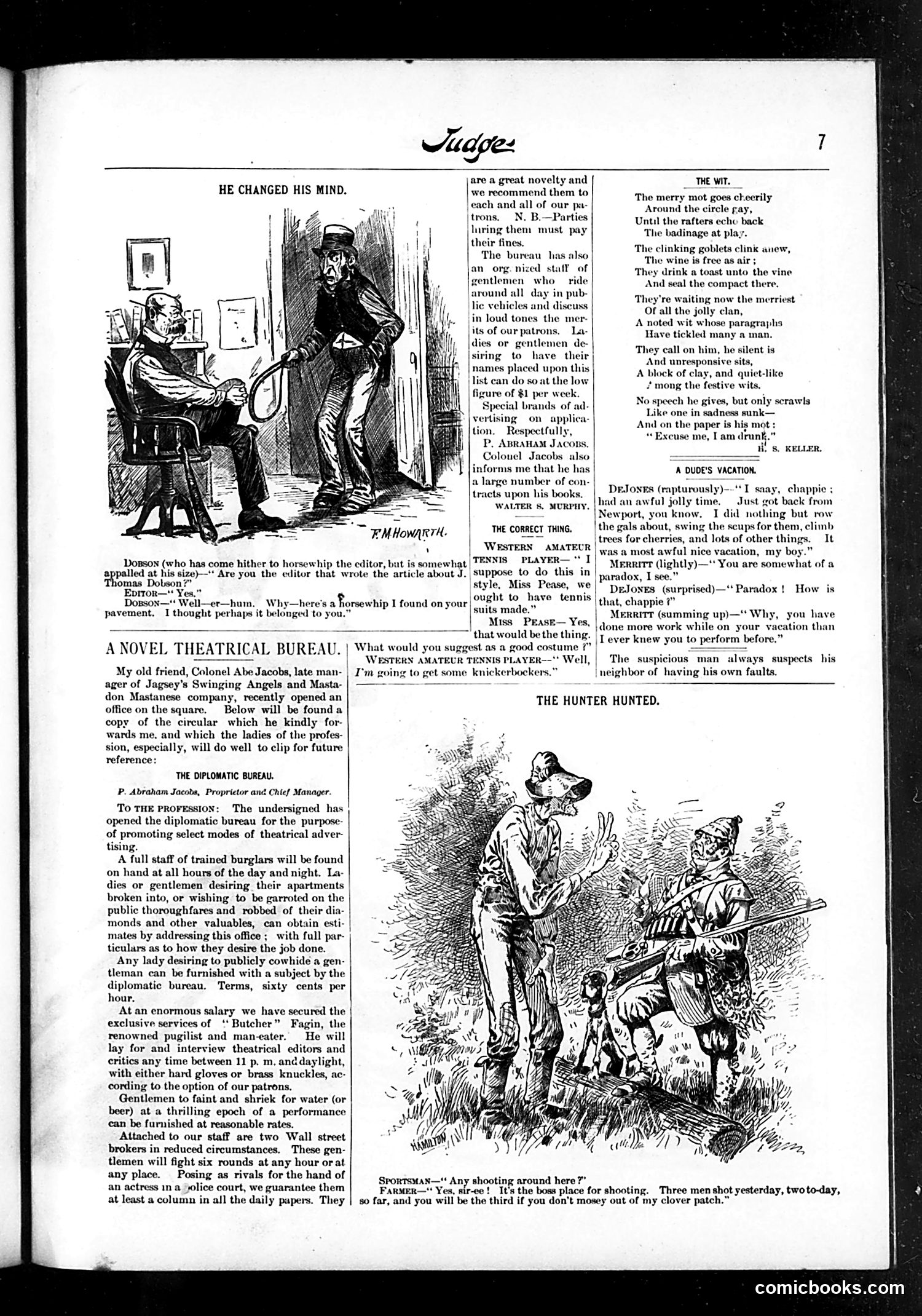
This page contains three satirical pieces mocking theatrical and social pretensions of the 1880s-90s era: **"HE CHANGED HIS MIND"**: A man (Dosson) arrives to horsewhip an editor over a published article but backs down upon seeing the editor's intimidating size—satirizing hollow threats and bluster. **"A NOVEL THEATRICAL BUREAU"**: Colonel Abe Jacobs advertises a fake "Diplomatic Bureau" offering absurd services: hiring burglars to rob clients' homes and gentlemen to be publicly beaten by ladies—mocking theatrical self-promotion and ridiculous publicity stunts. **"A DUDE'S VACATION"**: A wealthy socialite describes his Newport vacation as "doing nothing" except attending to women and picking fruit, contradicting the tennis player's suggestion he should work—satirizing the idle, parasitic lifestyle of the leisure class. The humor targets theatrical charlatans, social climbing, and upper-class pretension through exaggeration and irony.
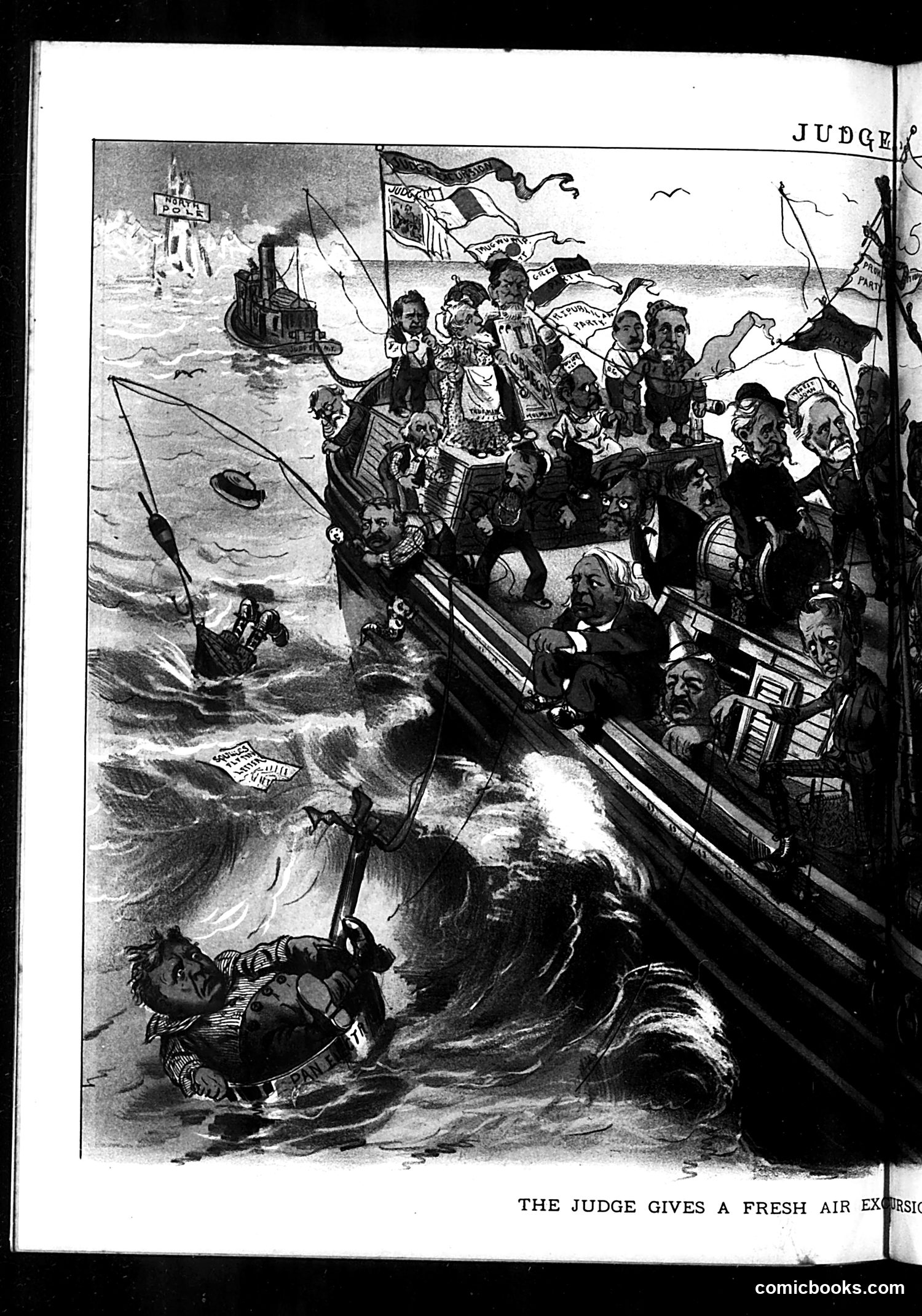
This political cartoon satirizes judicial corruption or abuse of power. A judge (center, elevated position with authority) is depicted literally throwing people overboard from a boat into rough seas—depicted as a "fresh air excursion," a euphemism for an outing. The cartoon mocks judges who claim to be performing public service or reform while actually harming citizens. The crowded boat of well-dressed onlookers represents the establishment or political machine observing this abuse passively or approvingly. The grotesque drowning figures and violent waves contrast sharply with the innocent-sounding phrase "fresh air excursion," exposing the hypocrisy. This likely critiques a specific judge's actions or judicial system failures, though the exact historical reference is unclear from this image alone. The satire's power lies in visualizing "justice" as literal murder dressed up in respectable language.
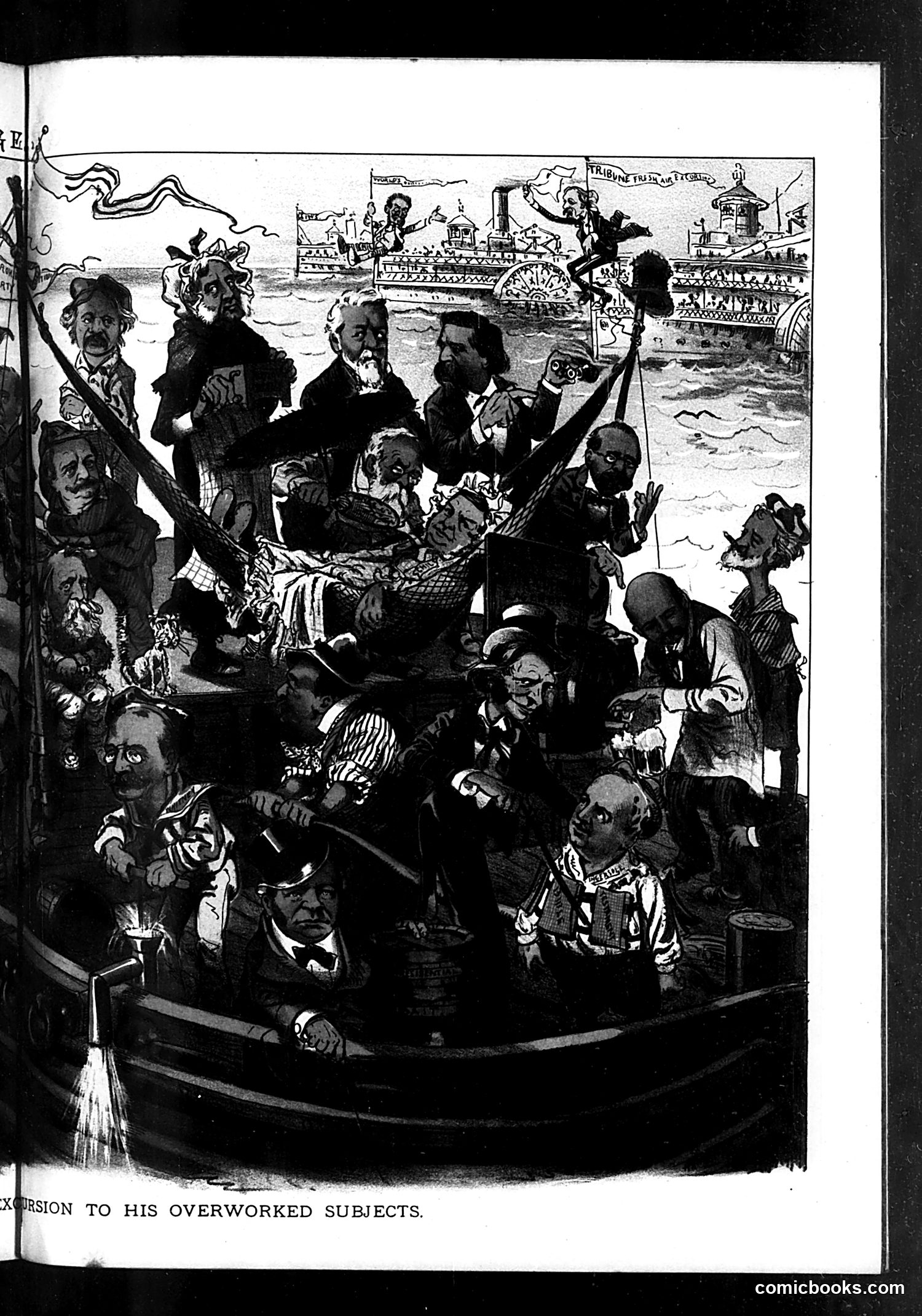
This cartoon depicts a ruler or authority figure (likely a European monarch or political leader) addressing a boat full of his subjects. The caption "VERSION TO HIS OVERWORKED SUBJECTS" suggests irony—the figure appears to be making some kind of excursion or leisure outing while his subjects labor. The exaggerated facial expressions and caricatures of the crowded subjects convey exhaustion and hardship. The steamships visible in the background suggest industrial-era context. The satire critiques the disconnect between leadership and the working classes: while those in power enjoy leisure activities, ordinary people remain burdened and overworked. The specific political target remains unclear without additional context from Judge magazine's publication date.
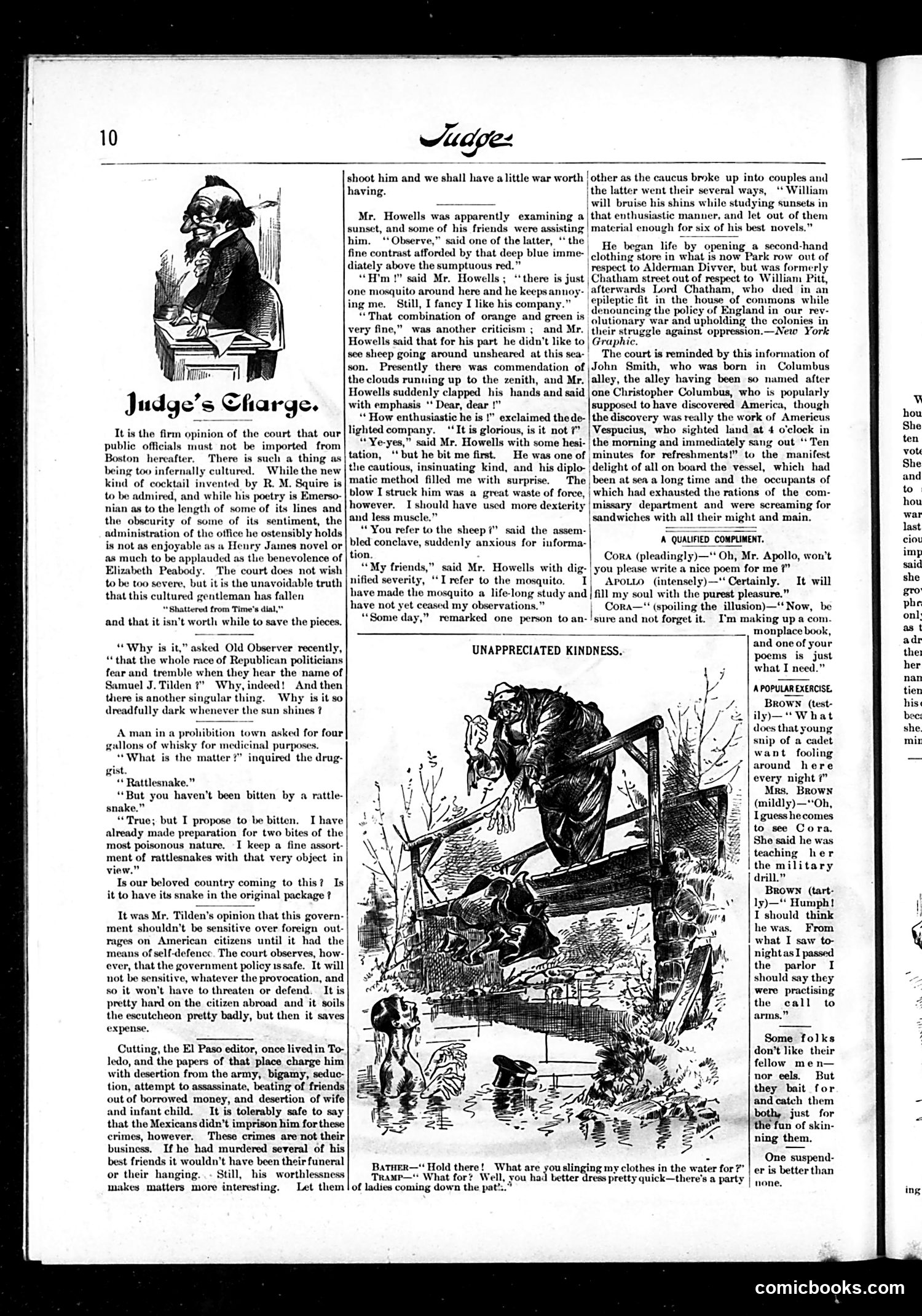
This page contains two satirical pieces typical of the magazine's political and social commentary: **"Judge's Charge"** (left column) is the main editorial commentary. It criticizes the importation of "cultured" public officials from Boston, suggesting that literary refinement doesn't translate to effective administration. The piece references Samuel J. Tilden (Democratic presidential candidate) and uses absurdist humor—a man wanting rattlesnakes in advance to cure potential snakebites—to mock government policy on protecting American citizens abroad. It concludes with cynical commentary about an El Paso editor's criminal past, sarcastically suggesting his worthlessness might at least provoke an entertaining war with Mexico. **The lower cartoon** depicts William Dean Howells, the renowned American novelist and literary figure, being bitten by a mosquito while friends admire a sunset. The joke: Howells remains fixated on the mosquito's annoyance rather than appreciating the natural beauty around him—satirizing his reputation for focusing on trivial domestic details in his fiction rather than grand themes. Both pieces employ sardonic humor targeting public figures and American cultural pretensions.
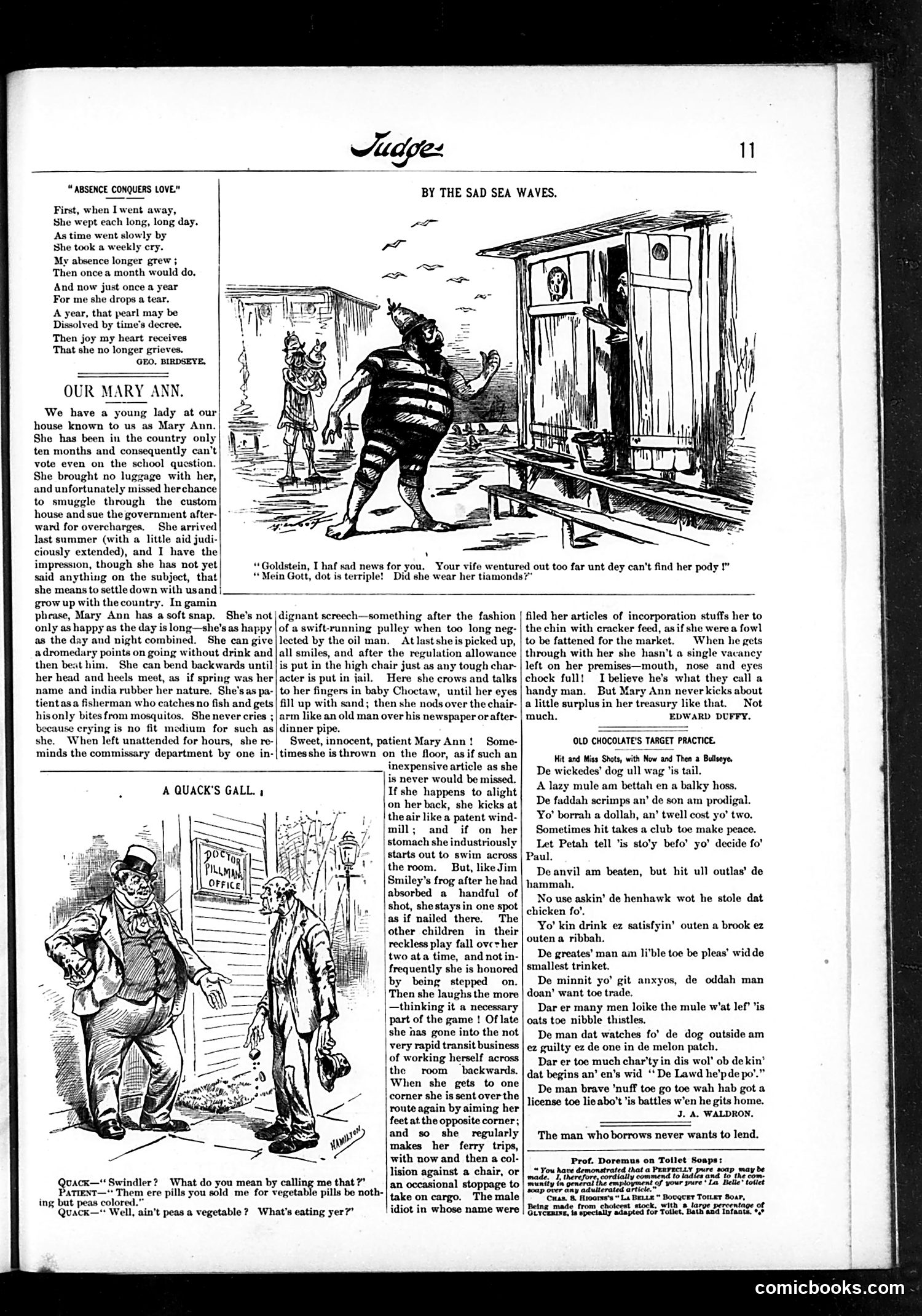
This page contains three distinct pieces of satirical content: **"Absence Conquers Love"** (poem): A sentimental verse about romantic love fading with prolonged separation, eventually dissolving entirely—a commentary on the transience of human affection. **"Our Mary Ann"**: A humorous sketch of a young immigrant woman newly arrived in America. The piece satirizes both her childlike simplicity and the casual neglect she receives from her host family. She's portrayed as remarkably resilient and good-natured despite being treated almost like furniture—stepped on, left alone, and fed carelessly. The satire targets both immigrant vulnerability and American household indifference. **"A Quack's Gall"**: A doctor-patient exchange mocking medical quackery. A charlatan selling fake "vegetable pills" defends his fraudulent product by arguing peas are vegetables—absurd logic used to expose patent medicine con artists, a common Judge target during this era of unregulated pharmaceuticals. The page reflects Progressive-era concerns: immigration integration, medical fraud, and romantic disillusionment.
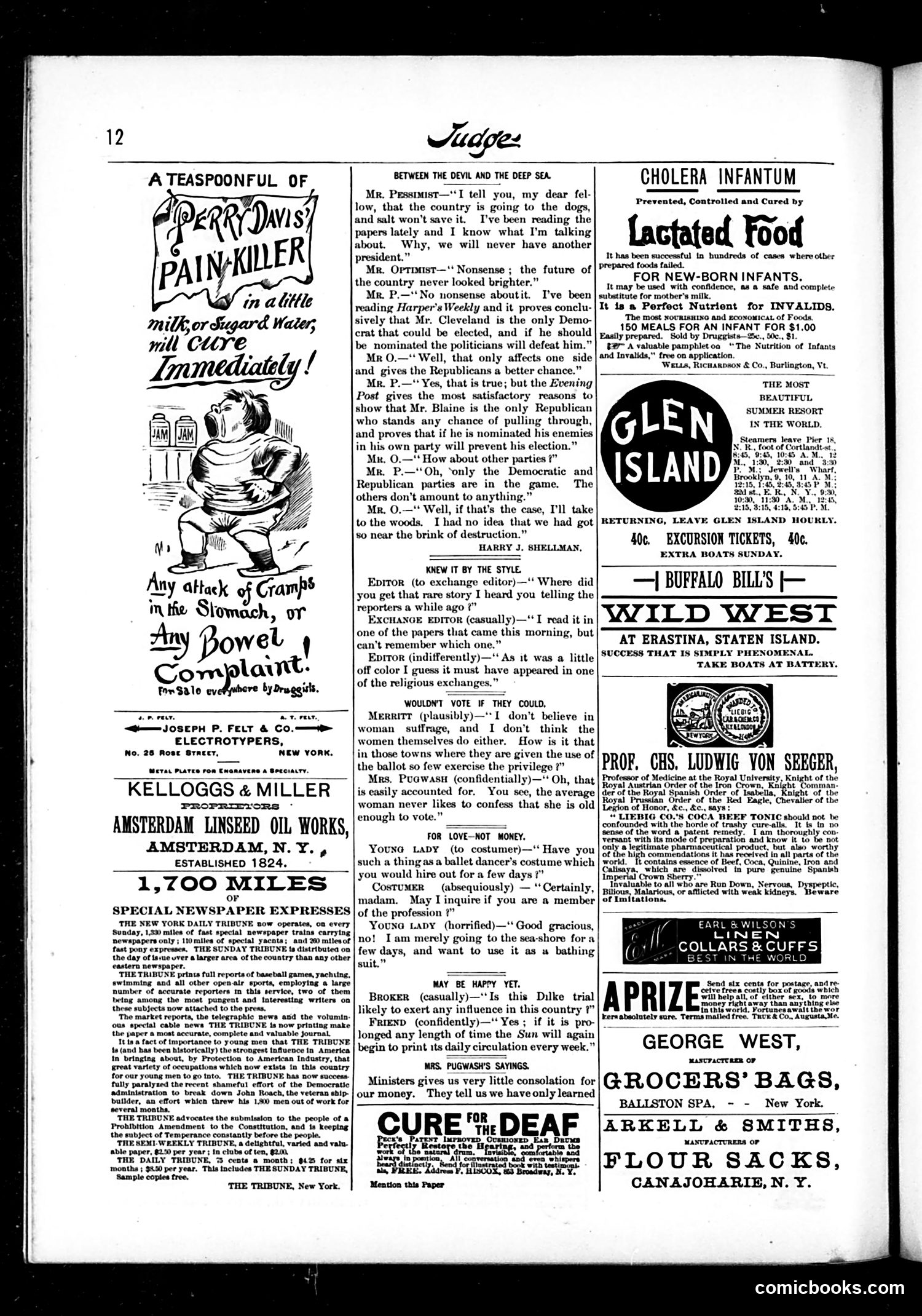
This political cartoon satirizes the 1884 presidential election pessimism. A pessimist argues the country faces ruin because: only Democrat Grover Cleveland could win for his party, but politicians would defeat him; only Republican James G. Blaine could win for Republicans, but his own party would prevent his election. The optimist points out this leaves only minor parties—to which the pessimist despairs they're irrelevant anyway. The joke targets both major parties' internal divisions and the fatalistic election discourse of 1884. By showing how each party's supposed "only viable candidate" faced party opposition, the cartoon mocks the political paralysis and doom-saying prevalent in that election cycle.
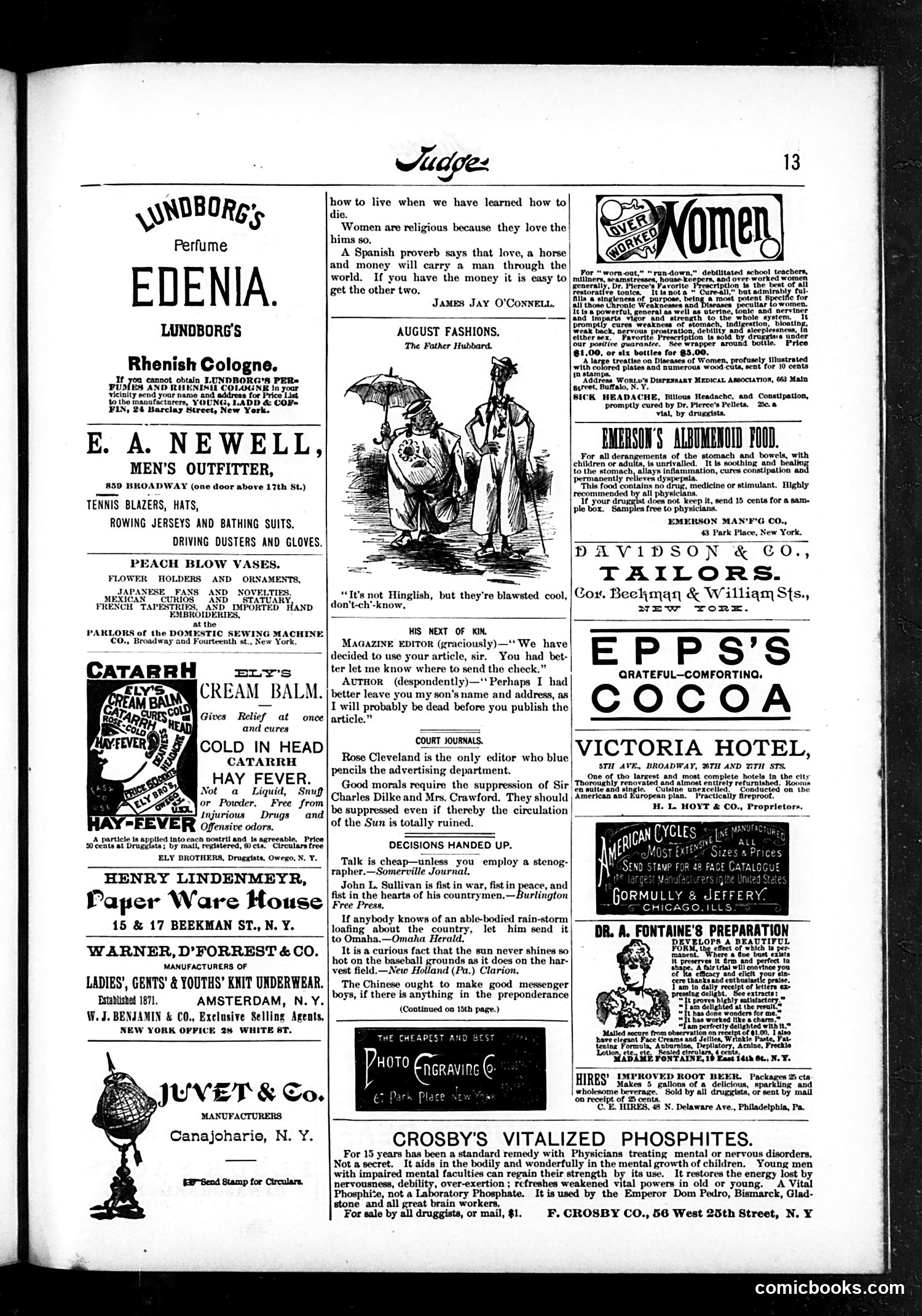
This page is primarily **advertisements and filler content**, typical of Judge magazine's layout. The main satirical content appears in small sections: **"His Next of Kin"** (center): A joke about a struggling author. An editor offers to publish his article but asks where to send payment. The author, despondently, suggests the editor use his son's address instead—implying he'll be dead before the magazine actually publishes it. This satirizes the notoriously slow publication timelines and poor payment practices of magazines. **"Court Journals" section**: Brief satirical quips about public figures. It references **Rose Cleveland** (President Grover Cleveland's sister, who served as White House hostess) as an editor who removes advertisements, and mentions the **Dilke scandal** (Sir Charles Dilke, a British politician involved in a divorce scandal with Mrs. Crawford). The remainder is straightforward period advertising for patent medicines, clothing, and household goods—a major revenue source for magazines of this era.
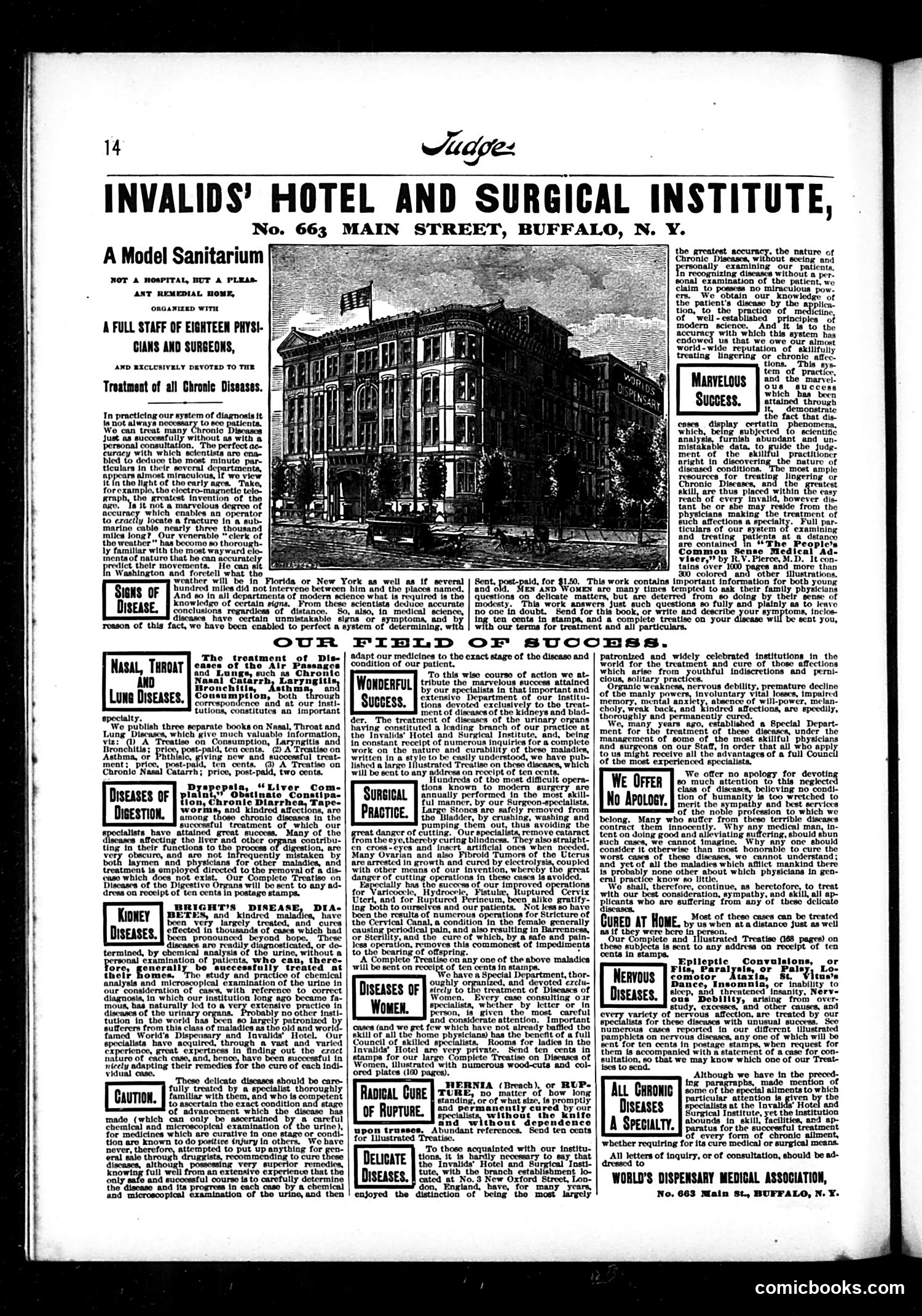
This page is primarily **advertising**, not satire or political commentary. It's a promotional advertisement for the "Invalids' Hotel and Surgical Institute" in Buffalo, New York—a mail-order medical practice claiming to diagnose and treat chronic diseases remotely, without seeing patients in person. The ad makes remarkable claims: doctors can diagnose illnesses accurately through correspondence alone, comparing their ability to telegraph operators locating submarine cable fractures or weather forecasters predicting distant weather. The institute offers "eighteen physicians and surgeons" and claims a "world-wide reputation." The page includes multiple disease categories (Nasal/Throat, Digestive, Kidney, Women's, Nervous) with detailed symptom descriptions designed to make readers self-identify ailments. This appears to be a 19th-century medical mail-order scheme—the type of dubious "distance diagnosis" that would later become heavily regulated. The satire, if present, likely lies in *Judge magazine's* willingness to publish obviously fraudulent medical claims, reflecting period concerns about quackery.
This page is primarily **advertisements mixed with brief humorous anecdotes**, not political cartoons. The satirical content is light and domestic rather than political. The small jokes scattered throughout mock Victorian-era absurdities: a barber's injured dignity, a child attributing daily provision to God rather than Uncle John, the irony of a servant girl's status measured by how visibly she hangs laundry for neighbors to see. The most pointed social commentary appears in a reference to "Chicago anarchists"—likely alluding to the 1886 Haymarket affair—where the author sarcastically suggests sending them westward, implying execution by lynching ("justice with a rope attached"). This reflects contemporary anxieties about labor radicalism. The bulk of the page consists of period patent-medicine advertisements (hair restorer, sulphur soap, corn remover, heart regulator)—typical Judge content where advertising subsidized publication. These ads targeted common Victorian health anxieties with dubious remedies.
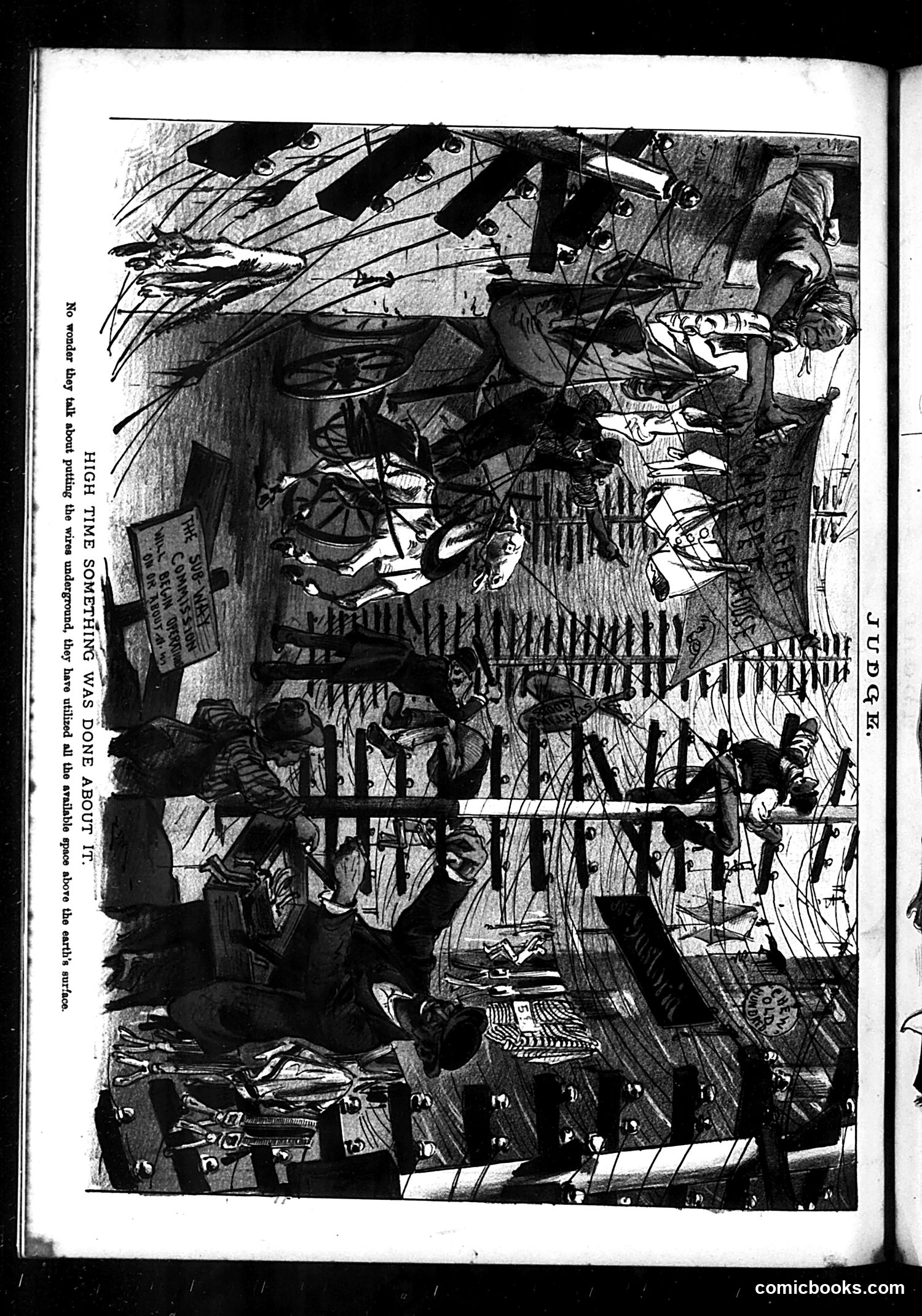
I cannot reliably decode the OCR text from this page—it appears corrupted or improperly scanned. From the image alone, this appears to be a political cartoon showing a crowded interior scene with multiple figures in period dress (appears to be late 19th century based on clothing and artistic style). There's a railing or fence visible, and the composition suggests a public gathering or institutional setting. The heavy use of cross-hatching and dramatic shading is typical of Judge magazine's satirical engravings. Without legible text identifying the specific figures, events, or political references, I cannot accurately explain what particular satire or joke this cartoon conveys. To properly analyze this, I would need either clearer OCR text or additional page context.