
Judge, 1886-08-14 · page 10 of 16
Judge — August 14, 1886 — page 10: what you’re looking at
What you’re looking at
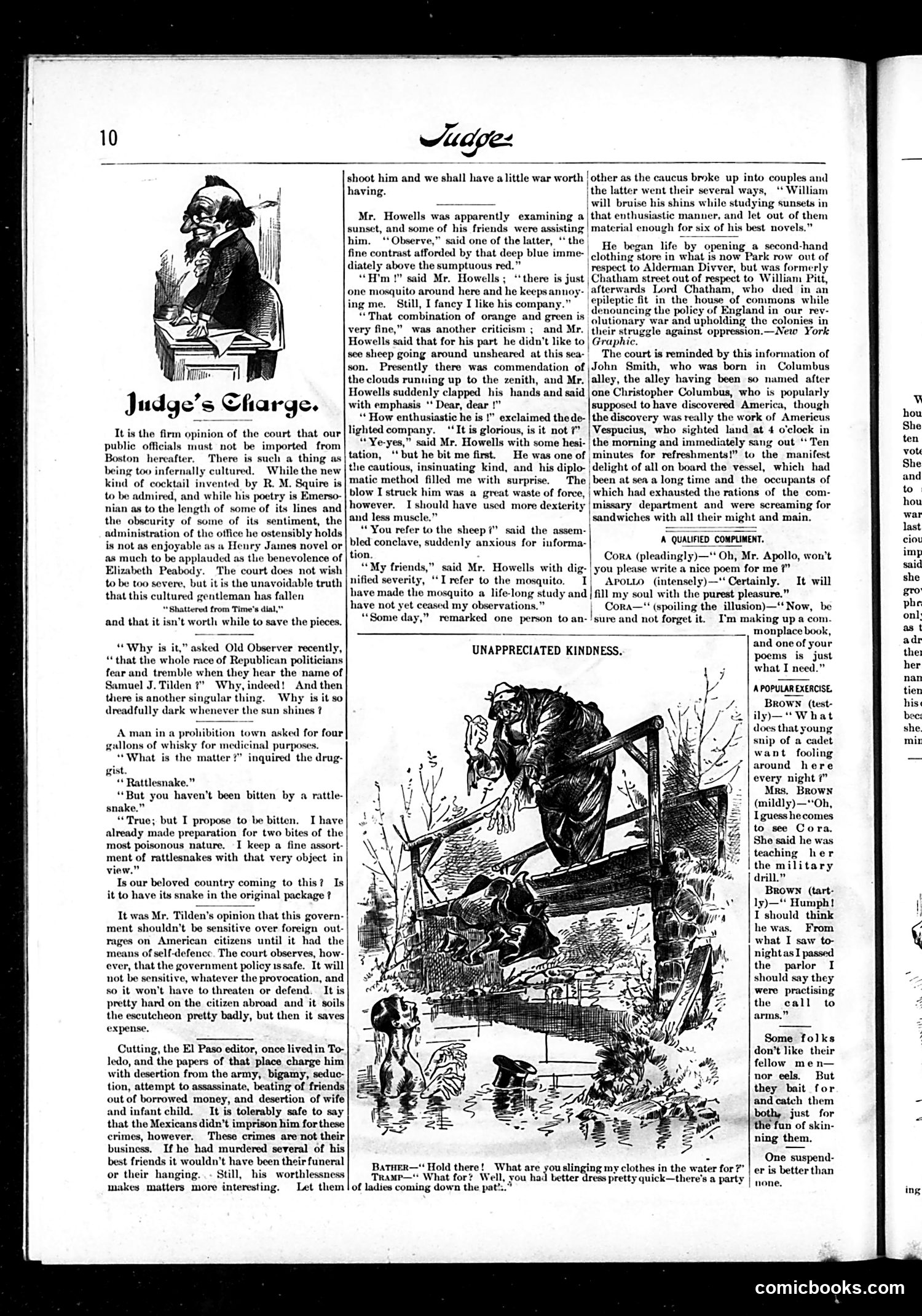
This page contains two satirical pieces typical of the magazine's political and social commentary: **"Judge's Charge"** (left column) is the main editorial commentary. It criticizes the importation of "cultured" public officials from Boston, suggesting that literary refinement doesn't translate to effective administration. The piece references Samuel J. Tilden (Democratic presidential candidate) and uses absurdist humor—a man wanting rattlesnakes in advance to cure potential snakebites—to mock government policy on protecting American citizens abroad. It concludes with cynical commentary about an El Paso editor's criminal past, sarcastically suggesting his worthlessness might at least provoke an entertaining war with Mexico. **The lower cartoon** depicts William Dean Howells, the renowned American novelist and literary figure, being bitten by a mosquito while friends admire a sunset. The joke: Howells remains fixated on the mosquito's annoyance rather than appreciating the natural beauty around him—satirizing his reputation for focusing on trivial domestic details in his fiction rather than grand themes. Both pieces employ sardonic humor targeting public figures and American cultural pretensions.
📄 Transcribed text from this page (OCR, searchable)
Machine-transcribed from the original scan — historical spelling and the odd misread are preserved.
Tiles 1) BR s Charge. It is the firm opinion of the court that our public officials must not be imported from There is such a thing as cultured. While the new vented by R. M. Squire is to be admired, and while his poetry is Emerso- nian as to the length of some of its lines and the obscurity of some of its sentiment, the administration of the office he ostensibly holds is not as enjoyable as a Heury James novel or as much to be applauded as the benevolence of Elizabeth Peabody. The court does not wish to be too severe, but it is the unavoidable truth that this cultured gentleman has fallen hattered from Time's dial,” and that it isn’t worth while to save the pieces. “Why is it,” asked Old Observer recently, “that the whole race of Republican politicians fear and tremble when they hear the name of Samuel J. Tilden ?” Why, indeed! And then there is another singular thing. Why is it so dreadfully dark whenever the sun shines ? Aman ina prohibition town asked for four gallons of whisky for medicinal purposes. “*What is the matter?” inquired the drug- gist. ‘* Rattlesnake.” “But you haven't been bitten by a rattle- snake.” “True; but I propose to be bitten. I have already made preparation for two bites of the most poisonous nature. I keep a fine assort- ment of rattlesnakes with that very object in view.” Is our beloved country coming to this? Is it to have its snake in the original package ? It was Mr, Tilden’s opinion that this govern- ment shouldn't be sensitive over foreign out- rages on American citizens until it had the means of self-defence. The court observes, how- ever, that the government policy issafe. It will not be sensitive, whatever the provocation, and so it won't have to threaten or defend. It is pretty hard on the citizen abroad and it soils the escutcheon pretty badly, but then it saves ng, the El Paso editor, once lived in To- ledo, and the papers of that place charge him with desertion from the army, bigamy, seduc- tion, attempt to assassinate, beating of friends out of borrowed money, and desertion of wife and infant child. It is tolerably safe to say that the Mexicans didn’t imprison him for these crimes, however. These crimes are not their business. If he had murdered several of his best friends it wouldn't have been their funeral or their hanging... Still, his worthlessness makes matters more interesting. Let them shoot him and we shall have alittle war worth | having. | Mr. Howells was apparently examining a sunset, and some of his friends were assisting | him. ‘ Observe,” said one of the latter, ‘ the fine contrast afforded by that deep blue imme- diately above the sumptuous red.” “Him !" said Mr. Howells ; ‘there is just, one mosquito around here and he keeps annoy- ing me. Still, I fancy I like his company “That combination of orange and green is very fine,” was another criticism ; and Mr. Howells said that for his part he didn’t like to| see sheep going around unsheared at this sea- son. Presently there was commendation of the clouds runuing up to the zenith, and Mr. Howells suddenly clapped his hands and said with emphasis ‘‘ Dear, dear !” “How enthusiastic he is !” exclaimed thede- lighted company. ‘‘It is glorious, is it not f” “Ye-yes,” said Mr. Howells with some hesi- tation, “but he bit me first. He was one of the cautious, insinuating kind, and his diplo- matic method filled me with surprise. ‘The blow I struck him was a great waste of force, | however. I should have used more dexterity | and less muscle.” | “You refer to the sheep?” said the assem- bled conclave, suddenly anxious for informa- tion. “My friends,” said Mr. Howells with dig-| nified severity, “I refer to the mosquito, I other as the caucus broke up into couples and the latter went their several ways, ‘* William will bruise his shins while studying sunsets in that enthusiastic manner, and let out of them material enough for six of is best novels.” He began life by opening a second-hand clothing store in what is now Park row out of respect to Alderman Divver, but was formerly Chatham street out of respect to William Pitt, afterwards Lord Chatham, who died in an epileptic fit in the house of commons while denouncing the policy of England in our rev- olutionary war and upholding the colonies in their struggle against oppression.—New York Graphic. The court is reminded by this information of John Smith, who was born Columbus alley, the alley having been so named after one Christopher Columbus, who is popularly supposed to have discovered America, though the discovery was really the work of Americus Vespucius, who sighted land at 4 o'clock in the morning and immediately sang out “Ten minutes for refreshments!” to the manifest delight of all on board the vessel, which had | been at sea a long time and the occupants of which had exhausted the rations of the com- missary department and were screaming for sandwiches with all their might and main, A QUALIFIED COMPLIMENT, Cora (pleadingly)—" Oh, Mr. Apollo, won't you please write a nice poem for me f” APOLLO (intensely)—‘‘ Certainly. It will have made the mosquito a life-long study and have not yet ceased my observations.” “Some day,” remarked one person to an- fill my soul with the purest pleasure.” Cora—* (spoiling the illusion)— Now, be sure and not forget it. I'm making up a com. monplace book, UNAPPRECIATED KINDNESS. and one of your poems is just what I need.” APOPULAR EXERCISE, Brown (test- ilyy—" What does that young snip of a cadet want fooling around here every night ¢” Mrs. Brown (mildly)—"Oh, I guess hecomes to see Cora. She said he was teaching her the military drill.” Brown (tart: ly)—“ Humph! I should think he was. From what I saw to- nightasI passed the parlor I should say they were practising the call to arms.” Some folks don’t like their fellow me n— nor eels. But they bait for and catch them both, just for the fun of skin- ning them. One suspend- BatHeR—‘ Hold there! What are you slinging my clothes in the water for?” | er is better than Tramp— What for? Well, vou had better dress pretty quick—there’s a party of ladies coming down the pat?:.” none. comicbooks.com ing