
A complete issue · 16 pages · 1885
Judge — December 5, 1885
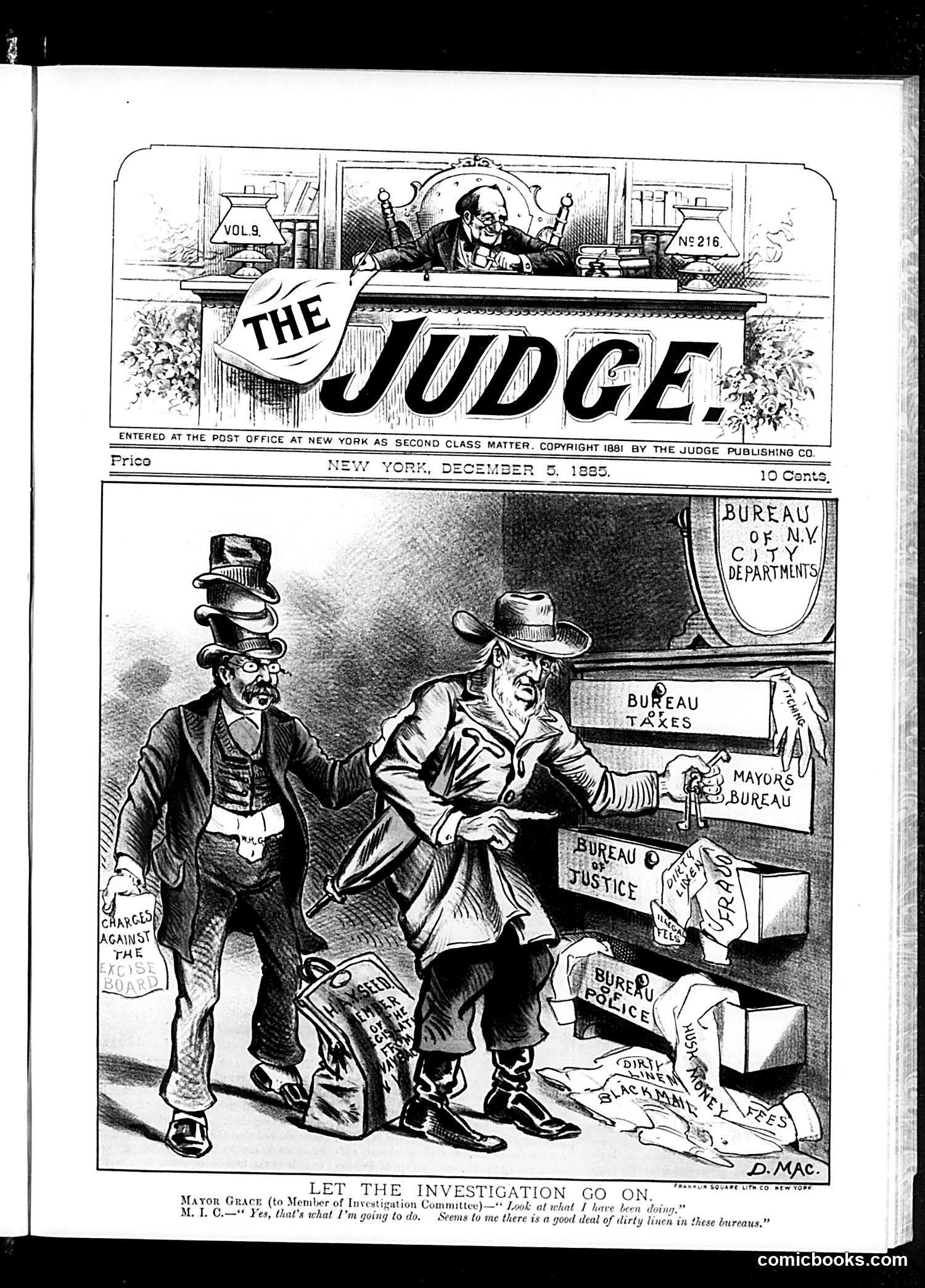
This cartoon satirizes New York City's municipal corruption and the Mayor's Grace (identified in the caption as M.I.C.—Member of Investigation Committee). The central figure, dressed as a gentleman, stands before stacked bureaucratic boxes labeled "Bureau of N.Y. City Departments," "Bureau of Taxes," "Mayors Bureau," "Bureau of Justice," and "Bureau of Police"—all apparently containing corruption ("dirty linen," "blackmail," etc.). The Mayor claims he's investigating these departments while clearly complicit in their dysfunction. The satire mocks the performative nature of investigations into entrenched city corruption, suggesting the Mayor profits from the very "dirty linen" he claims to expose. The cartoon criticizes the hollowness of municipal reform rhetoric.
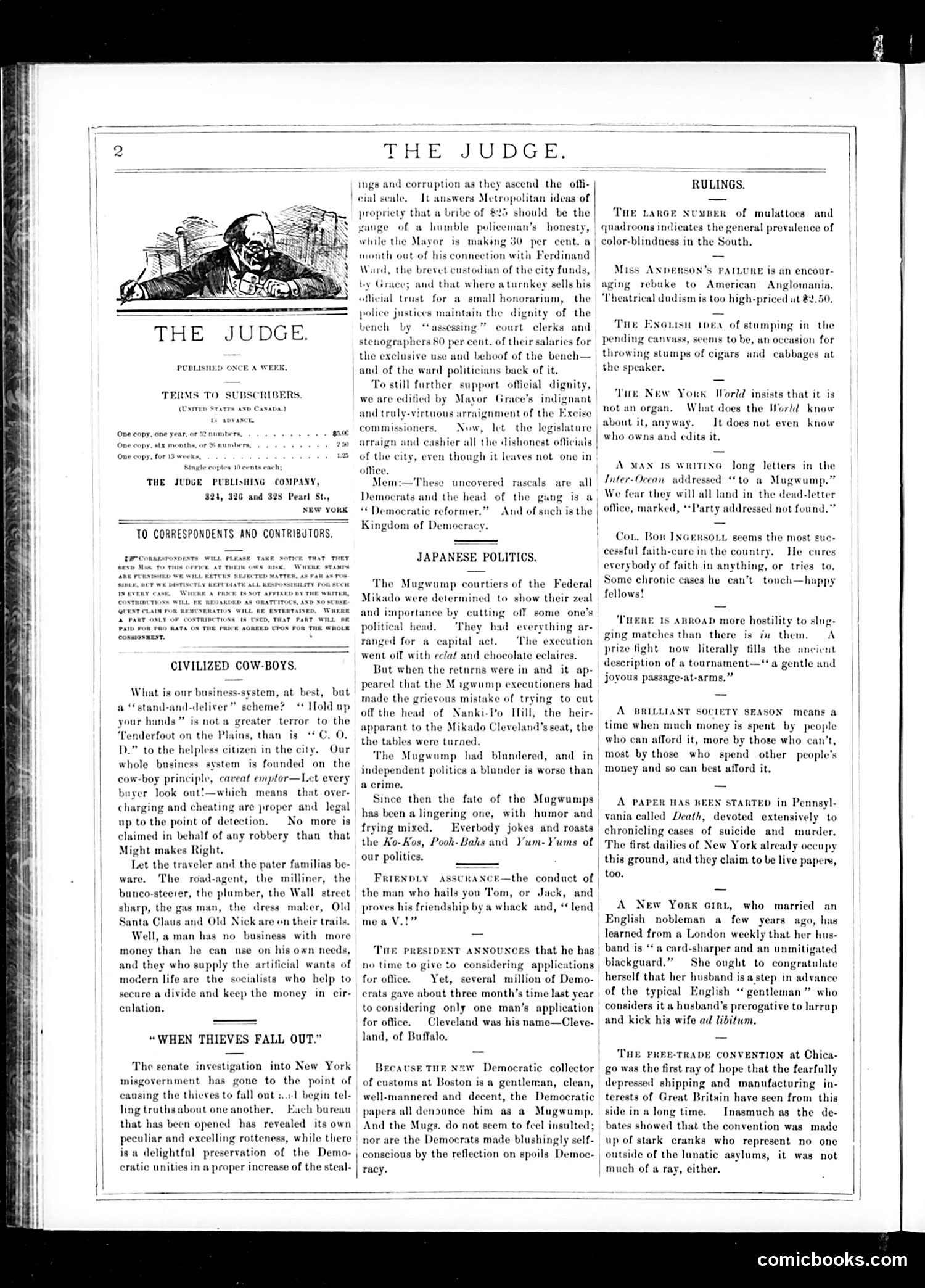
The main cartoon depicts a corpulent figure slouched at a desk, likely representing a corrupt political official or machine politician. The accompanying text criticizes Democratic Party corruption in New York City, specifically attacking: - Mayor Grace's connection to Ferdinand Ward (involved in a banking scandal) - Police justices receiving 80% of their salaries for "assessing" court clerks - Ward politicians profiting from city funds The satire accuses Democratic "reformers" of hypocrisy—claiming moral high ground while perpetuating systemic graft. References to "uncovered rascals" and "Democratic reformers" suggest this targets specific recent scandals in New York City politics, likely from the 1880s-1890s era when Judge magazine was actively satirizing Tammany Hall-style corruption. The cartoon's message: Democratic politicians are morally bankrupt despite their reform rhetoric.
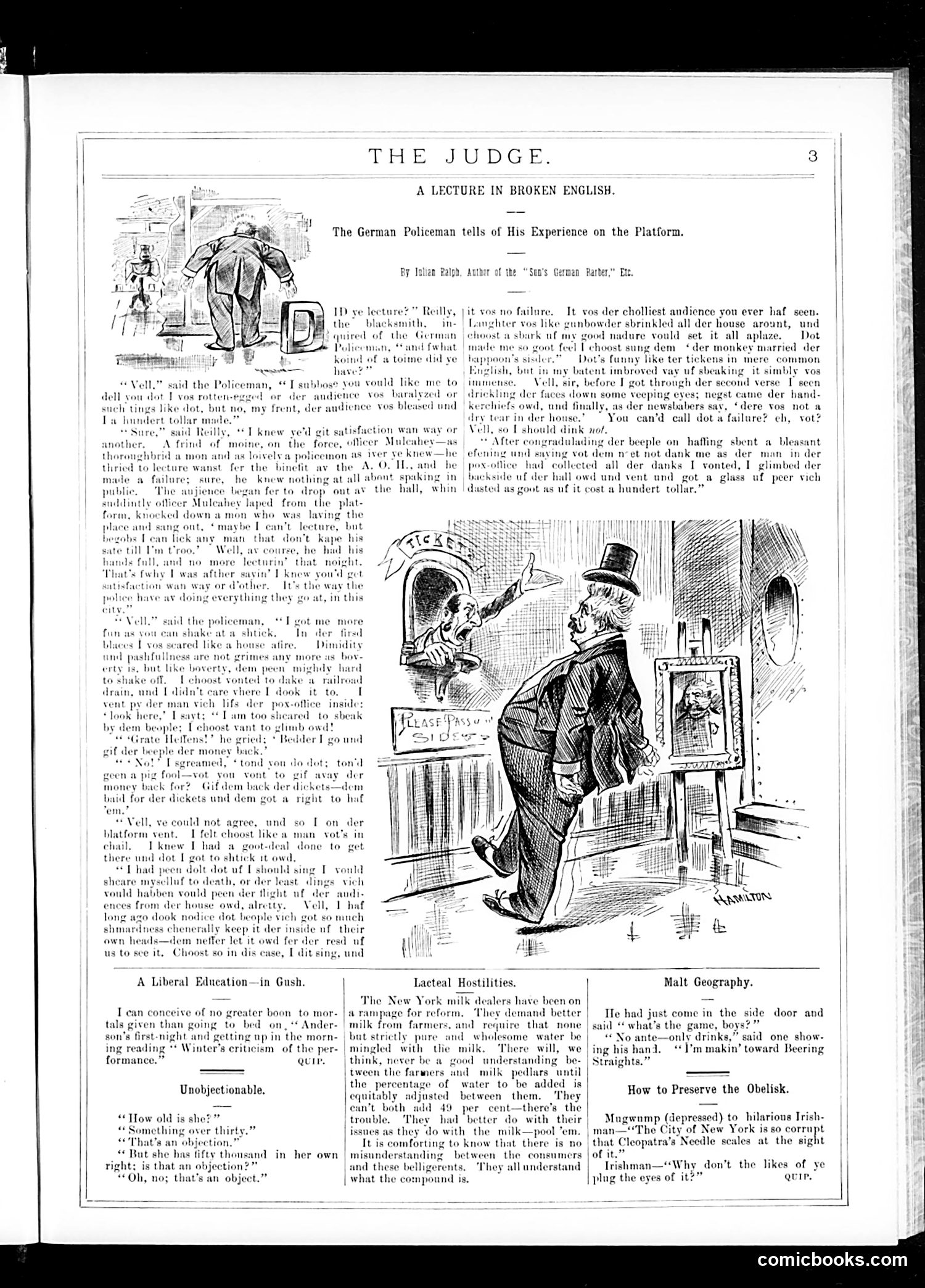
This page satirizes a German immigrant policeman recounting his disastrous attempt to give a public lecture. The main cartoon depicts the officer at a ticket booth, apparently having failed spectacularly on stage. The "broken English" dialect—heavy German accent rendered phonetically ("vos," "choost," "sbeak")—is the humor vehicle. The policeman describes how his lecture went poorly, audience members heckled him, and a fellow officer (Mulcahey) had to physically remove a disruptive audience member. The satire targets **immigrant incompetence and cultural mismatch**: a German cop attempting something beyond his station (public speaking/entertainment). The exaggerated accent underscores the period's stereotyping of German immigrants as foreigners ill-suited to American civic participation. Secondary items mock milk-dealer price disputes and contain brief humor pieces unrelated to the main cartoon. This reflects late 19th-century American attitudes toward immigration and ethnic stereotyping, common in Judge magazine's comedic approach.
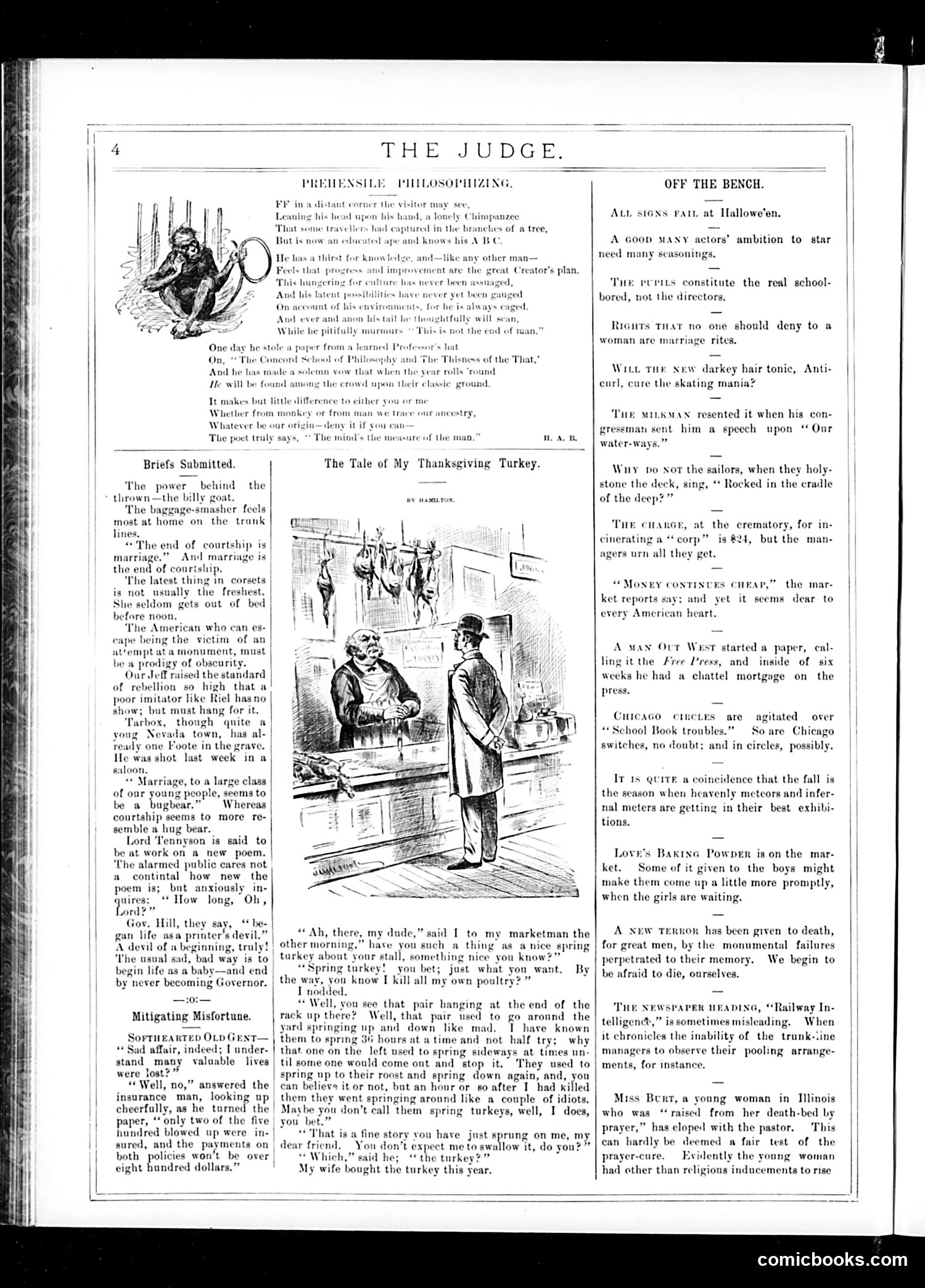
This page from the satirical magazine *Judge* contains several distinct sections mocking American social foibles: **"Prehensile Philosophizing"** (top left): A cartoon comparing a man to a chimpanzee, sarcastically suggesting humans aren't inherently superior to apes—a swipe at pretentious philosophy and social Darwinism debates of the era. **"The Tale of My Thanksgiving Turkey"** (center): A humorous anecdote where a customer disputes a marketman's absurd claim that turkeys were so vigorous they "sprung" for 36 hours after slaughter. The joke mocks tall tales and rural exaggeration. **"Briefs Submitted" & "Off the Bench"** (right column): Short satirical quips targeting contemporary topics: actors' ambitions, school governance, women's marriage rights, hair tonics, and sailors' traditions—typical *Judge* social commentary through pithy one-liners. The cartoons and text together exemplify *Judge's* formula: visual satire combined with biting social criticism of American culture, institutions, and pretension.
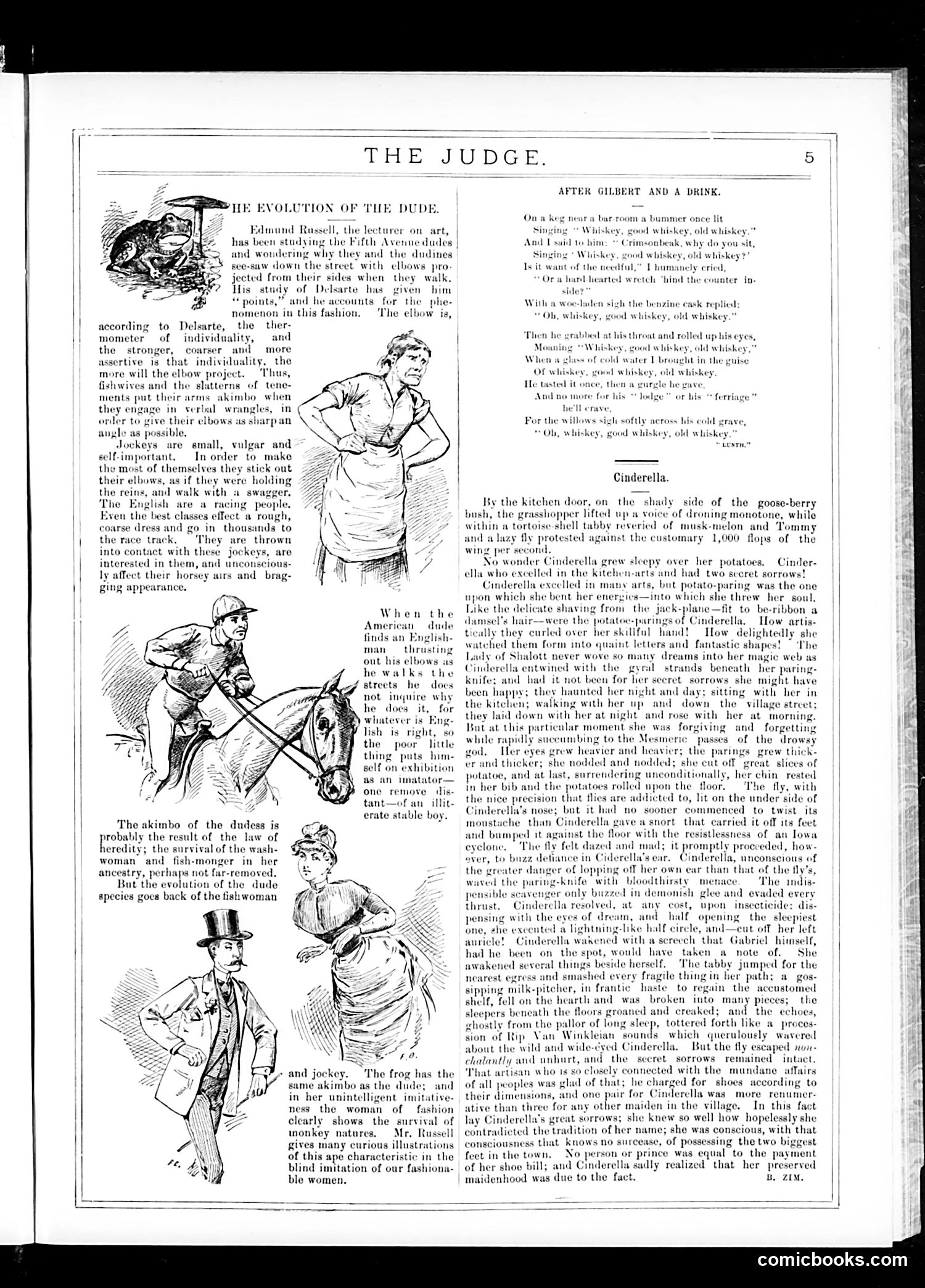
This page contains three satirical pieces typical of late 19th-century American humor: **"The Evolution of the Dude"** mocks fashionable young men who affected exaggerated poses and mannerisms. The article claims they adopted the affected elbow-jutting stance from English jockeys, who themselves copied working-class stable boys—suggesting American "dudes" were absurdly imitating a degraded copy of working-class affectation. The accompanying sketches show progressively ridiculous figures with protruding elbows. The satire targets both the dudes' pretentiousness and their mindless imitation of English fashion. **"After Gilbert and a Drink"** is a sentimental song-poem about a drunk's melancholy (typical period humor). **"Cinderella"** appears to be a whimsical story retelling the fairy tale with naturalistic details about potato-peeling, likely continuing further in the magazine. The cartoons rely on exaggerated caricature and physical comedy typical of Judge's satirical approach to American social pretension.
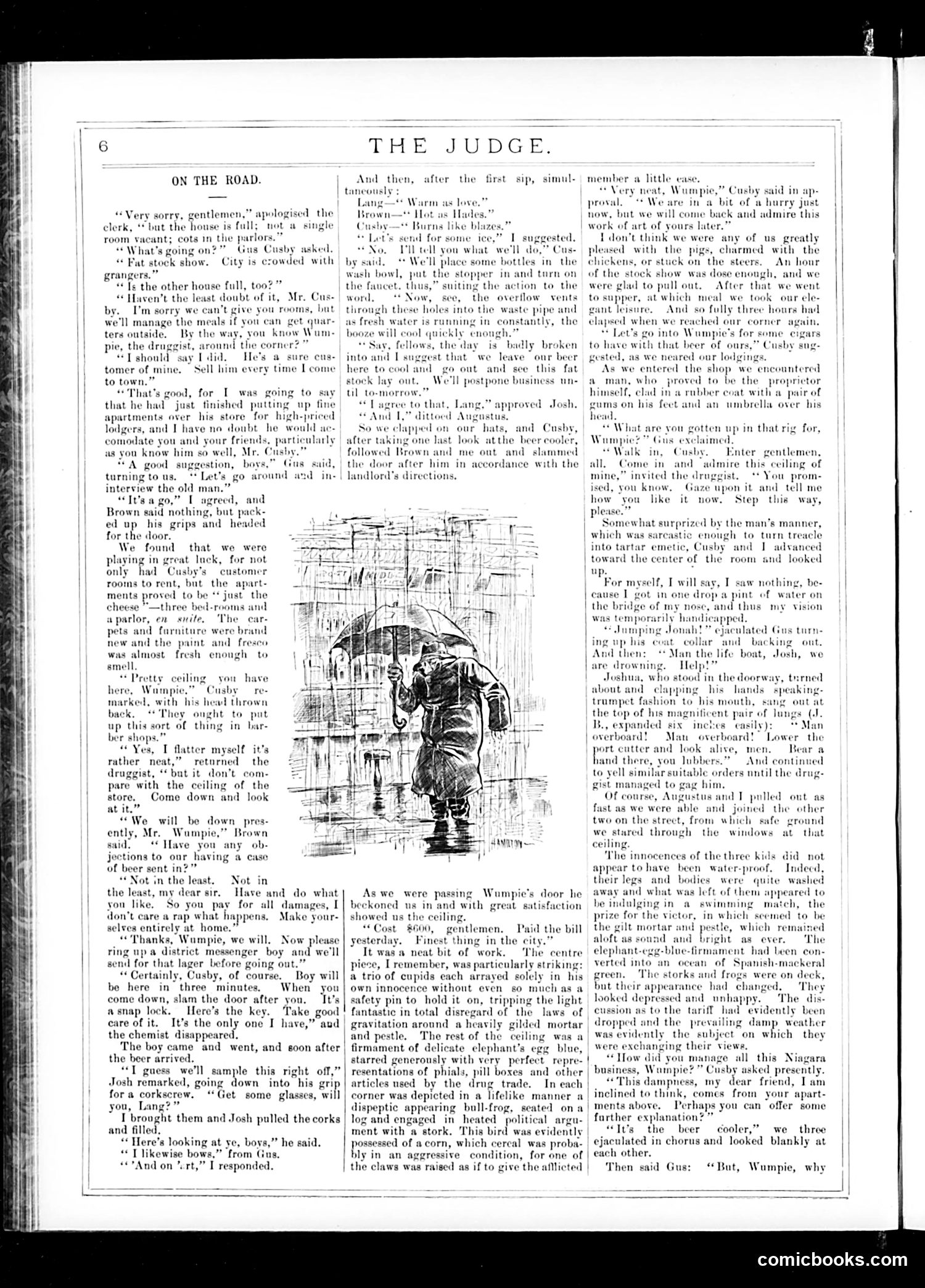
This story-comic satirizes American commercialism and opportunism during what appears to be a livestock/agricultural fair (referenced as "stock show"). **The Setup:** Traveling salesman Gus Cusby and friends seek lodging in a crowded town. A hotel clerk directs them to Brown, a local druggist who's recently built upscale apartments above his store—a perfect business opportunity. **The Satire:** Brown rents them rooms but exploits their situation mercilessly. When the guests complain the beer is warm, Brown instructs them to chill it using the landlord's overflow system—a setup that causes catastrophic water damage to the ceiling below. Brown then shamelessly displays his extravagant $600 ceiling (an enormous sum for 1880s-90s) decorated with cupids and pharmaceutical imagery, implicitly funded by guest damages. **The Point:** The joke exposes small-town greed and swindling—landlords and merchants ruthlessly exploiting travelers' misfortune while proudly displaying ill-gotten gains. Brown emerges as a con artist profiting from his guests' mistakes, embodying Gilded Age commercial excess.
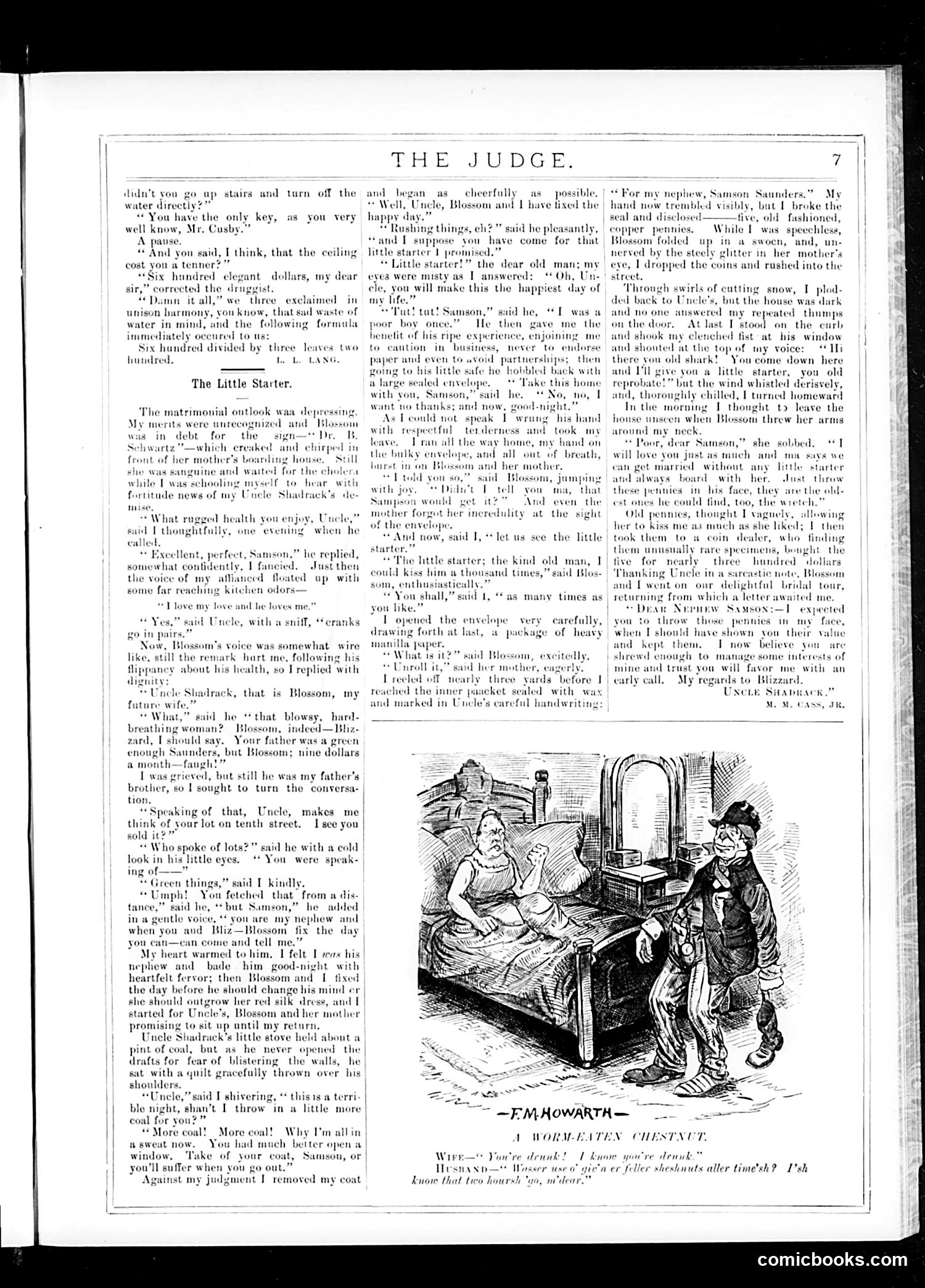
This story-cartoon satirizes the stinginess of older wealthy relatives and courtship customs of the era. The narrator, Samson, seeks a "starter"—a financial gift from his Uncle Shadrack to help him marry Blossom. The humor derives from Uncle Shadrack's miserliness: he keeps his stove nearly empty to avoid "blistering the walls," advises Samson to remove his coat rather than add coal, and hagggles over every expense. When finally providing the promised gift, he gives only old copper pennies—a humiliating insult that causes Blossom to faint and prompts Samson's furious return to confront him. The satire mocks both the uncle's absurd penny-pinching and the social expectation that young couples require elder approval (and money) to marry. The E.M. Howarth illustration shows the domestic scene where the bitter revelation occurs.
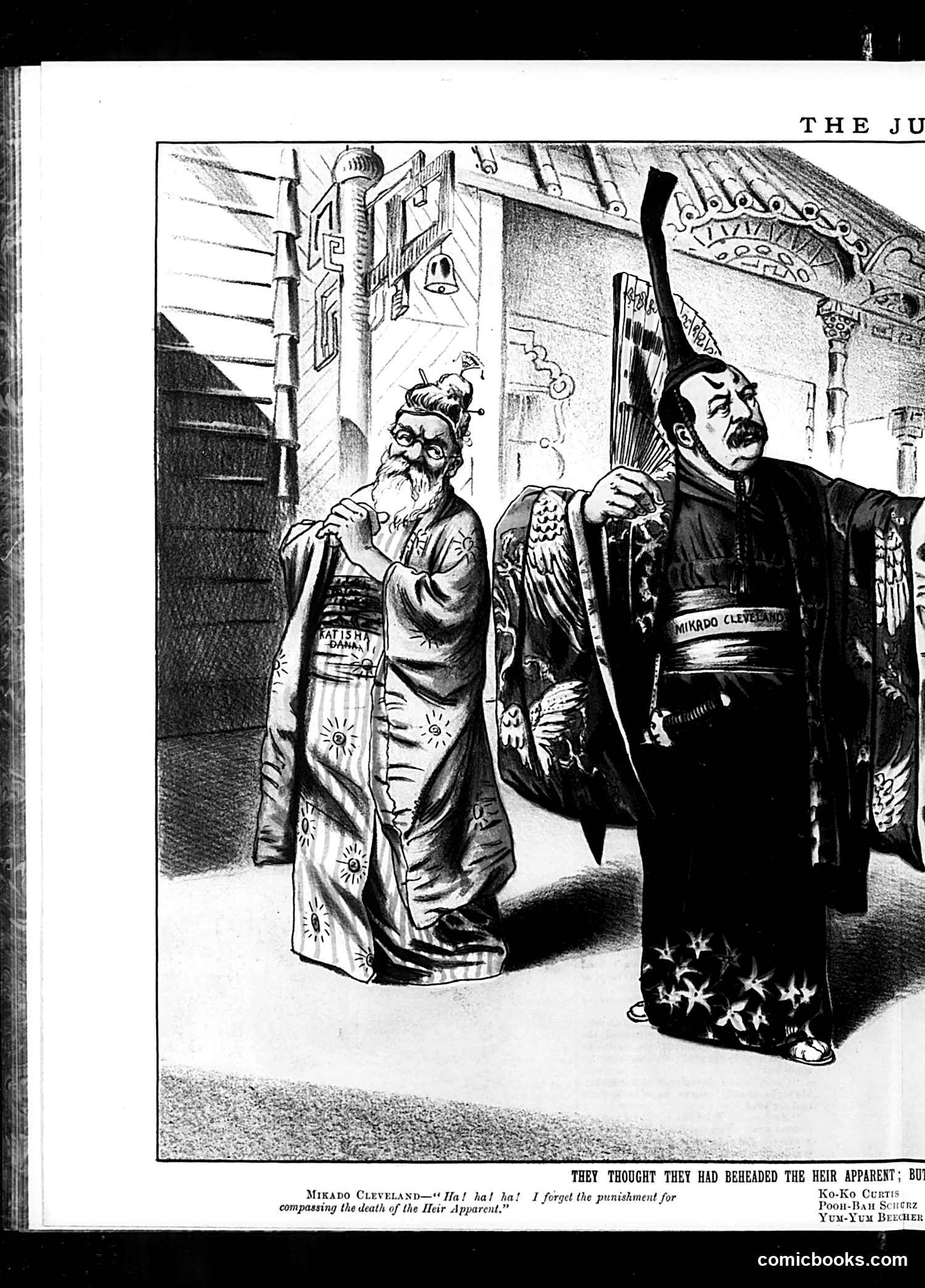
This cartoon satirizes **Mikado Cleveland** (President Grover Cleveland) in a scene adapted from Gilbert & Sullivan's operetta *The Mikado*. The figure on the right, labeled with Japanese costume and identified as "Mikado Cleveland," laughs at having supposedly executed "the Heir Apparent"—a reference to Cleveland's political rivals or opponents. The satire works through theatrical reference: just as *The Mikado* involves court intrigue and executions, Cleveland is portrayed as eliminating political enemies. The other figures wear Japanese costume, reinforcing the operetta parody. The joke appears to mock Cleveland's political ruthlessness or alleged elimination of rivals, treating serious political conflict as absurd comic theater. The referenced characters (Ko-Ko, Pooh-Bah, Yum-Yum) are *Mikado* roles, suggesting the entire administration is performing a farcical Japanese opera rather than governing seriously.
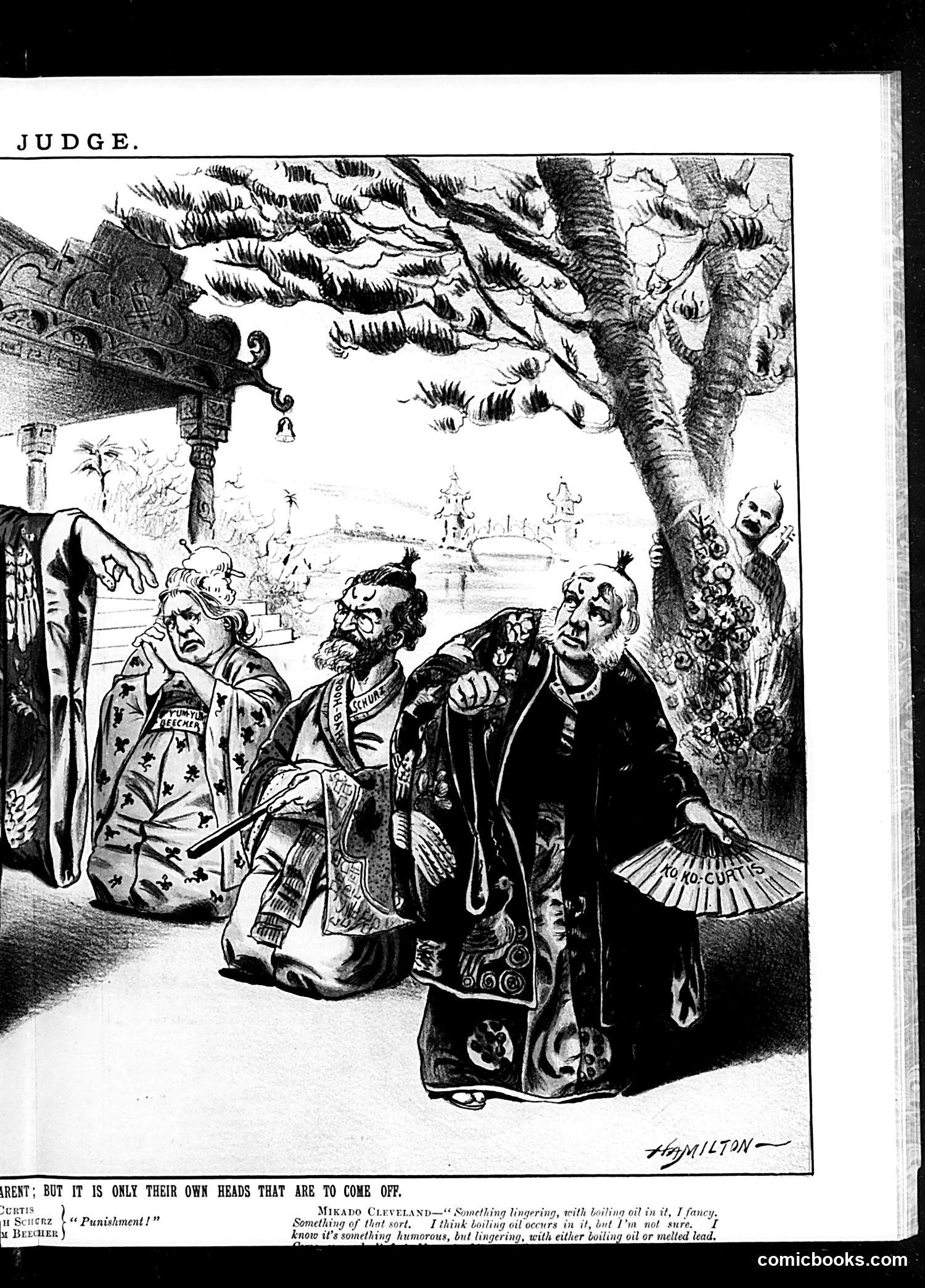
This political cartoon titled "Judge" depicts what appears to be foreign or Asian dignitaries (suggested by their elaborate traditional robes and distinctive facial features characteristic of period caricature) kneeling before an executioner's block. The artist Hamilton uses exaggerated features typical of late 19th/early 20th-century racist caricature. The caption references "Punishment!" with dark humor about boiling oil or melted lead—suggesting execution methods. The cartoon appears to satirize either colonial punishment of foreign leaders or international judicial proceedings, though the specific historical event remains unclear from the visible text. The ornate clothing and setting suggest commentary on non-Western governance or justice systems, viewed through a distinctly prejudiced lens typical of Judge magazine's often offensive satirical approach.
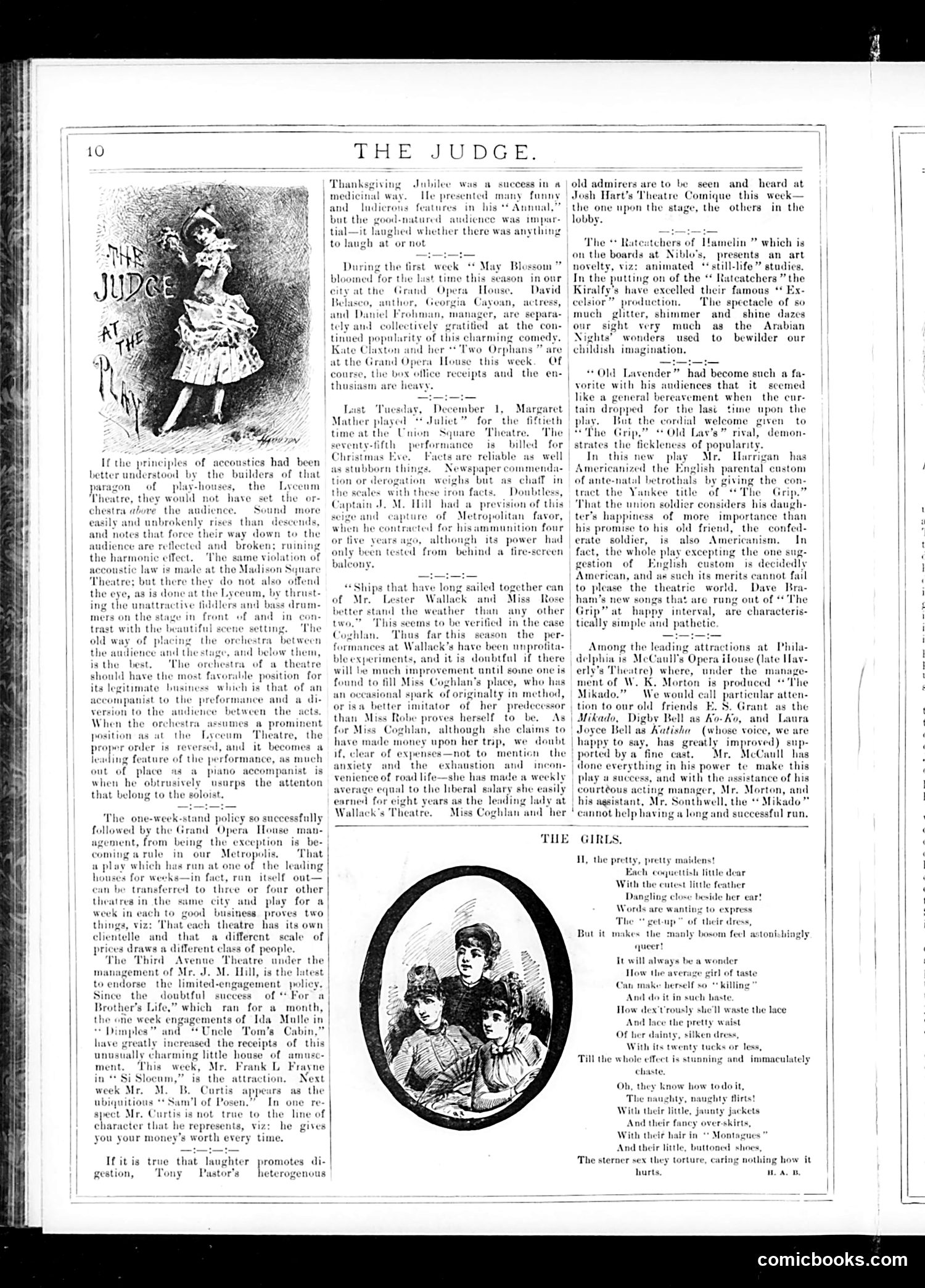
This page contains **theater reviews** rather than political cartoons. The primary illustrated content shows two engravings: the Judge magazine logo (left) and "The Girls," a decorative oval portrait of three young women (right). The text discusses Broadway productions of the 1880s, including *May Blossom*, *The Two Orphans*, and performances at Wallack's Theatre. The reviews critique acoustics at the Lyceum Theatre and discuss actresses like Margaret Mather and Miss Coghlan. "The Girls" section that follows is **lighthearted verse about young women's fashion and behavior**—their clothing, hairstyles, and social conduct. The tone is affectionate mockery typical of Victorian-era publications. This appears to be an **entertainment and social commentary page** rather than political satire. The humor targets theatrical management, architectural design flaws, and contemporary gender stereotypes—issues of interest to Judge magazine's educated, urban readership.
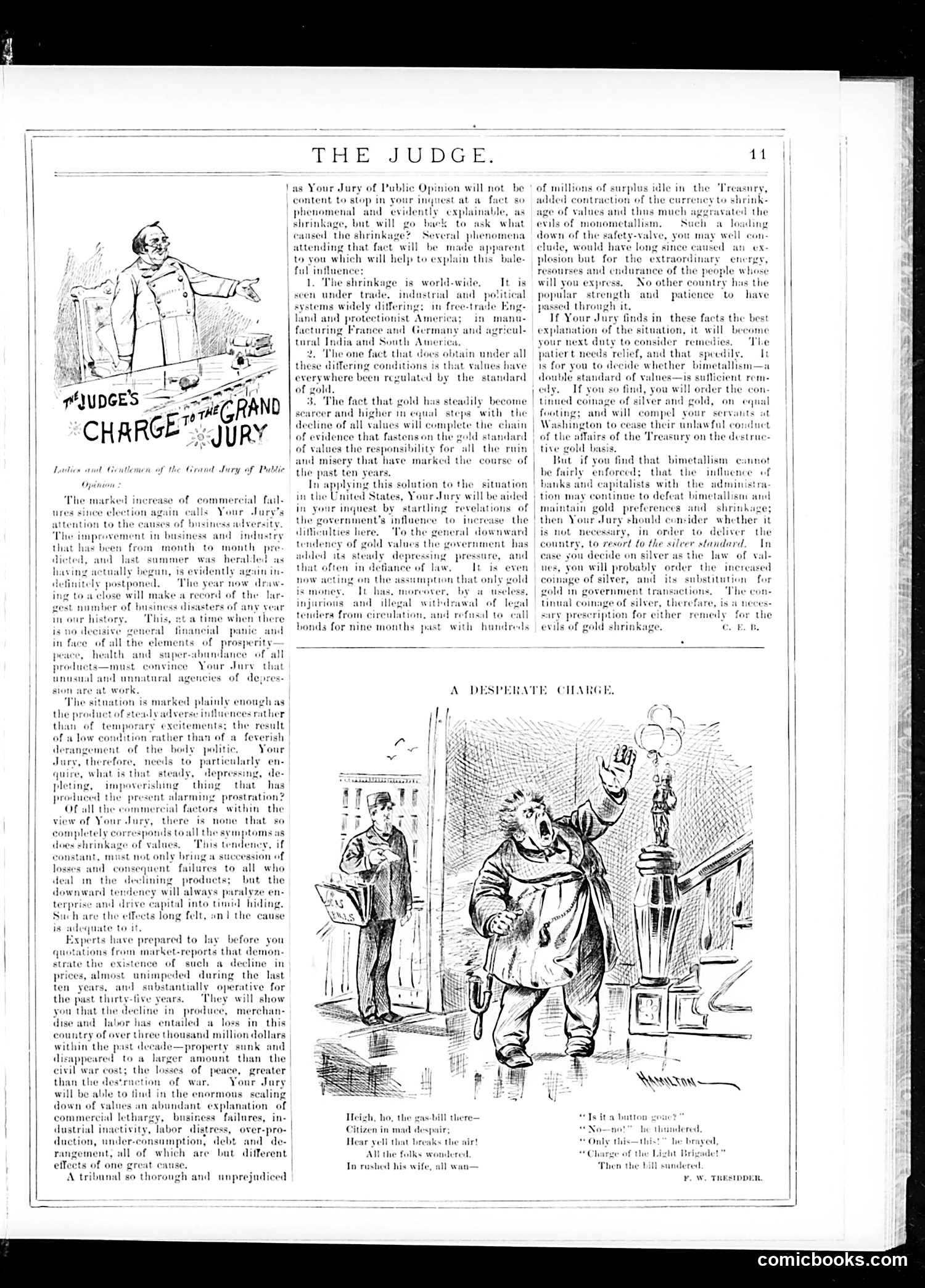
## Main Cartoons **"The Judge's Charge to the Grand Jury"** (left): A judge addresses a jury about economic crisis. The accompanying text discusses the "shrinkage" of commercial values—a widespread economic decline affecting trade, industry, and politics across America and Europe. **"A Desperate Charge"** (right): Depicts a frantic official or politician addressing Lady Liberty (holding torch) and other allegorical figures, appearing to urgently demand action amid crisis. ## Context The page addresses the **monetary/currency crisis** of the 1890s (likely the 1893 Panic or related depression). The text debates whether **bimetallism** (silver and gold standards) versus gold-only standards caused the economic collapse. The cartoons suggest political leadership is helpless ("desperate") to address the severe economic contraction affecting production, commerce, and employment that has persisted for decades. The satire mocks both the gravity of the situation and the inadequacy of official responses to resolve it.
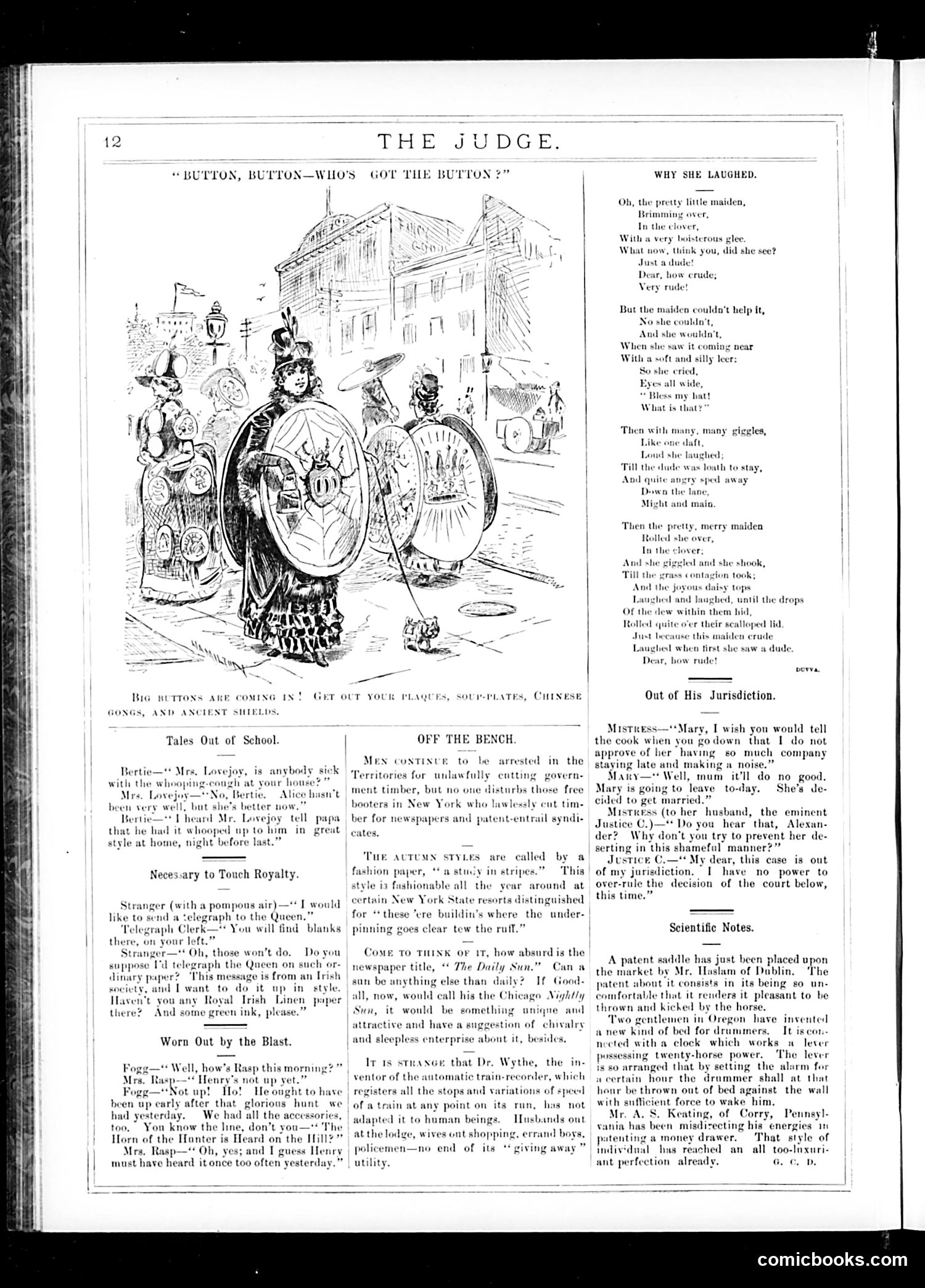
The main cartoon depicts a absurdist joke: well-dressed figures in elaborate costumes (appearing to represent royalty or nobility based on their ornate dress and crowns) are playing a children's game asking "who's got the button?" The humor lies in the incongruity of dignified, important people engaged in trivial child's play. The surrounding short pieces are typical Judge magazine humor: - **"Tales Out of School"** mocks social pretension and marital dynamics - **"Off the Bench"** satirizes judicial overreach and absurd legal situations (notably a justice claiming he has no jurisdiction over his own servant's personal decisions) - **"Scientific Notes"** uses exaggeration to mock impractical inventions The overall tone reflects late-19th century American satirical humor targeting upper-class affectation, institutional pomposity, and social absurdity. The "button" game specifically mocks the frivolousness of high society.
This is primarily **humorous content** rather than political satire. The page features: **"Seasonable Rhymes"** - Verses about winter's arrival, including comedic observations about: - Organ grinders disappearing in cold weather - Lovers taking sleigh rides (paid for by livery men) - A girl's heartbreak when her boyfriend goes skating with another girl **Short jokes/anecdotes** on contemporary topics: - Mary Anderson (likely the actress) hosting a breakfast - An actor's interaction with a rustic audience member - An Italian astronomer's theory about Mars being inhabited (satirizing both astronomy claims and free-trade debates) - A schoolteacher's exercise in sentence-forming with the word "trumpet" **Misc. quips** about bank checks, hunters mistaking women for bears, and the Sorosis Club (a women's organization). The satire is **mild and domestic** — poking fun at everyday life, romantic mishaps, and contemporary absurdities rather than attacking specific political figures or major events. This reflects Judge's general approach as an entertainment-focused satirical magazine.
This page contains primarily **humorous dialect stories** rather than political cartoons. The main content features two comedic narratives written in exaggerated German-American immigrant dialect (common in late 19th-century American humor): 1. **"Jake's Joke on His Father"** — A son mocks his elderly father's fashion choices and social pretensions, using malapropisms and broken English for comic effect. 2. **"Preserving Unities"** — Two newspaper editors discuss playwrights who are overly sensitive to criticism, with the joke being that writers become defensive when their work is critiqued. The satire targets **immigrant mannerisms and speech patterns**, which were popular stereotypical humor of the era. The page is otherwise filled with **period advertisements** (Lundborg's Perfumes, furniture, building companies), indicating this is standard magazine content rather than focused political satire. The humor relies on linguistic stereotyping rather than topical commentary.
This page is primarily **advertising**—it contains numerous commercial notices for printing services, binderies, lithographic inks, frames, and other trade businesses (Franklin Square Lithographic Co., George Mather's Sons, etc.). However, it does include two short **satirical pieces**: 1. **"The United Service"** (top left): A story about two theater critics debating whether playwrights should "preserve their unities" (a classical dramatic principle). When one critic harshly tells a young female playwright her work violates these unities, her brother beats him up. The satire mocks pedantic criticism and critics who hide behind rules while lacking human empathy. 2. **"Just As Represented"** (bottom right): A comic anecdote about a man (Messmener) who buys what he thinks is a horse blanket at auction, only to discover it's a woman's dressing gown infested with vermin. The joke satirizes auction fraud and the phrase "sold as represented." Both pieces are light, humorous takes on everyday deception and pretension—typical of Judge magazine's satirical approach.
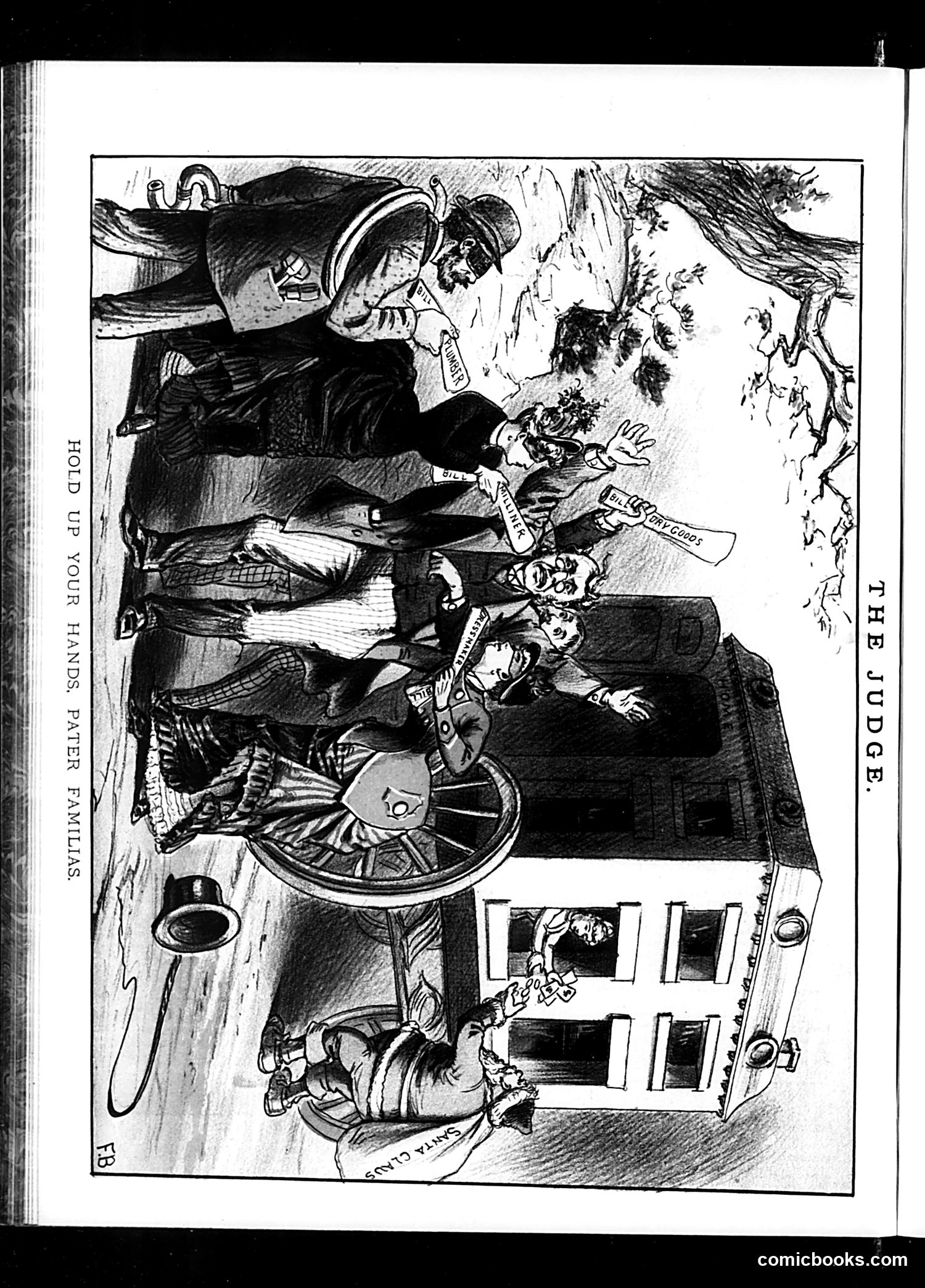
This page appears to be a title page or section header for *Judge* magazine, featuring the text "THE JUDGE" prominently on the right side. The main illustration shows a satirical scene set inside a house, depicting what appears to be a legal or judicial proceeding. Multiple figures in period dress (likely 19th century) are arranged around a central table or wheel-like object. The scene includes caricatured faces and formal attire suggesting courtroom or official business. However, the OCR text is largely garbled and provides no readable context. Without legible text identifying the specific case, figures, or political situation being satirized, I cannot reliably identify who these caricatures represent or what contemporary issue this cartoon addresses. The artistic style and formal setting suggest social or political commentary typical of *Judge* magazine's satirical content, but the specific subject remains unclear from this reproduction.