
A complete issue · 17 pages · 1885
Judge — October 10, 1885
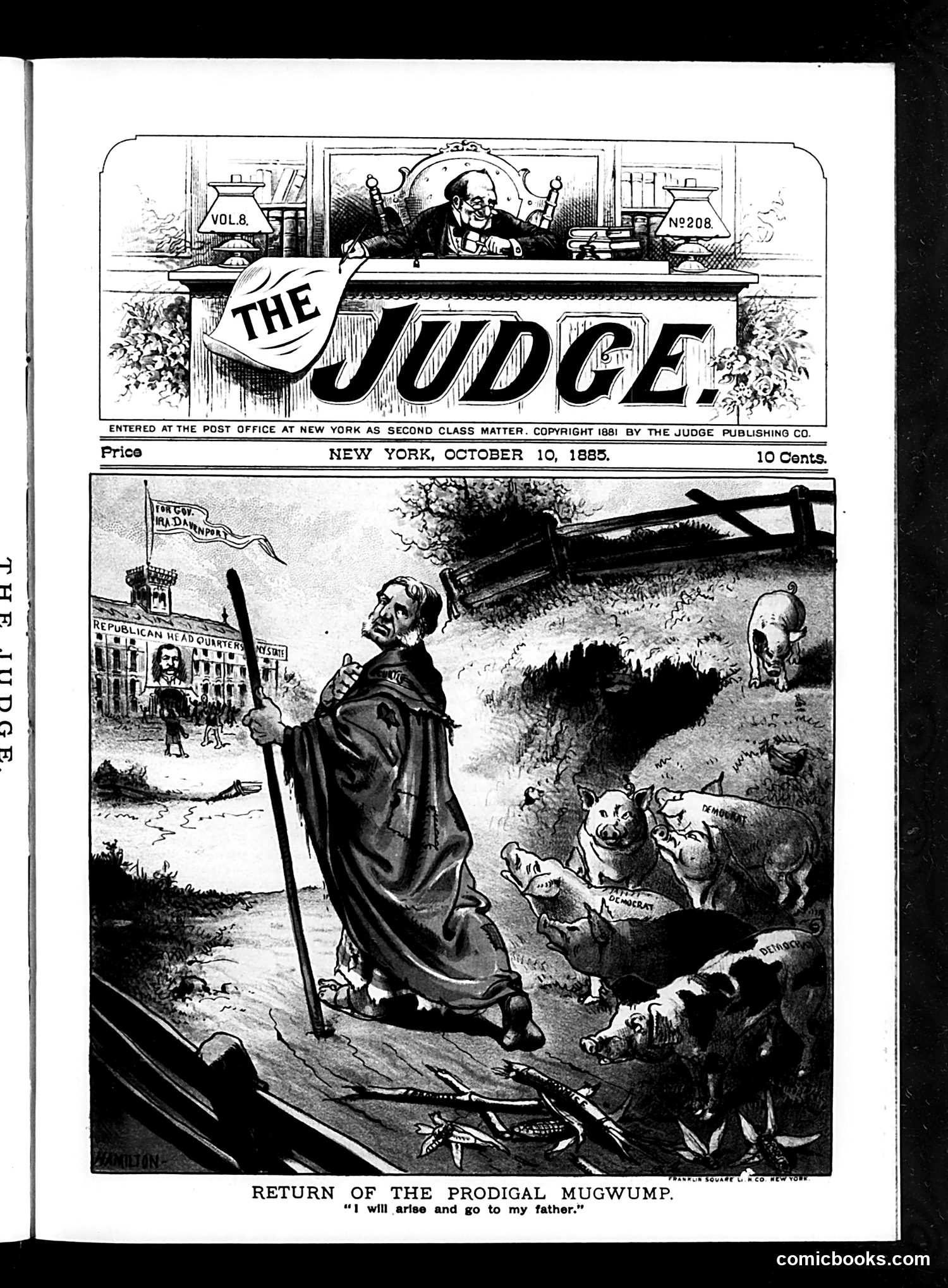
This political cartoon titled "Return of the Prodigal Mugwump" satirizes the "Mugwumps"—Republicans who abandoned their party to support Democrat Grover Cleveland in the 1884 presidential election. The central figure, dressed in ragged clothes and leaning on a staff, represents a returning Mugwump. The caption quotes the Biblical prodigal son: "I will arise and go to my father," suggesting these Republicans are attempting to reconcile with the GOP after Cleveland's election. The cartoon mocks them as foolish deserters. The pigs and degraded animals surrounding the figure reinforce the satirical message that Mugwumps have debased themselves through their political apostasy. The Republican headquarters visible in the background underscores the party-loyalty angle of the joke.
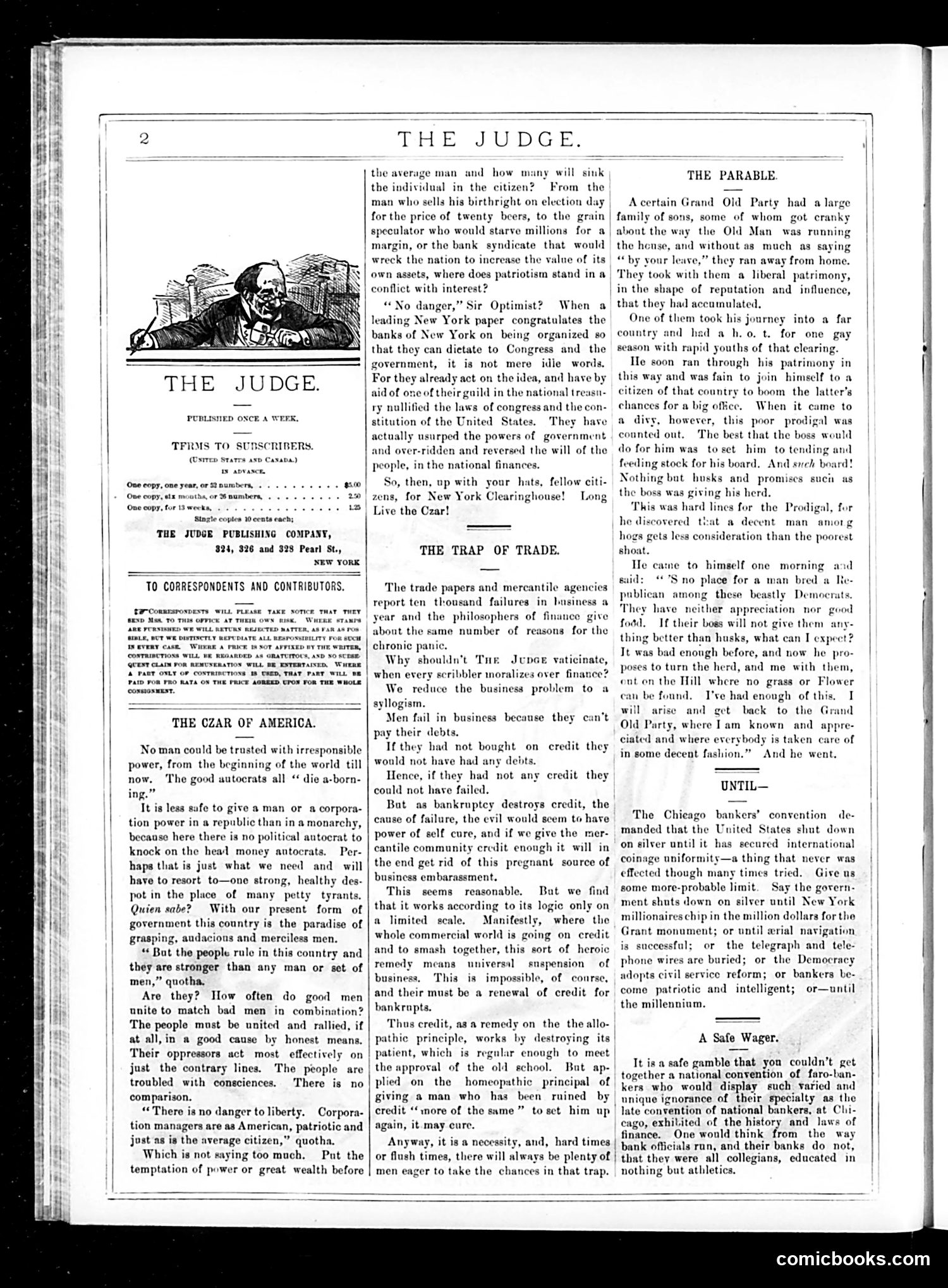
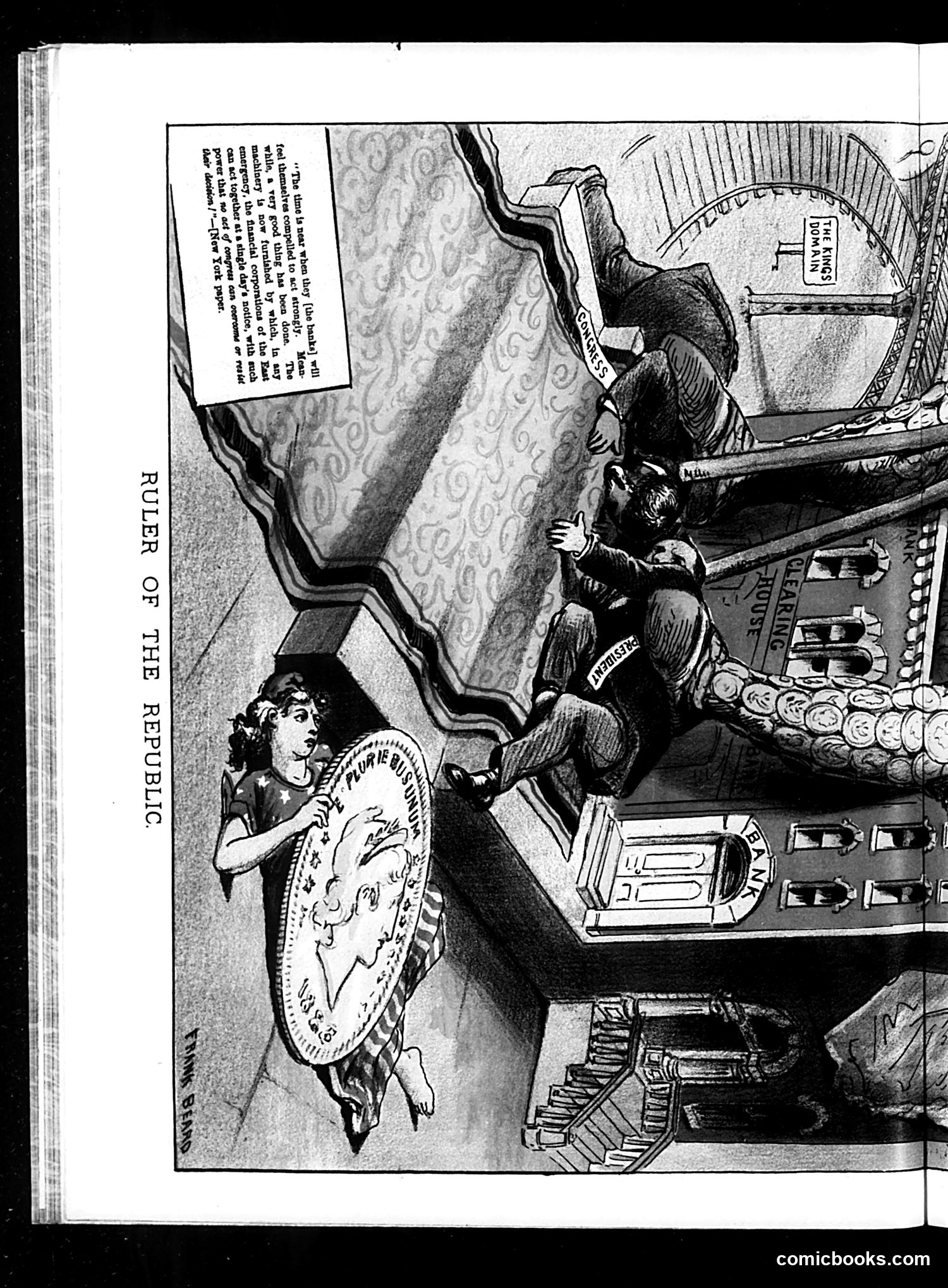
This page critiques the unchecked power of American financial institutions, particularly New York banks. The editorial argues that despite republican ideals of popular sovereignty, wealthy elites—especially bankers—function as an unaccountable "czar," wielding power comparable to absolute monarchy. The piece specifically references banks dictating to Congress and claims a Treasury official (likely Secretary of the Treasury) has nullified laws to serve banking interests. It sarcastically toasts the "New York Clearinghouse"—the actual banking consortium that coordinated responses to financial crises. The cartoon (showing a caricatured figure at a desk) appears to represent this concentrated financial power. The accompanying article "The Trap of Trade" analyzes business failures as resulting from credit systems, suggesting structural economic problems rather than individual failures. Overall, the page expresses progressive-era anxiety about plutocracy undermining democratic government.
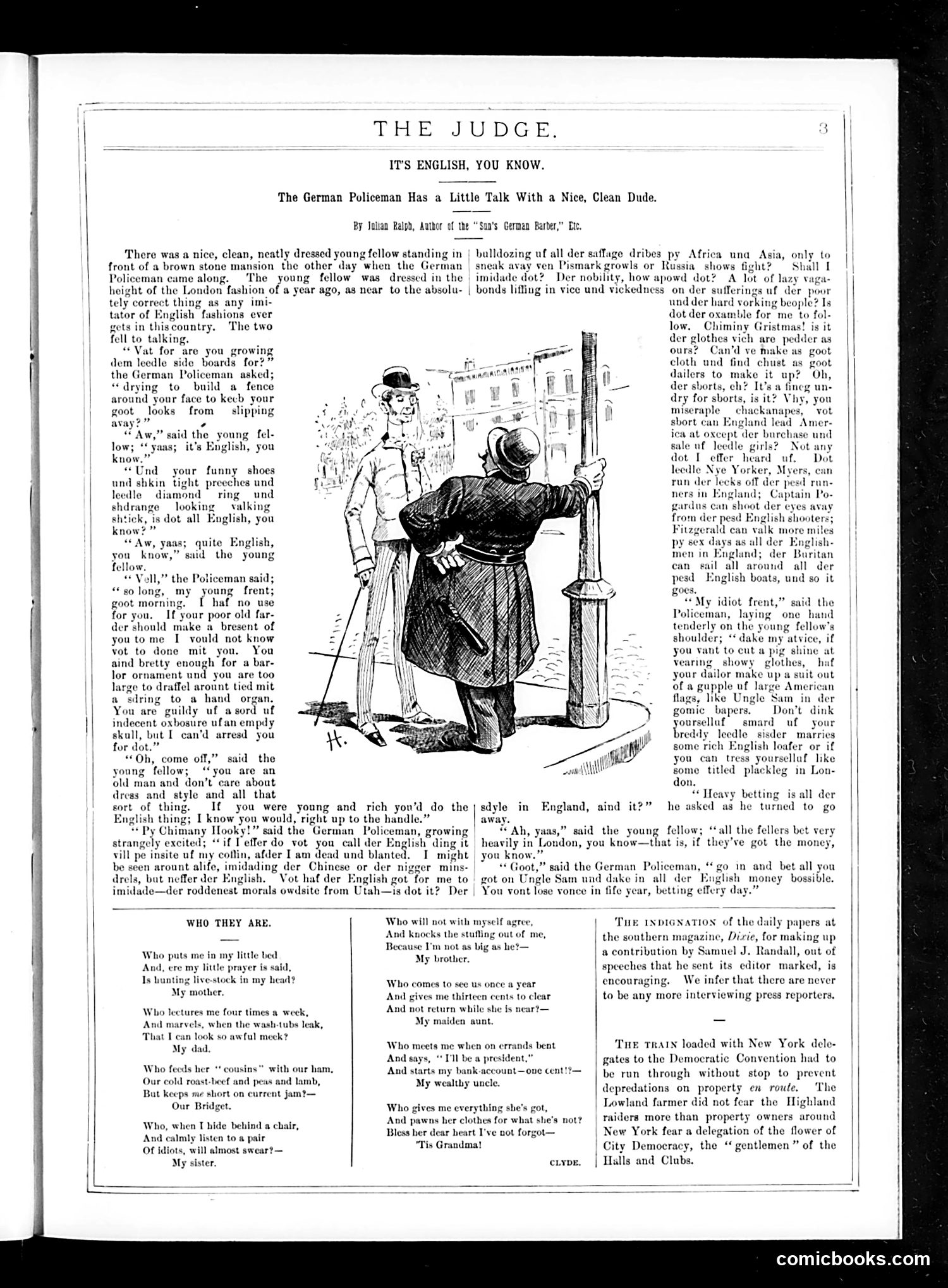
This 1880s-era *Judge* cartoon satirizes both German immigrants and American Anglophilia. A German policeman mocks a young American man dressed in the latest English fashions—tight trousers, sideburns, and fashionable shoes—as ridiculous affectation. The policeman, speaking in exaggerated German-accented English, represents the working-class immigrant's blunt perspective. He ridicules Americans' slavish imitation of English style while simultaneously boasting of German and German-American superiority. The satire cuts both ways: it mocks the young man's pretentious fashion-following, but also portrays the German character as crude and sanctimonious. The humor depends on period class anxieties—the nouveau riche American trying to adopt European aristocratic manners—and anti-immigrant sentiment expressing skepticism of German assimilation. The policeman's final advice to bet money on horse racing sends up both English gambling culture and German stereotypes about American naiveté.
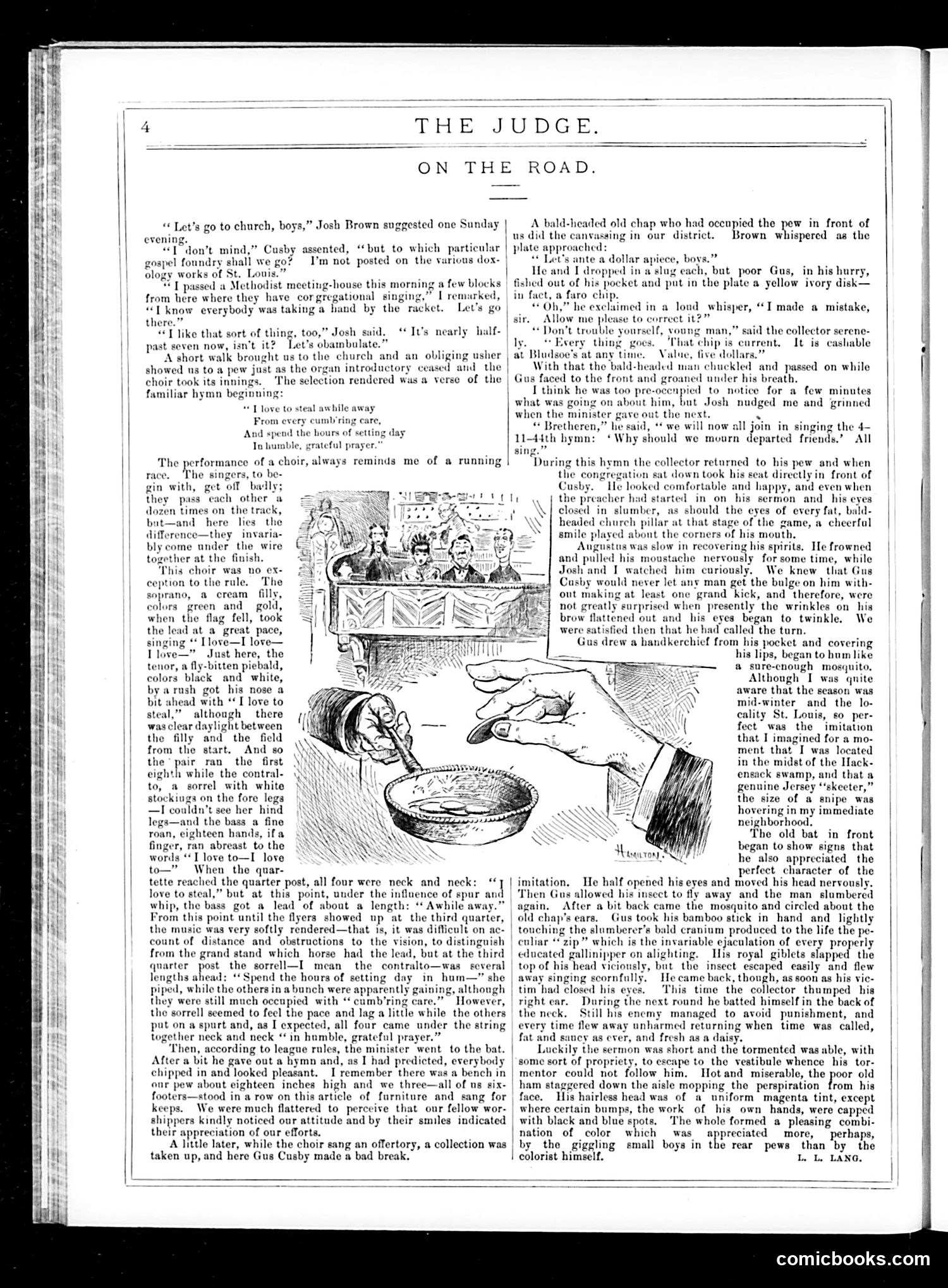
This is a humorous narrative about three men attending a Methodist church service in St. Louis. The satire operates on two levels: **The Choir as a Horse Race:** The author compares the choir's singing performance to a horse race, with each vocalist (soprano, tenor, contralto, bass) depicted as different racing horses competing through hymn verses. This absurdist comparison mocks both competitive church performances and the melodramatic delivery of 19th-century congregational singing. **The Collection Plate Joke:** The punchline involves Gus Cusby mistakenly dropping a "yellow ivory disk" (a poker chip or gambling chip) into the collection plate instead of money—suggesting he's more familiar with gambling than church. This satirizes either Cusby's character or, more broadly, the hypocrisy of churchgoers with questionable moral habits. The piece gently ridicules church culture, theatrical choir performances, and the pretense of piety among congregants.
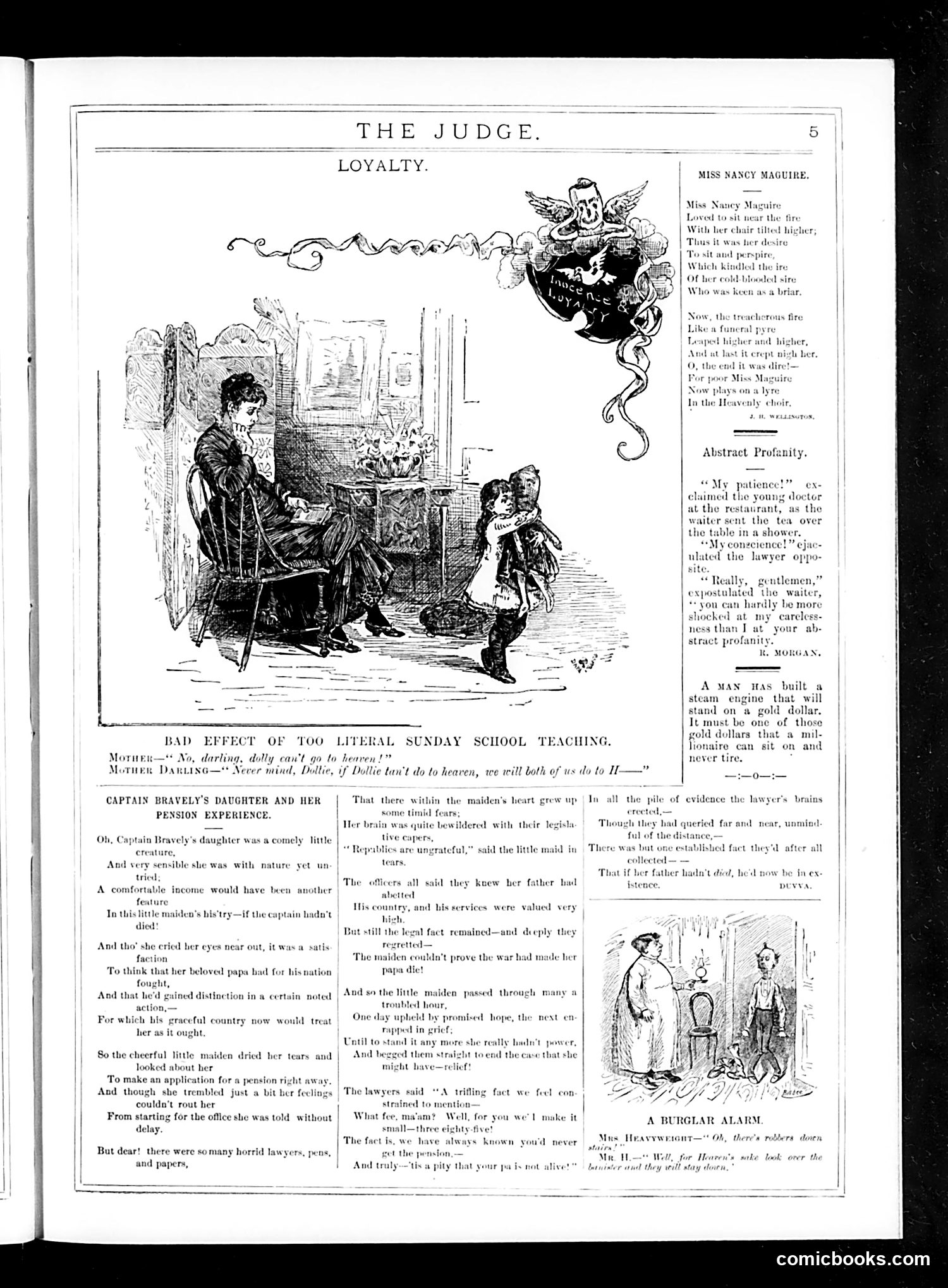
This page contains multiple satirical pieces typical of 19th-century American humor: **"Bad Effect of Too Literal Sunday School Teaching"** mocks rigid religious instruction through a dialogue where a mother tells her daughter she cannot go to heaven, so "we will both of us do to H—" (Hell). The satire criticizes overly stern moral teaching that produces absurd conclusions. **"Captain Bravely's Daughter and Her Pension Experience"** is a longer narrative poem about a military officer's orphaned daughter seeking a pension. The satire targets bureaucratic incompetence: despite her father's military service and death, lawyers cannot locate documented proof, leaving her in poverty. It critiques both legal systems and government's failure to support military families. The page also includes brief comic items mocking abstract profanity, an inventor with impractical ambitions, and a domestic burglary scene. Overall, the content satirizes institutional failures—religious dogmatism, legal incompetence, and government negligence—through domestic scenarios designed to seem absurd.
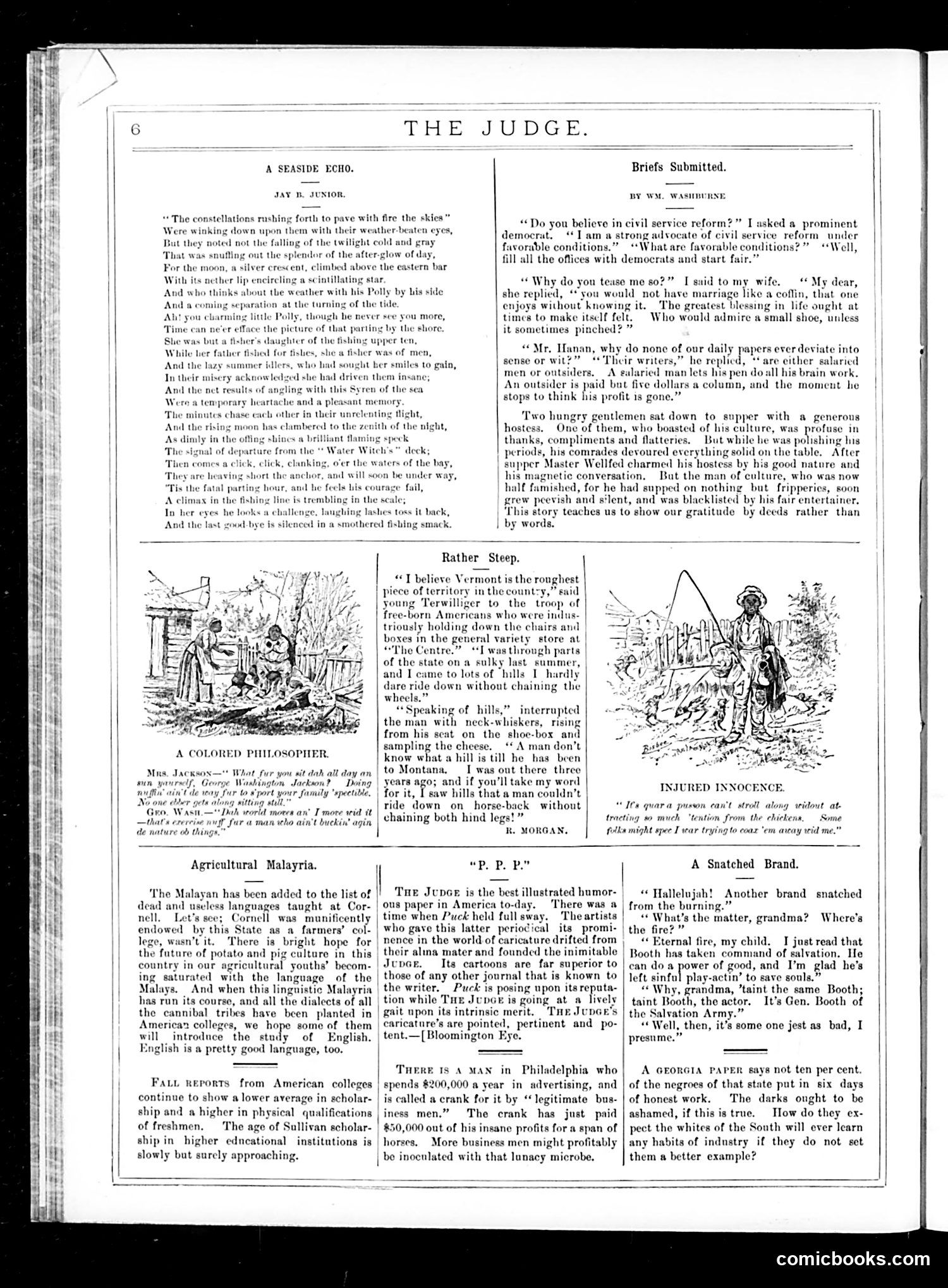
This page contains several satirical pieces typical of late 19th-century American humor journalism: **"Briefs Submitted"** mocks civil service reform advocates. A politician claims to support reform but admits he'd simply "fill all the offices with democrats and start fair"—exposing the hypocrisy that reformers just wanted their own party in power rather than genuine merit-based hiring. **"Rather Steep"** is a tall-tale competition where a young man brags about Vermont's dangerous hills, then a neck-whiskered character one-ups him with an implausible Montana story about hills so steep a man needed to chain his horse's *hind legs*. It's gentle frontier humor about exaggeration. **"A Colored Philosopher"** (illustration, lower left) appears to use dialect humor—common period entertainment, though by modern standards the racial caricature would be offensive. Other pieces include poetry, brief anecdotes about salaried vs. freelance writers, and social commentary on etiquette and behavior. The page emphasizes *Judge's* mix of political satire, social observation, and comic absurdism.
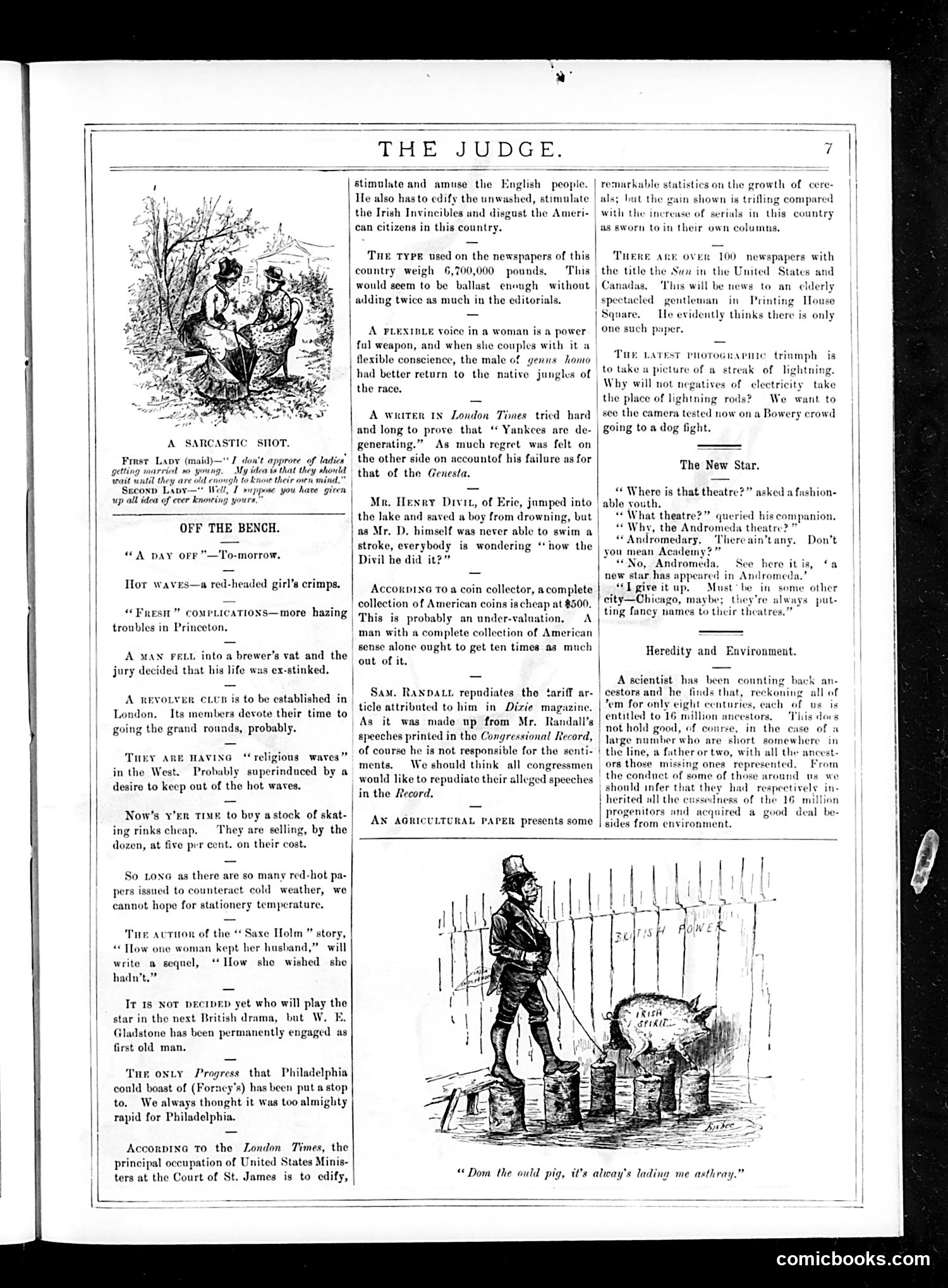
This page from Judge magazine contains brief satirical observations ("Off the Bench" column) rather than single large cartoons. The humor targets contemporary figures and social issues: **Key references:** - **Gladstone**: William Ewart Gladstone, British Prime Minister, mocked as being permanently cast as "first old man" in drama - **Forney's Progress in Philadelphia**: Refers to John W. Forney's newspaper, criticized as too rapid/radical - **Henry Divil of Erie**: Likely a pun on the name "Devil," joking about a man who saved a drowning boy despite not knowing how to swim - **Sam Randall's tariff article**: Samuel J. Randall, congressman, denies writing an article by claiming he's not responsible for his own Congressional Record speeches—satirizing politicians' evasiveness **Social satire includes**: women's education, revolver clubs in London, American decline ("Yankees degenerating"), and the proliferation of serialized stories in newspapers. The bottom cartoon shows a figure struggling against wind near Irish Street, likely commentary on Irish political turmoil of the era.
This Judge magazine cartoon satirizes control of American government. The image depicts a woman labeled "Marie Roget" (or similar) holding the actual steering wheel of state, while two men—apparently political leaders—sit passively above, unable to influence direction. The woman represents either a specific political figure's wife or, more broadly, female influence behind-the-scenes in politics. The satire critiques the notion that elected officials are puppets controlled by hidden powers—whether that's a spouse, special interests, or political machinery. The ornate ship's wheel and formal interior suggest the "ship of state" metaphor, emphasizing the gravity of this perceived loss of democratic control. Without clearer OCR text or date information, the specific political figures remain unclear, but the cartoon targets anxieties about who *actually* governs America.
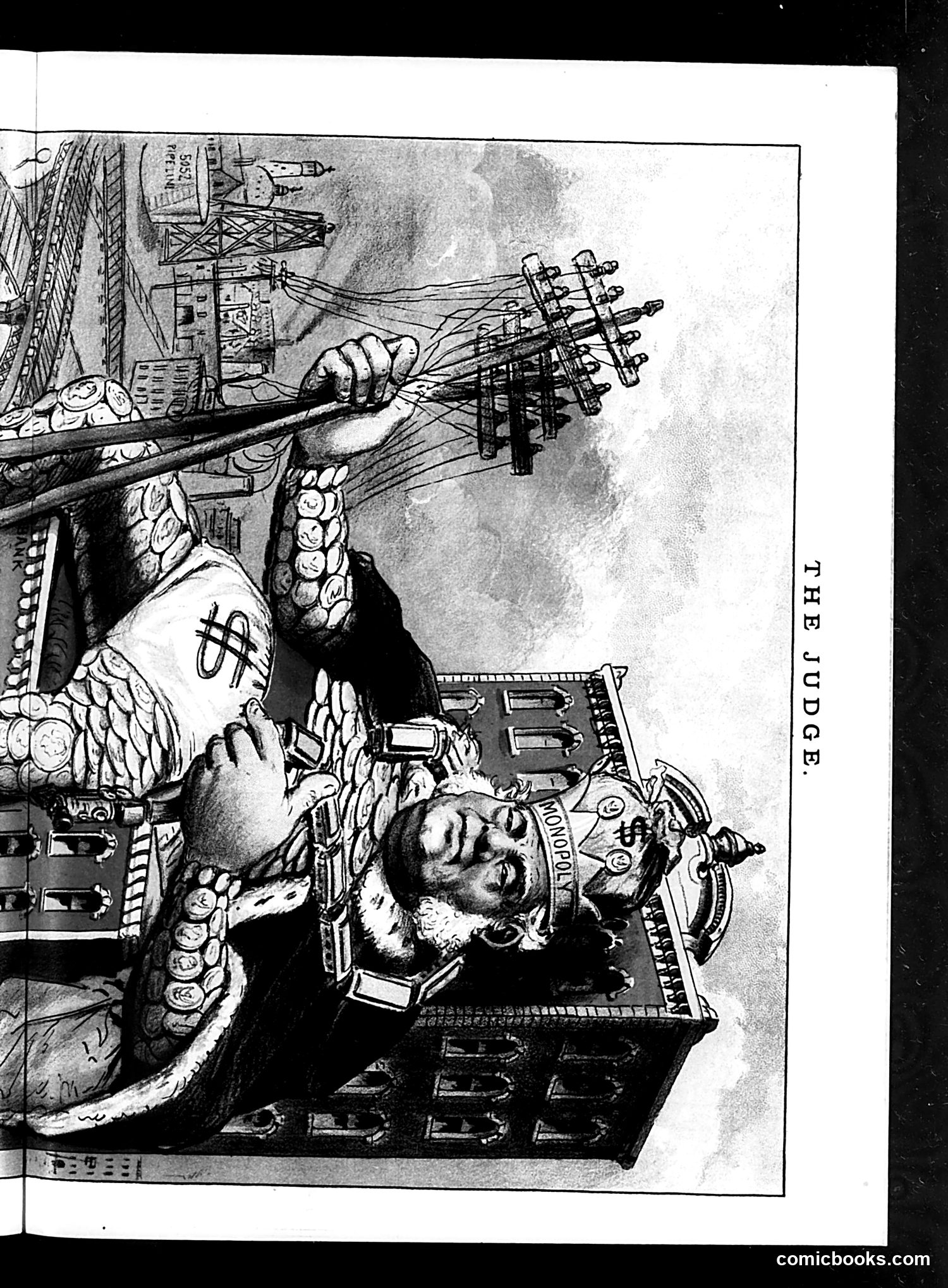
This page shows a political cartoon titled "THE JUDGE" (visible on the right margin). The image depicts a large, rotund judicial figure seated on an elevated throne or bench, wielding what appears to be a gavel or mallet against power lines or utility poles. The figure wears ornate robes decorated with circular medallions and holds the implements of justice. The cartoon likely satirizes judicial power over utility companies or monopolies—common targets of Gilded Age satire. The heavy, authoritative judge figure suggests both the weight of legal authority and, possibly, corruption or self-importance. Without clearer text identifying specific figures or dates, the precise target remains unclear, though it appears critical of either judicial overreach or inadequate regulation of major industries.
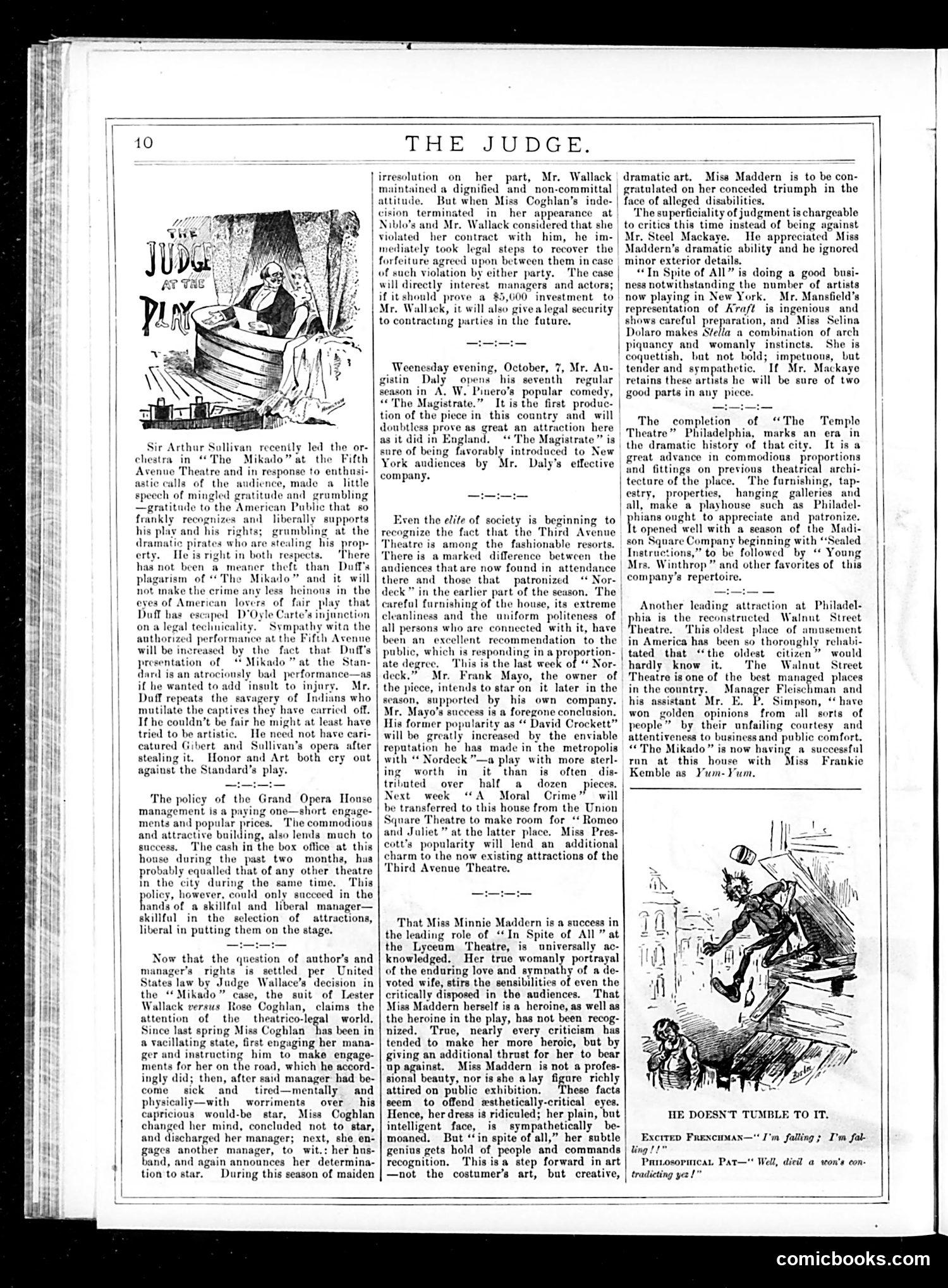
This page contains theatrical criticism and legal commentary rather than political cartoons. The main illustrated element is a small sketch labeled "HE DOESN'T TUMBLE TO IT" showing someone falling, accompanying two brief comic quips. The substantive content discusses a copyright lawsuit: Judge Wallace's decision in the "Mikado" case, establishing that playwright/composer rights supersede manager theft. The text praises this legal precedent while criticizing Mr. Duff's "atrociously bad" unauthorized production of Sullivan's opera at the Standard Theatre. The page also covers theatrical business and social notes—the Grand Opera House's successful policy of short engagements at popular prices, Austin Daly's opening of "The Magistrate," and notably, an actress named Rose Coghlan's contract dispute with Lester Wallack. Her repeated vacillation about starring (engaging managers, then firing them, then re-engaging her husband) is satirized as capricious behavior undermining theatrical stability. The satire targets artistic theft and unprofessional conduct by performers—not political issues.
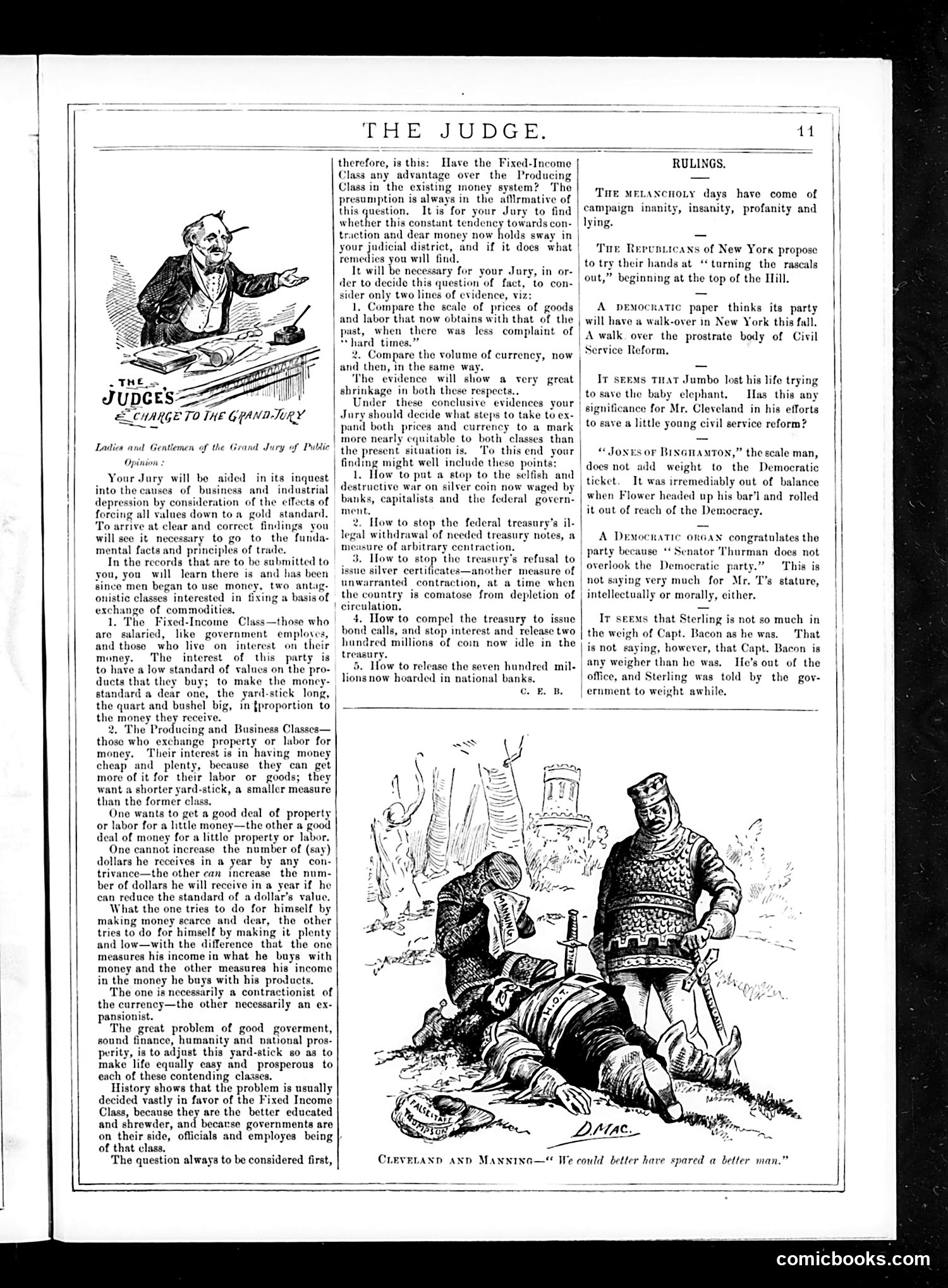
This page presents a lengthy editorial argument about monetary policy, illustrated by two cartoons. **Main Text ("The Judges' Charge to the Grand Jury"):** The piece argues that economic depression stems from a conflict between two classes: the "Fixed-Income Class" (salaried workers, government employees, those living on interest) who benefit from scarce, valuable money, and the "Producing and Business Classes" (laborers, manufacturers) who need plentiful, cheap money. The author contends the Fixed-Income Class unfairly dominates policy through government connections. **Bottom Cartoon ("Cleveland and Manning"):** Depicts two figures amid destruction, captioned "We would better have spared a letter man." This likely criticizes President Cleveland's administration (Manning was his Treasury Secretary), suggesting their monetary policies caused economic damage worse than losing a soldier. **Context:** This reflects 1890s "free silver" debates—expansionists blamed the gold standard and sound-money advocates for depression, while the latter saw currency expansion as inflationary recklessness.
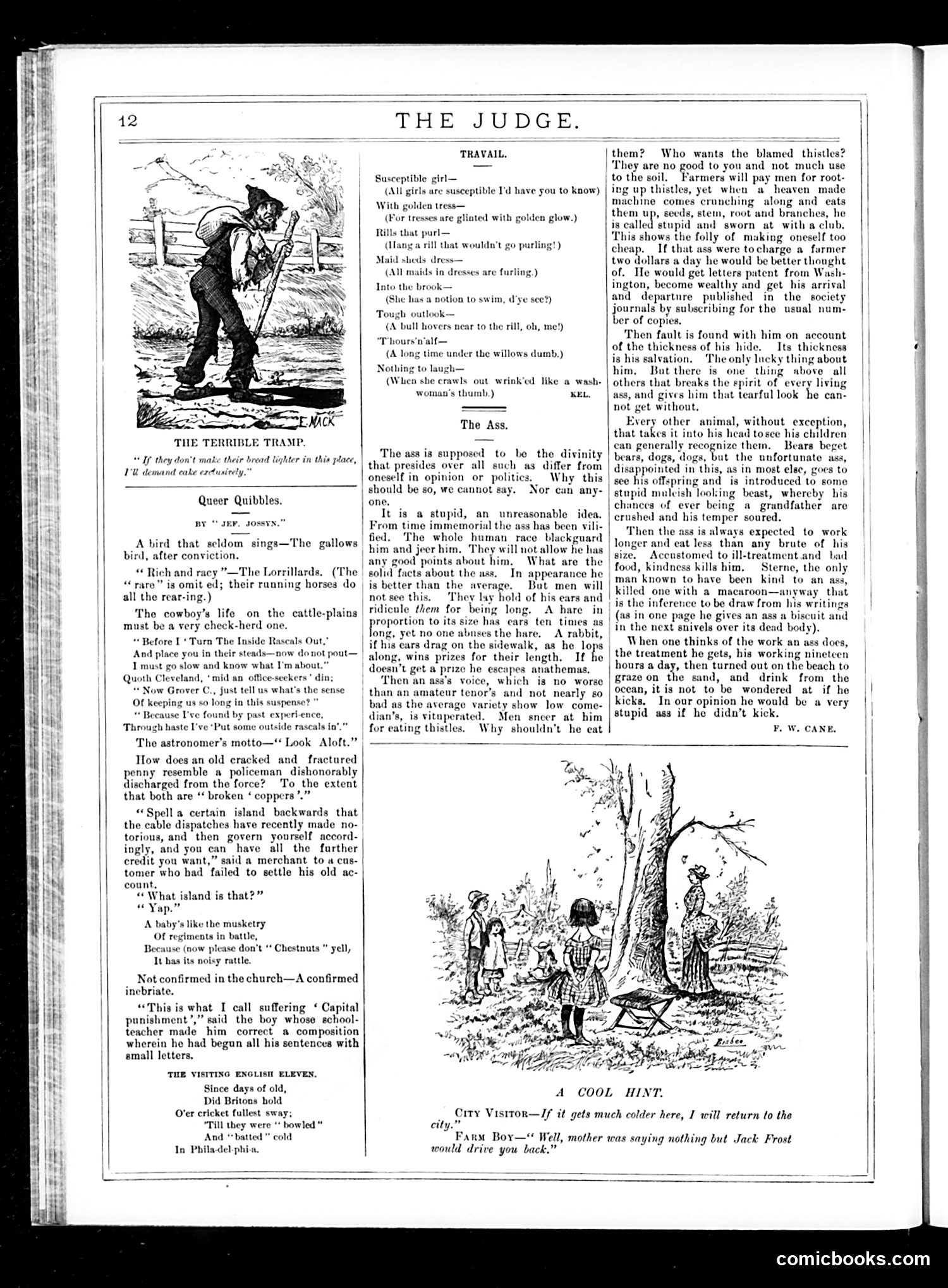
This page contains multiple humor pieces typical of *Judge* magazine's satirical style. The main essay, "The Ass," defends donkeys against human prejudice and mockery. The author argues that society unfairly ridicules the animal—criticizing its ears, voice, and diet of thistles—while praising identical traits in other creatures like rabbits and hares. The satire's real target appears to be **human hypocrisy and class prejudice**. The essay climaxes with the observation that the ass would be "better thought of" if it charged farmers for labor rather than working cheaply. This likely critiques how society devalues those of humble station regardless of actual merit or usefulness. The surrounding "Queer Quibbles" are wordplay jokes and puns. The page also includes illustrations of rural/working-class scenes, consistent with *Judge*'s mix of social commentary and light humor aimed at educated middle-class readers.
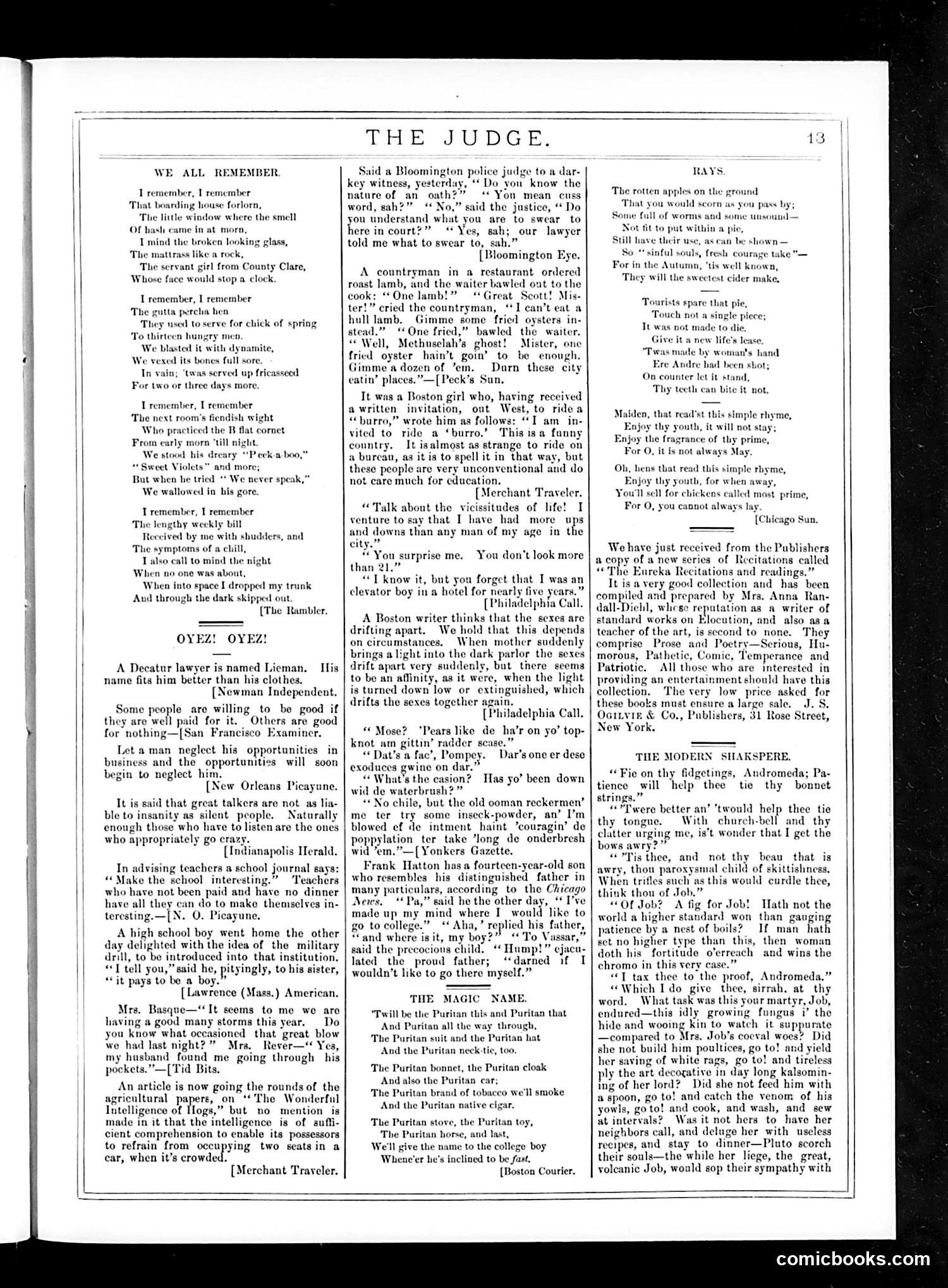
This page from **Judge** magazine (an American satirical publication) contains primarily **humorous anecdotes and short jokes** rather than political cartoons. The content reflects late 19th/early 20th-century American humor targeting: - **Working-class boarding houses** ("We All Remember"—satirizing cheap, poorly-maintained accommodations with terrible food) - **Class differences** (the Boston girl's pretentiousness about riding a "burro"; city vs. rural stereotypes) - **Gender and marital dynamics** (a wife finding her husband's money in his pockets) - **Legal/courtroom absurdities** (a Black witness in the South giving responses shaped by his lawyer) - **Small-town character types** (a naive countryman unfamiliar with city restaurants) The jokes rely on dialect humor, malapropisms, and situational comedy typical of the era. The "Oyez" section contains brief witticisms about lawyers, business, and social behavior. **There are no identifiable political figures or cartoons visible**—this appears to be a humor/editorial page rather than a satirical cartoon page.
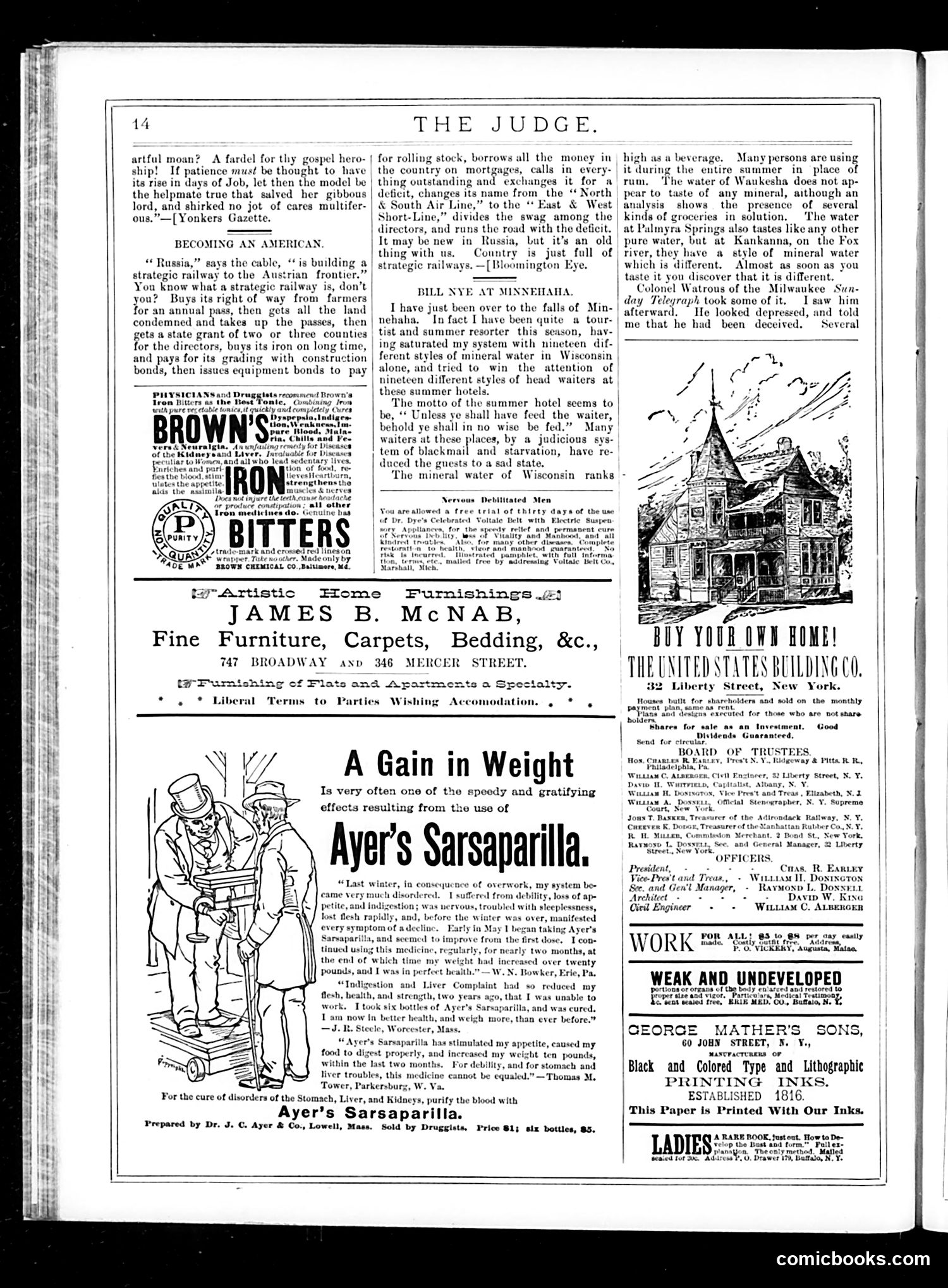
This page primarily contains **political-economic satire and travel journalism**, rather than traditional cartoons. **"Becoming an American"** satirizes railroad financing fraud. It explains how new rail companies—supposedly building "strategic railways"—exploit farmers by acquiring right-of-way cheaply, then use condemnation laws and government land grants to enrich directors while avoiding construction costs through deficit spending. The piece presents this as quintessentially American corruption, humorously suggesting Russia is now copying these schemes. **"Bill Nye at Minnehaha"** is humor columnist Bill Nye's account of visiting Minnesota falls and Wisconsin resorts. He jokes about mineral water's dubious health claims, head waiters using "blackmail and starvation" to extort tips from guests, and summer hotels' exploitative practices. Both pieces mock **late-19th-century American business practices**: fraudulent railroad schemes and tourist-trap resorts. The satire targets capitalist deception and labor exploitation presented as humorous examples of progress and American ingenuity. The remainder is **period advertising** (furniture, building companies, patent medicine), typical of magazine pages.
This page is primarily **advertisements** with one brief satirical anecdote titled "His Sight Was Failing." The joke mocks **medical quackery and professional deception**. A patient visits an expensive eye doctor repeatedly for operations. Though his actual vision worsens—he can no longer see his bank balance—the doctor insists he's improving markedly. The patient counters with practical evidence: his savings have vanished, so objectively something is wrong. The satire targets doctors who prioritize profit over results and gaslight patients into accepting false claims of progress. The patient's financial loss serves as undeniable proof of deterioration, cutting through the doctor's pseudo-scientific reassurances. The doctor's silence when confronted with this concrete evidence exposes the hollowness of his claims. This reflects late-19th-century skepticism toward medical professionals' trustworthiness and the prevalence of expensive, ineffective treatments marketed aggressively to vulnerable patients.
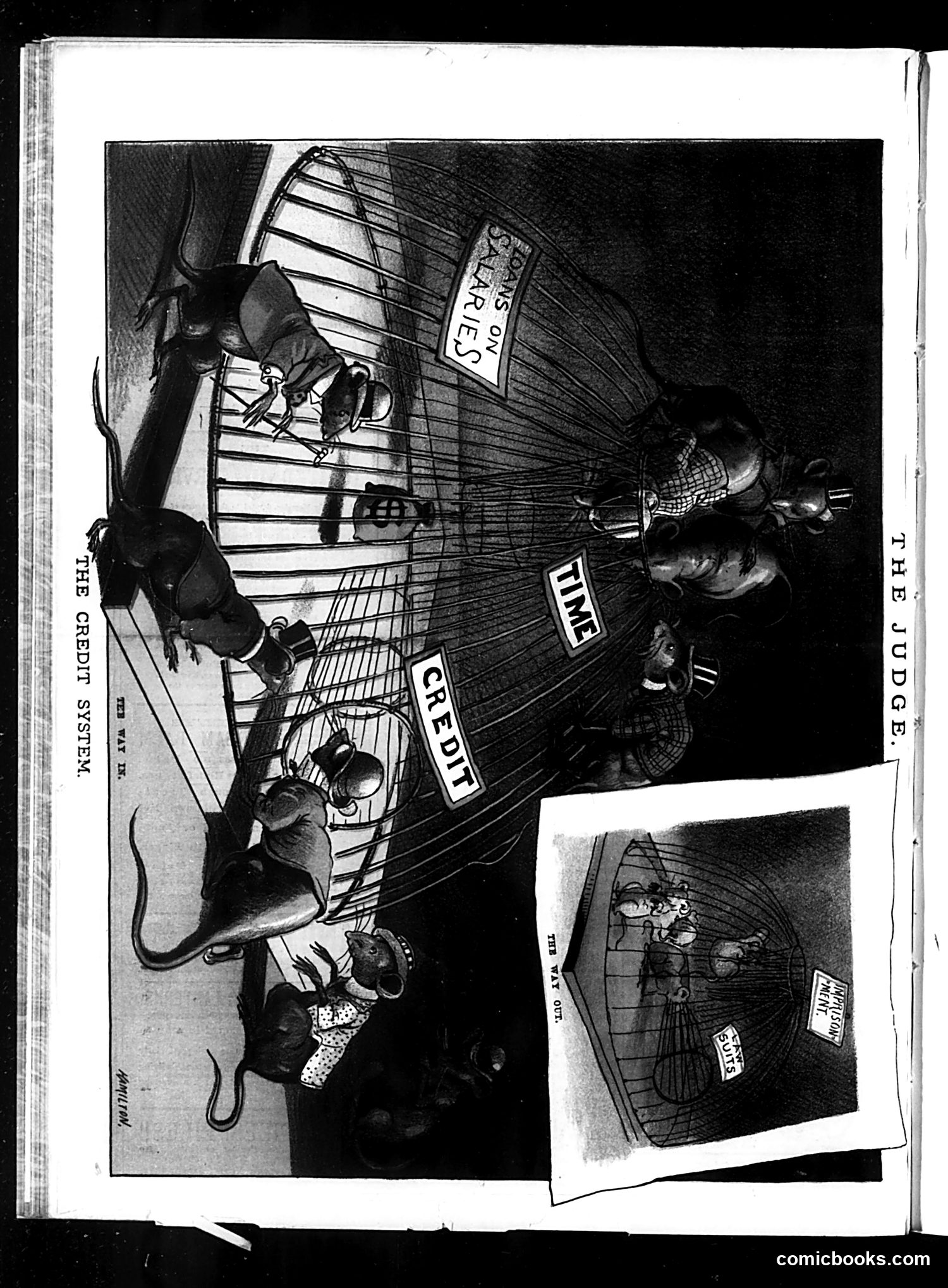
This page from *Judge* magazine contains two cartoon panels satirizing the American credit system. The main image, titled "The Credit System," depicts figures labeled "CREDIT" in what appears to be a cage or trap structure, with a mouse at the bottom. The smaller panel below is titled "The Judge" and shows a similar setup. The satire criticizes how credit operates as an inescapable mechanism—suggesting that credit, while seemingly useful, functions as a trap that ensnares users. The mouse imagery likely represents ordinary citizens or consumers caught within this system. This reflects early-to-mid 20th century concerns about consumer debt and the dangers of easy credit, particularly relevant during economic instability or after financial crises. The cartoons warn viewers about the illusory freedom credit promises versus its actual constraining effects.
I can see this is a page from *Judge* magazine, as indicated by the text "THE JUDGE" visible on the left margin. However, the page itself appears to be almost entirely blank—a white page with minimal visible content beyond the magazine's masthead/binding information. Without visible cartoon imagery, captions, or substantial text content to analyze, I cannot identify specific figures, political references, or satirical points. This appears to be either a blank page, a title page, or an advertising page from the magazine. To provide meaningful analysis of the satire and historical context, a page with actual cartoon artwork and readable text would be needed.