
Judge, 1885-10-10 · page 10 of 17
Judge — October 10, 1885 — page 10: what you’re looking at
What you’re looking at
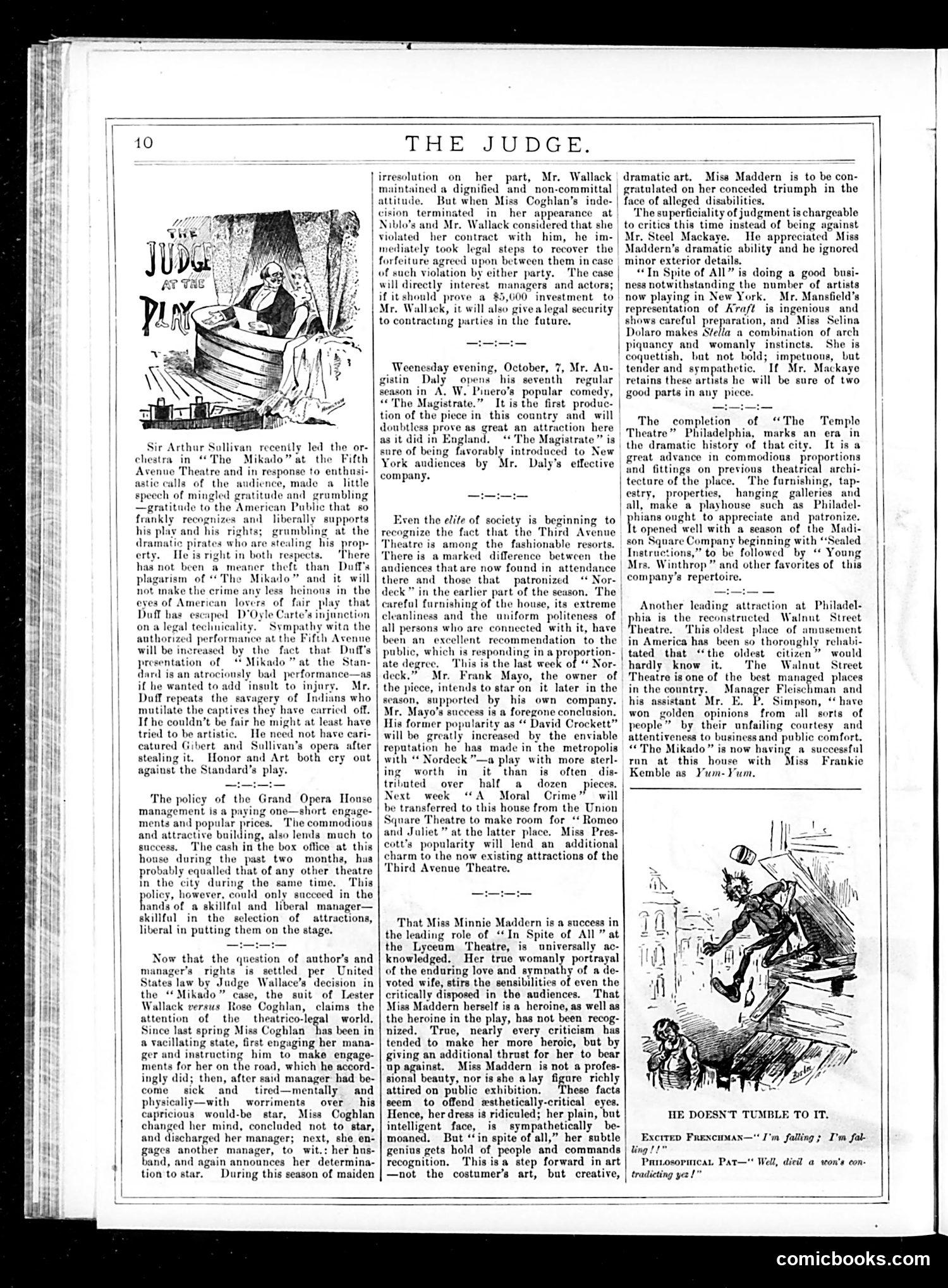
This page contains theatrical criticism and legal commentary rather than political cartoons. The main illustrated element is a small sketch labeled "HE DOESN'T TUMBLE TO IT" showing someone falling, accompanying two brief comic quips. The substantive content discusses a copyright lawsuit: Judge Wallace's decision in the "Mikado" case, establishing that playwright/composer rights supersede manager theft. The text praises this legal precedent while criticizing Mr. Duff's "atrociously bad" unauthorized production of Sullivan's opera at the Standard Theatre. The page also covers theatrical business and social notes—the Grand Opera House's successful policy of short engagements at popular prices, Austin Daly's opening of "The Magistrate," and notably, an actress named Rose Coghlan's contract dispute with Lester Wallack. Her repeated vacillation about starring (engaging managers, then firing them, then re-engaging her husband) is satirized as capricious behavior undermining theatrical stability. The satire targets artistic theft and unprofessional conduct by performers—not political issues.
📄 Transcribed text from this page (OCR, searchable)
Machine-transcribed from the original scan — historical spelling and the odd misread are preserved.
Sir Arthur Sullivan recently led the or- ain “The Mikado” at the Fifth Avenue Theatre and in response to enthu astic calls of the audience, made a little ch of mingled itude and grumbling atitude to th n Public that so frankly recogy liberally supports his play and his grumbling at the dramatic pirates who are stealing his prop- erty. He is right in both respects. ‘There has not been a meaner theft than Duff's plagarism of “The Mikado” and it will not mnake the crime any heinons in the eyes of American lovers of fair play that Duff bas escaped D'Oyle Carte’s injunction al technicality. Sympathy wita the atthe Fifth Avenue will be increased by the fact that Duff's presentation of |‘ Mikado at the Stan- dard is an atrociously bad perform if he wanted Duff repeats the mutilate the captives thi If he couldn’t be fair he might at least ha tried to be artis i i catured Gibert and Sullivan's opera stealing it. Honor and Art both cry against the Standard’s pla The policy of the Grand Opera Honse management is @ paying one—short engage- ments and popular prices. The commodious and attractive building, also lends much to success. The cash in the box office at this house during the past two montha, has probably equalled that of any other theatre in the city during the same time. This policy, however, could only succeed in the hands of a skillful and liberal manager— skillful in the selection of attractions, liberal in putting them on the stage. Now that the question of author’s and manager's rights is settled per United States law by Judge Wallace’s decision in the “Mikado” case, the suit of Lester Wallack versus Rose Coghlan, claims the attention of the theatrico-legal world. Since last spring Miss Coghlan has been in a vacillating state, first engaging her mana- ger and instructing him to make engage- ments for her on the road, which he accord- ingly did; then, after said manager had be- sick and tired—mentally and —with worriments over _ his capricious would-be star, Miss Coghlan changed her mind, concluded not to star, and discharged her manager; next, she en- gages another manager, to wit.: her hns- band, and again announces her determina- tion to star. During this season of maiden THE JUDGE. irresolution on her part, Mr, Wallack ned a dignified and’ non-committal attitude. But when Miss Coghlan’s inde- cision terminated in her appearance at Niblo’s and Mr. Wallack considered that she ed her contract with him, he im- mediately took legal steps to recover the forfeiture agreed upon between them incase of such violation by either party. The case will directly interest ers and actors; if it should prove a $5,000 investment to Mr. Wallack, it will also give a legal security to contracting parties in the future, Weenesday evening, October, 7, Mr. Au- istin Dal opens his seventh regular season in A, W. Pinero’s popular come “The Magistrate.” It is the first produc tion of the piece in this country and will doubtless prove as great an attraction here as it did in England. “The Magistrate” is sure of being favorably introduced to New York audiences by Mr. Daly’s etfective company. Even the elife of society is beginning to recognize the fact that the Third Avenue Theatre is among the fashionable resorts. ‘There is a marked difference between the andiences that are now found in attendance there and those that patronized ‘* Nor- deck” in the earlier part of the season. The careful furnishing of the house, its extreme cleanliness and the uniform politeness of all persons who are connected with it, have been an excellent recommendation to the public, which is responding in a proportion- ate degree. This ia the last week of ‘ Nor- | deck Mr. Frank Mayo, the owner of the picce, intends to star on it later in the season, supported by his own company. Mr. Mayo’s success is a foregone conclusion. His former popularity as “ David Crockett” will be greatly increased by the enviable ude in the metropolis play with more sterl- it than is often dis- tributed over half a dozen piec Next week ‘A Moral Crime” be transferred to this house from the Union Square Theatre to make room for ‘* Romeo and Juliet” at the latter place. Miss Pres- cott’s popularity will lend an additional charm to the now existing attractions of the Third Avenue Theatre. ing worth in That Miss Minnie Maddern is a success in the leading role of ‘In Spite of All” the Lyceum Theatre, is universally = knowledged. Her true womanly portrayal of the enduring love and sympathy of a de- voted wife, stirs the sensibilities of even the critically disposed in the audiences. That Miss Maddern herself is a heroine, as well as the heroine in the play, has not been recog- nized. True, nearly every criticism has tended to make her more heroic, but by giving an additional thrust for her to bear up against. Miss Maddern is not a profes- sional beauty, nor is she alay figare richly attired on public exhi hese facts seem to offend wsthetically-critical eyes. Hence, her dress is ridiculed; her plain, but intelligent face, is sympathetically be- moaned. But ‘in spite of all,” her Tubtle genius gets hold of people and commands recognition. This isa step forward in art —not the costumer’s art, but creative, dramatic art. Misa Maddern is to be con- gratulated on her conceded triumph in the face of alleged disabilities, ‘Tho superficiality of judgment is chargeable to critics this time instead of being against Mr. Ste k He appreciated Miss Maddern’s dramatic ability and he ignored minor exterior details, | In Spite of All” is doing a good busi- ness notwithstanding the number of artists now playing in New York. Mr. Mansfield’s representation of A’raft is ingenious and shows careful preparation, and Miss Selina | Dolaro makes S/el/a a combination of arch | piquancy and womanly instincts. She is coquettish, but not bold; impetuous, but tender and sympathetic. If Mr. Mackaye retains these artists he will be sure of two good parts in any piece. of The completion “The Temple Theatre” Philadelph marks an era in the dramatic history of that city. It is a great advance in commodious proportions und fittings on previous theatrical archi- | tecture of the place. The furnishing, tap- | estry, properties, hanging galleries and all, make a playhouse such as Philadel- pos ought to appreciate and patronize. t opened well with a season of the Madi- son Square Ci ‘ompany beginning with ‘Sealed Instructions,” to be followed by ‘ Young Mra, Winthrop” and other favorites of this company’s repertoire. Another leading attraction at Philadel- hia is the reconstructed Walnut Street Theatre. This oldest place of amusement in America has been so thoroughly rehabi- | tated that “the oldest citizen” would hardly know it. The Walnut Street Theatre is one of the best m ed places in the country. er Fleischman and his assistant Mr. E. P. Simpson, “ have won golden opinions from all sorts of people” by their unfailing courtesy and attentiveness to business and public comfort. “The Mikado” is now having a successful ron at this house with Miss Frankie Kemble as Yum- Yum. es. | will | HE DOESN'T TUMBLE TO IT. Excrrep FReNcuMAN: PrivosormicaL Pat—"* Well, | tradicting yea! I'm falling ; I’m fat- dicil a won's con- comicbooks.com