
Judge, 1885-10-10 · page 4 of 17
Judge — October 10, 1885 — page 4: what you’re looking at
What you’re looking at
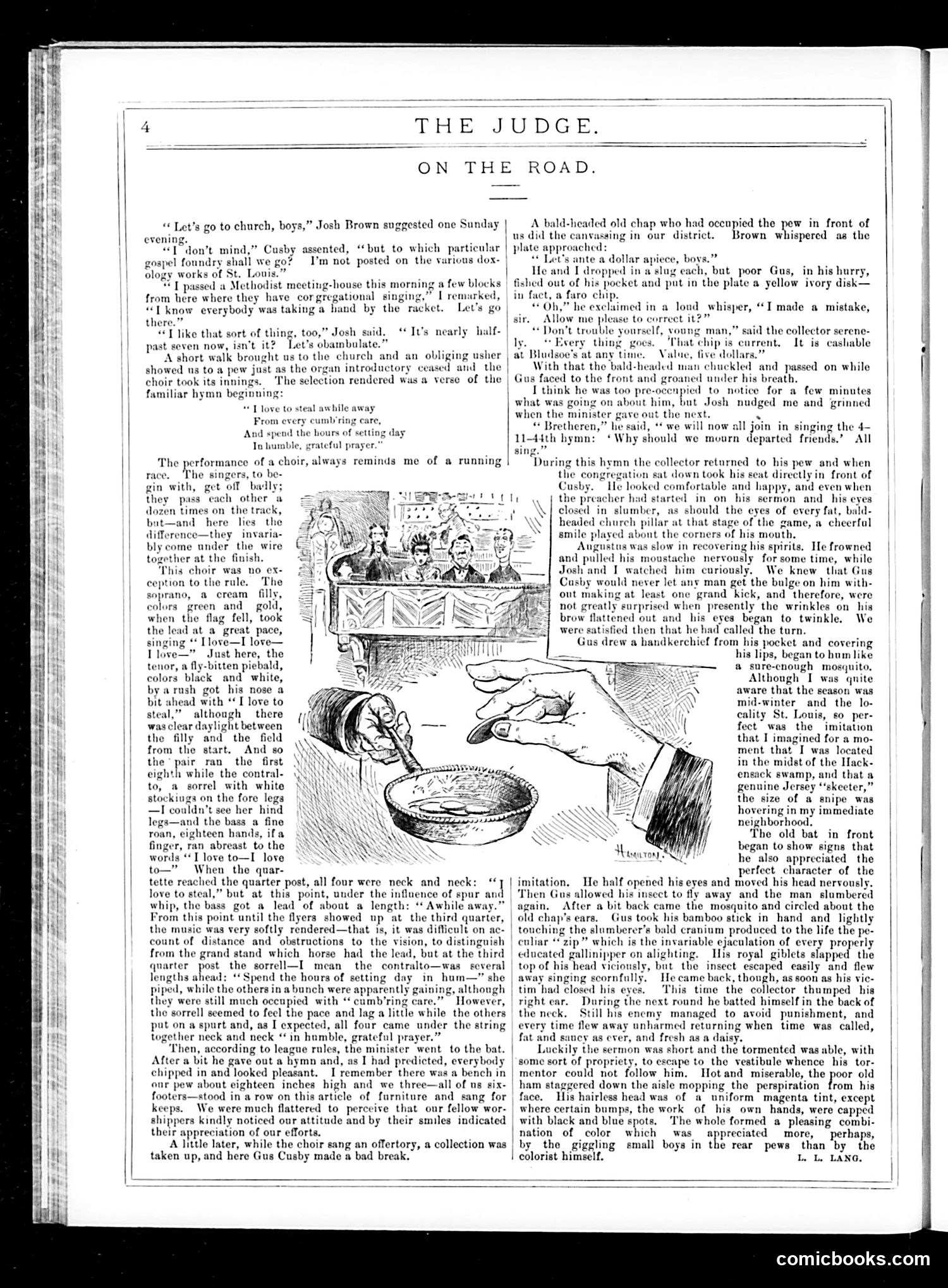
This is a humorous narrative about three men attending a Methodist church service in St. Louis. The satire operates on two levels: **The Choir as a Horse Race:** The author compares the choir's singing performance to a horse race, with each vocalist (soprano, tenor, contralto, bass) depicted as different racing horses competing through hymn verses. This absurdist comparison mocks both competitive church performances and the melodramatic delivery of 19th-century congregational singing. **The Collection Plate Joke:** The punchline involves Gus Cusby mistakenly dropping a "yellow ivory disk" (a poker chip or gambling chip) into the collection plate instead of money—suggesting he's more familiar with gambling than church. This satirizes either Cusby's character or, more broadly, the hypocrisy of churchgoers with questionable moral habits. The piece gently ridicules church culture, theatrical choir performances, and the pretense of piety among congregants.
📄 Transcribed text from this page (OCR, searchable)
Machine-transcribed from the original scan — historical spelling and the odd misread are preserved.
Es ey. i THE J ON THE UDGE. ROAD. « Let’s go to church, boys,” Josh Brown suggested one Sunday | evening. ; | «1 don’t mind,” Cusby assented, “but to which particular | el foundry shall we go? I’m not posted on the vurions dox- olo 'y works of St. Louis.” | a Methodist meeting-house this morning a few blocks from here where they have cor gregational singing,” I remarked, “Lknow everybody was taking a hand by the racket. Let's go there. I like that sort of thing, too,” Josh suid, past seven now, isn’t it? TLet’s obambulate.” A short walk brought us to the church and an obliging usher j showed us to a pew just as the organ introductory ceased and the | choir took its innings. ‘The selection rendered was a verse of the familiar hymn beginning: “ Tlove to From every cumb'ring And spend the hours of settin, In humble, grateful prayer.” The performance of a choir, always reminds me The singers, to be- get ‘oft b: Aly half. | “Tvs nearly al awhile away care, day of a running | r gin with, they pass each other a dozen times on the track, but—and here lies tl difference—they invari bly come under the wire together at the finish. his choir was no ex- ption to the rule. The soprano, a cream filly, colors green and gold, when the flag fell, took the lead @ great pace, singing “ [love—I love— I love—” Just here, the tenor, a fly-bitten pie colors black and white, by arush got his nose a ad with “I love to .” although there as clear daylight between the filly and the field from the start. And so the pair ran the first eighth while the contral- to, a sorrel with white stockings on the fore legs —I couldn’t see her hind legs—and the bass a fine roan, eighteen hands, ifa finger, ran abreast to the words “I love to—I love to—” When the quar- tette reached the quarter post, all four were neck and neck: | love to steal,” but at this point, under the influence of spur an p, the bass got a lead of about a length: * Awhile away From this point until the flyers sho: up at the third quarter, the music was very softly rendered—that is, it was difficult on count of distance and ‘obstructions to the vision, to distinguish from the grand stand which ho had the le but at the third quarter feet the sorrell—I mean the contralto—was several lengths ahead: ‘Spend the hours of setting day in hum—” she piped, while the others in a bunch were apparently gaining, although they were still much occupied with “cumb’ring care.” Howe: the sorrell seemed to feel the pace and lag a little while the others put on a spurt and, as I expected, all four came unde’ r the string together neck and neck ‘in humble, grateful pr ‘Then, according to league rules, the minister went to the bat. | After a bit he gave out a hymn and, as I had predicted, everyboc chipped in and looked pleasant. I remember there was a bench in our pew about eighteen inches high and we three—all of us six- footer tood in a row on this article of furniture and sang for kee We were much flattered to perceive that our fellow wor- shippers kindly noticed our attitude and by their smiles indicated their appreciation of our efforts. A little later, while the choir sang an offertory, a collection was taken up, and here Gus Cusby made a bad break. A bald-headed old chap who had occupied the pew in front of us did the canvassing in our district. Brown whispered as the plate ppronetied te a dollar apiece, boy He and I dropped in 4 ch, but poor Gus, in his hurry, fished out of his pocket and put in the plate a yellow ivory disk— in fact, a faro chip. Ob,” he exeluimed in a loud whisper, “I made a mistake, Allow me please to correct it?” Don’t trouble yourself, vour ’ 4 Ee thing ge aibak hip is current. at Bludgoe’s ‘at any time. Value, five dollars.” With that the bald-headed man sha led and passed on while Gus faced to the front and groaned under his breath, I think he was too pre-ocenpicd to notice for a few minutes what was going on about him, but Josh nudged me and grinned when the minister gave out the next. “ Bretheren,” he said, * we will now all join in. singing the 4 144th hymn: ‘Why should we mourn departed friends.’ All sin It is cashable During this hymn the collector returned to his pew and when the congregation sat down took his seat directly in front of Cusb: oked comfortable and happy, and even when \ j the y din on his sermon and_ his eyes \.| closed in slumber, as should the eyes of every fat, buld- headed church pillar at that stage of the game, a cheerfal smile played about the corners of his mouth, Augustus was slow in recovering his spirits. Ie frowned and pulled his moustache nervously for some time, while Josh and I watched him curiously, We knew that Gus Cusby would never let any man get the bulge on him with- out making at least one grand kick, and therefore, were not greatly surprised when presently the wrinkles on his brow flattened out and his eyes began to twinkle. We atisfied then that he had called the turn. Gus drew a handkerchief from his pocket and covering his lips, began to hum like @ sure-cnough mosquito, Although I was quite aware that the season was mid-winter and the lo- cality St. Louis, so per- fect was the imitation that I imagined for a mo- ment that I was located in the midst of the Hack- engack swamp, and that a genuine Jersey “skeeter,” the size of a snipe was hovering in my immediate neighborhood. The old bat in front began to show signs that he also appreciated the perfect character of the | imitation, He half opened his eyes and moved his head nervously. Then Gus allowed his insect to fly away and the man slumbered again. After a bit back came the mosquito and circled about the old chap’s ears. Gus took his nboo stick in hand and lightly tauching the slumberer’s bald cranium produced to the life the pe- culiar “zip” which is the invariable ejaculation of every properly educated gallinipper on alighting. His royal giblets slapped the top of his head viciously, but the insect escaped easily and flew away singing scornfully. He came back, though, as soon as his vie- tim had closed his e: This time the collector thumped his right ear. During the next round he batted himself in the back of the neck. Still his enemy managed to avoid punishment, and every time flew away unharmed returning when time was called, fat and saucy as ever, and fresh as a dai Luckily the sermon was short and the tormented was able, with some sort of propriety, to escape to the vestibule whence his tor- mentor could not follow him, Hotand miserable, the poor old ham staggered down the aisle mopping the perspiration from his face. His hairless head was of a uniform magenta tint, except where certain bumps, the work of his own hands, were capped with black and blue spots. ‘The whole formed a pleasing combi- nation of color which was appreciated more, perhaps, by the giggling small boys in the rear pews than by the | colorist himself. L, L, LANG, — comicbooks.com