
Judge, 1885-10-10 · page 11 of 17
Judge — October 10, 1885 — page 11: what you’re looking at
What you’re looking at
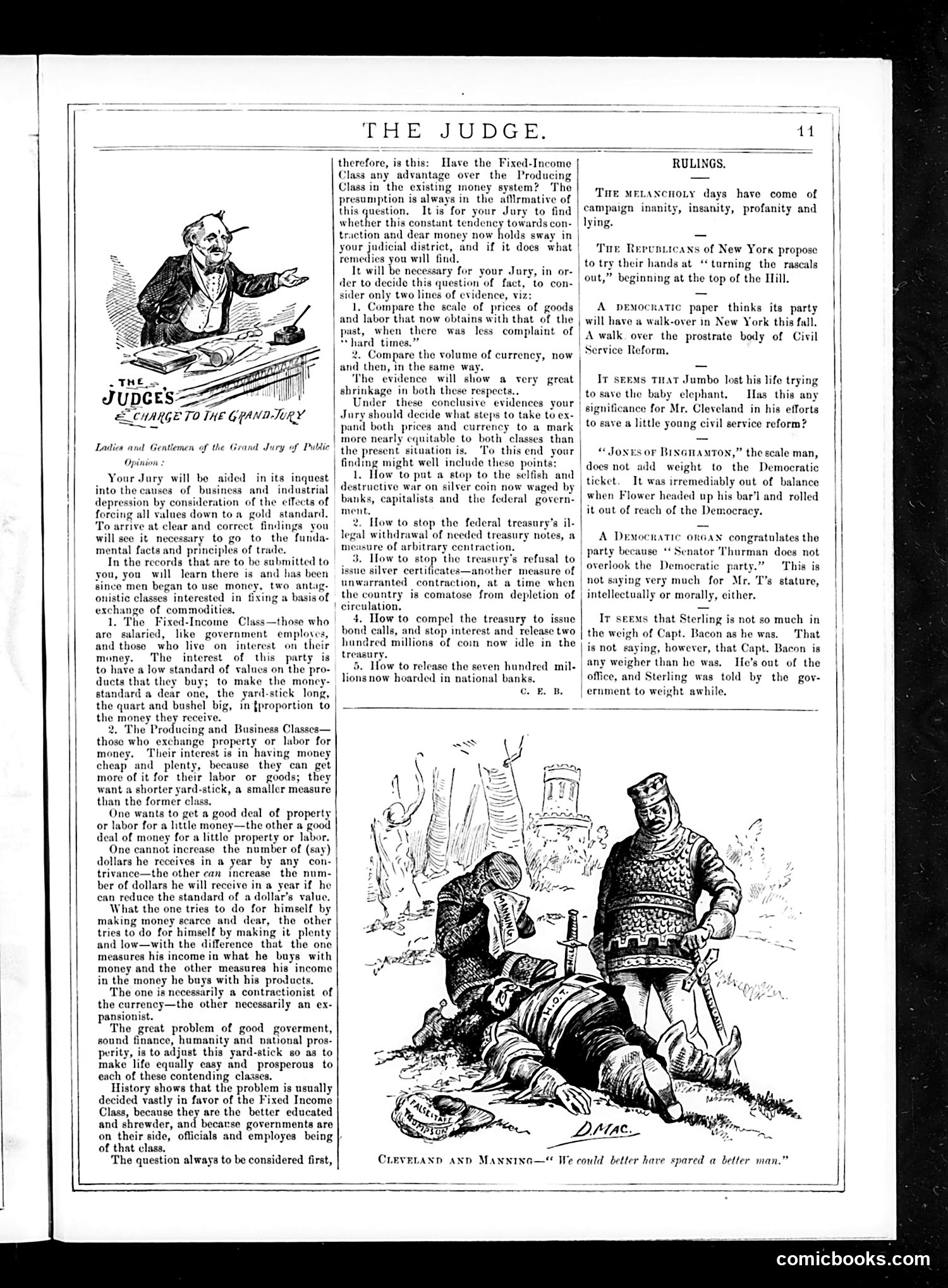
This page presents a lengthy editorial argument about monetary policy, illustrated by two cartoons. **Main Text ("The Judges' Charge to the Grand Jury"):** The piece argues that economic depression stems from a conflict between two classes: the "Fixed-Income Class" (salaried workers, government employees, those living on interest) who benefit from scarce, valuable money, and the "Producing and Business Classes" (laborers, manufacturers) who need plentiful, cheap money. The author contends the Fixed-Income Class unfairly dominates policy through government connections. **Bottom Cartoon ("Cleveland and Manning"):** Depicts two figures amid destruction, captioned "We would better have spared a letter man." This likely criticizes President Cleveland's administration (Manning was his Treasury Secretary), suggesting their monetary policies caused economic damage worse than losing a soldier. **Context:** This reflects 1890s "free silver" debates—expansionists blamed the gold standard and sound-money advocates for depression, while the latter saw currency expansion as inflationary recklessness.
📄 Transcribed text from this page (OCR, searchable)
Machine-transcribed from the original scan — historical spelling and the odd misread are preserved.
Ladies and Gentlemen of the Grand Jury of Public Opinion : Your Jury will be aided in its inquest into the causes of business and industrial depression by consideration of the effects of forcing all values down to a gold d. To arrive at clear and correct findings you will see it necessary to go to the funda- mental fa nd principles of trade. In the records that are to be submitted to you, you will learn there is and has been since men began to use money, two antag. onistic classes interested in fixing a basis of exchange of commodities. 1, The Fixed-Income Class—those who are salaried, like government emploves, and those who live on interest on their mone: The interest of this party is to have a low standard of values on the pro- ducts t y 'y; to make the mone standard a dear one, the yard-stick long, the quart and bushel big, in {proportion to the money they receive. 2. The Producing and Business Classes— those who exchange property or labor for money. Their interest is in having money cheap and plenty, because they can get more of it for their labor or goods; they want a shorter yard-stick, a smaller measure than the former class, One wants to get a good deal of property or labor for a little money—the other a good deal of money for a little property or labor. One cannot increase the number of (say) dollars he receives in a year by any con- trivance—the other can increase the num- ber of dollars he will receive in a year if he can reduce the standard of a dollar’s value. What the one tries to do for himself by making money scarce and dear, the other tries to do for himself by making it plenty and low—with the difference that the one measures his income in what he buys with money and the other measures his income in the money he buys with his products. The one is necessarily @ contractionist of the currency—the other necessarily an ex- pansionist. The great problem of good goverment, sound finance, humanity and national pros- perity, is to adjust this’ yard-stick so as to make life equally easy and prosperous to each of these contending classes. History shows that the problem is usually decided vastly in favor of the Fixed Income Class, because they are the better educated and shrewder, and becarse governments are on their side, officials and employes being of that class, The question always to be considered first, THE JUDGE. Have the Fixed-Income Class advan over the Producing Class in ‘the existing money system? ‘The presumption is always in the affirmative of this question, It is for your Jury to find whether this constant tendency towards con- traction and dear money now holds sway in your judicial district, and if it does what remedies you will find. It will be necess der to decide this question of fact,” to con- sider only two lines of evidence, viz: 1, Compare the scale of prices of goods and labor that now obtains with that of the past, when there was less complaint of ‘shard times.” Compare the volume of currency, now and then, in the same way. The evidence will show a very great shrinkage in both these respects. Under these Jury should decide what steps to take to ex- pand both prices and currency to a mark more nearly equitable to both classes than the present situation is. ‘To this end your finding might well include these points: 1, How to put a stop to the selfish and destructive war on silver coin now waged by banks, capitalists and the federal govern- ment, 2. How to stop the federal treasury’s il- legal withdrawal of needed treasury notes, a measure of arbitrary contraction. How to stop the treasury’s refusal to issue silver certificates—another measure of unwarranted contraction, at a time when the country is comatose from depletion of circulation. 4. Tow to compel the treasury to issue bond calls, and stop interest and release two hundred millions of coin now idle in the treasury . Ilow to release the seven hundred mil- lions now hoarded in national bank therefore, is this: ry for your Jury, in or- | conclusive evidences your | RULINGS. THE MELANCHOLY ¢ have come of | pampeign inanity, insanity, profanity and | lying. | a ‘Tue Rervnitcans of New Yor propose to try their hands at ‘turning the rascals out,” beginning at the top of the Hill. A peMocnatic paper thinks its party will have a walk-over in New York this fall. A walk over the prostrate body of Civil Service Reform, Ir seems THAT Jumbo lost his life trying to save the baby elephant, Tas this any significance for Mr. Cleveland in his efforts to save a little young civil service reform? «Jones or BiNGHaMToN,” the scale man, does not add weight to the Democratic ticket. It was irremediably out of balance when Flower headed up his bar'l and rolled it out of reach of the Democracy. A Democratic onGaAN congratulates the party because ‘Senator Thurman does not overlook the Democratic ty.” This is not saying very much for Mr, 'I’s stature, intellectually or morally, either. Ir seems that Sterling is not so much in the weigh of Capt. Bacon as he was. ‘That | is not saying, however, that Capt. Bacon is any weigher than he was. e's out of the office, and Sterling was told by the gov- ernment to weight awhile, comicbooks.com