
Judge, 1885-10-10 · page 2 of 17
Judge — October 10, 1885 — page 2: what you’re looking at
What you’re looking at
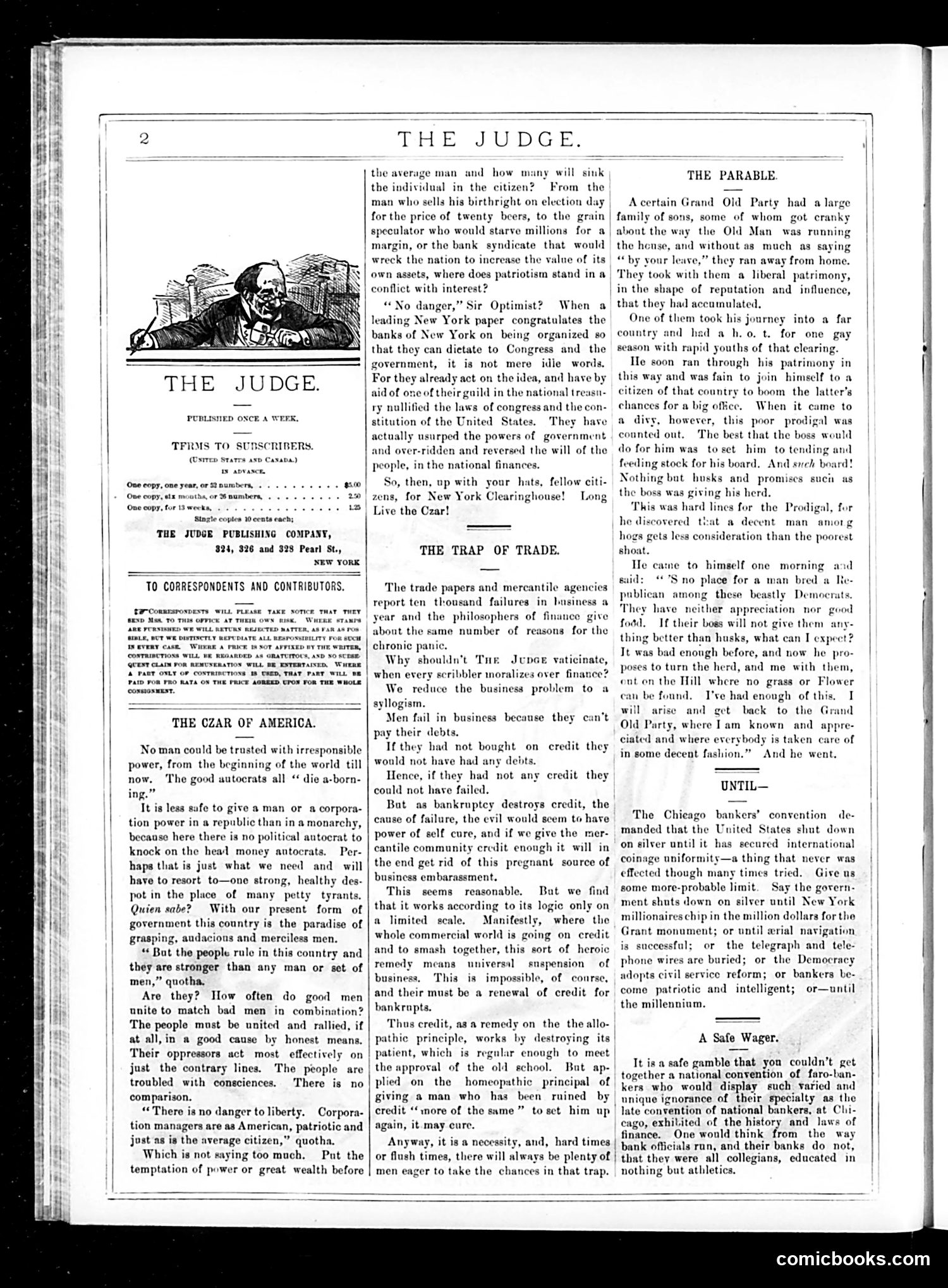
This page critiques the unchecked power of American financial institutions, particularly New York banks. The editorial argues that despite republican ideals of popular sovereignty, wealthy elites—especially bankers—function as an unaccountable "czar," wielding power comparable to absolute monarchy. The piece specifically references banks dictating to Congress and claims a Treasury official (likely Secretary of the Treasury) has nullified laws to serve banking interests. It sarcastically toasts the "New York Clearinghouse"—the actual banking consortium that coordinated responses to financial crises. The cartoon (showing a caricatured figure at a desk) appears to represent this concentrated financial power. The accompanying article "The Trap of Trade" analyzes business failures as resulting from credit systems, suggesting structural economic problems rather than individual failures. Overall, the page expresses progressive-era anxiety about plutocracy undermining democratic government.
📄 Transcribed text from this page (OCR, searchable)
Machine-transcribed from the original scan — historical spelling and the odd misread are preserved.
sted PEO aD ene = THE JUDGE. PURLISNED ONCE A WERK, TFRMS TO SUBSCRIBERS. (Usrrep Starrs axp Caxapay ty abvasce, Ove copy, one year, or 52 numbers, Ove copy, st mouths, or 8 numbers, One copy, for weeks, . . THE JUDGE PUBLISHING COMPANY, 824, 326 and $23 Pearl St., NEW YORK "TO CORRESPONDENTS AND CONTRIBUTORS. — SP-CoRRESPONDESTS WILL PLEASE TAKE NOTICE THAT THEY SEND Mat TO THUS OFFICK AT THEIL OWN WHERE sTaxr ARE YURSISNED WE WILL RETCRY REJECTED MATTER, A8 VAR 48 Foe AUMLE, 8CT WE DISTINCTLY REFUDIATE ALL RESPONSIBILITY FoR «UCM BWEVERY Case WHERE A PRICK [8 SOT AFFIXED HY THTE WRITER, CONTRIBCTIONS WILL HE REO: RATUITOUS, AND NO SESE quest cua 4A PART ONLY OF CONTRINCTIONS I CRED, THAT PART WILL BE PAID YOR FRO RATA ON THE PRICE AOREED UPON FOR TIE WHOLE conmoxaest. THE CZAR OF AMERICA. Noman could be trusted with irresponsible power, from the beginning of the world till now. The good autocrats all ‘ die a-born- ing.” It is less sufe to give a man or a corpora: tion power in a republic than in a monarchy, because here there is no political autocrat to knock on the heal money autocrats. Per- haps that is just what we need and will have to resort to—one strong, healthy des- potin the place of many petty tyrants, Quien sabe? With our present form of government this country is the paradise of grasping, audacions and merciless men. “But the people rule in this country and they are stronger than any man or set of men,” quotha, Are they? How often do good men unite to match bad men in combination? The people must be united and rallied, if at all, in a good cause by honest means, Their oppressors act most effectively on | just the contrary lines. The people are troubled with consciences. There is no comparison. “There is no danger to liberty. Corpora- tion managers are as American, patriotic and just as is the average citizen,” quotha, Which is not eaying too much. Put the temptation of power or great wealth before the average man and how many will: sink the individual in the citizen? rom the man who sells his birthright on election day for the price of twenty beers, to the grain speculator who would starve millions for a margin, or the bank syndicate that would wreck the nation to increase the value of its own assets, where does patriotism stand in a | conflict with interest? “No danger,” Sir Optimist? When o leading New York paper congratulates the banks of New York on being organized so that they can dietate to Congress and the government, it is not mere idle words. For they already act on the idea, and have by aid of one of their guild in the national treasu- ry nullified the laws of congress and the con- stitution of the United States. They hav actually usurped the powers of government. | and over-ridden and reversed the will of the people, in the national finances. So, then, up with your hats, fellow citi- zens, for New York Clearinghouse! Long Live the Czar! THE TRAP OF TRADE. ‘The trade papers and mercantile agencies report ten thousand failures in business a rand the philosophers of finance give about the same number of reasons for the chronic panic. Why shouldn't Tuk Jupce vaticinate, when every scribbler moralizes over finance? We reduce the business problem to a syllogism. Men fail in business because they can’t pay their debts. If they had not bought on credit they would not have had any debts. Hence, if they had not any credit they could not have failed. Bat as bankruptcy destroys credit, the cause of failure, the evil would scem to have power of self cure, and if we give the mer- cantile community credit enough it will in the end get rid of this pregnant source of business embarassment, This seems reasonable. But we find that it works according to its logic only on a limited scale. Manifestly, where the whole commercial world is going on credit and to smash together, this sort of heroic remedy means universal suspension of business, This is impossible, of course, and their must be a renewal of credit for bankrupts. Thus credit, as a remedy on the the allo- pathic principle, works by destroying its patient, which is regular enough to meet the approval of the old school. But ap- plied on the homeopathic principal of giving a man who has been ruined by credit ‘‘ nore of the same” to set him up again, it may cure. Anyway, it is a necessity, and, hard times or flush times, there will always be plenty of men eager to take the chances in that trap. PARABLE. Acertain Grand Old Party had a large | family of sons, some of whom got cranky about the way the Old Man was running the hense, and without as much as saying “by your leave,” they ran away from home. They took with them a liberal patrimony, in the shape of reputation and influence, that they had accumulate: One of them took his journey into a far country and hed a h.o. t. for one gay season with rapid youths of that clearing. He soon ran through his patrimony in this way and was fain to join himself to a citizen of that country to boom the latter's chances for a big off When it came to divy, however, this poor prodigal was counted out, The best that the boss would do for him was toset him to tending and feeding stock for his board. And sxeh board! Nothing but husks and promises suc as the boss was giving his herd. ‘This was hard lines for the Prodigal, for he discovered that a decent man amorg hogs gets less consideration than the poorest shoat. He caine to himself one morning and ‘Sno place for a man bred a Re- publican among these beastly Democrats. They have neither appreciation nor good fodd. If their boas will not give them any- thing better than husks, what can I expect? It was bad enough before, and now he pro- poses to turn the herd, and me with them, enten the Hill where no grass or Flower can be found, T've had enough of this. I will arise and get back to the Grand Old Party, where Lam known and appre- ciated and where everybody is taken care of in some decent fashion.” And he went. UNTIL— The Chieago bankers’ convention de- manded that the United States shut down on silver until it has secured international coinage uniformity—a thing that never was effected though many times tried. Give us some more-probable limit. Say the govern- ment shuts down on silver until New York millionaires chip in the million dollars for the Grant monument; or until wrial navigation is successful; or the telegraph and tele- phone wires are buried; or the Democracy adopts civil service reform; or bankers be- come patriotic and intelligent; or—until the millennium. A Safe Wager. It isa safe gamble that yon couldn’t get together a national convention of faro-ban- kers who would display such varied and unique ignorance of their specialty as the late convention of national bankers, at Chi- cago, exhilited of the history and laws of finance. One would think from the way bank officials ran, and their banks do not, that they were all collegians, educated in nothing but athletic comicbooks.com