
A complete issue · 16 pages · 1884
Judge — September 13, 1884
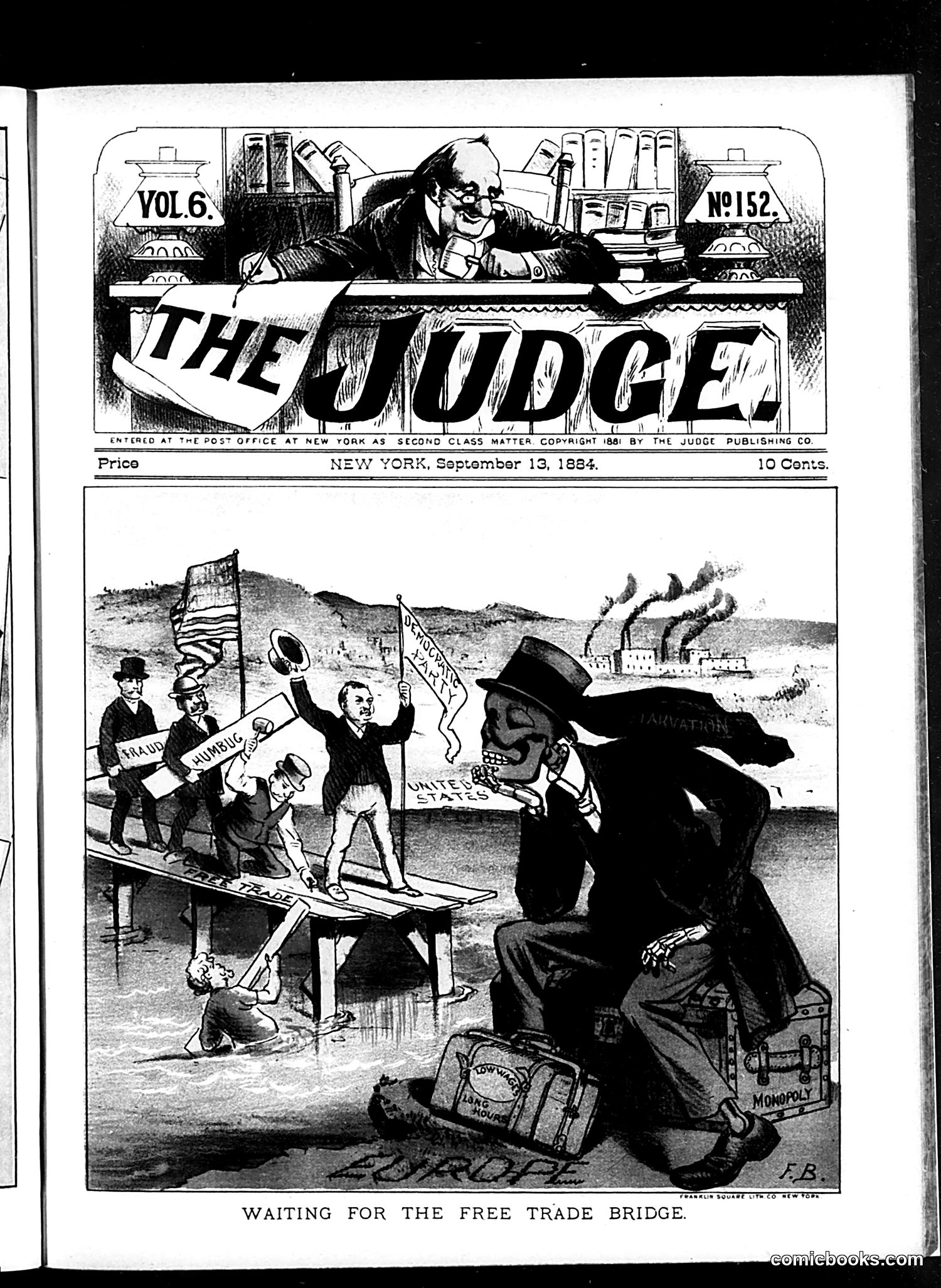
This 1884 *Judge* cartoon satirizes the debate over free trade versus protectionist tariffs in American politics. The central figure (right) appears to be a wealthy industrialist or politician labeled "Monopoly," wearing a top hat and sitting smugly while holding baggage labeled with his interests. Meanwhile, smaller figures—representing workers, farmers, and common people—stand on a makeshift platform in water, literally "waiting" and struggling with flags and signs advocating for free trade. The industrial smokestacks in the background suggest manufacturing interests. The cartoon's point: wealthy monopolists block the "free trade bridge" that ordinary Americans need, using political power to maintain protectionist policies that benefit themselves while the public waits helplessly. The satirical title suggests promised free trade remains perpetually out of reach.
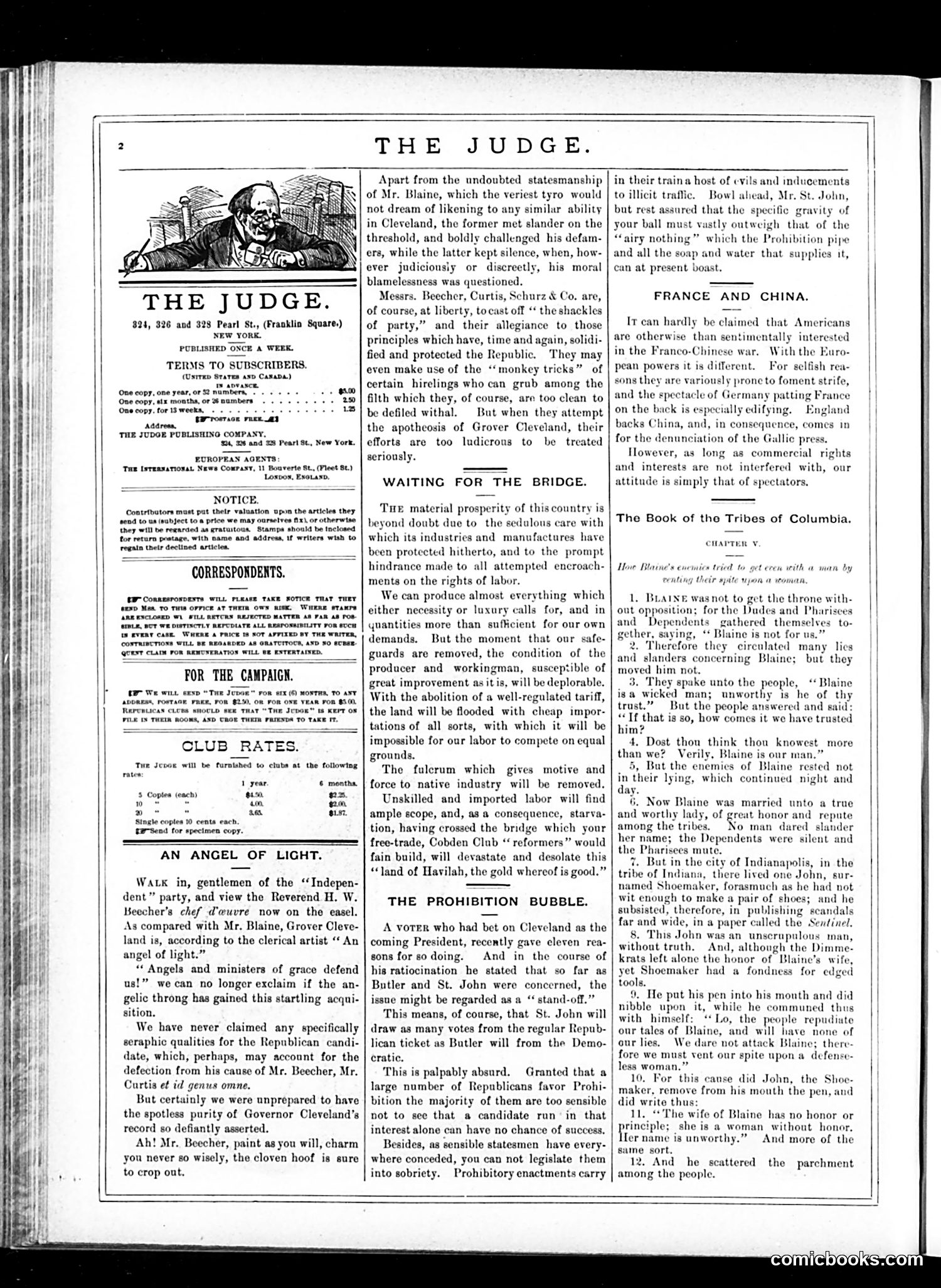
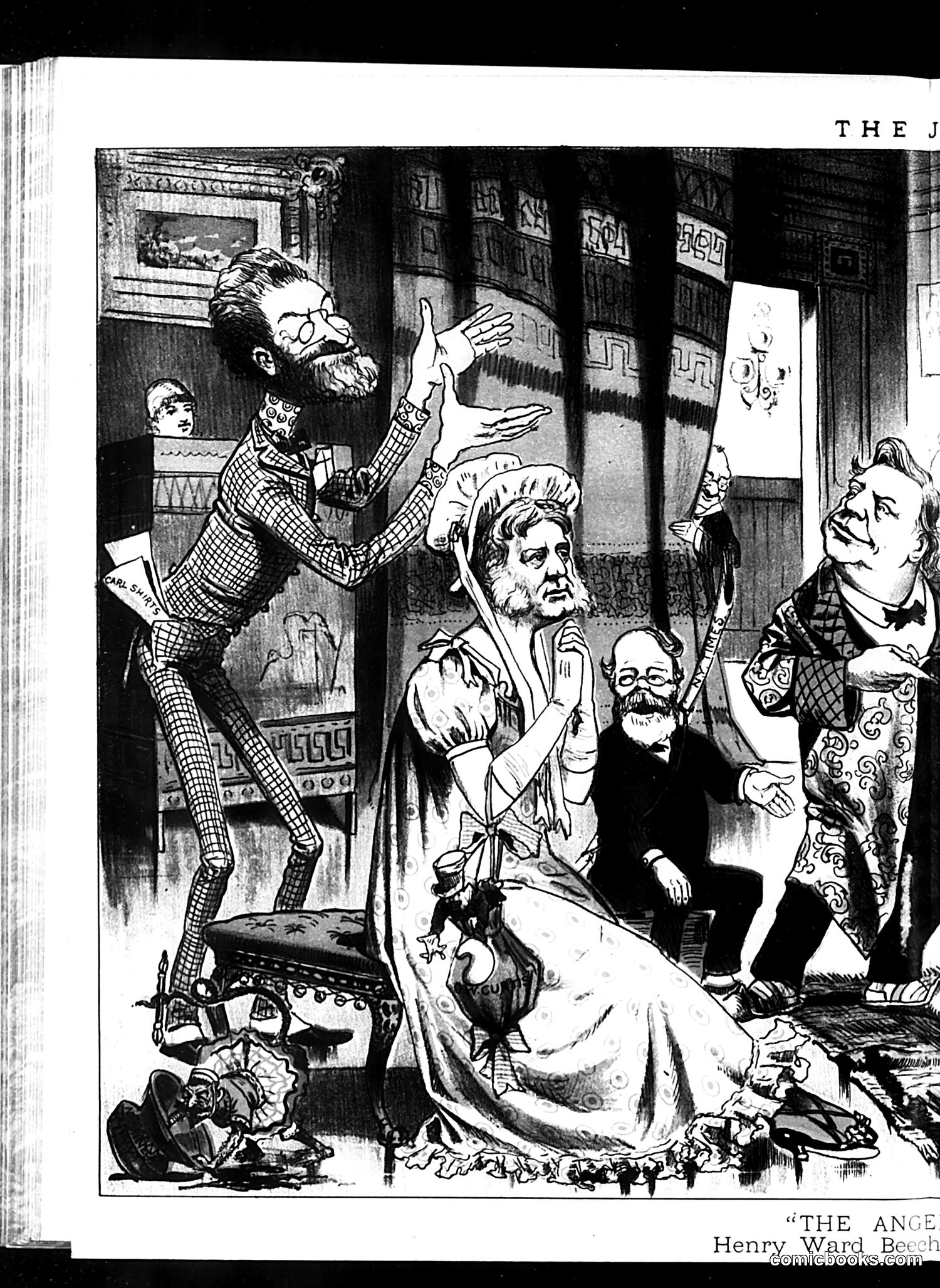
This page from Judge magazine (a Republican satirical publication) primarily contains **editorial commentary and administrative content** rather than major cartoons. The main satirical piece, "An Angel of Light," attacks Reverend Henry Ward Beecher and other "Independent" Republicans (including Carl Schurz and George Curtis) for supporting Democrat Grover Cleveland in the 1884 presidential election against Republican James G. Blaine. Judge mocks Beecher's characterization of Cleveland as "an angel of light," sarcastically suggesting that if Cleveland represents angelic purity, the Republican party's moral standards have collapsed. The piece implies Cleveland's record is actually tainted—the "cloven hoof" will eventually show. Judge defends Blaine as superior, claiming he boldly confronted slander while Cleveland remained suspiciously silent about unspecified moral accusations. The satire targets prominent Republicans who abandoned their party, portraying their defection as hypocritical moralism masking partisan opportunism.
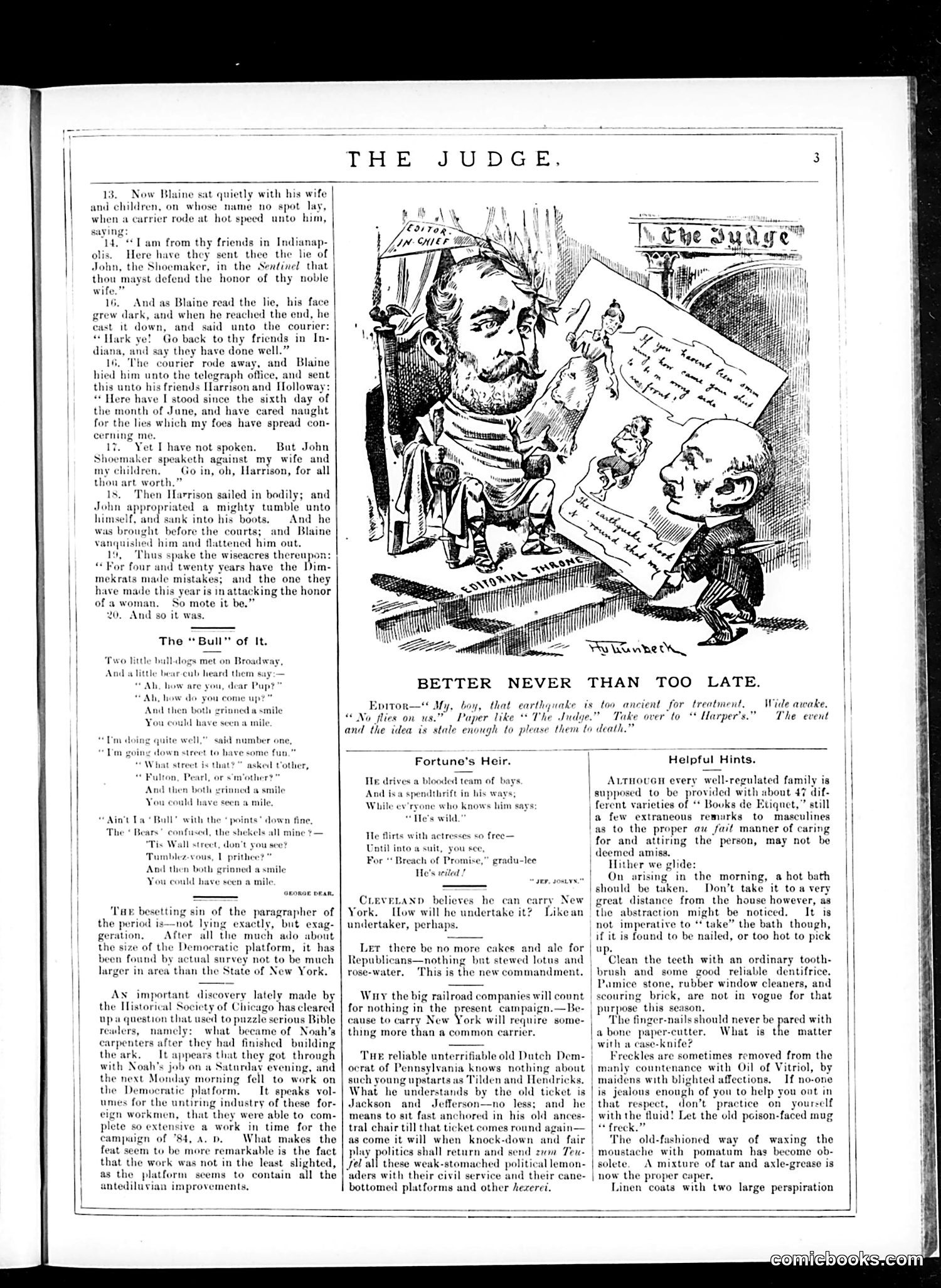
This page contains political satire referencing the 1884 presidential campaign. The main cartoon, "Better Never Than Too Late," appears to mock **James G. Blaine** (the bearded figure) and his response to attacks on his wife's honor. The narrative in biblical language describes Blaine receiving an insulting letter from Indianapolis, then enlisting **Benjamin Harrison** to defend his honor—Harrison subsequently gets defeated ("flattened"). The satire suggests Republicans made a strategic error attacking Blaine's wife, which backfired. References to "Dimmerats" (Democrats) and Harrison indicate **intra-party conflict** during the 1884 election. Secondary items mock the Democratic platform's size and attack **Cleveland's** (the Democratic nominee) viability in New York. The "Bull" poem satirizes market optimism. The cartoon uses exaggerated caricature and mock-biblical language typical of Gilded Age political humor—dense with insider references to campaign controversies modern readers would need historical context to fully appreciate.
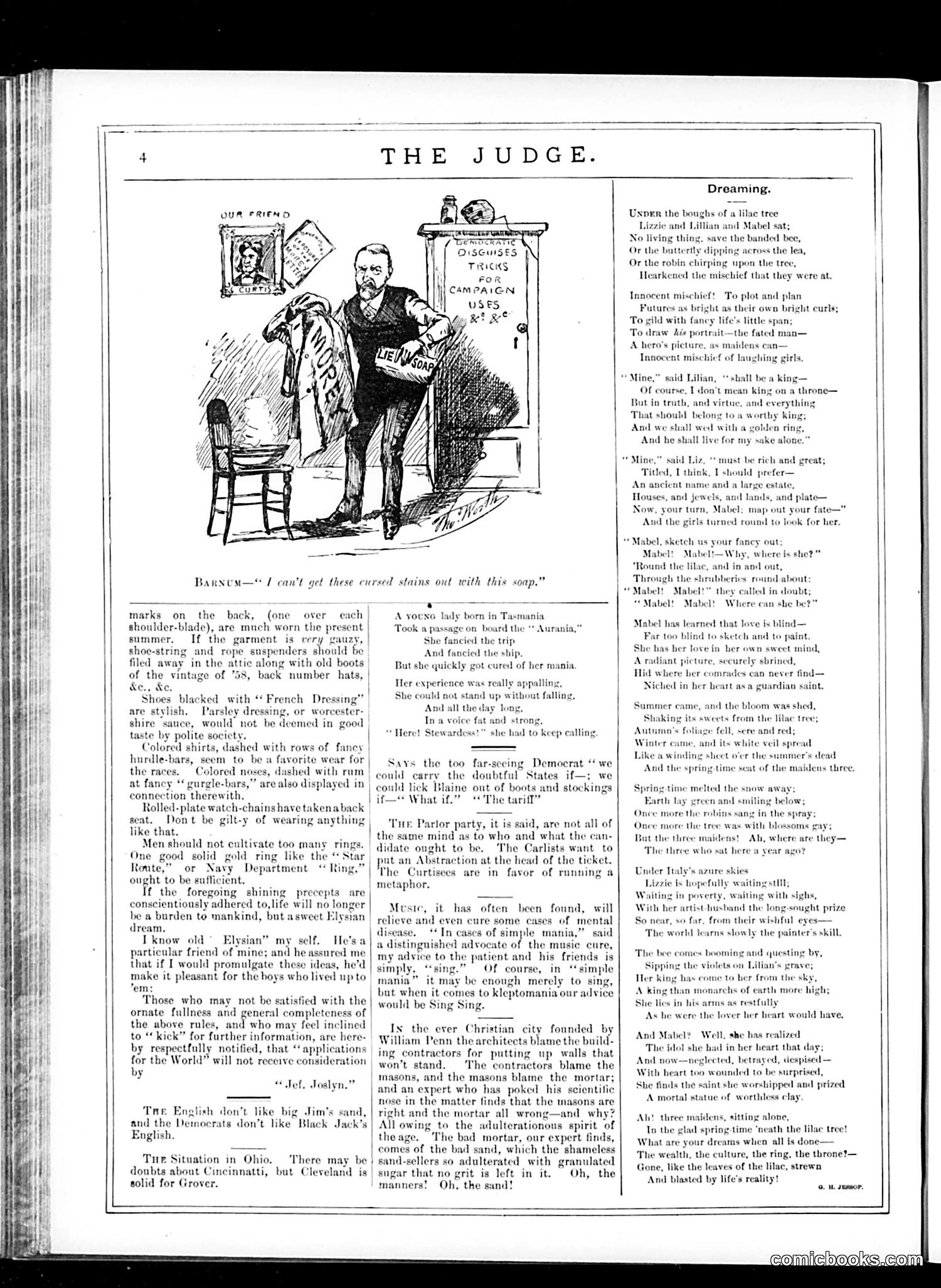
This satirical page from *Judge* magazine contains two main sections: **Main Cartoon:** "Barnum" (the famous showman P.T. Barnum) struggles to remove stains from clothing with soap, appearing frustrated. This likely satirizes Barnum's involvement in political campaigning or promotion—suggesting his attempts to "clean up" or promote a candidate are as futile as removing stubborn stains. The "tricks" and "campaign uses" referenced in the signs mock Barnum's manipulative showmanship applied to politics. **Surrounding Commentary:** The page mixes fashion advice (shoe-strings, rings, watches), political jabs at Democrats and the tariff debate, and commentary on Philadelphia's (founded by William Penn) construction problems caused by adulterated sand—itself a metaphor for corruption and degradation of standards. The overall theme: satire on American political deception, consumerism, and the infiltration of showmanship into serious civic matters during what appears to be a Gilded Age election cycle.
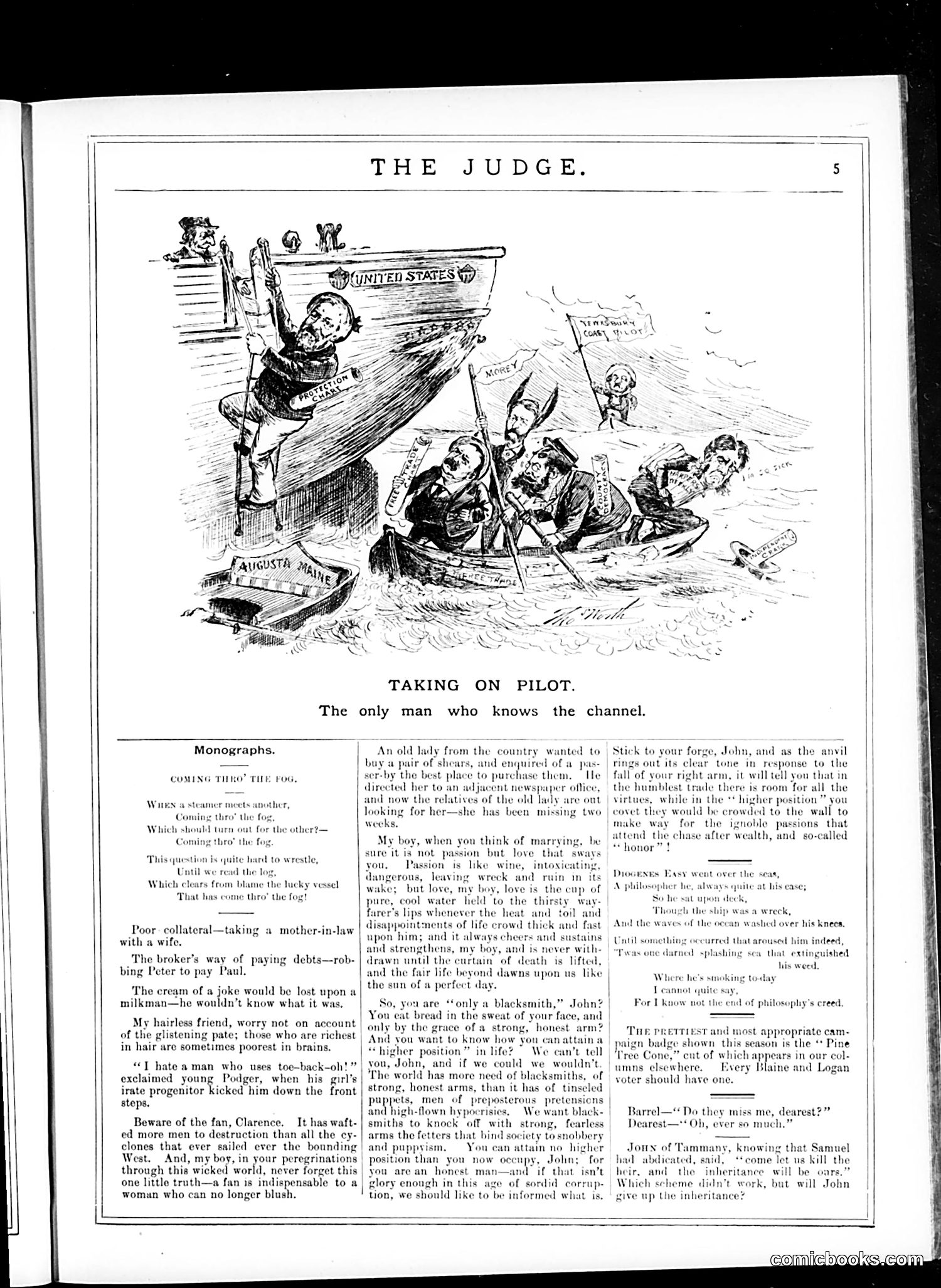
The main cartoon satirizes political navigation during an uncertain period. A figure labeled "United States" stands as a pilot in a boat, while various politicians and factions (labeled with flags suggesting different interests) row desperately in turbulent waters below, seeking guidance. The title "The only man who knows the channel" suggests that strong central leadership—represented by the pilot—is essential to steer the nation through treacherous political currents. The cartoon critiques the competing interests and lack of unified direction among politicians, depicted as floundering without proper guidance. The surrounding text includes miscellaneous short jokes and philosophical musings about character, blacksmiths, and propriety—typical of Judge magazine's satirical style. Without clearer date markers or specific figure identifications visible, the exact political moment remains unclear, but the cartoon's core message concerns leadership and national stability.
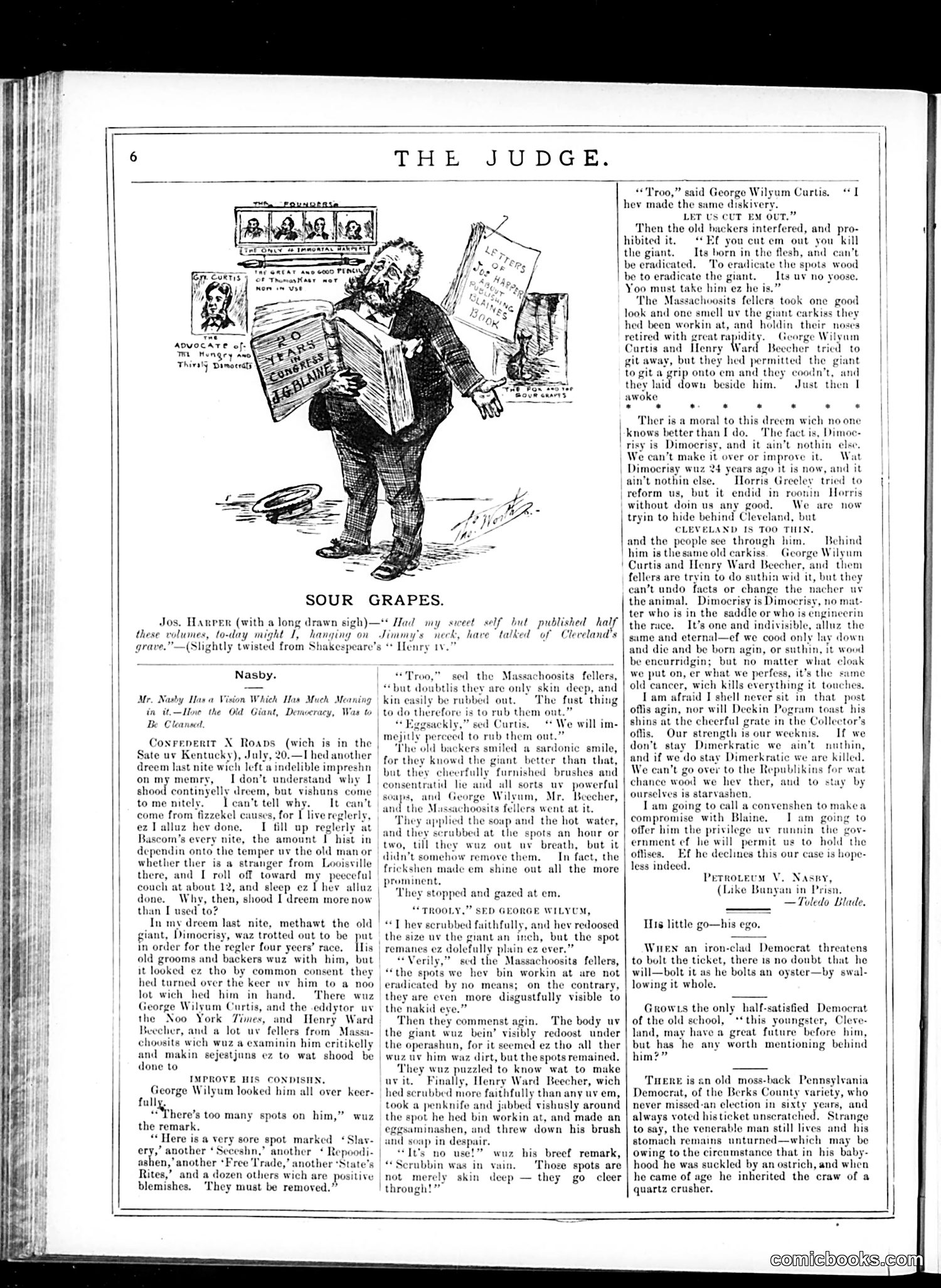
This satirical piece mocks reformers attempting to "clean up" the Democratic Party (personified as a giant). The figures—George William Curtis, Henry Ward Beecher, and editors from the *New York Times*—represent Republican/reform critics trying to scrub away Democratic moral blemishes (labeled "Slavery," "Repudiation," "Free Trade," etc.). The joke: their scrubbing only makes the spots more visible. When they finally suggest cutting them out entirely, the "old backers" (Democratic machine politicians) stop them, arguing such radical surgery would kill the party itself. The satire targets both sides—reformers for their naive optimism about cleansing politics, and Democrats for their entrenched corruption. The piece, written in Petroleum V. Nasby's vernacular dialect persona, suggests that Democratic corruption is fundamentally structural and cannot be removed without destroying the party.
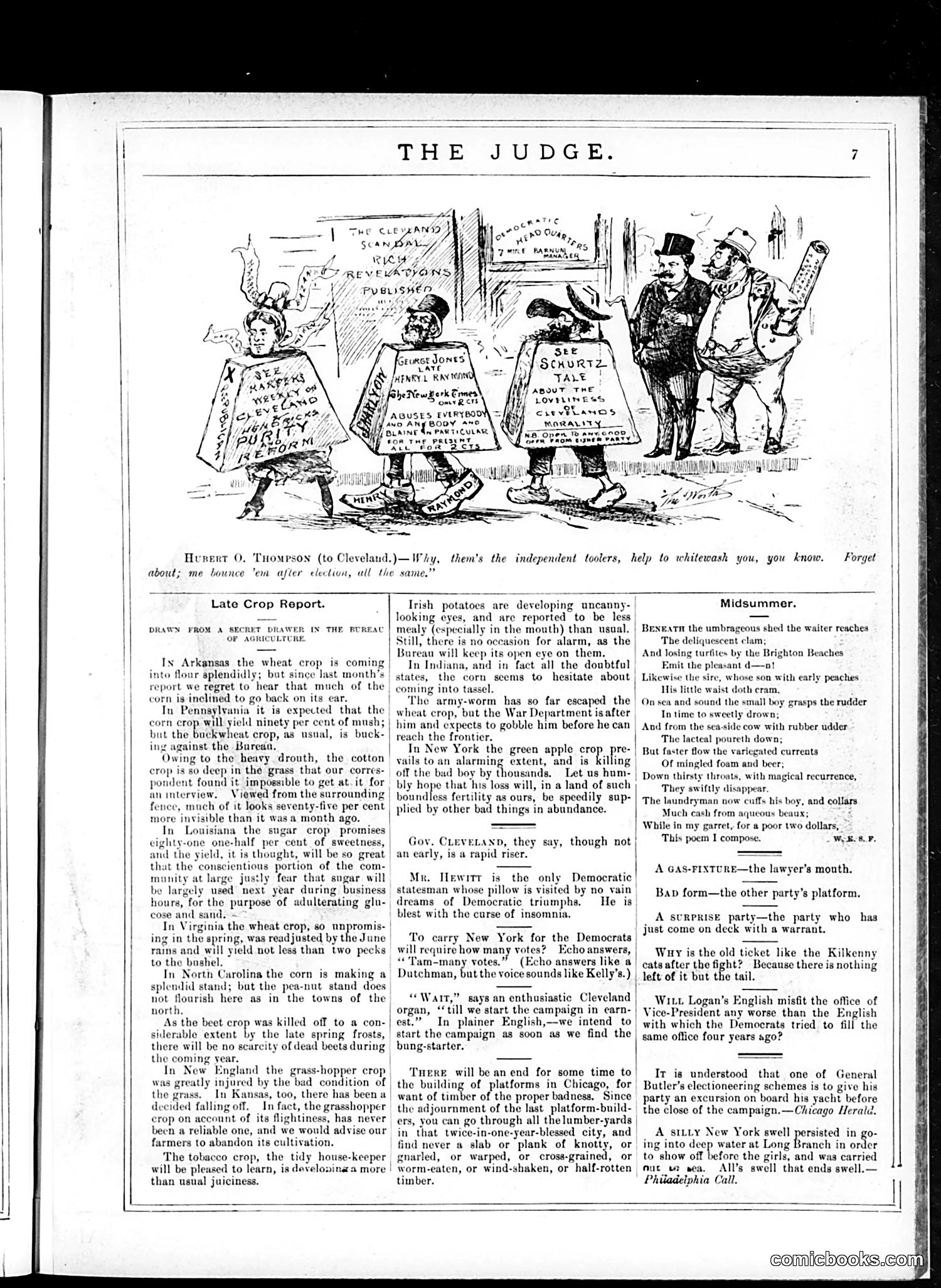
**Main Cartoon ("Independent Toolers"):** The cartoon depicts three figures wearing sandwich boards listing political promises ("Irish Votes," "Schurtz Tale," etc.). They represent independent voters or politicians being courted by the major parties. Hubert O. Thompson (likely a Democratic operative) addresses Cleveland, sarcastically suggesting these "independent toolers" will help "whitewash" him before being discarded after the election. The satire mocks the cynical manipulation of swing voters and the hollowness of campaign rhetoric. **"Late Crop Report" Section:** This humorous fake agricultural report uses farm crop failures as political metaphors for various states' electoral situations. References to "corn coming into tassel," grasshopper crop failures, and Wisconsin's "pea-nut stand" appear to encode commentary on Democratic prospects in swing states. The section explicitly mentions Indiana as a "doubtful state," suggesting electoral uncertainty. **Overall Context:** This appears from an 1884 election period, satirizing Democratic campaign strategy and the unreliability of independent voters as electoral assets.
This cartoon by Henry Ward Beecher (credited at bottom) appears to satirize a theatrical or social scene. A tall, thin figure in a checkered suit strikes an exaggerated pose on the left, gesturing dramatically with raised arms. Center stage sits a woman in period dress looking upward, surrounded by several well-dressed gentlemen in formal attire who gaze at her with apparent admiration or concern. The ornate interior setting with decorative panels suggests a drawing room or parlor. The overall composition mocks theatrical affectation and social posturing—likely critiquing Victorian-era dramatics, pretension, or courtship rituals among the upper classes. The extreme gestures and composed expressions suggest satire of melodramatic performance or artificial social behavior typical of Judge magazine's humor.
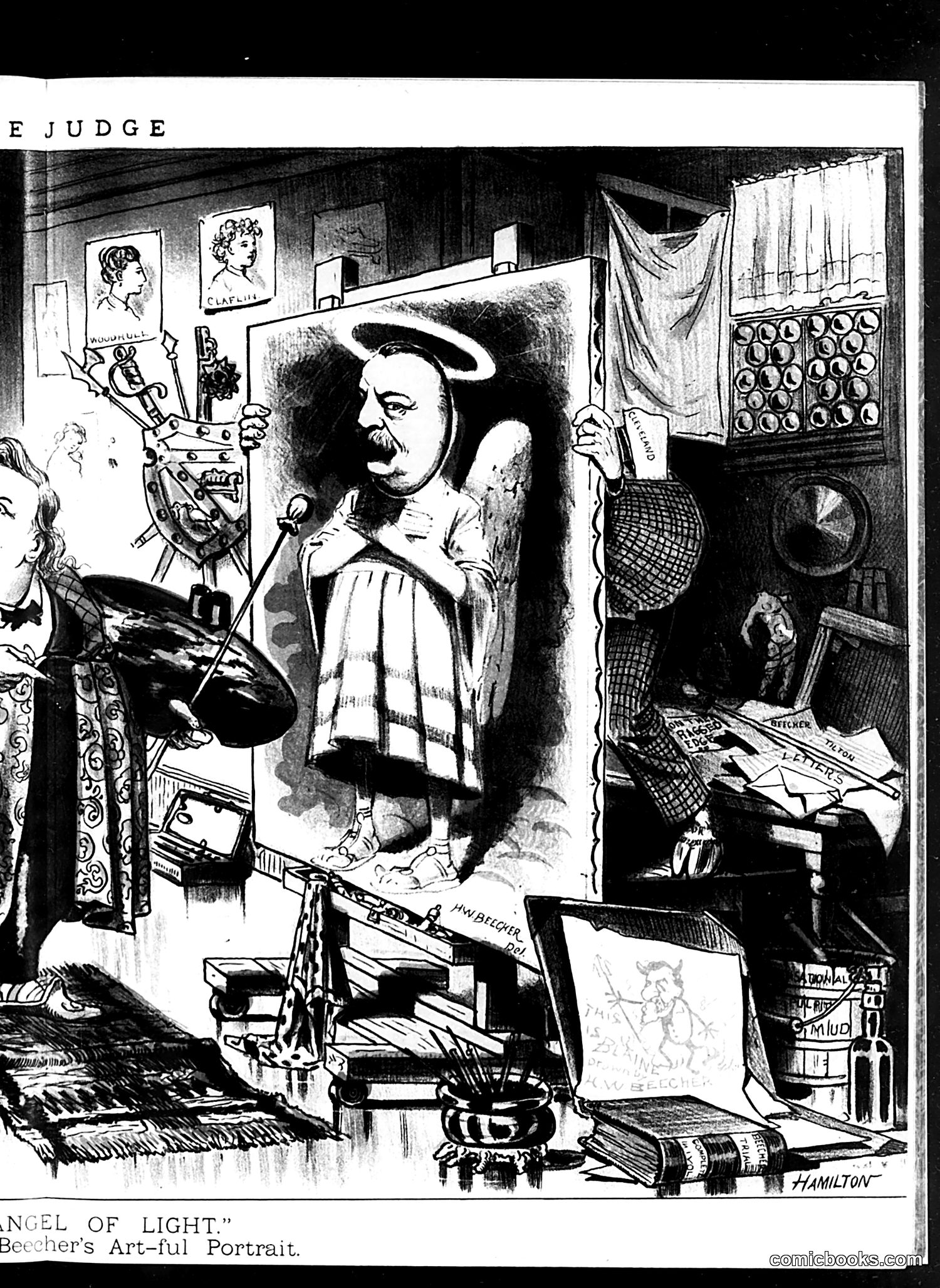
This Judge cartoon satirizes Henry Ward Beecher, a prominent 19th-century Brooklyn clergyman, in his studio surrounded by artistic materials and portraits. The halo above his head ironically labels him an "angel of light." The satire likely references Beecher's public image versus private conduct. The cluttered studio with various portraits and sketches suggests the construction or crafting of a carefully managed public persona. The title's emphasis on "Artful" implies deception—that Beecher skillfully manipulated his reputation. The cartoon appears critical of the gap between Beecher's saintly public reputation and rumors or knowledge of personal scandal. Judge magazine frequently mocked prominent figures' hypocrisy and pretense.
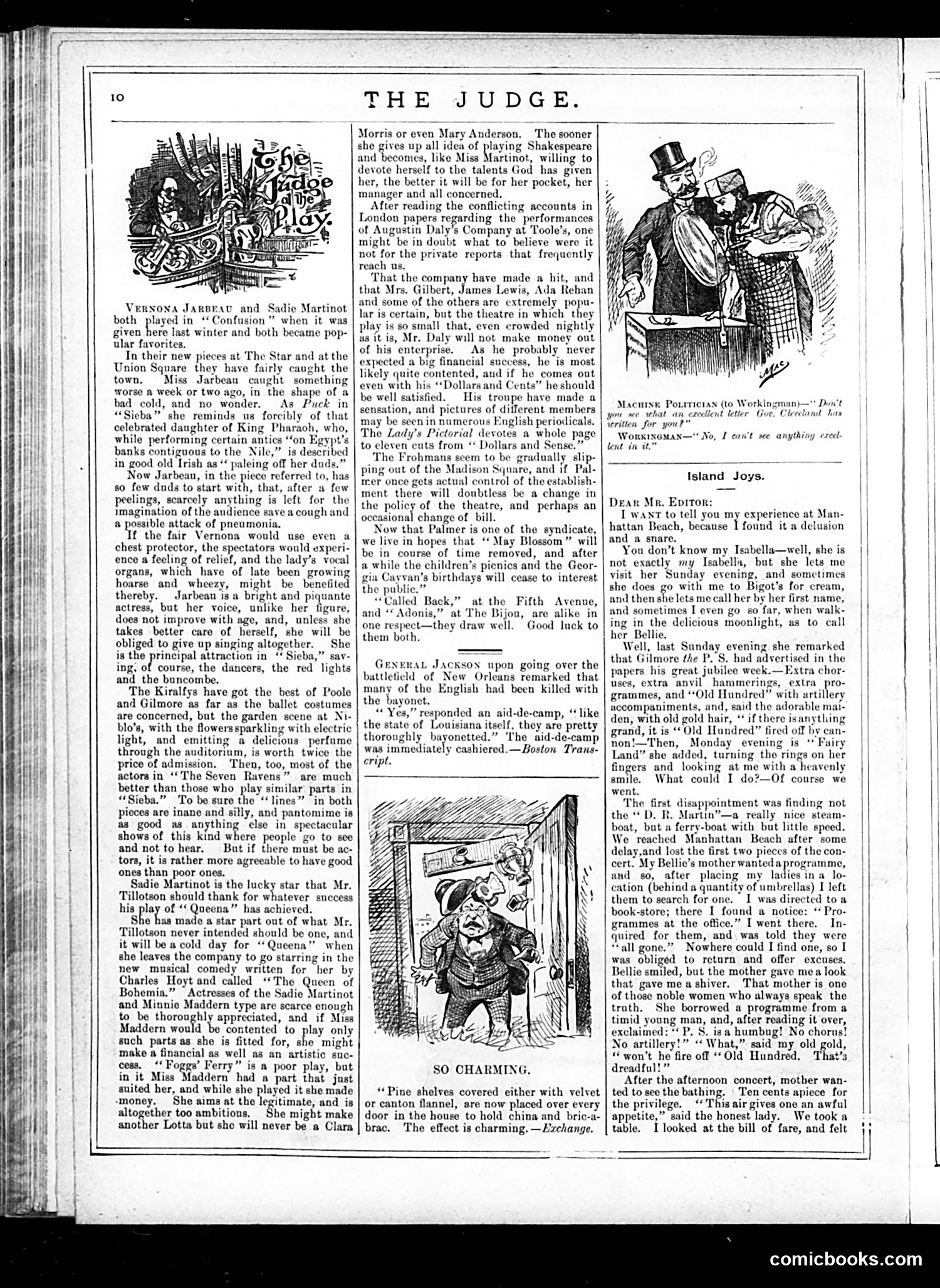
This page from *Judge* contains theater reviews critiquing performances by actresses Vernona Jarbeau and Sadie Martinot. The main satire targets Jarbeau's performance in "Sieba," where she performs with minimal costuming—the critic sardonically compares her to the biblical daughter of Pharaoh, joking that she removes so many clothes there's "scarcely anything left" for the audience's imagination, and warns she risks pneumonia. The reviews praise Martinot as naturally talented and urge other ambitious actresses (particularly Minnie Maddern) to accept roles suited to their abilities rather than overreaching for "legitimate" dramatic parts. The subtext: actresses should stick to their strengths and not be too ambitious. The cartoon labeled "Machine Politician" (top right) appears unrelated—showing a political figure, likely satirizing corruption or backroom dealings. The "Island Joys" section describes a mundane outing to Manhattan Beach involving musical entertainment and family activities, presented with gentle domestic humor.
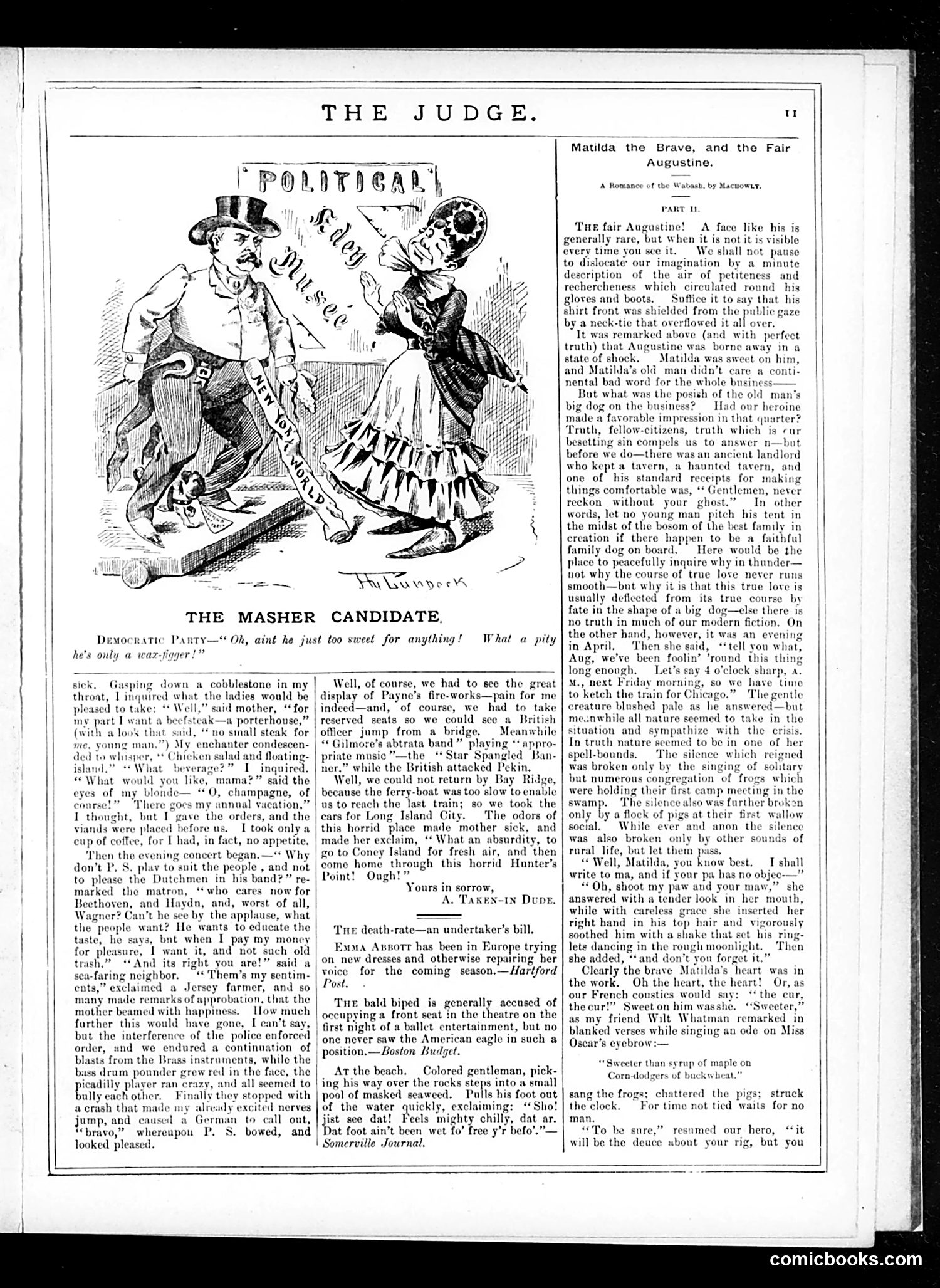
**Main Cartoon**: "The Masher Candidate" depicts a well-dressed man labeled "Political" being grabbed by a woman, with text calling him a "war-finger" who is "only a waz-figger!" (a fake, ornamental figure). The Democratic Party finds him attractive but insubstantial. A "masher" was 1890s slang for an aggressive flirt or seducer. The satire suggests the Democratic candidate is all surface charm with no real substance—a pretty-boy politician ("wax figure") rather than a serious leader. **Context**: This mocks Democratic politics as superficially attractive but hollow. The accompanying story ridicules complaints from concert-goers, ferry delays, and other urban annoyances, suggesting frivolous concerns preoccupy the Democratic base. The other brief items are typical magazine humor—puns about undertakers, ballet-goers, and a racial dialect joke at the beach.
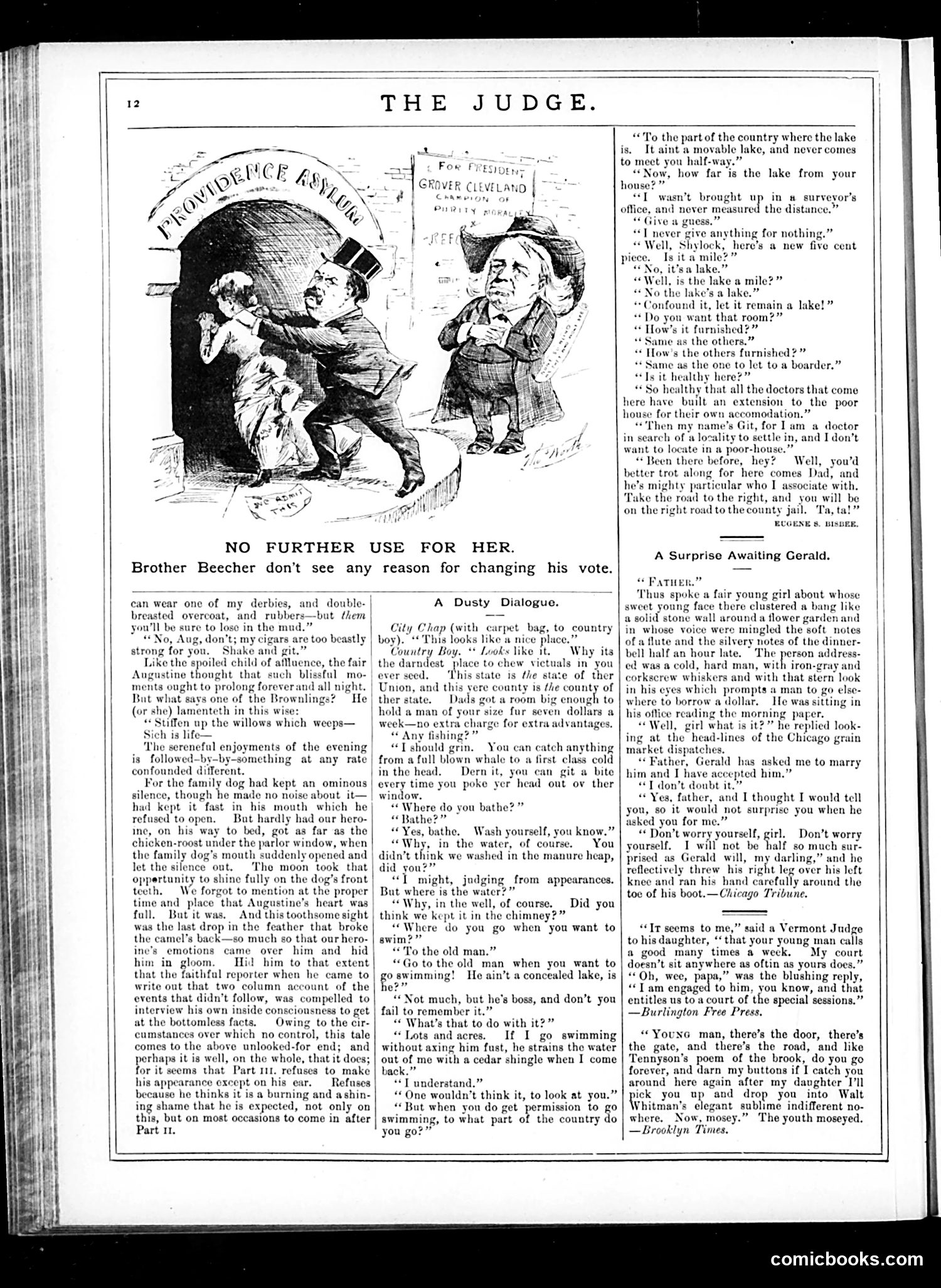
The main cartoon, "No Further Use for Her," satirizes **Henry Ward Beecher**, the famous Brooklyn clergyman, depicted as a portly figure in a "Providence Asylum" hat. The caption references Beecher's refusal to change his vote—likely alluding to the Beecher-Tilton scandal or contemporary political controversy. The image suggests Beecher has become a liability or embarrassment to his cause, hence "no further use." Below are two humorous dialogues: "A Dusty Dialogue" mocks rural American attitudes toward basic hygiene and bathing through a city visitor's interactions with a crotchety country boy. "A Surprise Awaiting Gerald" presents romantic comedy involving parental expectations and courtship. The page exemplifies *Judge* magazine's blend of political satire (targeting public figures) and genteel humor aimed at middle-class readers, contrasting urban sophistication with rural simplicity for comedic effect.
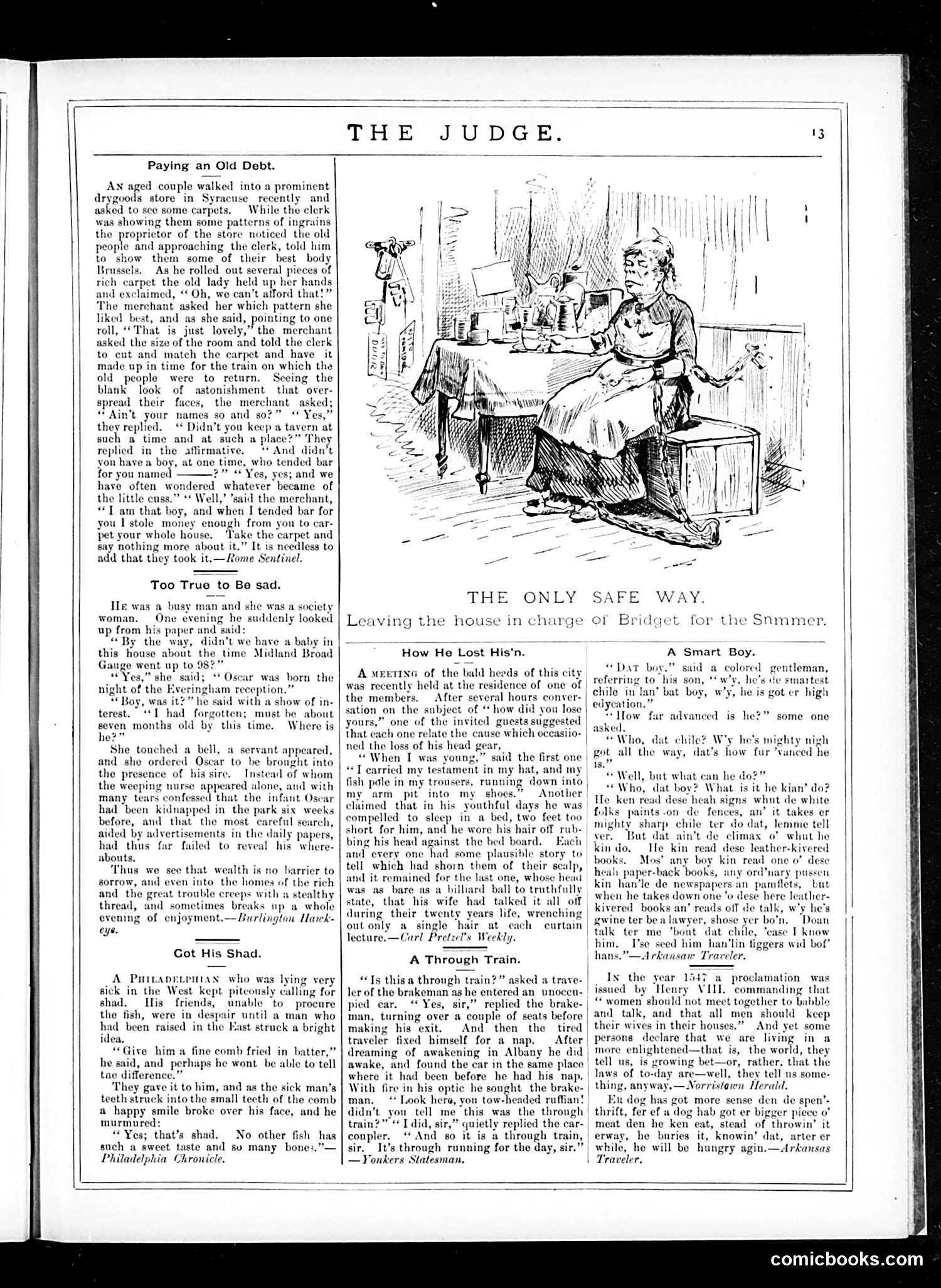
This page from *Judge* magazine contains several brief humorous anecdotes with accompanying illustrations, typical of late 19th-century American humor publications. **"Paying an Old Debt"** tells of an elderly couple who receive free carpet from a store owner—revealed to be a former boy employee who stole money from their tavern years ago and is now repaying the debt through generosity. **"The Only Safe Way"** (caption only, with illustration) jokes about leaving household management to a servant during summer. **"How He Lost His'n"** depicts bald men sharing origin stories for their hair loss, each attributing it to youthful misadventures (sleeping in too-short beds, etc.)—a gentle joke about male baldness and aging. **"A Smart Boy"** records a father praising his clever son, suggesting the child is precociously intelligent. **Other brief items** include anecdotes about train travel confusion and a sick Philadelphian fooled into eating a comb fried in butter as a substitute for shad fish. The humor is sentimental and folksy, reflecting period tastes for domestic comedy and gentle social observation rather than sharp political satire.
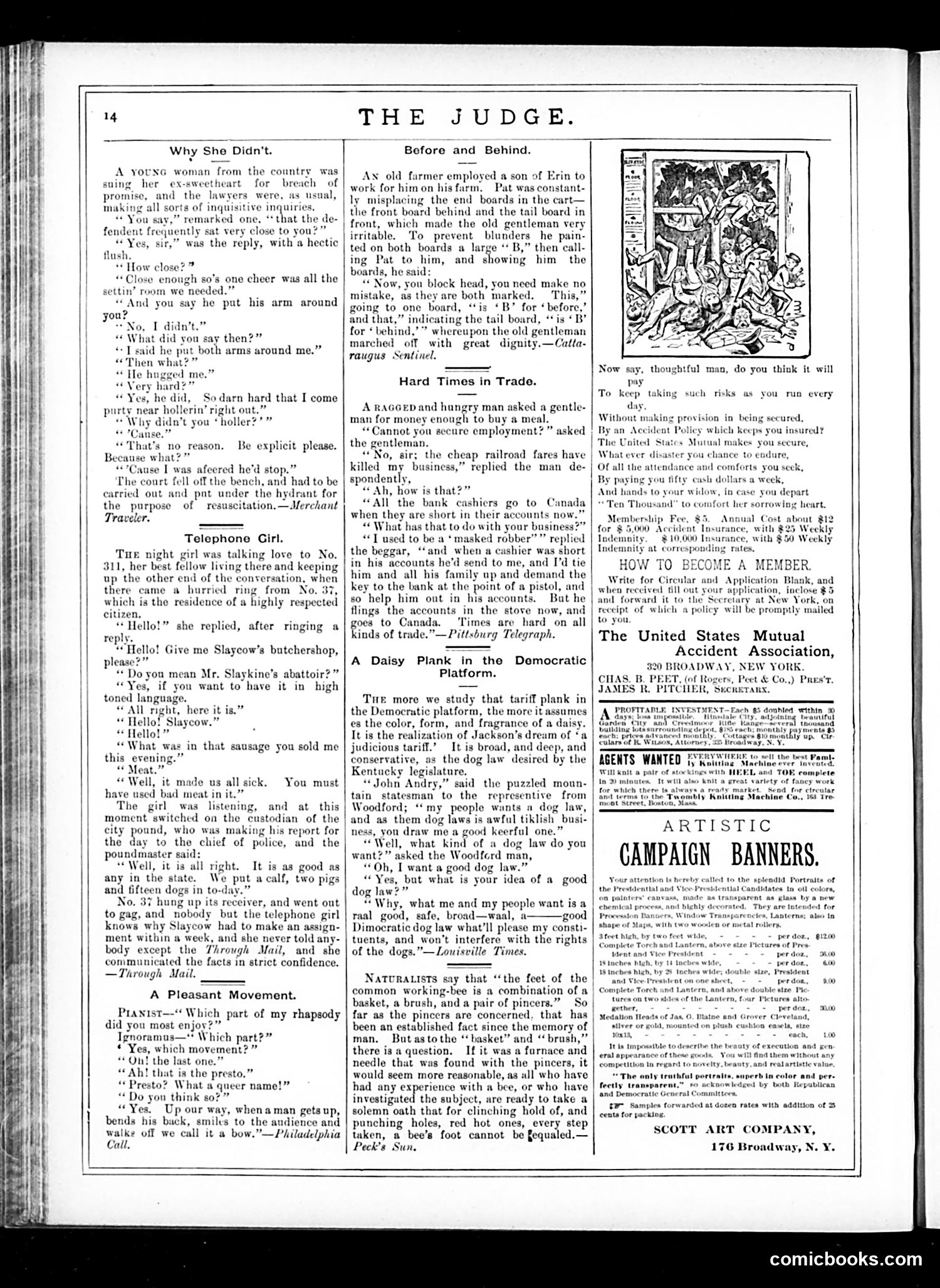
This page contains several brief humorous anecdotes typical of *Judge* magazine's satirical style: **"Why She Didn't"**: A breach-of-promise lawsuit (a legal action women could bring against men who broke engagement promises). The humor derives from the young woman's admission that her ex-suitor held her so tightly she nearly "hollered"—the court finds this hilariously inappropriate testimony. **"Telephone Girl"**: A switchboard operator overhears a complaint about bad meat from a butcher shop, then accidentally connects the caller to a city pound master discussing available animals. The caller unknowingly learns his butcher uses inferior meat sources. **"Before and Behind"**: An Irish farmworker (Pat) repeatedly misplaces cart boards. The farmer paints "B" on both, labeling them "before" and "behind," but Pat remains confused—satirizing either Irish stereotypes or general worker incompetence. **"Hard Times in Trade"**: A beggar reveals he was formerly a "masked robber" (bank robber) who helped cashiers cover embezzlement by robbing them. Now cashiers flee to Canada instead, eliminating his livelihood—dark satire on economic desperation and crime.
This page is primarily **advertisements and filler content**, typical of 19th-century magazines. The few brief satirical items are short, punchy jokes rather than developed cartoons: **The humor targets:** - **Gender relations**: A wife's expensive divorce habits; a bald man's vanity about hair - **Class/occupation**: Mockery of barbers and peddlers as low-status work - **Immigration**: Jokes about poor Italian immigrants at Castle Garden (NYC's immigration center) being unfamiliar with American currency - **Rural vs. urban**: A farmer's son impressing his hometown by knowing barkeepers by their first names (implied to be shallow city sophistication) - **Death and courtship**: A deceased bachelor's bequest to young women is neglected—satirizing women's materialism **Overall tone**: Cynical, focusing on human folly, hypocrisy, and vanity. The jokes assume readers share upper-class perspectives mocking working people, immigrants, and rural folks. The page is dominated by period advertisements (cocoa, pianos, lithography services), not editorial content.
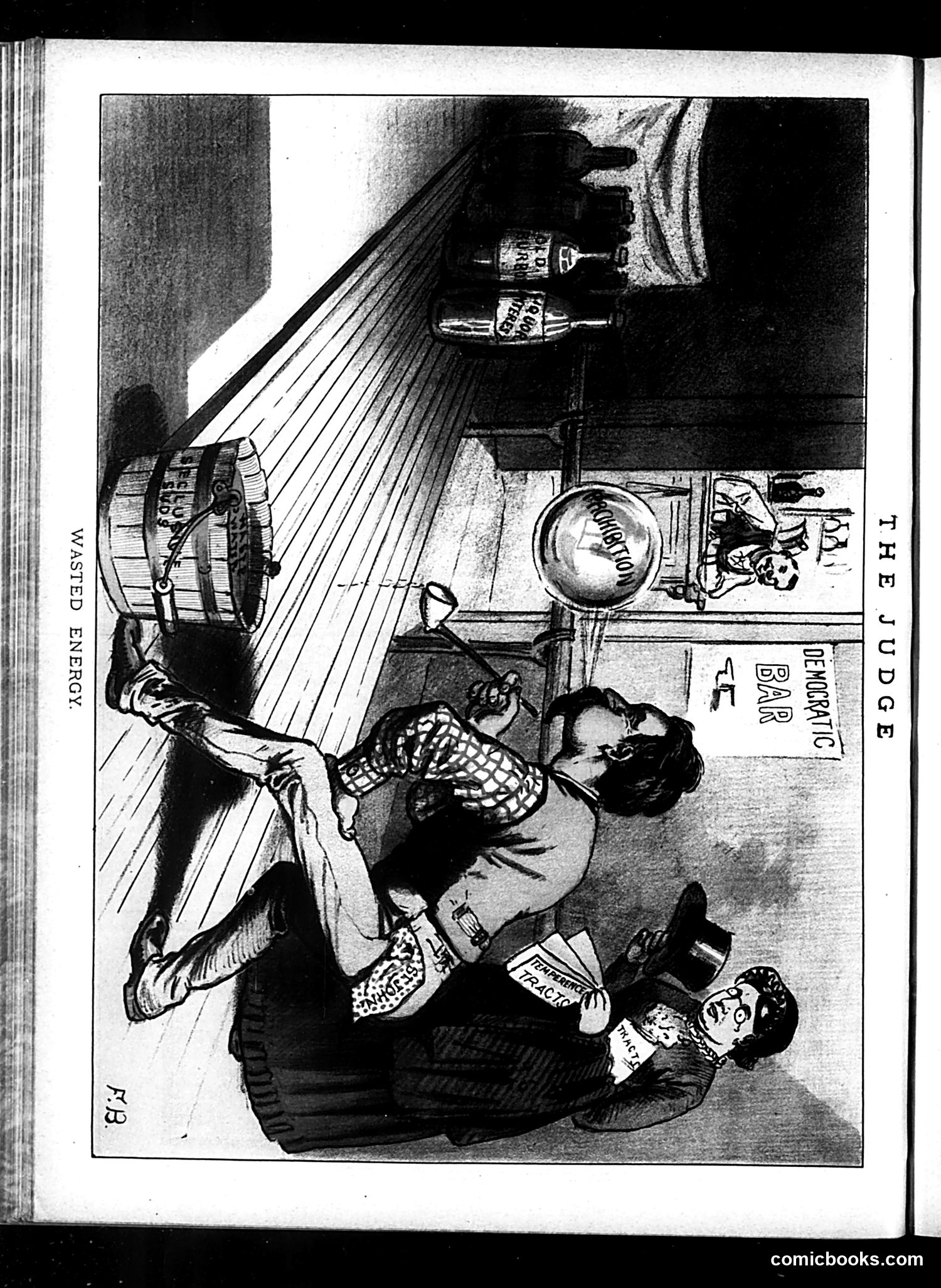
This page contains the title header "THE JUDGE" and appears to show a satirical illustration (rotated 90 degrees in the scan). The image depicts what appears to be a domestic or social scene with figures in period dress, though the rotation makes specific details difficult to interpret with certainty. The OCR text is largely illegible characters, suggesting either scanning errors or decorative elements rather than substantive text content. Without clearer text or proper image orientation, I cannot reliably identify the specific political figures, social commentary, or satirical point being made. To provide accurate historical interpretation, I would need either a properly oriented image or legible accompanying text identifying the cartoon's subject and date of publication.