
Judge, 1884-09-13 · page 10 of 16
Judge — September 13, 1884 — page 10: what you’re looking at
What you’re looking at
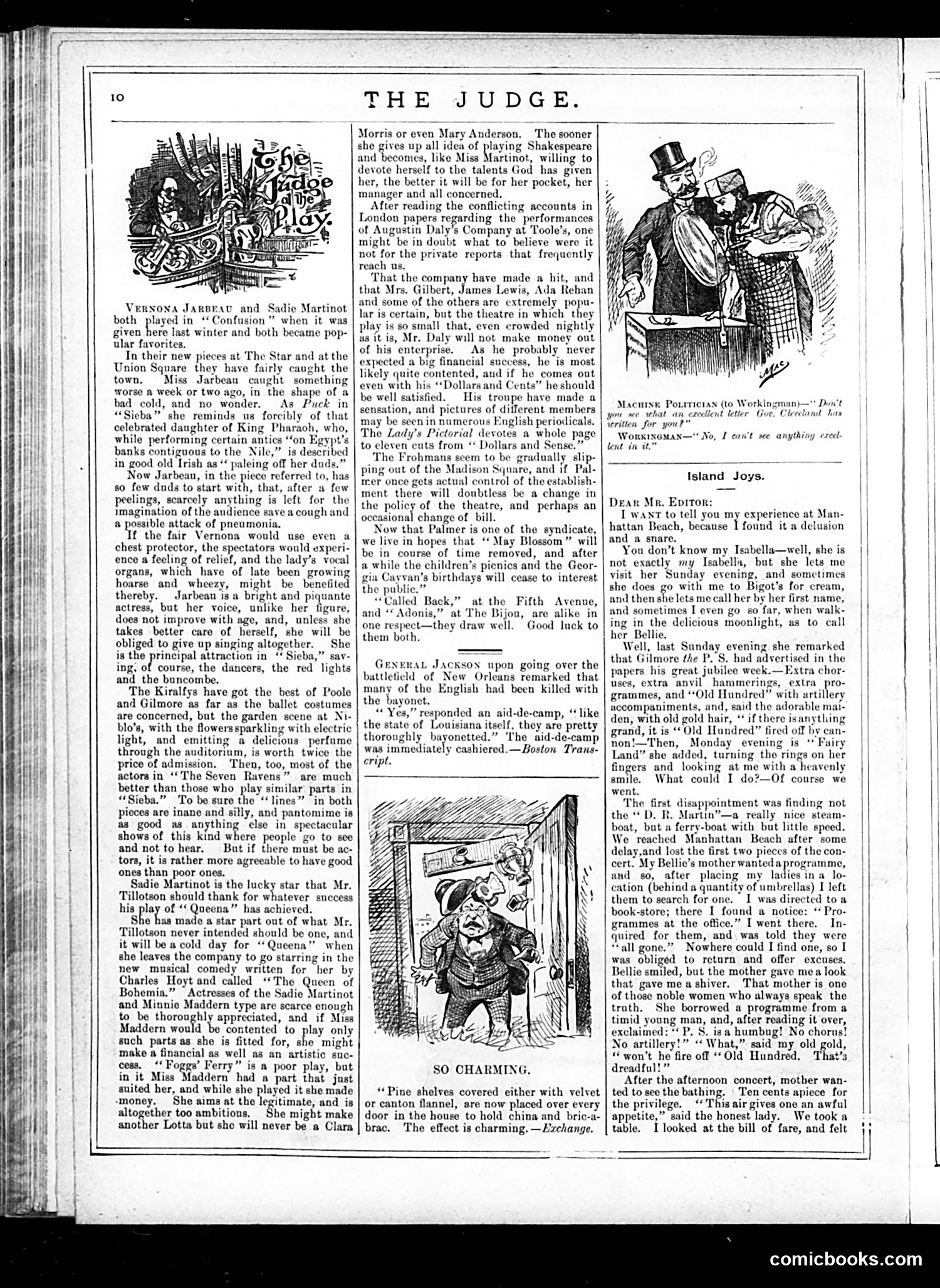
This page from *Judge* contains theater reviews critiquing performances by actresses Vernona Jarbeau and Sadie Martinot. The main satire targets Jarbeau's performance in "Sieba," where she performs with minimal costuming—the critic sardonically compares her to the biblical daughter of Pharaoh, joking that she removes so many clothes there's "scarcely anything left" for the audience's imagination, and warns she risks pneumonia. The reviews praise Martinot as naturally talented and urge other ambitious actresses (particularly Minnie Maddern) to accept roles suited to their abilities rather than overreaching for "legitimate" dramatic parts. The subtext: actresses should stick to their strengths and not be too ambitious. The cartoon labeled "Machine Politician" (top right) appears unrelated—showing a political figure, likely satirizing corruption or backroom dealings. The "Island Joys" section describes a mundane outing to Manhattan Beach involving musical entertainment and family activities, presented with gentle domestic humor.
📄 Transcribed text from this page (OCR, searchable)
Machine-transcribed from the original scan — historical spelling and the odd misread are preserved.
Ve A Jarprav and Sadie Martinot both played in “Confusion” when it was given here last winter and both became pop- ular favorites. In their new pieces at The Star and at the Union Square they have fairly caught the town. Miss Jarbean caught something worse a week or two ago, in the shape of a bad cold, and no wonder. As Puck in “Sieba” she reminds us forcibly of that celebrated daughter of King Pharaoh, who, while performing certain antics ‘‘on Egypt’s banks contiguous to the Nile,” is described in good old Irish as ‘* paleing off her duds, Now Jarbeau, in the piece referred to, so few duds to start with, that, after a few peelings, scarcely anything is left for the Imagination of the audience save a cough and a possible attack of pneumonia. f the fair Vernona would use even a chest protector, the spectators would experi- ence a feeling of relief, and the lady’s vocal organs, which have of late been growing hoarse and wheezy, might be benefited thereby. Jarbeau is a bright and piquante actress, but her voice, unlike her figure, does not improve with age, and, unless she takes better care of herself, she will be obliged to give up singing altogether. She is the principal attraction in ‘* Sieba,” sav- ing. of course, the dancers, the red lights and the buncombe. The Kiralfys have got the best of Poole and Gilmore ‘as far as the ballet costumes are concerned, but the garden scene at N blo’s, with the flowers sparkling with electric light, and emitting a delicious perfame through the auditorium, is worth twice the price of admission. Then, too, most of the actors in ‘The Seven Ravens” are much better than those who play similar parts in “Sieba.” To be sure the “lines” in both pieces are inane and silly, and pantomime is 4s good as anything else in spectacular shows of this kind where people go to see and not to hear. But if there must be ac- tors, it is rather more agreeable to have good ones than poor ones. Sadie Martinot is the lucky star that Mr. Tillotson should thank for whatever success his play of ‘‘ Queena” has achieved. She has made a star part out of what Mr. Tillotson never intended should be one, and it will be a cold day for ‘* Queena” when she leaves the company to go starring in the new musical comedy written for her by Charles Hoyt and called “The Queen of Bohemia.” “Actresses of the Sadie Martinot and Minnie Maddern type are scarce enough to be thoron bly appreciated, and if Miss Maddern would be contented’ to play only such parts as she is fitted for, she might make a financial as well as an artistic suc- cess. ‘‘Foggs’ Ferry” is a poor play, but it Miss Maddern had a part that’ just suited her, and while she played it she made ‘money. She aims at the legitimate, and is altogether too ambitions. She might make another Lotta but she will never be a Clara she gives up all idea of pl and becomes, like Miss Martinot, willing to Morris or even Mary Anderson. ‘The sooner ng Shakespeare devote herself to the talents God has given her, the better it will be for her pocket, her manager and all concerned, After reading the conflicting accounts in London papers regarding the performances of Augustin Daly’s Company at Toole’s, one might be in doubt what to believe were it not for the private reports that frequently reach us. ‘That the company have made a hit, and that Mrs. Gilbert, James Lewis, Ada Rehan and some of the others are extremely popu- ris certain, but the theatre in which they is so small that, even crowded nightly as it is, Mr. Daly will not make money out of his ‘enterprise. As he probably never expected a big financial success, he is most likely quite contented, and if he comes out even with his ‘Dollars and Cents” he should be well satisfied. His troupe have made a sensation, and pictures of ditferent members may be seen in numerous English periodicals. The Lady’s Pictorial devotes a whole page to cleven cuts from ‘* Dollars and Sense.” The Frohmans seem to be gradually slip- ping out of the Madison Square, and if Pal- mer once gets actual control of the establish- ment there will doubtless be a change in the policy of the theatre, and perhaps an occasional change of bill. Now that Palmer is one of the syndicate, we live in hopes that ‘* May Blossom” will be in course of time removed, and after a while the children’s picnics and the Geor- gia Cayvan’s birthdays will cease to interest the pul “Called Back,” at the Fifth Avenue, and ‘‘ Adonis,” at The Bijou, are alike in one respect—they draw well. | Good luck to them both. GeNeRAL JACKSON upon going over the battlefield of New Orleans remarked that many of the English had been killed with the bayonet. “Yes,” responded an aid-de-camp, “like the state of Louisiana itself, they are pretty thoroughly bayonetted.” ‘The aid-de-camp was immediately cashiered.—Boston Trans- cript. ELIT SO CHARMING, ‘Pine shelves covered either with velvet or canton flannel, are now placed over every door in the house to hold china and bric-a- brac. The effect is charming. —Hzchange. Macutxe Porrtictan (to Workingman)—** Don't you se what an excellent letter Gov. Clereland has veritten for you? Workixoman—"' No, I can't sce anything excel lent in it.” Island Joys. Dear Mr. Epitor: I wan to tell you my experience at Man- hattan Beach, because I found it a delusion and a snare, You don’t know my Isabella—well, she is not exactly my Isabella, but she lets me visit her Sunday evening, and sometimes she does go with me to Bigot’s for cream, and then she lets me call her by her first name, and sometimes I even go so far, when walk- ing in the delicious moonlight, as to call her Bellie. Well, last Sunday evening she remarked that Gilmore the P.’S. had advertised in the papers his great jubilee week.—Extra chor- uses, extra anvil hammering: grammes, and ‘Old Hundred” with artillery accompaniments, and, said the adorable mai- den, with old gold hair, if there isanything grand, it is Old Hundred” fired off by can- non!—Then, Monday evening is * y Land” she added, turning the rings on her fingers and looking at me with a heavenly smile. What could I do?—Of course we went. The first disappointment was finding not the ** D. R. Martin’—a really nice steam- boat, but a ferry-boat with but little speed. We reached Manhattan Beach after some delay,and lost the first two pieces of the con- cert. My Bellie’s mother wanteda programme, and 80, after placing my ladies ina lo- cation (behind a quantity of umbrellas) I left them to search for one. I was directed to a book-store; there I found a notice: ‘‘ Pro- grammes at the office.” I went there. In- quired for them, and. was told they were ‘all gone.” Nowhere could I find one, so I was obliged to return and offer excuses, Bellie smiled, but the mother gave mea look that gave mea shiver. That mother is one of those noble women who always speak the truth. She borrowed a programme from a timid young man, and, after reading it over, exclaimed: *‘ P. 8. isa humbug! No chorus! No artillery!” ‘* What,” said my old gold, «won't he fire off ‘Old Hundred. That’s dreadful!” After the afternoon concert, mother wan- ted to see the bathing. Ten cents apiece for the privilege. ‘This air gives one an awful appetite,” said the honest lady. We took a table. I looked at the bill of fare, and felt comicbooks.com