
Judge, 1884-09-13 · page 2 of 16
Judge — September 13, 1884 — page 2: what you’re looking at
What you’re looking at
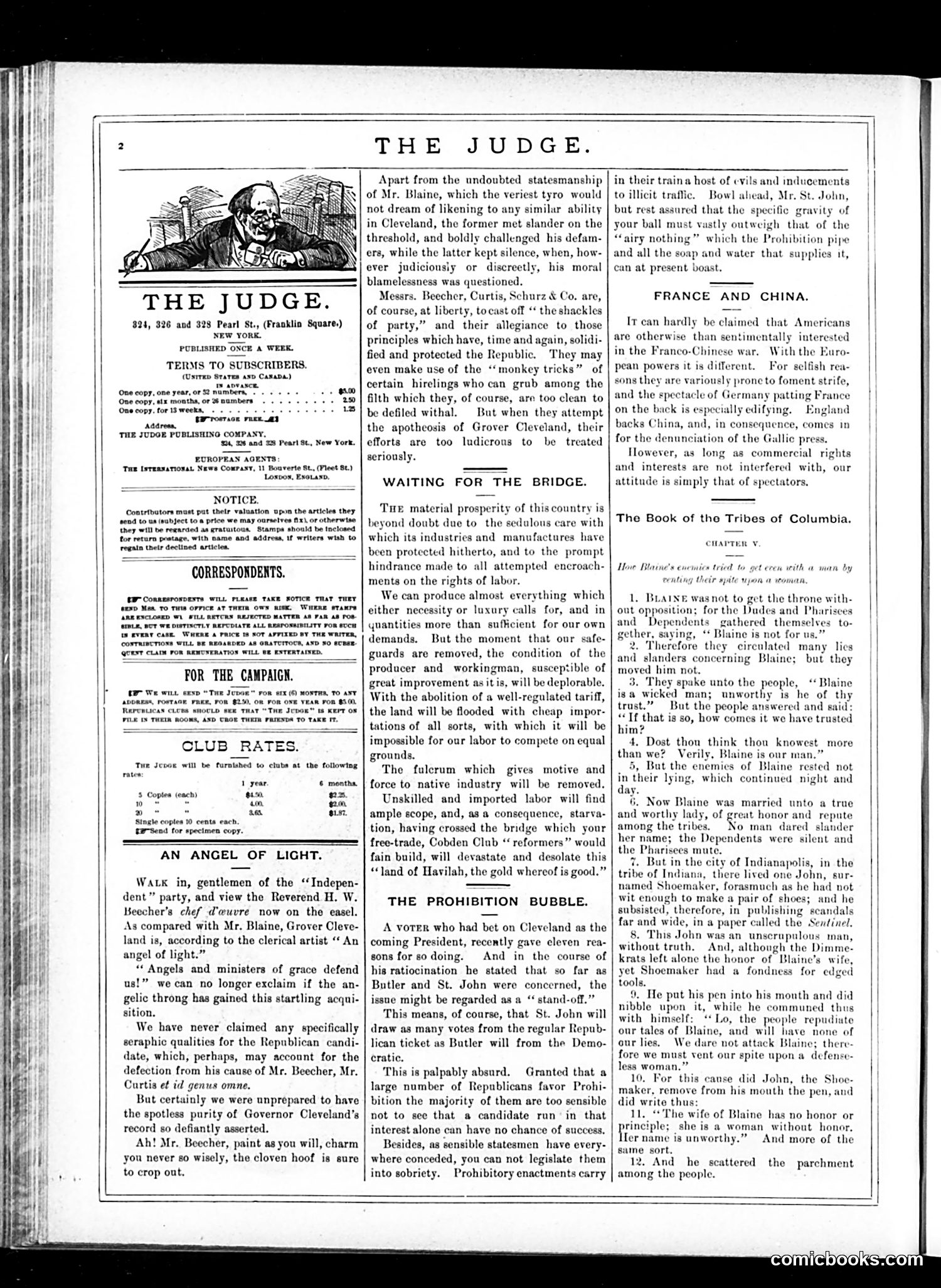
This page from Judge magazine (a Republican satirical publication) primarily contains **editorial commentary and administrative content** rather than major cartoons. The main satirical piece, "An Angel of Light," attacks Reverend Henry Ward Beecher and other "Independent" Republicans (including Carl Schurz and George Curtis) for supporting Democrat Grover Cleveland in the 1884 presidential election against Republican James G. Blaine. Judge mocks Beecher's characterization of Cleveland as "an angel of light," sarcastically suggesting that if Cleveland represents angelic purity, the Republican party's moral standards have collapsed. The piece implies Cleveland's record is actually tainted—the "cloven hoof" will eventually show. Judge defends Blaine as superior, claiming he boldly confronted slander while Cleveland remained suspiciously silent about unspecified moral accusations. The satire targets prominent Republicans who abandoned their party, portraying their defection as hypocritical moralism masking partisan opportunism.
📄 Transcribed text from this page (OCR, searchable)
Machine-transcribed from the original scan — historical spelling and the odd misread are preserved.
THE JUDGE. THE JUDGE. 824, 326 and 328 Pearl St., (Franklin Square. NEW YORK. TERMS TO SUBSCRIBERS. (Usrrap Staves axp Caxapa) 1 apvasce, One copy, one year, or 52 numbers, Ove copy, ax montha, or 3 numbers One copy. for IS weeks... twrromon Aad: roan, ‘THE JUDGE PUBLISHING COMPANY. $04, 2 and 228 Pearl St, New York. raced EUROPEAN AGENTS. ‘Tur [sreasanional News Comrasy, 11 Bouverte 8t., (Fleet 8t) NOTICE. Contributors must pat thelr valuation upon the articles they tend to us (subject to a price we may ourselves fix). or otherwise they will be regarded as gratuitous Stamps should be Inclosed for return pestage, with name and address, if writers wish to regain thelr declined articles. CORRESPONDENTS. (7 ConaesronDENTS WILL TLEAEE TAKE NOTICE THAT THEY axxo Maa To Twi OFFICE AT THEM OWS RISK, WHERE STANTS ARREXCLOMED WL SILL RETCRS REJECTED MATTER AB FAR AB POS: AUMLE, BUT WE DISTINCTLY REFCDLATE ALL REAPONAIBILITY FOR SUCH te EVERY Cage WHERE 4 TRICE [8 ROT AVYITED BY THE WRITER, CONTRIBCTIONS WILL BE REQARDED AS GRATUITOCR, AND 80 #CBAE. QUENT CLAIM FOR REMUNERATION WILL BE ENTERTAINED, FOR THE CAMPAIGN. (87 We wit. exyp “Tue JebaR” voR e1x (6) MONTHA, TO ANT ADDRESS, FORTAOR FRER, FOR €2%), OR FOR OXE YEAR FOR 80. JepoR 1 KEPT OF CLUB RATES. Tur Jcpoe will be furnished to clubs at the following rates 1 year ren un, 68 6 months ex. am as. 3 Coptes (each) > ” ‘Single coptes 10 centa each. fe-Send for specimen cup} AN ANGEL OF LIGHT. WaLk in, gentlemen of the ‘Indepen- dent” party, and view the Reverend H. W. Beecher’s chef d'euvre now on the easel. As compared with Mr. Blaine, Grover Cleve- land is, according to the clerical artist “An angel of light.” “Angels and ministers of grace defend us!” wecan no longer exclaim if the an- gelic throng has gained this startling acqui- sition. We have never claimed any specifically seraphic qualities for the Republican candi- date, which, perhaps, may account for the defection from his cause of Mr. Beecher, Mr. Curtis et id genus omne. But certainly we were unprepared to have the spotless purity of Governor Cleveland’s record so defiantly asserted. Ah! Mr. Beecher, paint as you will, charm you never so wisely, the cloven hoof is sure to crop out, Apart from the undoubted statesmanship of Mr. Blaine, which the veriest tyro would not dream of likening to any similar ability in Cleveland, the former met slander on the threshold, and boldly challenged his defam- ers, while the latter kept silence, when, how- ever judiciously or discreetly, his moral blamelessness was questioned. Messrs. Beecher, Curtis, Schurz & Co. are, of course, at liberty, tocast off “ the shackles of party,” and their allegiance to those principles which have, time and again, solidi- fied and protected the Republic. ‘They may even make use of the ‘‘monkey tricks” of certain hirelings who can grab among the filth which they, of course, are too clean to be defiled withal. But when they attempt the apotheosis of Grover Cleveland, their efforts are too ludicrous to treated seriously. be WAITING FOR THE BRIDGE. Tue material prosperity of this country is beyond doubt due to the sedulous care with which its industries and manufactures have been protected hitherto, and to the prompt hindrance made to all attempted encroach- ments on the rights of labor. We can produce almost everything which either necessity or luxury calls for, and in quantities more than sufficient for our own demands. But the moment that our safe- guards are removed, the condition of the producer and workingman, susceptible of great improvement as it is, will be deplorable. With the abolition of a well-regulated tariff, the land will be flooded with cheap impor- tations of all sorts, with which it will be impossible for our labor to compete on equal grounds. The fulcrum which gives motive and force to native industry will be removed. Unskilled and imported labor will find ample scope, and, as a consequence, starva- tion, having crossed the bridge which your free-trade, Cobden Club “reformers” would fain build, will devastate and desolate this “land of Havilah, the gold whereof is good.” THE PROHIBITION BUBBLE. A voter who had bet on Cleveland as the coming President, recently gave eleven rea- sons for o doing. And in the course of his ratiocination he stated that so far as Butler and St. John were concerned, the issue might be regarded as a “ stand-off.” This means, of course, that St. John will draw as many votes from the regular Repub- | lican ticket as Butler will from the Demo- | crati | This is palpably absurd. Granted that a | large number of Republicans favor Prohi- | bition the majority of them are too sensible | not to see that a candidate run in that interest alone can have no chance of success. Besides, as sensible statesmen have every- where conceded, you can not legislate them into sobriety. Prohibitory enactments carry in their traina host of evils and inducements to illicit traffic. Bowl ahead, Mr. St. John, but rest assured that the specific gravity of your ball must vastly outweigh that of the “airy nothing” which the Prohibition pipe nd all the soap and water that supplies it, can at present boast. FRANCE AND CHINA, Ir can hardly be claimed that Ameri are otherwise than sentimentally interest in the Franco-Chinese war. With the Euro- pean powers it is different. For selfish rea- sons they are variously prone to foment strife, and the spectacle of Germany patting France on the back is especially edifying. England backs China, and, in consequence, come for the denunciation of the Gullic press. long as commercial rights e not interfered with, our simply that of spectators, Ilowever, a: and inter attitude is The Book of the Tribes of Columbia. CHATTER Vv get even with a cir spite npon a woman. 1. BLAINE was not to get the throne with- out opposition; for the Dudes and Pharisee and Dependents gathered themselves to- ving, ‘¢ Blaine is not for us.” 2. Therefore they circulated many lies and slanders concerning Blaine; but they moved him not. 3. They spake unto the people, isa wicked man; unworthy is trust.” But the people answe “Tf that is so, how him? 4, Dost thou think thou know than we? Verily, Blaine is our man. 5, But the enemies of Blaine rested not in their lying, which continued night and d “Blaine he of th ed and said comes it we have truste more Now Blaine was married unto a true and worthy lady, of great honor and repute among the tribes. No man dared slander her name; the Dependents were silent and the Pharisees mute. 7. But in the city of Indianapolis, in the tribe of Indiana, there lived one John, sur- named Shoemaker, forasmuch as he had not wit enough to make a pair of shoes; and he subsisted, therefore, in publishing ‘scandals and wide, in a paper called the Sentinel. This John was an unscrupulous man, without truth, And, although the Dimm krats left alone the honor of Blaine’s wife, yet Shoemaker had a fondness for edged tools. i 9, He put his pen into his mouth and did nibble upon it, while he communed thus with himself: **Lo, the people repudiate our tales of Blaine, and will have none of our lies. We dare not attack Blaine; there- fore we must vent our spite upon a defe less woman.” 10. For this cause did John, the Sho | maker, remove from his mouth the pen, did write thus: “The wife of Blaine has no honor or she is a woman without honor, Ter name is unworthy.” And more of the same sort. 12. And he s among the people. tered the parchment