
A complete issue · 16 pages · 1884
Judge — March 29, 1884
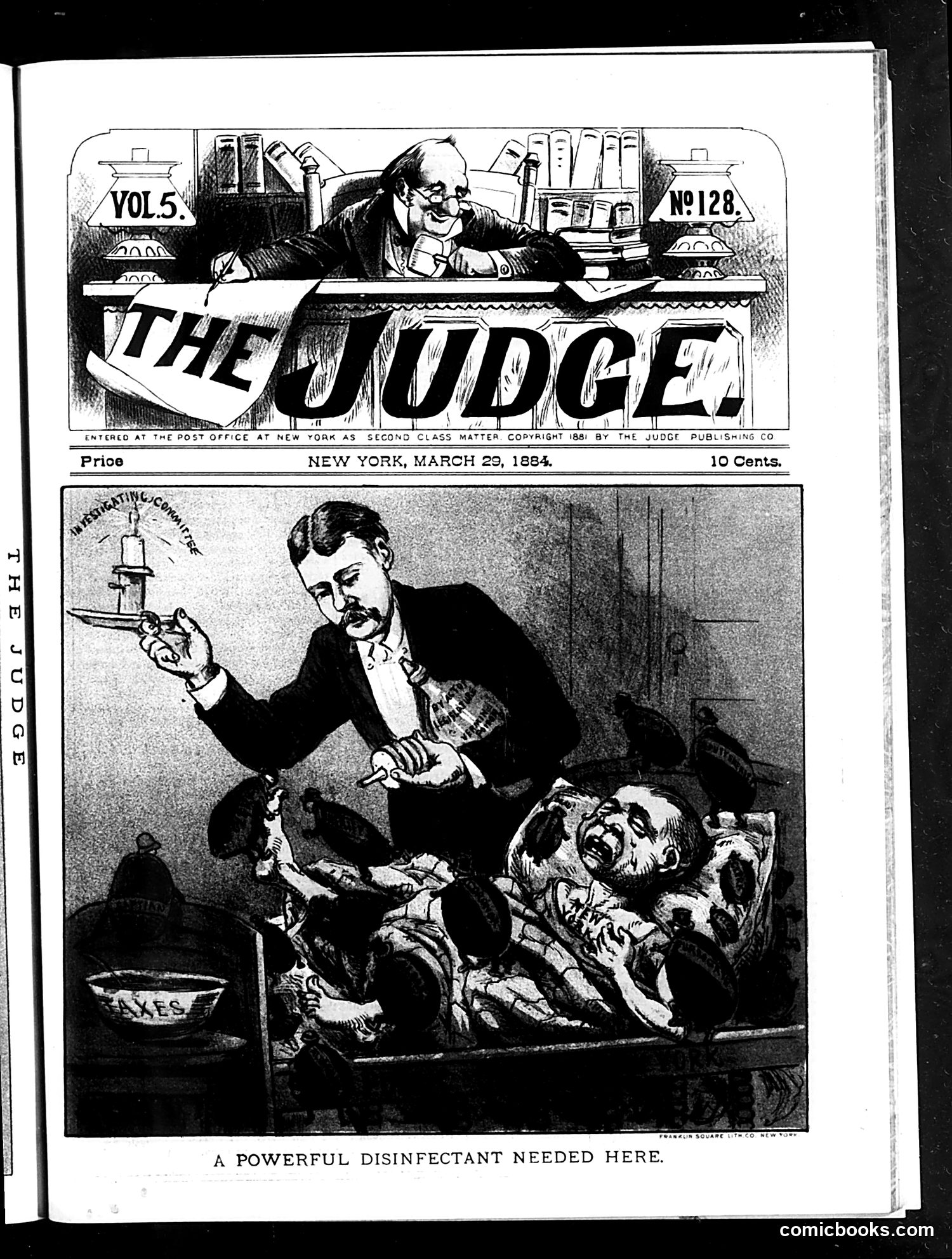
This political cartoon satirizes a physician or public health official (likely representing a contemporary political figure) performing a medical procedure on diseased patients. The caption "A Powerful Disinfectant Needed Here" uses medical metaphor to criticize corruption or social decay in New York politics or institutions. The doctor's aggressive stance—wielding a surgical instrument—suggests harsh remedies are required. The patients' distressed expressions and the clinical setting imply systemic illness requiring drastic intervention. Without identifying the specific figure depicted, the cartoon appears to advocate for aggressive reform measures against corruption or mismanagement, a common Judge magazine theme during the Gilded Age. The medical metaphor was standard satirical language for political "disease" and "cure" rhetoric of the era.
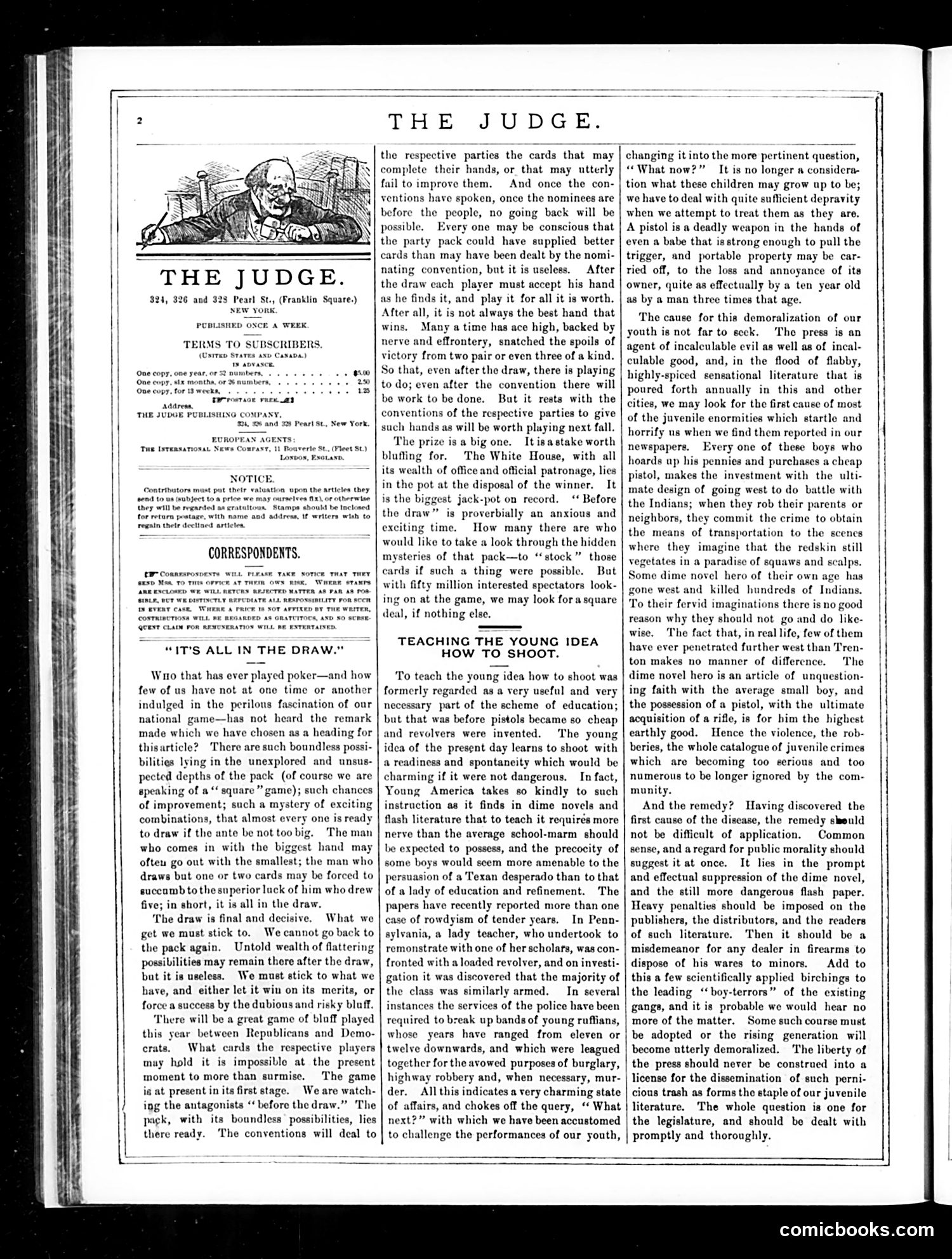
This page uses an extended **poker metaphor** to discuss the upcoming presidential election. The editorial "It's All in the Draw" compares the Republican and Democratic parties to poker players awaiting the national conventions (the "draw"). The key conceit: once the conventions nominate their candidates, the parties must "play the hand" they've been dealt, regardless of whether better options existed in the party "pack." The ultimate prize is "the biggest jack-pot on record"—the White House with its patronage and offices. The article argues that while the draw (nomination) matters, what follows requires skillful political "play." It warns against lamenting lost possibilities once nominees are chosen. The second article, "Teaching the Young Idea How to Shoot," critiques the prevalence of cheap pistols and revolvers enabling youth violence—a social problem the author argues became worse after firearms became affordable and accessible. This appears a satirical commentary on American gun culture and public safety concerns.
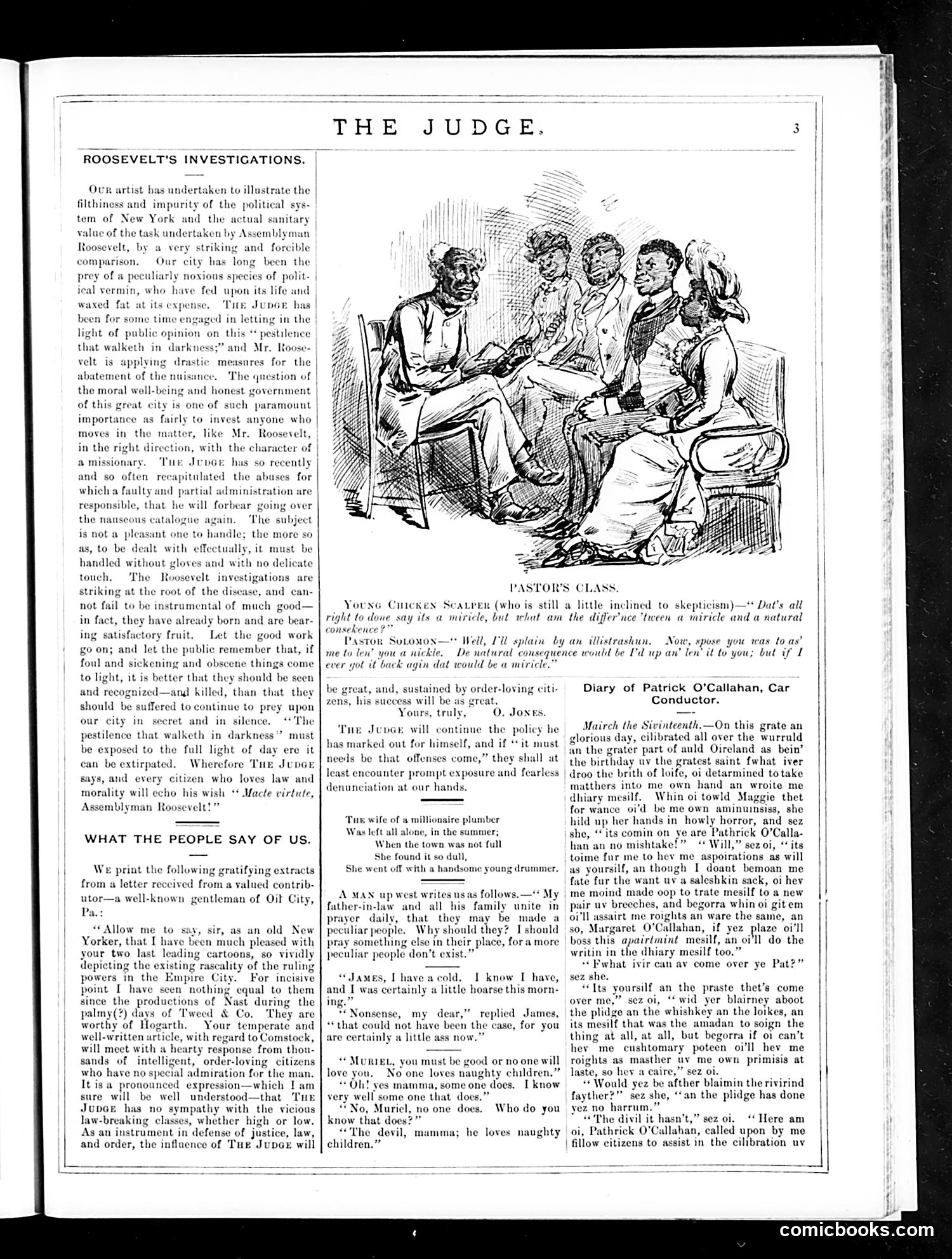
This page celebrates Assemblyman Theodore Roosevelt's anti-corruption probe into New York City politics. The main cartoon depicts Roosevelt (seated left) interrogating political figures—caricatured as parasitic "vermin" feeding on the city. The accompanying text uses metaphors of disease and filth to describe Albany's corruption, praising Roosevelt as a "missionary" applying "drastic measures" to expose wrongdoing. Judge compares his work favorably to Thomas Nast's famous Tammany Hall exposés during the Tweed Ring era. The secondary "Pastor's Class" cartoon makes a separate joke: a skeptical child asks what distinguishes miracles from natural consequences; the pastor's example is lending a nickel—getting it back would be miraculous. Reader letters praise Judge's own muckraking cartoons as matching Nast's incisiveness. The page positions Roosevelt as a reformer cleaning up systemic corruption through public exposure.
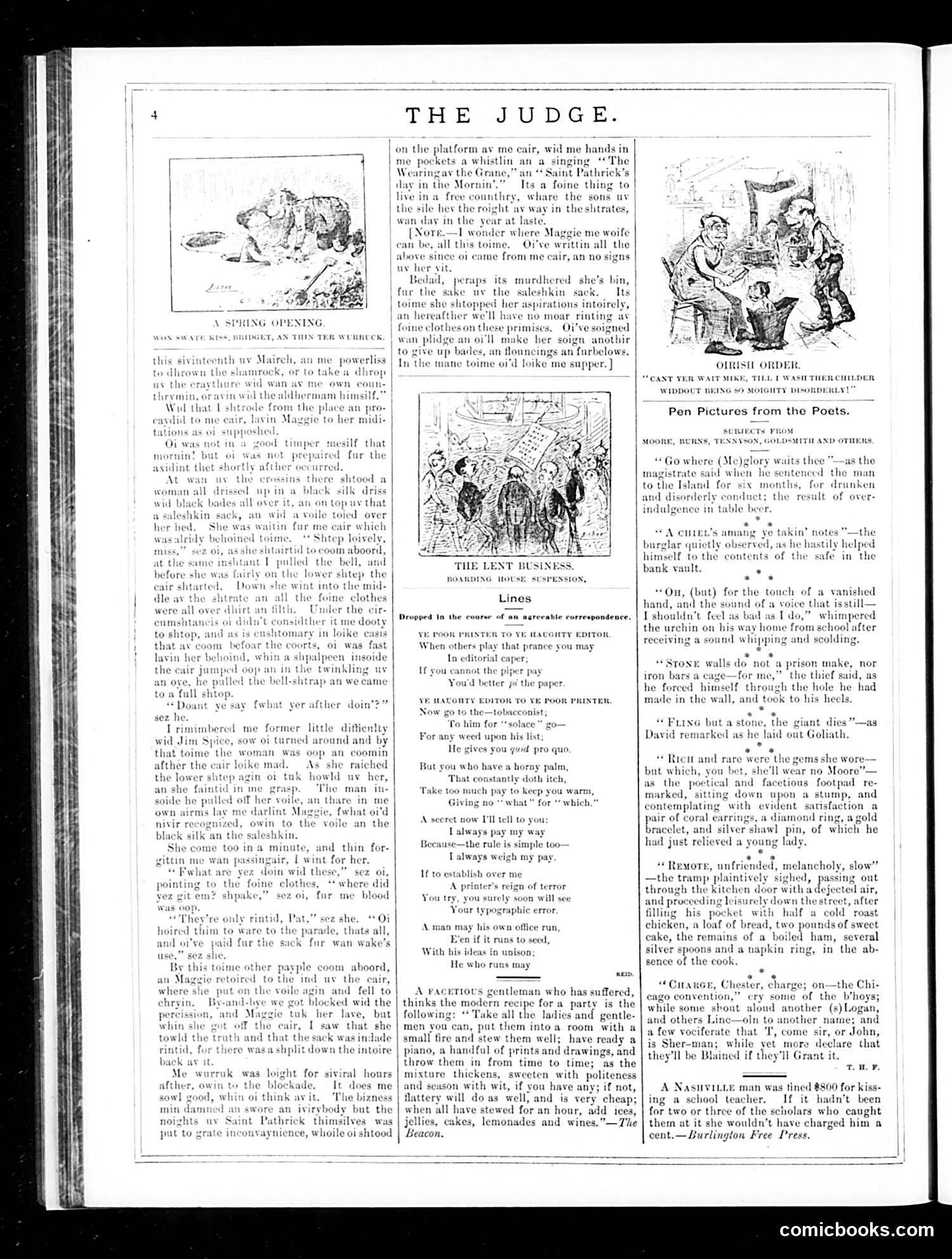
This page contains Irish-dialect humor and satirical poetry typical of late 19th-century American magazines. **Main Content:** The large left column presents a rambling Irish-accented monologue by a streetcar conductor describing a St. Patrick's Day incident involving an injured woman. The heavy dialect humor—common in the era—relies on stereotypical Irish working-class speech patterns. The narrator worries his wife Maggie hasn't returned home, suggesting domestic anxiety beneath the comedy. **"Pen Pictures from the Poets"** (right section) offers satirical brief scenarios based on famous literary quotes. These mock sentimental Victorian poetry by applying famous lines to mundane or ironic situations—a schoolboy beaten by teachers, a thief in jail—deflating the romanticism of the originals. **"Lines" section** contains satirical advice about journalism and social behavior, targeting editors, printers, and society etiquette. The overall tone is working-class vernacular humor mixed with literary satire, characteristic of Judge's approach: poking fun at both immigrant stereotypes and pretentious middle-class culture.
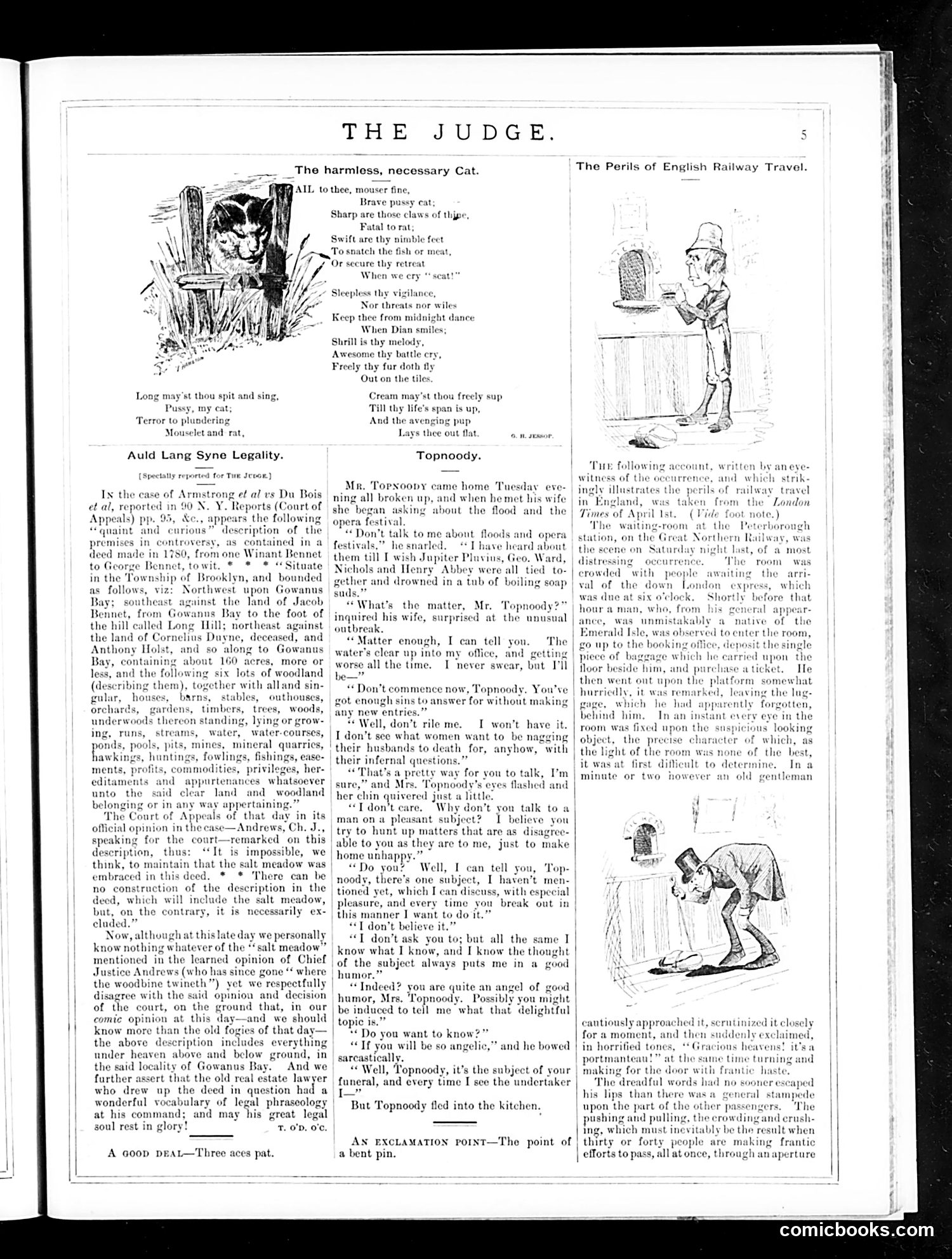
This page from *Judge* contains three distinct pieces: **"The Harmless, Necessary Cat"** (left): A sentimental poem praising cats' hunting abilities and vigilance—likely straightforward content rather than satire. **"Auld Lang Syne Legality"** (center): A satirical commentary on an 1870s property dispute case (*Arnold v. Du Bois*). The author humorously mocks the court's overly strict interpretation of an 18th-century property deed from Brooklyn. The joke: legal "fogies" missed the obvious intent of ornate legal language that "includes everything under heaven above and below ground," suggesting lawyers are unnecessarily pedantic when interpreting old documents. **"The Perils of English Railway Travel"** (right): A humorous anecdote about a commuter who discovers he's left his train ticket behind at the station. The satire targets the anxieties of Victorian-era rail travel—the new, modern transportation technology created novel social embarrassments and vulnerabilities for travelers. Both satirical pieces mock institutional rigidity: overly-literal legal interpretation and railway bureaucracy's inflexibility.
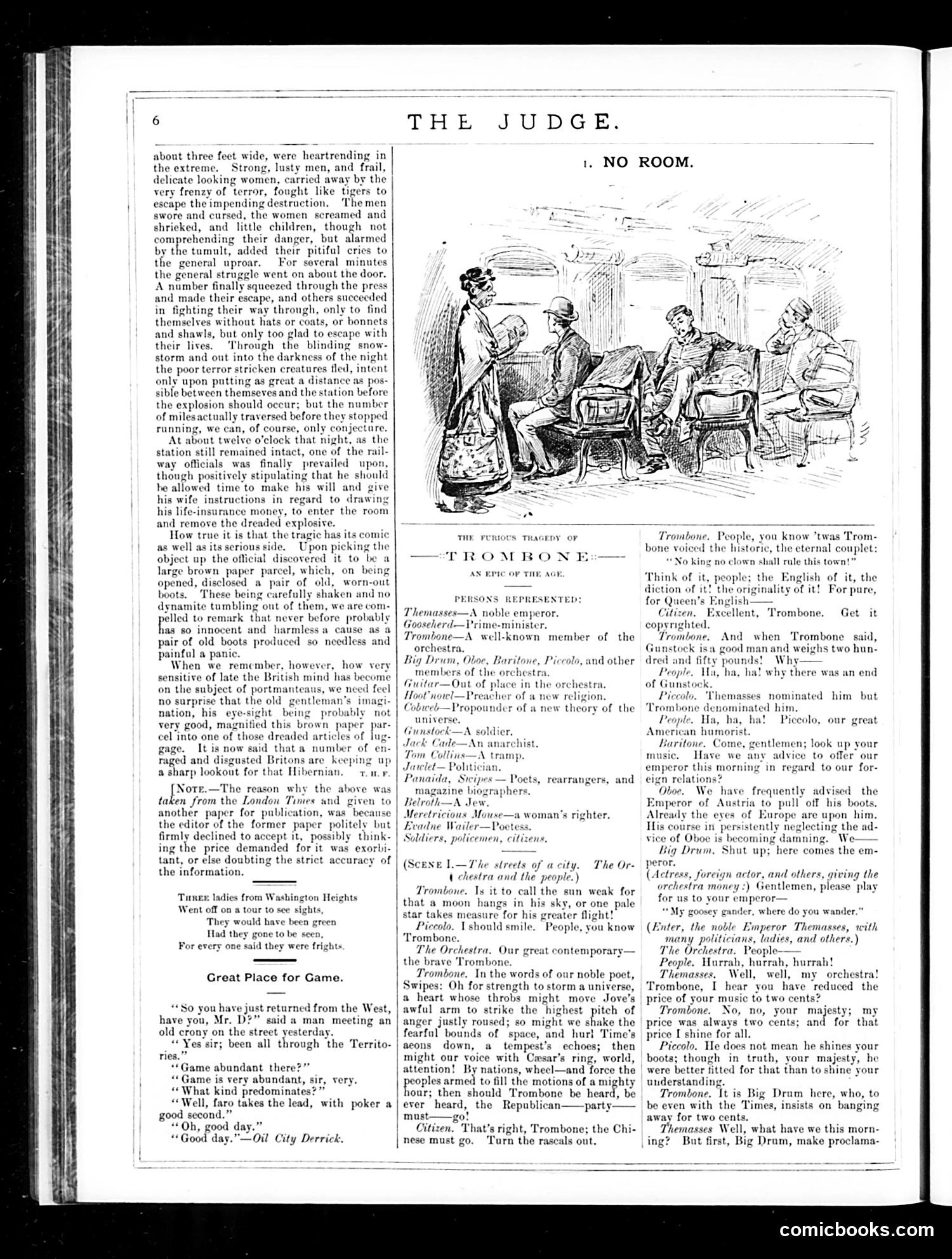
This page from the satirical magazine *Judge* contains two distinct pieces: **Main Story: "The Tragedy of Trombone"** - A mock-heroic drama poking fun at contemporary social types. The cast list lampoons various figures: "Trombone" (the central character, apparently a politician or public figure), alongside absurdist character names like "Cobweb," "Hoot-Nowl," and "Meretricious Mouse." The elaborate dramatis personae suggests satire of pretentious theatrical productions and the social movements of the era. **"No Room" Illustration** - Shows what appears to be a crowded domestic or public scene with working-class figures, likely satirizing overcrowding or social congestion—common Judge themes. **Bottom Section: "Great Place for Game"** - A brief dialogue joke about Western territories where "faro takes the lead, with poker a good second"—satirizing gambling prevalence in frontier regions. The overall page reflects *Judge's* characteristic blend of social satire, class commentary, and absurdist humor targeting contemporary American society.
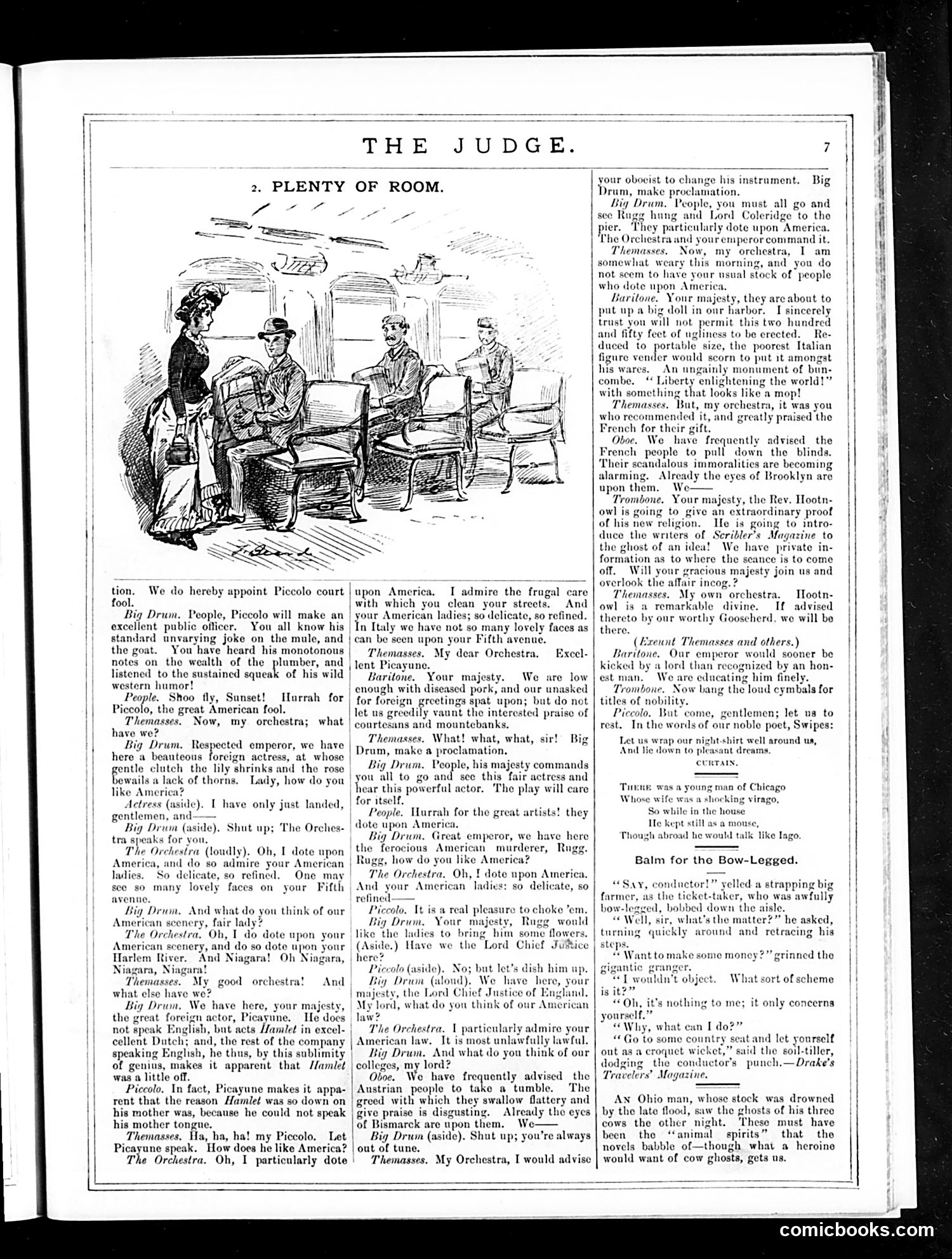
This satirical sketch mocks American eagerness to celebrate visiting celebrities and dignitaries while ignoring—or being flattered by—their contempt for American society. **The Setup:** A foreign emperor tours America with his entourage (an orchestra, actress, murderer, and English judge). Each visitor offers extravagant praise for American scenery, streets, and women while making backhanded insults. **The Satire:** American hosts eagerly accept these compliments despite their obvious insincerity and condescension. The "Themasses" (representing common Americans) initially object to courting praise from "courtesans and mountebanks," but are overruled. The emperor then commands citizens to see the murderer and actress perform. **The Point:** Judge satirizes American social climbing and desperation for foreign validation—the willingness to be fleeced and insulted by European visitors simply because they're foreign and prestigious. The repetitive "I dote upon America" becomes absurd mockery of hollow flattery masking actual disdain.
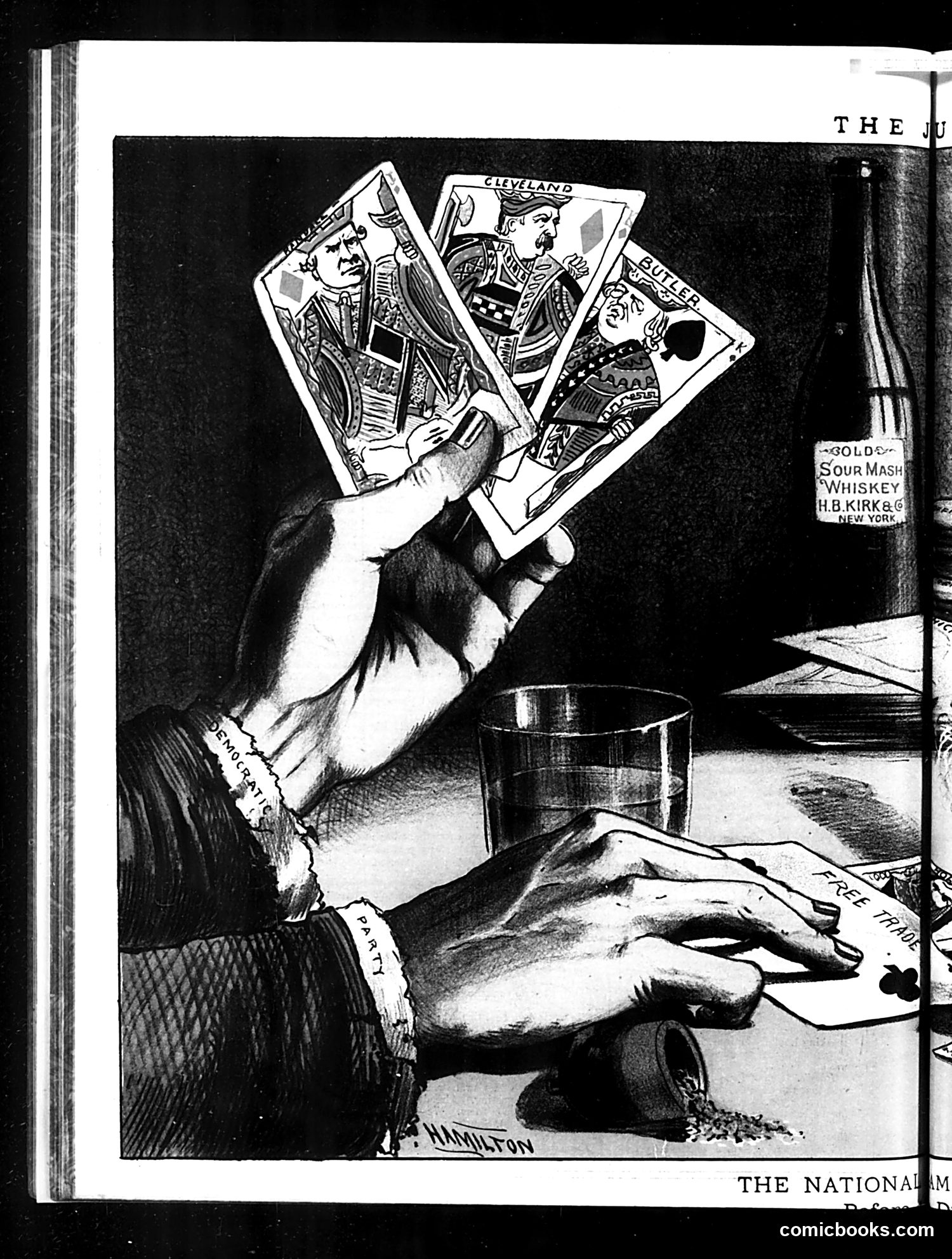
This cartoon by Hamilton depicts a man in formal attire holding three playing cards labeled with city names: one appears to read "Cleveland," another "Butler," suggesting these are political figures or locations. A whiskey bottle labeled "H.B. Kirk & Co., New York" sits nearby, along with a glass and scattered cards on the table. The satire likely concerns political gambling or corruption—the playing cards may represent political "players" or candidates being shuffled like a card game. The whiskey suggests backroom dealing or questionable dealings conducted in smoky rooms. However, without clearer OCR text or additional context, the specific political situation or figures being mocked remain uncertain. The cartoon appears to critique machine politics or political manipulation of the era.
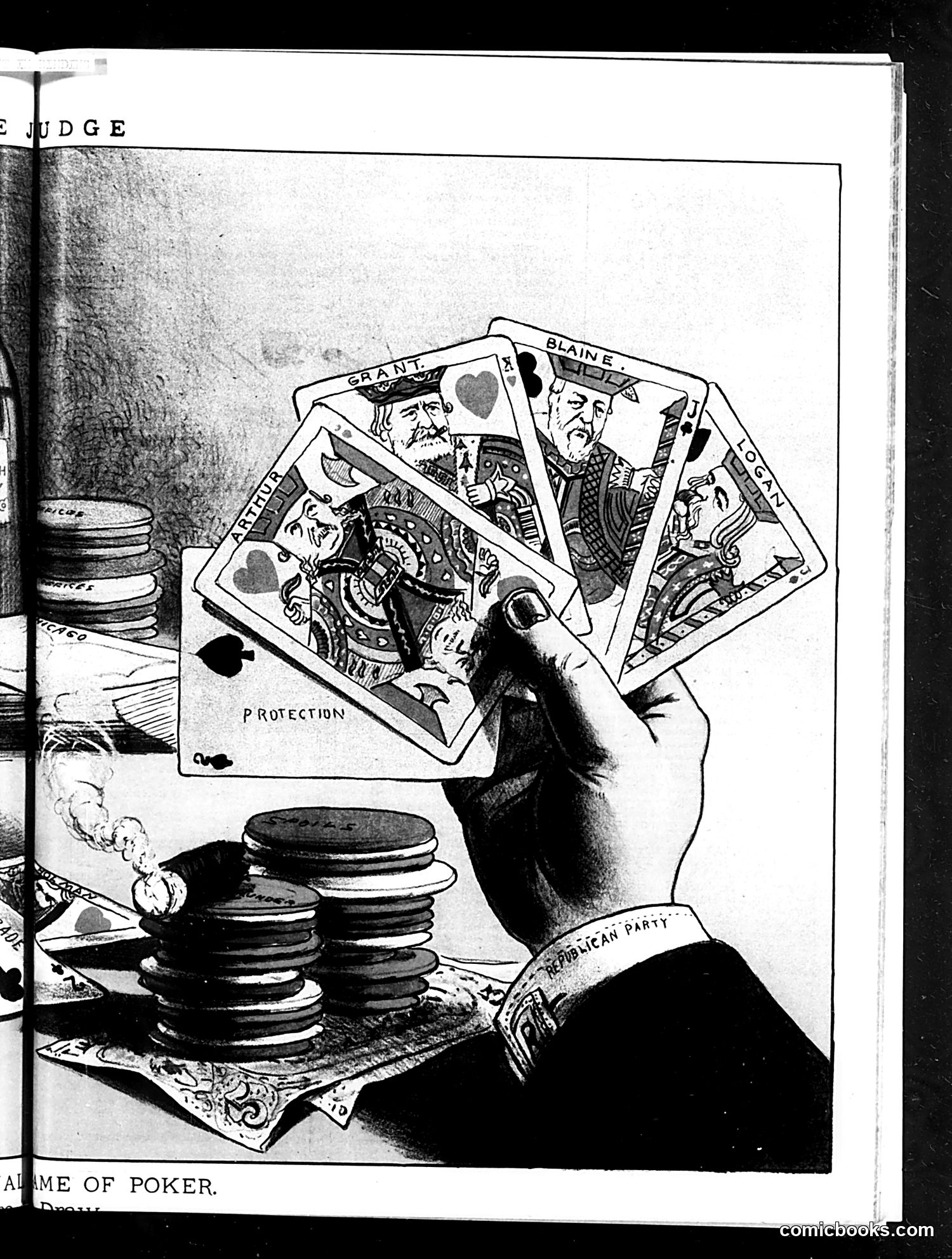
This cartoon satirizes Republican Party politics as a rigged card game. A hand labeled "Republican Party" holds playing cards showing the faces of prominent Republican figures including Grant and Blaine. The cards are labeled "Protection" (referring to protective tariffs, a key Republican policy). Stacks of poker chips sit on the table, suggesting money and corruption. The satire implies Republicans are manipulating their political "cards" (their candidates and policies) to win power and profits—treating politics like a fixed gambling game rather than honest governance. The cartoon likely dates to the late 19th century, when tariff policy and Republican leadership were contentious political issues. The joke targets Republican hypocrisy: they claim moral authority while engaging in cynical political maneuvering for financial gain.
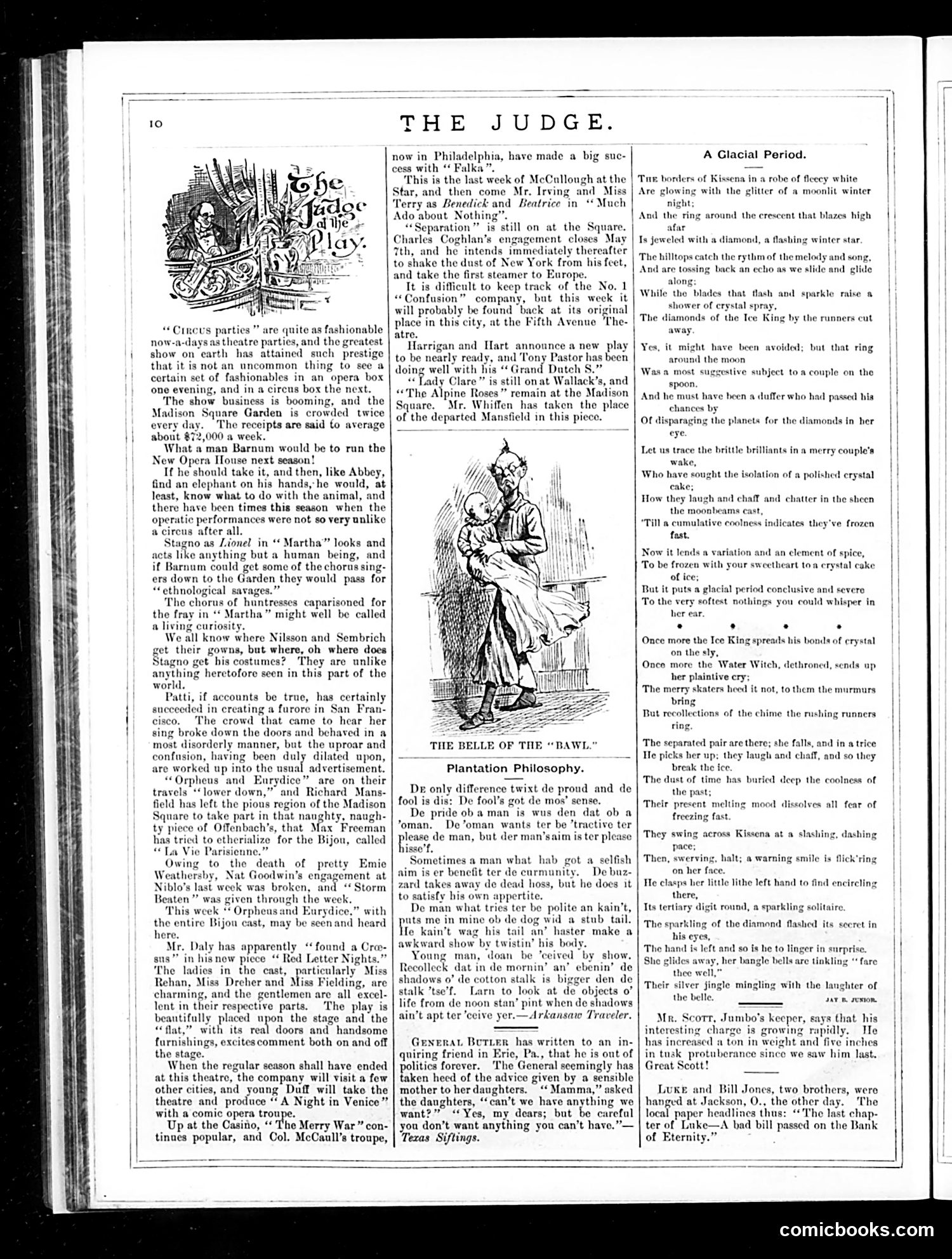
This page mixes theater gossip with a satirical illustration titled "The Belle of the 'Bawl.'" The cartoon depicts an elegantly dressed woman holding a fussy infant, likely mocking fashionable society women who attend both opera and circus—a newly trendy "slumming" practice. The article notes that circus attendance has become as socially acceptable as theater-going among the wealthy elite. The extensive text column is theater criticism covering 1880s New York performances: operatic stars (Nilsson, Patti, Sembrich), actors like Henry Irving and Ellen Terry, and various productions at venues like Madison Square Garden and Wallack's Theatre. Judge's satirist pokes fun at the operatic world—mocking Stagno's ridiculous costumes and questioning where performers source their wardrobes—while celebrating the booming "show business" generating $72,000 weekly at Madison Square Garden. The satire targets the artificiality and pretension of both high society and theatrical culture.
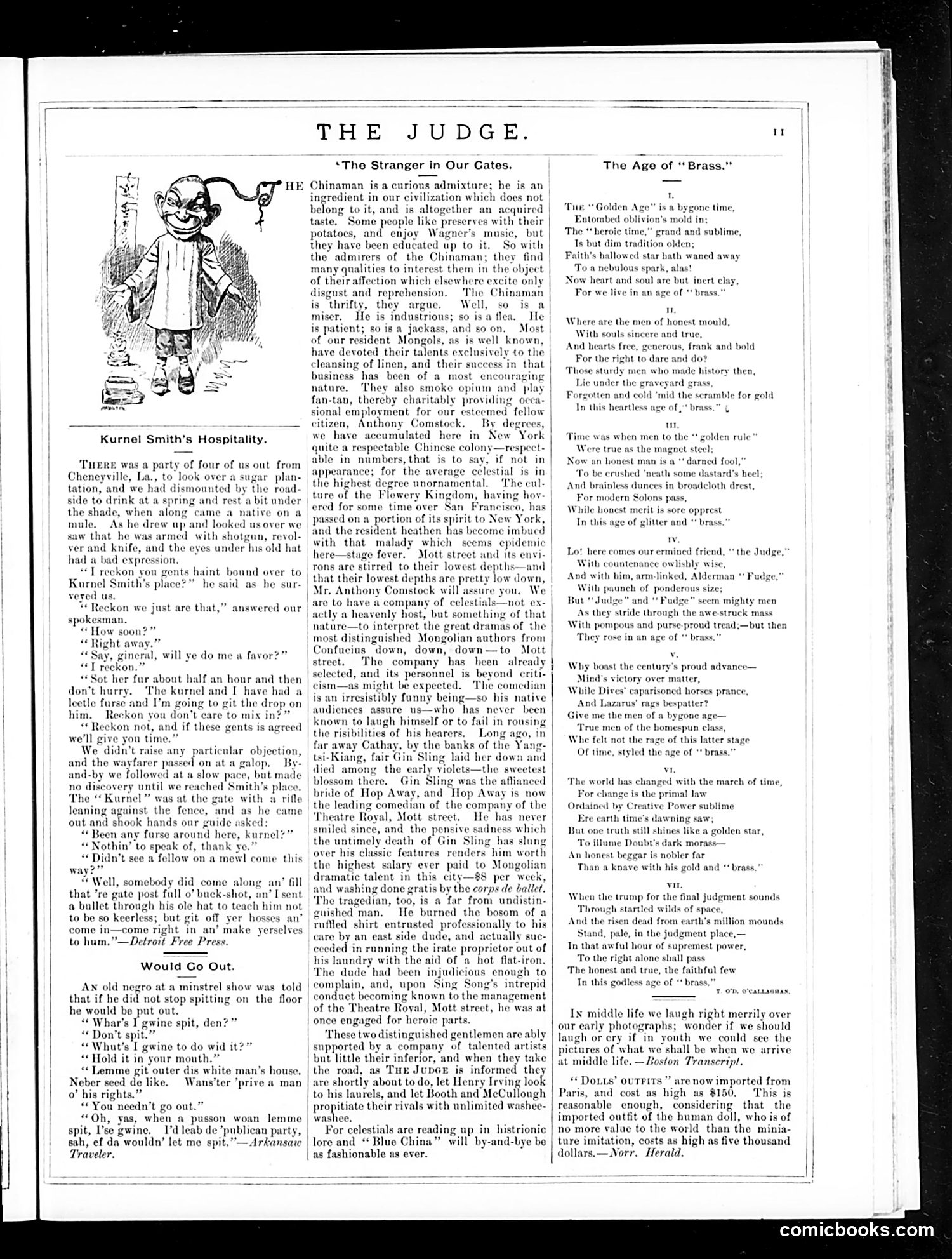
This page contains two separate pieces of satirical humor typical of Judge magazine's approach to social issues. **"The Stranger in Our Gates"** mocks both Chinese immigrants and their American admirers. The text sarcastically praises Chinese workers—calling them "thrifty" (like a miser) and "industrious" (like a flea)—while depicting them as undesirable additions to civilization. The piece criticizes wealthy New Yorkers who romanticize Chinese culture while the actual Chinese residents are portrayed as opium smokers and gambling enthusiasts ("fan-tan") requiring moral supervision by Anthony Comstock (a real contemporary anti-vice crusader). The piece expresses xenophobic anxiety about a "respectable Chinese colony" forming in New York's Mott Street neighborhood. **"Kurnel Smith's Hospitality"** is a humorous anecdote about Southern frontier justice, while **"Would Go Out"** is a minstrel-show joke using racist dialect humor about a Black man's supposed attachment to spitting rights. All reflect period attitudes: xenophobia toward Chinese immigrants, celebration of rough Southern violence, and casual racial mockery.
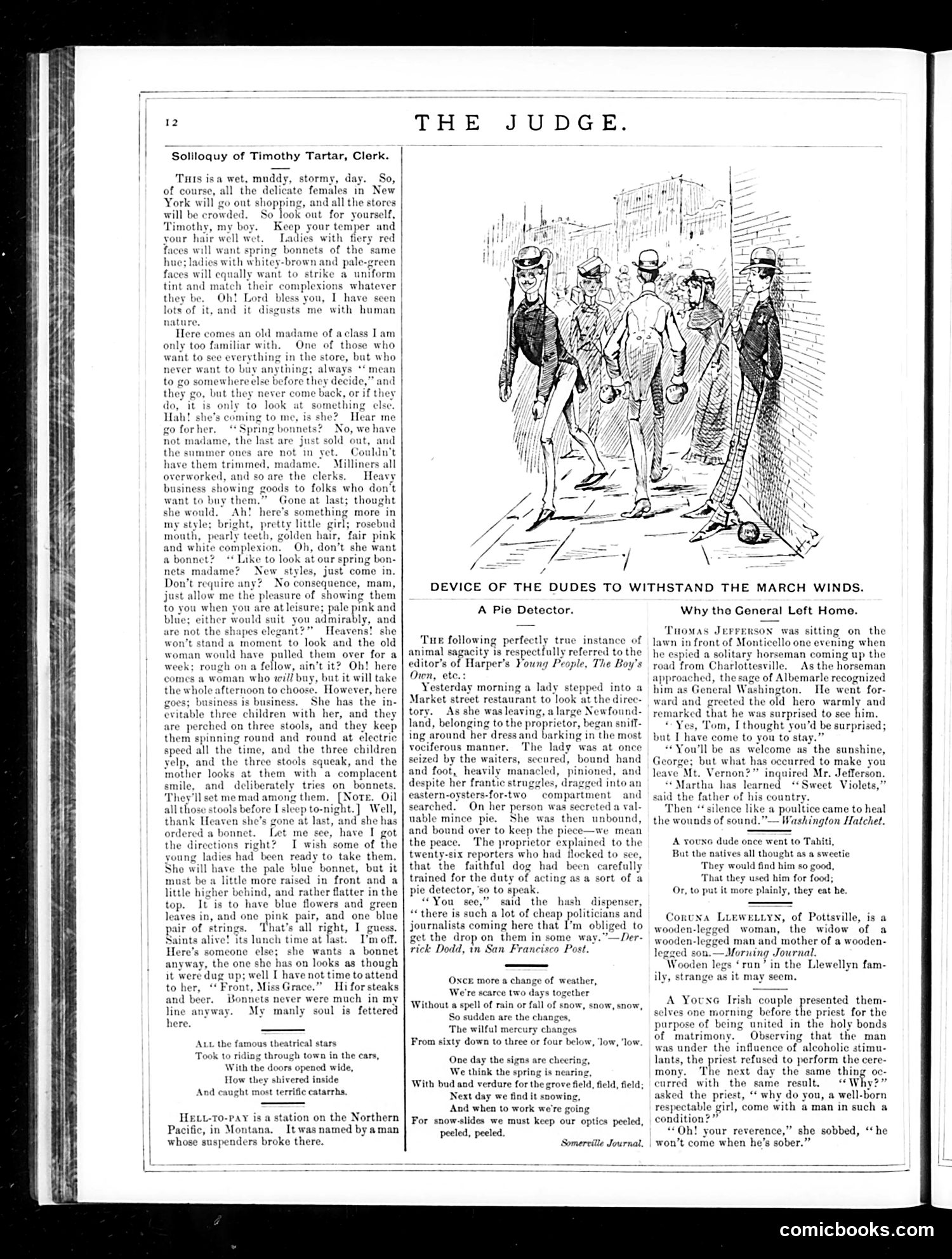
This page from *Judge* magazine contains three distinct satirical pieces: **Main Feature: "Soliloquy of Timothy Tartar, Clerk"** - A monologue from a department store clerk enduring a rainy shopping day. The satire targets female shoppers' behavior: women who browse extensively without buying, constantly change their minds about bonnets and accessories, and waste clerks' time. The piece mocks the absurdity of detailed fashion preferences (matching bonnet colors to complexion tints) and women's perceived indecisiveness. **"Device of the Dudes to Withstand the March Winds"** - A small illustration showing men in hats bracing against wind, satirizing fashionable gentlemen ("dudes") and their affected concern with appearance. **"A Pie Detector"** and **"Why the General Left Home"** - Brief anecdotal humor pieces poking fun at domestic situations and practical mishaps. The overall tone reflects 19th-century attitudes stereotyping female consumers as frivolous and irrational, while mocking male vanity and poor decision-making.
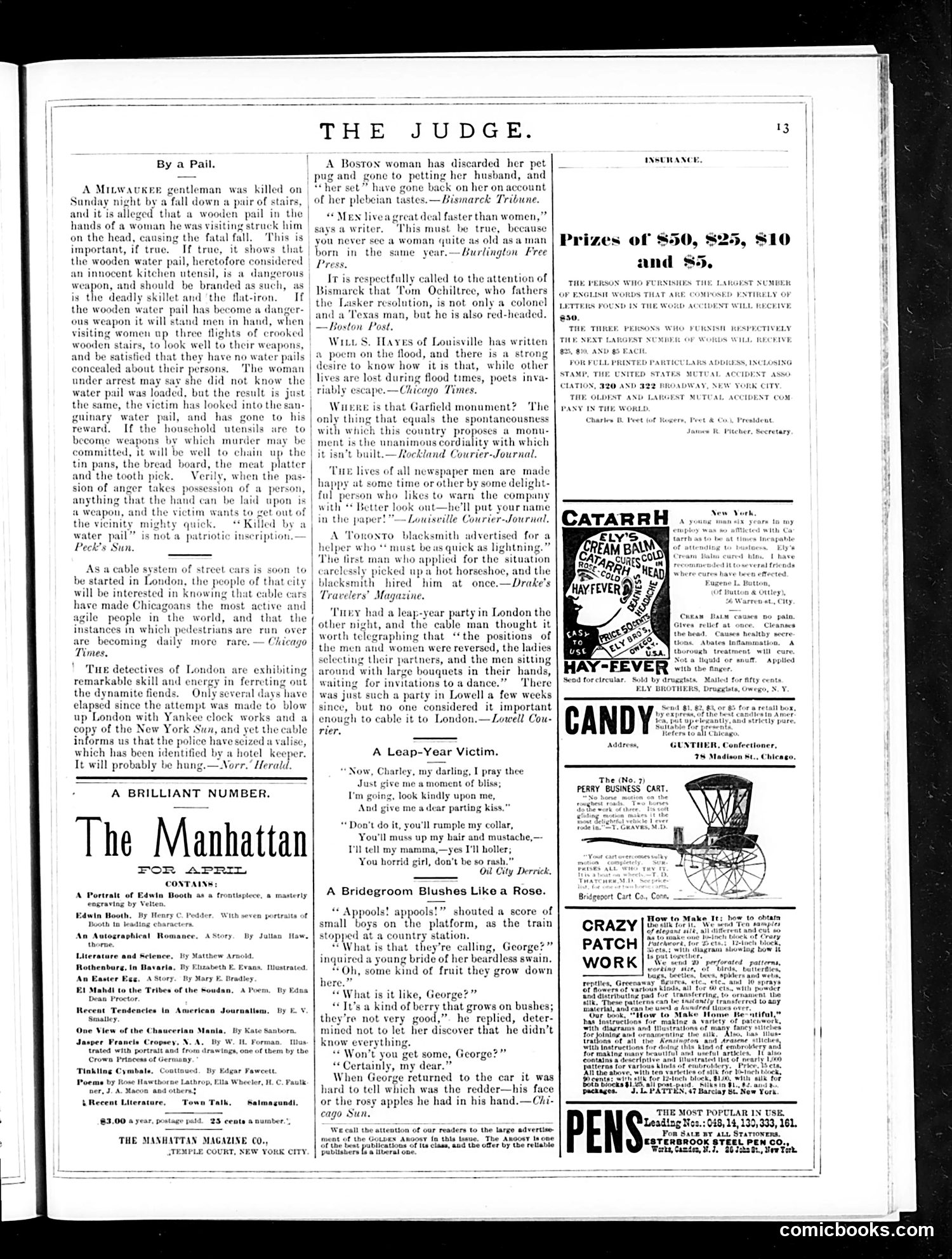
This page from *Judge* magazine contains brief satirical news items and advertisements rather than formal political cartoons. **"By a Pail"** mockingly reports a Milwaukee man's death from a fall, sarcastically suggesting that household items like water pails have become "dangerous weapons" requiring regulation alongside "deadly skillet[s]" and flat-irons. The satire critiques overreaction to a domestic accident—treating ordinary kitchen equipment as threatening weapons. **Other brief items** include jokes about: - A Boston woman preferring her husband to her pet pug - Gender observations about aging - References to a "Lasker resolution" involving Colonel Tom Ochiltree (identified as red-headed, suggesting stereotypes) - Complaints about the slow progress of a Garfield monument These are light, cynical observations on contemporary social news—typical of *Judge's* satirical format. The humor relies on absurdist exaggeration and wordplay rather than specific political figures or major events. The page is primarily filler material alongside advertisements for products like "Crazy Patch Work" and pen refills.
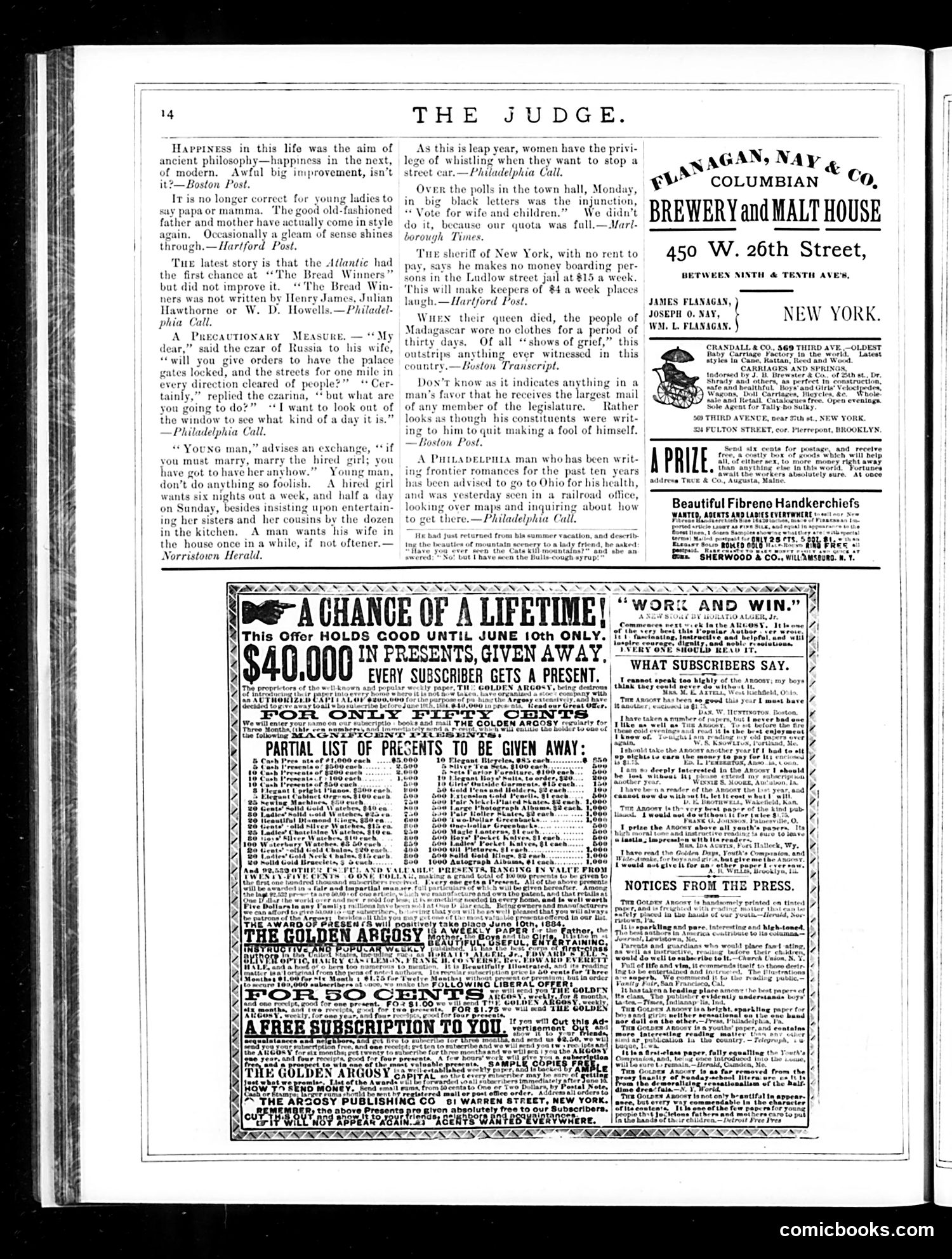
This page from **Judge** magazine (a satirical weekly) consists primarily of **short humor items and advertisements** rather than traditional political cartoons. The humor pieces are brief, witty observations on contemporary social issues: - **Gender/courtship satire**: Jabs at women's newfound boldness in leap year, critiques of marriage's practical demands - **Political/civic commentary**: References to Russian autocracy (the Czar's paranoia), New York jail economics, and election procedures - **Literary mockery**: A jab at frontier romance writer's need to actually visit Ohio for authenticity The page's dominant visual element is a massive **advertisement for "The Golden Argosy,"** a competing magazine offering $40,000 in prizes for subscriptions—reflecting the fierce circulation wars between 19th-century periodicals. Overall, this represents Judge's typical content: **lightweight social satire targeting middle-class American readers**, rather than hard-hitting political cartooning. The tone is gently mocking of contemporary manners, institutions, and pretensions.
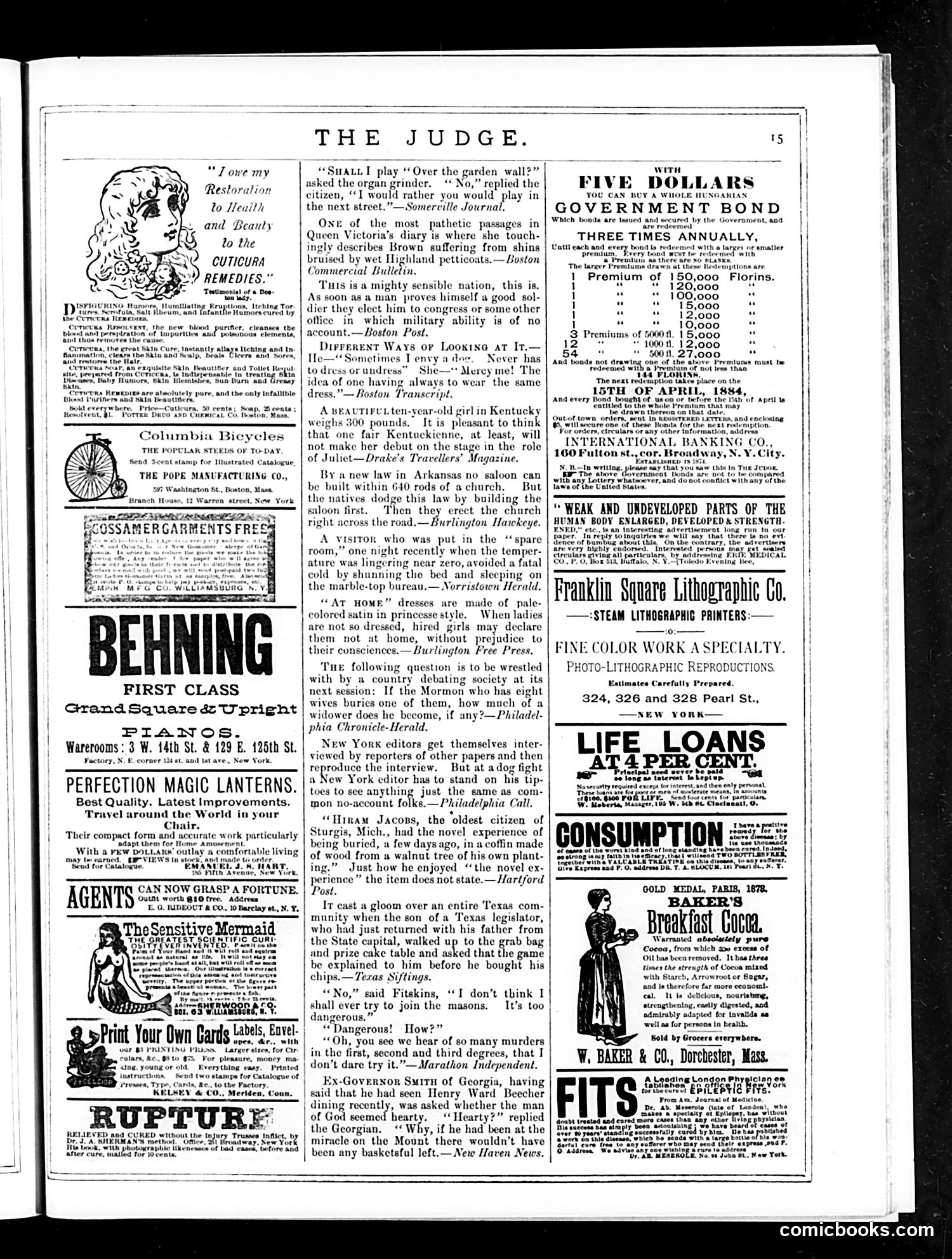
This is primarily a **humor/joke compilation page** from Judge magazine, featuring brief satirical items rather than political cartoons. The jokes target various social absurdities of the era: **Key items visible:** - A quip about Queen Victoria's servant John Brown and Highland petticoats (referencing the famous scandal around Victoria's close relationship with her Scottish attendant) - Mockery of Arkansas's hypocrisy: passing laws against saloons near churches, then building saloons first and churches second to circumvent them - Satire on New York editors' pretentiousness - Absurdist humor about Mormon polygamy and burial customs - A joke about a Texas legislator's son asking rules before gambling at a church bazaar **The page's purpose:** General social satire and ridicule of contemporary American life—legislative stupidity, regional oddities, class pretension, and moral hypocrisy. The surrounding **advertisements** (pianos, bicycles, remedies) reflect 1880s consumer culture. This represents Judge's typical format: irreverent commentary on news, manners, and public figures through short comic items.
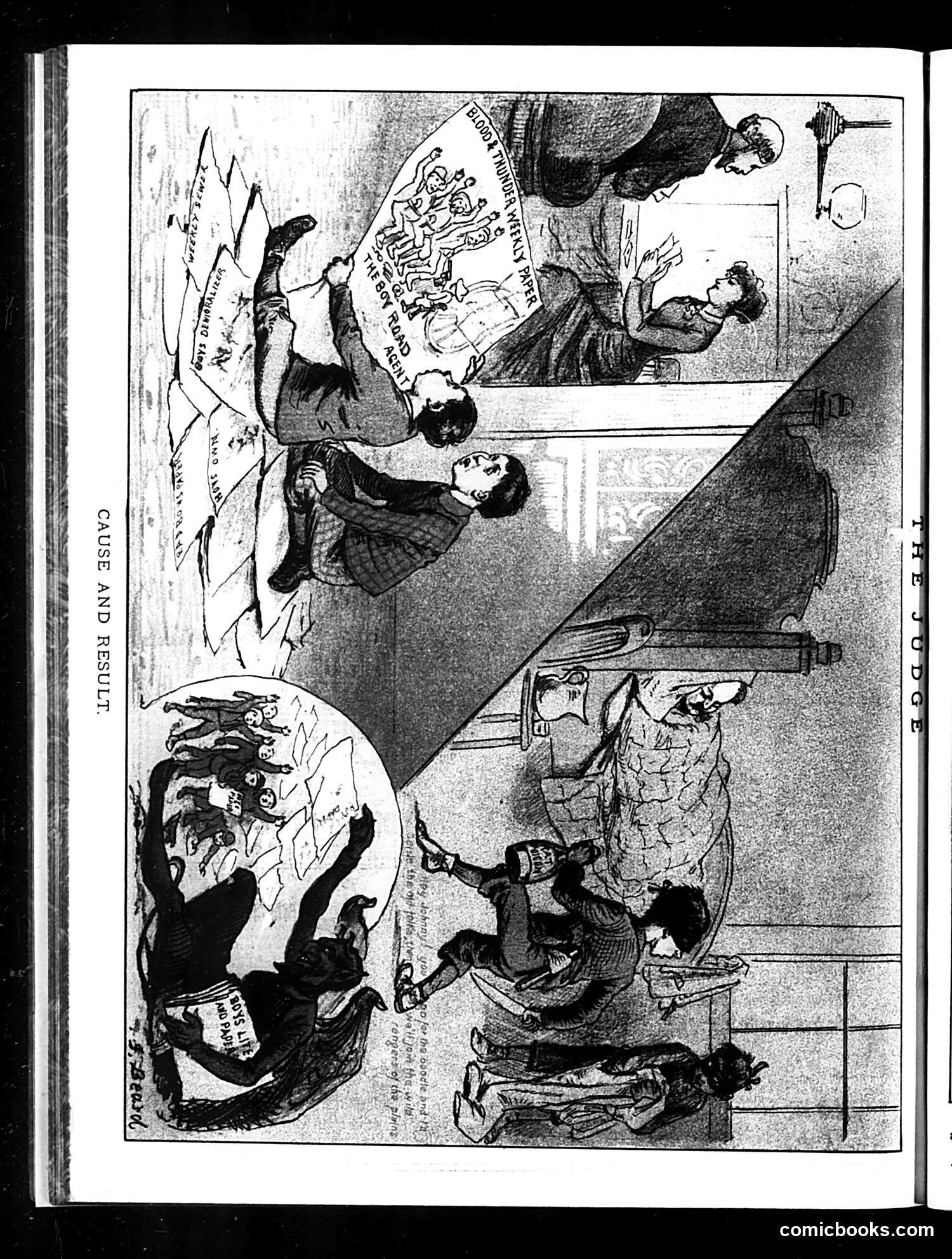
This political cartoon satirizes the consequences of some implied cause-and-effect relationship, though the specific historical reference is unclear from the visible text. The page shows multiple scenes depicting chaos and destruction: figures appear to be rioting or in conflict, with what looks like property damage and violence across different vignettes. The title "CAUSE AND RESULT" suggests the cartoon contrasts an initial action or policy with its disastrous outcomes. The style and imagery suggest late 19th or early 20th-century American politics, possibly addressing labor unrest, immigration policy, or social upheaval, but without clearer text or identifying labels on the figures, the specific political critique cannot be determined with certainty.