
Judge, 1884-03-29 · page 2 of 16
Judge — March 29, 1884 — page 2: what you’re looking at
What you’re looking at
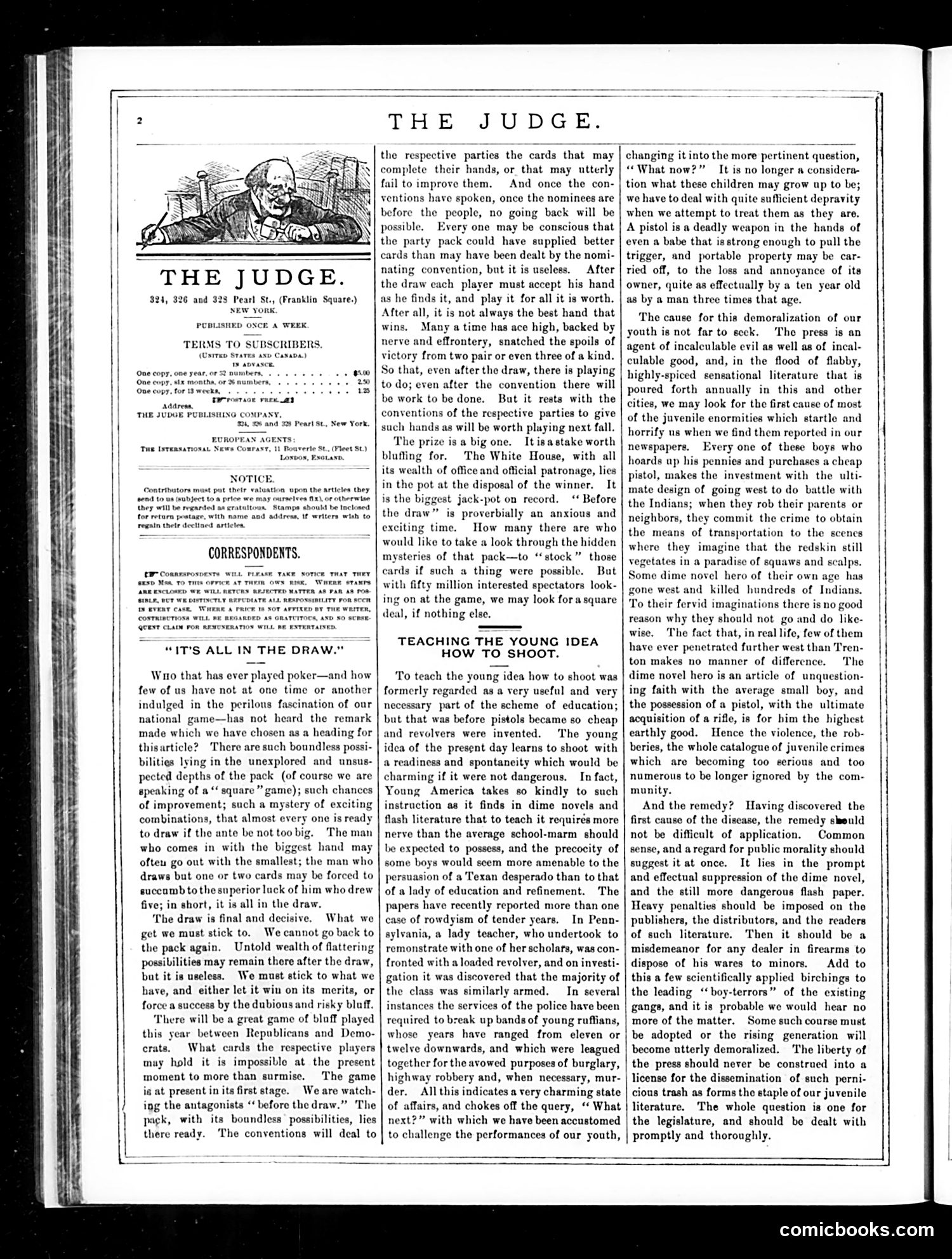
This page uses an extended **poker metaphor** to discuss the upcoming presidential election. The editorial "It's All in the Draw" compares the Republican and Democratic parties to poker players awaiting the national conventions (the "draw"). The key conceit: once the conventions nominate their candidates, the parties must "play the hand" they've been dealt, regardless of whether better options existed in the party "pack." The ultimate prize is "the biggest jack-pot on record"—the White House with its patronage and offices. The article argues that while the draw (nomination) matters, what follows requires skillful political "play." It warns against lamenting lost possibilities once nominees are chosen. The second article, "Teaching the Young Idea How to Shoot," critiques the prevalence of cheap pistols and revolvers enabling youth violence—a social problem the author argues became worse after firearms became affordable and accessible. This appears a satirical commentary on American gun culture and public safety concerns.
📄 Transcribed text from this page (OCR, searchable)
Machine-transcribed from the original scan — historical spelling and the odd misread are preserved.
THE JUDGE. 824, 326 and 323 Pearl St., (Franklin Square.) TERMS TO SUBSCRIBERS. THE JUDGE PUBLISHING COMPANY, J. <8 and 2 Pearl St, New York. NOTICE. Contributors must put thelr ratuation upon the WT AVVIXED BY THE ORATTITOCA, AND XO SCRE QUENT CLAIM FOR REXUNERATION WILL REE EXTRRTAINED. “IT’S ALL IN THE DRAW.” Wno that has ever played poker—and how few of us have not at one time or another indulged in the perilous fascination of our national game—has not heard the remark made which we have chosen as a heading for thisarticle? There are such boundless possi- bilities lying in the unexplored and unsus- pected depths of the pack (of course we are speaking of a“ square” game); such chances of improvement; such a mystery of exciting combinations, that almost every one is ready to draw if the ante be not too big. The man who comes in with the biggest hand may ofteu go out with the smallest; the man who draws but one or two cards may be forced to succamb to the superior luck of him who drew five; in short, it is all in the draw. he draw is final and decisive. What we get we must stick to. We cannot go back to the pack again. Untold wealth of flattering i jes may remain there after the draw, but it is useless. We must stick to what we have, and either let it win on its merits, or force a success by the dubious and risky bluff. There will be a great game of bluff played this year between Republicans and Demo- crats. What cards the respective players muy hold it is impossible at the present moment to more than surmise. The game ie at present in its first stage. We are watch- ing the antagonists “before thedraw.” The pack, with its boundless possibilities, lies there ready. ‘The conventions will deal to THE JUDGE. the respective parties the cards that may complete their hands, or that may utterly And once the con- fail to improve them. ventions have spoken, once the nominees are before the people, no going back will be Every one may be conscious that the party pack could have supplied better possible. cards than may have been dealt by the nomi- nating convention, but it is useless. the draw cach player must accept his hand as he finds it, and play it for all it is worth. After all, it is not always the best hand that wins, Many a time has ace high, backed by nerve and effrontery, snatched the spoils of victory from two pair or even three of a kind. So that, even after the draw, there is playing to do; even after the convention there will be work to be done. But it rests with the conventions of the respective parties to g such hands as will be worth playing next fall. The prize is a big one. It isastake worth bluffing for, The White House, with all its wealth of office and official patronage, lies in the pot at the disposal of the winner. It is the biggest jack-pot on record. ‘“ Before the draw” is proverbially an anxious and exciting time. How many there are who would like to take a look through the hidden mysteries of that pack—to “stock” those cards if such a thing were possible. But with fifty million interested spectators look- ing on at the game, we may look fora square deal, if nothing else. TEACHING THE YOUNG IDEA HOW TO SHOOT. To teach the young idea how to shoot was formerly regarded as a very useful and very necessary part of the scheme of education; but that was before pistols became so cheap and revolvers were invented. The young idea of the present day learns to shoot with a readiness and spontaneity which would be charming if it were not dangerous. In fact, Young America takes so kindly to such instruction as it finds in dime novels and flash literature that to teach it requires more nerve than the average school-marm should be expected to possess, and the precocity of some boys would seem more amenable to the persuasion of a Texan desperado than to that of a lady of education and refinement. The papers have recently reported more than one case of rowdyism of tender years. In Penn- sylvania, a lady teacher, who undertook to remonstrate with one of her scholars, was con- fronted with a loaded revolver, and on investi- gation it was discovered that the majority of the class was similarly armed. In several instances the services of the police have been required to break up bands of young ruffians, whose years have ranged from eleven or twelve downwards, and which were leagued together for the avowed purposes of burglary, highway robbery and, when necessary, mur- der. All this indicates a very charming state of affairs, and chokes off the query, “ What next?” with which we have been accustomed to challenge the performances of our youth, After © changing it into the more pertinent question, “What now?” It is no longer a considera tion what these children may grow up to be; we have to deal with quite sufficient depravity when we attempt to treat them as they are. A pistol is a deadly weapon in the hands of even a babe that is strong enough to pull the trigger, and portable property may be car- ried off, to the loss and annoyance of its owner, quite as effectually by a ten year old as by a man three times that age. The cause for this demoralization of our youth is not farto scck. ‘The press is an agent of incalculable evil as well as of incal- culable good, and, in the flood of flabby, highly-spiced sensational literature that is poured forth annually in this and other cities, we may look for the first cause of most of the juvenile enormities which startle and horrify us when we find them reported in our newspapers. Every one of these boys who hoards up his pennies and purchases a cheap pistol, makes the investment with the ulti- mate design of going west to do battle with the Indians; when they rob their parents or neighbors, they commit the crime to obtain the means of transportation to the scenes where they imagine that the redskin still vegetates in a paradise of squaws and scalps. Some dime novel hero of their own age has gone west and killed hundreds of Indians. To their fervid imaginations there is no good reason why they should not go and do like- wise. The fact that, in real life, few of them have ever penetrated further west than Tren- ton makes no manner of difference. The dime novel hero is an article of unquestion- ing faith with the average small boy, and the possession of a pistol, with the ultimate acquisition of a rifle, is for him the highest earthly good. Hence the violence, the rob- beries, the whole catalogue of juvenile crimes which are becoming too serious and too numerous to be longer ignored by the com- munity. And the remedy? Having discovered the first cause of the disease, the remedy sleuld not be difficult of application. Common sense, and a regard for public morality should suggest it at once. It lies in the prompt and effectual suppression of the dime novel, and the still more dangerous flash paper. Heavy penalties should be imposed on the publishers, the distributors, and the readers of such literature. Then it should be a misdemeanor for any dealer in firearms to dispose of his wares to minors. Add to this a few scientifically applied birchings to the leading “boy-terrors” of the existing gangs, and it is probable we would hear no more of the matter. Some such course must be adopted or the rising generation will become utterly demoralized. The liberty of the press should never be construed into a license for the dissemination of such perni- cious trash as forms the staple of our juvenile literature. The whole question is one for | the legislature, and should be dealt with | promptly and thoroughly. comicbooks.com