
Judge, 1884-03-29 · page 11 of 16
Judge — March 29, 1884 — page 11: what you’re looking at
What you’re looking at
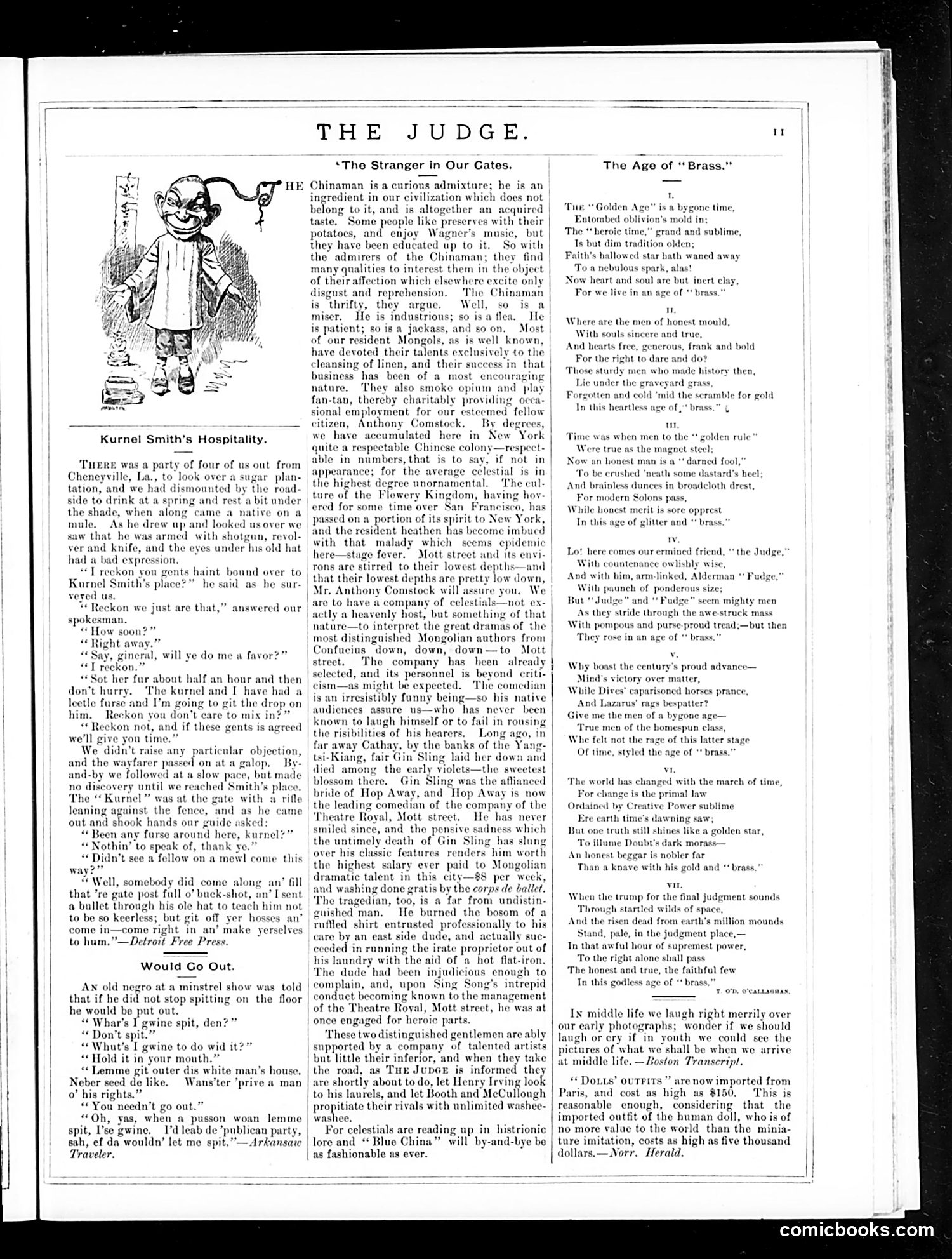
This page contains two separate pieces of satirical humor typical of Judge magazine's approach to social issues. **"The Stranger in Our Gates"** mocks both Chinese immigrants and their American admirers. The text sarcastically praises Chinese workers—calling them "thrifty" (like a miser) and "industrious" (like a flea)—while depicting them as undesirable additions to civilization. The piece criticizes wealthy New Yorkers who romanticize Chinese culture while the actual Chinese residents are portrayed as opium smokers and gambling enthusiasts ("fan-tan") requiring moral supervision by Anthony Comstock (a real contemporary anti-vice crusader). The piece expresses xenophobic anxiety about a "respectable Chinese colony" forming in New York's Mott Street neighborhood. **"Kurnel Smith's Hospitality"** is a humorous anecdote about Southern frontier justice, while **"Would Go Out"** is a minstrel-show joke using racist dialect humor about a Black man's supposed attachment to spitting rights. All reflect period attitudes: xenophobia toward Chinese immigrants, celebration of rough Southern violence, and casual racial mockery.
📄 Transcribed text from this page (OCR, searchable)
Machine-transcribed from the original scan — historical spelling and the odd misread are preserved.
THE JUDGE. “The Stranger in Our Cates. HE Chinaman is a curious admixture; he is an Kurnel Smith’s Hospitality. Tuere was a party of four of us out from Cheneyville, La., to look over a sugar plan- nd we had dismounted by the road- side to drink at a spring and rest a bit under the shade, when along came a native on a mule. As he drew up and looked us over we saw that he was armed with shotgun, revol- ver and knife, and the eyes under his old hat had a bad expression. T reckon you gents haint bound over to Kurnel Smith’s place?” he said as he sur- vered us. “Reckon we just are that,” pkesman. “How soon? “Right away ’, gineral, will ye do me a favor?” “T reckon, “Sot her fur about half an hour and then don’t hurry. ‘The kurnel and I ha leetle furse and I’m going to git the dr him. Reekon you don’t care to mix in?” Reckon noi, and if these gents is agreed we'll give you time.” We didi’t raise any particular objection, and the wayfarer passed on at a galop. By- and-by we followed at a slow pace, but made no discovery until we reached Smith's place. The ‘‘ Kurnel” was at the gate with a rifle leaning against the fence, and as he came out and shook hands our guide asked: “ Been any furse around here, kurnel?” “ Nothin’ to speak of, thank ye.” “Didn't see a fellow on a mewl come way?” “Well, somebody did come along an’ fill that ’re gate post fall o’ buck-shot, an’ I'sent a bullet through his ole hat to teach him not to be so keerless; but git off yer hosses an’ come in—come right in an’ make yerselves to hum.”—Detroit Free Press. nswered our this Would Go Out. Aw old ne a minstrel show was told that if he did not stop spitting on the floor he would be put out. “* Whar’s I gwine spit, den? “Don't spit.” “ Whut’s I gwine to do wid it?” “* Hold it in your mouth.” “Lemme git outer dis white man’s house. Neber seed de like. Wans’ter ’prive a man 0’ his rights.” “You needn’t go out. “ oh, yas, when a pusson woan lemme spit, I’se gwine. I'd leab de’publican party, sah, ef da wouldn’ let me spit.”—Arkansaw Traveler. ingredient in our civilization which does not belong to it, and is altogether an acquired taste. Some people like preserves with their potatoes, and enjoy Wagner’s music, they have been educated up to it. So with the admirers of the Chinaman; they d many qualities to interest them in the object of their affection which elsewhere excite only disgust and reprehension, ‘The Chinaman is thrifty, they argue. Well, is a miser. He is industrious; so isa flea. He is patient; so is a jackass, and soon. Most of our resident Mongols, as is well known have devoted their talents exclusively to th cleansing of linen, and their success in that business has been of a most encouraging nature, ‘They also smoke opium and } fan-tan, thereby charitably providing o¢ sional employment for our esteemed fellow citizen, Anthony Comstock. By degrees, we have accumulated here in New York quite a respectable Chinese colony—respect- able in numbers, that is to say, if not in appearance; for the average celestial is in the highest degree unornamental. ‘The cul- ture of the Flowery Kingdom, having hov- ered for some time over San Francisco, hi passed on a portion of its spirit to New York, and the resident heathen has become imbued with that malady which seems epidemic here—stage fever. Mott street and its envi- rons are stirred to their lowest depths—and that their lowest depths are pretty low down, Mr. Anthony Comstock will assure you. We e to have a company of celestials—not ex- actly a heavenly host; but something of that nature—to interpret the great dramas of t most distinguished Mongolian authors from Confucius down, down, down—to Mott street. The company has been already selected, and its personnel is beyond criti- cism—as might be expected. The con is an irresistibly funny being. audiences assure us—who has never been known to laugh himself or to fail in ronsing the risibilities of his hearers, Long in far away Cathay, by the banks of the Ya: ang: tsi-Kiang, fair Gin’ Sling laid her down and died among the early violets—the sweetest blossom there. Gin Sling was the aflianced bride of Hop Away, and Hop Away is now the leading comedian of the company of the ‘Theatre Royal, Mott street. He never smiled since, and the pensive sadness which the untimely death of Gin Sling has slung over his classic features renders him worth the highest salary ever paid to Mongolian dramatic talent in this city—88 per week, and wa done gratis by the corps de ballet. The tragedian, too, is a far from undistin- guished man. He burned the bosom of a ruffled shirt entrusted professionally to his care by an east side dude, and actually sue- eceded in running the irate proprietor out of his laundry with ‘the aid of a hot flat-iron. The dude’ had been injudicious enough to complain, and, upon Sing Song’s intrepid conduct becoming known to the management of the Theatre Royal, Mott street, he was at once engaged for heroie parts. ‘These two distinguished gentlemen are ably supported by a company of talented artists but little their inferior, and when they take the road, as Tur JupGE is informed they are shortly about todo, let Henry Irving look to his laurels, and let Booth and McCullough Props te their rivals with unlimited washee- washee. | For celestials are reading up in histrionic lore and “Blue China” will by-and-bye be | as fashionable as ever. but | | | The Age of “Brass.” Tue “Golden 3 y Entombed oblivion’s mold in; ‘The “heroic time,” grand and sublime, Is but dim traditi 4 Faith's hallowed star hath waned away To a nebulous spark, alas? Now heart and soul are but inert clay time, For we live in an age of * brass.” un re the men of honest mould, With souls sincere and true, And hearts free, generous, frank For the right to dare and do? ‘Those sturdy men who made history then, Lie under tI tten and cold ‘mid th In this heartless age of Ww d bold graveyard grass F scramble for gold “brass.” m1 © Was when men to the Were true as the magnet steel “darned fo » be erushed “neath some dastard’s heel; ‘es in broadcloth drest, ern Solons pass, While honest In thi ow an honest man is, ss du nerit is so of glitter and opprest “brass, Ww Lo! here comes our ermined friend, ** With countenance owlishly wise, And with him, armJinked, Alderman “+ With paunch of ponderous size; But "Judge m mighty As they stride through the awestruck m: With pompous and purse proud tread;—but then ‘They rose in an age of ** the Judgi Fudge, and “Fudge” s en brass," .. st the century's proud advance— d ictory over matter, Whi And Lazarus’ rag: ve me the men o! e Dives’ caparisoned horses prance, bespatter? bygone True men of the homespun class, Whe felt not the rage of this latter stage Of time, styled the age of * brass.”” v1, s changed wil The world b For chang 1 the march of time, s the primal law Ordained by Creative Power sublime Ere earth time’s dawning saw; But one truth still shines like olden star, ‘To illume Doubt's dark morass— An honest beggar is nobler far Than a knave with his gold and “brass.” vit. for the final judgment sounds startled wilds of space, e risen dead from carth’s million mounds the judgment place, t awful hour of supremest power, To the right alone shall pass ‘The honest and true, the faithful few In this godless age of “* brass,”” Whe hrou Andt the trum Iy middle life we | our early photog! laugh or cry if in youth we could sce pictures of w at middle life th right merrily over aphs; wonder if we should the we shall be when we arrive —Boston Transcript. “ DoLts’ ovTPITS ” are now imported from Paris, and cost as high as $150, This is reasonable enough, considering that the imported outfit of the human doll, who is of no more value to the world than the minia- ture imitation, ¢: as high as five thousand dollars.—Norr. Herald. comicbooks.com