
A complete issue · 16 pages · 1882
Judge — September 16, 1882
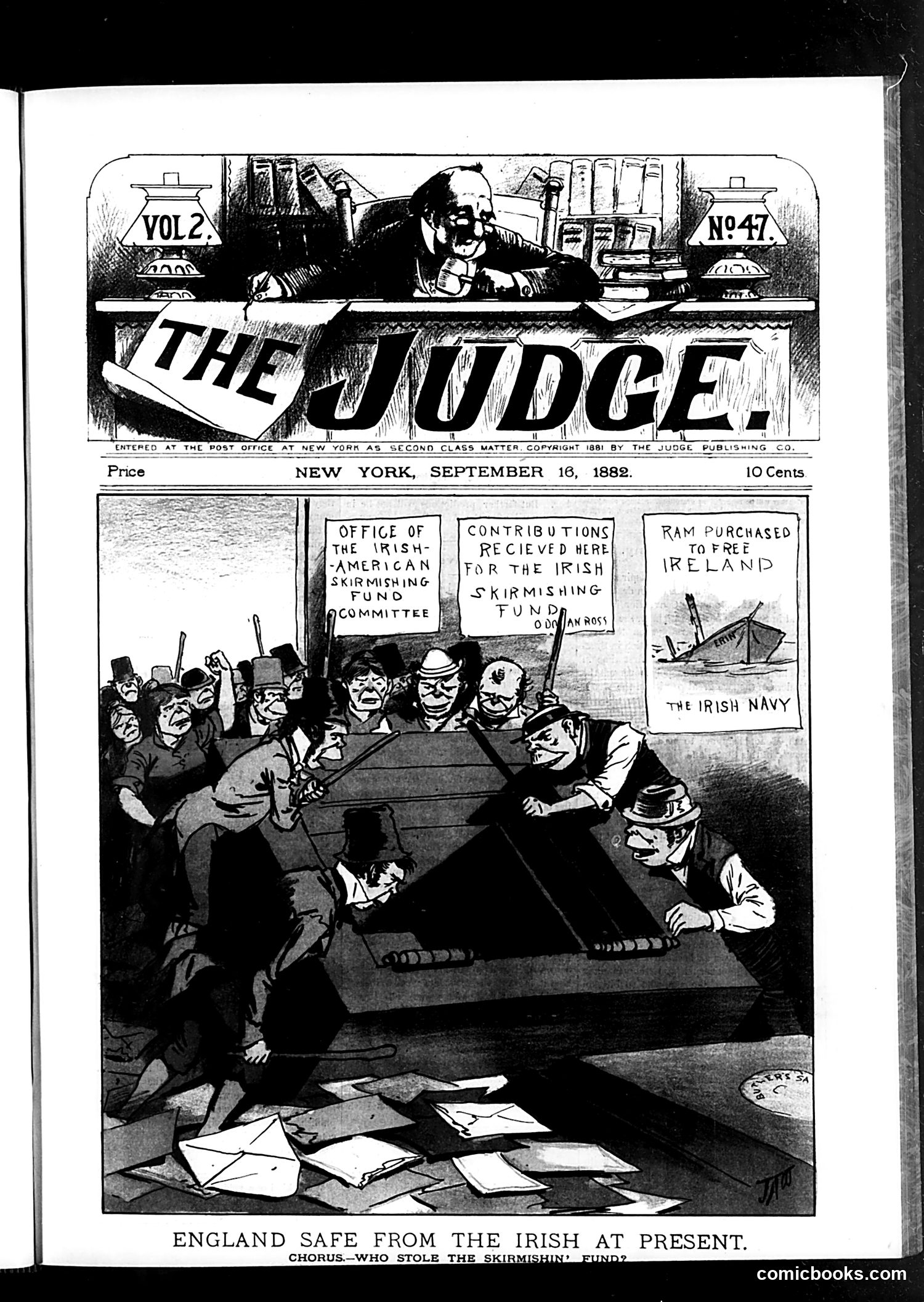
This satirical cartoon mocks Irish-American fundraising for Irish independence. The central image shows caricatured figures (with offensive stereotypical features typical of 1880s anti-Irish imagery) gathered around the "Office of the Irish-American Skirmishing Fund Committee," which collected money ostensibly for Irish causes. The cartoon's bitter irony—suggested by the title and chorus question "Who stole the skirmishin' fund?"—implies that Irish-American organizers were embezzling or misappropriating donations. The inset showing a wrecked ship labeled "The Irish Navy" reinforces the joke: the funds supposedly for Irish military efforts produced nothing. The satire reflects anti-Irish prejudice common in 1880s American media, mocking both Irish immigrants and their nationalist sympathies while suggesting Irish-American leaders were fraudsters exploiting their own community's patriotic donations.
This page contains editorial articles rather than cartoons. The main pieces address New York State politics circa 1879-1880. **"The Race to Albany"** discusses the upcoming gubernatorial race. It critiques Governor Cornell's association with railroad magnate Jay Gould, suggesting he's unfit for renomination despite Republican support. The article warns that unless Republicans unite behind a candidate untainted by "stock-jobbing" scandals, they risk defeat. It also mocks Democrats—particularly the Tilden faction and John Kelly—for their internal divisions, noting their hypocrisy in condemning Cornell's corruption while supporting the "monumental railroad wrecker" Tilden. **"England Saved Again"** appears to satirize Irish-American political agitation, using dialect humor to mock Irish immigrants' political enthusiasm and their concerns about British rule. The satire targets machine politics, railroad corruption, and ethnic stereotyping typical of Gilded Age American journalism.
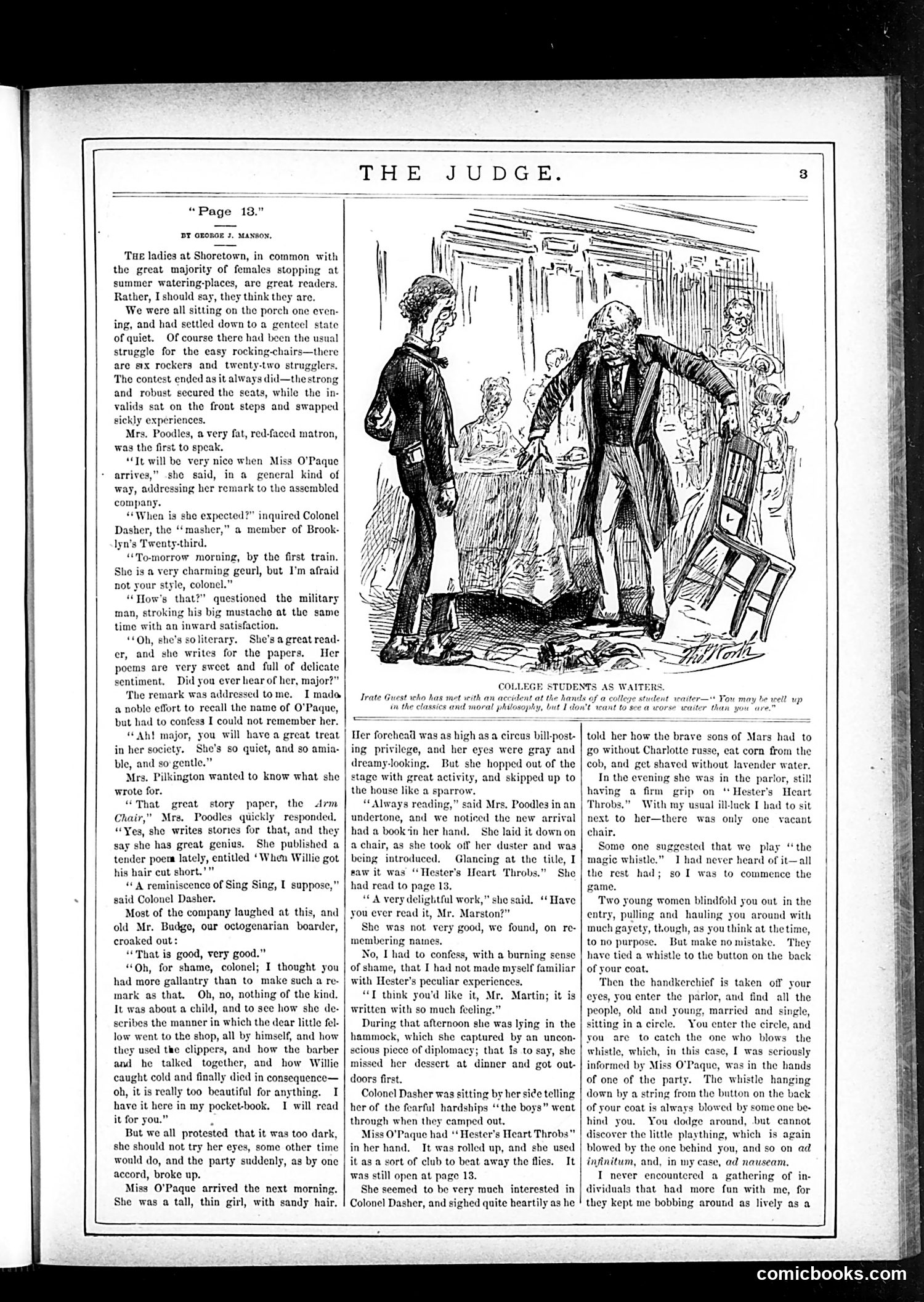
This is a **satirical story** (not a political cartoon) mocking pretentious literary culture among upper-class women at summer resorts. **The Setup:** Mrs. Poodles and other ladies at a seaside town discuss Miss O'Paque, an aspiring writer for *The Arm Chair* (a popular story paper). Mrs. Poodles gushes over O'Paque's "tender" poem titled "When Willie Got His Hair Cut Short"—which turns out to be mawkishly sentimental drivel about a child dying of cold after a haircut. **The Joke:** Colonel Dasher quips the title sounds like "a reminiscence of Sing Sing" (the prison), mocking the absurdity. When O'Paque arrives, she's always reading—even *Hester's Heart Throbs*, clearly another overwrought sentimental melodrama. The humor lies in exposing the gap between what *pretentious* female readers claim to appreciate (serious literature) and what they actually read (cheap, melodramatic sentiment). **Context:** This reflects period anxieties about women's education and the mass-market "story papers" that proliferated in the late 19th century.
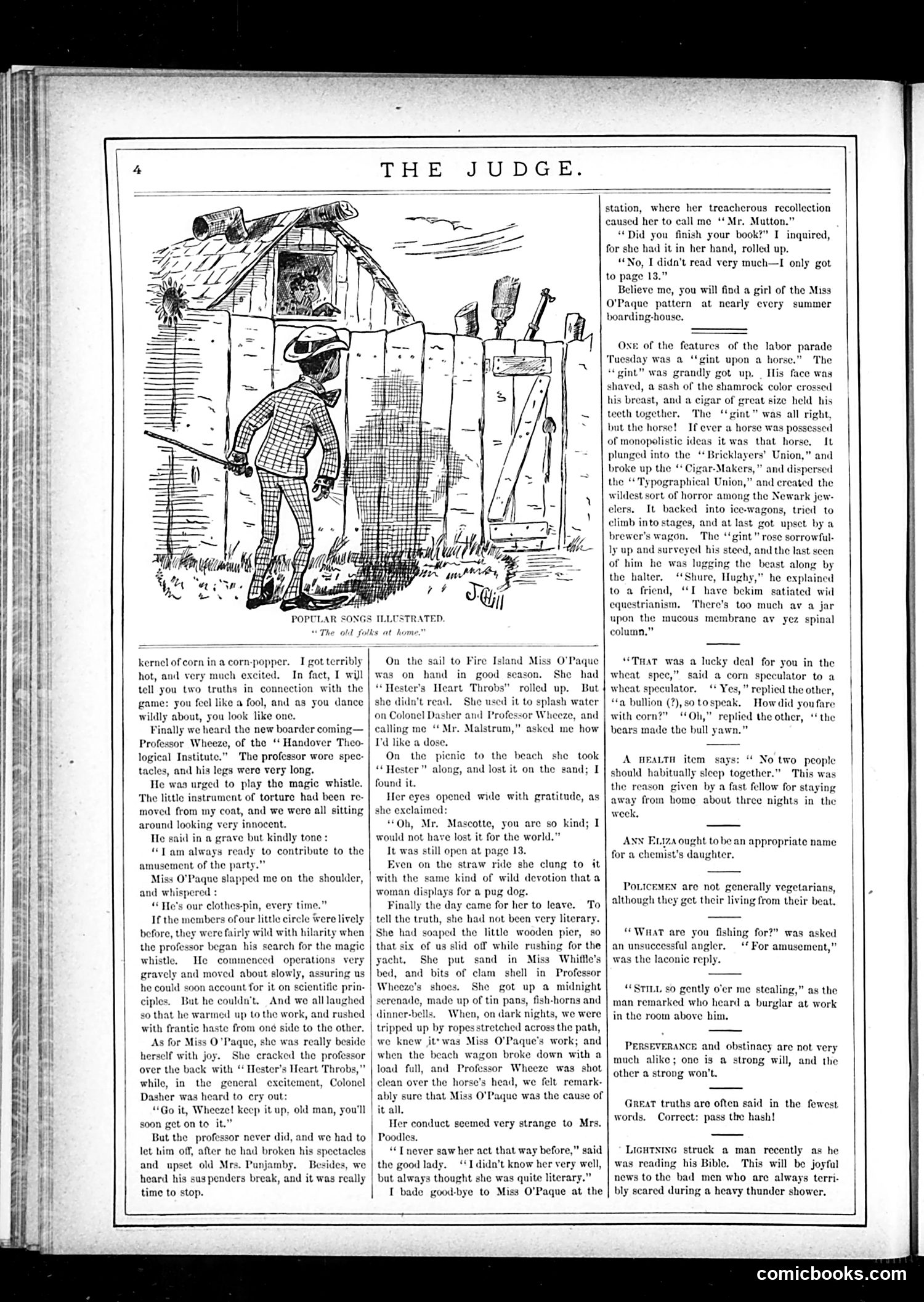
This page features a humorous short story rather than political satire. The main illustration shows a man operating a corn-popper, labeled "Popular Songs Illustrated" with a reference to "The Old Folks at Home." The accompanying text is a comedic narrative about Miss O'Paque, a troublemaking female boarder at a summer resort who carries a book called "Hester's Heart Throbs" (appearing to be sentimental popular fiction). Despite claiming to be literary, she's actually destructive—sabotaging activities, pranking guests, and barely reading past page 13 of her book. The joke targets pretentious bourgeois boarding-house culture and women who affect literary sophistication while causing chaos. The secondary content includes brief moral maxims typical of Judge's filler material. This represents Judge's entertainment content rather than its primary political commentary.
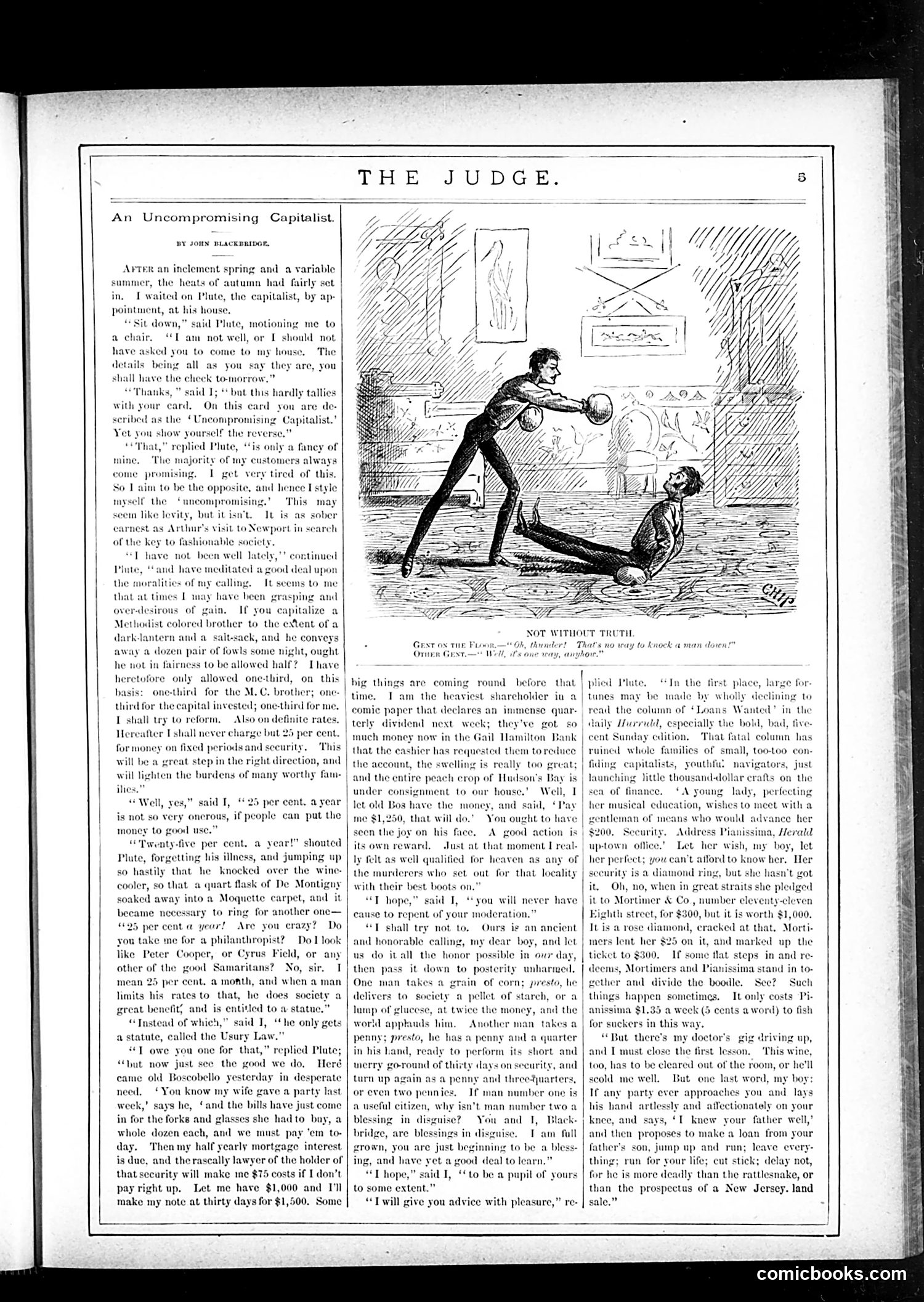
This satirical story by John Blackbridge mocks a wealthy capitalist named Plute who embodies ruthless, exploitative business practices. The cartoon illustrates a scene where Plute, caught mid-gesture, interacts with a visitor—likely depicting the story's narrator. **The satire's targets:** Plute represents the "uncompromising" businessman who justifies predatory lending and wage exploitation through callous logic. He charges 25% monthly interest (300% annually), defends paying workers one-third rations while keeping two-thirds for himself, and dismisses moral objections as sentimentality. He even boasts about profiting from others' desperation—lending $1,000 at usurious rates to desperate clients. **The social critique:** The piece attacks Gilded Age capitalism's brutal indifference to human suffering. Plute's self-aware villainy ("I style myself the Uncompromising") and his claim that honesty makes him unique expose how normalized such exploitation had become. The story suggests that conscience was uncommon enough among capitalists to be noteworthy. The cartoon ridicules wealthy elites who justified inequality and suffering as natural market mechanics.
This page from *Judge* contains two distinct pieces of satirical content: **"An Antique Bargain"** is a poem mocking women who marry for wealth. It depicts a woman at Long Branch (a fashionable resort) who traded her heart for luxury—diamonds, fine horses, and social status—while pining for a lost love. The satire presents her as morally compromised, comparing her unfavorably to mere animals "marked for sale." The "antique bargain" refers sardonically to the woman herself, treated as a commodity. **"An Outrage of the Deepest Dye"** is a humorous letter-to-the-editor complaint from an associate editor at the *Bubblebug Herald* (a fictional Southern journal). The editor describes being violently confronted by his managing editor over poorly-handled reader submissions—specifically, overwrought, pretentious poems from an unknown correspondent claiming poetic genius. The satire ridicules both the managing editor's theatrical rage and the contributor's pompous, incomprehensible verse, mocking the pretension of amateur poets and editorial incompetence. Both pieces employ exaggeration and ridicule as social commentary on greed and artistic pretension.
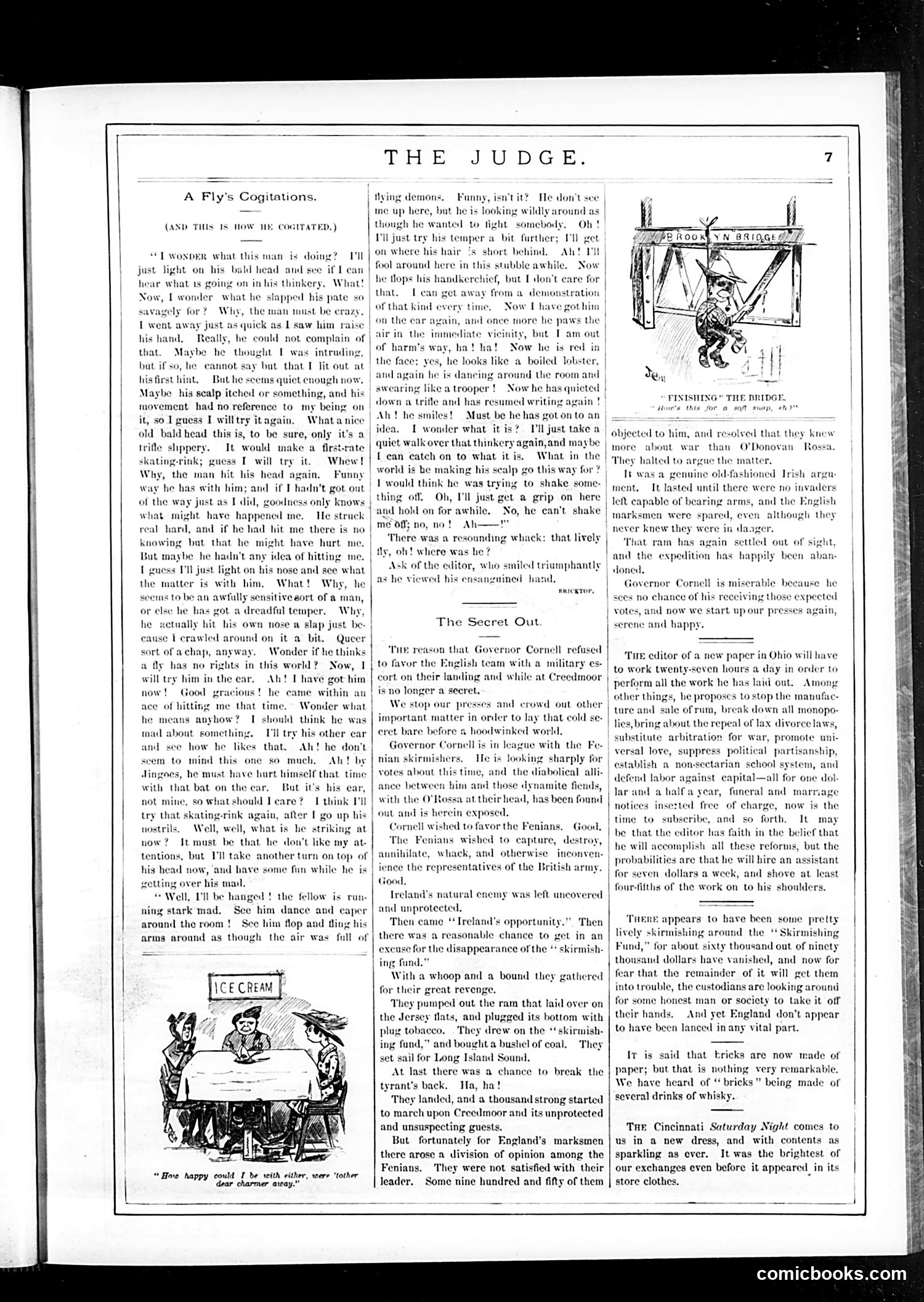
This humorous piece satirizes an absent-minded or irritable man through the observations of a fly landing on his bald head. The fly narrates its perspective as the man repeatedly swats at it in frustration, interpreting each violent reaction as evidence of the man's unstable temperament and poor self-control. The joke mocks male vanity and hair loss—the bald head becomes a skating rink and vulnerable target. More broadly, the satire critiques thin-skinned, quick-tempered men who lose composure over minor annoyances, eventually "dancing" around the room in rage. The fly's innocent perspective ("he don't like my attentions") emphasizes the man's overreaction. The accompanying piece, "The Secret Out," references Governor Cornell's refusal to escort English soldiers and hints at Fenian involvement—Irish-American political tensions of the era. The overall page mixes personal character mockery with political commentary typical of *Judge* magazine's satirical approach.
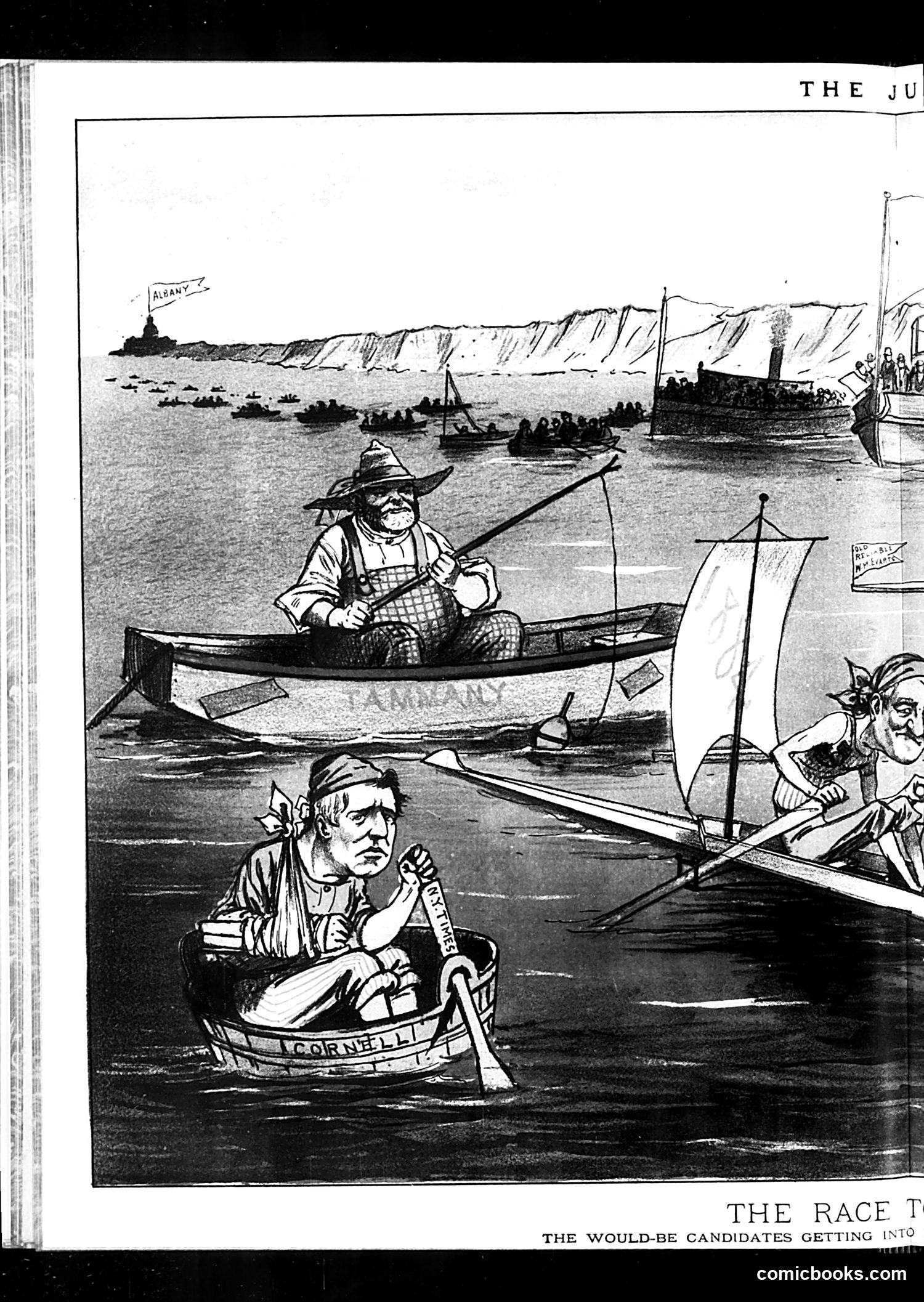
This Judge magazine cartoon satirizes political candidates competing in a "race" represented as boats on water near Albany (visible flag). The figure labeled "CORNELL" in the foreground appears to be a political candidate struggling or floundering in his small boat. Other candidates are shown in various vessels in the background, with larger steamships representing established political power also visible. The satire likely mocks the 1880s New York gubernatorial or senatorial race, depicting lesser candidates as inadequate competitors ("would-be candidates") unable to navigate serious politics. The caricatured faces and exaggerated body positions emphasize their incompetence or desperation. The crowded harbor suggests multiple weak challengers competing against stronger establishment forces, a common Judge theme ridiculing minor political figures.
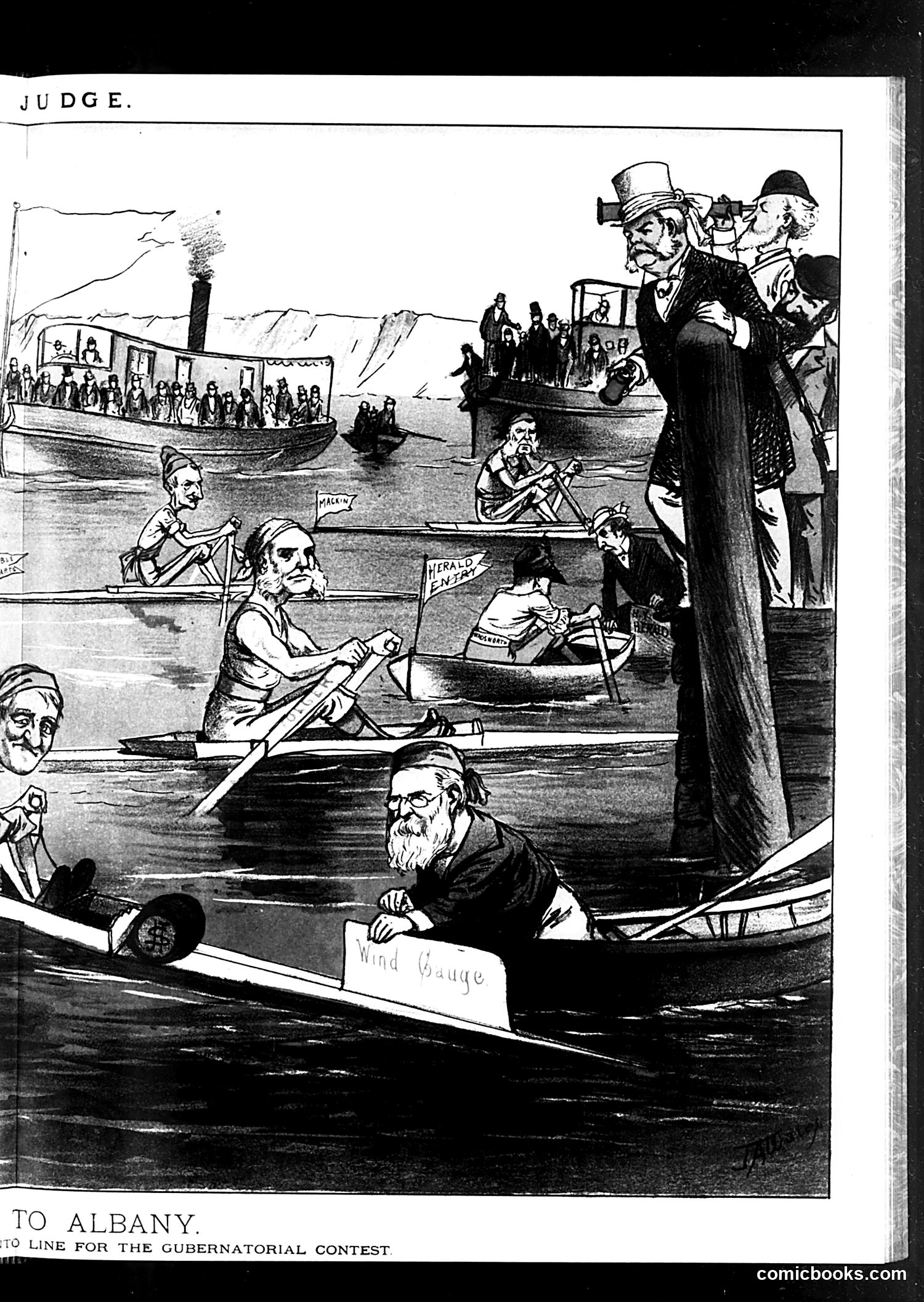
This Judge magazine cartoon satirizes a New York gubernatorial election contest. The image depicts various political figures as rowers in boats heading "to Albany" (New York's capital), suggesting candidates competing for the governorship. The central figure on the right—a tall man in formal dress with a top hat—appears to be judging or overseeing the competition. Various labeled boats represent different candidates or political factions, with visible labels including "HERALD," "WIND GAUGE," and "MERCY." The cartoon mocks the chaotic nature of the election race, depicting it as a rowboat competition where different newspapers, political interests, and candidates jostle for position and influence. The "Wind Gauge" reference likely comments on political opportunism—candidates shifting positions with public opinion. Without clearer date information, the specific election remains uncertain, but the satire targets typical machine politics and media involvement in gubernatorial races.
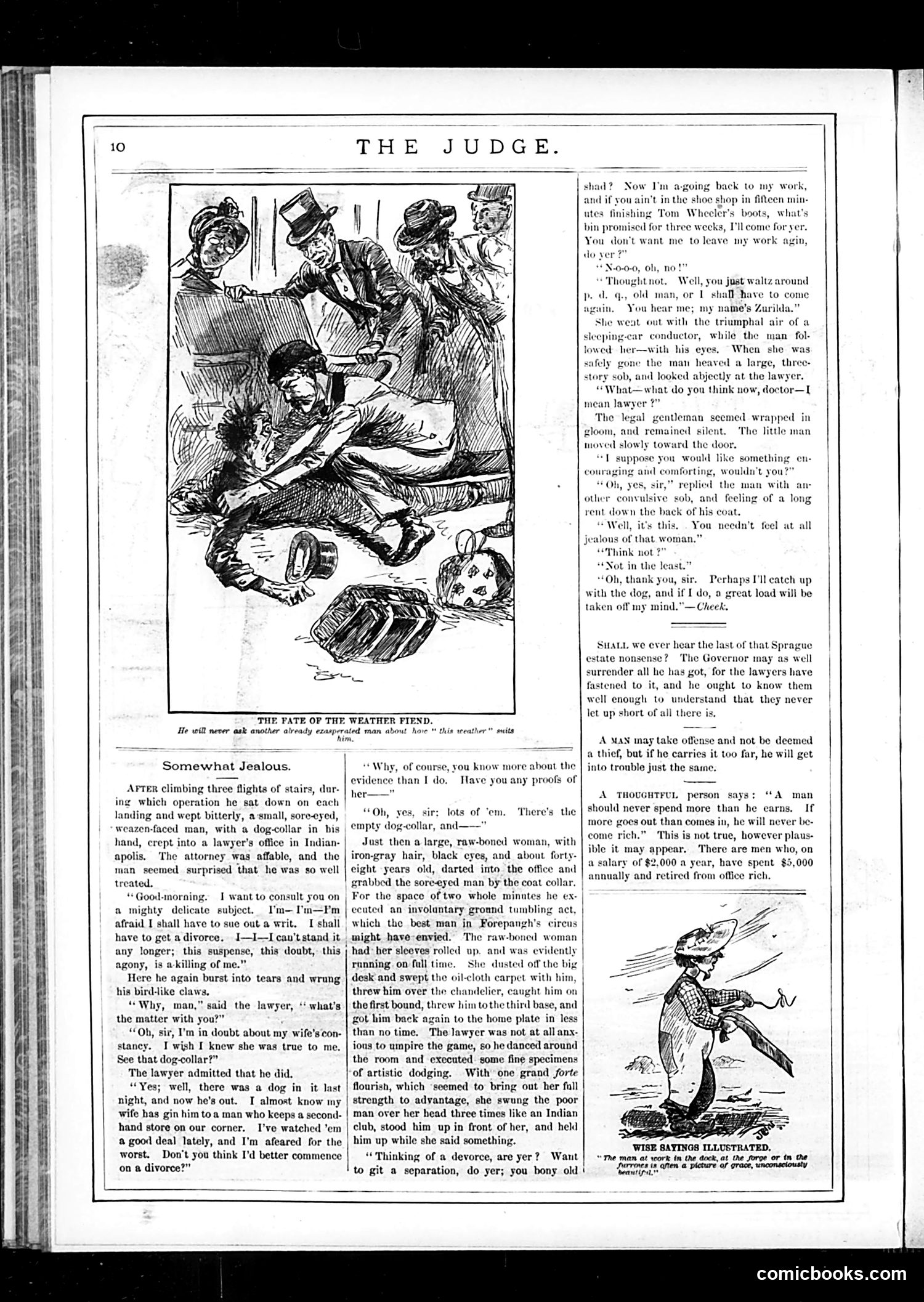
This cartoon satirizes a henpecked husband seeking divorce. The scraggly, meek man consults a lawyer, claiming his wife gave away the family dog—his "proof" of her infidelity. His "evidence" is laughably thin. The joke pivots on the wife's arrival. The large, muscular "raw-boned woman" named Zurilda physically dominates him, hurling him around the office like a wrestler. She threatens to return and pummel him if he doesn't get back to work making shoes within fifteen minutes. The satire targets marital power dynamics: the supposedly wronged husband is actually the submissive one. His jealous suspicions about the dog are absurd compared to her actual controlling behavior. The lawyer's stunned silence at the end underscores the irony—the real problem isn't infidelity but matrimonial inequality favoring the aggressive wife. It's commentary on marriage and masculinity, mocking both the man's weak accusations and his complete domination by his spouse.
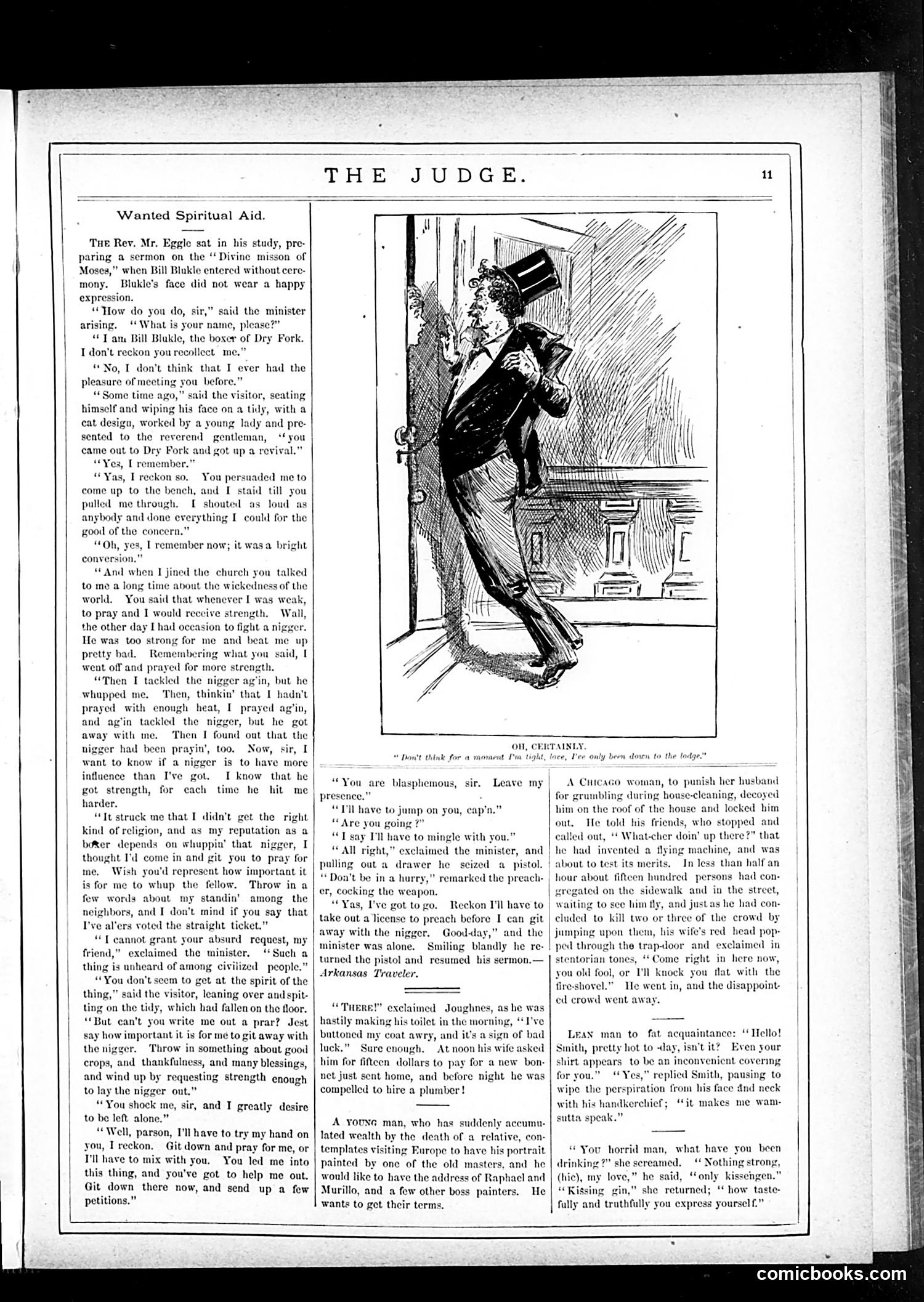
This satirical story mocks both rural Southern violence and ministerial hypocrisy. Bill Blukle, a boxer from "Dry Fork," visits Reverend Eggle demanding he pray for strength to defeat a Black man in a fight. The reverend had previously encouraged Blukle's piety, promising prayer brings spiritual strength. The humor lies in Blukle's literal-minded literalism: if prayer gave *him* strength, why did his Black opponent also gain strength from prayer? He threatens violence on the minister unless he helps, forcing Eggle to produce a pistol. The satire targets the absurdity of weaponized religion in the post-Reconstruction South—using Christian rhetoric to justify racial violence while exposing how easily ministers abandon their principles under duress. Blukle's final line about needing a "license to preach" sarcastically suggests fighting Black people is itself a form of ministry, underlining the cartoon's critique of how religious justification enabled racial brutality.
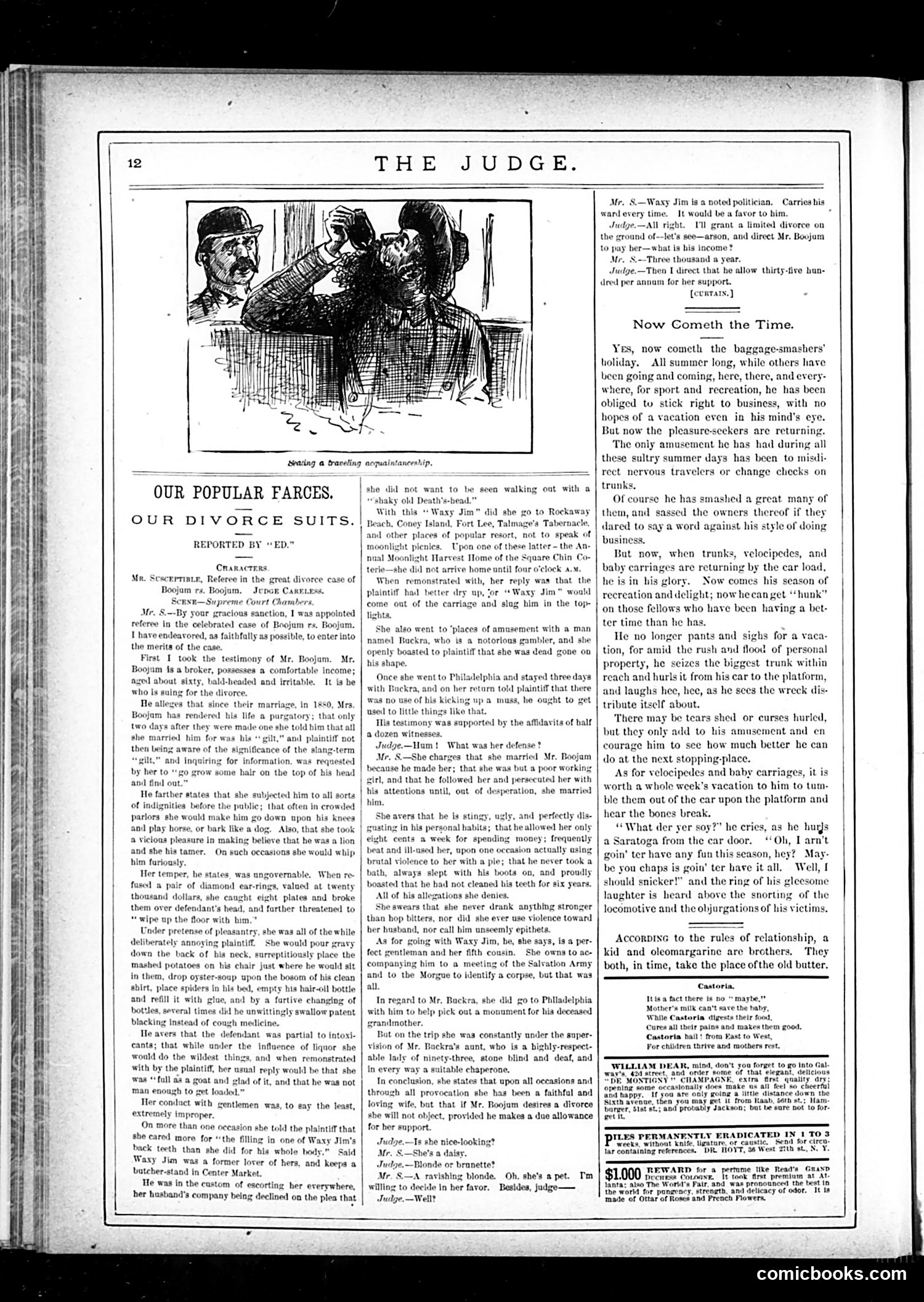
This is a satirical article about a divorce case between "Mr. Boojum" and "Mrs. Boojam," presented as courtroom testimony. The piece mocks the absurdity and melodrama of contemporary divorce proceedings. The husband alleges his wife is uncontrollably temperamental and unfaithful. He describes humiliating public behavior (making him "play horse"), elaborate pranks (putting glue in his hair-oil bottle, mashed potatoes on his chair), and her open preference for a former lover nicknamed "Waxy Jim," a barber she frequently accompanies to resorts and amusement venues. The satire targets both the excessive emotional displays and petty grievances that characterized divorce suits of the era, and likely the fashionable practice of divorce itself among the leisure class. The ridiculous specificity of complaints (a man's teeth, hair-oil bottles) and her defiant attitude lampoon how trivial marital disputes became matters of public legal spectacle in Gilded Age America.
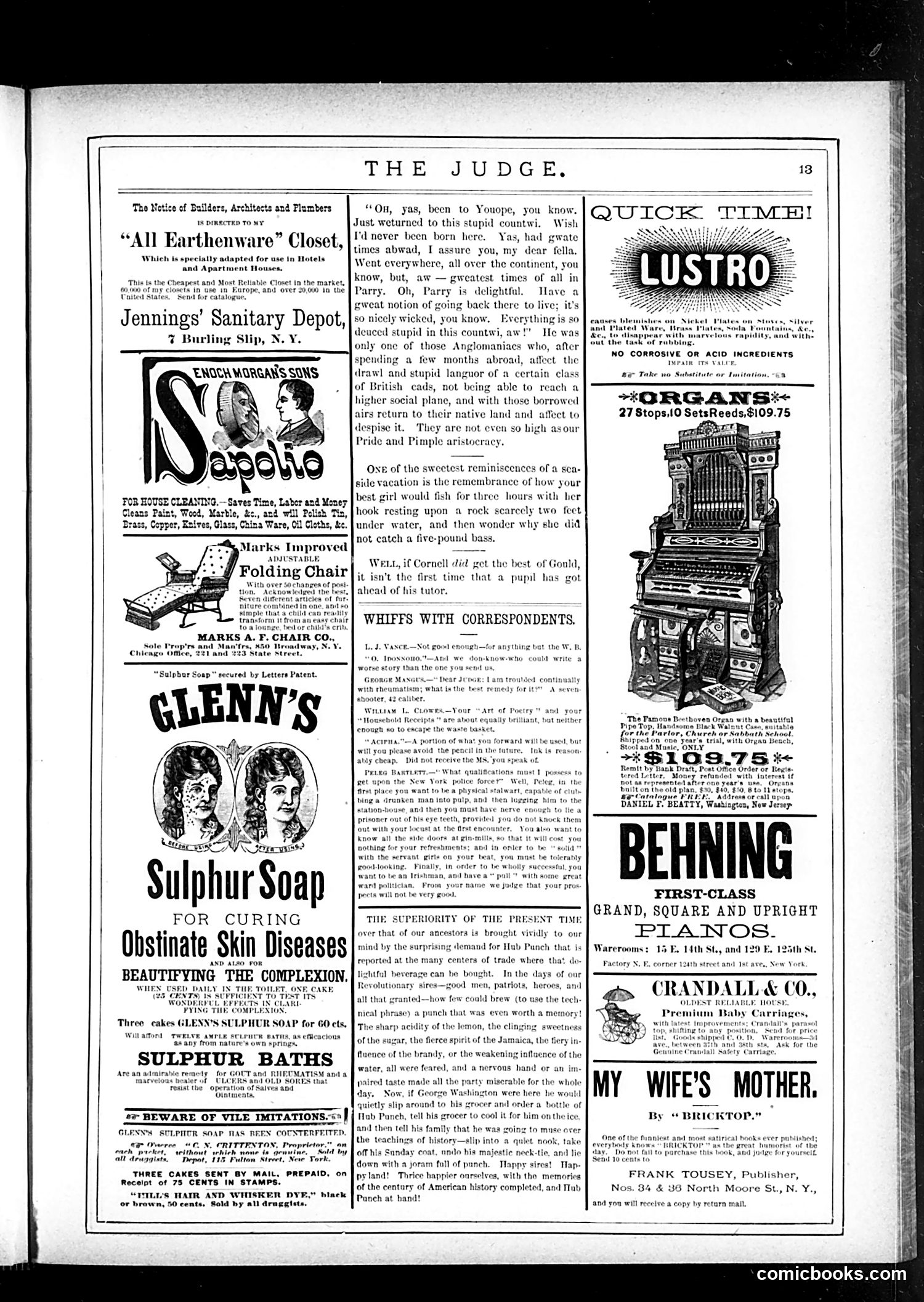
This page is primarily **advertising** for various Victorian-era products (sanitary fixtures, cleaning products, soap, furniture, organs, pianos, and hair dye). However, it contains one brief satirical piece titled "WHIFFS WITH CORRESPONDENTS." The main cartoon/text mockery targets a returning American traveler who has adopted affected European mannerisms. The figure speaks in an exaggerated British accent ("Yas," "Parry" for Paris, "gwate") and snobbishly claims Europe is superior to America, calling his homeland "stupid." The satire ridicules **Anglomaniac** pretension—Americans who spend time abroad and return affecting British affectation and contempt for their own country while claiming superior taste. A secondary joke references **Cornell beating Gould**, likely a sports or academic competition, playing on the phrase "when the student surpasses the teacher." The page reflects common late-19th-century American anxiety about imported European sophistication and the ridicule of social climbing through affected foreign manners.
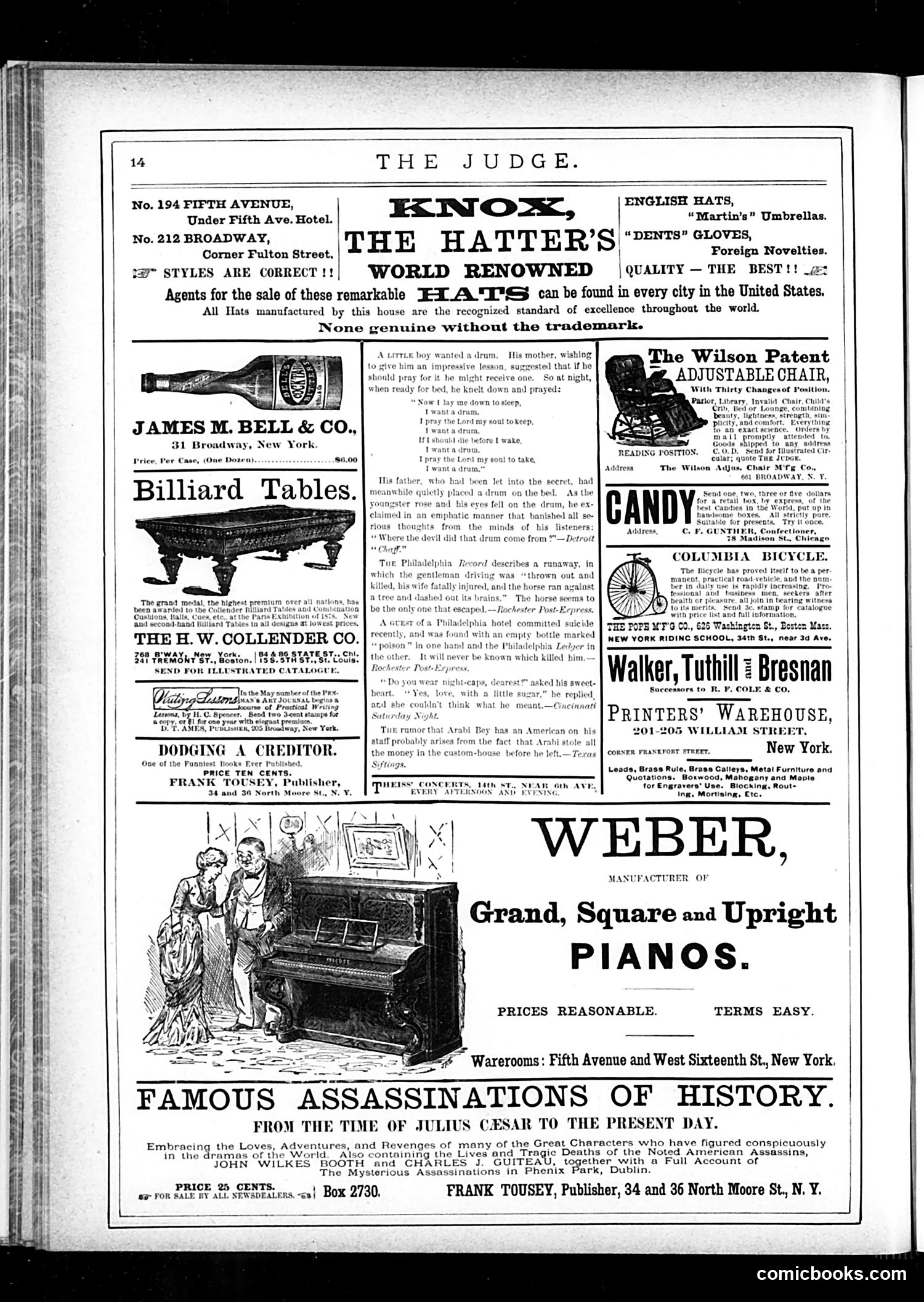
This page is primarily **advertising**, not satirical content. It's from *Judge* magazine but contains commercial notices rather than editorial cartoons. The visible advertisements include: - **Knox hats** and haberdashery (top) - **James M. Bell & Co.** liquor (with bottle imagery) - **Billiard tables** manufacturer - **Weber pianos** (with an illustration of a couple admiring an instrument) - **Walker, Tuthill & Bresnan** printers' warehouse - A book advertisement for "**Famous Assassinations of History**" featuring John Wilkes Booth and Charles Guiteau There's a small narrative vignette about a child wanting a drum, but it's merely a brief anecdote, not political satire. **The point**: This reflects late-19th-century magazine economics—*Judge* relied heavily on paid advertising to fund operations. The ads reveal period consumer interests: parlor entertainment (pianos, billiards), fashion, and sensationalist reading material.
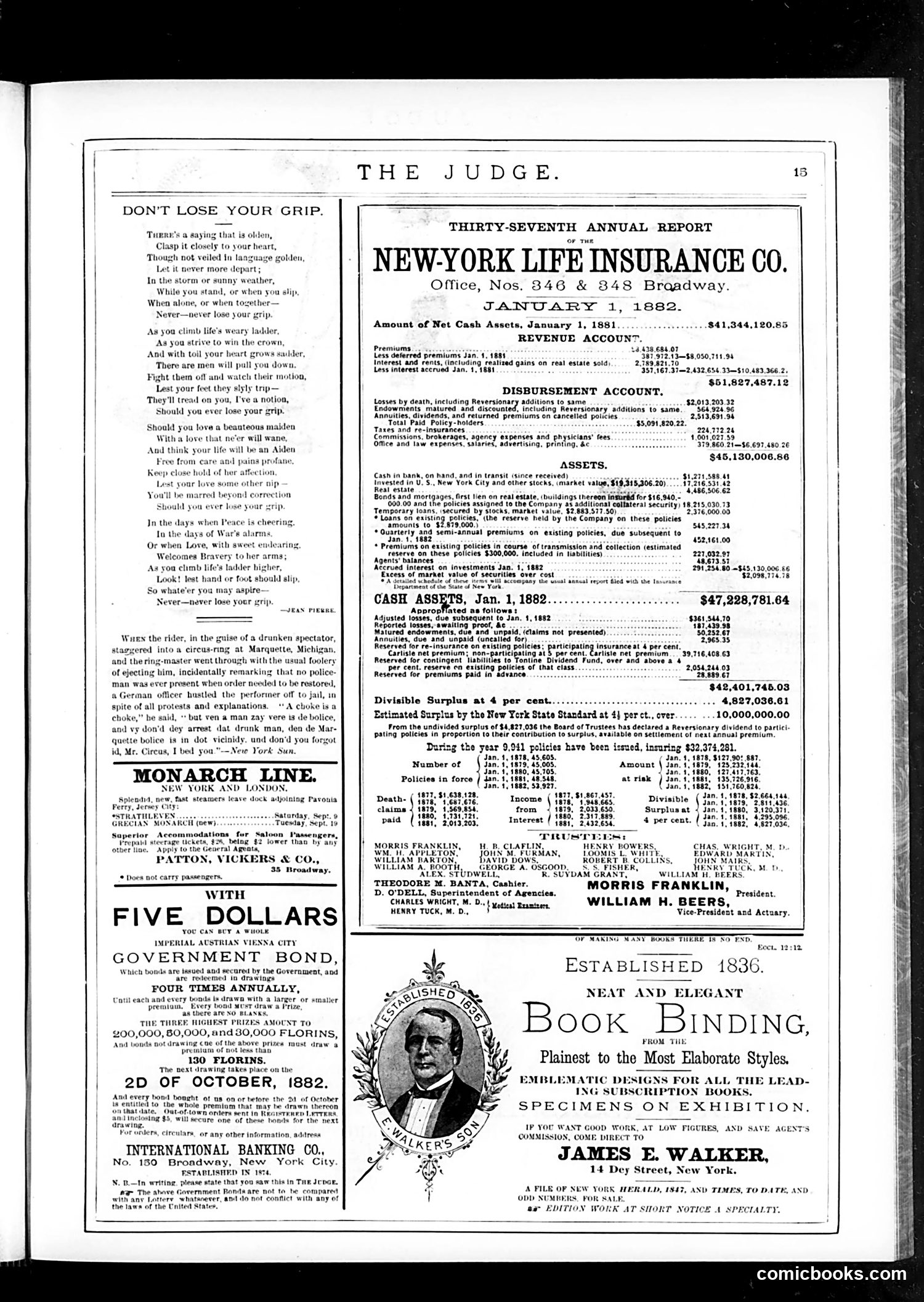
This page is **primarily advertising and financial reporting**, not a satirical cartoon issue. The dominant content is the **New-York Life Insurance Company's thirty-seventh annual report** (center), displaying detailed financial statements and asset valuations totaling $45.12 million—typical corporate disclosure for the era. The only narrative humor appears at top left: **"Don't Lose Your Grip,"** a moralizing poem about maintaining resolve through life's challenges (romantic, financial, social). It's sentimental Victorian verse, not political satire. Below that is a brief anecdote about a **drunken circus spectator in Marquette, Michigan**, where a German police officer jails the ring-master for the disruption, sarcastically asking why the circus exists if police won't maintain order—a mild jab at civic authority and municipal policing logic. The remainder contains **shipping advertisements, Austrian government bonds, and book-binding services**—standard late-19th-century Judge filler material. No significant political satire or caricature is present on this particular page.
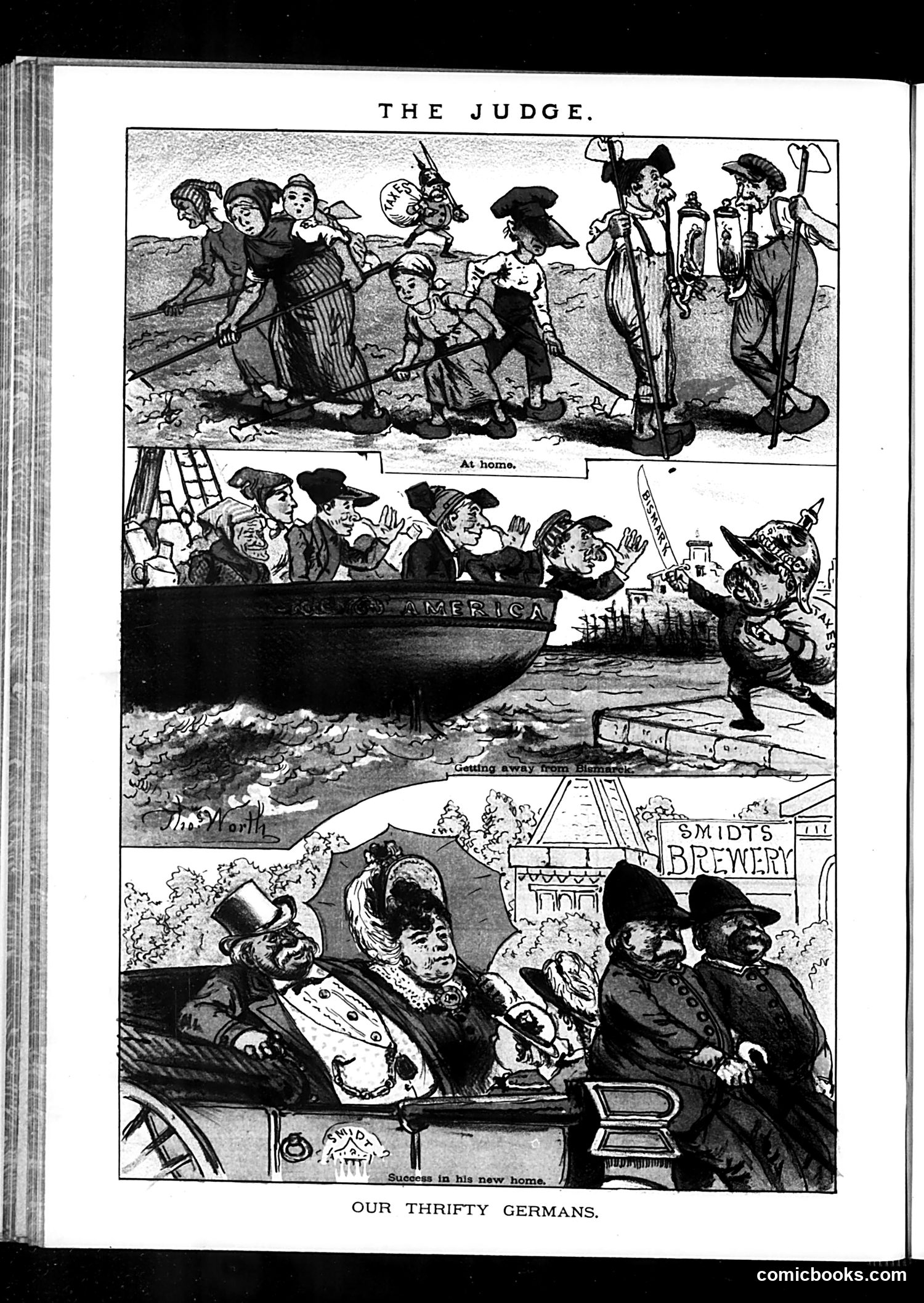
This multi-panel satirical comic mocks German immigrants' economic success and assimilation in America. The title "Our Thrifty Germans" uses irony—"thrifty" being a positive trait—to critique their rapid advancement. The panels show: - **Top**: Germans as children at home, appearing poor or struggling - **Middle**: "Getting away from Bismarck"—departure from Germany toward America (the ship labeled "America") - **Bottom**: "Success in his new home"—the same figures now prosperous, relaxing at a brewery (Smidt's Brewery visible), dressed well and apparently wealthy The cartoon satirizes the stereotype of German immigrants as industrious but also suggests resentment of their quick economic rise. The brewery reference invokes period stereotypes about German-Americans and alcohol consumption. This reflects late 19th-century American attitudes toward immigrant success and cultural identity.