
Judge, 1882-09-16 · page 2 of 16
Judge — September 16, 1882 — page 2: what you’re looking at
What you’re looking at
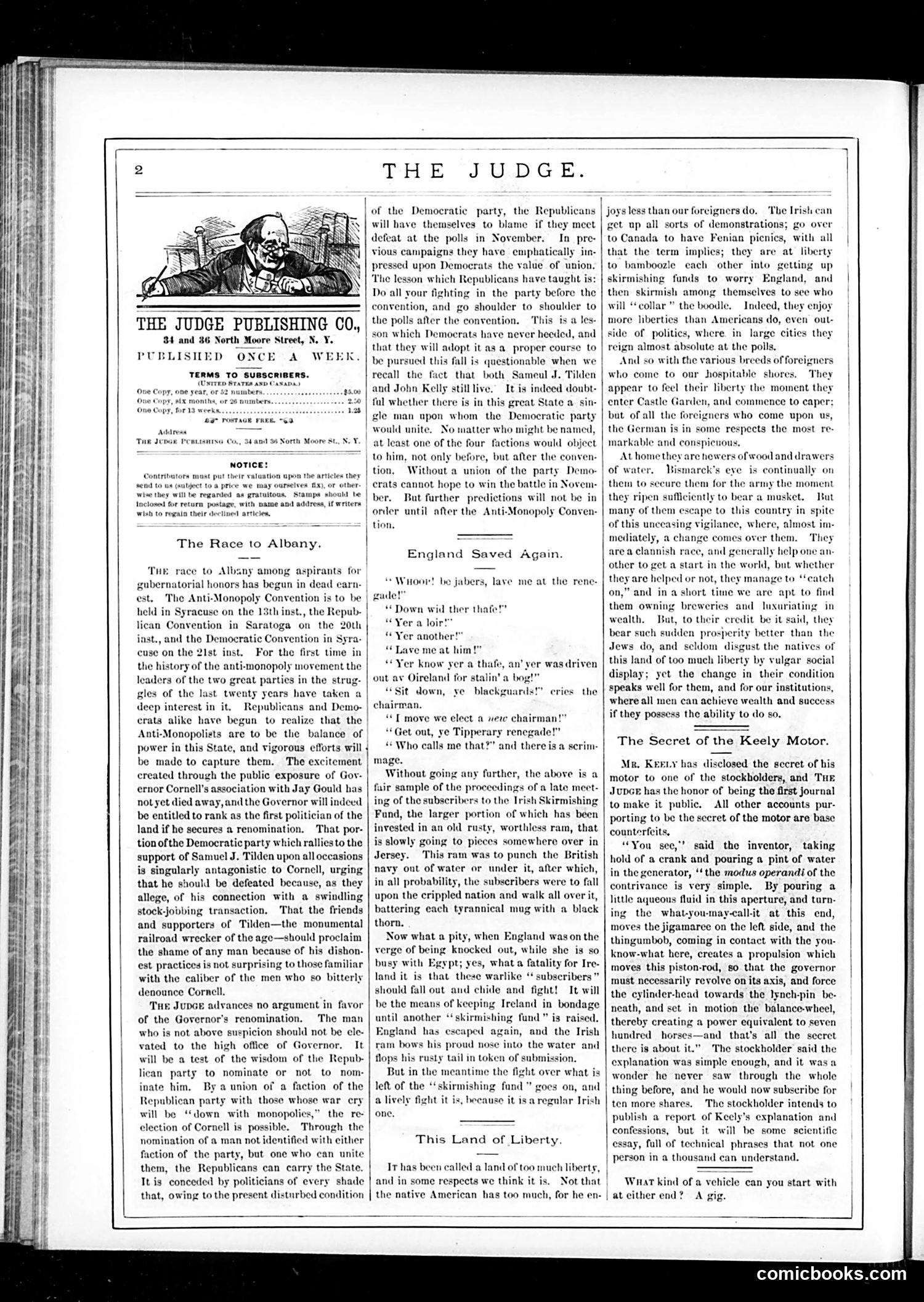
This page contains editorial articles rather than cartoons. The main pieces address New York State politics circa 1879-1880. **"The Race to Albany"** discusses the upcoming gubernatorial race. It critiques Governor Cornell's association with railroad magnate Jay Gould, suggesting he's unfit for renomination despite Republican support. The article warns that unless Republicans unite behind a candidate untainted by "stock-jobbing" scandals, they risk defeat. It also mocks Democrats—particularly the Tilden faction and John Kelly—for their internal divisions, noting their hypocrisy in condemning Cornell's corruption while supporting the "monumental railroad wrecker" Tilden. **"England Saved Again"** appears to satirize Irish-American political agitation, using dialect humor to mock Irish immigrants' political enthusiasm and their concerns about British rule. The satire targets machine politics, railroad corruption, and ethnic stereotyping typical of Gilded Age American journalism.
📄 Transcribed text from this page (OCR, searchable)
Machine-transcribed from the original scan — historical spelling and the odd misread are preserved.
THE JUDGE PUBLISHING CO., 34 and 36 North Moore Street, N. Ys PUBLISHED ONCE A WE TERMS TO SUBSCRIBERS. (Ustrep Brarea ai IK. NOTICE! ast put thelr valuation apo ject toa price we may ourselves fx) regarded as gratuitous, Stamps sho for return postage, with name and address, if writers wish to regain their declined articles, they ot ritel send to ts (4 wise they wi Inclor The Race to Albany. Tuk race to Albany among aspirants for gubernatorial honors has begun in dead earn- est. The Anti-Monopoly Convention is to be held in Syracuse on the lican Convention in Sa: inst., and the Democratic Convention in Syra- cuse on the 2Ist i For the fi time in the history of the anti-monopoly movement the leaders of the two great parties in the strug- gles of the last twenty years have taken a deep interest in it. Republicans and Demo- crats alike have begun to realize that the Anti-Monopolists are to be the balance of power in this State, and vigorous efforts will be made to capture them. toga on the 20th ernor Cornell's association with Jay Gould has notyet died away, and the Governor will indced be entitled to rank as the first politician of the land if he secures a renomination. That por- tion ofthe Democratic party which ralliesto the support of Samuel J. Tilden upon all occasions is singularly antagonistic to Cornell, urging that he should be defeated because, as they allege, of his connection with a swindling stock-jobbing transaction, That the friends and supporters of Tilden—the monumental railroad wrecker of the age—should proclaim the shame of any man because of his dishon- est practices is not surprising to those familiar with the caliber of the men who so bitterly denounce Cornell. ‘Tue JupGe advances no argument in fa of the Governor's renomination. The man who is not above suspicion should not be ele- vated to the high office of Governor. It will be a test of the wisdom of the Repub- lican party to nominate or not to nom- inate him, By a union of a faction of the Republican party with those whose war ery will be ‘down with monopolies,” the re- election of Cornell is possible. Through the nomination of a man not identified with either faction of the party, but one who can unite them, the Republicans can carry the Stat It is conceded by politicians of every shade that, owing to the present disturbed condition sth inst, the Repub- | The excitement | created through the public exposure of Gov- | THE JUDGE. | of the Democratic party, the Republicans will have themselves to blame if they meet defeat at the polls in November. In pre- vious campaigns they have emphatically im- pressed upon Democrats the value of union. The lesson which Republicans have taught i Do all your fighting in the party before the convention, and go shoulder to shoulder to the polls after the convention. This is a les- son which T ats have never heeded, and that they will adopt it as a proper course to | be pursued this fall is questionable when we | recall the fact that both Sameul J. Tilden and John Kelly still live. It is indeed doubt- fal whether there is in this great State a gle man apon whom the Democratic party | would unite. No matter who might be named, at least one of the four factions would object to him, not only before, but after the conve tion. Without a union of the party Dew crats cannot hope to win the battle in Novem- | ber. But further predictions will not be in | order until after the Anti-Monopoly Conven- tion, moc! England Saved Again. “Wuoov! be jabers, lave me at the rene- “ Down wid ther thafe!” “Yer a loir “ Yer anothe ave me at him!” “Yer know yer a thafe, an’ yer was driven out av Oireland for stalin’ a b i “Sit down, ye blackguards! chairman. “*T move we elect a were chairma “Get out, ye Tipperary renegade! “Who calls me that?” and there is a scrim- mage. Without going any further, the above is a fair sample of the proceedings of a late meet- ing of the subscribers to the Irish Skirmishing Fund, the larger portion of which has been invested in an old rusty, worthless ram, that is slowly going to pieces somewhere over in Jersey. ‘This ram was to punch the British navy ont of water or under it, after which, in all probability, the subscribers were to fall upon the crippled nation and walk all over it, battering each tyrannical mug with a black thorn. Now what a pity, when England was onthe verge of being knocked out, while she is so y with Egypt; yes, what a fatality for Ire- land it is that these warlike ‘“ subscribers ” should fall out and chide and fight! It will be the means of keeping Ireland in bondage until another “skirmishing fund” is raised. England has escaped again, and the Irish | ram bows his proud nose into the water and flops his rusty tail in token of submission, But in the meantime the fight over what is left of the ‘skirmishing fund a lively fight it is, because it is one, cries the on, a regular Trish This Land of Liberty. | of water. | contrivance is very simple. Ir has been called a land of too much liberty, | and in some respects we think it is. Not that the native American has too much, for he en- joys less than our foreigners do. ‘The Irish get up all sorts of demonstrations; go over to Canada to have Fenian picnics, with all that the term implies; they are at liberty to bamboozle each other into getting up skirmishing funds to worry England, and then skirmish among themselves to see who will “collar” the boodle. Indeed, they enjoy more liberties than Americans do, even out- side of politics, where in large cities they reign almost absolute at the poils, And so with the various breeds of foreigners who come to our hospitable shores. They appear to feel their liberty the moment they enter Castle Garden, and commence to caper; but of all the foreigners who come upon us, the German is in some respects the most re- markable and conspicuous. At home they are hewers of wood and drawers Bismarck’: ure them for the arm: n sufficiently to be om e3¢ ve ntinually on the moment a musket. But many of t pe to this country in spite of this unceasing vigilance, where, almost im- mediately, a change comes over them. ‘They area clannish race, and generally help one an. other to get a start in the world, but whether they are helped or not, they manage to “catch on,” and in a short time w apt to find them owning breweries and luxuriating in wealth. But, to their eredit be it said, they bear such sudden prosperity better than the Jews do, and seldom disgust the natives of this land of too much liberty by vulgar social display; yet the change in their condition speaks well for them, and for our institutions, where all men can achieve wealth and success if they possess the ability to do so. them to s they r The Secret of the Keely Motor. Mr. Kee.y has disclosed the secret of his motor to one of the stockholders, and THE JUDGE has the honor of being the first journal to make it public. All other accounts pur- porting to be the secret of the motor are base counterfeits, “You see,’ said the inventor, taking hold of a crank and pouring a pint of water in the generator, ‘the modus operandi of the By pouring a little aqueous fluid in this aperture, and turn- ing the what-you-may-call-it at this end, moves the jigamarce on the left side, and the thingumbob, coming in contact with the you- know-what here, creates a propulsion which moves this piston-rod, so that the governor must necessarily revolve on its axis, and force the cylinder-head towards the lynch-pin be- neath, and set in motion the balance-wheel, thereby creating a power equivalent to seven hundred horses—and that's all the secret there is about it.” The stockholder said the explanation was simple enough, and it was a wonder he never saw through the whole thing before, and he would now subscribe for ten more shares, The stockholder intends to publish a report of Keely’s explanation and confessions, but it will be some. scientific ay, full of technical phrases that not one person in a thousand can understand. Wnuat kind of a vehicle can you start with ateitherend? A gig. is 2 comicbooks.com