
Judge, 1882-09-16 · page 3 of 16
Judge — September 16, 1882 — page 3: what you’re looking at
What you’re looking at
This is a **satirical story** (not a political cartoon) mocking pretentious literary culture among upper-class women at summer resorts. **The Setup:** Mrs. Poodles and other ladies at a seaside town discuss Miss O'Paque, an aspiring writer for *The Arm Chair* (a popular story paper). Mrs. Poodles gushes over O'Paque's "tender" poem titled "When Willie Got His Hair Cut Short"—which turns out to be mawkishly sentimental drivel about a child dying of cold after a haircut. **The Joke:** Colonel Dasher quips the title sounds like "a reminiscence of Sing Sing" (the prison), mocking the absurdity. When O'Paque arrives, she's always reading—even *Hester's Heart Throbs*, clearly another overwrought sentimental melodrama. The humor lies in exposing the gap between what *pretentious* female readers claim to appreciate (serious literature) and what they actually read (cheap, melodramatic sentiment). **Context:** This reflects period anxieties about women's education and the mass-market "story papers" that proliferated in the late 19th century.
📄 Transcribed text from this page (OCR, searchable)
Machine-transcribed from the original scan — historical spelling and the odd misread are preserved.
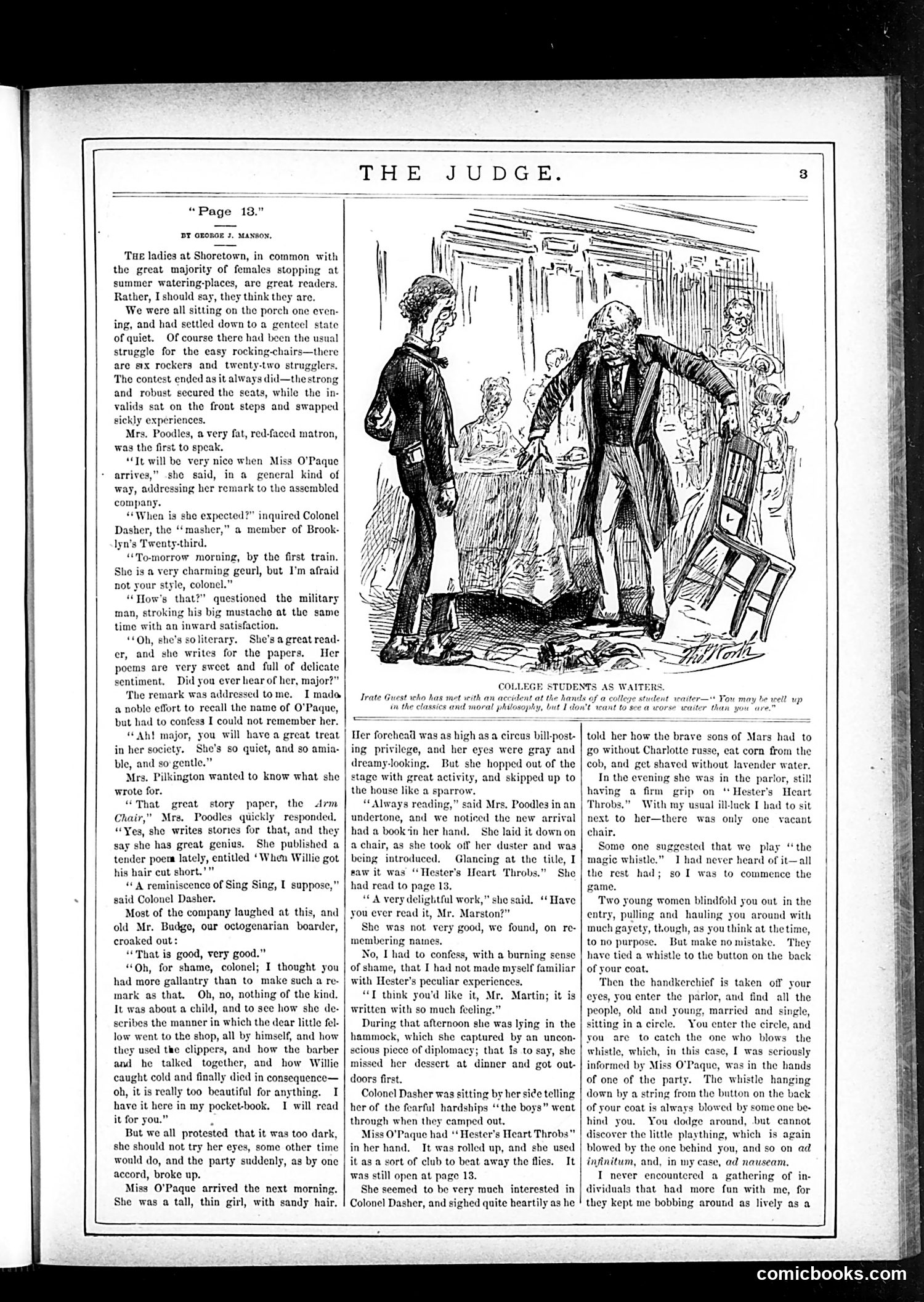
Page 13.” br aronor 3, staxox. Tue ladies at Shoretown, in common with the great majority of females stopping at summer watering-places, are great readers. Rather, I should say, they think they are. We were all sitting on the porch one even- ing, and had settled down to a genteel state of quiet. Of course there had been the usual struggle for the easy rocking-chairs—there are six rockers and twenty-two strugglers. The contest ended as it always did—the strong and robust secured the seats, while the in- valids sat on the front steps and swapped sickly experiences. Mrs. Poodles, a very fat, red-faced matron, was the first to speak. “Tt will be very nice when Miss O'Paque arrives,” she said, in a gencral kind of way, addressing her remark to the assembled company. “When is she expected?” inquired Colonel Dasher, the “masher,” a member of Brook- lyn’s Twenty-third. “To-morrow morning, by the first train. She is a very charming geurl, but I’m afraid not your style, colonel.” “How's that?” questioned the military man, stroking his big mustache at the same time with an inward satisfaction, “Oh, she’ literary, She's a great read- er, and she writes for the papers. Her poems are very sweet and full of delicate sentiment. Did you ever hear of her, major?” The remark was addressed tome. I mado a noble effort to recall the name of O'Paque, but had to confess I could not remember her. “Ah! major, you will have a great treat in her society, She's so quiet, and so am ble, and so gentle.” Mrs. Pilkington wanted to know what she wrote for. “That great story paper, the Arm Chair,” Mra. Poodles quickly responded. “Yes, sho writes stories for that, and they say she has great genius. She published a tender poera lately, entitled ‘When Willie got his hair cut short.’” “4 reminiscence of Sing Sing, I sup} said Colonel Dasher. Most of the company laughed at this, and old Mr. Budge, our octogenarian boarder, croaked out: “That is good, very good.” “Oh, for shame, colonel; I thought you had more gallantry than to make such a re- mark as that. Oh, no, nothing of the kind. It was about a child, and to see how she de- scribes the manner in which the dear little fel- low went to the shop, all by himself, and how they used the clippers, and how the barber and he talked together, and how Willic caught cold and finally died in consequence— oh, it is really too beautiful for anything. I have it here in my pocket-book. 1 will read it for you.” . But we all protested that it was too dark, she should not try her eyes, some other time would do, and the party suddenly, as by one accord, broke up. Miss O'Paque arrived the next morning. She was a tall, thin girl, with sandy hair. —-_ WU Wot STUDENTS AS WAITERS Irate Guest who has met with an accident at the hants in the classics anit moral philosophy, but 1 don 8 high asa circus ill-post- , and her eyes were gray and dreamy-looking. But she hopped out of the stage with great activity, and skipped up to the house like a sparrow. “ Always reading,” said Mrs. Poodles in an undertone, and we noticed the new arrival had a book in her hand, She laid it down on achair, as she took off her duster and was being introduced, Glancing at the title, I saw it was ‘Hester's Heart Throbs.” She had read to page 13. “CA very delightful work,” she said. “ Have you ever read it, Mr. Marston?” She was not very good, we found, on re- membering names. No, I had to confess, with a burning sense of shame, that I had not made myself familiar with Hester's peculiar experiences. “T think you'd like it, Mr. Martin; it is written with so much feeling.” During that afternoon she was lying in the hammock, which she captured by an uncon- scious piece of diplomacy; that fs to say, she missed her dessert at dinner and got out- doors first. Colonel Dasher was sitting by her si¢e telling her of the fearful hardships ‘the boys” went through when they camped out. Miss O'Paque had ‘ Hester's Heart Throbs" in her hand. It was rolled up, and she used it as a sort of club to beat away the flies. It was still open at page 13. She seemed to be very much interested in Colonel Dasher, and sighed quite heartily as he of a college student waite * You may be well up "t want to see a worse wa r than you are.” told her how the brave sons of Mars had to go without Charlotte russe, eat corn from the cob, and get shaved without lavender water. In the evening she was in the parlor, stil! having a firm grip on ‘Hester's Heart Throbs.” With my usual ill-luck I had to sit next to her—there was only one vacant chair. Some one suggested that we play “the magic whistle.” I had never heard of it—all the rest had; so I was to commence the game. ‘Two young women blindfold you ont in the entry, pulling and hauling you around with much gayety, though, as you think at thetime, to no purp But make no mistake. ‘They have tied a whistle to the button on the back of your coat. hen the handkerchief is taken off your eyes, you enter the parlor, and find all the people, old and young, married and single, sitting in acircle. You enter the circle, and you are to catch the one who blows the whistle, which, in this case, I was seriously informed by \ O'Paque, was in the hands of one of the party. The whistle hanging down by a string from the button on the back of your coat is always blowed by some one be- hind you. You dodge around, but cannot discover the little plaything, which is again blowed by the one behind you, and so on ad inginitum, and, in my case, ad nauseam. I never encountered a gathering of in- 3 that had more fun with me, for they kept me bobbing around as lively as a comicbooks.com