
A complete issue · 16 pages · 1882
Judge — September 9, 1882
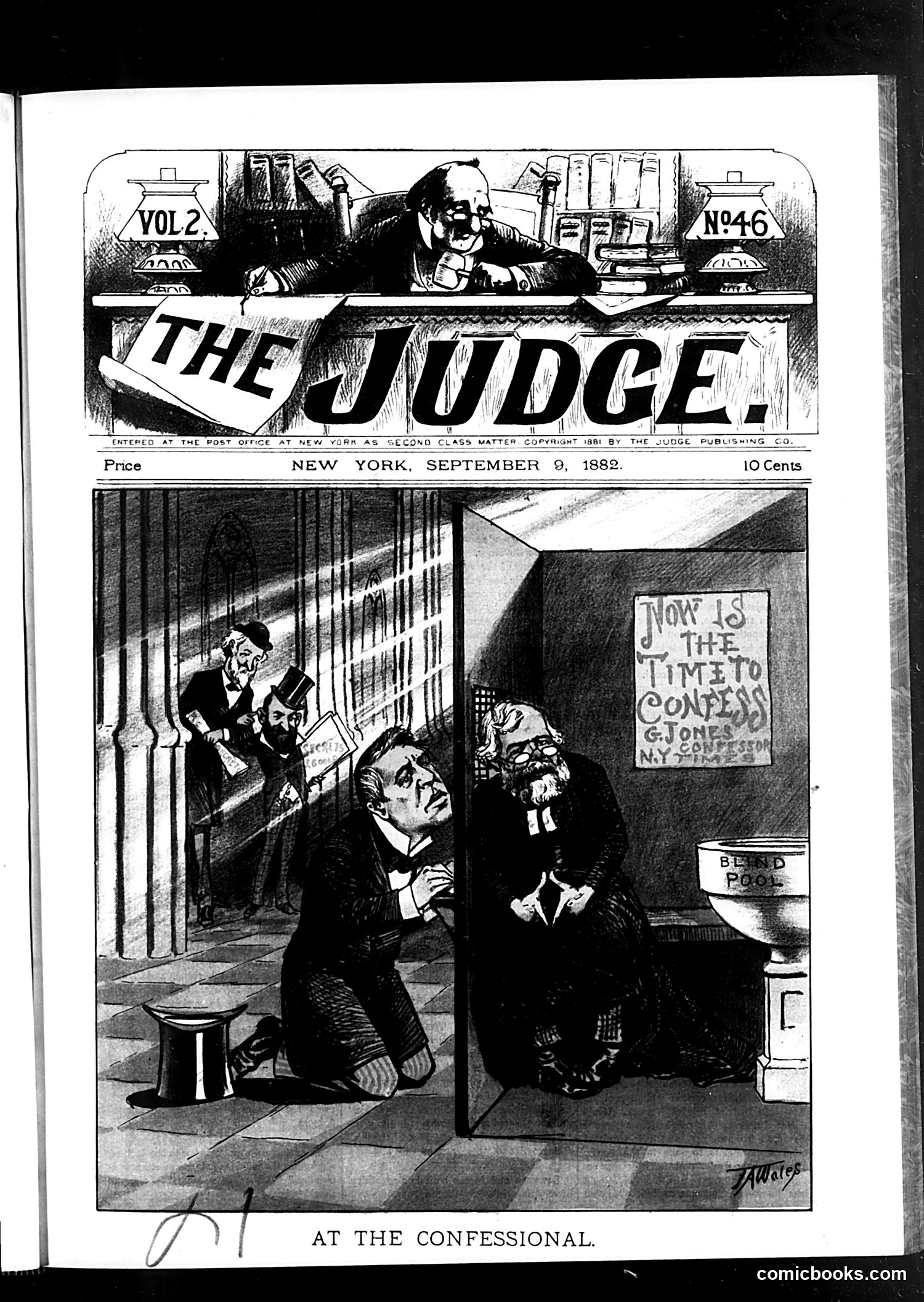
This cartoon satirizes confession in the Catholic Church. A man kneels at the confessional booth, appearing to confess sins to a priest. A sign reads "NOW IS THE TIME TO CONFESS" with what appears to be a name reference (partially legible). The satire likely targets either: - Hypocrisy of prominent figures seeking absolution while continuing questionable practices - General mockery of the confession sacrament as ineffective for genuine moral reform - A specific political scandal where a notable figure sought religious forgiveness The cartoon's humor depends on recognizing the figure being confessed or the reference on the sign—details unclear from this image alone. The elaborate setup and prominent placement suggests this was commentary on a recognizable contemporary scandal or public figure.
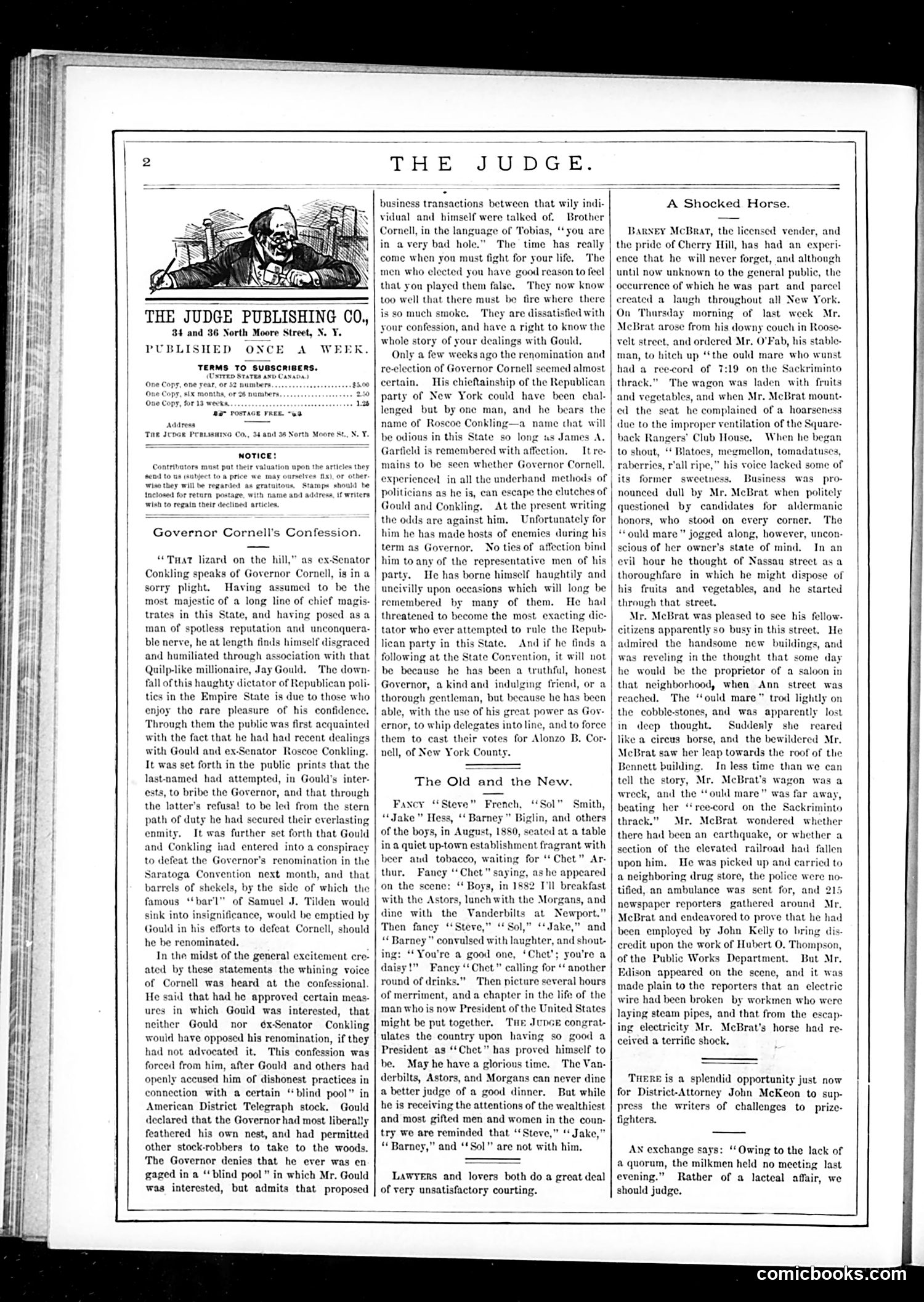
This page attacks **New York Governor Alonzo Cornell** for his entanglement with railroad magnate **Jay Gould** and politician **Roscoe Conkling**. The satire's target: Cornell, who posed as virtuous and incorruptible, is exposed as compromised. Though he denied direct bribery, his admission of discussing business dealings with Gould reveals hypocrisy. Judge mocks his "confession" as forced and incomplete—he claims innocence in a "blind pool" scheme while admitting prior negotiations. The political context involves the 1882 Republican Convention dispute, where Gould and Conkling allegedly plotted Cornell's defeat through financial pressure. Judge argues Cornell created his own downfall through arrogance and association with corrupt business interests, losing support from the Republican establishment he once controlled. The cartoon's message: even powerful politicians cannot escape consequences when connected to robber-baron capitalism.
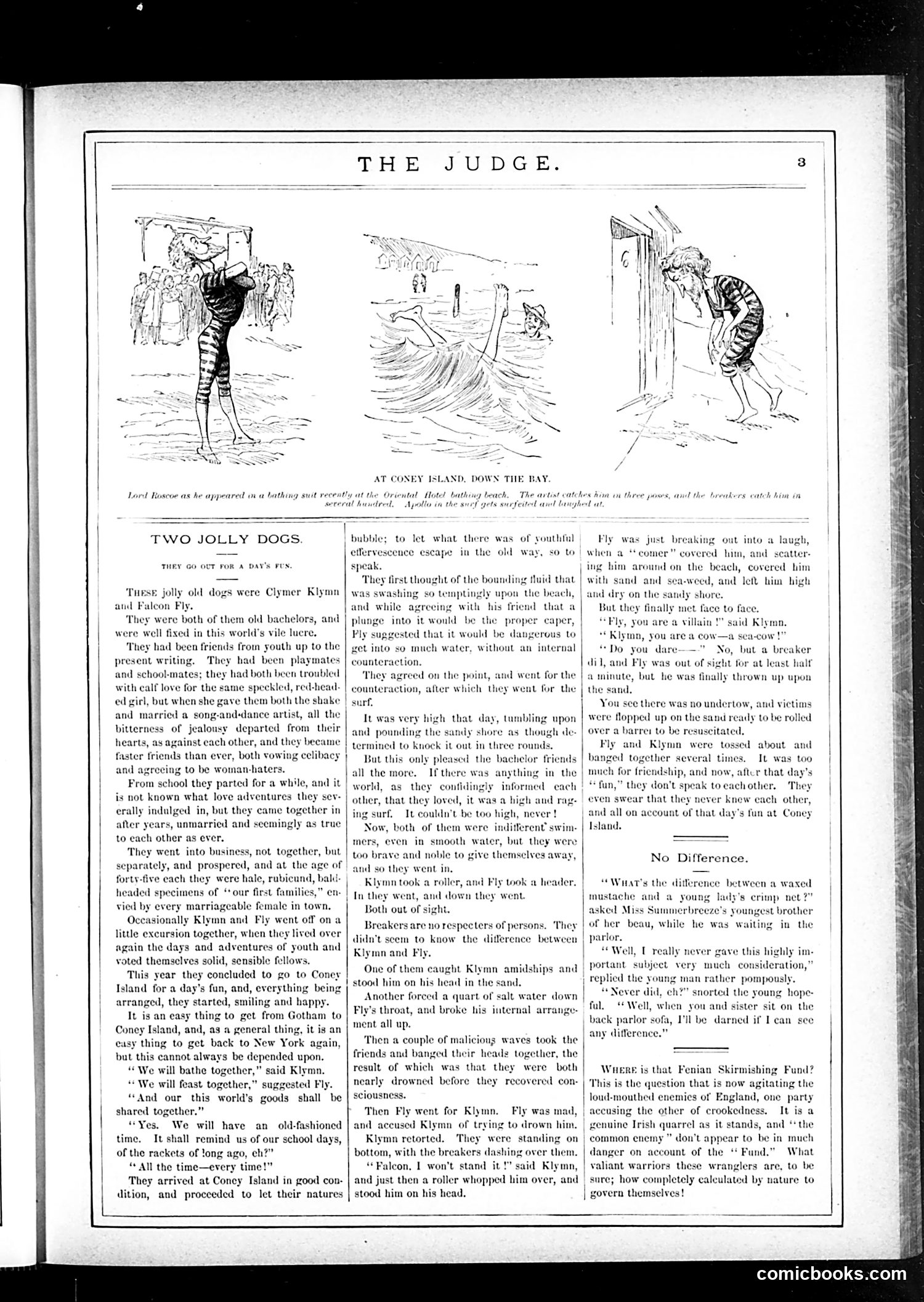
This is a humorous short story ("Two Jolly Dogs") about two aging bachelors—Clymer Klymn and Falcon Fly—who vacation at Coney Island. The accompanying illustrations show a figure identified as "Lord Roscoe" in a bathing suit at the beach. The satire targets pretentious or foolish behavior: two self-satisfied, wealthy old men who pride themselves on their sophistication and bravery venture into the ocean at Coney Island (a popular working-class resort). The joke is that nature humbles them—they're knocked around by rough waves, nearly drowned, and forced to swallow saltwater despite their blustering confidence. The accompanying piece "No Difference" continues light satirical commentary on class and affectation. This reflects *Judge* magazine's typical humor: poking fun at vanity, pretension, and the gap between self-image and reality among the supposedly refined classes.
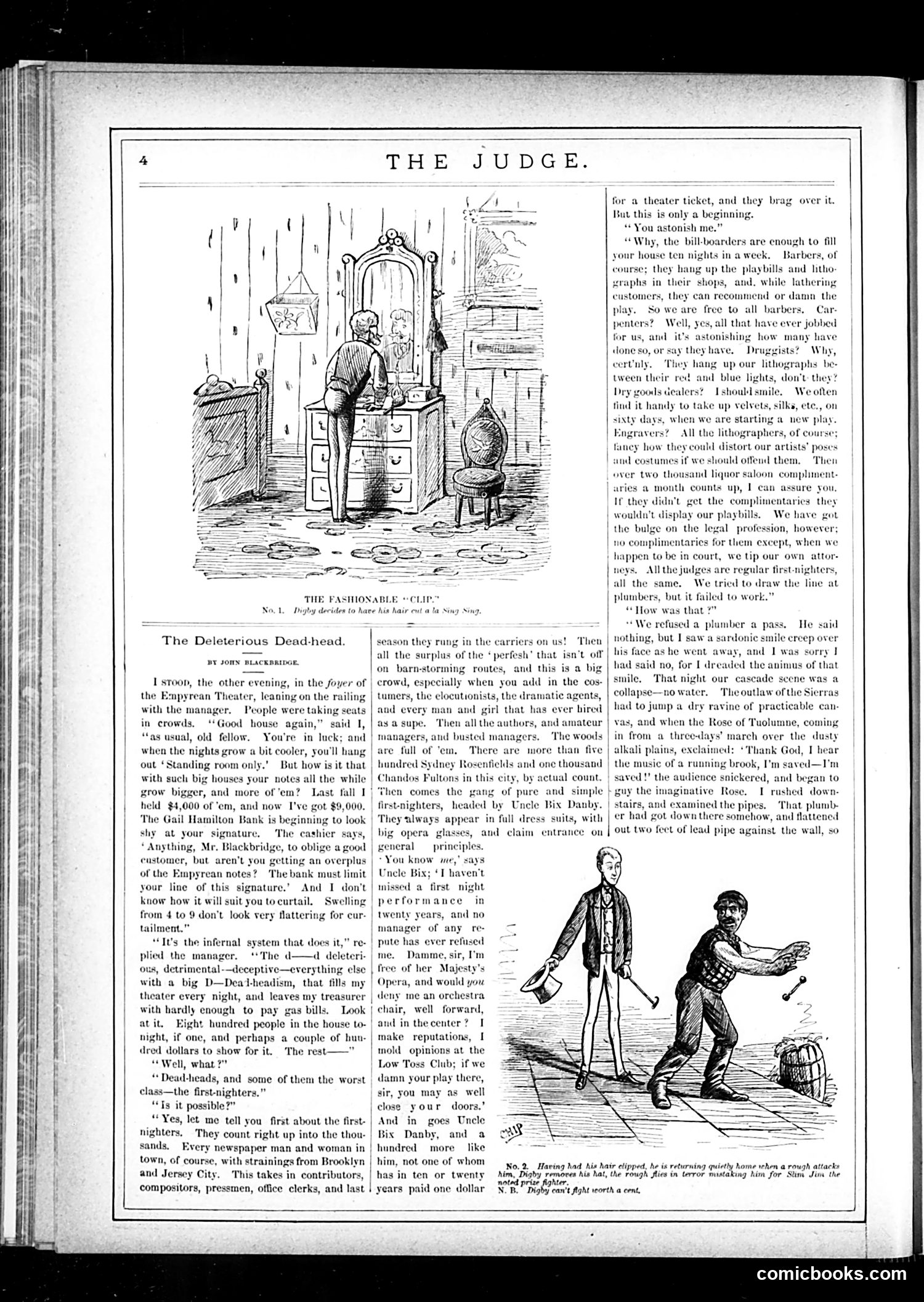
This page contains two satirical pieces from Judge magazine: **"The Fashionable 'Clip'"** (top cartoon): A visual joke about a man getting his hair cut "à la Sing Sing"—referencing the famous prison. The humor lies in fashionable imitation of convict styling. **"The Deleterious Dead-head"** (main article): A theater manager complains about "dead-heads"—people receiving free tickets. The satire catalogs how widespread complimentary passes have become: theater bill-posters, barbers, druggists, engravers, lithographers, liquor saloons, and judges all expect free admission. The manager notes this system backfired when he refused a plumber a pass; the plumber sabotaged the theater's water system during a crucial scene. The piece mocks how dependent theaters were on these unpaying audiences and how vulnerable to retaliation when denying passes. The broader satire critiques theatrical economics and the unsustainable practice of unlimited free admissions.
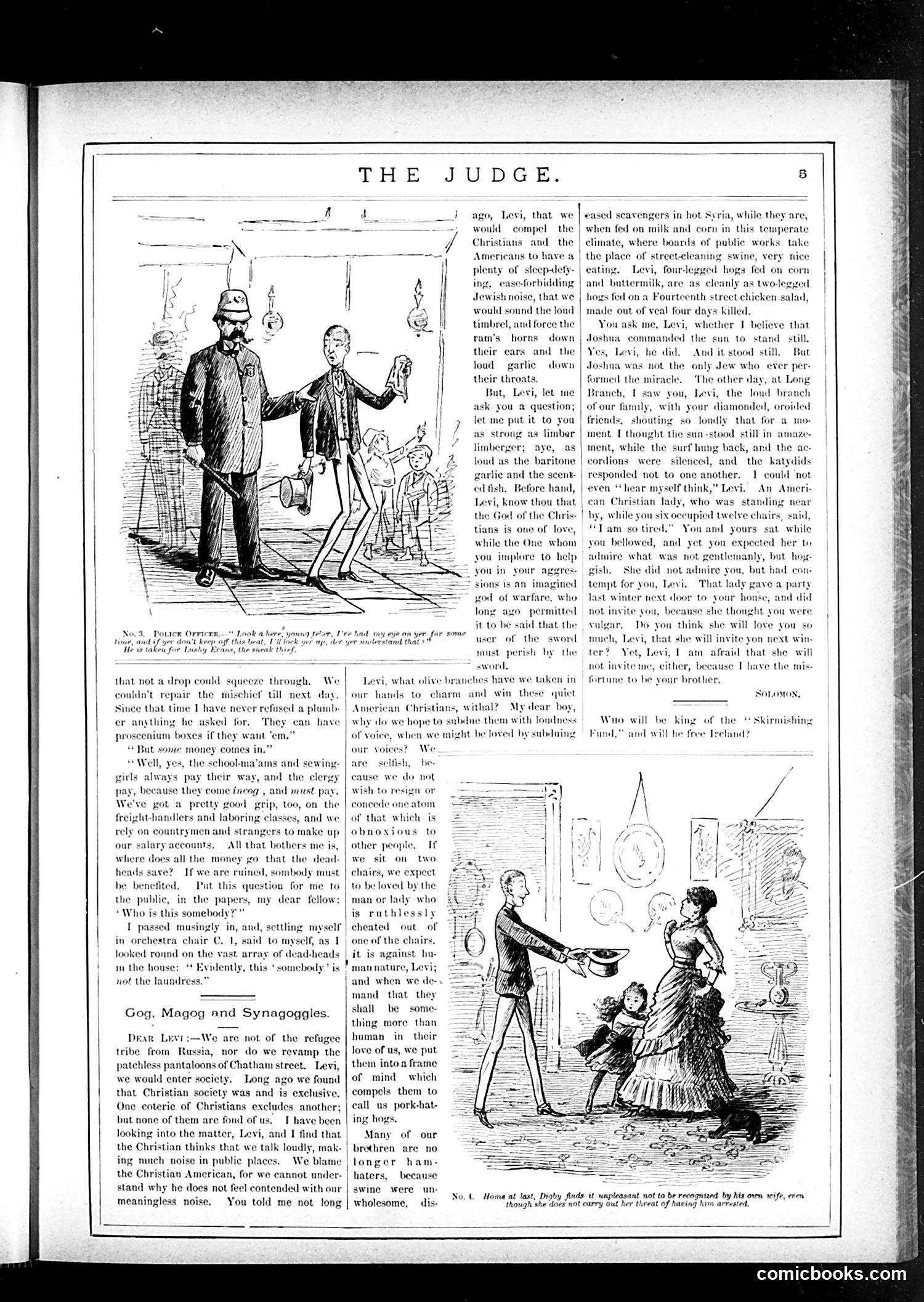
This page satirizes Jewish immigrants' perceived loud, ostentatious behavior and their failure to assimilate into American Christian society. The dialogue between "Solomon" and "Levi" (stereotypical Jewish names) contrasts Jewish noisiness with Christian gentility. Solomon criticizes Levi's family for their loud, vulgar conduct at Long Branch (a resort), claiming their noise temporarily stopped the world—echoing Joshua's biblical miracle but mockingly. The satire argues Jews reject quiet, dignified assimilation and instead cling to "obnoxious" cultural traits. Solomon suggests Jewish loudness alienates them from respectable American society, exemplified by a Christian woman who disdains Levi and won't invite him to social gatherings. The cartoons illustrate this theme through exaggerated physical caricatures emphasizing Jewish otherness. This reflects widespread late-19th-century anti-immigrant sentiment blaming newcomers for social discord rather than examining structural discrimination.
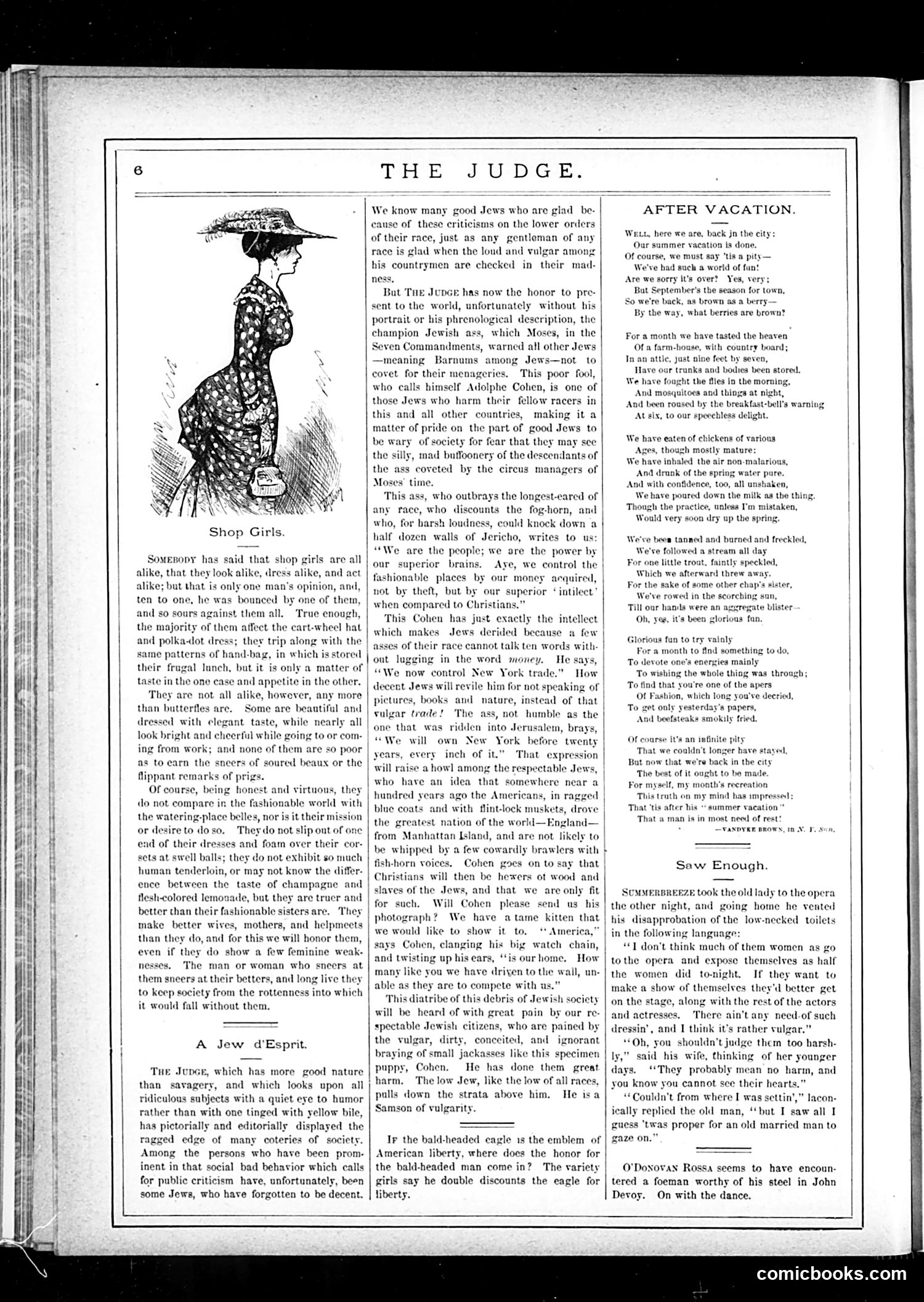
This page contains two distinct pieces satirizing social behavior. The "Shop Girls" essay defends working-class women retail clerks against snobbish dismissal, praising their virtue and character despite their modest circumstances and fashionable uniformity. The cartoon section, titled "A Jew d'Esprit," attacks a Jewish businessman named Adolphe Cohen. The satire targets Cohen's boastful claims about Jewish wealth and control of New York commerce, and his repeated emphasis on money in conversation. Judge criticizes Cohen as embodying negative Jewish stereotypes—specifically, vulgar materialism and arrogance about financial power. The piece distinguishes between "good Jews" who feel embarrassed by such behavior and these "ridiculous" individuals. The biblical references (Moses, Jericho, circus managers) mock Cohen as an ass, using religious language for contempt. This reflects 19th-century antisemitic tropes about Jewish obsession with wealth, even while framing criticism as directed at individual bad behavior rather than the entire group.
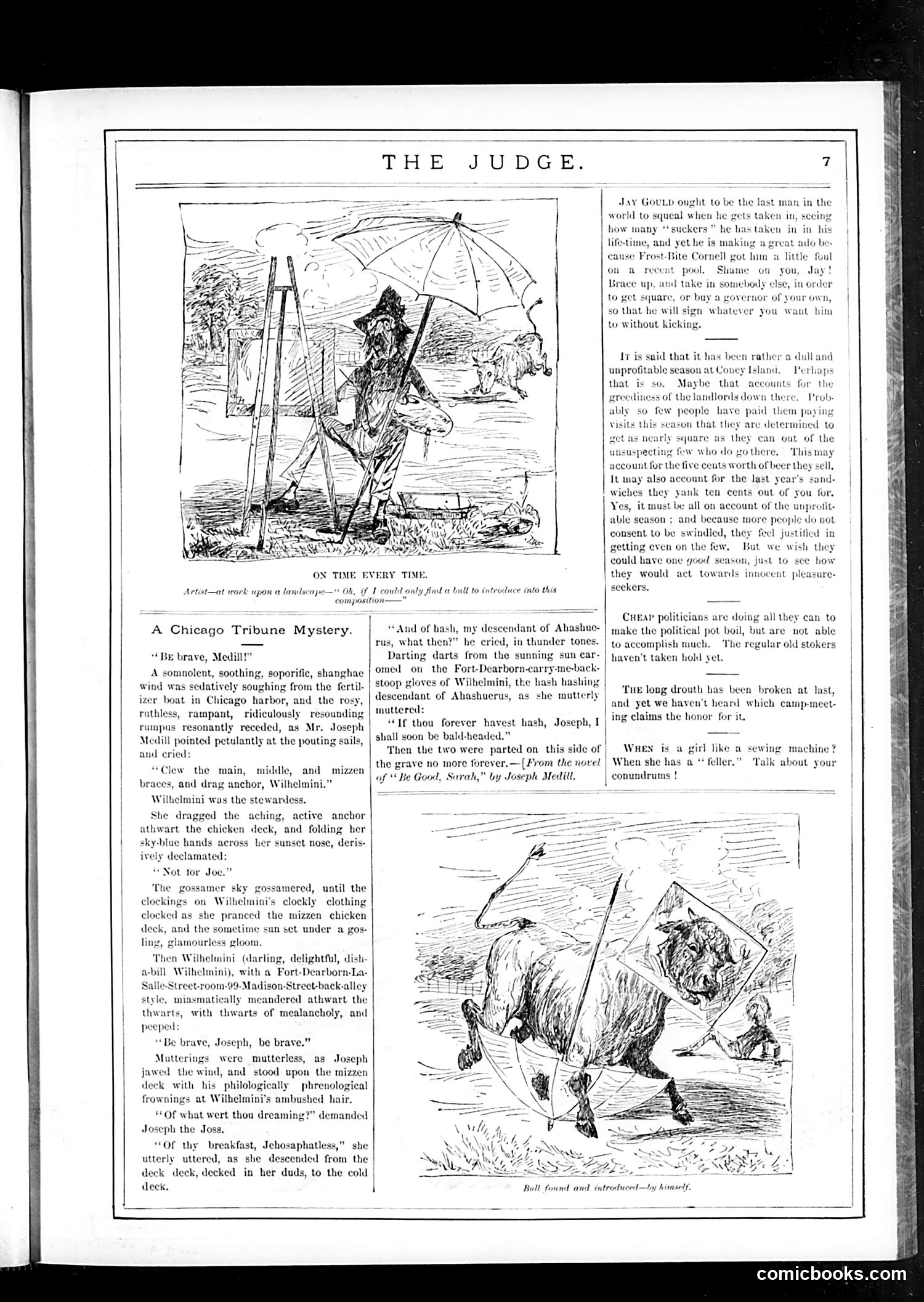
This page contains satirical commentary on prominent figures and social issues of the era: **Jay Gould Commentary**: The opening text mocks railroad magnate Jay Gould for complaining about being swindled in a pool game, given his reputation for defrauding countless investors ("suckers") throughout his career. The satire suggests he deserves such treatment. **Coney Island Editorial**: Commentary on a disappointing tourist season at Coney Island, attributing it to landlords' greed and their swindling of visitors, which deters repeat business. **"Chicago Tribune Mystery"**: A parody of Joseph Medill, editor of the Chicago Tribune, written in deliberately overwrought, nonsensical prose mocking his pretentious writing style. The absurdist narrative aboard a ship with a character named "Wilhelmini" appears designed to ridicule Medill's literary affectations. **Minor Items**: Brief jokes about politicians and a pun ("When is a girl like a sewing machine? When she has a 'feller'"). The page exemplifies Judge's approach: targeting wealthy industrialists and newspaper editors through direct criticism and literary parody.
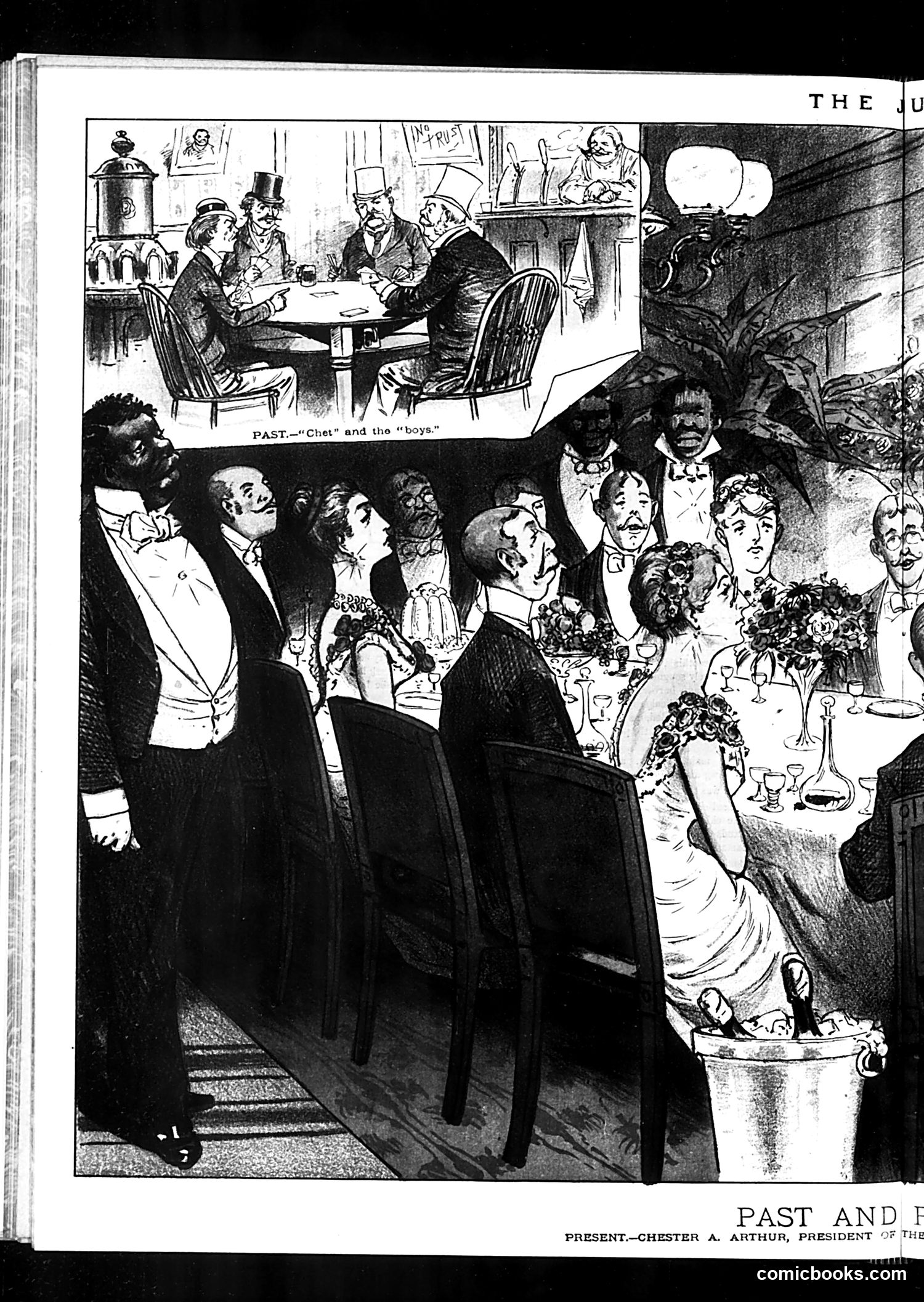
This page presents two contrasting scenes labeled "Past" and "Present" (subtitle indicates Chester A. Arthur, President of the...). **Upper panel ("Past"):** Shows "Chet" and the "boys" in what appears to be a casual, informal gathering—men in period dress playing cards or socializing in a relaxed setting. **Lower panel ("Present"):** Depicts a formal, elaborate dinner party with well-dressed guests, women in evening wear with flowers, waiters, and fine dining—suggesting wealth and formal society. **The satire:** The comparison mocks Chester Arthur's transformation from his reputation as a casual, convivial politician ("Chet and the boys") to his role as President conducting formal state functions and high society events. It satirizes how political office elevated him to refined, stiff formality, contrasting his earlier informal reputation with his present dignified but less personable status.
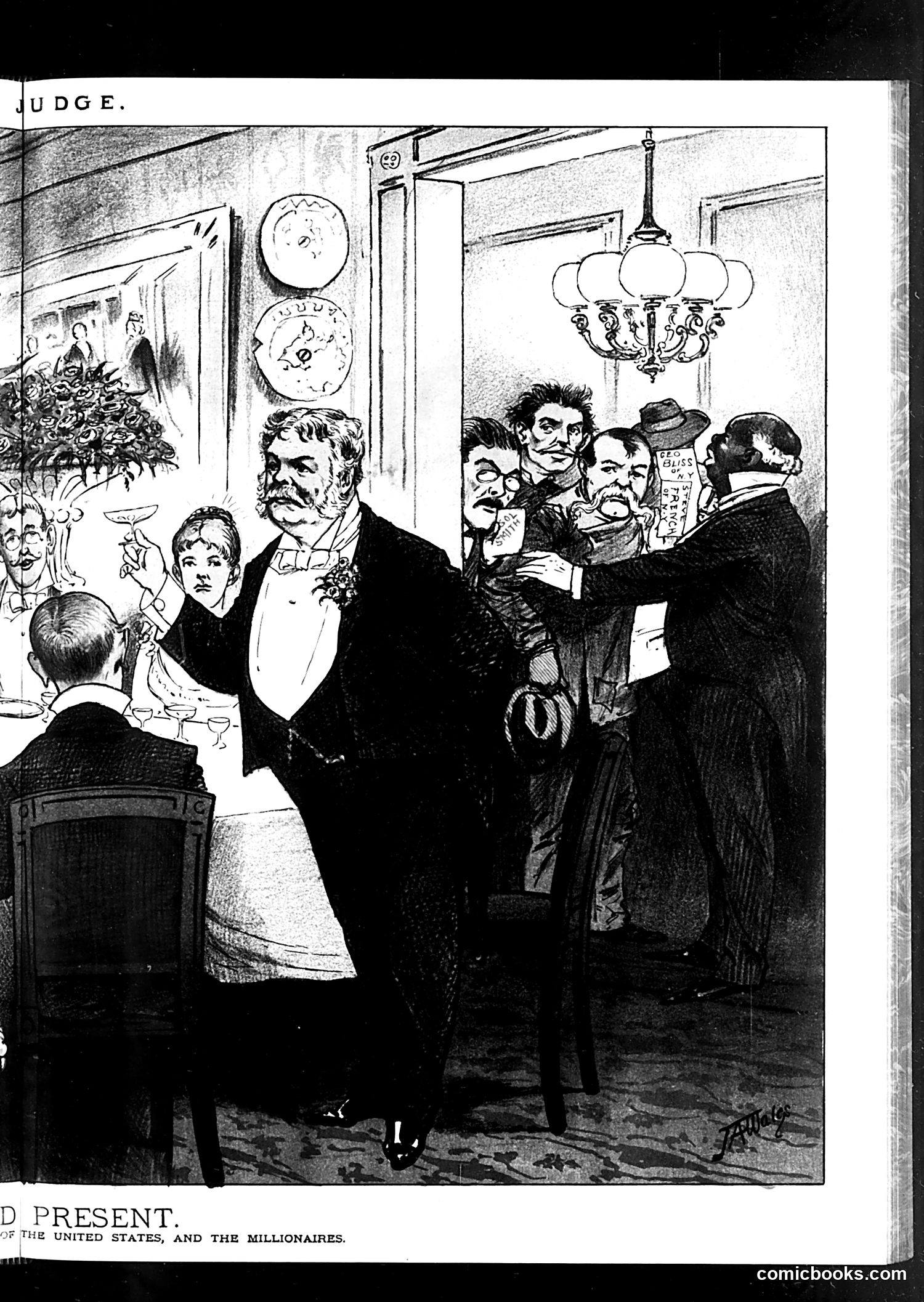
This page from *Judge* magazine depicts a formal dinner scene with exaggerated facial features typical of late 19th/early 20th-century political satire. The title references "THE UNITED STATES, AND THE MILLIONAIRES," suggesting the cartoon critiques the relationship between government and wealthy industrialists. The central figure—a distinguished gentleman in formal attire—appears to represent either a judge or government official, while the clustered men on the right, characterized by prominent mustaches and aggressive expressions, likely represent wealthy businessmen or industrialists. Their physical positioning and body language suggest they're either pressuring or controlling the central authority figure. The satire appears to comment on the corruption or undue influence of wealthy interests over American judicial or governmental systems—a common Progressive Era critique. The decorative furnishings and refined setting contrast ironically with the suggestion of impropriety.
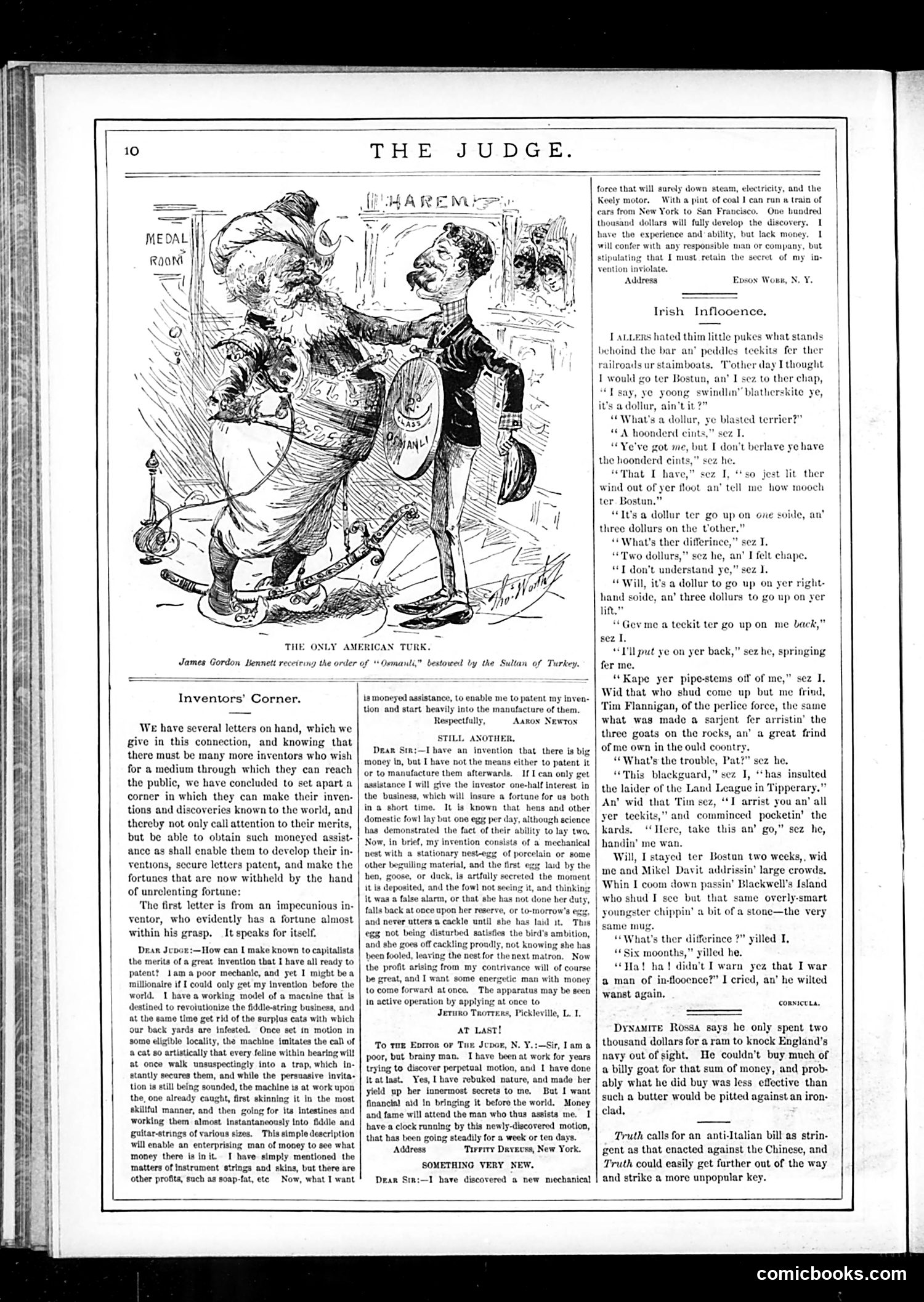
The main cartoon depicts a portly man wearing a Turkish fez and military uniform receiving a medal labeled "Oxmanti" from the Sultan of Turkey. The figure appears to be **James Gordon Bennett**, founder of the *New York Herald* newspaper. The satire mocks Bennett's self-aggrandizing pretensions and his cultivation of foreign honors. The reference to receiving an Ottoman decoration suggests he's been celebrated abroad while perhaps seeking greater legitimacy or status than he possessed domestically. The "Medal Room" label emphasizes his collecting of accolades. The surrounding "Inventors' Corner" section presents absurd patent proposals—a cat-catching machine that skins cats for fiddle strings, and a device to trick hens into laying extra eggs—satirizing both the flood of ridiculous invention submissions and the get-rich-quick schemes prevalent in the era. Together, the page mocks vanity, dubious entrepreneurship, and the American obsession with novelty and profit.
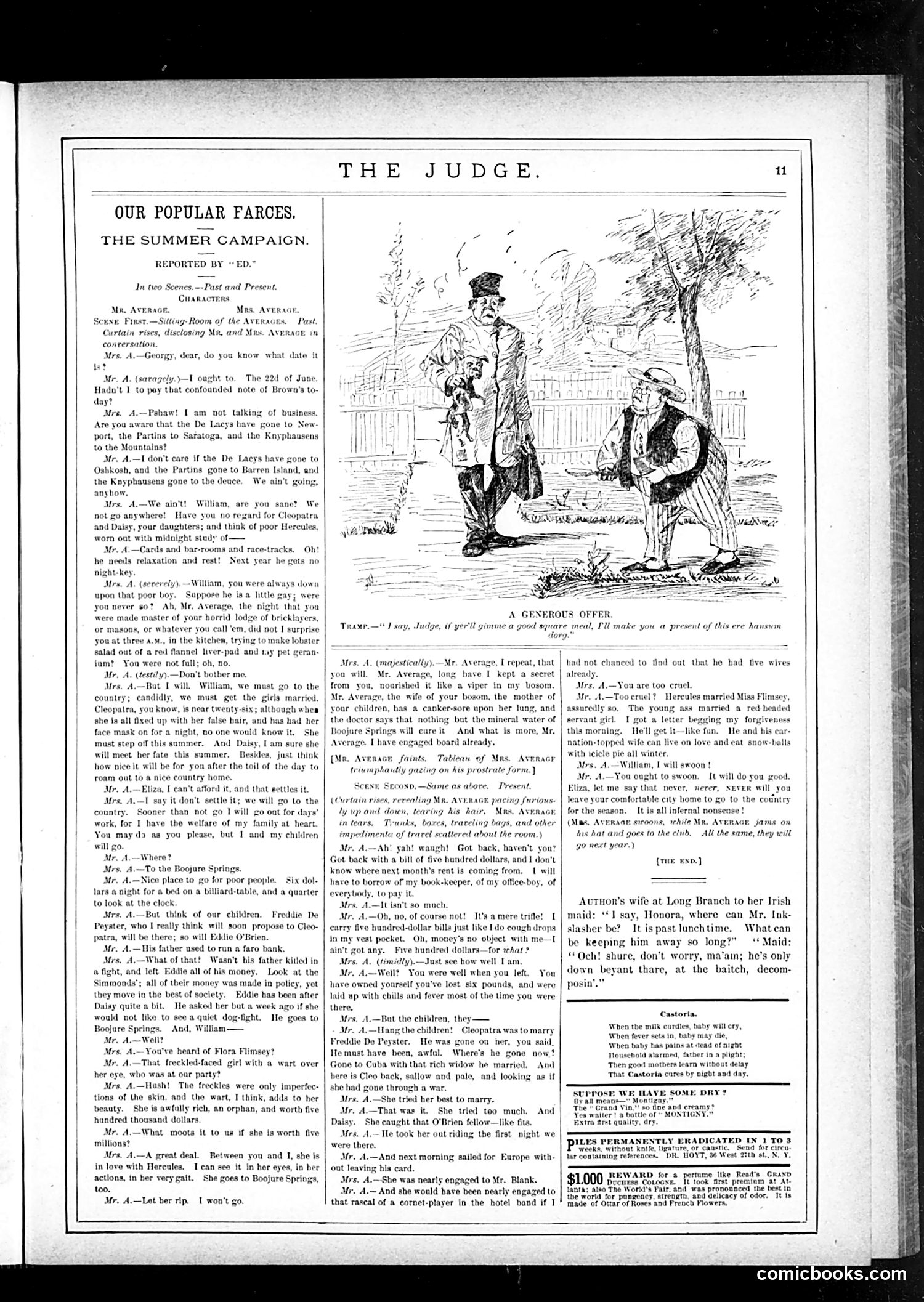
This is a satirical two-act play called "The Summer Campaign," mocking middle-class American social pretensions in the late 19th century. **The Setup**: Mr. and Mrs. Average argue about their summer plans. Mrs. Average insists they must go to "Boojure Springs" (a fashionable resort) because their wealthy neighbors have gone elsewhere, and their daughters need to marry well. She lists eligible bachelors: Freddie De Peyater and Eddie O'Brien (son of a faro-bank owner), and most importantly, Flora Flimsey—a wealthy orphan with a five-hundred-thousand-dollar fortune. **The Satire**: The joke targets the obsession with status and marriage markets among aspirational middle-class families. Mrs. Average's arguments reveal the hypocrisy of "respectable society"—she dismisses Mr. Average's valid concerns about cost while defending obviously questionable people (O'Brien's father ran gambling operations; the Simmonds made money from illegal "policy" betting) simply because they're wealthy. **The Drawing** shows Mr. Average resisting while his wife dominates, a common Victorian domestic humor trope. The accompanying tramp advertisement provides additional comedic relief.
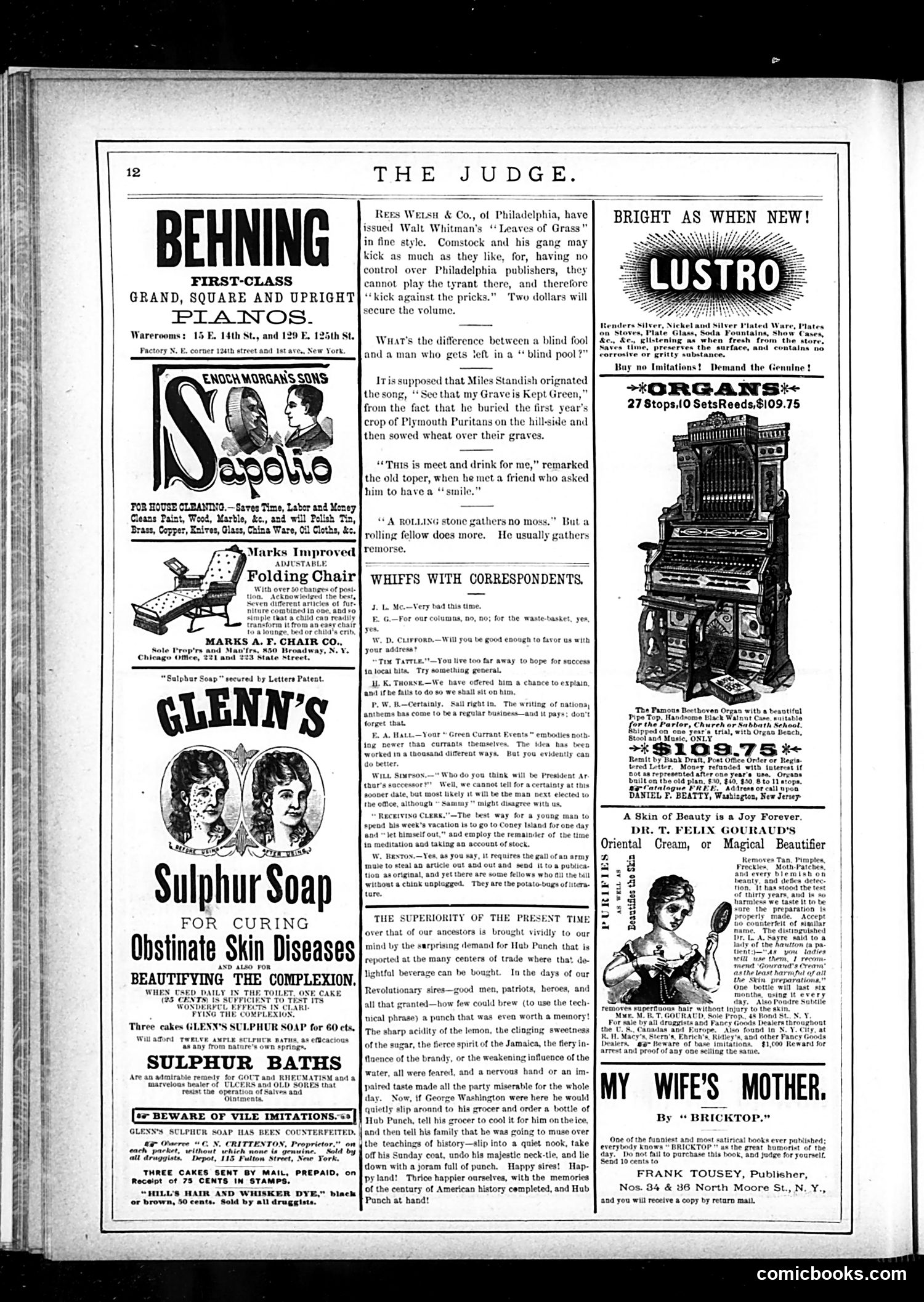
This page is primarily **advertising**, not satirical content. It features commercial notices for pianos, cleaning products, soap, and other goods typical of late 19th-century periodicals. The limited editorial content includes: **"Whiffs with Correspondents"** — a humorous advice column where the magazine responds to reader submissions with brief, witty rejections or comments. Most submissions are dismissed as unsuitable for publication. **Scattered jokes** about historical figures (Miles Standish) and wordplay ("blind fool" vs. "blind pool"). **A brief note** praising Philadelphia publishers Rees Welsh & Co. for issuing Walt Whitman's *Leaves of Grass*, suggesting Comstock (likely Anthony Comstock, a notorious censorship advocate) cannot suppress it outside his jurisdiction—a subtle dig at censorship attempts. The page demonstrates how 19th-century satirical magazines balanced editorial commentary with substantial advertising revenue. The jokes and references are light social humor rather than pointed political satire.
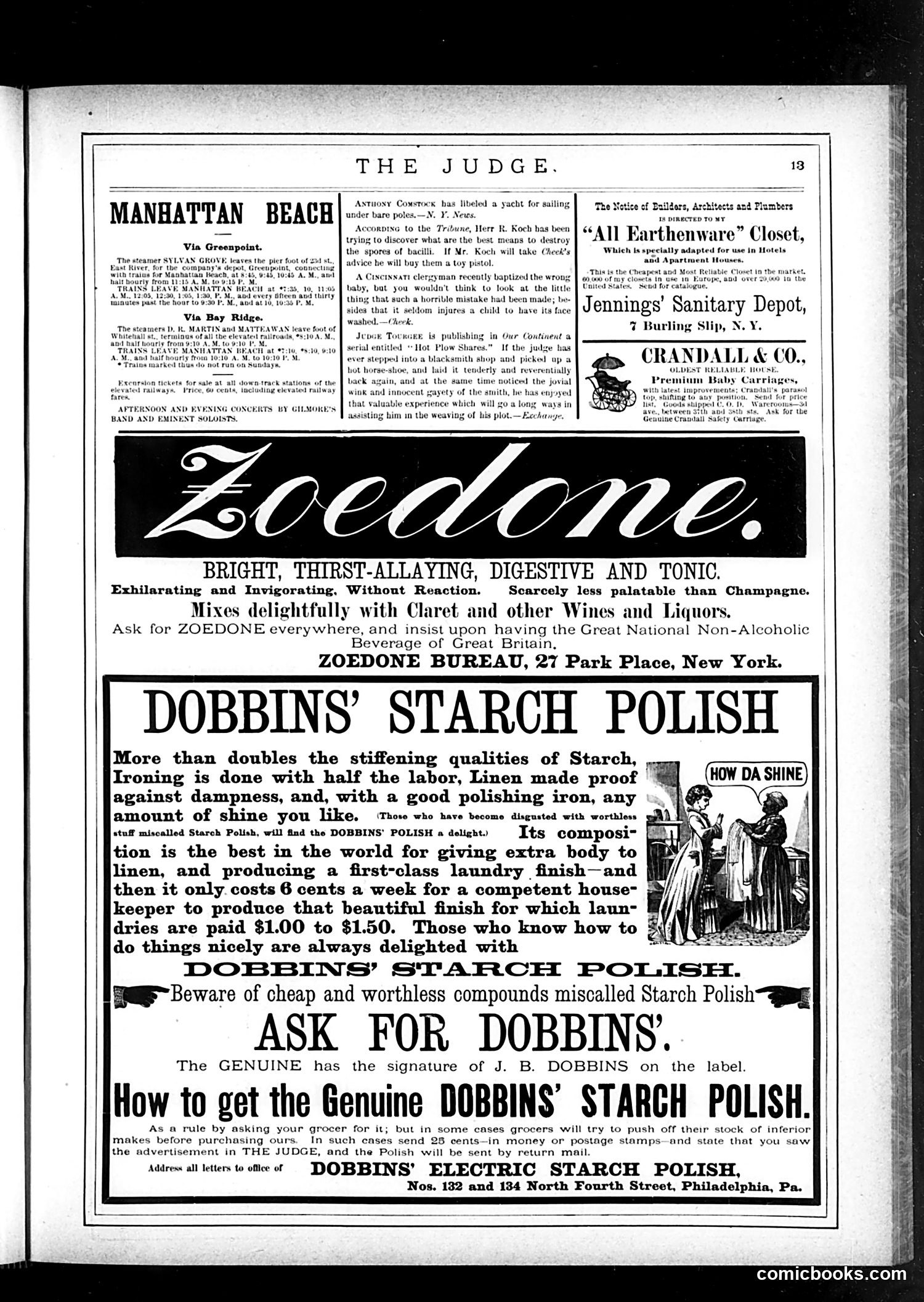
This page is **primarily advertising**, not satire or political commentary. The dominant content comprises commercial advertisements for consumer products popular in the late 19th century. The small editorial section at top mentions **Dr. Robert Koch's research on bacilli** (bacteria), referencing his genuine scientific work on tuberculosis and infection control—presented as noteworthy news rather than satire. The bulk of the page advertises: - **Zoedone**: a non-alcoholic beverage marketed as a "Great National" drink - **Dobbins' Starch Polish**: a laundry product claiming superiority over competitors, with warnings against cheap imitations These ads employ typical period marketing tactics: exaggerated claims, celebrity/authority endorsement appeals, and competitive positioning against inferior products. The Dobbins ad explicitly warns readers to avoid counterfeit versions. The page reflects Judge's business model: satirical editorial content subsidized by paying advertisers reaching the magazine's middle-class readership concerned with household management and respectability.
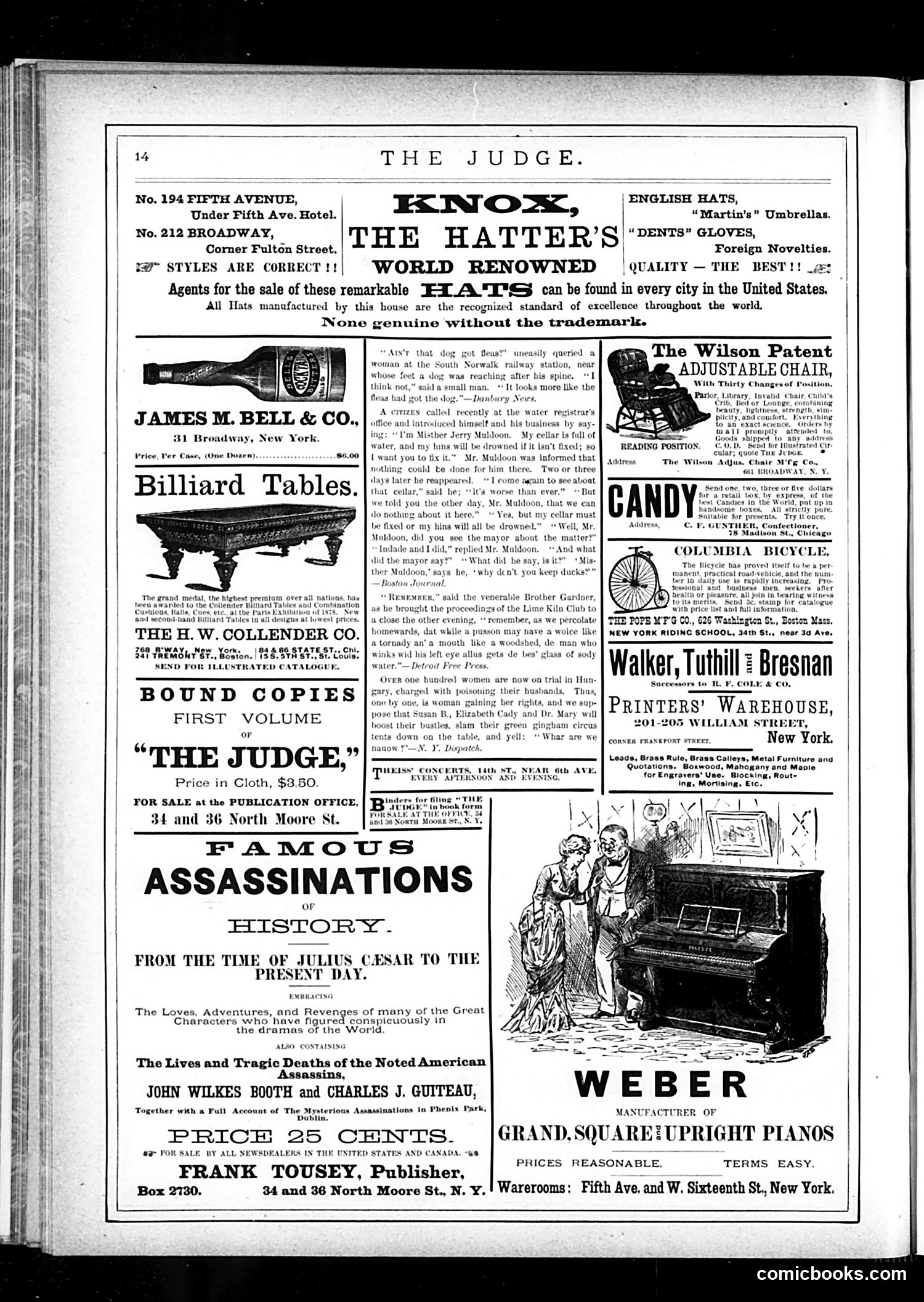
This page is **primarily advertising**, not satirical content. It's dominated by commercial notices for period products: Knox hats (with trademark emphasis), James M. Bell billiard tables, Wilson Patent adjustable chairs, and Weber pianos. The only substantive editorial content is a **bound book advertisement** for "Famous Assassinations of History," priced at 25 cents, published by Frank Tousey. This sensationalist title promises accounts of historical assassinations from Julius Caesar onward, notably including **John Wilkes Booth** (Lincoln's assassin) and **Charles J. Guiteau** (who assassinated President Garfield in 1881). The advertisement also references the "Phoenix Park" murders in Dublin—likely the 1882 killings of British officials in Ireland. The page reflects late 19th-century American print culture: lurid true-crime publishing coexisting with genteel consumer goods advertising in a satirical magazine. The assassination book's prominence suggests contemporary public fascination with political violence.
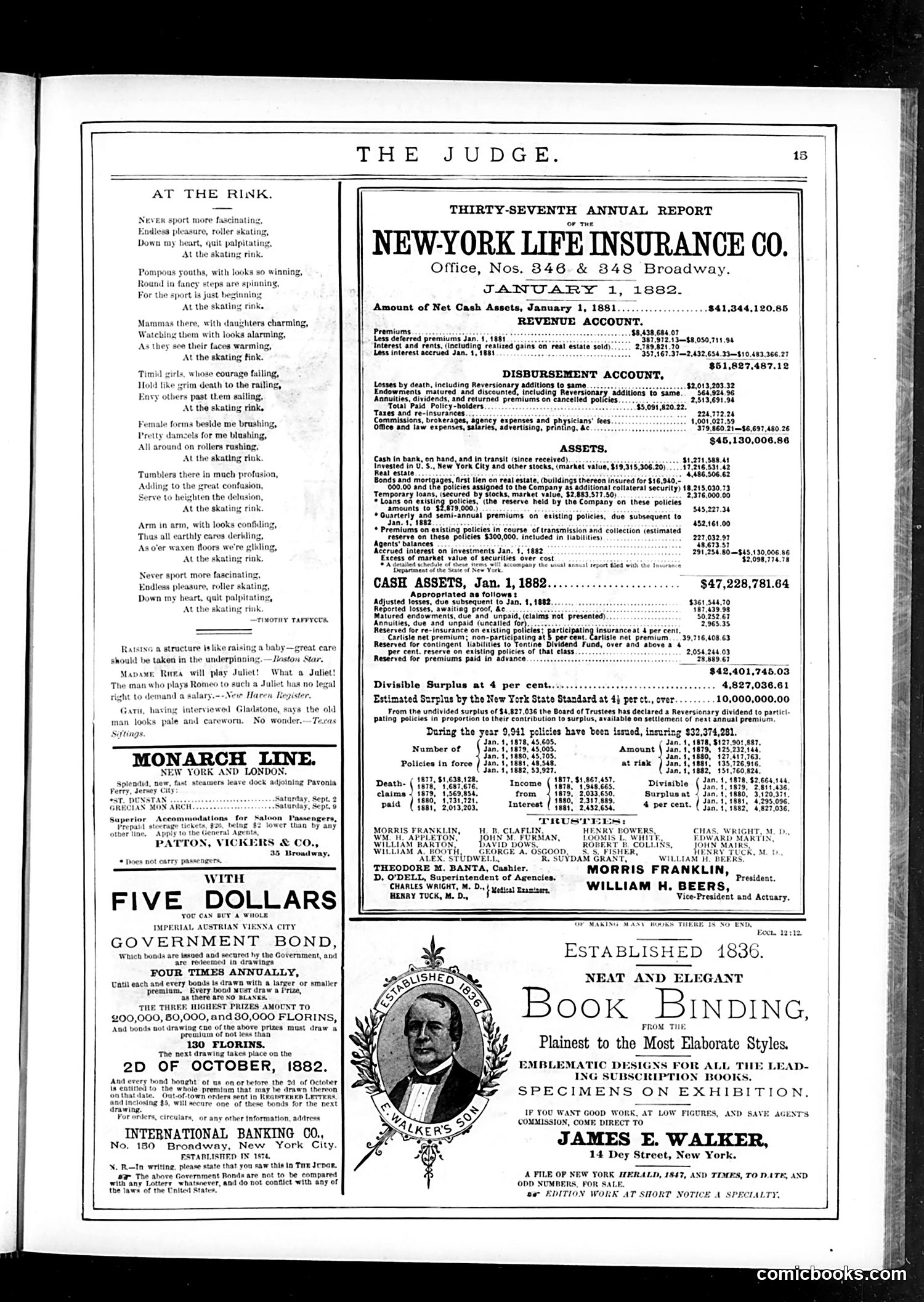
This page is primarily **advertisements and financial notices**, not satirical content. The dominant feature is the New-York Life Insurance Company's "Thirty-Seventh Annual Report" (dated January 1, 1882), displaying assets, revenues, and disbursements. The left column contains light **verse about roller skating** by Timothy Taffyсca, a humorous poem celebrating the social scene at skating rinks—young couples flirting, timid girls clinging to railings, and general romantic atmosphere. It's genteel humor reflecting 19th-century courtship customs. Below are several brief **satirical quips** (typical of Judge magazine): jokes about acting, architecture, and Gladstone (the British Prime Minister), none requiring deep historical knowledge beyond recognizing he was a public figure. The remaining space advertises **steamship lines, government bonds, and book binding services**—standard commercial notices for the era. Nothing here constitutes substantive political satire or requires specific historical context beyond understanding this is a magazine mixing humor with commercial advertising.
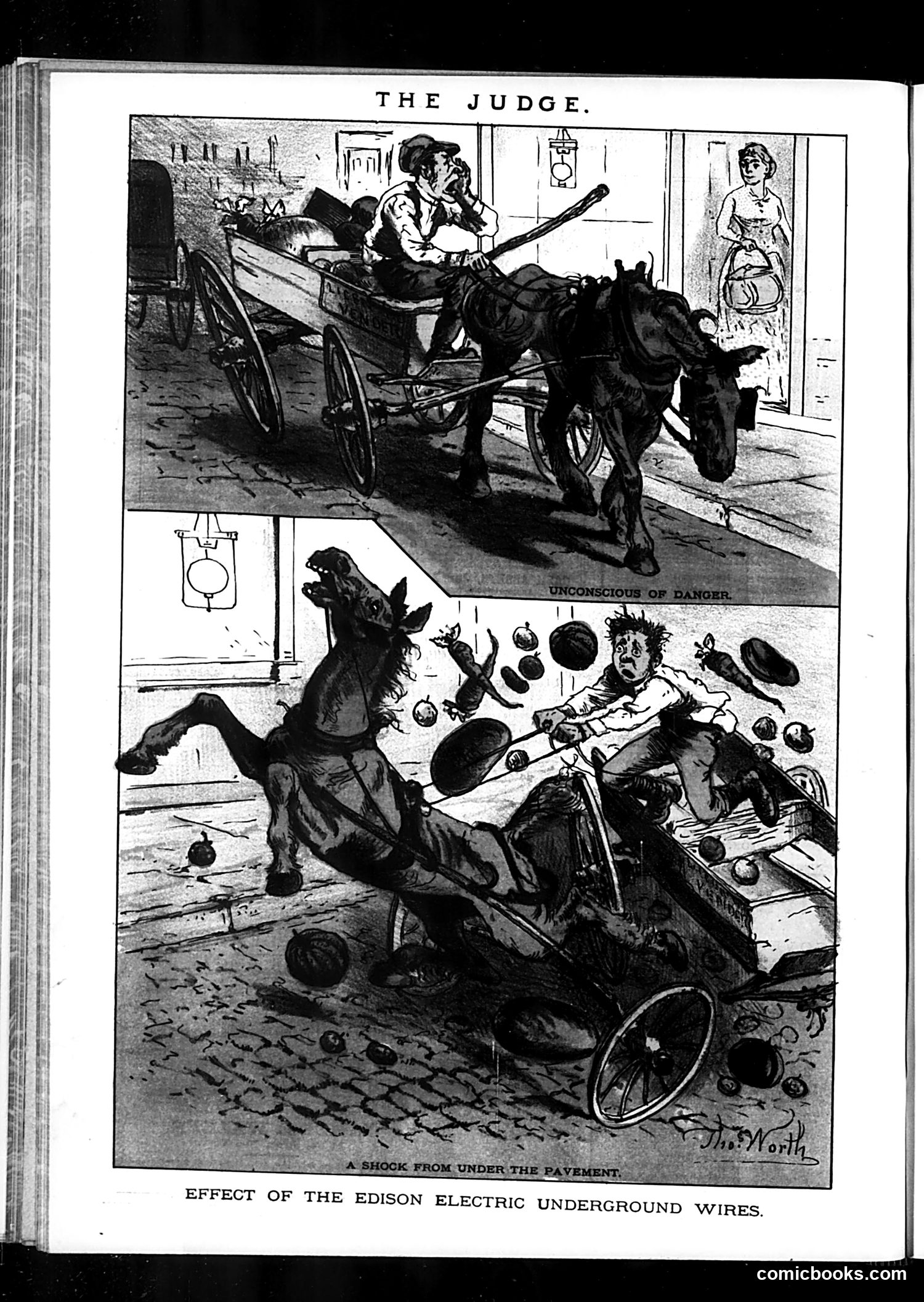
This satirical cartoon critiques the dangers of Thomas Edison's newly installed underground electrical wiring system. The top panel shows a man obliviously driving a cart while a woman watches from a doorway—captioned "Unconscious of Danger." The bottom panel, titled "A Shock from Under the Pavement," depicts the aftermath: the man and horse have been violently thrown, surrounded by scattered objects and debris. The joke warns that buried electrical wires pose hidden hazards to unsuspecting pedestrians and drivers. The irony is that Edison's innovation—meant to modernize cities by concealing wires underground—actually created unpredictable electrocution risks. The cartoon satirizes the gap between technological progress and public safety, showing how "modern" infrastructure could literally shock Gilded Age urbanites without warning.