
Judge, 1882-09-09 · page 5 of 16
Judge — September 9, 1882 — page 5: what you’re looking at
What you’re looking at
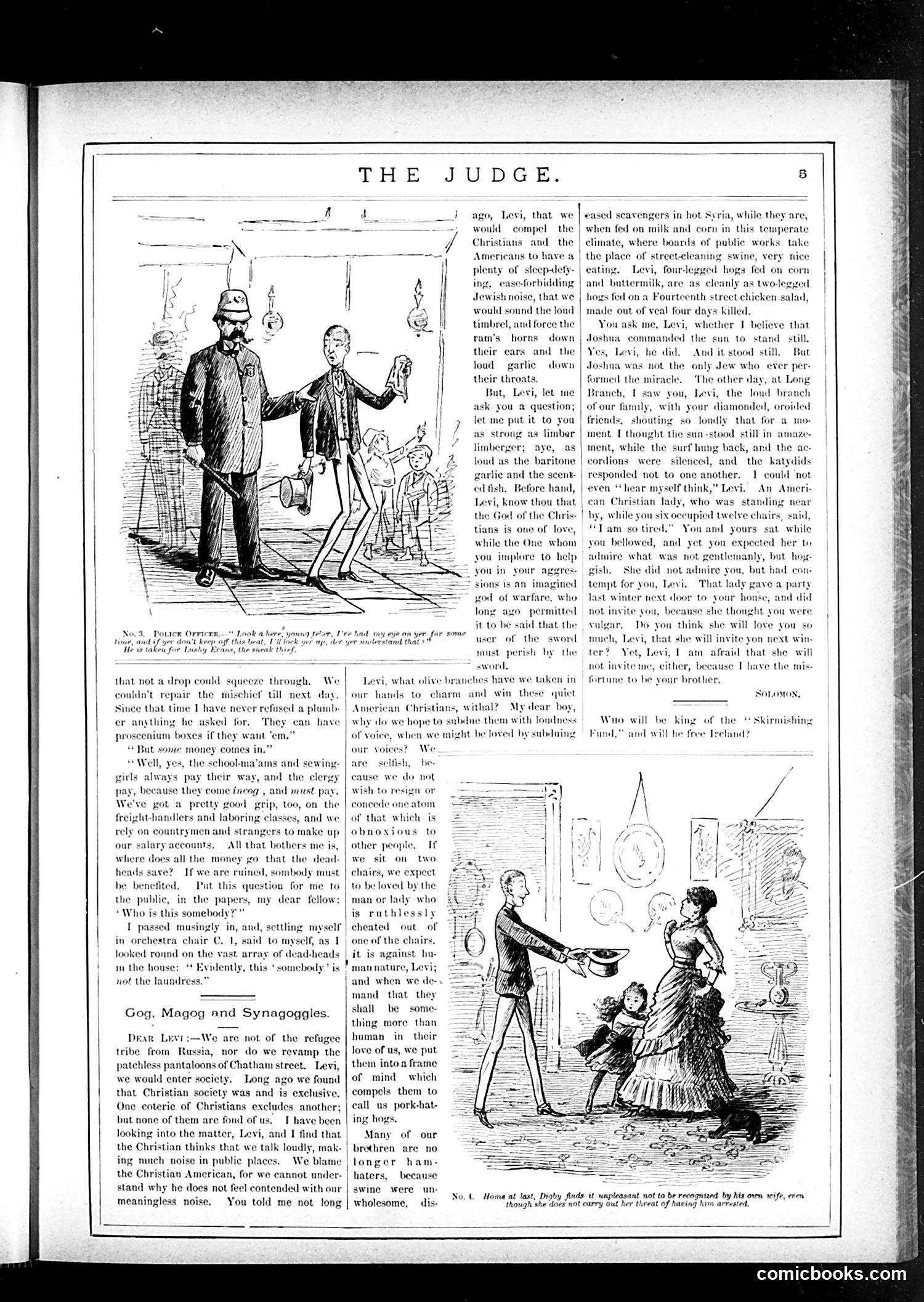
This page satirizes Jewish immigrants' perceived loud, ostentatious behavior and their failure to assimilate into American Christian society. The dialogue between "Solomon" and "Levi" (stereotypical Jewish names) contrasts Jewish noisiness with Christian gentility. Solomon criticizes Levi's family for their loud, vulgar conduct at Long Branch (a resort), claiming their noise temporarily stopped the world—echoing Joshua's biblical miracle but mockingly. The satire argues Jews reject quiet, dignified assimilation and instead cling to "obnoxious" cultural traits. Solomon suggests Jewish loudness alienates them from respectable American society, exemplified by a Christian woman who disdains Levi and won't invite him to social gatherings. The cartoons illustrate this theme through exaggerated physical caricatures emphasizing Jewish otherness. This reflects widespread late-19th-century anti-immigrant sentiment blaming newcomers for social discord rather than examining structural discrimination.
📄 Transcribed text from this page (OCR, searchable)
Machine-transcribed from the original scan — historical spelling and the odd misread are preserved.
THE JUDGE. Levi, that we | eased scavengers in hot Syria, while they are, would compel the | when fed on milk and corn in this temper Christians and the | climate, where boards of public works Americans to have a | the plas street-cleaning swine, very 1 plenty of p-defy- | cating. Levi, four. 1 hogs fed on corn ing, forbidding | and buttermilk, are as cleanly as two-legged Jewish noise, that we | hogs fed ona Fourteenth street chicken would sound the loud | made out of veal four days killed, timbrel, and force the | You ask me, Levi, whether I believe that ram's horns down | Joshua commanded the sun to stand still, their ears and the | Yes, Levi, he did. And it stood still, But loud garlic down | Joshua was not the only Jew who ever per- their throats. | formed the mirac ‘The other day, at Long But, Levi, let me | Braneh, 1 saw you, Levi, the loud branch sk you a question; | of our family, with your diamonded, oroided let me put it to you | friends, shouting so londly that for a mo- as strong as limber | ment I thonght the sun-stood still in am: limberger; aye, as | ment, while the surf hung back, and the ai loud as the baritone | cordions were silenced, and the katydids garlic and the scent- | responded not to one another. 1 could not edfish, Before hand, | even “hear myself think,” Levi. An Levi, know thou that | can Christian lady, who was standin, the God of the Chris- | by, while 5 airs, tians is one of love, Tam Bae ) sat while the One whom you bellowed, and yet you expected her to you implore to help admire what was not gentlemanly, but hog- = you in your s gish. She did not admire you, but had con- sions is an imagined | tempt for you, Levi. lady gave a party youl of warfare, who last winter next door to your house, and did long ago permitted not invite you, because she thought you were ° it to be said that the | vulgar, Do you think she will love you so Fone eee eek naar ctr yee enue er 2™ user of the sword | much, Levi, that she will invite yon next win- y Bra must p poby the ter? Yet, Levi, 1 am afraid that she will = sword, not invite me, either, because I have the mis that not a drop could > through. we | Leri, whnt olive branches have wo taken in | furtune to he your broth ‘ouldn’t repair the 1 ill next day. | our hands to charm and win these quiet SOLOMON. Since that time I ased a plumb. | Ame christians, withal? My dear t =—== cr anything he asked for, ‘They can have | why do we hope to subdue them with loudr Wo will be king of the © Skirmishins proscenium boxes if they want ‘em.” of voice, when we might be loved by subduing — Fund,’ will he free Ireland? “But some money comes in.” | our voices? We “Well, yes, the school-ma’ams and sewing- 1, be and the clergy | cause we do not pay > they og, and must pay. | wish to resign or We've got a pretty good grip, too, on the | concede one atom freight-handlers and laboring classes, and we | of that which is y on countrymen and st stomake up | obnoxious to lary accounts. All that bothers me is, | other people. If does all the: mone that the dead- | we sit on two uy If we are sombody must | chairs, we expect be benefit Pat this question for me to | to beloved by the the public, in the papers, my dear fellow: is this somebody?” is ruthlessly I passed musingly in, and, settling myself cheated out of in orchestra chair C. 1, said to myself, as [| one of the chairs. looked round on the F of dead-he is against hu- | man or lady who | in the house: Evidently, this ‘somebody’ is ! man nature, Levi; not the laundress.” and when we de- mand that they Gog, Magog and Synagoggles. | Slll_ be some- thing more than Dear Levi:—We are not of the refugee | human in their tribe from Russia, nor do we revamp the | love of us, we put patchless pantaloons of Chatham street, Levi, | them intoa frame we would enter society. Long ago we found | of mind which that Christian society was and is exclusive. | compels them to One coterie of Christians excludes another; | call us pork-hat- but none of them are fond of us. I have been | ing hog: looking into the matter, Levi, and I find that | Many of our the Christian thinks that we talk loudly, mak- | brethren are no ing much noise in public places. We blame longer ham- the Christian American, for we cannot under: | haters, because stand why he does not feel contended with our | swine were un- ES . - No. 4. Home at last, Digby finds tt unpleasant not to be recognized by his oven wi meaningless noise. You told me not long | wholesome, ae dan ey Sid carry at her threat af honing hime entra. oe comicbooks.com