
Judge, 1882-09-09 · page 2 of 16
Judge — September 9, 1882 — page 2: what you’re looking at
What you’re looking at
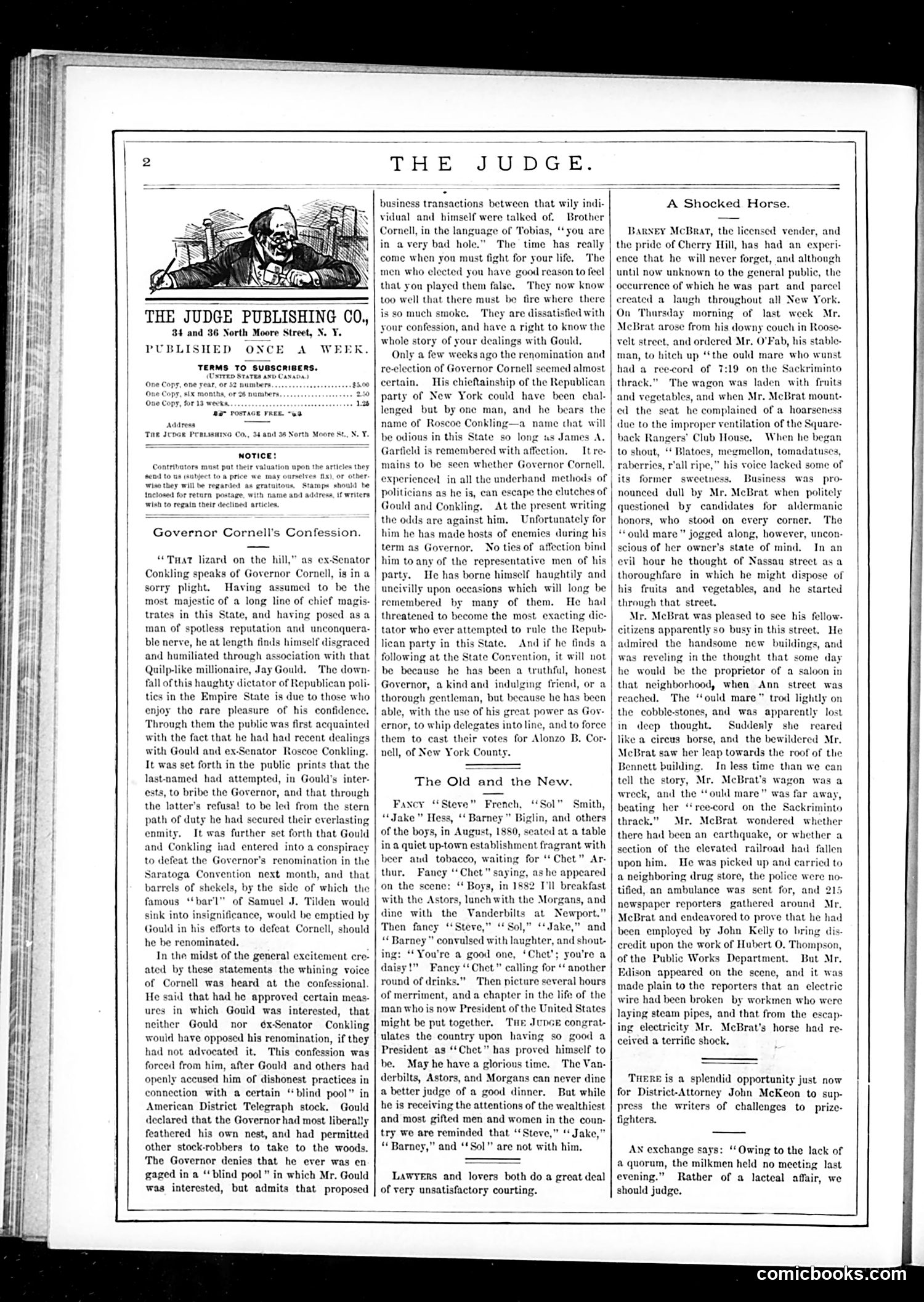
This page attacks **New York Governor Alonzo Cornell** for his entanglement with railroad magnate **Jay Gould** and politician **Roscoe Conkling**. The satire's target: Cornell, who posed as virtuous and incorruptible, is exposed as compromised. Though he denied direct bribery, his admission of discussing business dealings with Gould reveals hypocrisy. Judge mocks his "confession" as forced and incomplete—he claims innocence in a "blind pool" scheme while admitting prior negotiations. The political context involves the 1882 Republican Convention dispute, where Gould and Conkling allegedly plotted Cornell's defeat through financial pressure. Judge argues Cornell created his own downfall through arrogance and association with corrupt business interests, losing support from the Republican establishment he once controlled. The cartoon's message: even powerful politicians cannot escape consequences when connected to robber-baron capitalism.
📄 Transcribed text from this page (OCR, searchable)
Machine-transcribed from the original scan — historical spelling and the odd misread are preserved.
THE JUDGE PUBLISHING C0, 34 and 36 North Moore Street, ‘Y. PUBLISHED ONCE A WE (Ustren States a3 Ps, one year, or $2 numbers 8 numbers. One ¢ 713 weeks, aa rostal Address Tae Icpor return postage, Wish to regain their declined an Governor Cornell's Confession “Tua? lizard on the hill,” as ex-Senator Conkling speaks of Governor Cornell, is in a sorry plight. Having assumed to be the most majestic of a long line of chief magis- trates in this State, and having posed asa man of spotless reputation and unconquera- ble nerve, he at length finds himself disgraced and humiliated through association with that Quilp-like millionaire, Jay Gould. ‘The down- fall of this haughty dictator of Republican poli- tics in the Empire State is due to those who enjoy the rare pleasure of his confidence. Through them the public was first acquainte with the fact that he had had recent dealing with Gould and ex-Senator Roscoe Conkling. It was set forth in the public prints that the last-named had attempted, in Gould's inter- ests, to bribe the Governor, and that through the latter’s refusa! to be led from the stern path of duty he had secured their everlasting enmity. It was further set forth that Gould and Conkling iad entered into a conspiracy to defeat the Governor's renomination in the Saratoga Convention next month, and that barrels of shekels, by the side of which the famous ‘‘bar'l” of Samuel J. Tilden would sink into insignificance, would be emptied by Gould in his efforts to defeat Cornell, should he be renominated. In the midst of the general excitement cre- ated by these statements the whining voice of Cornell was heard at the confessional He said that had he approved certain meas- ures in which Gouid was interested, that neither Gould nor 6x-Senator Conkling would have opposed his renomination, if they had not advocated it. This confession was forced from him, after Gould and others had openly accused him of dishonest practices in connection with a certain “blind pool” in American District Telegraph stock. Gould declared that the Governor had most liberal}: feathered his own nest, and had permitted other stock-robbers to take to the woods. The Governor denies that he ever was en gaged in a “blind pool” in which Mr. Gould was interested, but admits that proposed THE JUDGE. business transactions between that wily indi- vidual and himself were talked of. Brother Cornell, in the language of s, “you are in avery bad hole.” The time has reall come when yon must fight for your life. ‘The men who elected you have good reason to feel that yon played them false. They now know too well that there must be fire where there moke. They are dissatisfied with your confession, and have a right to know the whole story of your dealings with Gould. Only a few weeks ago the renomination and re-election of Governor Cornell seemed almost certain. His chieftainship of the Republican party of New York could have been chal- lenged but by onc man, and he bears the | name of Roscoe Conkling—a name that will be odious in this State s s James jarticld is remembered with affection, It re- mains to be seen whether Governor Cornell. experienced in all the underhand methods of Politicians as he is, can escape the clutches of Gould and Conkling. At the present writing the odds are against him. Unfortunately for him he has made hosts of enemies during h term a: vernor, No ti ion bind him to any of the representative men of his party. He has borne himself haughtily and uncivilly upon occasions which will long be remembered by many of them. He bo threatened to become the most exacting dic- tator who ever attempted to rule the Repub- lican party in this State. And if he finds a following at the State Convention, it will not | be because he has been a truthful, honest Governor, a kind and indulging friend, or a thorough gentleman, but because he has been | able, with the use of his great power as Gov- ernor, to whip delegates into line, and to foree them to cast their votes for Alonzo B. Cor- nell, of New York County, obia is so mu > long The Old and the New. Fancy ‘ Steve” French, ‘Sol” Smith, “Jake” Hess, ‘ Barney” Biglin, and others of the bo: sust, 1880, seated at a table ina quiet up-town establishment fragrant with beer and tobacco, waiting for ‘‘ Chet” Ar- thur. Fancy “Chet” saying, ashe appeared on the scene: ‘ Boys, in 1882 I'll breakfast with the Astors, lunch with the Morgans, and dine with the Vanderbilts at Newport.” Then fancy ‘‘Steve,” ‘‘ Sol,” “Jake,” and “Barney” convulsed with laughter, and shout- ing: “You're a good one, ‘Chet’; you're a !" Fancy “Chet” calling for ‘‘ another round of drinks.” Then picture several hours of merriment, anda chapter in the life of the man who is now President of the United States might be put together. Tur Jupce congrat- ulates the country upon having so good a President as ‘*Chet” has proved himself to be. May he have a glorious time. The Van- derbilts, Astors, and Morgans can never dine a better judge of a good dinner. But while he is receiving the attentions of the wealthiest and most gifted men and women in the coun- try we are reminded that Steve,” “Jake,” “ Barney,” and ‘Sol" are not with him. Lawyers and lovers both do a great deal of very unsatisfactory courting. A Shocked Horse. Barney McBrat, the licensed vender, and the pride of Cherry Hill, has had an experi- ence that he will never forget, and although until now unknown to the general public, the occurrence of which he was part and parcel ted a laugh throughout all New York. On Thursday morning of last week Mr. arose from his downy couch in Roose- velt street, and ordered Mr, O'Fab, his st: man, to hitch up “the ould mare who wunst a ‘ecord of 7:19 on the Sackriminto thrack.” ‘The wagon was laden with fruits and vegetables, and when Mr. McBrat mount- ed the seat he complained of a hoarseness due to the improper ventilation of the Square- back Rangers’ Club House. When he began to shout, ‘ Blatocs, megmelion, tomadatuses, raberrics, r’all ripe,” his voice lacked some of ts former sweetness. B pro- nounced dull by Mr. McBrat when politely questioned by candidates for aldermanic honors, who stood on every corner. The ‘ould mare” jogged along, however, uncon- scious of her owner's state of mind. In an evil hour he thought of Nassau street as a thoroughfare in which he might dispose of his fruits and vegetables, and he started through that street. Mr. McBrat was pleased to see his fellow- citizens apparently so busy in this street. He admired the handsome new buildings, and was reveling in the thought that some day he would be the proprietor of a saloon in that neighborhood, when Ann street was reached. The ‘ould mare” trod lightly on the cobble-stones, and was apparently lost in deep thought. Suddenly she reared like a cireus horse, and the bewildered Mr. McBrat saw her leap towards the roof of the Bennett building. In less time than we can tell the story, Mr. McBrat’s wagon was a wreck, and the “ould mare” was far away, beating her ‘‘ree-cord on the Sackriminto Mr. McBrat wondered w there had been an earthquake, or whe! section of the elevated railroad had f upon him, He was picked up and carried to a neighboring drug store, the police were no- tified, an ambulance was sent for, and 215 newspaper reporters gathered around Mr. McBrat and endeavored to prove that he had been employed by John Kelly to bring dis- credit upon the work of Hubert 0. Thompson, of the Public Works Department. But Mr. Edison appeared on the scene, and it was made plain to the reporters that an electric wire had been broken by workmen who were laying steam pipes, and that from the escap- ing electricity Mr. MeBrat’s horse had re- ceived a terrific shock, ness was Tuere is a splendid opportunity just now for District-Attorney John McKeon to sup- press the writers of challenges to p fighters. AN exchange says: ‘Owing to the lack of a quorum, the milkmen held no meeting last evening.” Rather of a lacteal affair, we should judge. comicbooks.com