
A complete issue · 16 pages · 1882
Judge — May 20, 1882
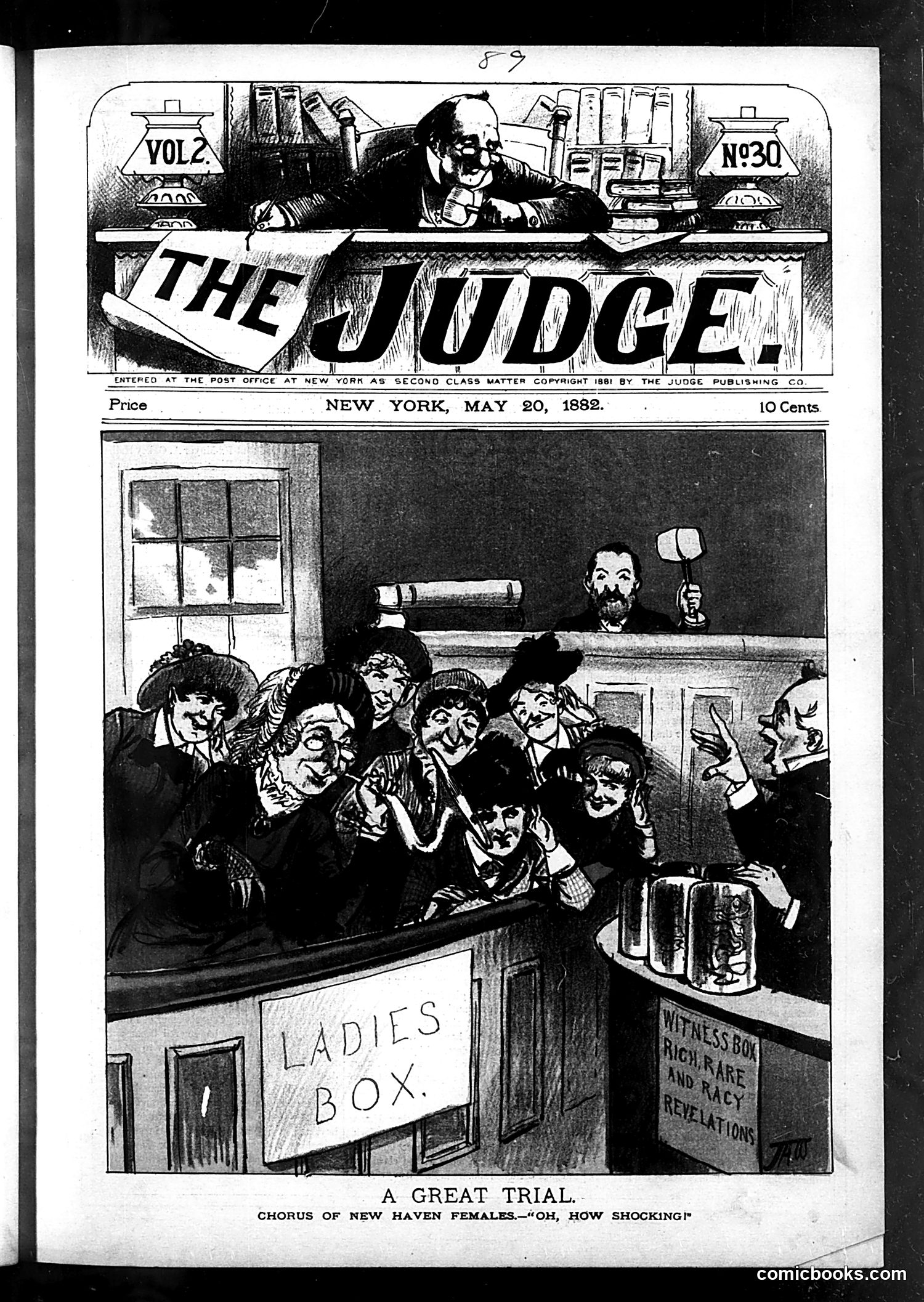
This cartoon satirizes a sensational trial in New Haven, Connecticut, by depicting women crowding into the "Ladies Box" (witness seating) at court. The judge presides above with a gavel, while spectators—drawn with exaggerated, gossipy expressions—pack the courtroom. The satire targets two things: the public's (particularly women's) appetite for scandalous court proceedings, and contemporary anxieties about female participation in civic spaces. The caption "Oh, How Shocking!"—uttered by women supposedly scandalized by trial testimony—mocks their simultaneous fascination and feigned outrage. The "Witness Box" sign reference and the crowd's behavior suggest this was likely a high-profile case attracting unseemly public attention. The cartoon criticizes both the sensationalism of the trial itself and society's voyeuristic fascination with it.
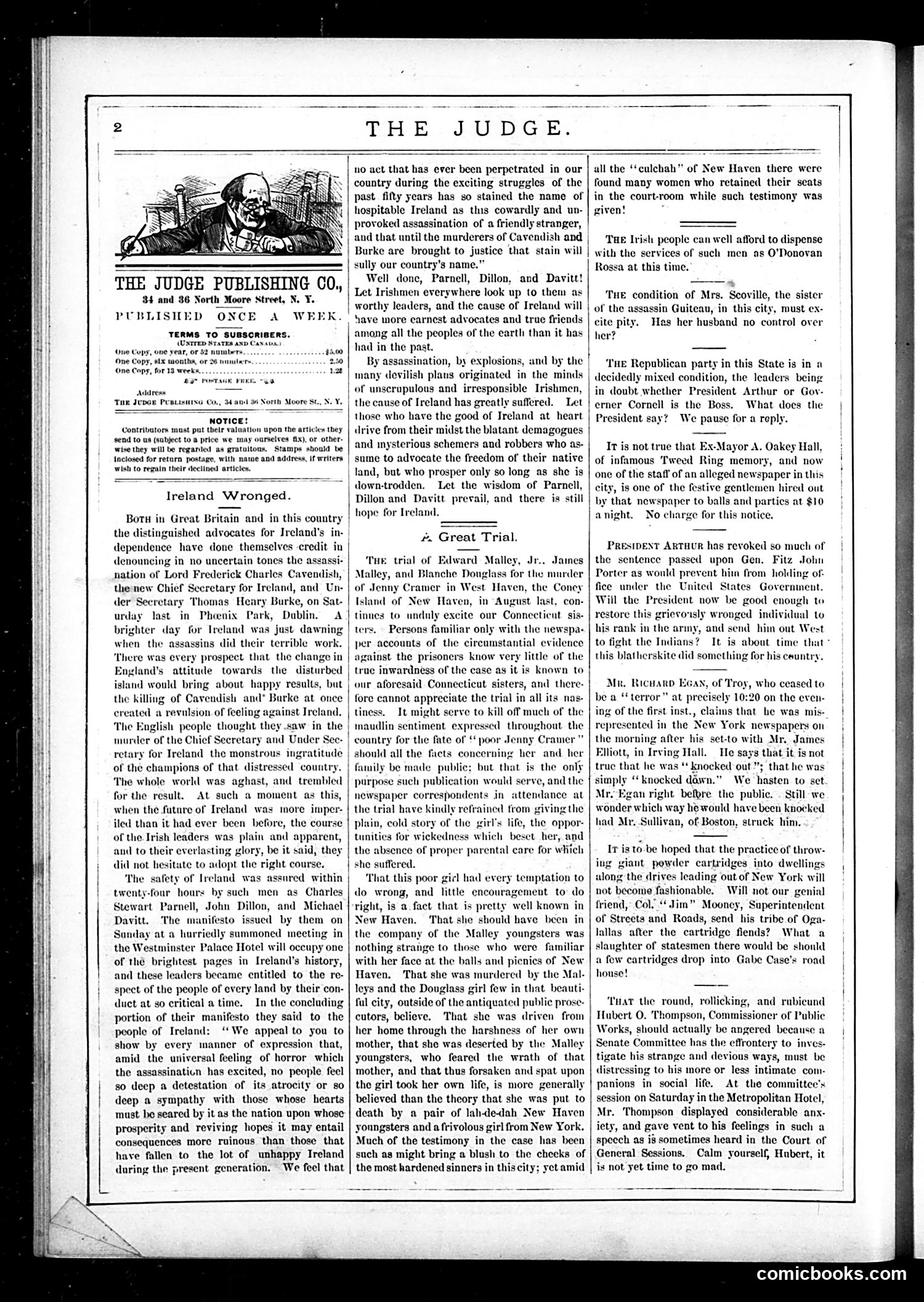
This page from Judge magazine (appears to be from 1882, based on historical context) discusses the **Phoenix Park murders** in Dublin, where Irish Chief Secretary Lord Frederick Cavendish and Under Secretary Thomas Henry Burke were assassinated. The editorial praises Irish nationalist leaders **Charles Stewart Parnell, John Dillon, and Michael Davitt** for publicly condemning the killings despite supporting Irish independence. Judge argues this demonstrated their integrity and actually *helped* Ireland's cause by distancing legitimate nationalist sentiment from violent extremism. The satire's point: Judge credits these leaders for recognizing that political assassination undermined Ireland's credibility with English opinion. By denouncing the murders, they proved Irish nationalism wasn't synonymous with terrorism—a crucial distinction for gaining sympathy and political progress. The remaining articles address other contemporary Irish-American issues, including legal trials and political disputes.
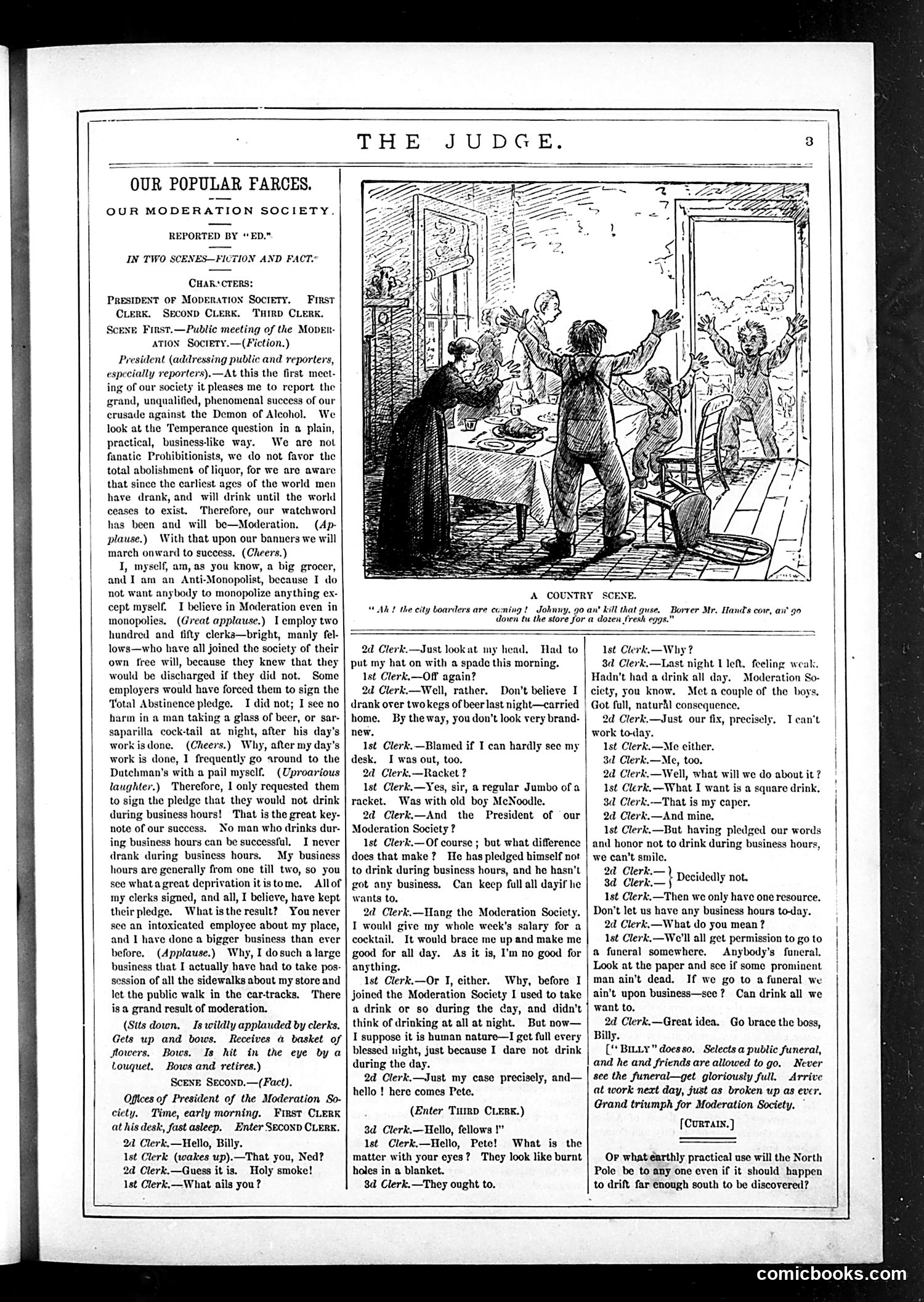
This two-part sketch mocks the hypocrisy of a temperance organization's leadership. In **Scene One (Fiction)**, the Moderation Society's President addresses the public, claiming success in promoting alcohol restraint. He boasts of employing 250 clerks who pledged not to drink *during business hours* — conveniently defining "business hours" as only 1-2 PM daily, allowing drinking otherwise. In **Scene Two (Fact)**, we see the reality: two clerks arrive at the office severely hungover, having drunk "two kegs of beer" the previous night while carousing with the President himself. The satire exposes the Society's meaningless pledge — merely a PR stunt that permits drinking outside narrow "business hours" while the leadership openly violates the spirit of temperance. The joke targets how reformers create technically compliant but practically useless restrictions, and how leaders enforce rules hypocritically on subordinates while exempting themselves.
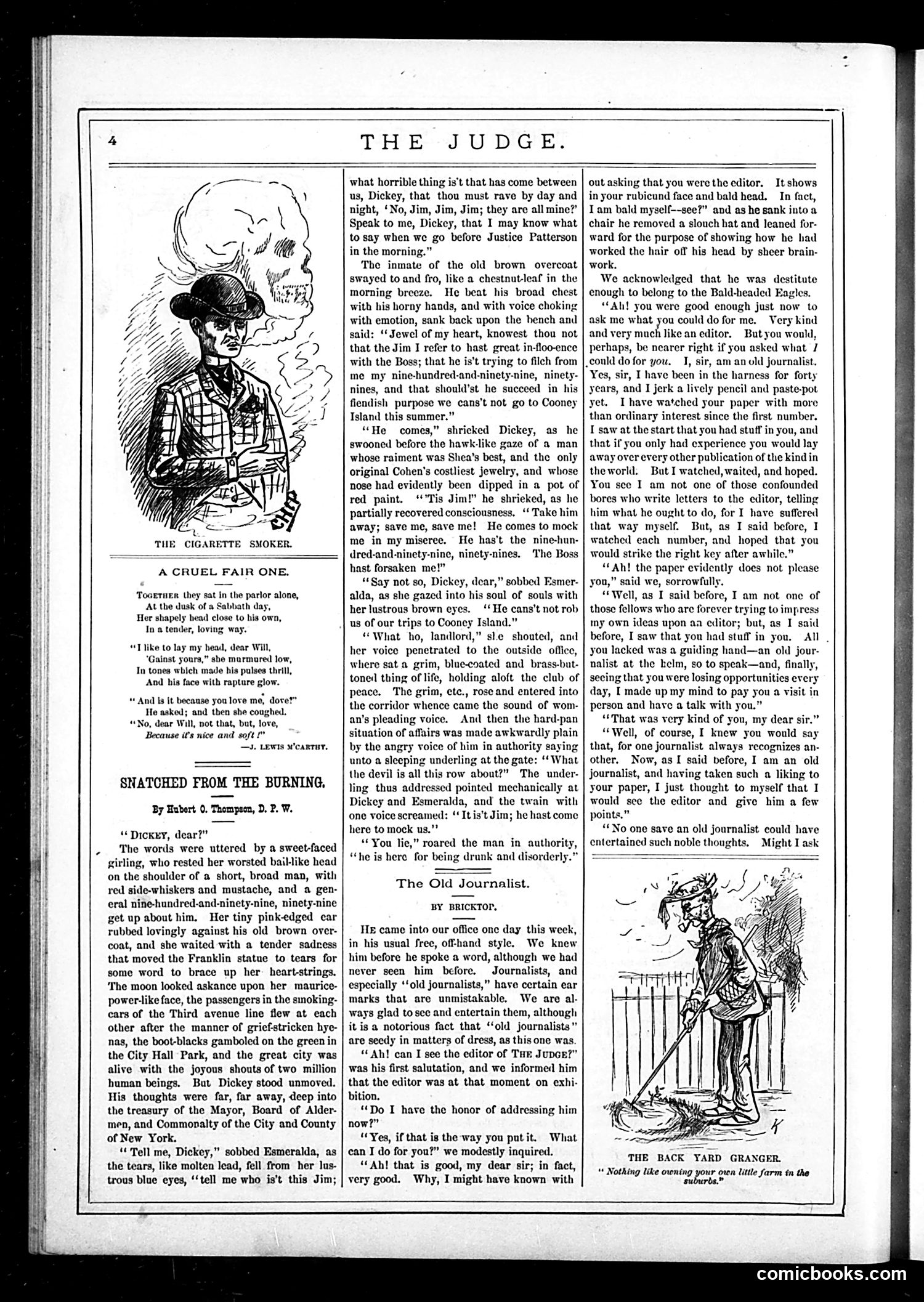
This page contains three satirical pieces mocking romantic sentimentality and bureaucratic corruption: **"The Cigarette Smoker"** and **"A Cruel Fair One"** are short humorous poems about romance undermined by practical concerns—a woman resting her head on her suitor's shoulder not from affection but because it's "soft," and another couple's romantic moment interrupted by coughing. **"Snatched from the Burning"** is the main satire, a melodramatic story parodying sentimental Victorian fiction. The protagonist "Dickey" is emotionally distressed not by romantic troubles but by fear that a rival named "Jim" will use political influence to deprive him of his government position (his "nine-hundred-and-ninety-nine" refers to a civil service rank). His fiancée Esmeralda's pleas are interrupted when authorities arrive. The piece satirizes both overwrought sentimental literature and New York's corrupt patronage system, where employment depended on political connections rather than merit.
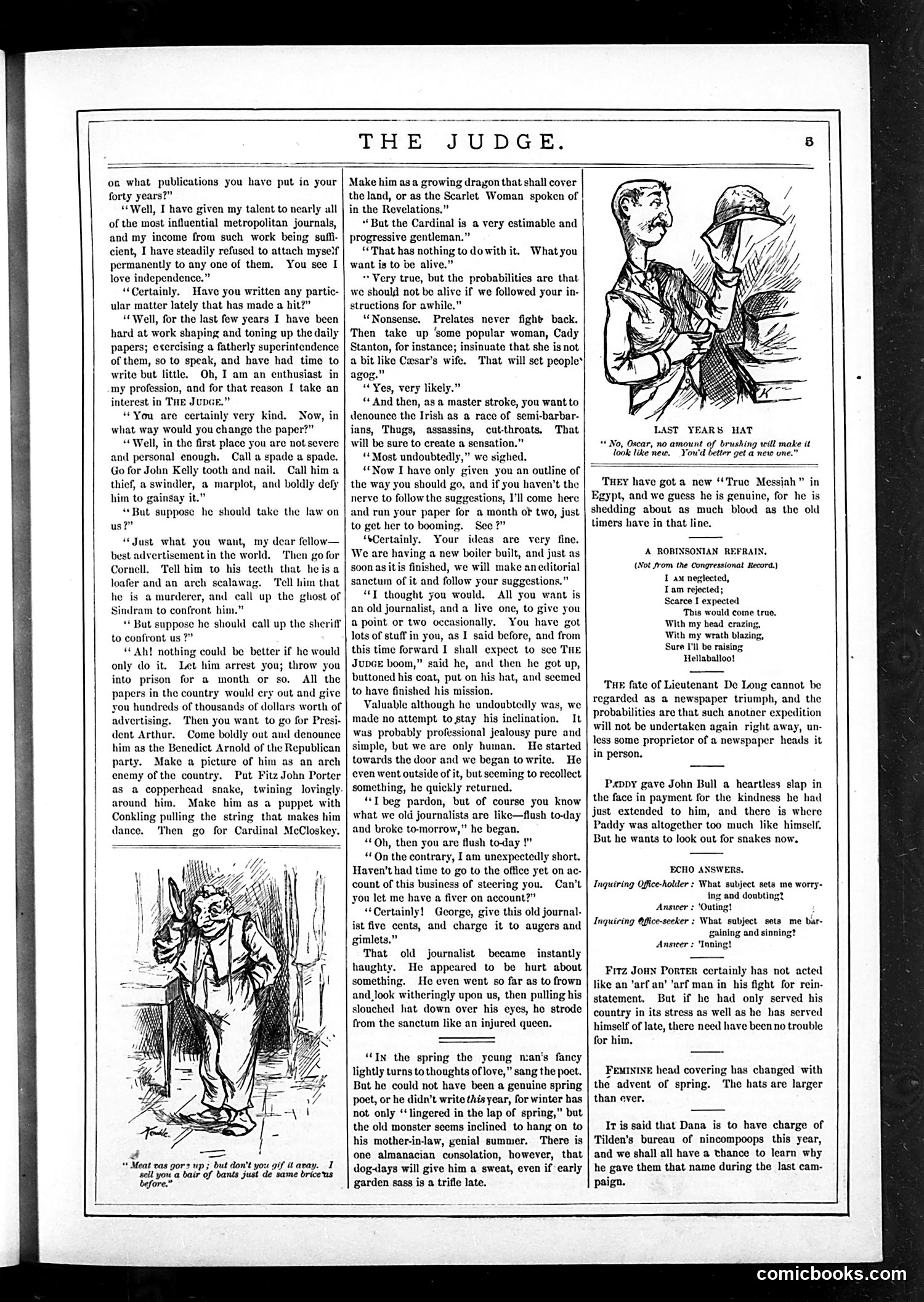
This page satirizes a self-aggrandizing freelance journalist pitching inflammatory editorial strategies to *Judge* magazine's editors. The visitor, depicted in the caricature as an older man, claims decades of experience with major publications and advises the editors to pursue sensationalism and personal attacks: targeting political figures like John Kelly and President Arthur, attacking Cardinal McCloskey, denouncing Irish people as "semi-barbarians," and even insinuating impropriety about women's rights advocate Cady Stanton. The satire mocks both the journalist's reckless cynicism and the editorial philosophy he represents—that controversy and lawsuits generate publicity. The editors' increasingly sarcastic responses ("Most undoubtedly," "we sighed") signal their skepticism. The final joke—suggesting they'll convert their new boiler into an editorial office to "follow your suggestions"—implies his advice belongs in the furnace, not in print.
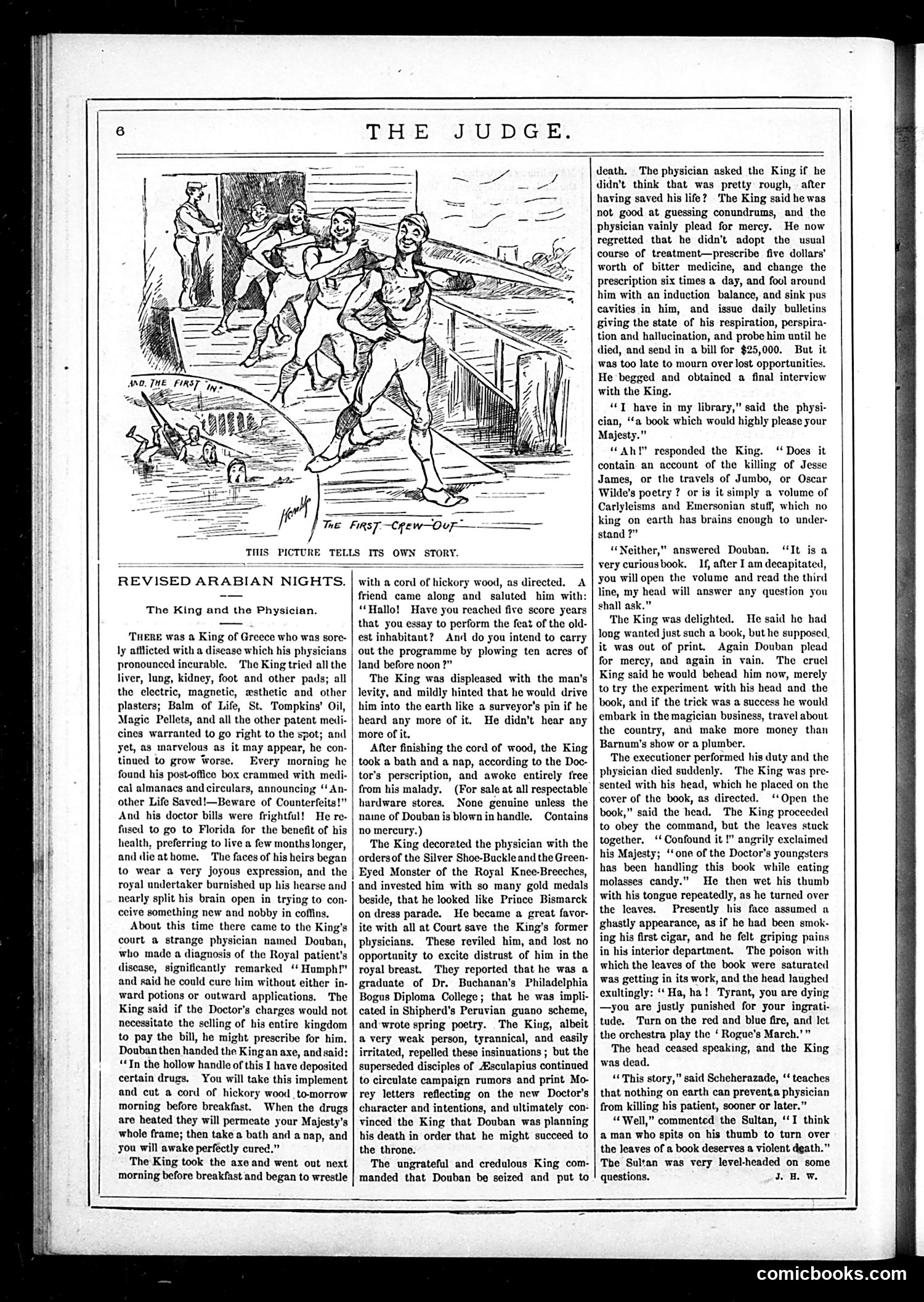
This is a satirical fable mocking medical quackery and the medical establishment of the era. The cartoon depicts a King of Greece who's been fleeced by countless dubious doctors peddling patent medicines, electrical treatments, and expensive plasters—all worthless. A physician named Douban arrives with an absurdly simple cure: chop wood. The physical labor itself heals the King, who recovers completely. The satire targets two groups: first, the legitimate medical profession (represented by the King's original physicians who grow jealous), and second, the patent medicine industry flooding America with mail circulars and false remedies. The joke is that vigorous exercise—free and obvious—cures what expensive medical interventions cannot. The "hardware store" sales pitch at the end mocks how patent medicines were marketed. This reflects late-19th-century American frustration with both establishment medicine's limitations and the proliferation of fraudulent cure-alls exploiting the desperate ill.
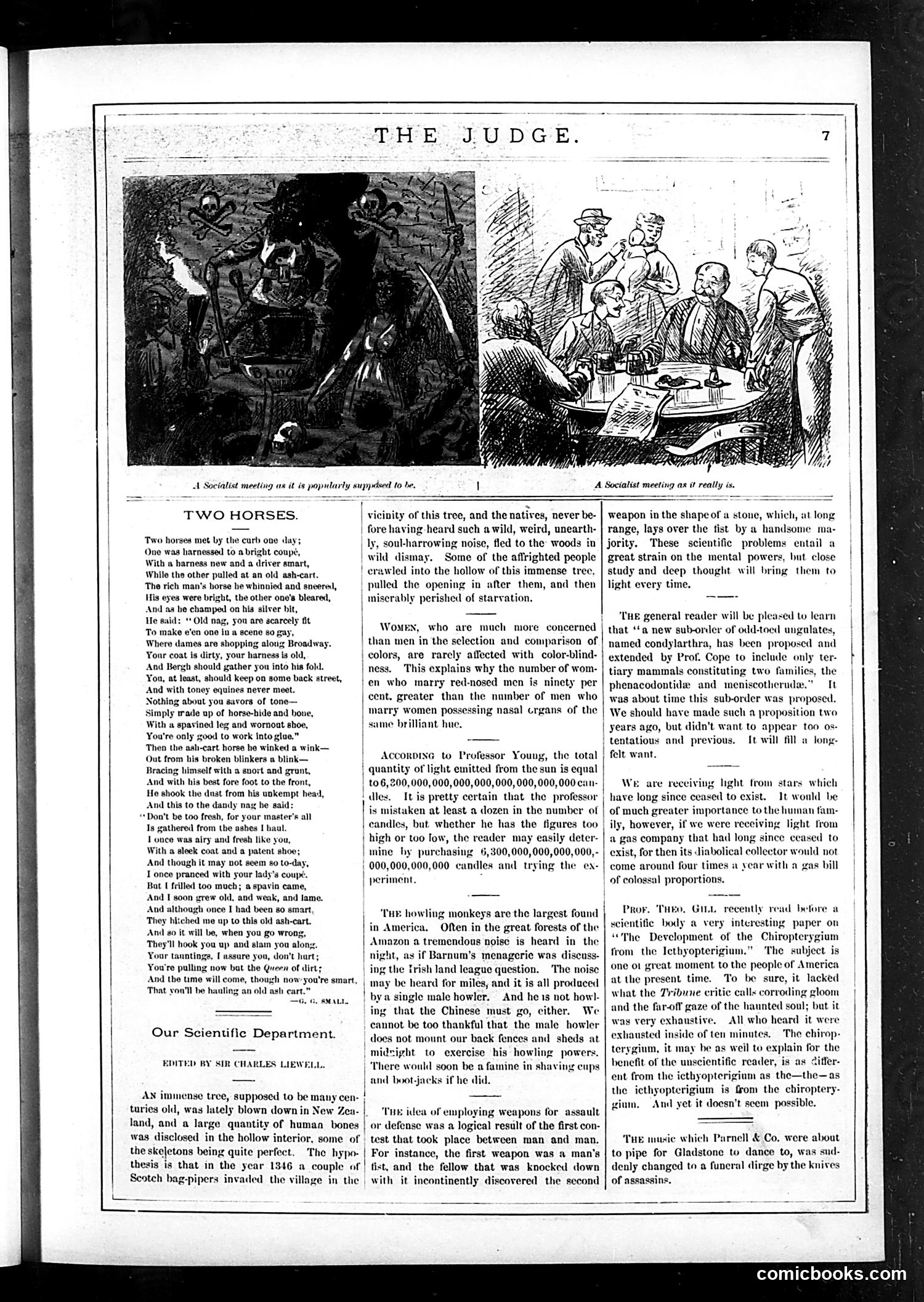
## "Two Horses" (Main Cartoon) The two woodcut illustrations depict a fable contrasting a wealthy man's sleek carriage horse with a ragged ash-cart horse. The rich horse mocks the poor one's appearance and low station. The ash-cart horse's rejoinder—that he too was once elegant but suffered misfortune (a spavined leg)—carries a moral: wealth and status are temporary; anyone can fall into poverty through accident or circumstance. **Social Commentary**: This is satirical commentary on class inequality and the precarious nature of wealth in late-19th-century America. The piece mocks the snobbery of the wealthy while suggesting that misfortune befalls anyone, undercutting rigid class hierarchies. ## "Our Scientific Department" This section parodies pseudo-scientific humor, offering absurd "explanations" for phenomena (Scottish bagpipes causing mass death in New Zealand; color-blindness statistics; solar light measurements). The satire ridicules both credulous readers and overconfident scientists making unfounded claims. **Combined Message**: The page satirizes social pretension and intellectual hubris—twin targets of Judge's editorial voice.
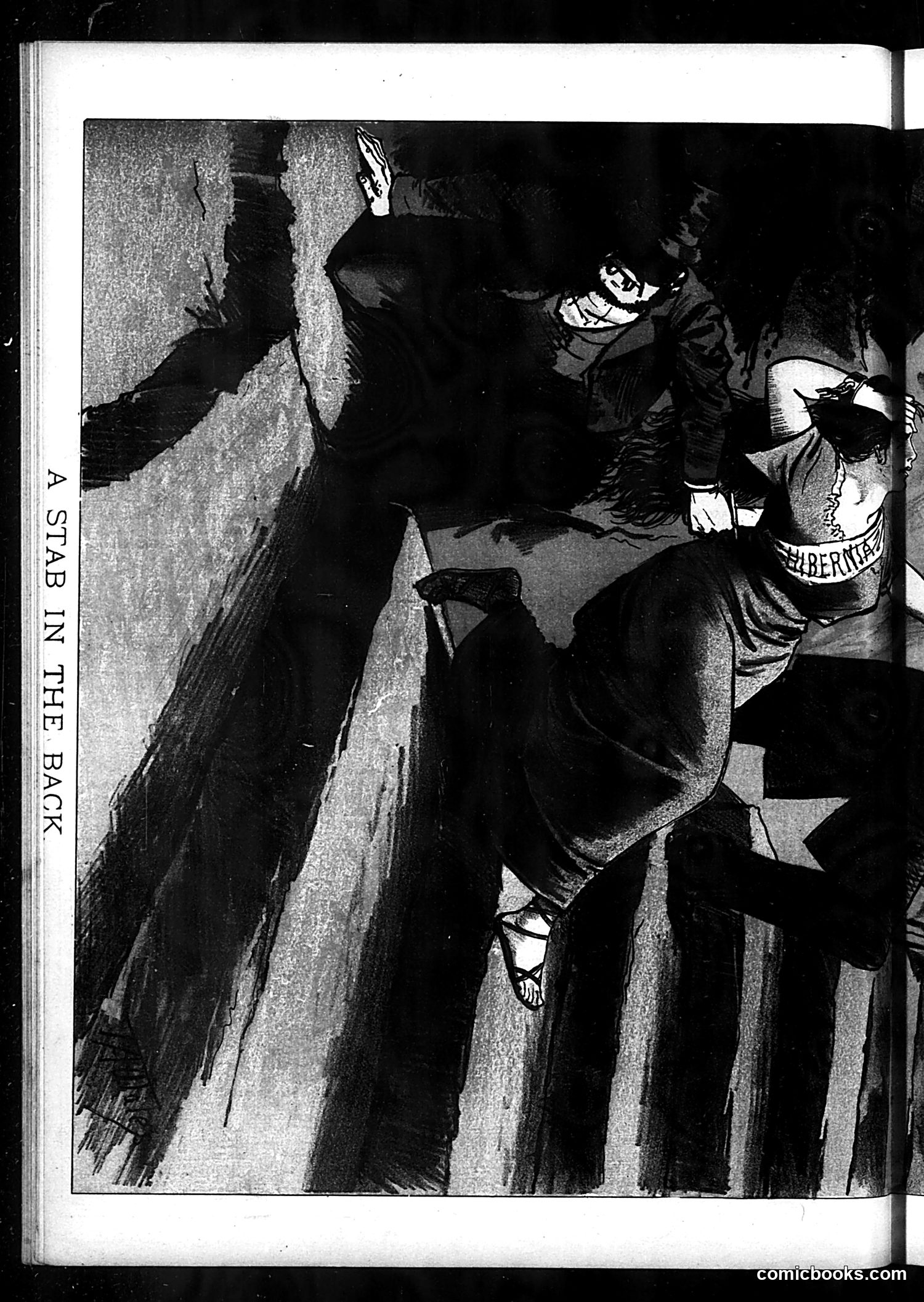
This appears to be a satirical illustration from Judge magazine depicting a masked figure stabbing another person in the back. The caption "A STAB IN THE BACK" suggests betrayal or treachery as the central theme. The visible text on clothing includes what appears to be "IBERTIES" (likely "LIBERTIES"), suggesting this cartoon concerns political betrayal regarding American freedoms or civil rights. The masked perpetrator and dramatic nighttime setting evoke imagery of vigilante violence. Without additional context or visible dates/captions, the specific historical reference remains unclear—this could reference various political betrayals or attacks on civil liberties throughout American history. The cartoon's point appears to be criticizing covert attacks on freedom, likely targeting politicians or groups the magazine opposed.
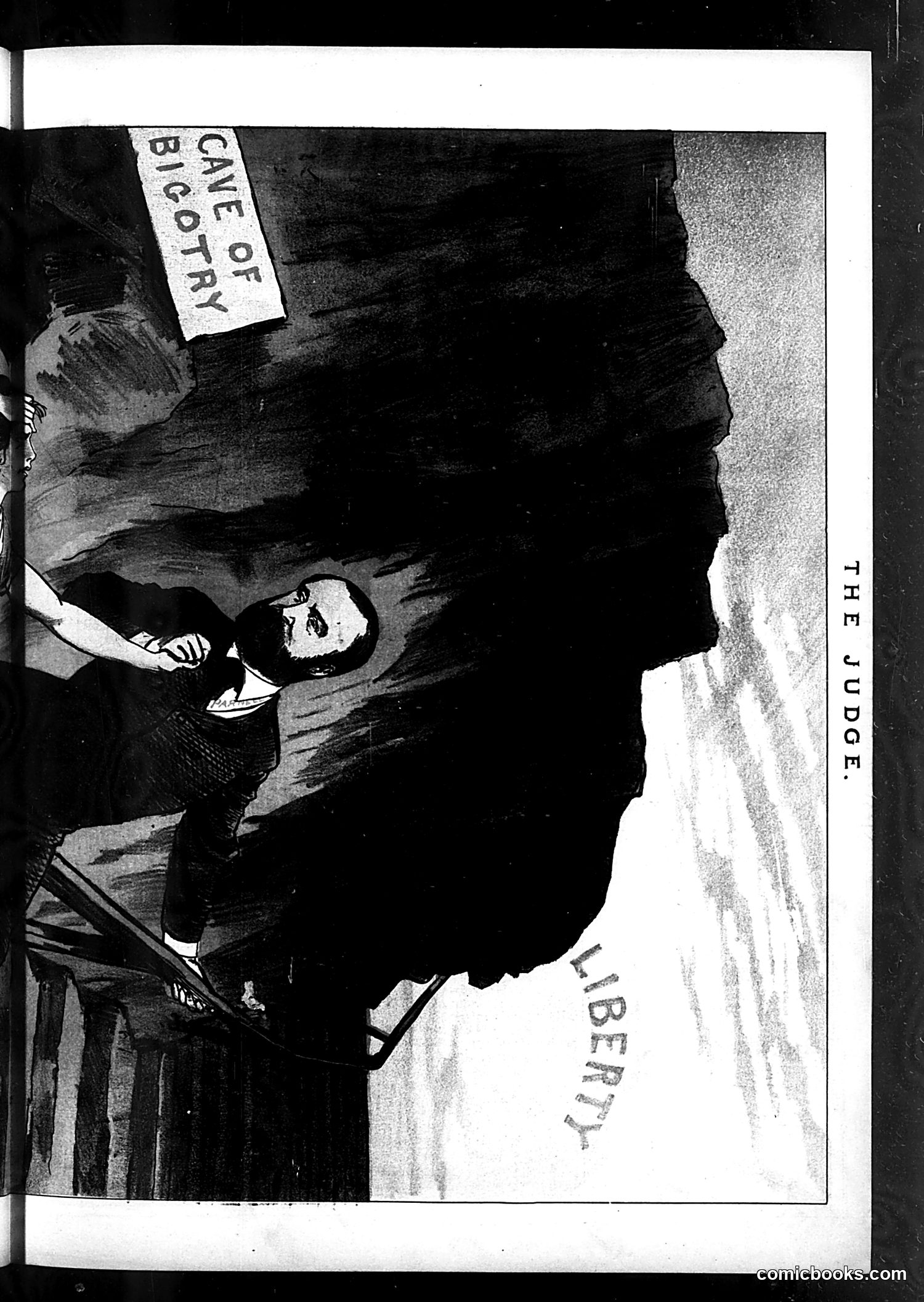
This page appears to be a title or section header from *Judge* magazine, oriented sideways. The visible text reads "THE JUDGE" vertically on the right side, and "CANE OF BIGOTRY" on the upper left, with "LIBERTY" visible on the lower right. The image shows a figure in dark clothing holding what appears to be a cane or stick labeled "CANE OF BIGOTRY." The composition suggests a political cartoon critiquing prejudice or discriminatory behavior, with Liberty seemingly affected or threatened by this "cane of bigotry." However, without clearer visibility of all text and details, the specific historical context and target of this satire remains somewhat unclear. The cartoon likely addressed contemporary prejudice issues, but the exact political situation or figures involved cannot be definitively determined from this image alone.
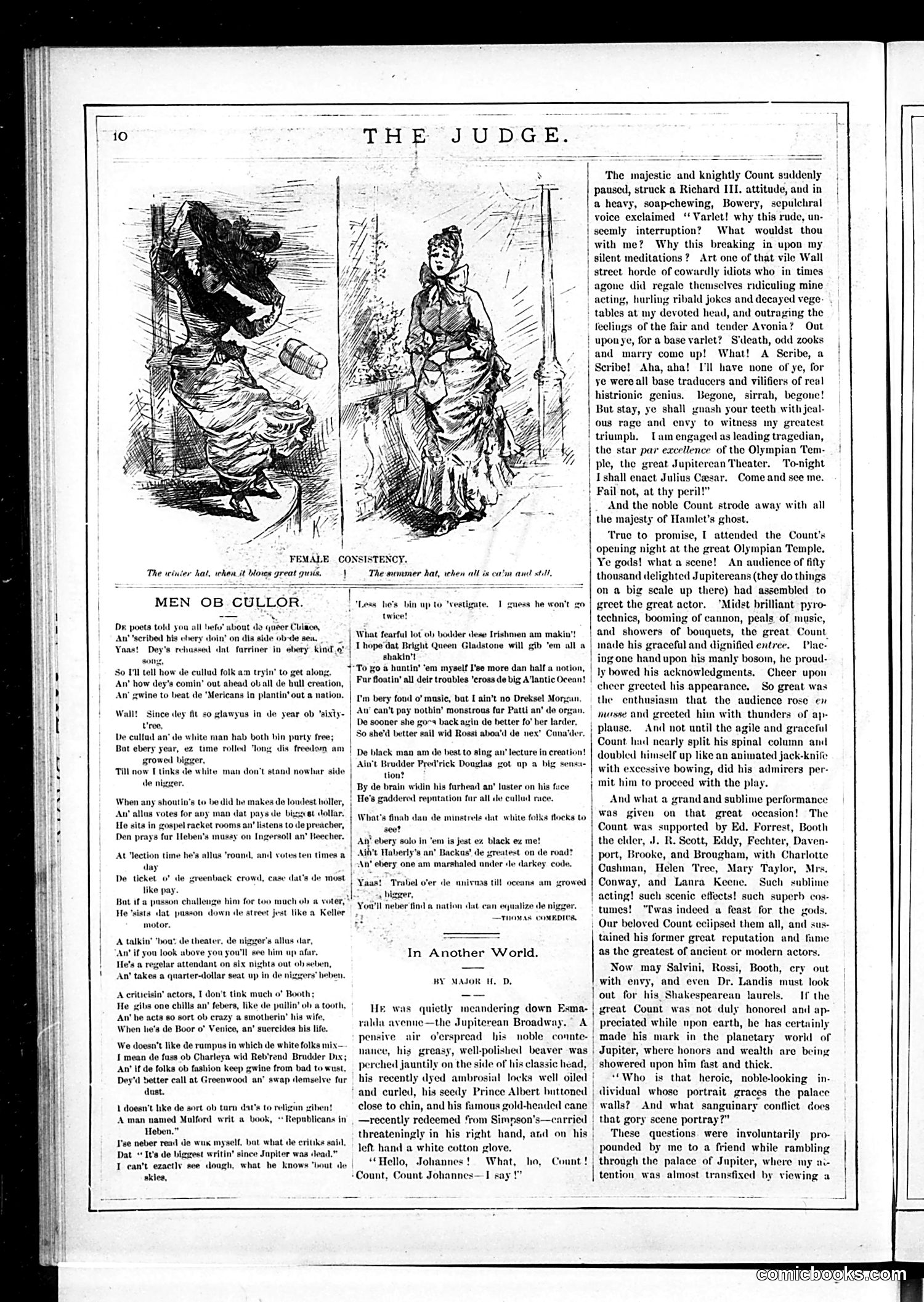
This page contains two distinct pieces of racial satire typical of 1880s American humor magazines: **"Men Ob Cullor"** uses heavy dialect to present an African American speaker praising Black achievement and criticizing white behavior—a format that appears to mock both subjects simultaneously. References to voting rights, church attendance, and figures like Frederick Douglass suggest post-Reconstruction era tensions around Black political participation and social mobility. **"In Another World"** depicts an absurdly dressed, pompous character on "Exmeralda avenue" (the "Jupiterean Broadway"), apparently satirizing pretentious theatrical or social figures through exaggerated physical description. Both pieces employ crude racial caricature and dialect stereotyping standard to Judge's era. The cartoons' intent—whether genuinely laudatory, purely mocking, or some confusing mixture—remains ambiguous to modern readers, reflecting the deeply problematic racial attitudes embedded in late-19th-century American popular media.
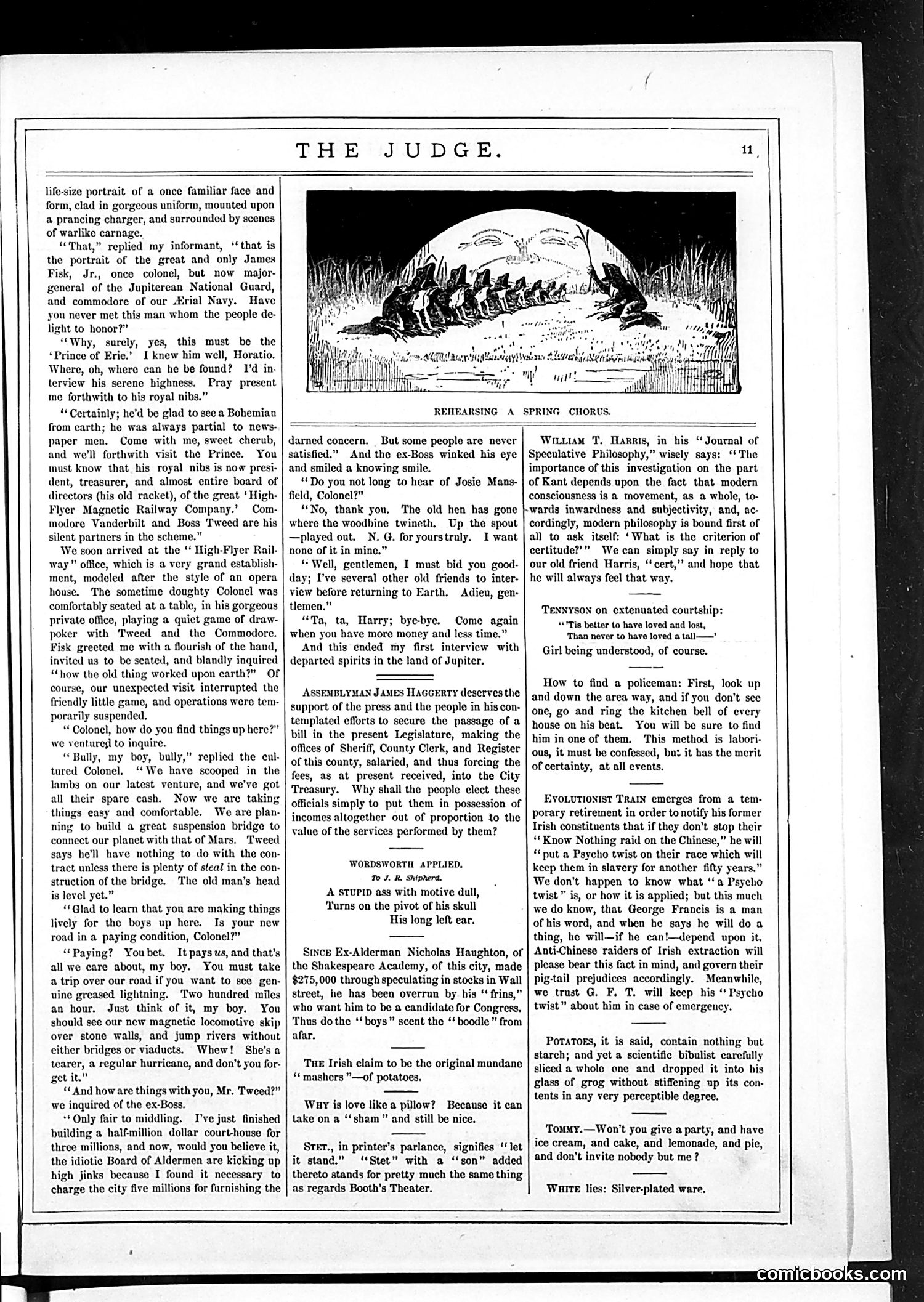
This page presents a fictional afterlife conversation mocking **James Fisk Jr.**, the notorious Gilded Age financier and railroad speculator. The satirist depicts Fisk in heaven alongside **Boss Tweed** (the corrupt Tammany Hall politician) and **Commodore Vanderbilt**, portraying them as continuing their earthly schemes in the afterlife. The satire targets their brazen corruption: Fisk boasts about "scooping" money from investors; Tweed admits overbilling the city five million dollars on a half-million-dollar courthouse. Their casual admissions of fraud and their continued partnership mock the era's elite corruption and lack of accountability. The cartoon "Rehearsing a Spring Chorus" (illustration, top right) appears separate—likely another satirical commentary, though details aren't specified in the text. The dialogue format allows **Judge** magazine to expose financial scandals through biting humor aimed at readers familiar with these public figures' notorious reputations.
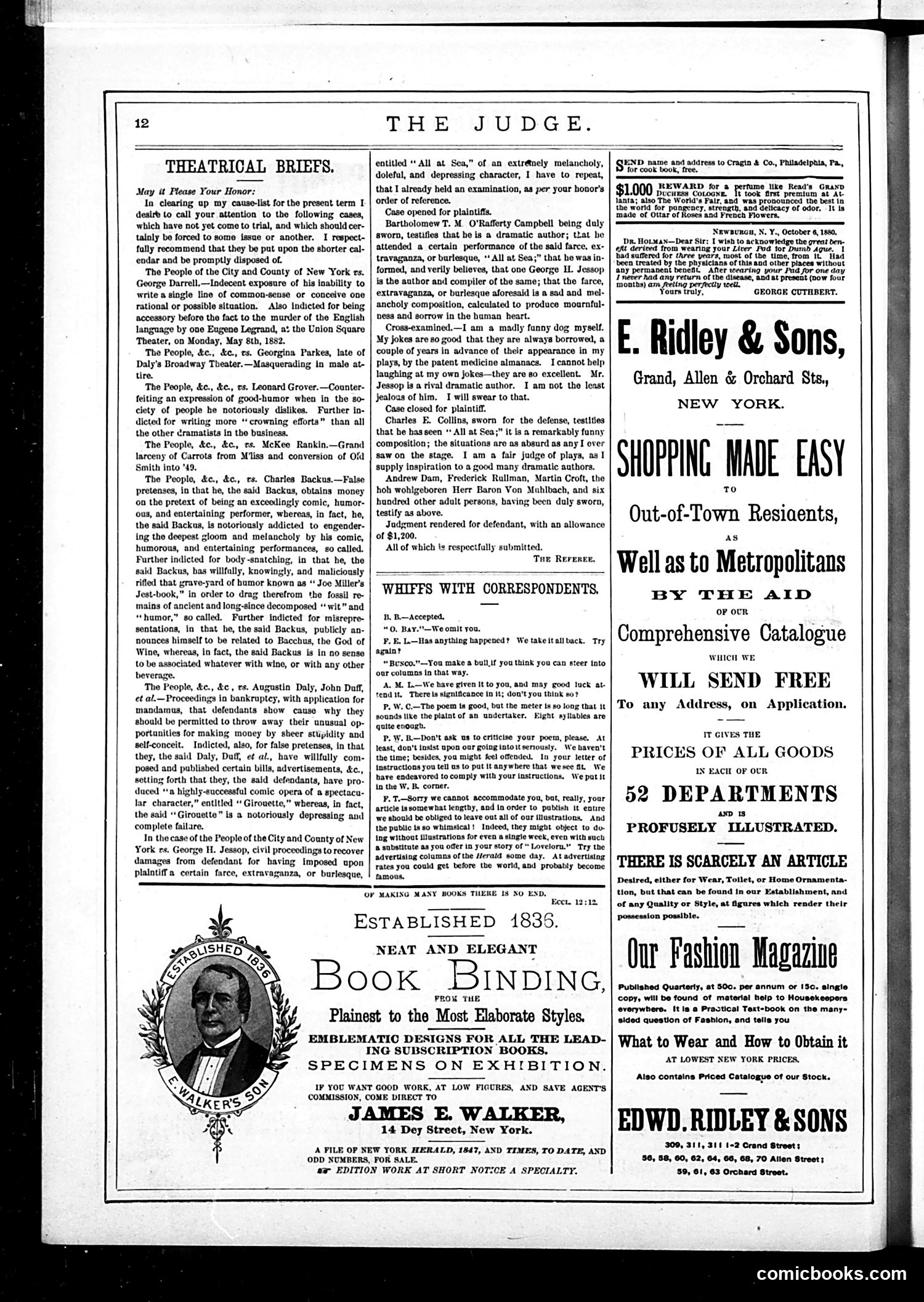
This page from *Judge* magazine (dated 1882, based on the theatrical references) is primarily **satirical theater criticism disguised as legal proceedings**. The author, writing as a magistrate clearing his docket, "indicts" contemporary theater performers and producers for various comic offenses. The targets include: - **George Darrell** — accused of writing nonsensical plays - **Charles Backus** — mocked for being unfunny despite claiming to be a comedian; accused of stealing jokes from "Joe Miller's Jest-book" (an old, exhausted source of humor) - **Augustin Daly** and others — criticized for the failed comic opera "Girouetto" - **George H. Jessop** — sued for the depressing play "All at Sea" (which should be entertaining) The satire's point: these theatrical figures are incompetent, derivative, and defrauding audiences. By framing poor theater as legal crimes, *Judge* mocks both the mediocre entertainment and the pretensions of Broadway's producers. The remainder consists of advertisements for book binding and fashion catalogues.
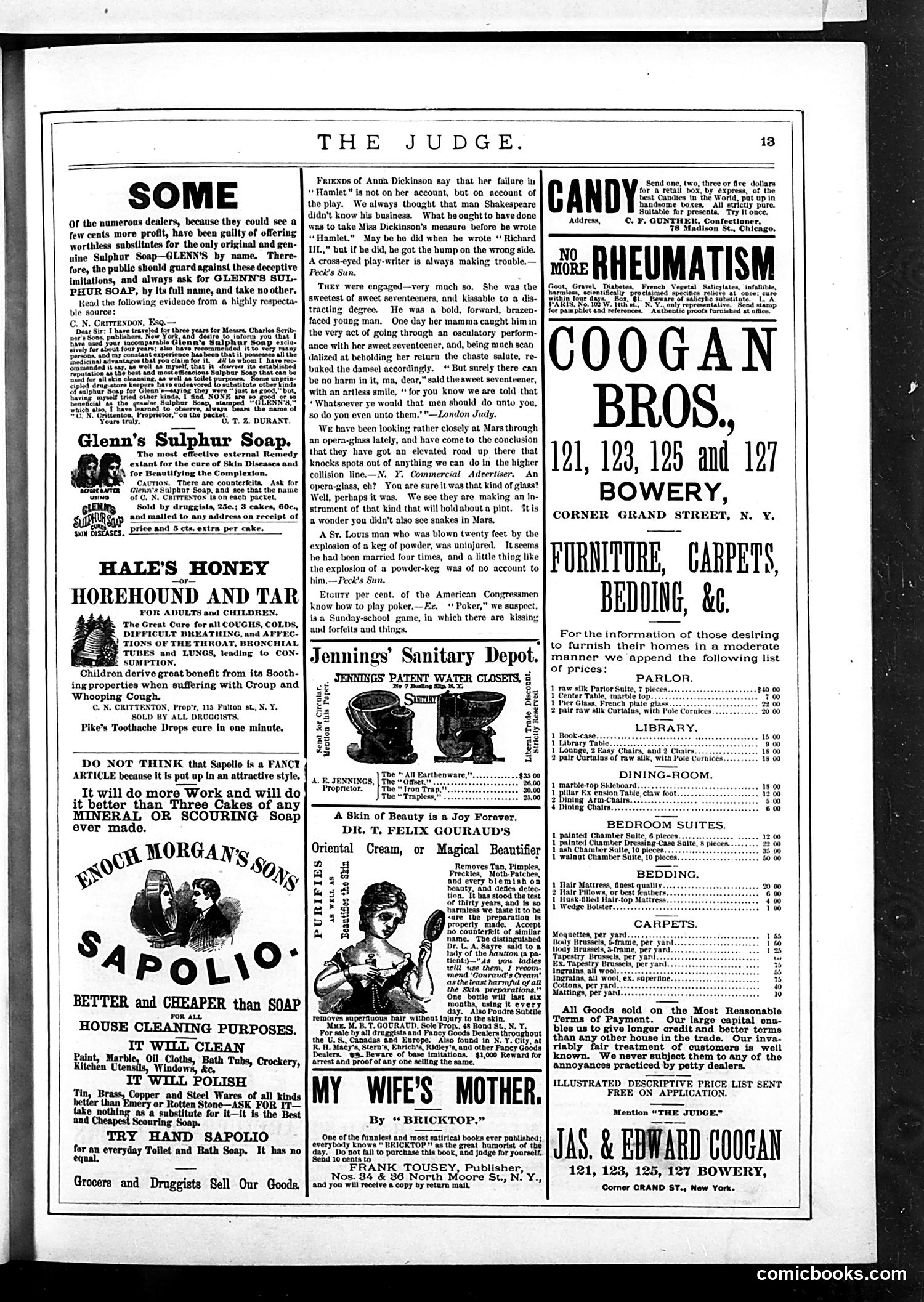
This page is primarily **advertisements and brief satirical humorous items** rather than political cartoons. The page contains numerous product ads (Glenn's Sulphur Soap, Sapolio, Hale's Honey, etc.) interspersed with short joke items typical of Judge magazine's humor section. **Notable satirical content:** - **Anna Dickinson/Shakespeare quip**: Mocks actress Anna Dickinson's failed performance in "Hamlet," sarcastically suggesting Shakespeare wrote the play wrong rather than crediting her poor performance. The "cross-eyed play-writer" joke implies incompetence. - **Young couple kissing joke**: A humorous item about a mother catching her daughter kissing her boyfriend, with the daughter defending herself using scripture ("do unto others"). - **Mars observations**: A tongue-in-cheek item about viewing Mars through opera glasses, with a follow-up joke suggesting the observer may have been drunk. - **St. Louis explosion victim**: Dark humor about an accident victim being unharmed because his multiple marriages made him immune to disasters. These are brief, conventional Victorian-era jokes with no deeper political significance—the page is dominated by consumer product advertising.
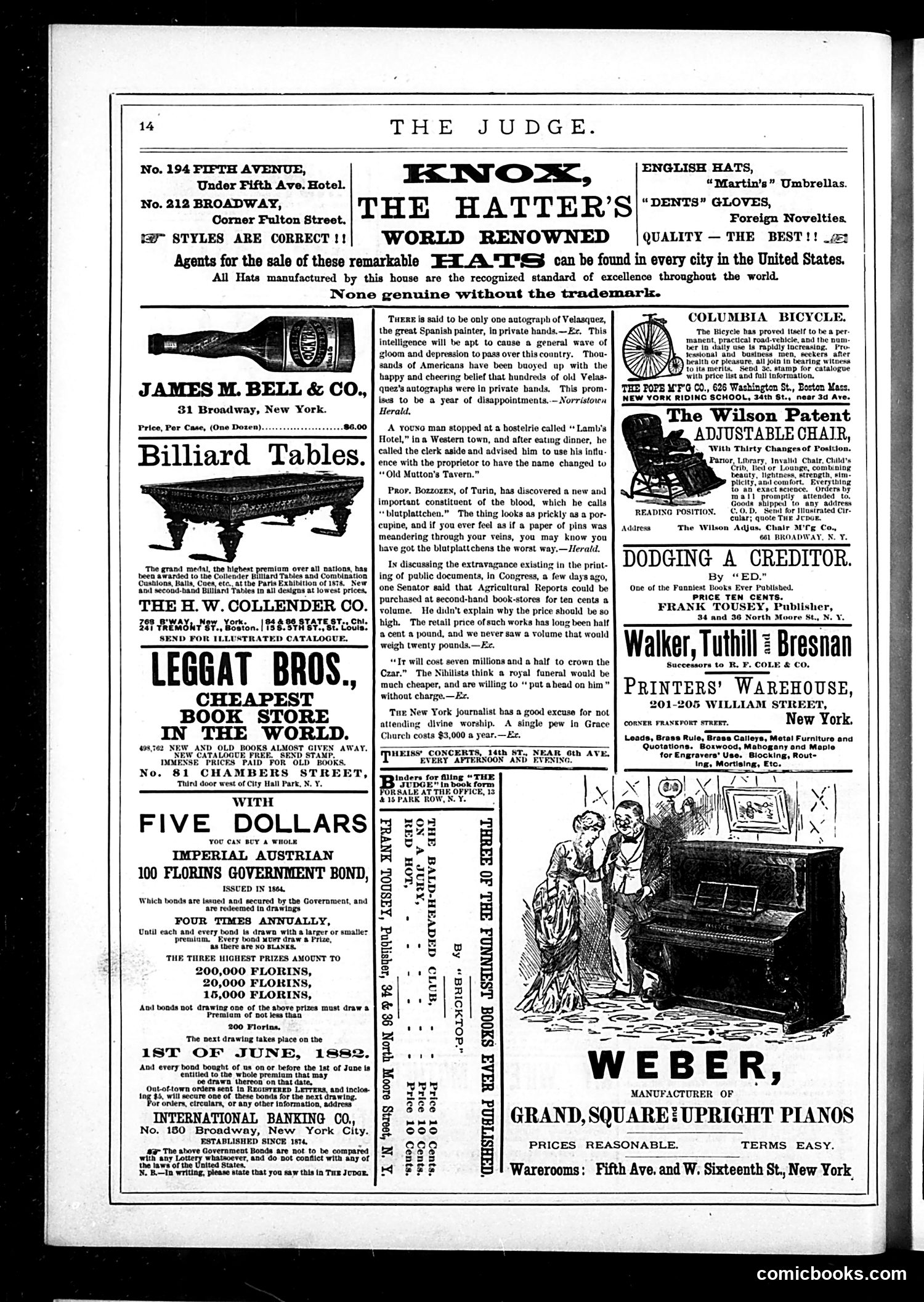
This page is primarily **advertising and filler content** with minimal political or satirical cartoons. The dominant visual element is a **Weber piano advertisement** featuring an illustration of two well-dressed women at a grand piano—typical late-19th-century marketing imagery emphasizing refinement and domestic gentility. The text content consists of **humorous anecdotes and quips** rather than political satire: - A joke about Spanish painter Velásquez having only one known autograph, disappointing American collectors - Wordplay about a hotel renaming itself from "Lamb's Hotel" to "Old Mutton's Tavern" - A satirical jab at a professor's scientific discovery of "blutplattchen" (blood platelets), mocking its odd German name - Commentary on the absurdity of agricultural reports costing ten cents when they weigh far less The remaining space features **commercial advertisements** for billiard tables, books, Austrian government bonds, and various luxury goods—typical of Judge's revenue model. **No clear political figures or major satire are identifiable** on this particular page.
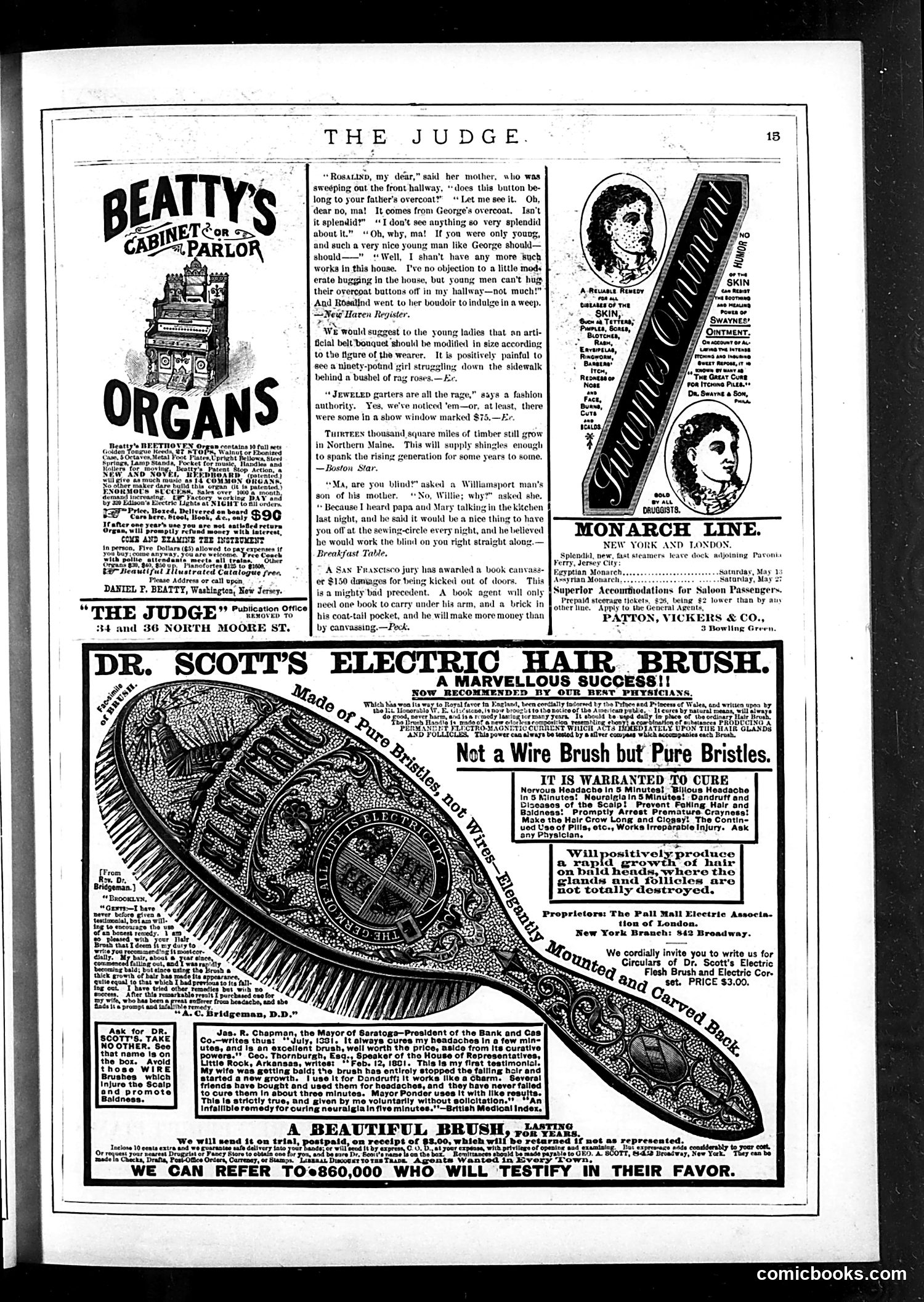
This is primarily a **commercial advertising page** from Judge magazine, dominated by two major product ads: Beatty's Cabinet Organs and Dr. Scott's Electric Hair Brush. The page includes **brief comic anecdotes** typical of the era's humor magazines: - A story about a young woman finding a button from a gentleman's overcoat, suggesting improper physical contact ("hugging"), which scandalized her mother - A quip about artificial belt flowers being too large on thin women - A joke about a "Williamson's man" working the blind on a neighbor **What we'd miss today:** These represent Victorian-era anxieties about courtship propriety, fashion excess, and emerging consumer culture. The humor relies on genteel middle-class sensibilities—particularly the scandal of casual physical contact between unmarked young people. The **product advertisements** (electrical hair brush, organs) showcase period pseudoscience and the era's fascination with electrical devices as cure-alls, offering dubious medical claims (curing headaches in five minutes). The page is largely promotional rather than satirical.
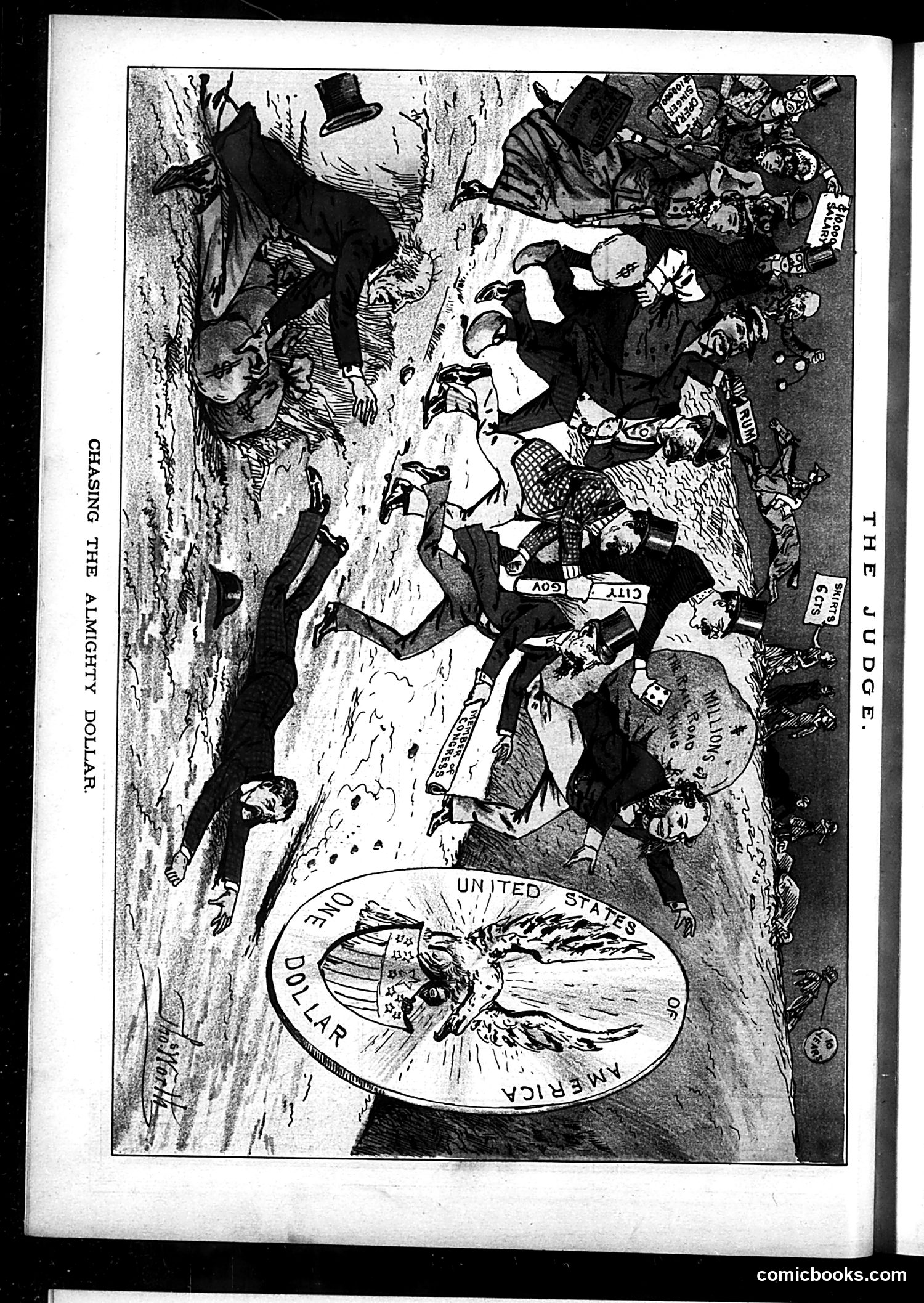
This satirical illustration depicts wealthy figures literally chasing a giant U.S. dollar coin across a landscape. The image critiques American materialism and greed during the Gilded Age period—specifically the relentless pursuit of wealth by the affluent classes. The well-dressed gentlemen (appearing to represent businessmen or plutocrats) are shown in undignified poses, desperately scrambling after money. Their top hats and formal attire contrast comically with their frenzied behavior, suggesting that despite their social standing, they're enslaved to financial ambition. The title emphasizes the religious/moral dimension of the critique: the "Almighty Dollar" is personified as a false god these men worship. Judge magazine frequently satirized wealthy elites' obsession with accumulation at the expense of ethical behavior or social responsibility—a common Progressive Era theme.