
Judge, 1882-05-20 · page 2 of 16
Judge — May 20, 1882 — page 2: what you’re looking at
What you’re looking at
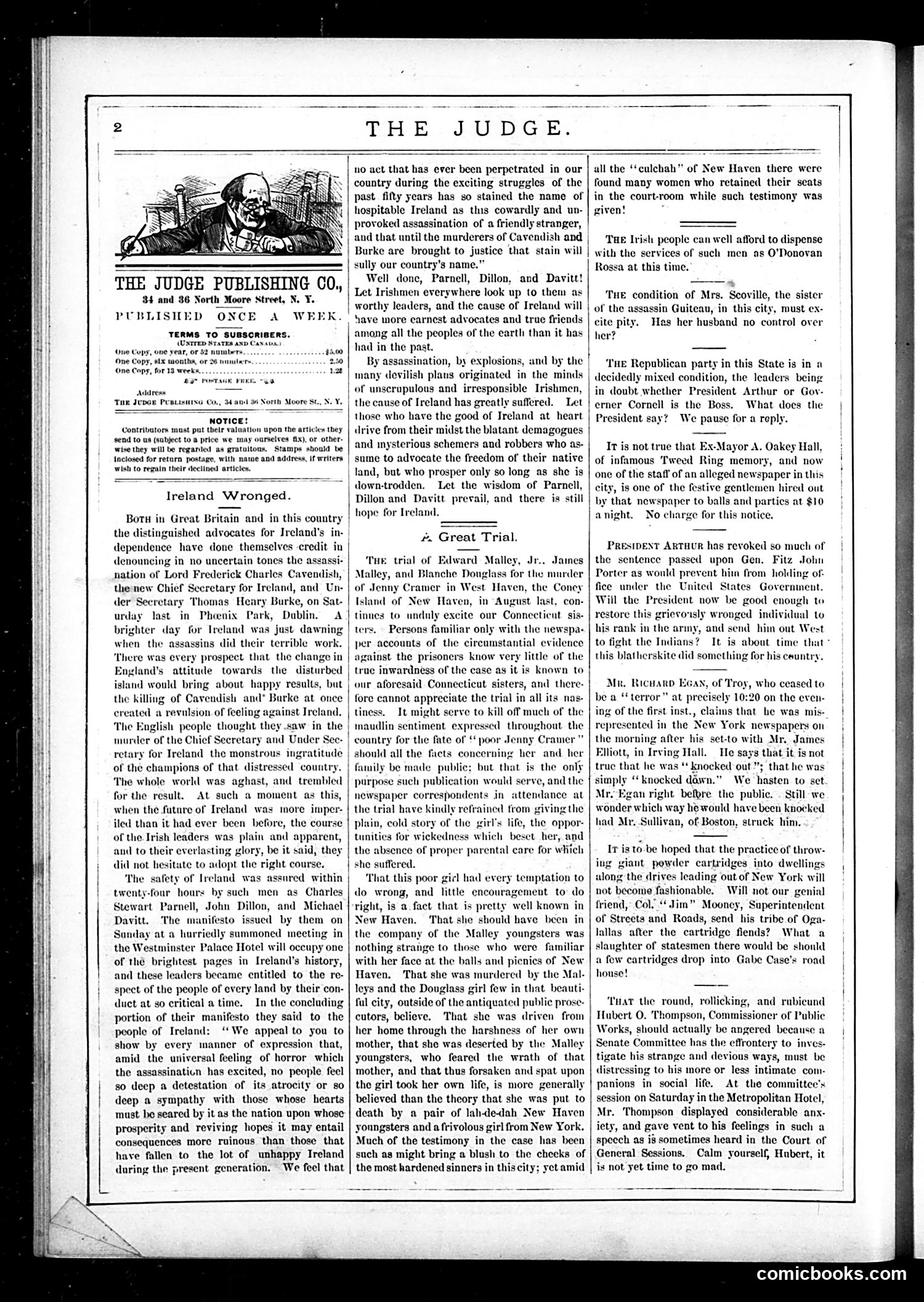
This page from Judge magazine (appears to be from 1882, based on historical context) discusses the **Phoenix Park murders** in Dublin, where Irish Chief Secretary Lord Frederick Cavendish and Under Secretary Thomas Henry Burke were assassinated. The editorial praises Irish nationalist leaders **Charles Stewart Parnell, John Dillon, and Michael Davitt** for publicly condemning the killings despite supporting Irish independence. Judge argues this demonstrated their integrity and actually *helped* Ireland's cause by distancing legitimate nationalist sentiment from violent extremism. The satire's point: Judge credits these leaders for recognizing that political assassination undermined Ireland's credibility with English opinion. By denouncing the murders, they proved Irish nationalism wasn't synonymous with terrorism—a crucial distinction for gaining sympathy and political progress. The remaining articles address other contemporary Irish-American issues, including legal trials and political disputes.
📄 Transcribed text from this page (OCR, searchable)
Machine-transcribed from the original scan — historical spelling and the odd misread are preserved.
THE JUDGE. THE JUDGE PUBLISHING CO, 34 and 36 North Moore Street, NY. PUBLISHED ONCE A WF TERMS TO ORIBERS. (USEFED NrATEA AXD CANADA) K. ‘Que Cops One Copy, #1x wonths, One Cops, for 13 week: Address Tur Jepor Pee Contributors must put thelr valoation upon the articles they send to us (subject to a price we may ourselves fix), or other- wise they will be regaried as gratuitous. Stamps should be Anclosed for retarn postage, with natoe and address, if writers wish Co regain thelr declined articles. Ireland Wronged. Bott in Great Britain and in this country the distinguished advocates for Ireland's in- dependence have done themselves credit in denouncing in no uncertain tones the assas: nation of Lord Frederick Charles Cavendish, the new Chief Secretary for Ireland, and Un- der Secretary Thomas Heary Burke, on Sat- last in Phoenix Park, Dablin, A hter day for Ireland was just dawning when the assassins did their terrible work. ‘There was every prospect that the change in England’s attitude towards the disturbed island would bring about happy results, but the killing of Cavendish and* Burke at once | created a revulsion of feeling against Ireland. | The English people thought they .saw in the | murder of the Chief Secretary and Under See: | retary for Ireland the monstrous ingratitude | of the champions of that distressed country. | The whole world was aghast, and trembled | for the result. At such a moment as this, | when the fature of Ireland was more imper- iled than it had ever been before, the cow of the Irish leaders was plain and apparent, and to their everlasting glory, be it said, they did not hesitate to adopt the right course. ‘The safety of Ireland was assured within twenty-four hours by such men as Charles Stewart Parnell, John Dillon, and Michael Davitt. ‘The manifesto issued by them on Sunday at a hurriedly summoned meeting in the Westminster Palace Hotel will occupy one of thé brightest pages in Ireland’s history, and these leaders became entitled to the re- spect of the people of every land by their con- duct at go critical a time. In the concluding portion of their manifesto they said to the people of Ireland: ‘We appeal to you to show by every manner of expression that, amid the universal feeling of horror which the assassination has excited, no people feel so deep a detestation of its atrocity or so deep a sympathy with those whose hearts must be seared by it as the nation upon whose prosperity and reviving hopes it may entail consequences more ruinous than those that have fallen to the lot of unhappy Ireland during the present generation, We feel that no act that has ever been perpetrated in our country during the exciting struggles of the past fifty years has go stained the name of hospitable Ireland as this cowardly and un- | provoked assassination of a friendly stranger, and that until the murderers of Cavendish and Burke are brought to justice that stain will sully our country’s name.” Well done, Parnell, Dillon, and Davitt! Let Irishmen everywhere look up to them as have more carnest advocates and true friends among all the peoples of the earth than it has had in the past. By assassination, by explosions, and by the many de’ plans originated in the minds | of unscrupulous and irresponsible Irishmen, the cause of Ireland has greatly suffered. Let those who have the good of Ireland at heart drive from their midst the blatant demagogues and mysterious schemers and robbers who as- sume to advocate the freedom of their native land, but who prosper only so long as she is down-trodden. Let the wisdom of Parnell, Dillon and Davitt prevail, and there is still hope for Ireland. % Great Trial. ‘Tue trial of Edward Malley, Jr.. Jaines Malley, and Blanche Douglass for the murder of Jenny Cramer in West Haven, the Coney New Haven, in August last, con- tinues to unduly excite our Connecticut sis- te Persons familiar only with the newspa- accounts of the circumstantial evidence ainst the prisoners know very little of the true inwardness of the case as it is known to our aforesaid Connecticut sisters, and there- fore cannot appreciate the trial in all its nas- tiness, It might serve to kill off much of the maudlin sentiment expressed throughout the country for the fate of ‘poor Jenny Cramer” should all the facts concerning her and her family be made public; but that is the only purpose such publication would s newspaper correspondents jn attend: the trial have kindly refrained from giving the plain, cold story of the girl's life, the oppor- tunities for wickedness which besct her, and the absence of proper parental care for which she suffered. ‘That this poor gicl had every temptation to do wrong, and little encouragement to do right, is a fact that is pretty well known in New Haven. That she should have been in the company of the Malley youngsters was nothing strange to those who were familiar with her face at the balls and picnics of New Haven, That she was murdered by the Mal- leys and the Douglass girl few in that beauti- ful city, outside of the antiquated public prose- cutors, believe. That she was driven from her home through the harshness of her own mother, that she was deserted by the Malley youngsters, who feared the wrath of that mother, and that thus forsaken and spat upon the girl took her own life, is more generally believed than the theory that she was put to death by a pair of lahdedah New Haven youngsters and a frivolous girl from New York. Much of the testimony in the case has been such as might bring a blush to the cheeks of the most hardened sinners in thiscity; yet amid worthy leaders, and the cause of Ireland will | all the ‘‘culchah” of New Haven there were found many women who retained their seats in the court-room while such testimony was given! ‘Tue Irish people can well afford to dispense with the services of such men as O'Donovan Rossa at this time. Tue condition of Mrs. Scoville, the sister of the assassin Guiteau, in this city, must ex- cite pit, Hes her husband no control over her? ‘Tne Republican party in this State is in a decidedly mixed condition, the leaders being in doubt whether President Arthur or Gov- erner Cornell the Boss. What does the President say? We pause for a reply. Ir is not true that Ex-Mayor A. Oakey Hall, of infamous Tweed Ring memory, and now one of the staff of an alleged newspaper in this y, is one of the festive gentlemen hired out | by that newspaper to balls and parties at $10 anight. 0 charge for this notice. PRESIDENT ARTHUR has revoked so much of the sentence passed upon Gen. Fitz John Porter as would prevent hit from holding of: fice under the United States Government. Will the President now be good enough to restore this grievously wronged individual to his rank in the army, and send him out West to fight the Indians? It is about time that this blatherskite did something for his country. Mr. Ricuarp Ecan, of Troy, who ceased to be a “terror” at precisely 10:20 on the even- ing of the first inst., claims that be was mis- represented in the New York newspapers on the morning after his set-to with Mr. James Elliott, in Irving Hall. He says that it is not true that he was “knocked out”; that he was simply ‘‘ knocked dawn.” We hasten to set Mr.-Egan right befgre the public. . Still we wonder which way he would have been knocked had Mr, Sullivan, of Boston, struck him. Ir is to-be hoped that the practice of throw- ing giant powder cartridges into dwellin along the drives leading out of New York will not become fashionable. Will not our genial friend, Col. “Jim” Mooncy, Superintendent of Streets and Roads, send his tribe of Oga- lallas after the cartridge fiends? What a slaughter of statesmen there would be should a fow cartridges drop into Gabe Case's road house! ‘Tuat the round, rollicking, and rubicund Hubert O. Thompson, Commissioner of Public Works, should actually be angered because a Senate Committee has the effrontery to inv tigate his strange and devious ways, must be distressing to his more or less intimate com- panions in social life. At the committee's session on Saturday in the Metropolitan Hotel, Mr. Thompson displayed considerable anx- iety, and gave vent to his feelings in such a speech as is sometimes heard in the Court of General Sessions. Calm yourself, Hubert, it is not yet time to go mad. comicbooks.com