
Judge, 1882-05-20 · page 4 of 16
Judge — May 20, 1882 — page 4: what you’re looking at
What you’re looking at
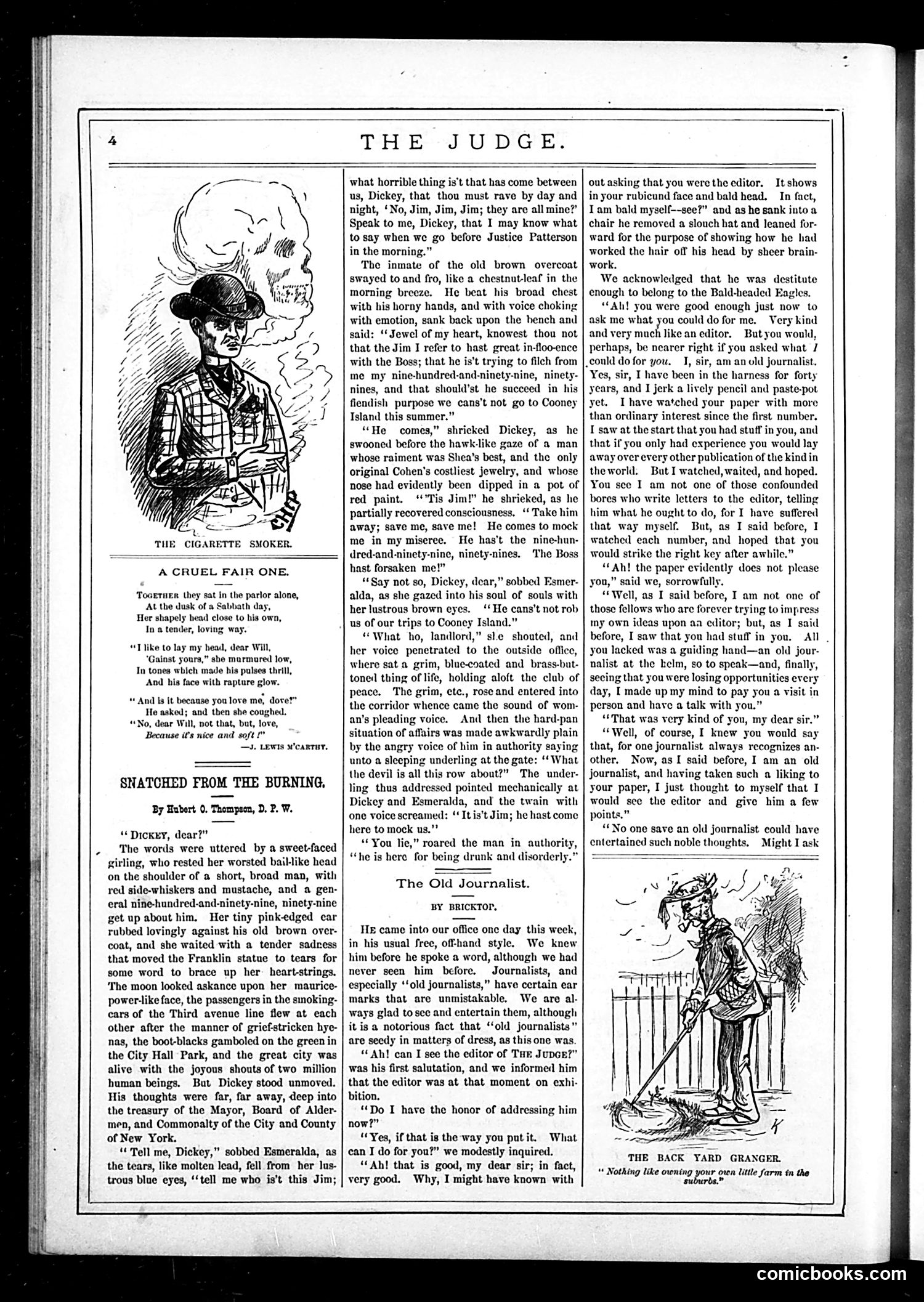
This page contains three satirical pieces mocking romantic sentimentality and bureaucratic corruption: **"The Cigarette Smoker"** and **"A Cruel Fair One"** are short humorous poems about romance undermined by practical concerns—a woman resting her head on her suitor's shoulder not from affection but because it's "soft," and another couple's romantic moment interrupted by coughing. **"Snatched from the Burning"** is the main satire, a melodramatic story parodying sentimental Victorian fiction. The protagonist "Dickey" is emotionally distressed not by romantic troubles but by fear that a rival named "Jim" will use political influence to deprive him of his government position (his "nine-hundred-and-ninety-nine" refers to a civil service rank). His fiancée Esmeralda's pleas are interrupted when authorities arrive. The piece satirizes both overwrought sentimental literature and New York's corrupt patronage system, where employment depended on political connections rather than merit.
📄 Transcribed text from this page (OCR, searchable)
Machine-transcribed from the original scan — historical spelling and the odd misread are preserved.
THE JUDGE. We THE CIGARETTE SMOKER. A CRUEL FAIR ONE. Tocetuer they sat in the parlor alone, At the dusk of a Sabbath day, Her shapely head close to his own, Ina tender, loving way. “Tlike to lay my head, dear Will, ‘Gainst yours,” she murmured low, In tones which made his pulses thrill, And his face with rapture glow. “ And is it because you love mo, dove!” He asked; and then she coughed. “No, dear Will, not that, but, love, Because it's nice and soft!" —J. LEWIS M’CARTHY. SNATCHED FROM THE BURNING. By Hubert 0. Thompaca, D, P. W. “Dickey, dear?” The words were uttered by a sweet-faced girling, who rested her worsted bail-like head on the shoulder of a short, broad man, with red side-whiskers and mustache, and a gen- eral nine-hundred-and-ninety-nine, ninety-nine get up about him. Her tiny pink-edged car rubbed lovingly against his old brown over- coat, and she waited with a tender sadress that moved the Franklin statue to tears for some word to brace up her: heart-strings. ‘The moon looked askance upon her maurice- power-like face, the passengers in the smoking- cars of the Third avenue line flew at each other after the manner of grief-stricken hye- nas, the boot-blacks gamboled on the green in the City Hall Park, and the great city was alive with the joyous shouts of two million human beings. But Dickey stood unmoved. His thoughts were far, far away, deep into the treasury of the Mayor, Board of Alder- men, and Commonalty of the City and County of New York. “Tell me, Dickey,” sobbed Esmeralda, as the tears, like molten lead, fell from her lus- what horrible thing is't that has come between us, Dickey, that thou must rave by day and night, ‘No, Jim, Jim, Jim; they are all mine?’ Speak to me, Dickey, that I may know what to say when we go before Justice Patterson in the morning.” The inmate of the old brown overcoat swayed to and fro, like a chestnutleaf in the morning breeze. He beat his broad chest with his horny hands, and with voice choking with emotion, sank back upon the bench and said: ‘Jewel of my heart, knowest thou not that the Jim I refer to hast great in-floo-ence with the Boss; that he is’t trying to filch from me my nine-hundred-and-ninety-nine, ninety- nines, and that should’st he succeed in his fiendish purpose we cans’t not go to Cooney Island this summer.” “He comes,” shricked Dickey, as he swooned before the hawk-like gaze of a man whose raiment was Shea’s best, and the only original Cohen's costliest jewelry, and whose nose had evidently been dipped in a pot of red paint. ‘Tis Jim!” he shrieked, as he partially recovered consciousness. ‘Take him away; save me, save me! He comes to mock me in my miseree. He has’t the nine-hun- dred-and-ninety-nine, ninety-nines. The Boss hast forsaken me!” “Say not so, Dickey, dear,” sobbed Esmer- alda, as she gazed into his soul of souls with her lustrous brown ey “He cans't not rob us of our trips to Cooney Island.” “What ho, landlord,” sl.e shouted, and her voice penetrated to the outside office, where sata grim, blue-coated and brass-but- toned thing of life, holding aloft the club of peace. The grim, etc., rose and entered into the corridor whence came the sound of wom- an’s pleading voice. And then the hard-pan situation of affairs was made awkwardly plain by the angry voice of him in authority saying unto a sleeping underling at the gate: ‘What the devil is all this row about?” The under- ling thus addressed pointed mechanically at Dickey and Esmeralda, and the twain with one voice screamed: ‘It is't Jim; he hast come here to mock us.”’ “You lie,” roared the man in authori “the is here for being drunk and disorderly.” The ola Journalist. BY BRICKTOr, HE came into our office one day this week, in his usual free, off-hand style. We knew him before he spoke a word, although we had never seen him before. Journalists, and especially ‘‘old journalists,” have certain ear marks that are unmistakable. We are al- ways glad to sce and entertain them, although it is a notorious fact that ‘old journalists” are seedy in matters of dress, as this one was. “Ah! can I see the editor of Tar JupcE?” was his first salutation, and we informed him that the editor was at that moment on exhi- bition. “Do I have the honor of addressing him now?” “Yes, if that is the way you putit. What can I do for you?” we modestly inquired. “Ah! that is good, my dear sir; in fact, very good. Why, I might have known with out asking that you were the editor. It shows in your rubicund face and bald head. In fact, Tam bald myself--see?” and as he sank intoa chair he removed a slouch hat and leaned for- ward for the purpose of showing how he had worked the hair off his head by sheer brain- work, We acknowledged that he was destitute enough to belong to the Bald-headed Eagles. ‘Al! you were good enough just now to ask me what you could do for me. Very kind and very much like an editor. But you would, perhaps, be nearer right if you asked what / could dofor you. I, sir, am an uld journalist. Yes, sir, I have been in the harness for forty years, and I jerk a lively pencil and paste-pot yet. I have watched your paper with more than ordinary interest since the first number. I saw at the start that you had stuff in you, and that if you only had experience you would lay away over every other publication of the kind in theworld. But I watched, waited, and hoped. You see I am not one of those confounded bores who write letters to the editor, telling him what he ought to do, for I have suffered that way myself. But, as I said before, I watched each number, and hoped that you would strike the right key after awhile.” “Ah! the paper evidently does not please you,” said we, sorrowfully. “Well, as I said before, I am not one of those fellows who arc forever trying to impress my own ideas upon aa editor; but, as I said before, I saw that you had stuff in you. All. you lacked was a guiding hand—an old jour- nalist at the kelm, so to speak—and, finally, secing that you were losing opportunities every day, I made up my mind to pay you a visit in person and have a talk with you.” “That was very kind of you, my dear sir.” “Well, of course, I knew you would say that, for one journalist always recognizes an- other. Now, as I said before, I am an old journalist, and having taken such a liking to your paper, I just thought to myself that I would see the editor and give him a few points.” “No one save an old journalist could have entertained such noble thoughts. Might I ask THE BACK YARD GRANGER. “ Nothing like owning your own little farm tn the cabereae ed a blue eyes, ‘‘tell me who is’t this Jim; comicbooks.com