
A complete issue · 16 pages · 1882
Judge — May 13, 1882
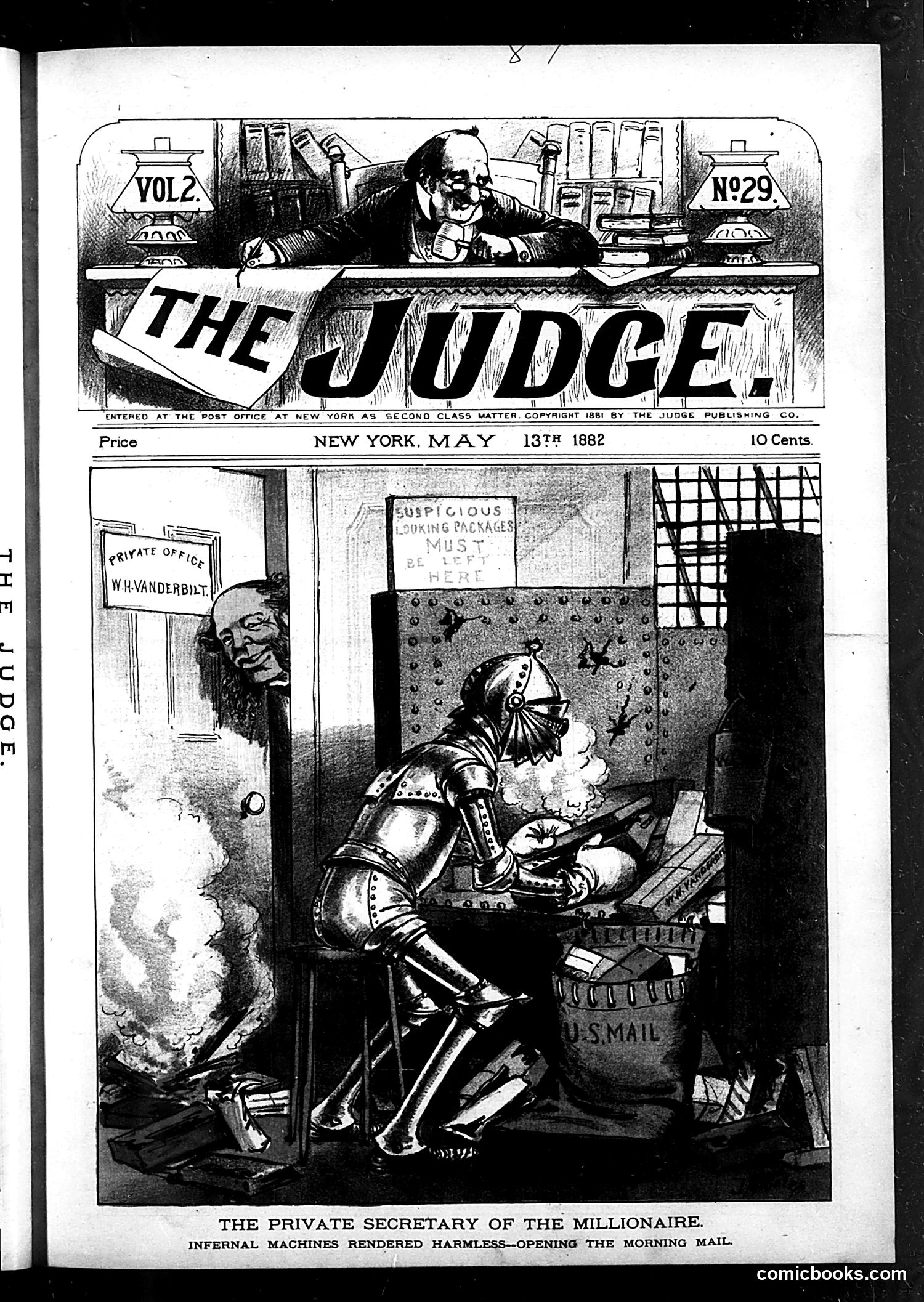
This 1882 *Judge* cartoon satirizes wealth and danger in the Gilded Age. The main image shows a heavily armored secretary opening a millionaire's mail—literally wearing medieval knight's armor. A sign warns "SUSPICIOUS LOOKING PACKAGES MUST BE OPENED HERE," while a fire burns nearby. The satire targets anarchist violence and labor unrest of the era. Wealthy industrialists received mail bombs from radical groups protesting economic inequality. The cartoon mocks the absurd lengths the rich must take to protect themselves, suggesting their exploitation of workers has made them targets. The top vignette shows a judge's office, establishing the legal/authority framing. The exaggerated armor transforms a secretary into a soldier—commenting on how industrial conflict had militarized daily life for the wealthy elite.
This page contains editorial content criticizing President Chester Arthur regarding Apache violence in Arizona and New Mexico. The main article, "A Hint to President Arthur," responds to a telegram from Tucson residents reporting nearly 100 pioneer deaths from Apache attacks. The satire argues that Arthur—formerly a New York "good fellow" and political appointee elevated to presidency after Garfield's assassination—must abandon leisure activities and prioritize frontier security. The piece criticizes U.S. Indian policy as dangerously permissive, suggesting the government has essentially armed Native Americans to attack settlers. The implicit message: Arthur lacks the gravitas for his office and must prove himself through decisive action on western violence, not ceremonial events like the Fortress Monroe military display mentioned. The cartoon likely depicts Arthur dismissing serious matters, reinforcing the editorial's central complaint about his unsuitability for executive responsibility.
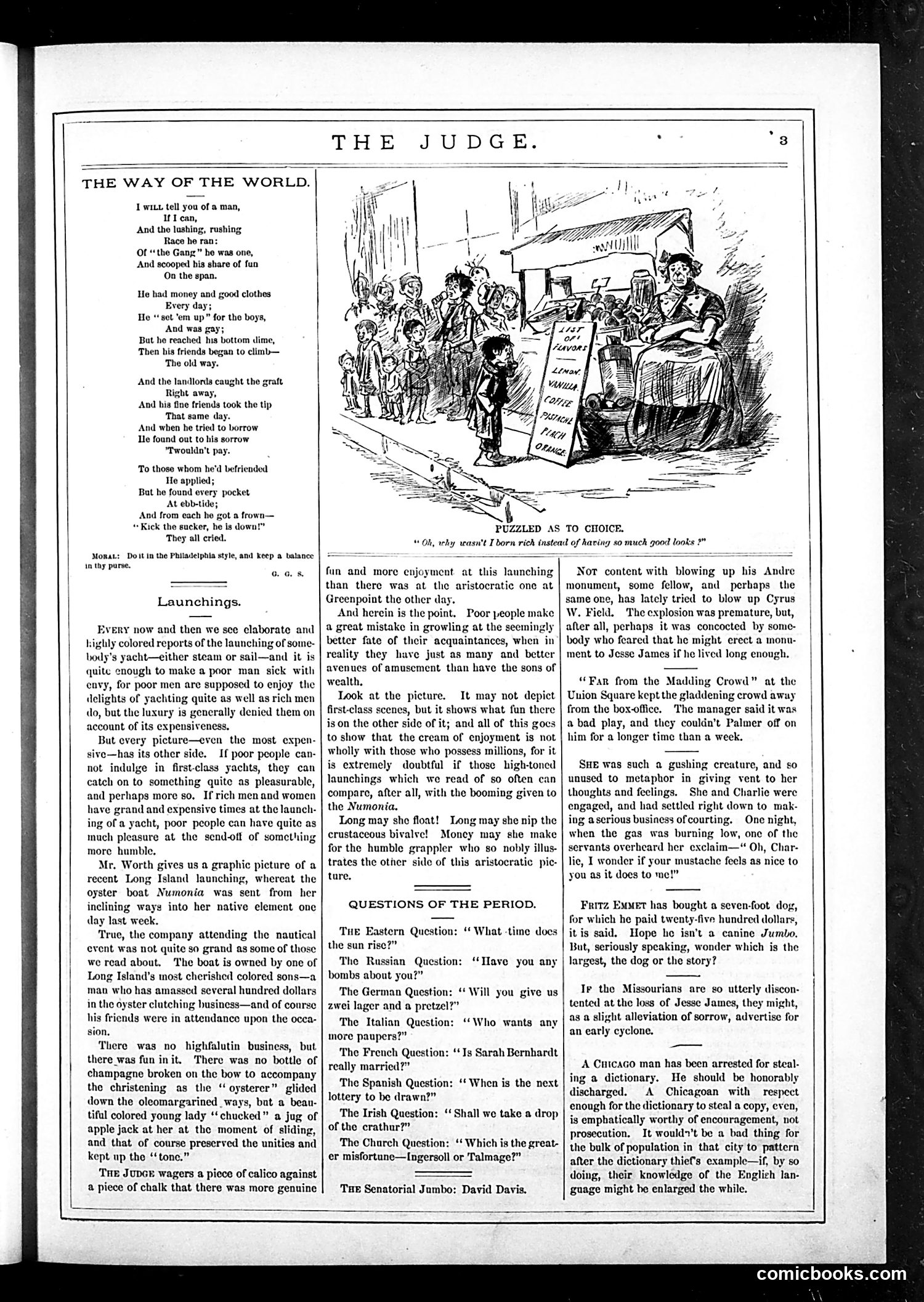
**"The Way of the World"** (poem and moral) depicts a cautionary tale about social climbing and fair-weather friendship. A man from "the Gang" enjoys wealth and popularity, generously treating companions. When he loses his money, those same friends abandon him—they literally "kick" him while down. The moral warns against excessive spending and the transience of friendships based on money rather than character. **"Puzzled as to Choice"** (cartoon) shows an oyster-seller's boat launching attended by Black laborers and their families. Judge celebrates this humble celebration as equal to—or superior to—wealthy whites' yacht launchings, arguing that "cream of enjoyment" isn't exclusive to the rich. It's a somewhat patronizing assertion of democratic pleasure, presenting the scene as evidence that poor people shouldn't resent the wealthy's advantages. Both pieces express working-class populism mixed with class-based moral instruction typical of late 19th-century satirical magazines.
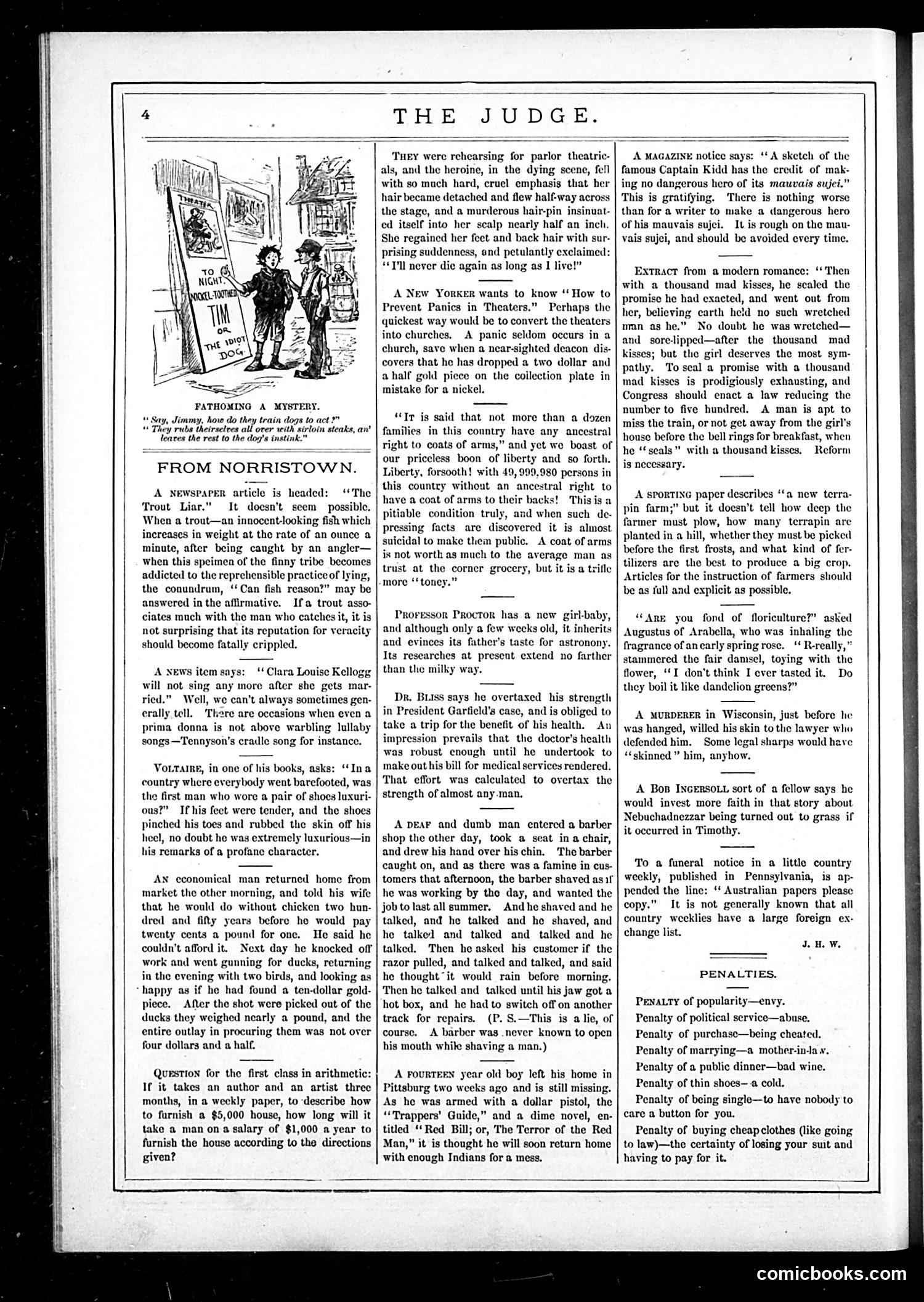
This page from Judge magazine contains several brief satirical pieces typical of the publication's style. The main cartoon, "Fathoming a Mystery," shows a simple exchange about dog training—a mild joke about how dogs are motivated by food rather than understanding commands. The surrounding text offers social commentary through humorous observations: a dig at opera singer Clara Louise Kellogg (implying prima donnas will abandon principles for domesticity); mockery of American class pretensions (noting most citizens lack "ancestral coats of arms" yet celebrate liberty); and satire of nouveau-riche excess (describing an economical man who spends four dollars hunting ducks to save twenty cents per pound). The pieces reflect Judge's characteristic approach: poking fun at contemporary social foibles, gender roles, and middle-class aspirations through brief anecdotes and rhetorical questions rather than explicit political commentary.
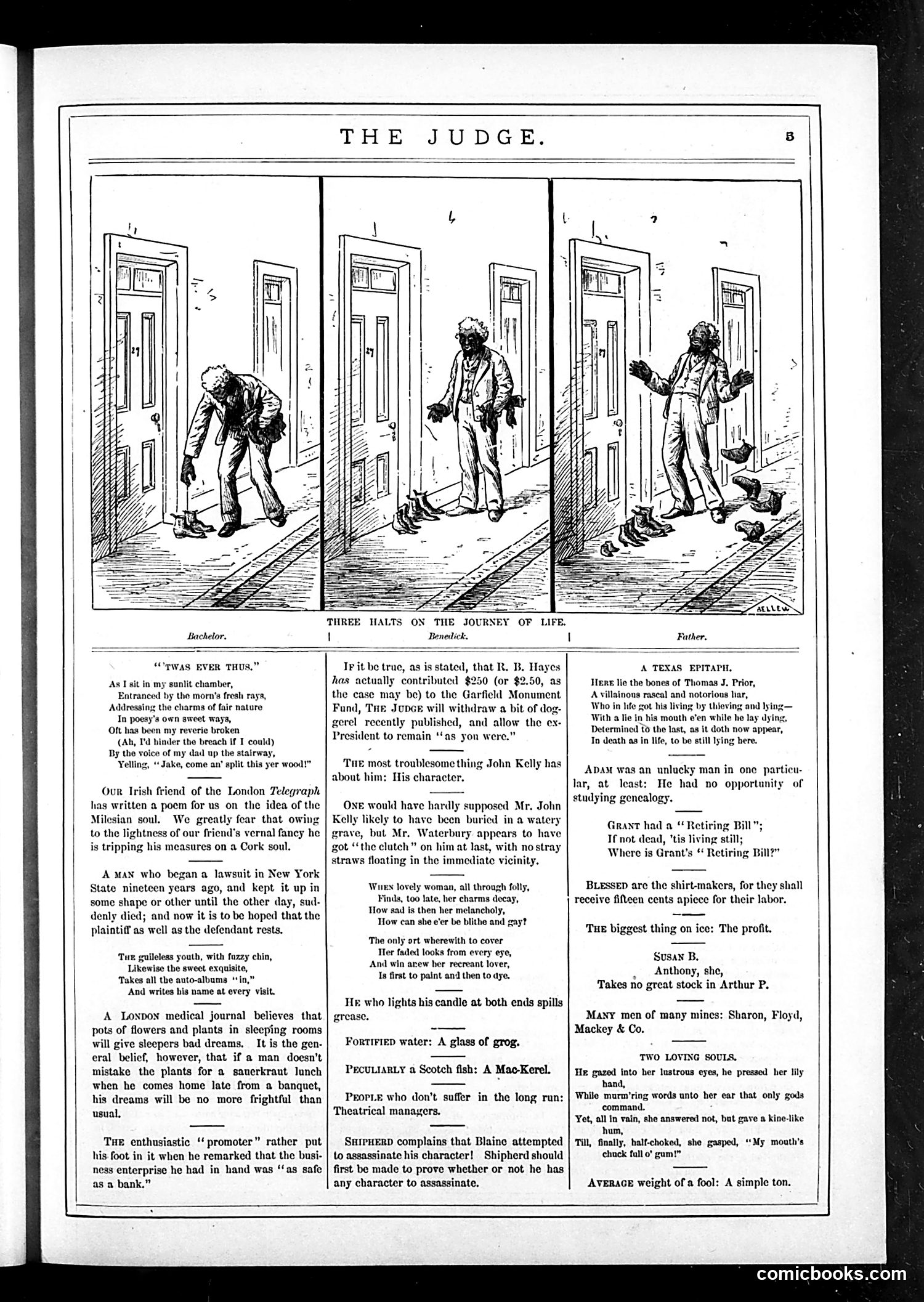
This three-panel cartoon satirizes life's stages through a man progressively burdened by domestic responsibilities. As a "Bachelor," he's carefree; as a "Benedick" (married man), he's weighed down; as a "Father," he's utterly overwhelmed—surrounded by shoes and children's items. The page contains satirical commentary on contemporary figures: R.B. Hayes (former president, mocked for a small Garfield Monument contribution); John Kelly (likely the Tammany Hall politician, criticized for character); and James Blaine (whose reputation Shipherd allegedly attacked). A Texas epitaph mocks a deceased liar named Thomas J. Prior. References to Susan B. Anthony and Arthur (likely President Chester Arthur) appear in brief jibes. The humor relies on wordplay ("Mac-Kerel" for Scotch fish) and social commentary typical of *Judge*'s satirical style—targeting politicians, social pretension, and domestic life.
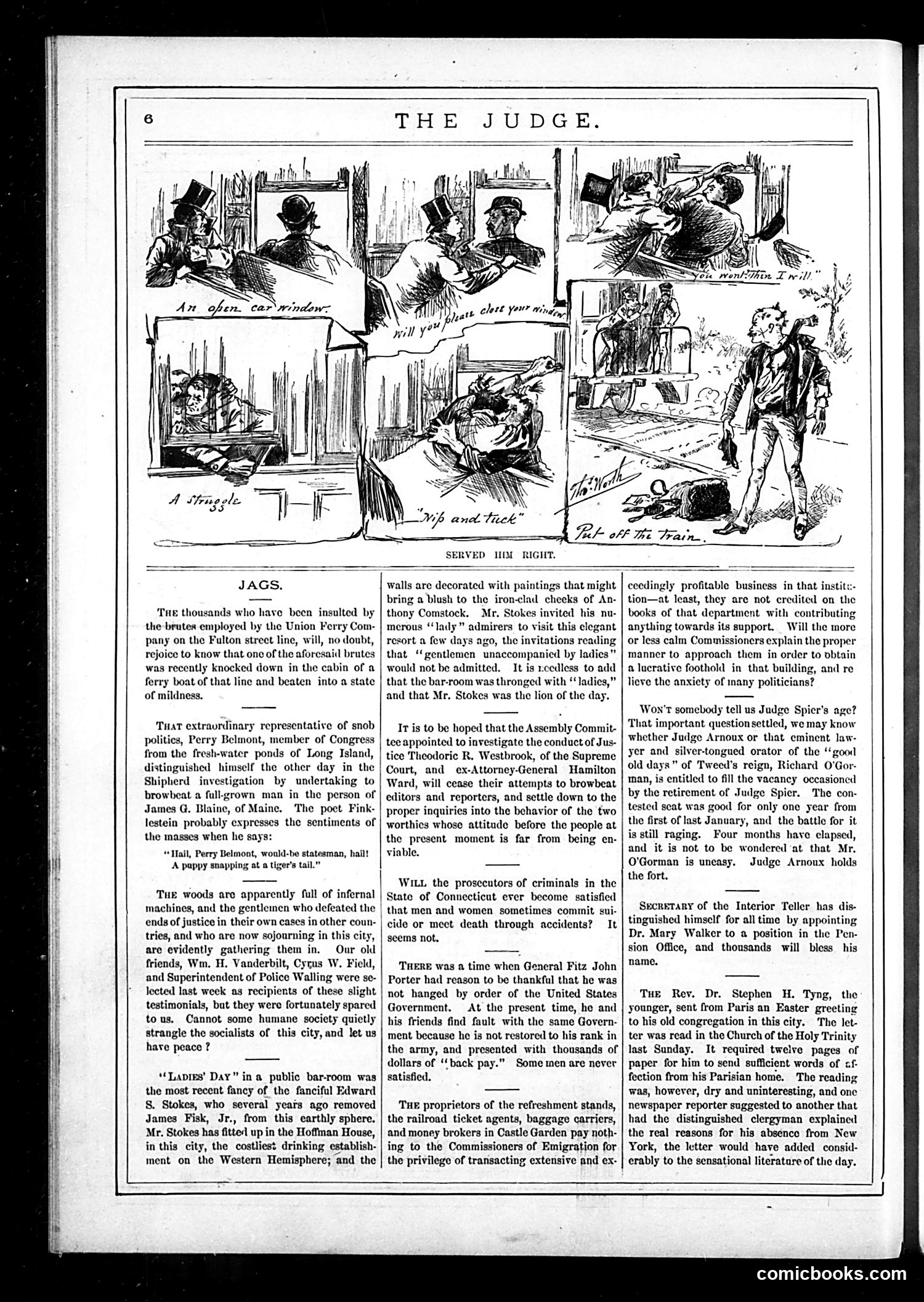
This page from *Judge* contains six separate satirical commentaries on 1870s-80s scandals and figures: **"Served Him Right"** (top cartoon) depicts a ferry worker beaten after mistreating passengers—celebrating violence against Union Ferry Company employees known for brutality. **Perry Belmont** is mocked as a snobbish congressman who bullied witness James G. Blaine during the Shipherd investigation. **Edward S. Stokes** is ridiculed for his "Ladies' Day" bar at the Hoffman House—an ostentatiously decorated establishment that attracted women of questionable reputation (Stokes had killed James Fisk Jr. years earlier). **Justice Theodoric Westbrook** and ex-Attorney-General Hamilton Ward face investigation for intimidating reporters and editors. **General Fitz John Porter** is criticized for complaining about lack of military restoration and back pay—seeming ungrateful. **Castle Garden officials** are accused of allowing vendors to profit without contributing to the emigration station's support. The overall tone: satirizing corruption, abuse of power, and hypocrisy among the wealthy and politically connected.
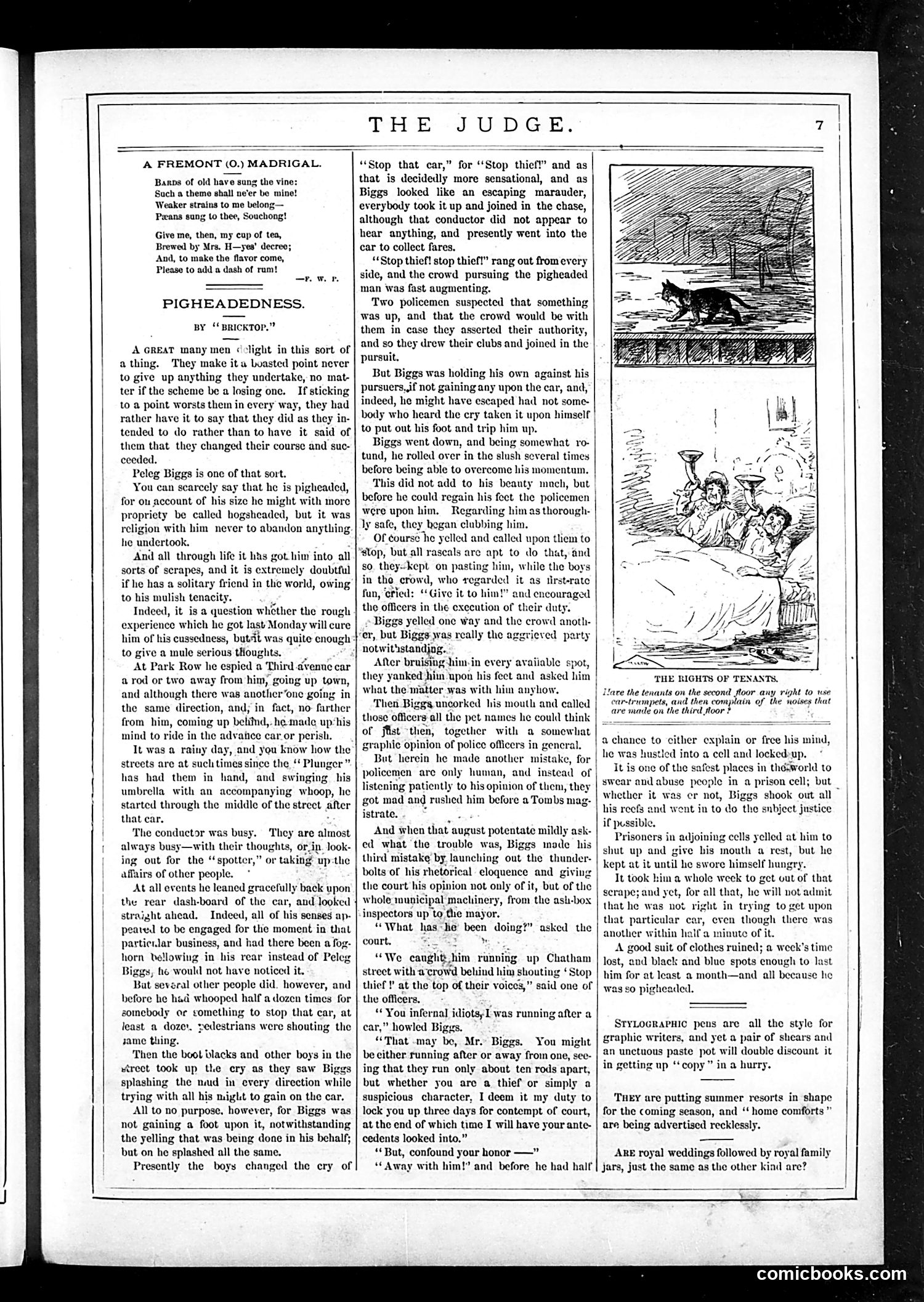
This story satirizes stubborn obstinacy through the character Peleg Biggs, a man so determined to board a specific streetcar that he pursues it through muddy Park Row streets despite another car being equally convenient and closer behind him. The humor escalates when bystanders, seeing his frantic splashing and shouting, misinterpret his chase as a theft in progress. Their cries of "Stop thief!" attract boot blacks, street boys, pedestrians, and eventually police—all joining an absurd mob pursuing an innocent man simply because he refused to abandon his arbitrary goal. The satire mocks American masculine pride: the cultural value placed on never "changing course" or admitting defeat, even when persistence serves no rational purpose. Biggs would rather be beaten by police than admit his initial choice was suboptimal. The irony—that his pigheaded determination to pursue *one specific car* transforms him into an actual fugitive—perfectly captures the self-destructive nature of refusing flexibility for the sake of pride. The piece is bylined "Bricktop," likely a pseudonym.
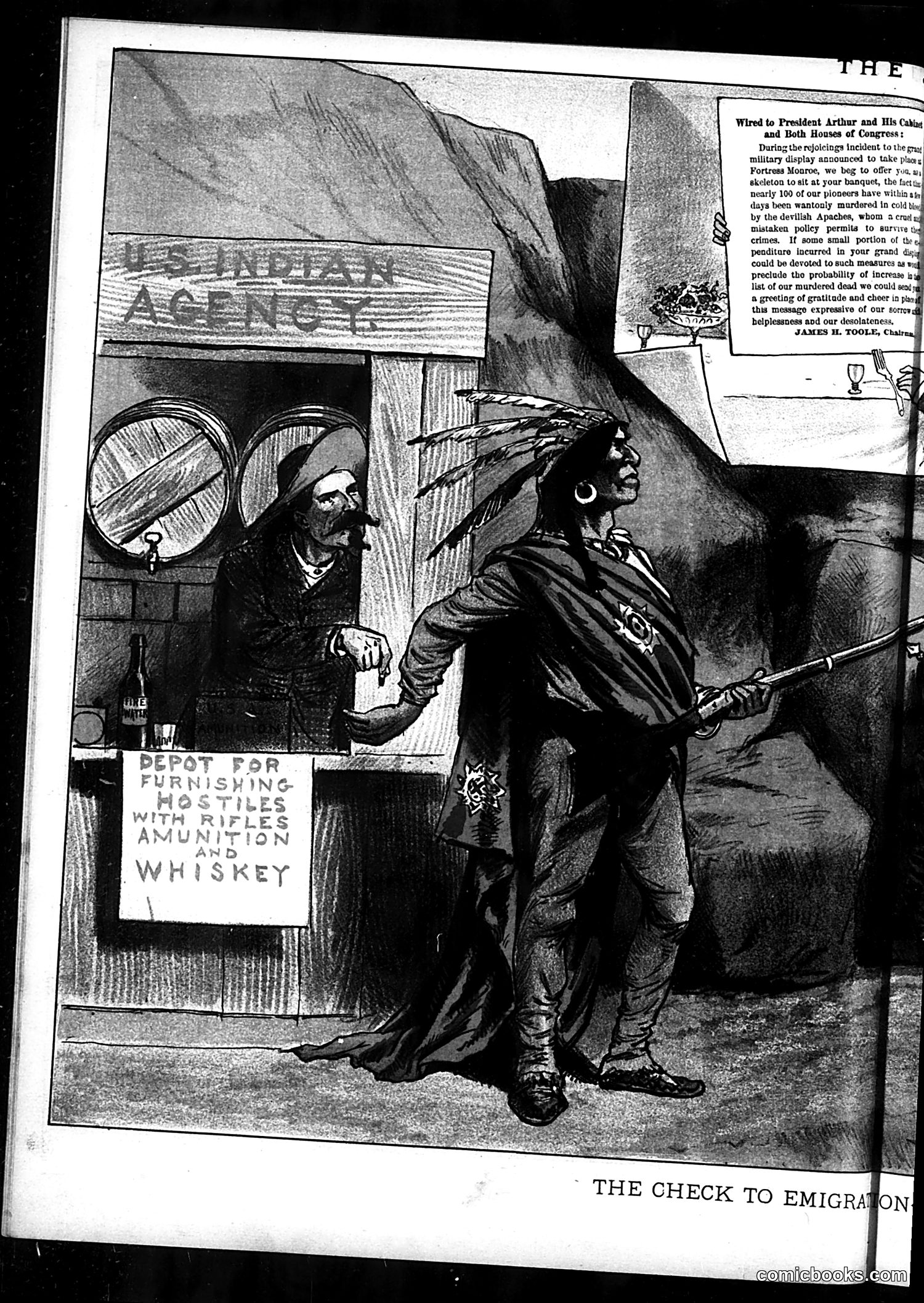
This political cartoon satirizes the U.S. military's priorities during Apache conflicts in the Southwest. The image shows an Apache warrior (depicted in caricatured style typical of the era) outside a "Depot for Furnishing Hostiles with Rifles Ammunition and Whiskey"—suggesting the government was indirectly supplying Native American fighters. The accompanying text, a mock telegram from James H. Toole to President Arthur and Congress, uses bitter irony to criticize military spending on ceremonial displays at Fortress Monroe while nearly 100 settlers had been "wantonly murdered" by Apache forces. The satire argues that frontier resources devoted to grand military pageantry should instead fund measures to prevent further deaths and stop emigration to dangerous territories. The cartoon reflects contemporary anxieties about Western settlement safety and critiques perceived government incompetence in protecting citizens.
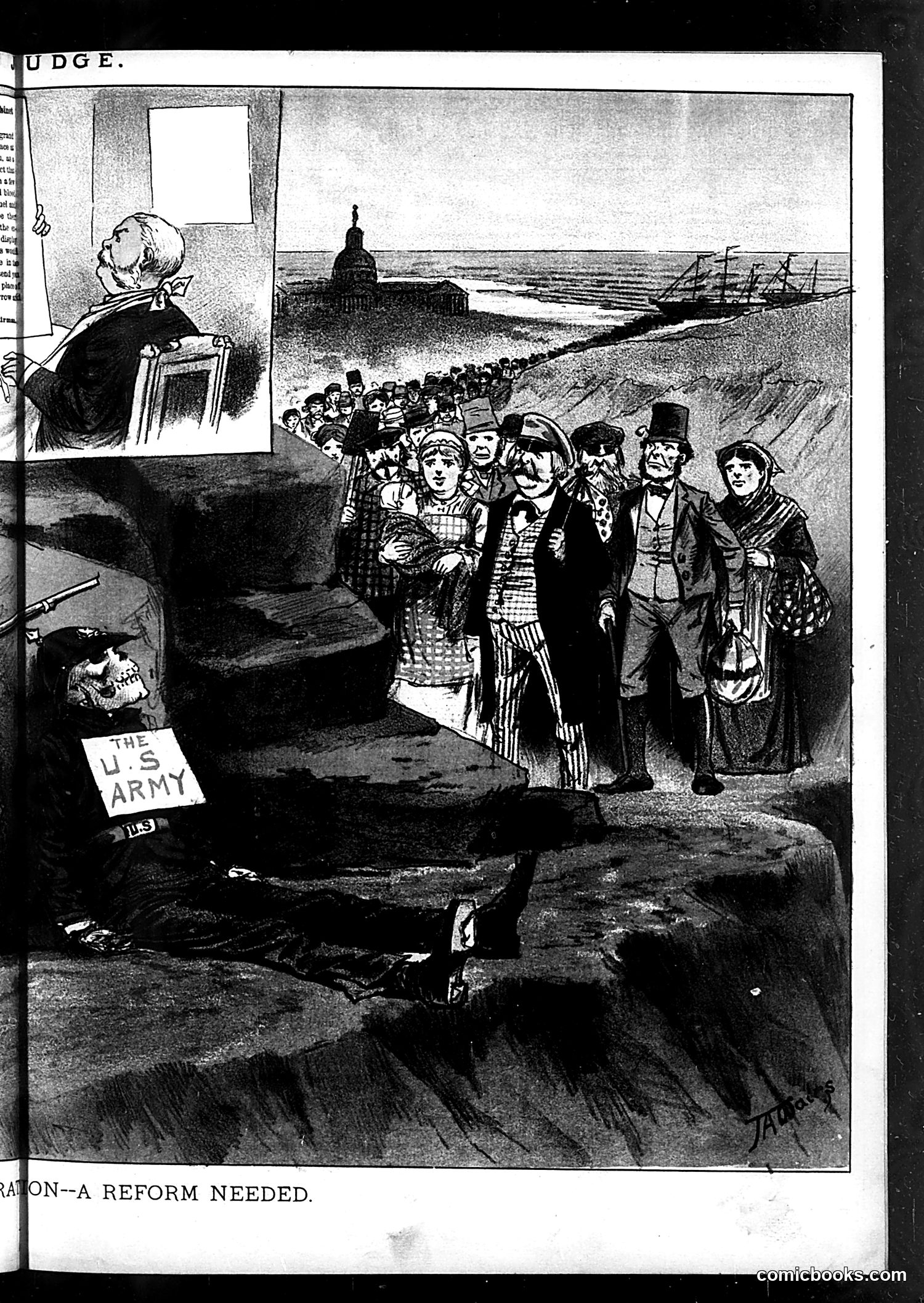
This political cartoon from *Judge* magazine critiques U.S. Army administration. The caption reads "RATION—A REFORM NEEDED." The cartoon depicts a judge or authority figure (upper left, in an inset) observing a large crowd of common people/soldiers gathered at what appears to be Washington D.C. (the Capitol building is visible in the background). In the foreground lies a skeletal figure labeled "THE U.S. ARMY," suggesting the military is starving or dying. The satire targets inadequate military rations and supplies. The judge watches from above while the masses gather, implying that despite public awareness and governmental oversight, the army's subsistence remains dangerously deficient. The cartoon advocates for military provisioning reform, suggesting that current ration standards fail to adequately sustain troops.
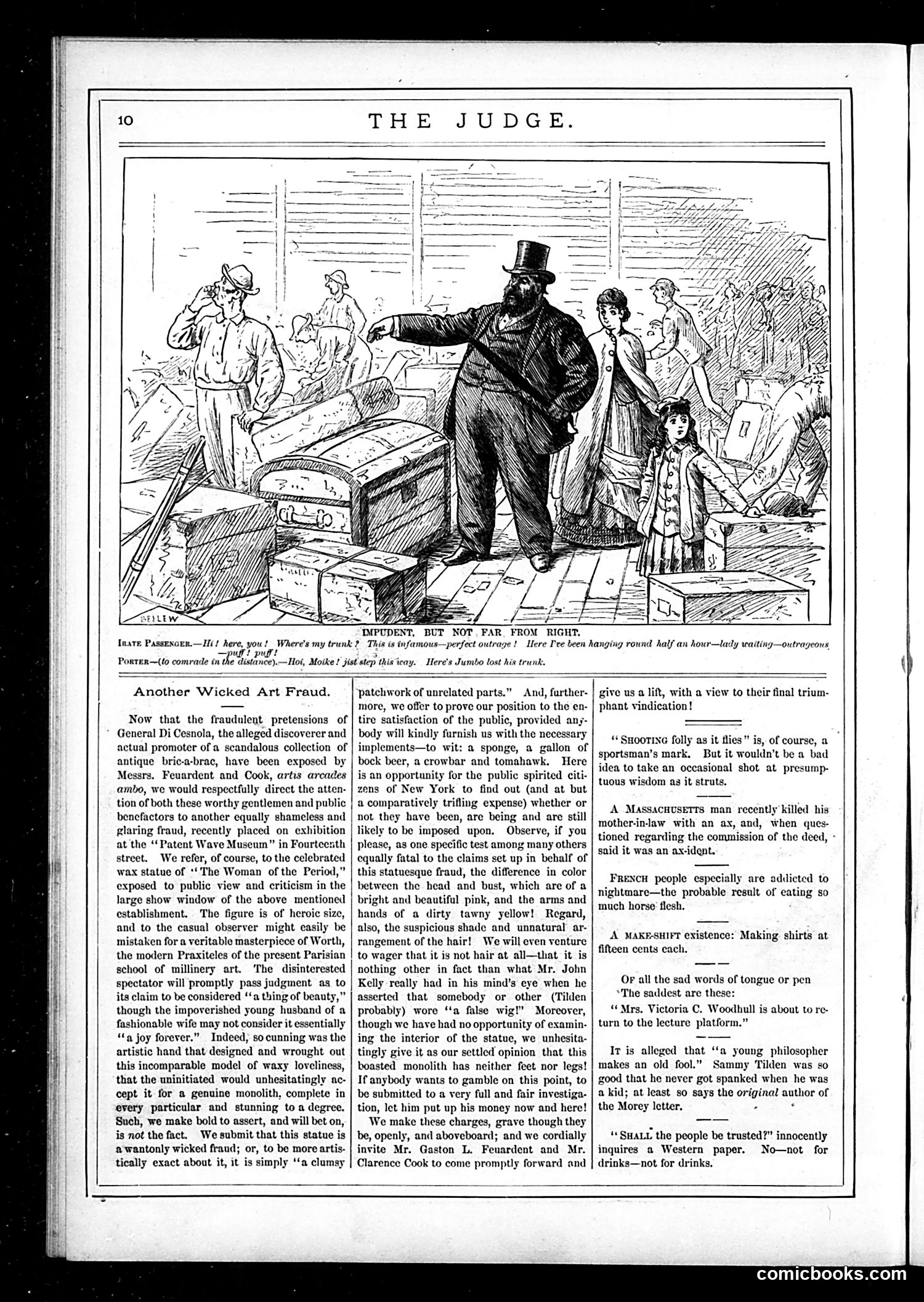
This *Judge* page contains two satirical pieces: **The Main Cartoon** depicts a porter at what appears to be a train station, with an irate passenger demanding his trunk. The caption suggests the porter sarcastically compares the missing trunk to "Jumbo" (likely P.T. Barnum's famous elephant), mocking the passenger's exaggerated complaint. **"Another Wicked Art Fraud"** is an extended article sarcastically attacking a wax museum's "Woman of the Period" statue on Fourteenth Street. The satire mocks the statue's poor construction—noting mismatched coloring between head and body, suspicious hair quality, and claiming it lacks proper legs and feet. The piece invokes General Di Cesnola (a real figure involved in an antiquities fraud scandal) to draw parallels, suggesting New York museums peddle fraudulent goods to credulous audiences. The writing ridicules both the fake artistry and the public's gullibility in accepting obvious fakes as genuine cultural artifacts.
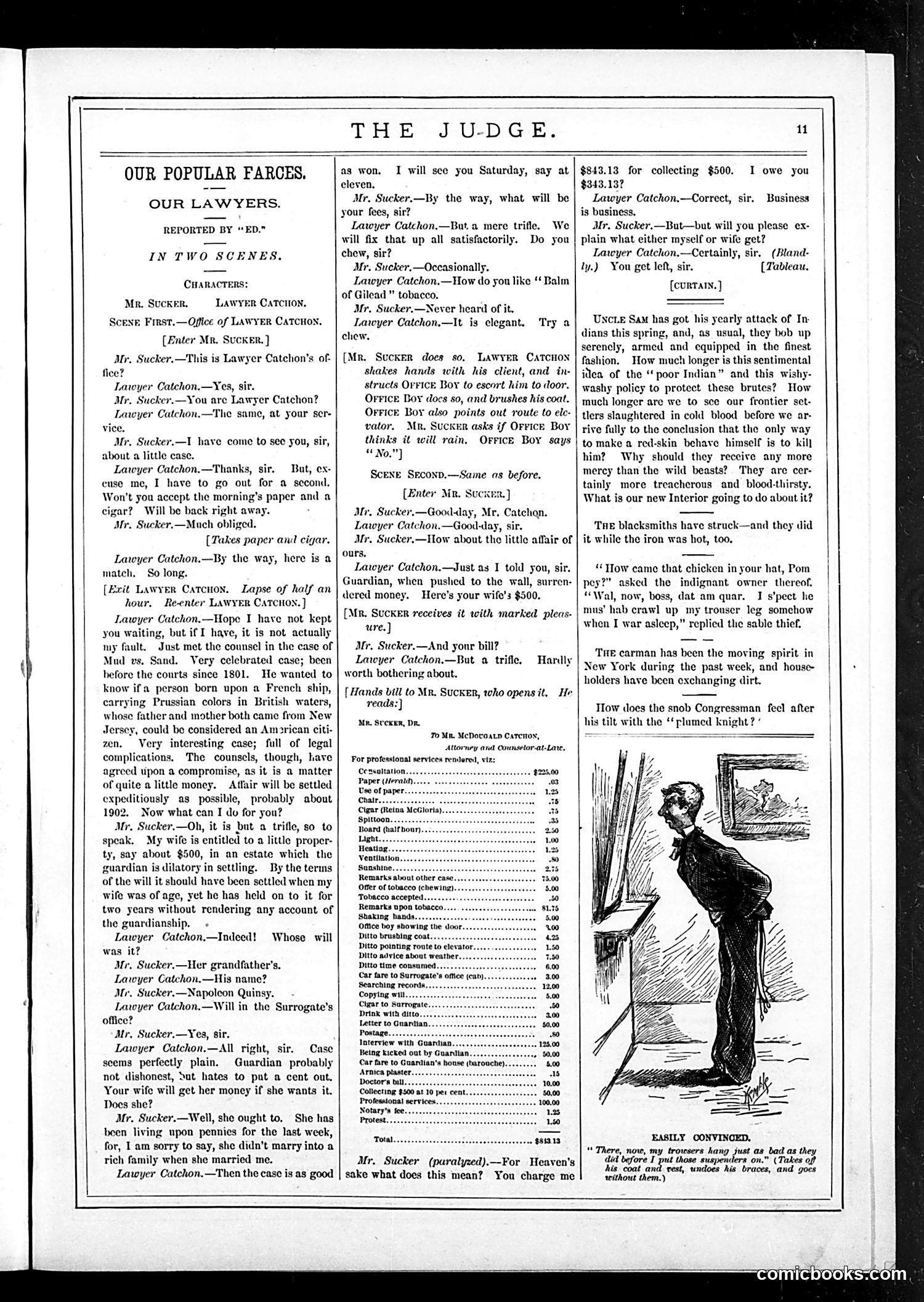
This two-scene farce satirizes exploitative lawyers who charge vastly inflated fees for simple legal work. **The Setup:** Mr. Sucker consults "Lawyer Catchon" about recovering his wife's modest $500 inheritance, wrongfully withheld by a guardian. Catchon dismisses it as trivial while regaling Sucker with an absurdly complicated, 101-year-old case involving citizenship questions about someone born on a French ship with Prussian colors in British waters—obviously fictional padding meant to inflate his importance. **The Punchline:** Catchon successfully recovers the $500 but presents a bill of $843.13 (shown in the detailed fee schedule). Every minor action—"Consultation," "Splitting hairs," "Office boy brushing coat," "Advice about weather"—is itemized and charged. The lawyer essentially pockets most of the recovered amount through fees, leaving Sucker worse off than before. The satire exposes how lawyers use legal complexity and petty itemization to justify astronomical bills for straightforward cases, effectively robbing their own clients.
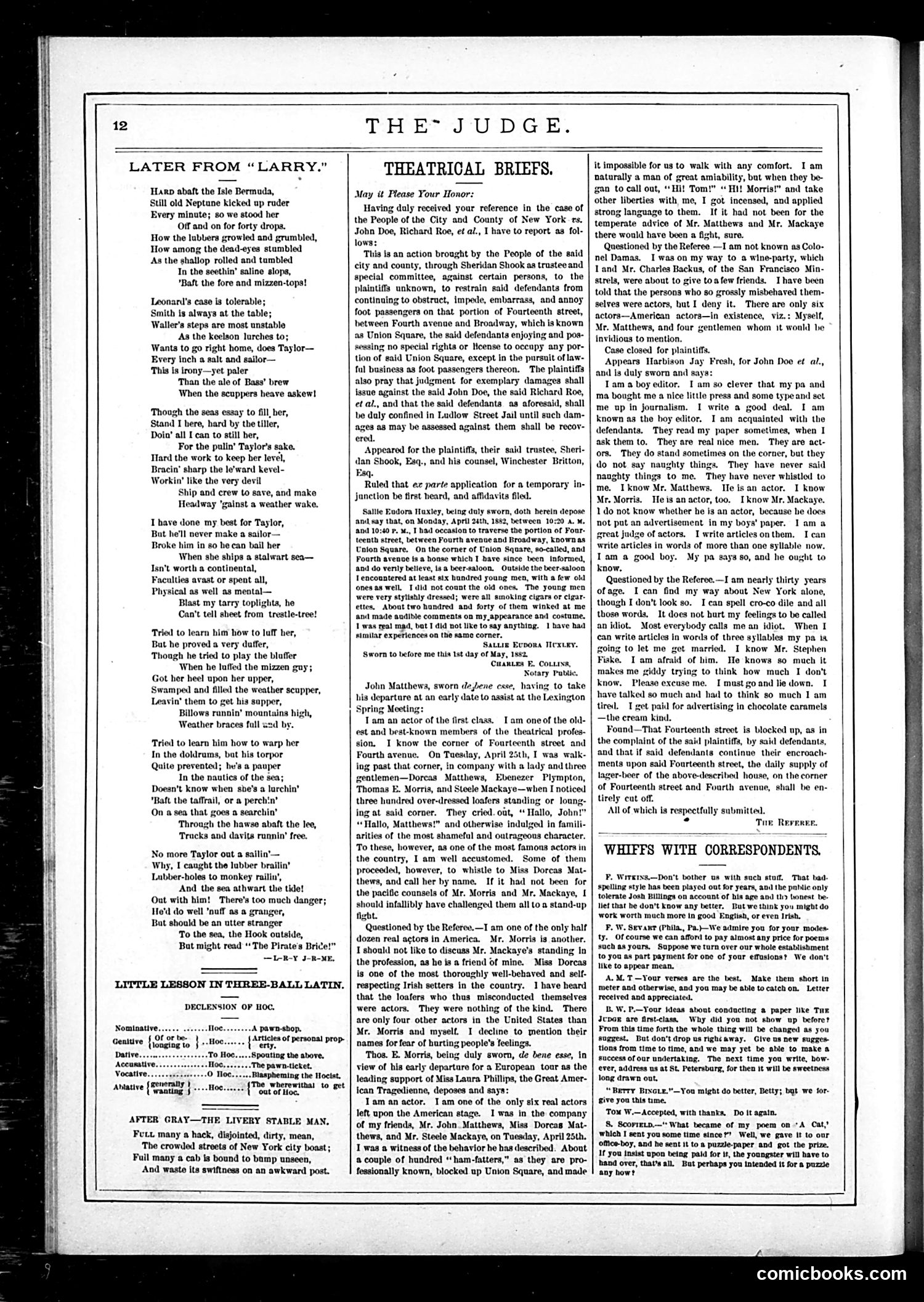
This page from Judge contains satirical content about theatrical and social matters of the era. The main sections include: **"Later from 'Larry'"** - A nautical poem mocking an incompetent sailor named Taylor who cannot learn seamanship despite efforts by the experienced narrator. The satire ridicules landlubbers attempting maritime work, using exaggerated nautical jargon to emphasize Taylor's hopelessness. **"Theatrical Briefs"** - A mock legal complaint against unnamed defendants obstructing foot traffic at Union Square in New York City. The satirical "case" uses legal language absurdly, likely commenting on actual street congestion or loitering problems blamed on theater-goers or street performers. **"Little Lesson in Three-Ball Latin"** - A humorous declension of "hoc" (Latin for "this"), punning on "hock" as pawnbroking, mocking pretentious pseudo-Latin wordplay. **"After Gray"** - The opening of a poem about shabby New York livery horses and cabs. The page emphasizes Judge's satirical approach: mocking incompetence, legal pomposity, and urban nuisances through exaggeration and wordplay.
This page is primarily **advertising**, featuring multiple product promotions for E. Ridley & Sons housekeeping supplies, Enoch Morgan's Sapolio soap, and other household goods typical of the late 19th century. The small satirical items at the top include brief jokes about: - A waiter unsurprised by a caterpillar in soup (seasonal complaint) - A grammatical pun on "Portuguese" - A comment on Bismarck suppressing a comic newspaper in Germany - A reference to "Sam Ward" as a "Parliamentary Agent" (a lobbyist), with a jab at his pretension The most substantive satire references a letter mailed in 1853 that arrived decades later with a marriage proposal—the joke being the recipient's delighted surprise at the "fast mail service." Overall, this is a **typical Judge page mixing light humor with commercial advertising**, rather than containing significant political cartooning or commentary.
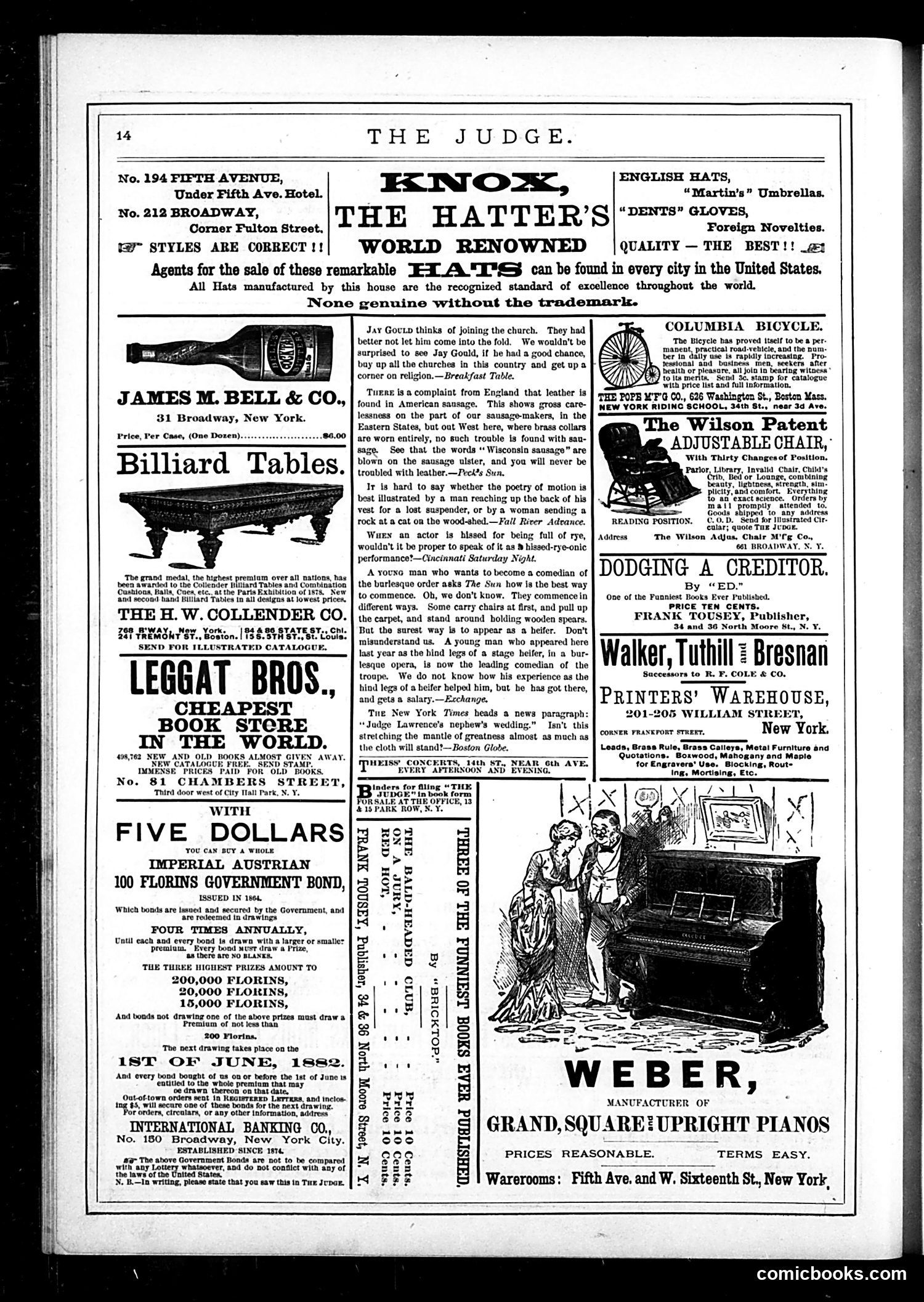
This page is primarily **advertisements** with small satirical text snippets, but features one notable cartoon titled "Dodging a Creditor" showing a well-dressed man and woman examining artwork on a wall while ignoring a creditor at the door. The satire illustrates a common social problem: **wealthy people evading financial obligations**. The couple's casual indifference to the creditor—focusing instead on their art collection—mocks the dishonesty of the well-to-do who could pay debts but avoid them through pretense or absence. The cartoon suggests that creditors were frequently dodged by the affluent, who used excuses and social pretense to avoid accountability. This reflects **Gilded Age anxieties** about business ethics and class behavior, where wealthy individuals could ignore financial responsibilities without serious consequence, while ordinary people faced harsh debt collection. The humor derives from the brazen disregard for legitimate claims.
This page is primarily **advertising**, not political satire. It contains commercial listings for furniture dealers (Coogan Bros.), candy makers, and other retail businesses typical of 1880s New York. The small text snippets are reprinted jokes and news items from competing publications like *Texas Siftings* and *Grip*. These include mild humor: a servant's pretentious aesthetic decorating, wordplay about mules dying naturally, and political jabs at figures like Belknap (likely Secretary of War William W. Belknap, who faced scandal). One item mocks a Kentucky congressman eagerly requesting agricultural seeds, implying politicians pursue trivial benefits. The magazine itself announces that contributor Henry Clay Lukens is departing *Judge* for other work—presented sarcastically as prioritizing money over principle ("Commercial to the last!"). **No significant cartoon or caricature appears on this visible page.** It's a typical back section mixing advertisements with reprinted humor.
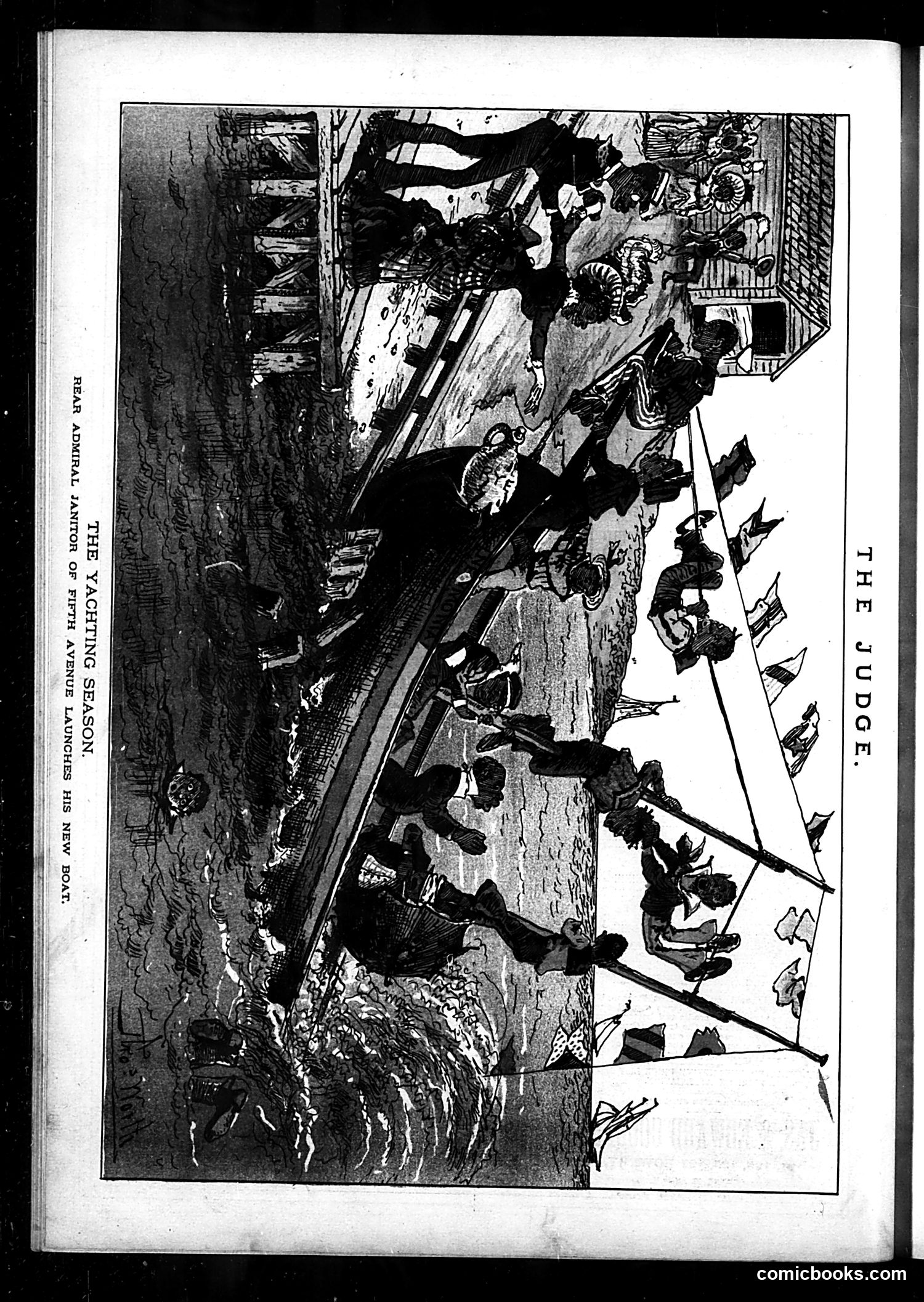
This satirical cartoon mocks the pretensions of wealthy Fifth Avenue residents. The caption's humor lies in calling a janitor a "Rear Admiral"—a naval rank—while he "launches" what appears to be a modest or makeshift vessel. The satire targets the Gilded Age practice of the wealthy displaying their yachts as status symbols during the yachting season. By depicting a janitor (a working-class employee) participating in this elite ritual, the cartoon ridicules how absurdly the wealthy valued such conspicuous consumption. The joke suggests that even a servant figure deserves the grandiose military title when engaging in yachting—mocking both the pretentiousness of yacht owners and the class barriers of the era. The image is oriented sideways, requiring rotation to view properly.