
Judge, 1882-05-13 · page 12 of 16
Judge — May 13, 1882 — page 12: what you’re looking at
What you’re looking at
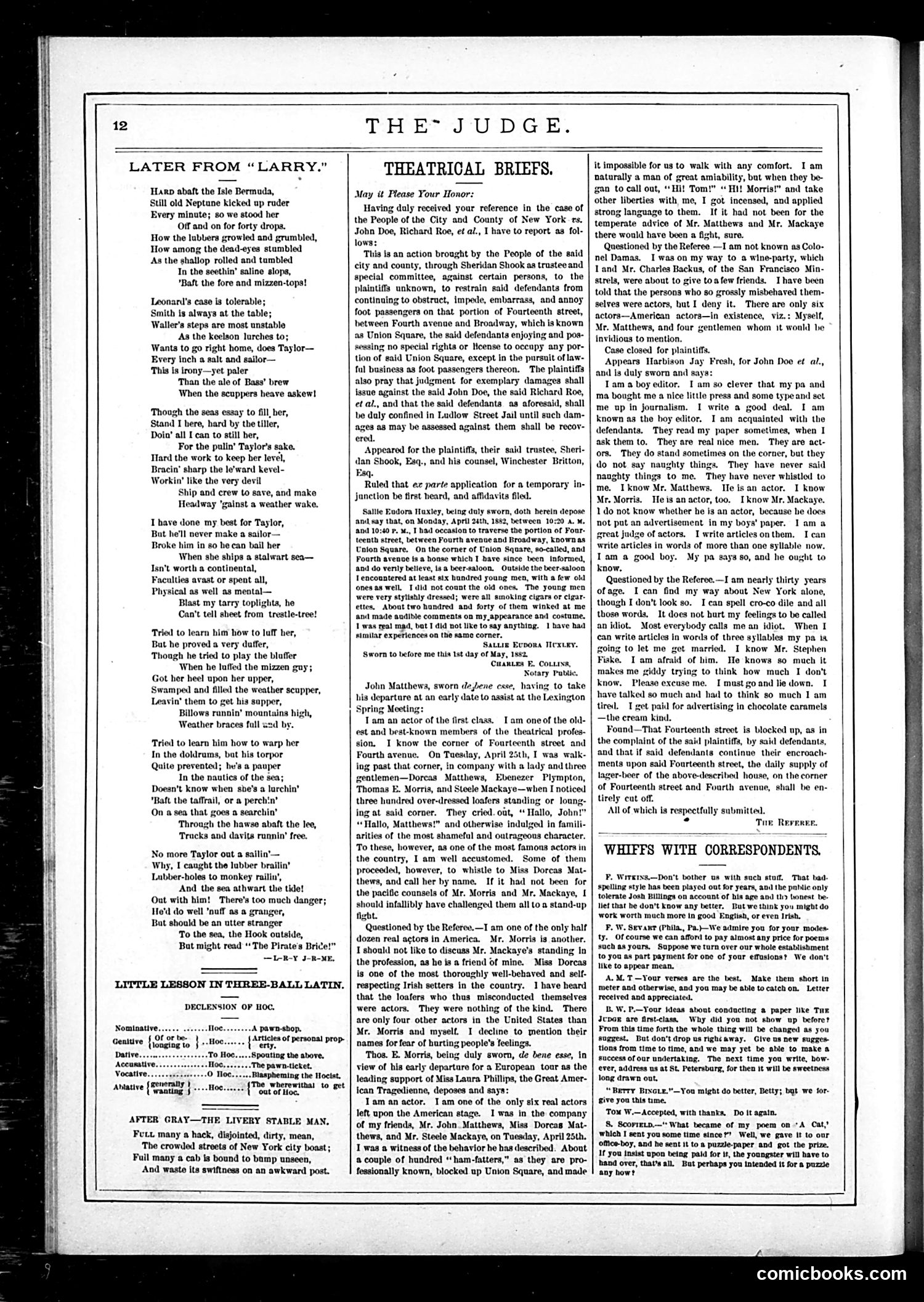
This page from Judge contains satirical content about theatrical and social matters of the era. The main sections include: **"Later from 'Larry'"** - A nautical poem mocking an incompetent sailor named Taylor who cannot learn seamanship despite efforts by the experienced narrator. The satire ridicules landlubbers attempting maritime work, using exaggerated nautical jargon to emphasize Taylor's hopelessness. **"Theatrical Briefs"** - A mock legal complaint against unnamed defendants obstructing foot traffic at Union Square in New York City. The satirical "case" uses legal language absurdly, likely commenting on actual street congestion or loitering problems blamed on theater-goers or street performers. **"Little Lesson in Three-Ball Latin"** - A humorous declension of "hoc" (Latin for "this"), punning on "hock" as pawnbroking, mocking pretentious pseudo-Latin wordplay. **"After Gray"** - The opening of a poem about shabby New York livery horses and cabs. The page emphasizes Judge's satirical approach: mocking incompetence, legal pomposity, and urban nuisances through exaggeration and wordplay.
📄 Transcribed text from this page (OCR, searchable)
Machine-transcribed from the original scan — historical spelling and the odd misread are preserved.
THE JUDGE. LATER FROM “LARRY.” Harp abaft the Isle Bermuda, Still old Neptune kicked up ruder Every minute; 80 we stood her Off and on for forty dropa. How the labters growled and grumbled, How among the dead-eyes stumbled As the shallop rolled and tumbled In the seethin’ saline slops, *Baft the fore and mizzen-tops! Leonani!’s case is tolerable; ‘Smith is always at the table; Waller's steps are most unstable ‘As the keelson lurches to; Wants to go right home, does Taylor— Every inch a salt and sailor— ‘This is trony—yet paler ‘Than the ale of Bass’ brew ‘When the scuppers heave askew! ‘Though the seas essay to fill, her, ‘Stand I here, hard by the tiller, Doin’ all can to still her, For the pulin’ Taylor’s sake. Tard the work to keep her level, Bracin’ sharp the le’ward kevel- Workin’ like the very devil Ship and crew to save, and make Headway ‘gainst a weather wake. Thave done my best for Taylor, But he'll never make a sailor— Broke him in so he can bail her When she ships a stalwart sea— Isn't worth a continental, Faculties avast or spent all, Physical as well as mental— Blast my tarry toplighta, he Can't tell sheet from trestle-tree! Tried to learn him how to lulf her, Bat he proved a very dutfer, Though he tried to play the blaffer ‘When he luffed the mizzen guy; Got her heel upon her upper, Swamped and filled the weather scupper, Leavin’ them to get his supper, Billows runnin’ mountains high, Weather braces fall axd by. Tried to learn him how to warp her In the doldrums, but his torpor Quito prevented; he’s a pauper In the nautics of the sea; Doesn't know when sbe’s a lurchin’ "Batt the taffrail, or a perchn’ On a sea that goes a searchin’ Through the hawse abaft the lee, Trucks and davits runnin’ free. No more Taylor out a sailin’— Why, I caught the lubber brailin’ Lubber-holes to monkey railin’, And the sea athwart the tide! Out with him! There's too much danger; He'd do well ‘nuff a8 a granger, Bat should be an utter stranger To the sea, the Hook outside, Bat might read “The Pirate's Brice!” LR J-R-wE, LITTLE LESSON IN THREE-BALL LATIN. DECLENSION OP HOC, Nominative... Gentuve {oi eng to A pawn-shop. Articles of personal riicles of personal prop- Spouting the above, “The pawn-ticket. ‘Blaspheming the Hoctst, Hoos... {TMe, wherewithal to get ansave (Reza. SS AFTER GRAY—THE LIVERY STABLE MAN. Fett many a hack, disjointed, dirty, mean, The crowded streets of New York city boast ; Fuil many a cab is bound to bump unseen, And waste its swiftness on an awkward post. THEATRICAL BRIEFS. May it Please Your Honor: Having daly received your reference in the case of the People of the City and County of New York ts. John Doe, Richard Roe, et al., I have to report as fol- lows: This is an action brought by the People of the said city and county, through Sheridan Shook as trusteeand special committee, against certain persons, to the plaintiffs unknown, to restrain said defendants from continuing to obstruct, impede, embarrass, and annoy foot passengers on that portion of Fourteenth street, between Fourth avenue and Broadway, which is known a8 Union Square, the said defendants enjoying and pos- sessing no special rights or Neense to occupy any por tion of said Union Square, except in the pursuit of law- ful business as foot passengers thereon. The plaintiffs also pray that judgment for exemplary damages shall issue against the said John Doe, the said Richard Roe, et al., and that the said defendants as aforesaid, shall be daly confined in Ludlow Street Jail until such dam- ages as may be aaseased against them shall be recov- ered. Appeared for the plaintiffs, their said trustee, Sheri- dan Shook, Esq., and his counsel, Winchester Britton, Esq. Ruled that ez parte application for a temporary in- Junction be first heard, and affidavits Bled. Sallie Eudora Haxley, being duly sworn, doth herein depose and say that, on Monday, April 24th, 1882, between 10:20 a. M. aand 10:40 P. M., I had occasion to traverse the portion of Four- teenth street, between Fourth avenue and Broadway, known as, Union Square. On the corner of Union Square, so-called, and Fourth avenoe ts a honse which I bave since been Informed, and do verily believe, is a beer-ealoon. Outside the beer-aaloon Tencountered at least six handred young men, with afew okl ones as well. Tdld not count the old ones. The young men were very stylishly dressed; were all sinoking cigars oF clgar- ettes, About two hundred apd forty of them winked at me and made audible comments on my,appearance and costume, 1 was real mad, bat T did not like to-say angthing. 1 have had similar experiences on thie name corner. Satu Evora Mexury. Sworn to before me this Ist day of May, 1882. Cuantes F. COLLIN, Notary Pubtic. John Matthews, sworn depene esse, having to take his departare at an early date to assist at the Lexington Spring Meeting: Tam an actor of the first class, Iam oneof the old est and best-known members of the theatrical profes- sion. I know the corner of Fourteenth street and Fourth avenue. On Tuesday, April 25th, I was walk- ing past that corner, in company with a lady and threo gentlemen—Dorcas Matthews, Ebenezer Plympton, Thomas E. Morris, and Steele Mackaye—when I noticed three hundred over-dressed loafers standing or loung- ing at said corner. They cried. ot, ‘Talo, Jobn' “Hallo, Matthews!” and otherwise indulged in fam arities of the most shamefal and outrageous character. To these, however, as one of the most famons actors in the country, I am well accustomed. Some of them proceeded, however, to whistle to Miss Dorcas Mat- thews, and call her by name, If it had not been for the pacife counsels of Mr. Morris and Mr. Mackaye, { should infallibly have challenged them all to a stand-up figbt. Questioned by the Referee.—I am one of the only half dozen real actors in America, Mr, Morris is another. I should not like to discuss Mr. Mackaye’s standing in the profession, as he is a friend of mine. Misa Dorcas is one of the most thoroughly well-behaved and self- respecting Irish setters in the country. 1 have heard that the loafers who thus misconducted themselves were actors, They were nothing of the kind. There are only four other actors in the United States than Mr. Morris and myself. I decline to mention their names for fear of hurting people's feelings. Thos. E. Morris, being duly sworn, de bene esse, in view of his early departure for a European tour as the leading support of Miss Laura Phillips, the Great Amer- ican Tragedienne, deposes and says: Tam an actor. Iam one of the only six real actors left upon the American stage. I was in the company of my frienda, Mr. John. Matthew, Miss Dorcas Mat- thews, and Mr. Steele Mackaye, on Tuesday, April 25th. I was a witness of the behavior he has described. About couple of hundred *‘ham-fatters,” as they are pro- fessionally known, blocked up Union Square, and made it impossible for us to walk with any comfort. Iam naturally a man of great amiability, bat when they be- gan to call out, “Hi! Tom!” “Hi! Morris!” and take other liberties with me, I got incensed, and applied strong language to them. If it had not been for the temperate advice of Mr. Matthews and Mr, Mackaye there would have been a fight, sure. Questioned by the Referee —I am not known as Colo- nel Damas. I was on my way to a wine-party, which Land Mr. Charles Backus, of the San Francisco Min- strela, were about to give toafew friends, Ihave been told that the persona who 80 grossly misbehaved them- selves were actors, but I deny it. There are only six actors—American actora—in existence, viz.: Myself, Mr. Matthews, and four gentlemen whom it would be invidious to mention. Case closed for plaintiffs. Appears Harbison Jay Fresh, for John Doo et al, and is duly sworn and says: Tam a boy editor. I am so clever that my pa and ma bought mo a nice little press and some typeand set me up in journalism. I write a good deal. I am known as the hoy editor. I am acquainted with the defendants. They read my paper sometimes, when I ask them to. They are real nice men. They are act- ors. They do stand sometimes on the corner, but they do not say naughty things, They have never said nanghty things to me. They have never whistled to me. Iknow Mr. Matthews. Ie isan actor. I know Mr. Morris, eis an actor, too. I know Mr. Mackaye. 1 do not know whether he is an actor, because he docs not put an advertisement in my boys’ paper. I am a great judge of actors, I write articles on them, I can write articles in words of more than one syllable now, Tam a good boy. My pa says so, and he ought to know. Questioned by the Referee.—I am nearly thirty years ofage. I can find my way about New York alone, though I don't look so. I can spell cro-co dile and all those words, It does not hurt my feelings to be called an idiot. Most everybody calls me an idiot. When I can write articles in words of three syllables my pa ia going to let me get married. I know Mr. Stephen Fiske. Iam afraid of him. He knows so much it makes me giddy trying to think how much I don’t know. Pleaso excuse me. I must goand lie down. I have talked so much and had to think so much I am tired. I get paid for advertising in chocolate caramels —the cream kind. Found—That Fourteenth street is blocked up, as in the complaint of the said plaintiffs, by said defendants, and that if said defendants continue their encroach- ments upon aid Fourteenth street, the daily supply of lager-beer of the above-described house, on the corner of Fourteenth street and Fourth avenue, shall be en- tirely cut off. Allof which is respectfully submitted. - Tue Revi WHIFFS WITH CORRESPONDENTS, F, Wrrerxa—Don’t bother us with such stom, ‘That bad- spelling style has been played out for years, and the pntic only tolerate Joan Billings on account of hia age and tty tronest be- et that he don’t know any better. Dut we think you might do work worth much more in good Engtiah, or even Irish. P. W. Sevaxt (Phila, Pa.)—We admire you for your modes: ty. Of course we can afford to pay almost any price for poems such as yours. Suppose we turn over our whole establishment to you as part payment for one of your effusions? We don't Uke to appear mean, A.M. T—Your verses are the best, Make them short in meter and otherwise, and you may be able tocatchon. Letter received and appreciated. B. W. P,—Your ideas about conducting a paper ike THe Jepor are first-class. Why did you not show up before? From this time forth the whole thing will be changed as you suggest. But don't drop us right away. Give us new sugges tions from time to time, and we may yet be able to make & success of our undertaking. The next time you write, bow: ever, address us at St. Petersburg, for then It will be sweetness long drawn out, “BETTY Brxote."—You might do better, Betty; byt we tor- give you this time. Tom W.—Accepted, with thanks, Do It again. S. Scorrmy.—" What became of my poem on A Cat,’ which I sent you some time since?” Well, we gave It to our oMice-boy, and he sent it to puzze-paper and got the prize. If you insist upon being paid for if, the youngster will have to hand over, that's all. Bat perhaps you Intended it for a puze any how? comicbooks.com