
A complete issue · 16 pages · 1882
Judge — March 11, 1882
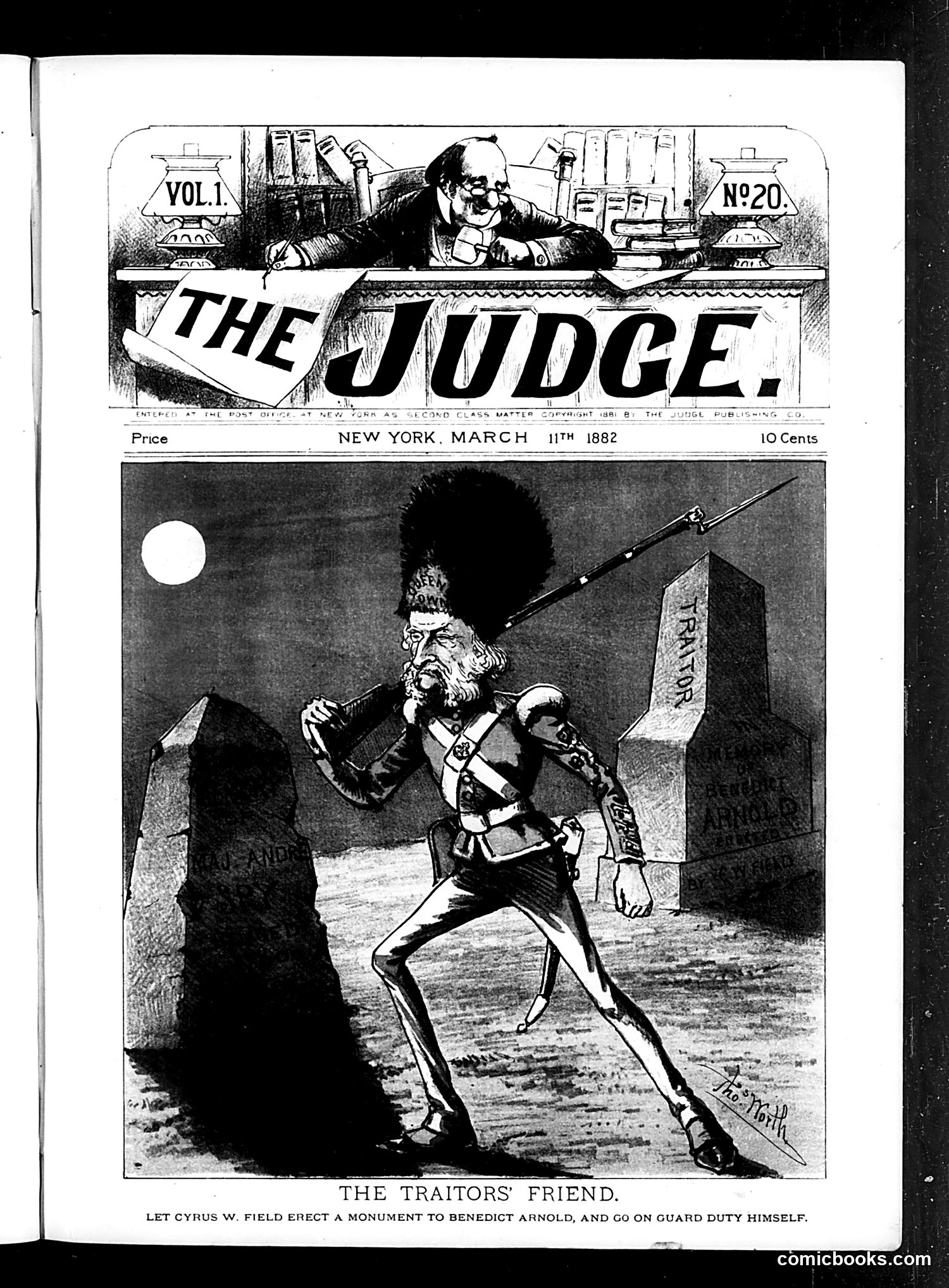
The main cartoon criticizes **Cyrus W. Field**, a prominent businessman and telegraph pioneer, by comparing him to **Benedict Arnold**, the American Revolutionary general who defected to the British. The caption sarcastically suggests Field should erect a monument to Arnold—implying Field himself is equally traitorous. The figure shown is a skeletal military officer at night, likely representing Arnold's ghost or legacy of betrayal. The specific complaint appears connected to Field's business dealings, though the exact controversy isn't entirely clear from this page alone. The satire uses Arnold—America's most infamous traitor—as the ultimate insult to question Field's patriotism or business ethics during this Gilded Age period of corporate scrutiny.
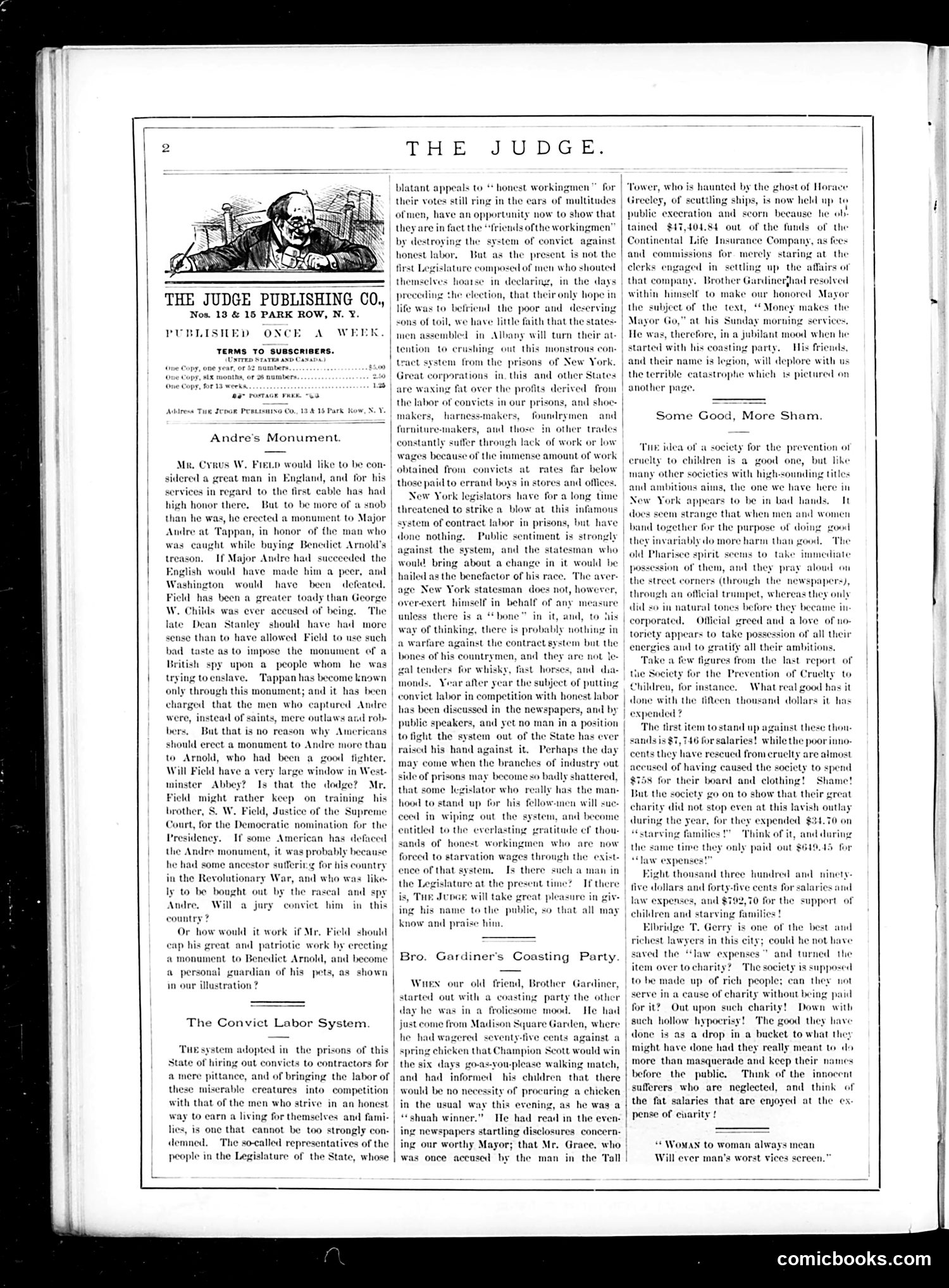
This page contains several political/social commentary pieces rather than traditional cartoons. **André's Monument**: The main article criticizes wealthy businessman Cyrus W. Field for erecting a monument to Major André (a British spy executed during the Revolutionary War) at Tappan, New York. The satire questions Field's patriotism—suggesting he's more interested in appearing cultured and impressing the English than honoring American heroes. The piece mockingly asks if Field should instead monument Benedict Arnold, implying Field's judgment is absurdly backwards. **The Convict Labor System**: This section attacks the practice of hiring out prison convicts to private contractors at below-market wages, which undercuts honest workers. The satire criticizes state legislators who campaign as "friends of workingmen" but fail to abolish this exploitative system, calling out their hypocrisy. Both pieces use sarcasm and ironic suggestions to expose what Judge viewed as moral failings among the wealthy and political class.
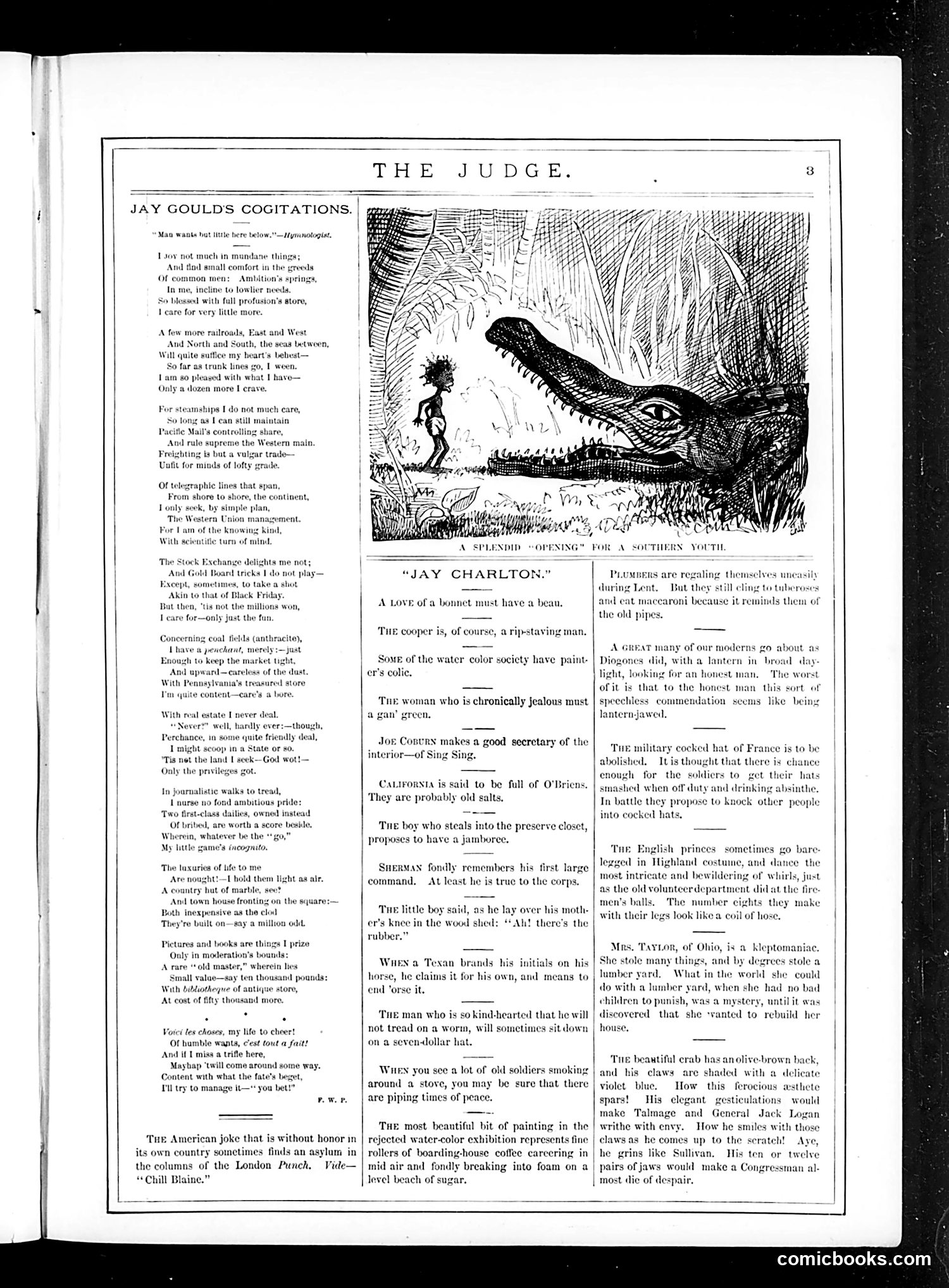
This page satirizes **Jay Gould**, the notorious railroad magnate and robber baron, through a mock-serious poem presenting his supposed innermost thoughts. The satire's genius lies in **ironic contrast**: Gould claims to want nothing—"Man wants but little here below"—while the poem systematically catalogs his actual vast acquisitions: railroads, coal fields, Pennsylvania lands, and multiple residences. The cartoon (showing a tiny figure beside a massive crocodile) visualizes this theme: Gould appears insignificant against the predatory forces of wealth accumulation he embodies. The satire mocks Gould's hypocrisy and greed during the Gilded Age, when such industrialists wielded enormous economic and political power while claiming modest desires. Judge's readers would recognize the bitter irony—Gould's "humble wants" actually encompassed controlling entire industries and landscapes. The page also includes miscellaneous short jokes and social commentary typical of the magazine's format.
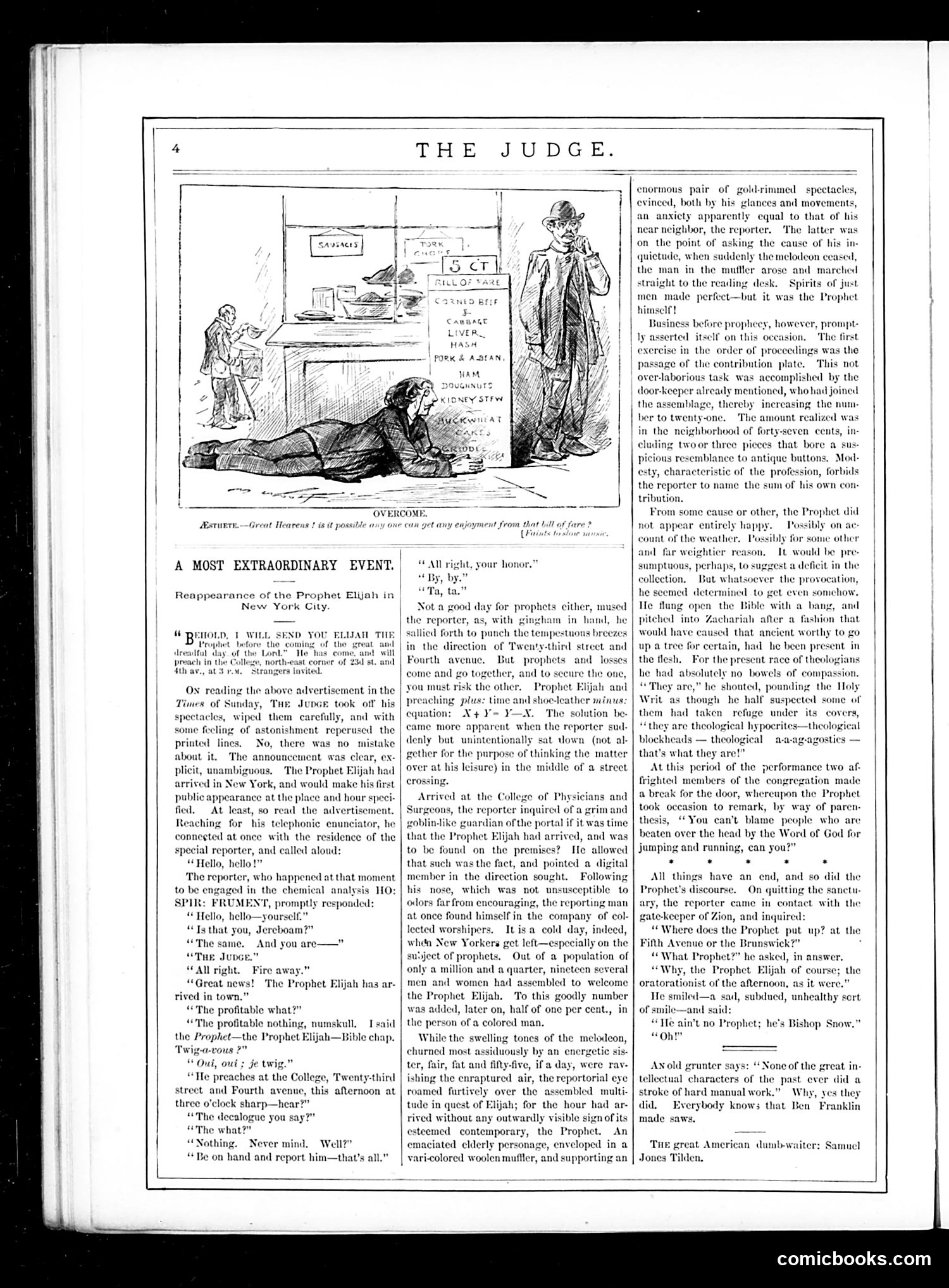
This satirical piece mocks a fraudulent religious advertisement. A newspaper announcement claims the Prophet Elijah (the biblical figure) will preach at a New York address, attracting a pathetically small congregation—only about nineteen people plus the reporter. The satire targets several things: the gullibility of New Yorkers who fall for obvious hoaxes; the proliferation of dubious religious movements in the city; and the absurdity that even in a city of over a million people, barely anyone shows up for such an obvious swindle. The cartoon illustration shows the cramped, dingy setting where this "miracle" supposedly occurs, with a charlatan-looking figure presiding. The joke's bitter edge suggests Judge's skepticism toward unvetted religious claims and those promoting them. The detailed, deadpan narration of the reporter's investigation heightens the comedy through its mock-serious tone.
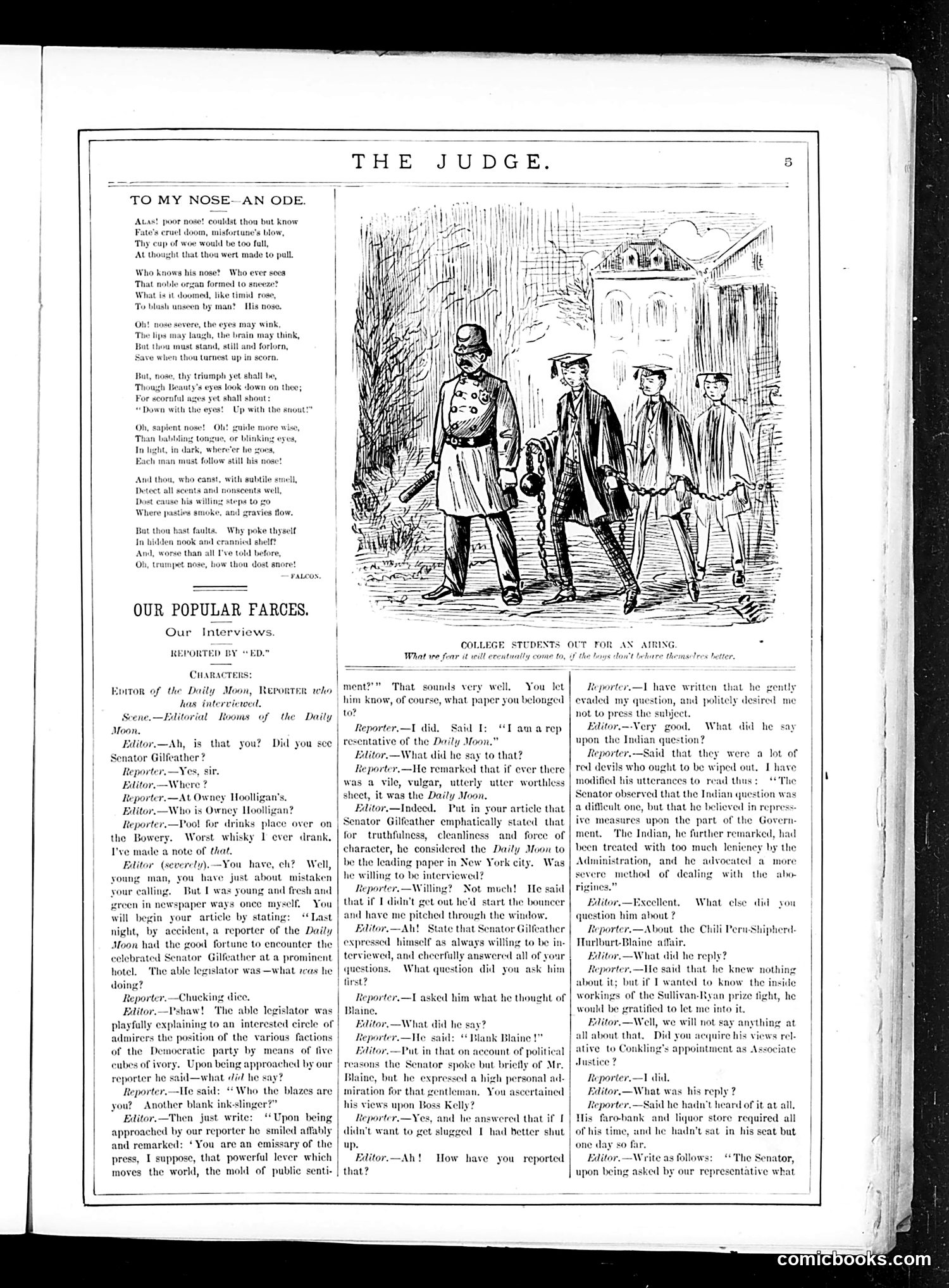
This **Judge** page contains two distinct satirical pieces: ## "To My Nose—An Ode" (Left) A humorous poem mocking pretentious Romantic poetry by addressing the nose as if it were a noble, suffering subject. The satire targets the overwrought sentiment of 19th-century verse. ## "Our Popular Farces: Our Interviews" (Main Content) A dialogue between an **Editor of the Daily Moon** and a **Reporter** satirizing journalistic practices. The joke centers on the reporter interviewing **Senator Gilfeather** (appears to be a fictional politician), who rudely refuses cooperation, throws the reporter out, and insults the Daily Moon as "worthless." **The satire:** The editor instructs the reporter to fabricate a flattering interview anyway—to write that the Senator "smiled affably" and praised the paper as "the leading paper in New York city," despite his actual contempt. This exposes press dishonesty and the gap between what politicians actually say versus published accounts. The cartoon (top right) shows well-dressed college students, captioned "College Students Out for an Airing." **The point:** Mocking both sensationalist journalism and political hypocrisy through invented quotes.
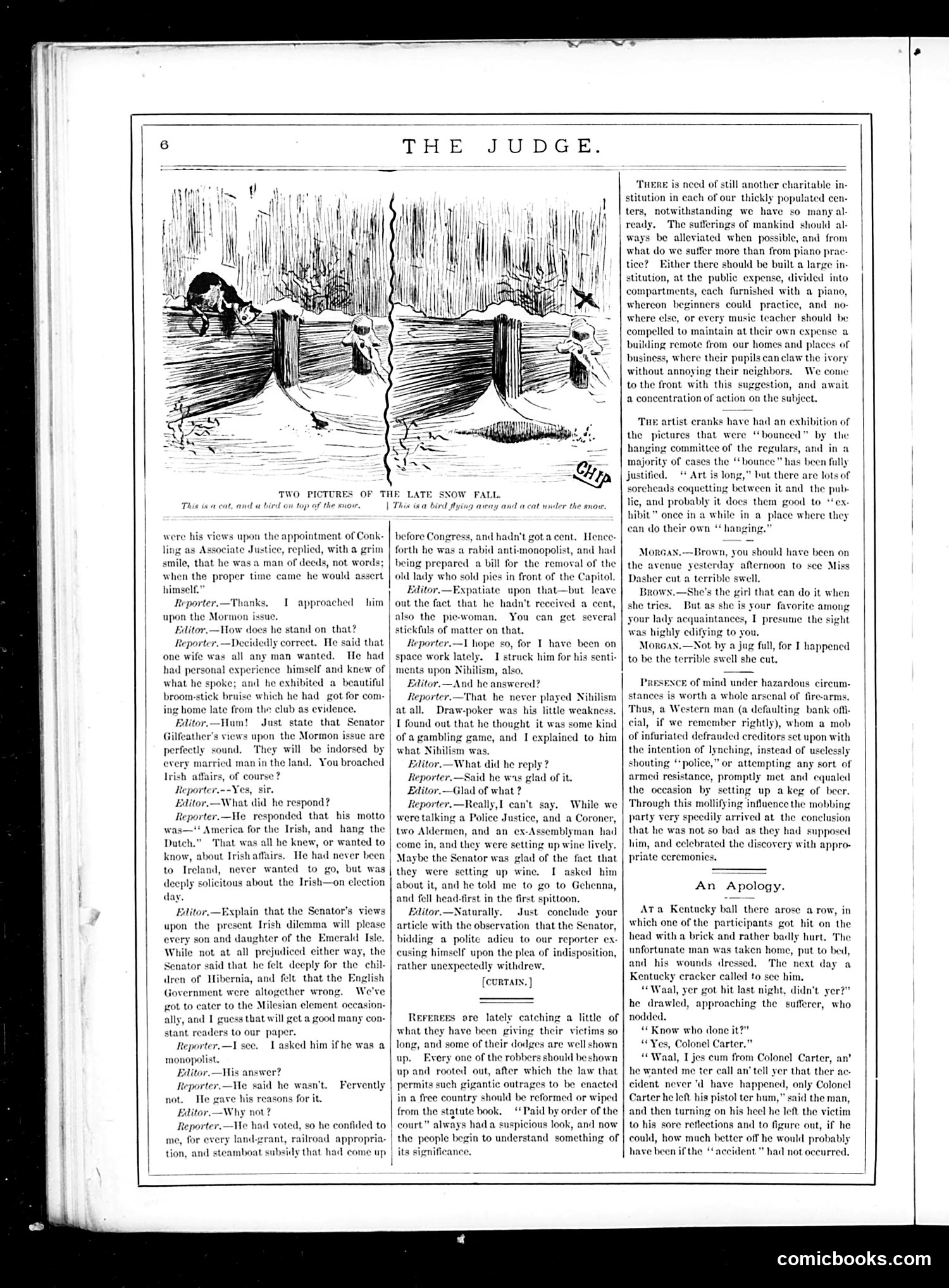
**The Cartoons:** Two small sketches titled "Two Pictures of the Late Snow Fall" show a cat and bird in winter—one depicts the cat hunting the bird on snow; the other shows the bird escaping while the cat remains trapped below. This is a simple visual joke about role reversals in nature. **The Main Content:** The bulk of the page is a satirical interview between a Reporter and Editor about a Senator (likely Senator Roscoe Conkling, referenced in the text). The satire mocks the Senator's transparently hypocritical positions: - He claims anti-monopoly views while having voted for every corporate subsidy - He professes deep feeling for Irish causes (purely for election-day votes) while admitting indifference - He denounces Nihilism without understanding what it is, confusing it with draw-poker - He gets drunk and falls into a spittoon **The Point:** Judge ridicules politicians who adopt whatever positions serve their self-interest—supporting immigrants for votes, corporations for kickbacks—while remaining fundamentally ignorant and dishonest about their actual beliefs and motivations.
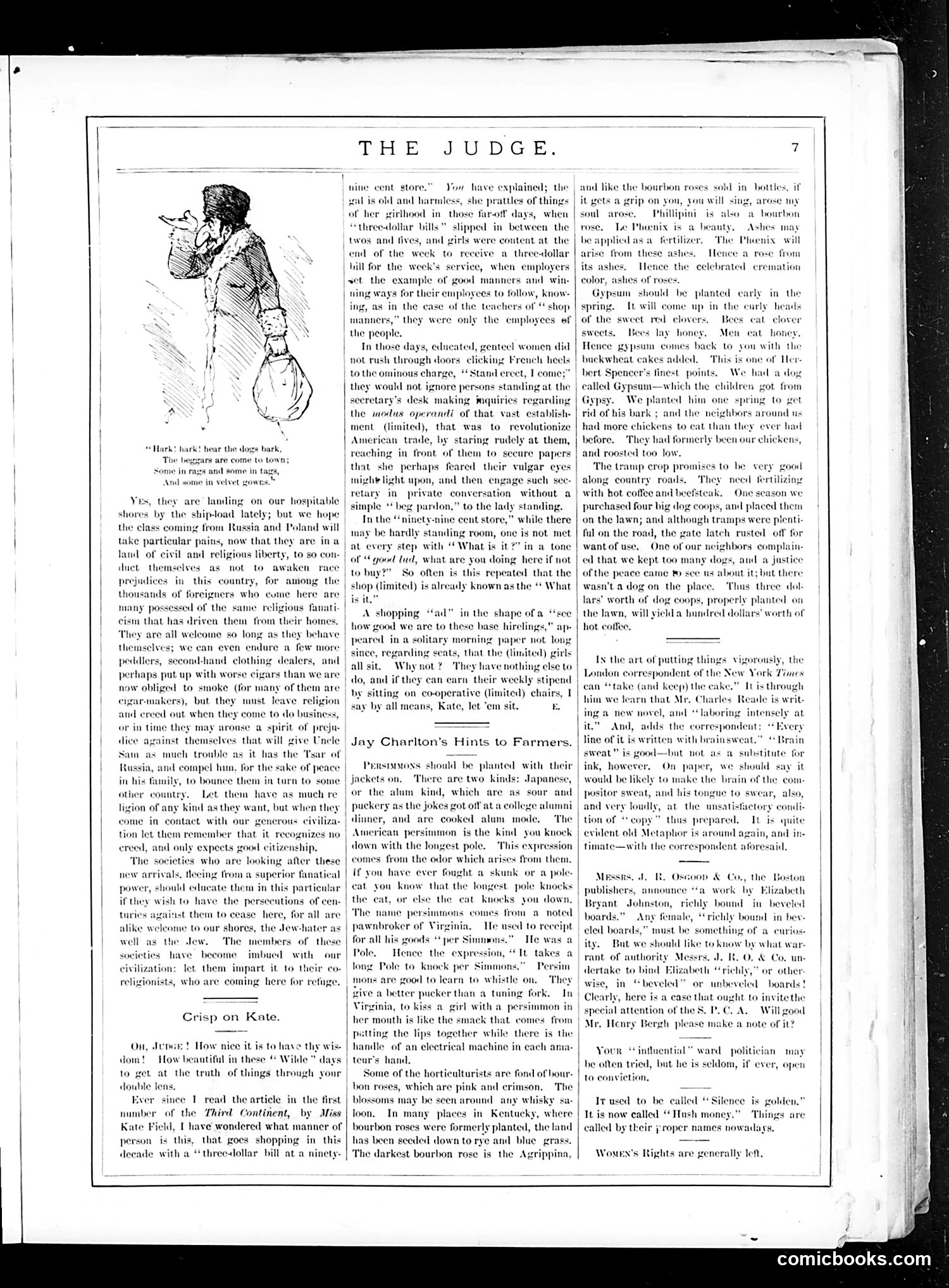
This page from *Judge* contains two distinct pieces of social commentary: ## Main Cartoon/Article: "Immigration and Religion" The lead article criticizes recent Russian and Polish immigrants for bringing religious fanaticism to America. It warns that unless these newcomers abandon sectarian practices and assimilate into American civic life, they'll provoke the same religious prejudice that drove them from their homelands—potentially forcing the U.S. government to expel them as troublesome, much as European nations have done. The satire targets both the immigrants' perceived rigidity and American nativist anxiety about religious minorities. The implicit argument: religious tolerance requires immigrants to privatize their faith. ## Secondary Pieces **"Crisp on Kate"** responds to Kate Field's previous *Third Continent* article, praising *Judge's* satirical clarity for exposing social hypocrisy. **"Jay Charlton's Hints to Farmers"** offers agricultural advice about persimmons, interspersed with domestic humor. The page reflects late-19th-century anxieties about immigration and religious pluralism, framed through *Judge's* characteristic blend of satire and genteel moralizing.
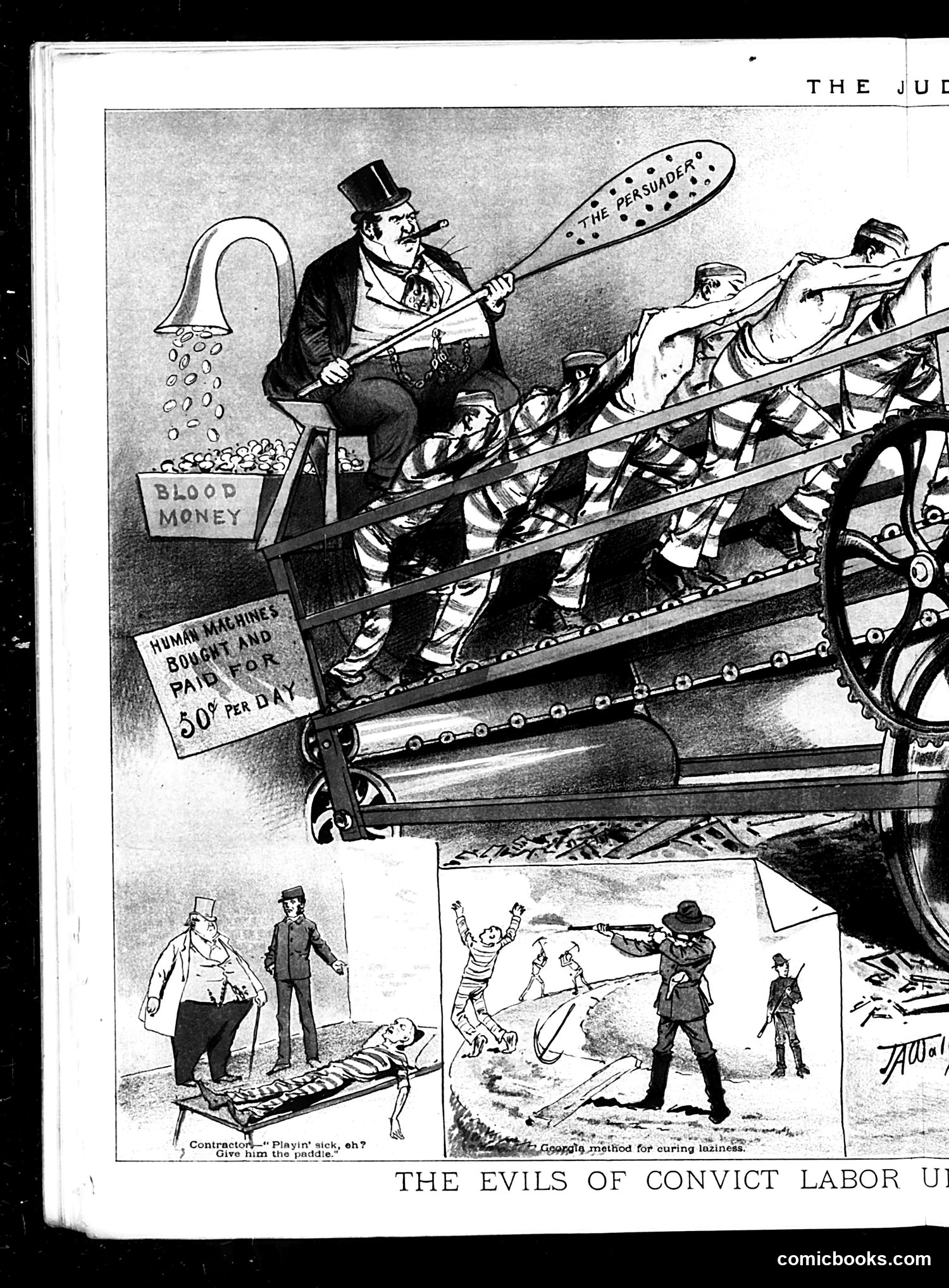
This satirical cartoon critiques the exploitation of imprisoned laborers. The top panel shows a well-dressed contractor operating a machine labeled "The Persuader," spraying "blood money" while whipping convicts forced to work. A sign reads "Human Machines Bought and Paid For 50¢ Per Day"—exposing the brutal economics of convict labor systems. The bottom panels depict cruel punishments: a sick prisoner being denied medical care ("Playin' sick, eh? Give him the paddle") and the "Cowgirl method for curing laziness," showing guards administering corporal punishment. The cartoon condemns the profit-driven exploitation of incarcerated people and the violence endemic to convict labor systems, which were particularly prevalent in the American South during the late 19th/early 20th century.
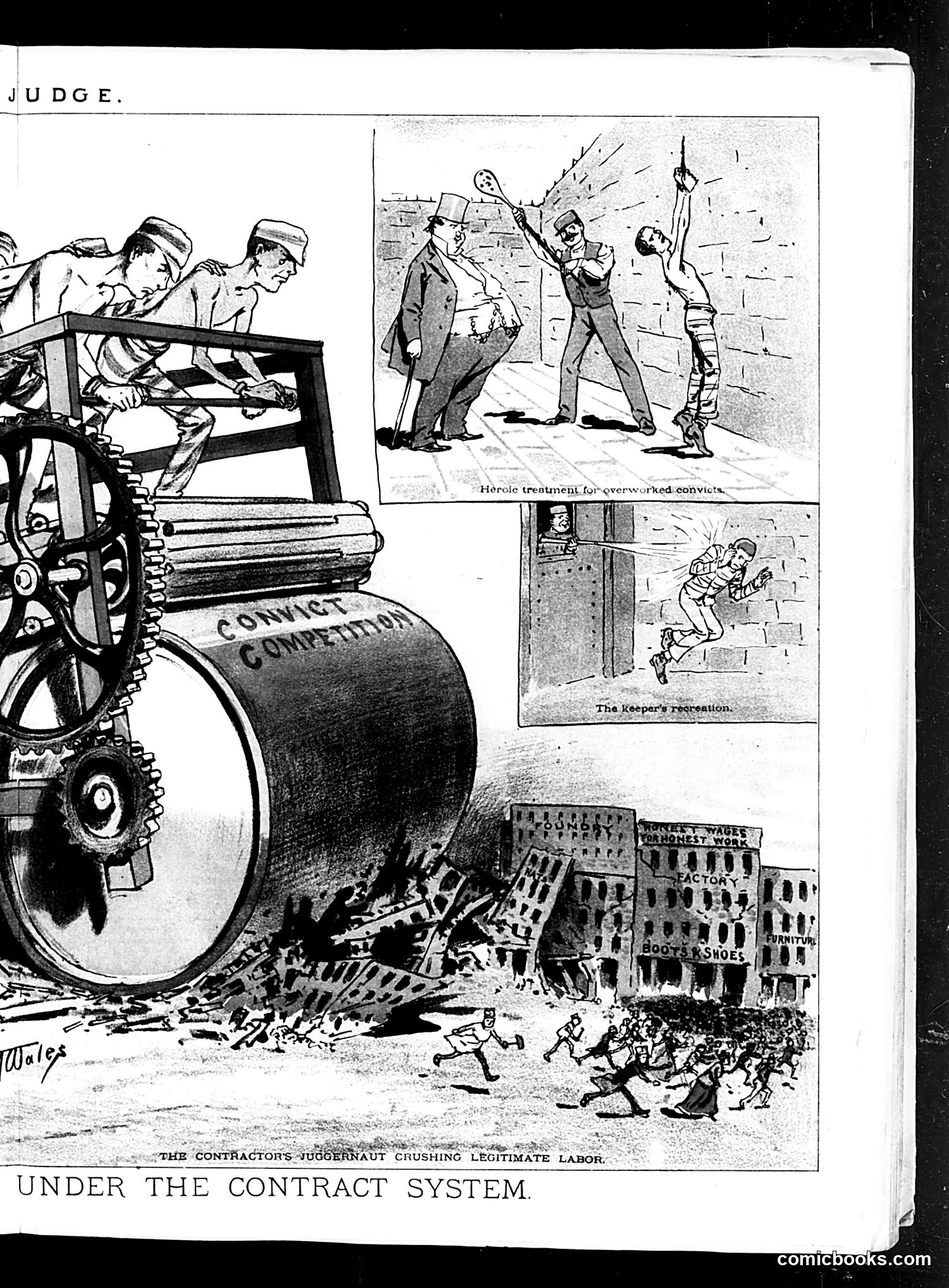
This Judge cartoon critiques the "contract system" of labor in the late 19th/early 20th century. A massive steamroller labeled "Convict Conviction" is operated by two officials crushing buildings below marked with legitimate trades (factory, furniture, boots & shoes). Tiny workers flee in panic. The satire attacks how prison labor contracts—where convicts performed work for contractors—undercut honest workers and small businesses. The inset panels show judicial "treatment for overworked convicts" (torture/hanging) and "the keeper's recreation" (abuse), depicting the brutal reality behind convict-lease systems. The "juggernaut" metaphor emphasizes how this system's power overwhelms legitimate commerce and labor. This was a serious reform issue: convict labor competed unfairly with free workers and enabled prison exploitation.
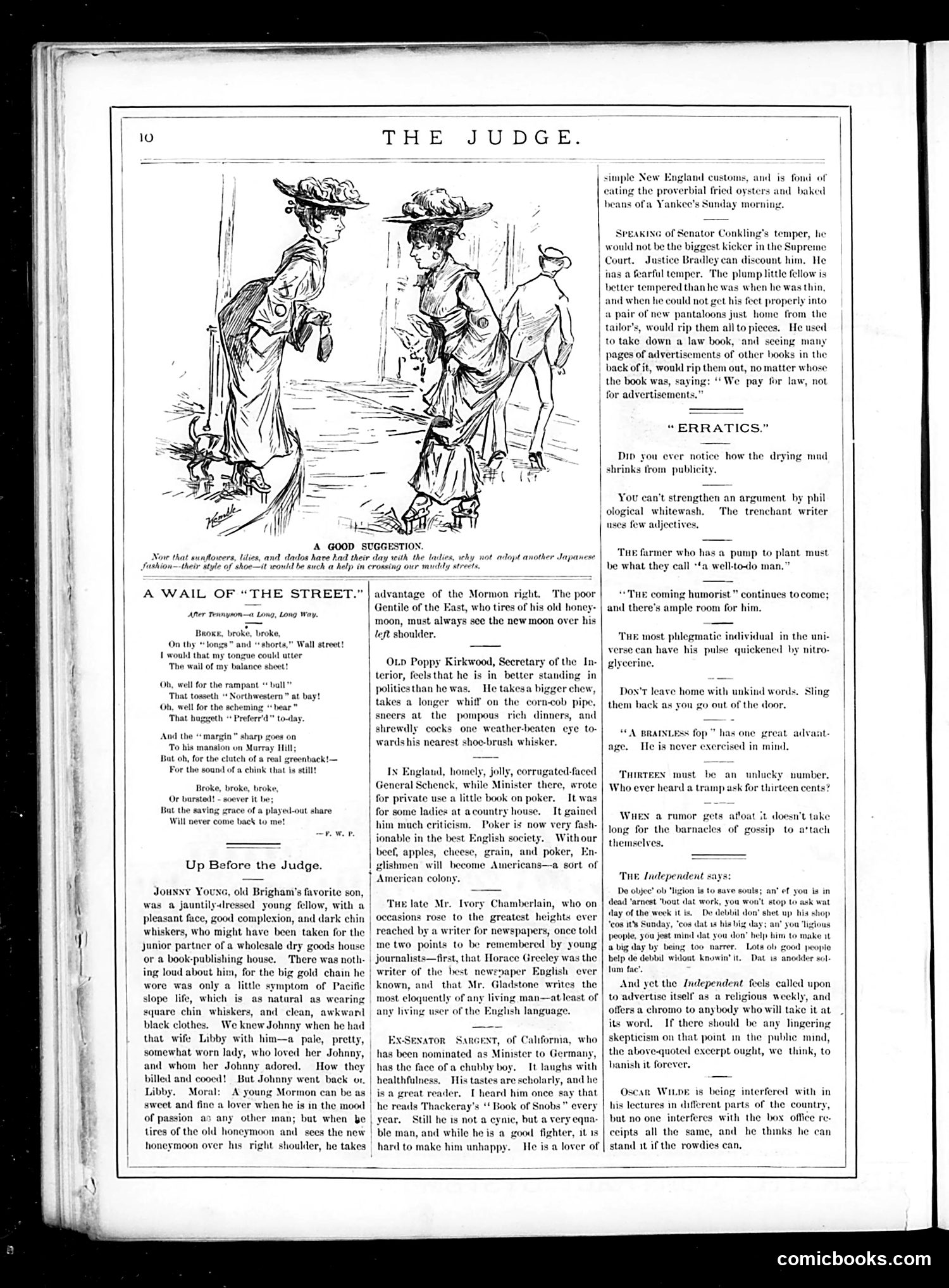
This page satirizes prominent 19th-century American political figures through brief character sketches. The main cartoon depicts two fashionable women, likely mocking Japanese aesthetic influences that were popular in the era. The text ridicules: - **Johnny Young** (apparently a Mormon figure), contrasting Mormon polygamy practices with Eastern monogamy constraints - **Poppy Kirkwood** (Secretary of Interior), portrayed as coarse and newly confident in politics - **General Schenck** (English minister), criticized for writing a poker manual that supposedly made gambling fashionable among English aristocracy - **Senator Sargent** (nominated Minister to Germany), described positively as scholarly but simple in tastes The overall satire critiques American political corruption, hypocrisy, and the troubling influence of certain public figures on society. The "Wall Street" poem parodies Tennyson, lamenting financial losses. The humor relies on readers recognizing these public figures and understanding contemporary political scandals and social pretensions.
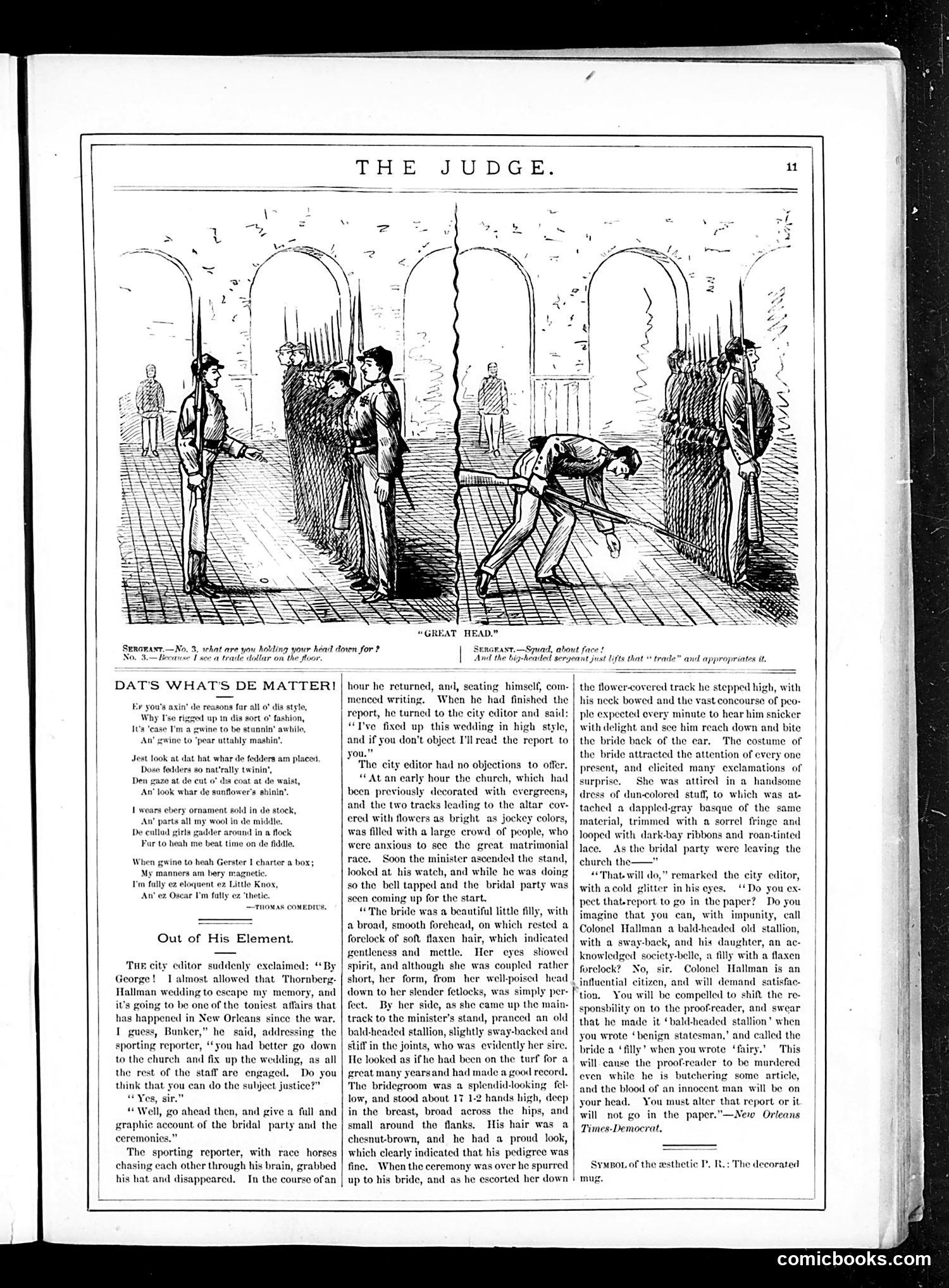
This Judge page contains two distinct satirical pieces: **Top cartoon**: A racist minstrel-show sketch depicting a Black character in exaggerated dialect boasting about flashy clothing and accessories. The humor relies on racist stereotypes common to 19th-century American entertainment—portraying Black individuals as vain, ostentatious, and obsessed with superficial status symbols. **"Out of His Element" story**: Satirizes a sporting reporter assigned to cover a high-society wedding. The joke is that he describes the wedding entirely in horse-racing terminology—bride and groom as "filly" and "stallion," the ceremony as a race with "tracks" to the altar, and attendees as spectators. His unfamiliarity with refined social events causes him to report the wedding using the only vocabulary he knows (racing), creating absurdist humor through the mismatch between subject and language. Both pieces exemplify Judge's satirical approach: one through offensive racial caricature (now widely condemned), the other through occupational incompetence played for laughs.
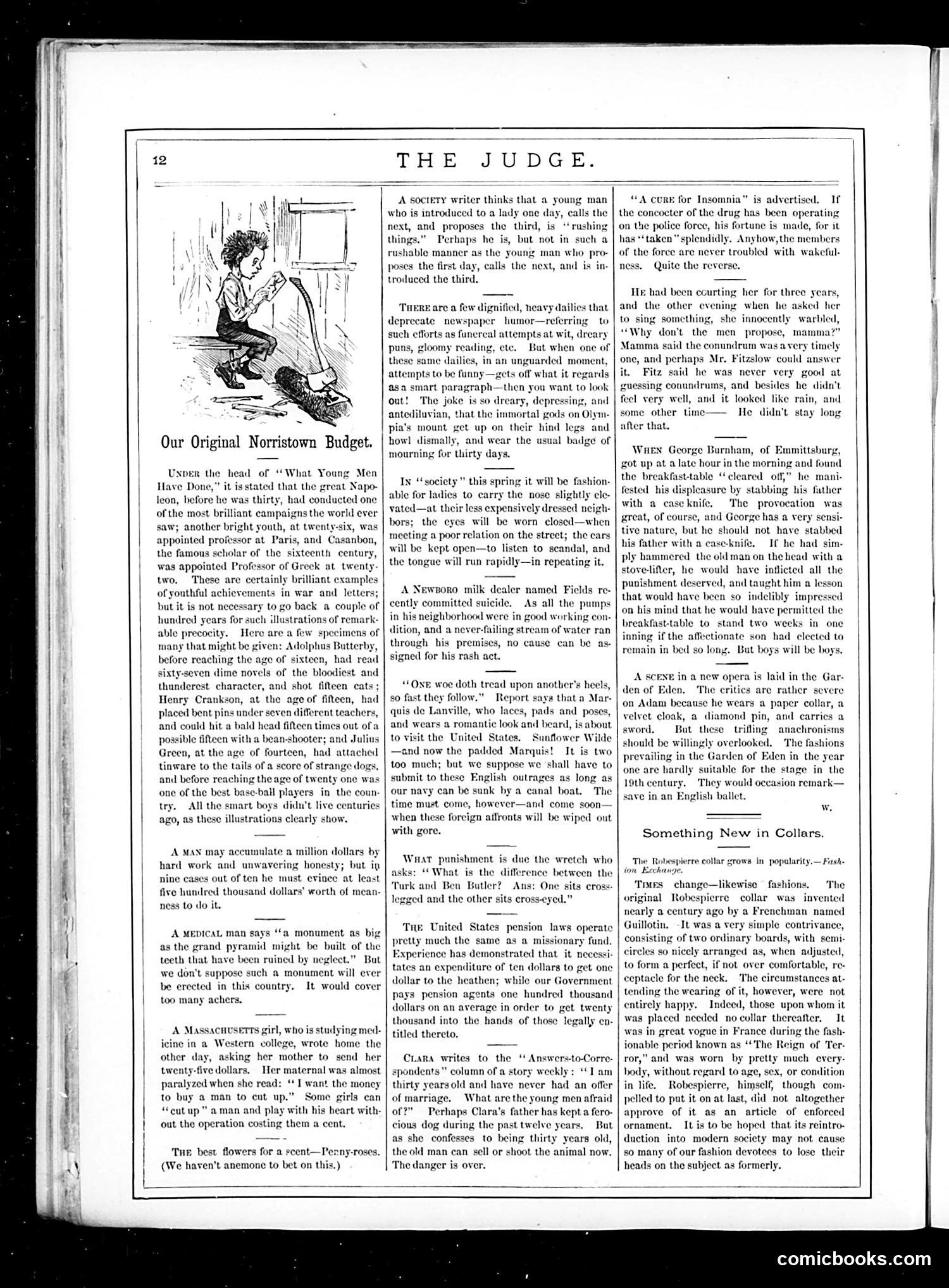
This page from *Judge* magazine contains humorous social commentary rather than political cartoons. The main illustration shows a disheveled man at a window, accompanying "Our Original Norristown Budget"—a satirical column mocking small-town life and human folly. The humor targets various subjects: young men's pretensions to greatness (contrasting Napoleon with local boys who've merely read dime novels and vandalized property); hypocrisy about money-making; and society ladies' shallow affectations (wearing noses "slightly elevated" toward poorer neighbors, keeping eyes "closed" when meeting poor relations). Specific targets include dignified newspapers attempting humor (described as "dreary" and "antediluvian"), fashionable social pretense, and the absurdity of a milk dealer's suicide when he had water access. The satire reflects *Judge's* typical focus: ridiculing middle-class pretension, small-town mediocrity, and social vanity rather than partisan politics.
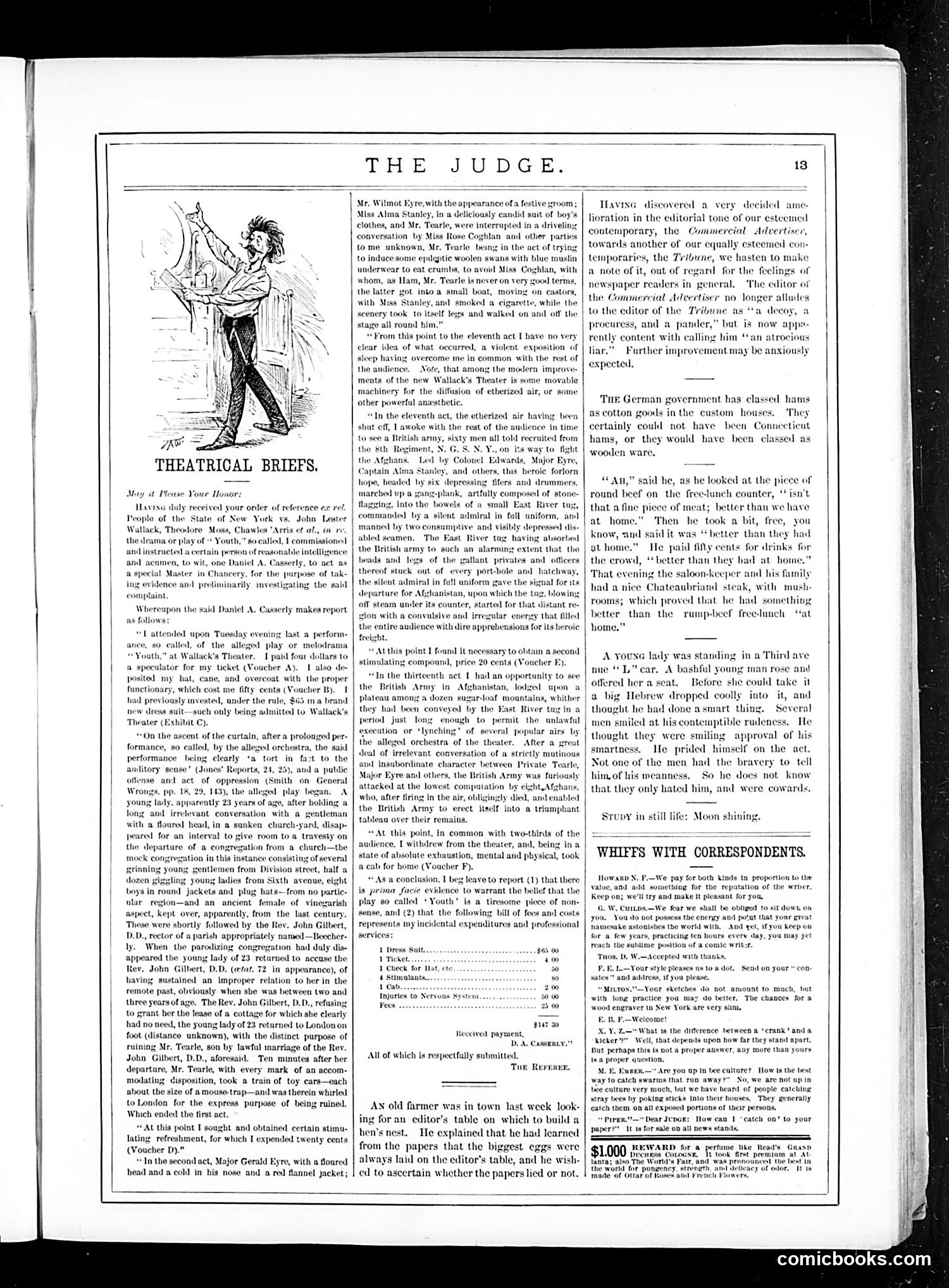
This page contains a satirical legal complaint disguised as a theater review of the play "Youth" at Wallack's Theater. The humor operates through mock-serious judicial language applied to theatrical absurdities. The reviewer (Daniel A. Casserly) formally "reports" on the play's ridiculous plot: a 23-year-old woman appears, has irrelevant conversations, then accuses an elderly clergyman of impropriety from when she was "two or three years old." The play climaxes with the clergyman's son taking a toy train to London to be "ruined." The satire targets both the melodrama's illogical storytelling and the pretentious legal formality used to describe it. By presenting theatrical incompetence in court language—complete with exhibits and vouchers—Judge mocks both the play's quality and society's tendency to take seriously what deserves ridicule. The reviewer's deadpan documentation of plot nonsense (epileptic wool swans, characters on castors) emphasizes how absurd the production truly was.
This page is primarily advertisements and filler content, but the main literary piece is a satirical poem titled "To Columbia" (addressing America personified). The poem mocks an American traveler who boasts of rubbing shoulders with European royalty—claiming he "dined with Victoria, and lunch[ed] with the Czar" and "swig at champagne with the King of Bavaria." The satire targets American social climbing and pretentiousness: the speaker inflates his importance and international connections while asking Columbia (America) to "smooth from thy brow every trace of severity." The accompanying anecdotes mock various character types: a creditor-dodger, a grocer who exploits a customer, pedantic advice-givers, and politicians. The overall theme is exposing American vanity, hypocrisy, and social absurdity through humor.
This page is **primarily advertising**, not editorial content or political satire. It showcases luxury goods and services typical of 1880s New York: Knox hats, billiard tables, pianos, bicycles, canes, and furniture. The only potential cartoon appears in the lower right—an illustration of two well-dressed figures at a piano labeled "Weber" pianos. This appears to be a domestic/lifestyle advertisement rather than political satire, depicting genteel Victorian leisure activities to market pianos to affluent readers. The only textual content approaching editorial commentary is a small poem titled "HE DON'T UNDERSTAND IT," which satirizes a man's obliviousness to his wife's musical taste—a domestic humor joke, not political commentary. **Bottom line:** This is an advertising-heavy magazine page with incidental domestic humor, not a vehicle for the political cartoon satire one might expect from Judge's reputation.
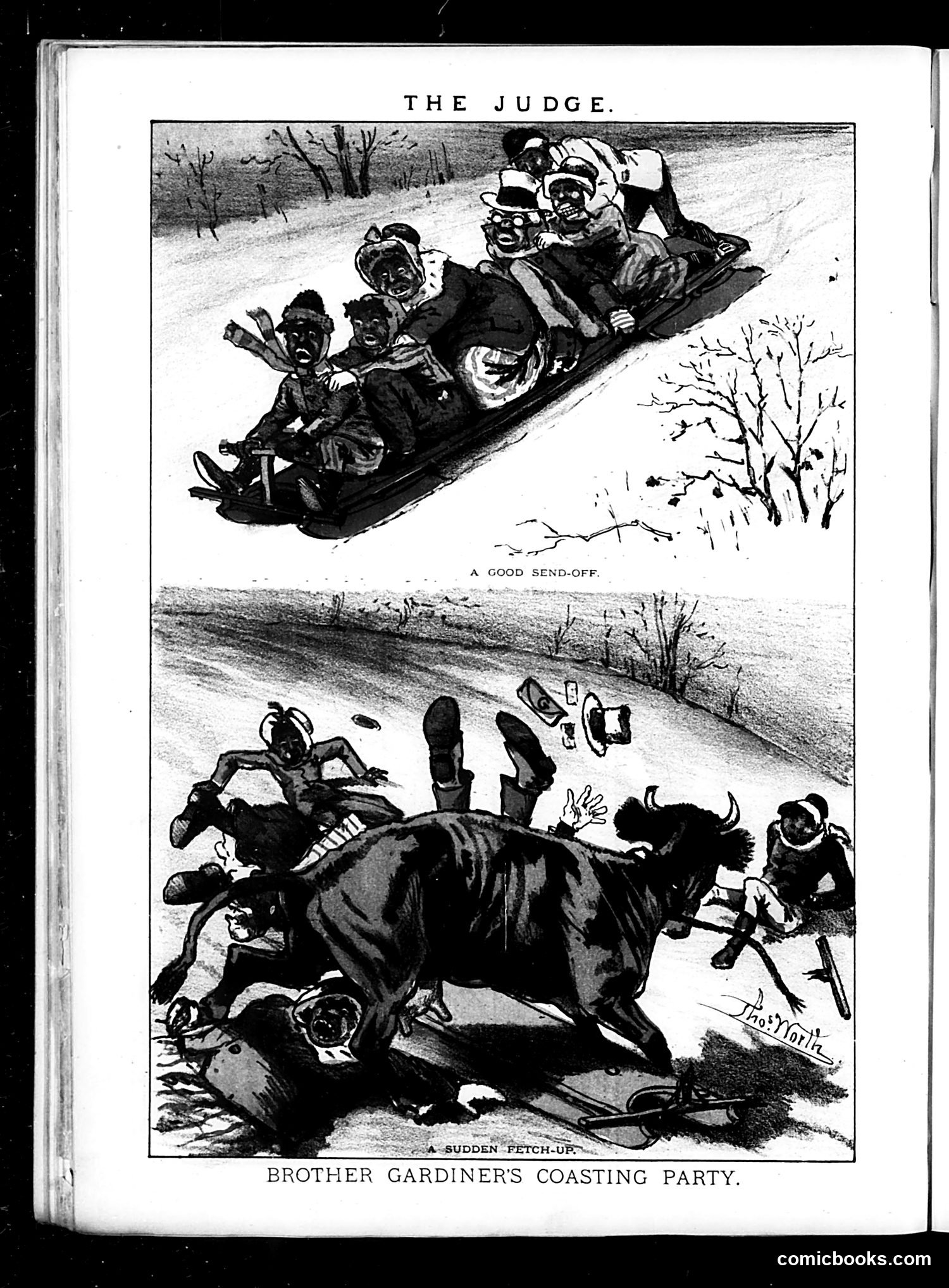
This two-panel cartoon satirizes an outing by "Brother Gardiner" and companions. The top panel shows a cheerful group sledding downhill together ("A Good Send-Off"). The bottom panel depicts "A Sudden Fetch-Up"—their sled has crashed into a cow in an icy stream, sending the passengers flying. The satire appears to mock the contrast between optimistic expectations and humiliating reality. The specific reference to "Brother Gardiner" suggests this was a recognizable contemporary figure, likely someone prominent enough for Judge's readership to identify. Without additional context, the exact identity and reason for ridicule remain unclear, but the cartoon's point is unmistakable: the party's disaster serves as comedic comeuppance.