
Judge, 1882-03-11 · page 6 of 16
Judge — March 11, 1882 — page 6: what you’re looking at
What you’re looking at
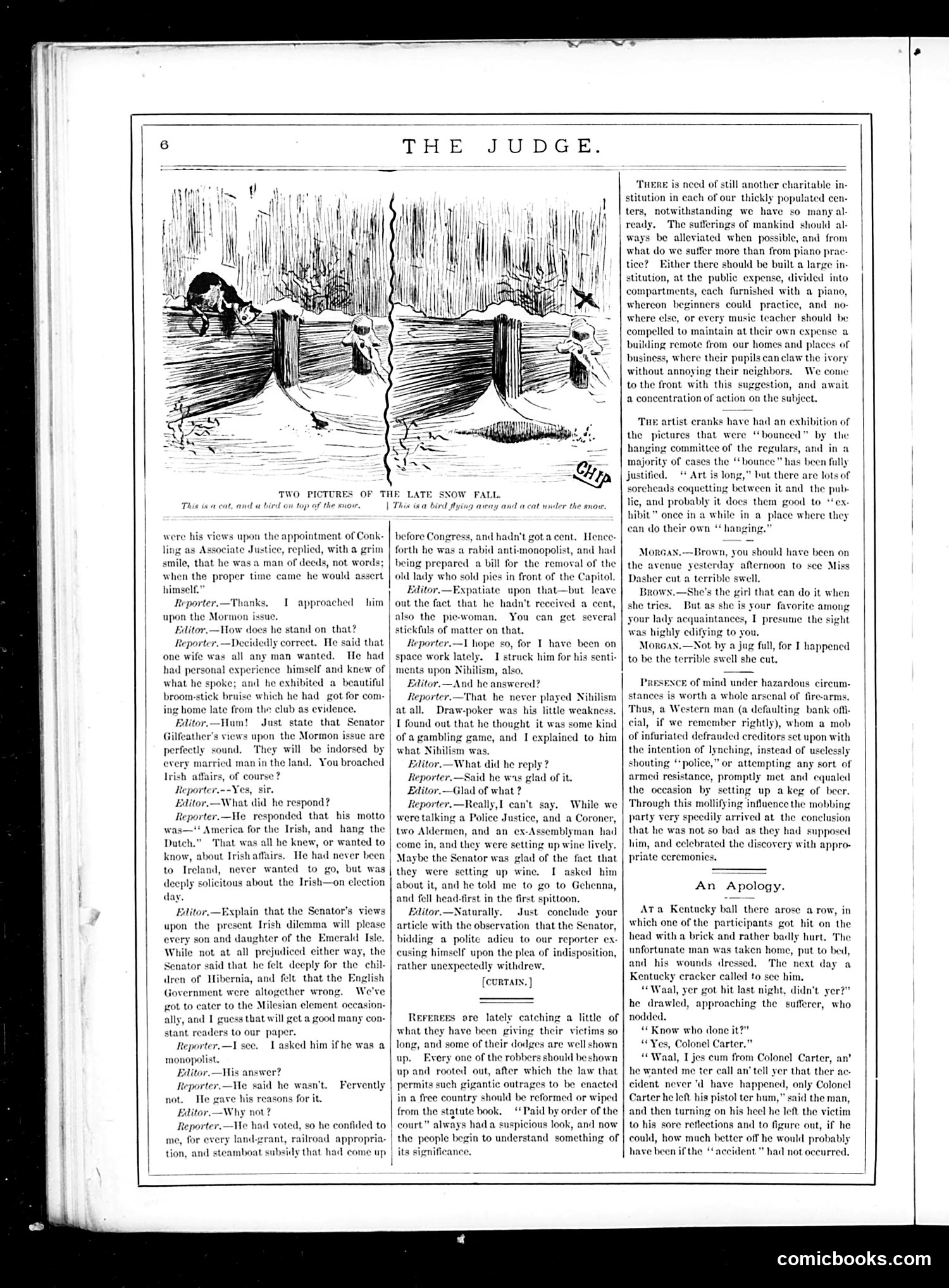
**The Cartoons:** Two small sketches titled "Two Pictures of the Late Snow Fall" show a cat and bird in winter—one depicts the cat hunting the bird on snow; the other shows the bird escaping while the cat remains trapped below. This is a simple visual joke about role reversals in nature. **The Main Content:** The bulk of the page is a satirical interview between a Reporter and Editor about a Senator (likely Senator Roscoe Conkling, referenced in the text). The satire mocks the Senator's transparently hypocritical positions: - He claims anti-monopoly views while having voted for every corporate subsidy - He professes deep feeling for Irish causes (purely for election-day votes) while admitting indifference - He denounces Nihilism without understanding what it is, confusing it with draw-poker - He gets drunk and falls into a spittoon **The Point:** Judge ridicules politicians who adopt whatever positions serve their self-interest—supporting immigrants for votes, corporations for kickbacks—while remaining fundamentally ignorant and dishonest about their actual beliefs and motivations.
📄 Transcribed text from this page (OCR, searchable)
Machine-transcribed from the original scan — historical spelling and the odd misread are preserved.
TWO This is a cat, and a bird ¢ PICTURE were his views upon the appointment of Conk- ling as Associate Justice, replied, with a grim smile, that h jecds, not words; when the proper time came he would assert himself.” Reporter.—Thanks, 1 upon the Mormon issue. Ediitor.—Mow does he stand on that? Reporter. —Decidedly correct. He said that one wife was all any man wanted. We had had personal experience himself and knew of what he spoke; and he exhibited a beautiful broomstick bruise which he had got for com- ing home late from the club as evidence. Editor.—Hum! Just state that Senator Gilfeather’s views upon the Mormon issue are perfectly sound. They will be indorsed by every married man in the land, You broached h affairs was a man ¢ approached — him course ? Yes, sir. Editor, —What did he respond? Reporter.—He responded that his motto America for the Irish, and hang the ‘That was all he knew, or wanted to Dutch.” know, about Irish atfairs, He had never been to Ireland, never wanted to go, but was citous about the Irish—on election eeply s¢ day, Editor.—Explain that the Senator's views upon the present Irish dilemma will please every son and daughter of the Emerald Isle. While not at all prejudiced either way, the Senator said that he felt deeply for the chil- dren of Hibernia, and felt that the English Government were altogether wrong. We've got to cater to the Milesian element occasion- ally, and I guess that will get a good many con- stant readers to our paper. asked him ifhe was a Reporter, —I sec. monopolist. Editor.—Nis answer? Reporter.—Ne said he wasn't. not. He gave his reasons for it. Editor. —Why not? Reporter.—Me had voted, so he confided to me, for every land-grant, railroad. appropri tion, ly that had come up, Fervently nd steamboat sub OF THE i LATE SNOW FALL. This isa bird flying aay and acat under the snow. before Congress, and hadn't gota cent. Hence- forth he w: bid anti-monopolist, and had being preparcd a bill for the removal of the old lady who sold pies in front of the Capitol. Editor.—Expatiate upon that—but leave out the fact that he hadn't received a cent, also the pic-woman. You can get several stickfuls of matter on that. Keporter.—I hope so, for I have been on space work lately. I struck him for his senti- ments upon Nihilism, also, Editor.—And he answered? Reporter.—That he never p d Nihilism atall. Draw-poker was his little weakness. I found out that he thought it was some kind of agambling game, and I explained to him what Nihilism wa —What did he rep! Reporter.—Said he was glad of it. Editor.—Glad of what? Reporter,—Really,1 can’t While we were talking a Police Justice, and a Coroner, two Aldermen, and an ex-Assemblyman had come in, and they were setting up wine liv Maybe the Senator was glad of the fact that they were setting up wine. I asked him about it, and he told me to go to Gehenna, and fell head-first in the first spittoon. Fditor.—Naturally. Just conclude your article with the observation that the Senator, bidding a polite adieu to our reporter ex cusing himself upon the plea of indisposition, rather unexpectedly withdrew, (curTaty.} REFEREES ore lately catching a little of what they have been giving their victims so long, and some of their dodges are well shown up. Every one of the robbers should beshown up and rooted out, after which the law that permits such gigantic outrages to be enacted in a free country should be reformed or wiped from the statute book, “Paid by order of the court” always had a suspicious look, and now the people begin to understand something of its significance. ‘Tuene is need of still another charitable in- stitution in each of our thickly populated cen- ters, notwithstanding we have so many al- ri ready. The sufferings of mankind should al- w be alleviated when possible, and from what do we suifer more than from piano prac- tice? Either there should be built a lar, stitution, at the public expense, divided into compartments, cach furnished with a piano, whereon beginners could practice, and no- where else, or every music teacher should be compelled to maintain at their own expense a building remote from our homes and places of business, where their pupils can claw the ivory without annoying their neighbors. to the front with this suggestion, and await a concentration of action on the subject. We come Tue artist cranks have had an exhibition of the pictures that were “bounced” by the committee of the regulars, and in a majority of cases the “bounce” has been fully justified.“ Art is long,” but there are lots of sorcheads coquetting between it and. the pub. lic, and probably it docs them good to “ex: hibit” once ina while in a place where they can do their own “ hanging, MorGan.—Brown, you should have been on the afternoon to sce Miss Dasher cut a terrible swell. Brow She's the girl that can do it when she tries. But as she is your favorite among your lady acquaintances, I presume the sight was highly edifying to you, MorGAN.—Not by a jug full, for I happened to be the terrible swell she cut, avenue yesterd Presence of mind under hazardous circum- stances is worth a whole arsenal of fire-arms. Thus, a Western man (a defaulting bank offi- cial, if we remember rightly), whom a mob of infuriated defrauded creditors set upon with the intention of lynching, instead of usclessly shouting “police,” or attempting any sort of armed resistance, promptly met and equaled the occasion by setting up akeg of beer. Through this mollifying influence the mobbing party very speedily arrived at the conclusion that he was not so bad as they had supposed him, and celebrated the discovery with appro- priate ceremonies. An Apology. Ata Kentucky ball there arose a row, in which one of the participants got hit on the head with a brick and rather badly hurt. The unfortunate man was taken home, put to bed, and his wounds dressed. ‘The next day a Kentucky cracker called to see him, “Waal, yer got hit last night, didn’t yer?” he drawled, approaching the sufferer, who nodded. “ Know who done it?” “Yes, Colonel Carter.” “Waal, I jes cum from Colonel Carter, an he wanted me ter call an’ tell yer that ther a cident never ‘d have happened, only Colonel Carter he Ieft his pistol ter hum,” said the man, and then turning on his heel he left the victim to his sore reflections and to figure ont, if he could, how much better off he would probably have been if the ‘accident. ” had not occurred, comicbooks.com