
A complete issue · 16 pages · 1881
Judge — October 29, 1881
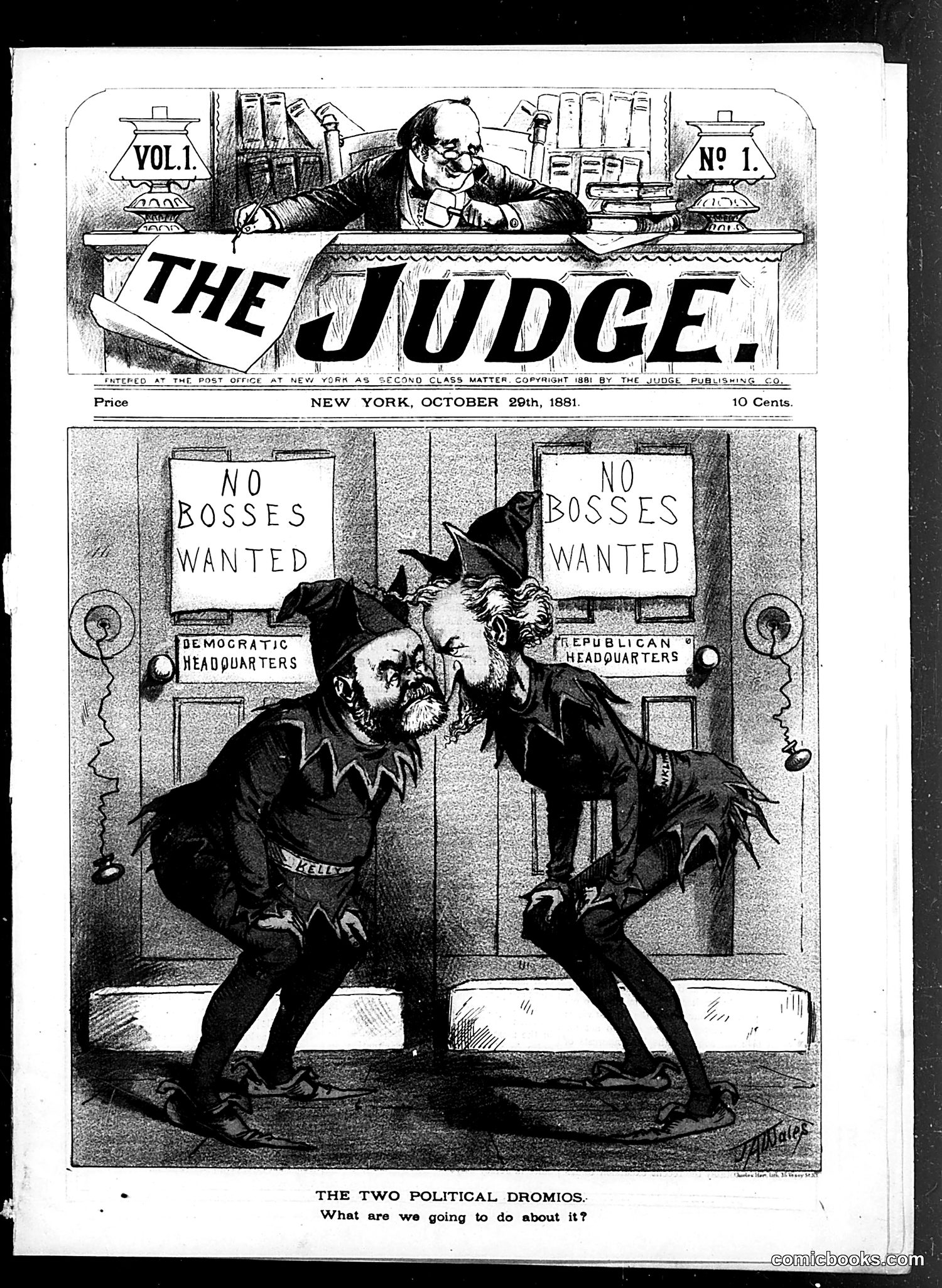
This cartoon satirizes the Democratic and Republican parties as twin donkeys confronting each other outside their respective headquarters, both displaying "NO BOSSES WANTED" signs. The title references Shakespeare's "Comedy of Errors" (the Dromios were identical twins), suggesting the parties are indistinguishable from each other. The satire appears to critique both major parties for hypocrisy regarding political "bosses" (party machine leaders who wielded considerable power). By depicting them as identical animals making the same claim, Judge mocks the parties' shared reliance on patronage and backroom control despite their public denials. The caption "What are we going to do about it?" expresses satirical helplessness—voters had no genuine alternative, as both parties engaged in the same corrupt practices they publicly condemned.
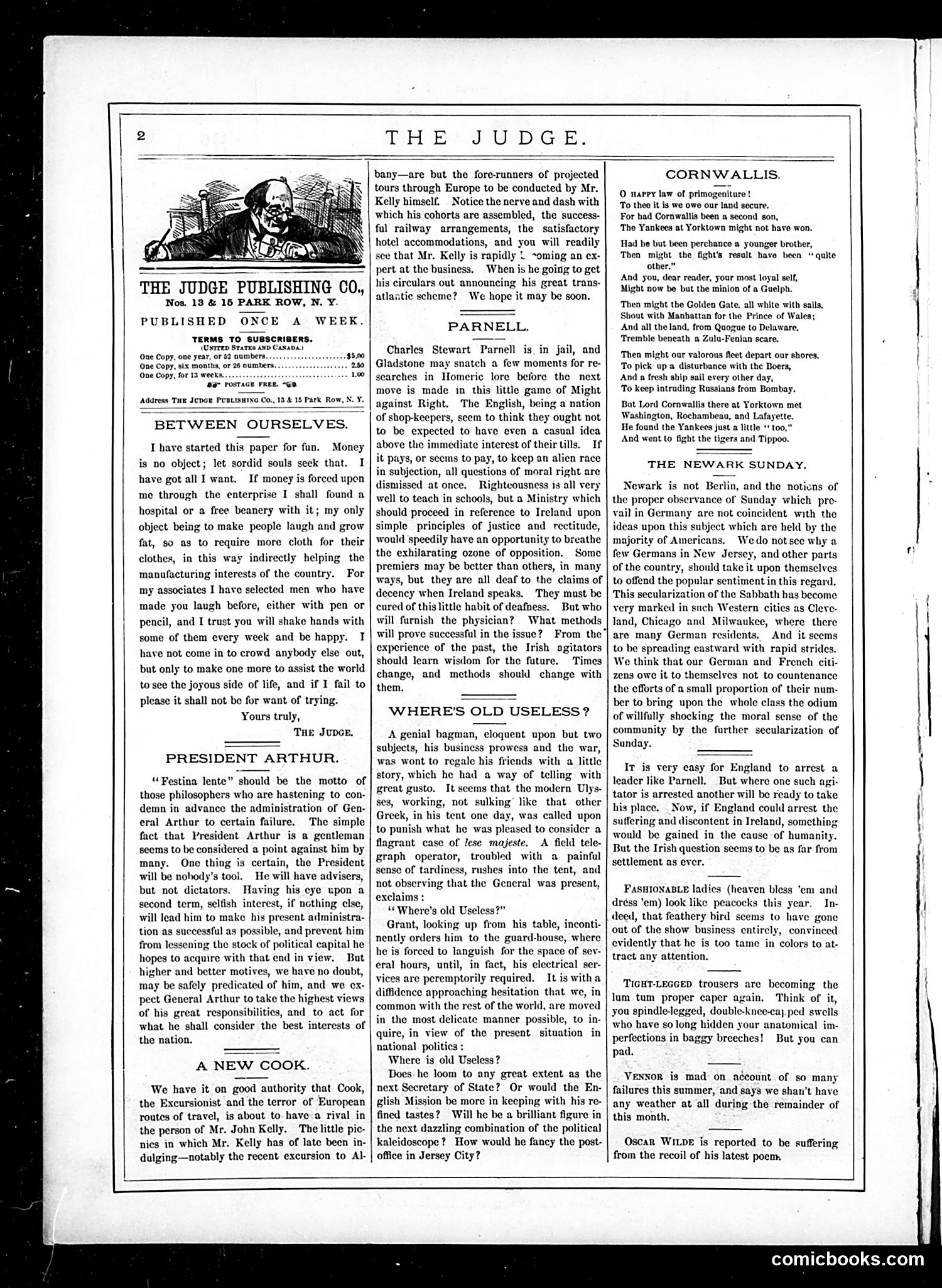
This page introduces **Judge**, a new satirical weekly magazine launched by its publisher to provide humor and social commentary. The masthead cartoon depicts the publication's irreverent spirit. The editorial discusses three political figures: 1. **President Arthur**: Cautiously optimistic about the new administration, urging patience before judging his performance. Notes his gentlemanly character shouldn't count against him. 2. **John Kelly**: Satirized as an ambitious organizer planning grand European tours, positioned as a rival to "Cook, the Excursionist." Kelly appears to be a Tammany Hall political figure leveraging his organizational skills commercially. 3. **Charles Stewart Parnell**: The Irish nationalist leader imprisoned in this period (likely 1881-82). Judge criticizes the English government's hypocrisy—teaching righteousness in schools while oppressing Ireland for economic convenience, dismissing moral principles when profit is at stake. The page is primarily editorial/text-based rather than cartoon-heavy, establishing the magazine's satirical voice attacking political corruption and inconsistency.
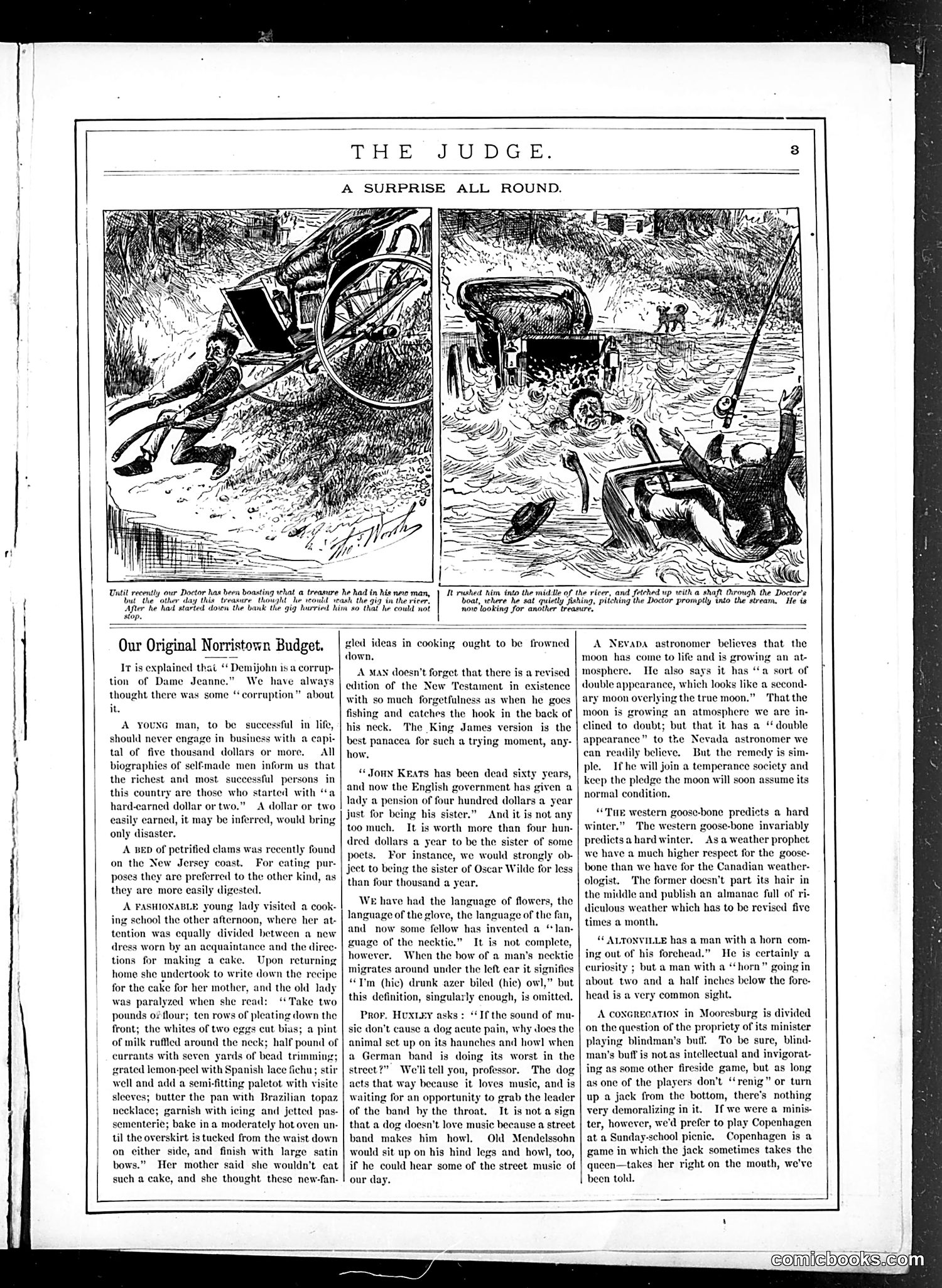
This two-panel comic depicts a slapstick mishap involving a doctor and a horse-drawn gig (carriage). In the left panel, the doctor boasts to someone about discovering a "treasure" he's hidden in his gig. The right panel shows the punchline: the gig has plunged into a river, and the doctor is being thrown into the water while frantically reaching upward. The satire mocks the doctor's misplaced confidence—his supposed "treasure" becomes worthless when the gig crashes, and he becomes the unwitting victim of his own boasting. The caption notes he's now "looking for another treasure," suggesting he's learned nothing from the disaster. The page also contains unrelated humorous snippets criticizing various social conventions: fashion-obsessed young women mixing sewing and cooking instructions, pompous philosophical questions about dogs and music, and commentary on pensions and literary figures. These represent typical Judge magazine satirical commentary on American society's absurdities.
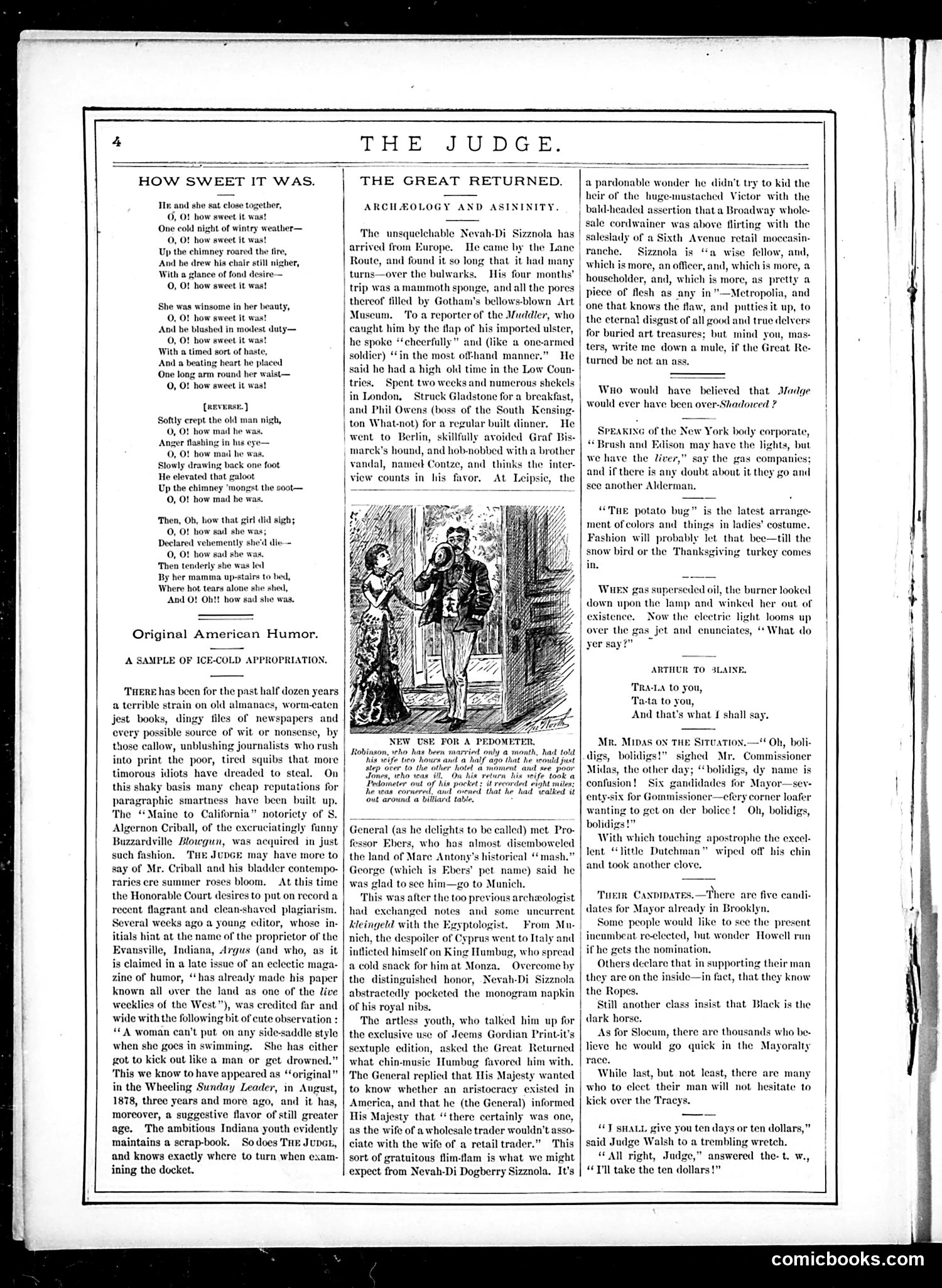
This satirical piece mocks **Nevah-Di Sizznola** (likely a play on a real art expert or archaeologist of the period), who has just returned from Europe claiming grand cultural experiences. The satire works through **exaggeration and deflation**: Sizznola boasts of his European travels—visiting London, meeting politicians like Gladstone, traveling through the Low Countries and Berlin—presenting himself as a sophisticated cultural figure. However, the text undermines his pretensions by showing his actual behavior: he's described as a sponge "filled" by New York's art museums, suggesting he's absorbed nothing of real value; his interactions seem opportunistic rather than intellectual. The accompanying illustration appears to show a domestic scene, likely depicting Sizznola's return home, which contrasts sharply with his grand European narrative—a common satirical technique of showing the gap between public claims and private reality. The piece critiques **pretentious pseudo-intellectuals** who travel abroad and return claiming sophistication they haven't genuinely acquired.
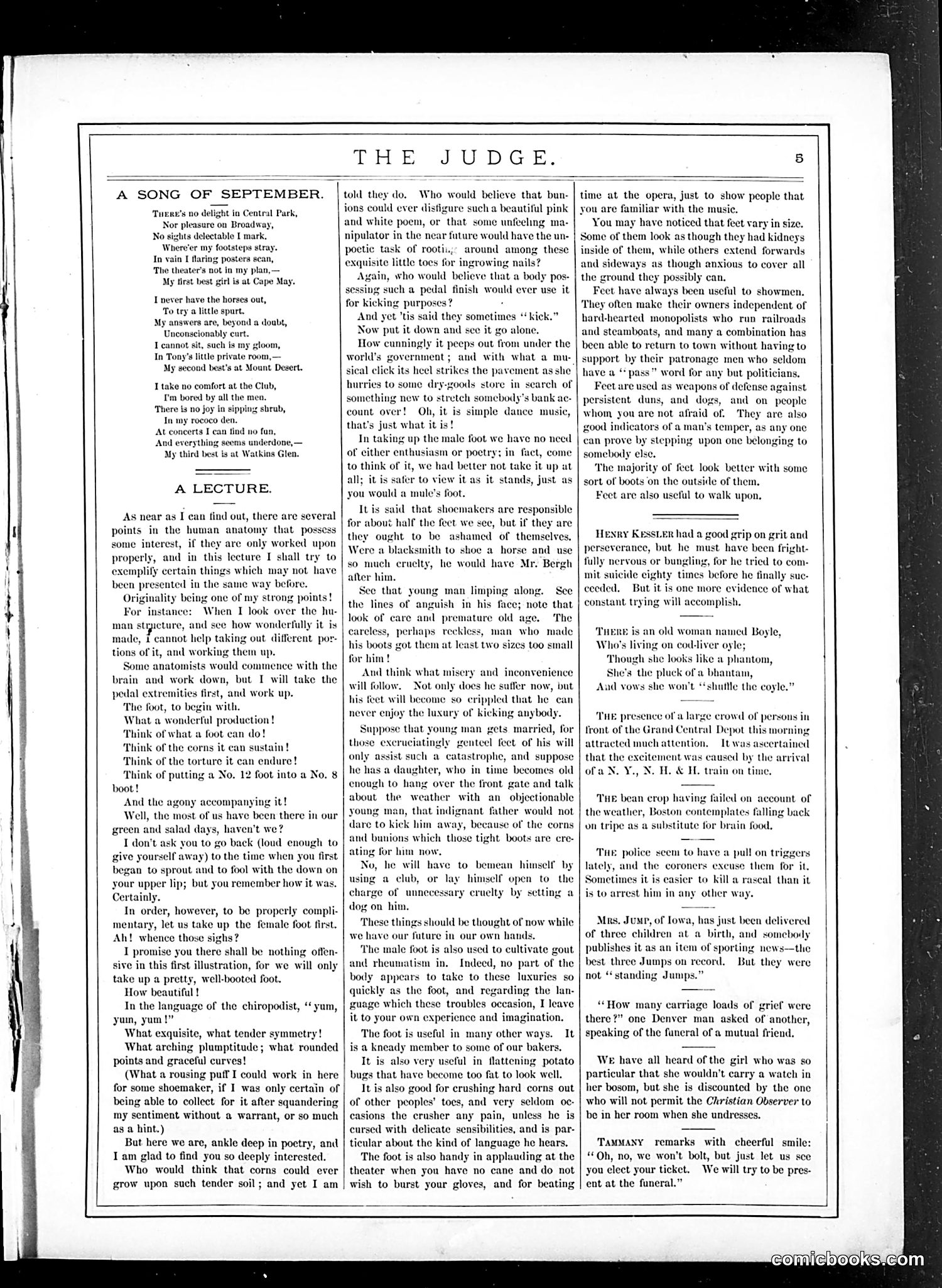
This page contains two unrelated pieces of satirical writing typical of Judge magazine's format. "A Song of September" is a humorous poem about a man distracted from urban pleasures (Central Park, Broadway, theaters, clubs) because his romantic interests are scattered at distant summer destinations (Cape May, Mount Desert, Watkins Glen). The joke is the repetition of "my first/second/third best girl" at each location—satirizing the leisured class's seasonal migration and romantic entanglements. "A Lecture" is a longer comedic monologue by a speaker analyzing human anatomy, focusing on feet. It humorously contrasts the "exquisite" female foot with the utilitarian male foot ("like a mule's foot"), makes jokes about corns and ill-fitting boots, and gently mocks shoemakers and chiropodists. The satire targets vanity, fashion absurdity, and overwrought romantic language about women's bodies. Both pieces satirize upper-class leisure culture and social pretensions of the era.
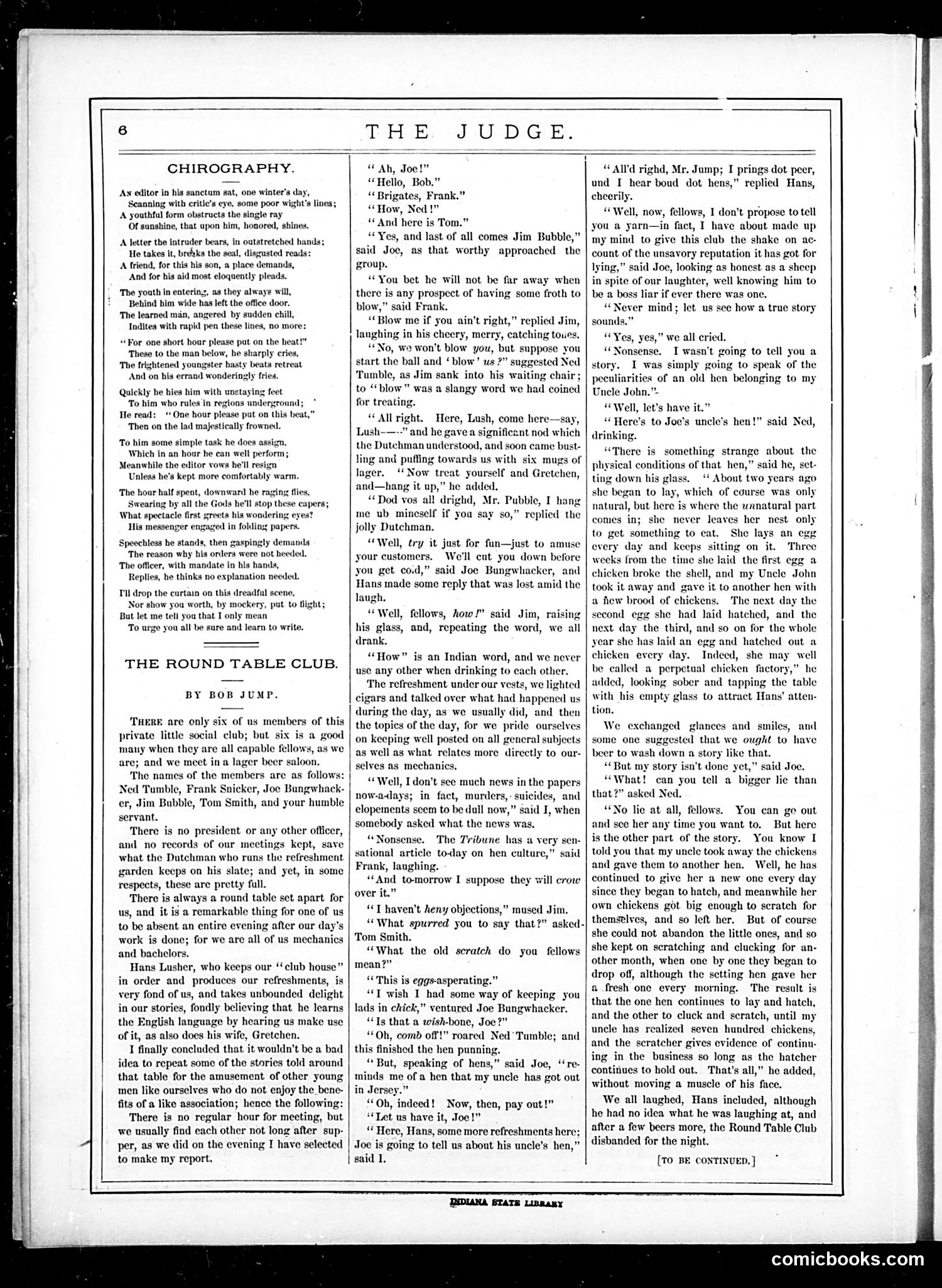
This page contains two pieces of humor content: **"Chirography"** (top): A satirical poem about workplace miscommunication. An editor, annoyed at being cold, writes a curt note to the basement worker: "For one short hour please put on the heat!" The messenger, misinterpreting this as an order to literally apply heat for an hour, ignores his actual duties and focuses on the written instruction. The satire mocks both poor handwriting/unclear written communication and literal-minded obedience to poorly worded orders. The moral warns readers to "learn to write" clearly. **"The Round Table Club"** (bottom): The beginning of a serialized humor story about six working-class mechanics who meet regularly at a German beer saloon (run by Hans Lusher). This appears to be lighthearted social comedy chronicling their conversations and interactions—a slice-of-life narrative for working men. The piece emphasizes their camaraderie and everyday banter, with no apparent political satire intended. Both pieces target middle/working-class audiences with gentle humor about communication mishaps and social club life.
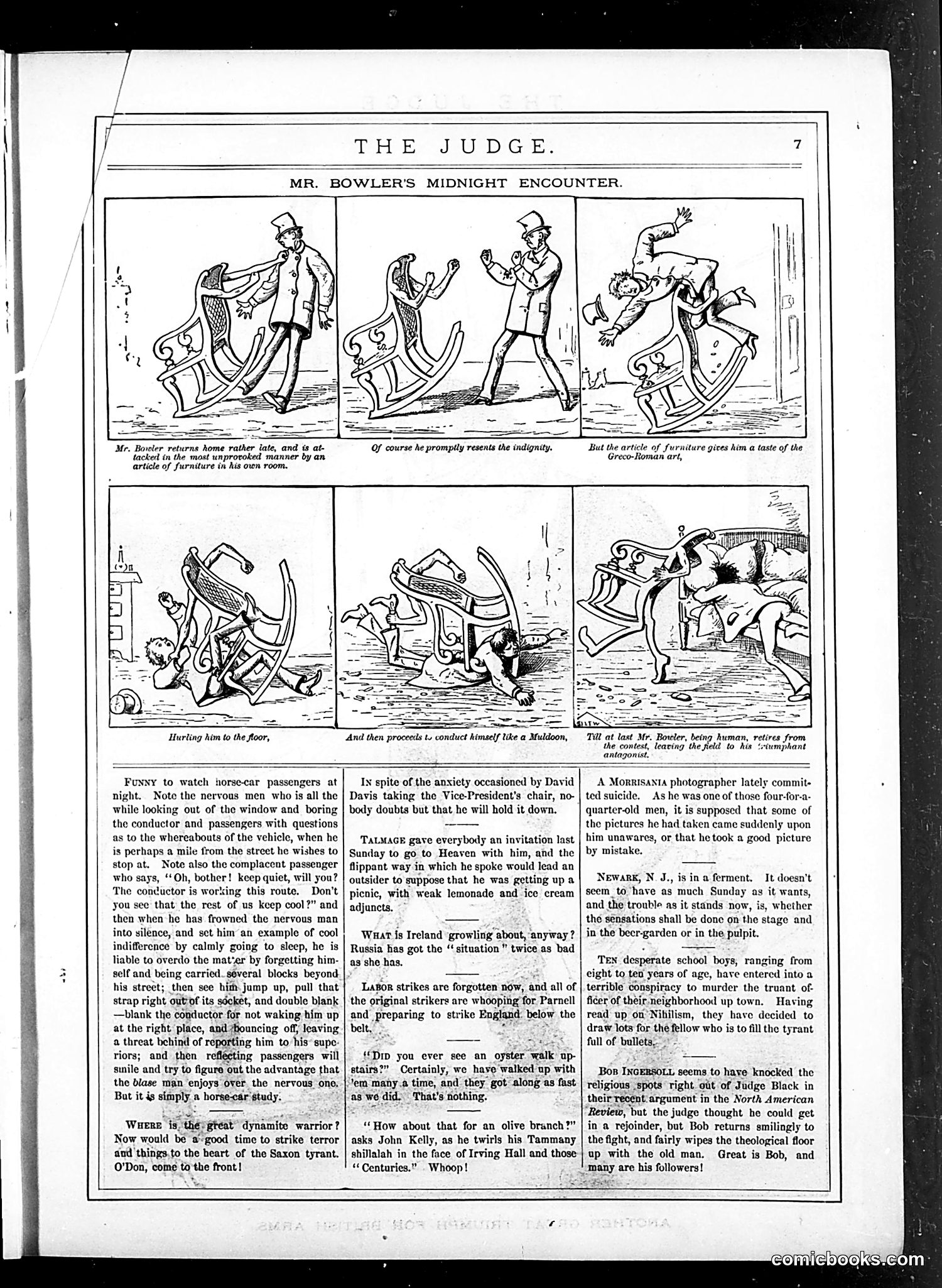
This comic strip depicts a humorous domestic mishap: Mr. Bowler returns home late and is attacked by a piece of furniture (appears to be a chair or settee), which he tries to fight back against. The furniture "wins" through what the caption calls "Greco-Roman art"—suggesting wrestling or classical fighting moves—eventually forcing Bowler to surrender. The joke plays on the absurdity of a man being physically bested by inanimate household furniture, treated as if it were an actual opponent. This appears to be satirizing either masculine pride, drunken clumsiness (suggested by his late return), or the general incompetence of everyday life. The accompanying text discusses unrelated contemporary matters: labor strikes, Irish politics (Parnell), religious figures (Talmage), and various social observations, typical of Judge magazine's satirical format.
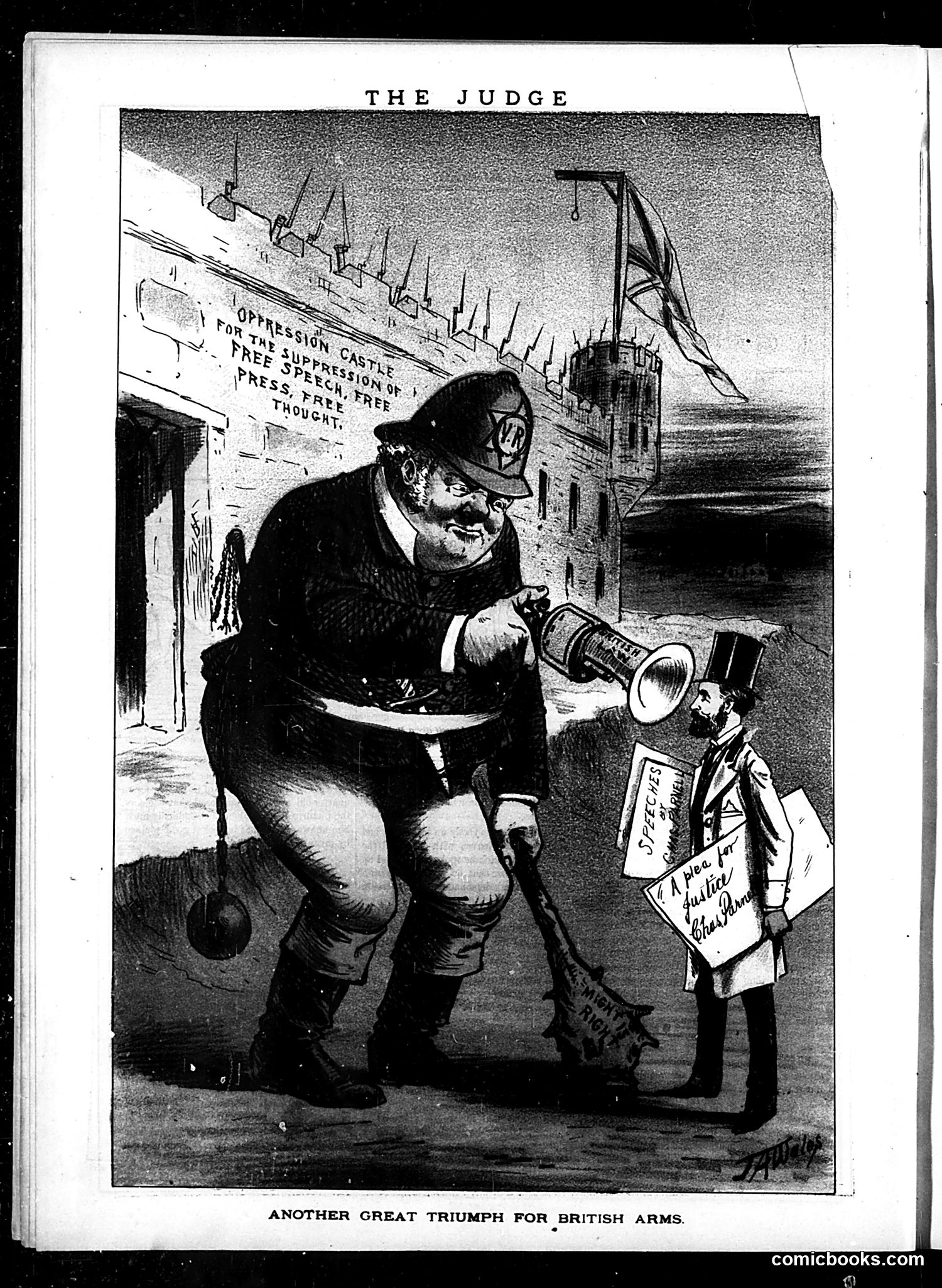
This political cartoon from *Judge* magazine satirizes British military oppression, likely during the Irish independence struggles of the early 20th century. A large, brutish British soldier dominates the image, wielding a megaphone as a weapon against a small, defenseless figure labeled "Ireland" (identifiable by the label on his clothing). The soldier stands before a castle bearing signs about "oppression," "free speech," and "free thought"—concepts the cartoon suggests Britain is crushing in Ireland. The title "Another Great Triumph for British Arms" is sarcastic: the "triumph" being depicted is not military victory but the suppression of basic freedoms. The cartoon condemns British imperial policy as authoritarian bullying of a weaker population, using heavy-handed caricature to mock British claims of civilized governance.
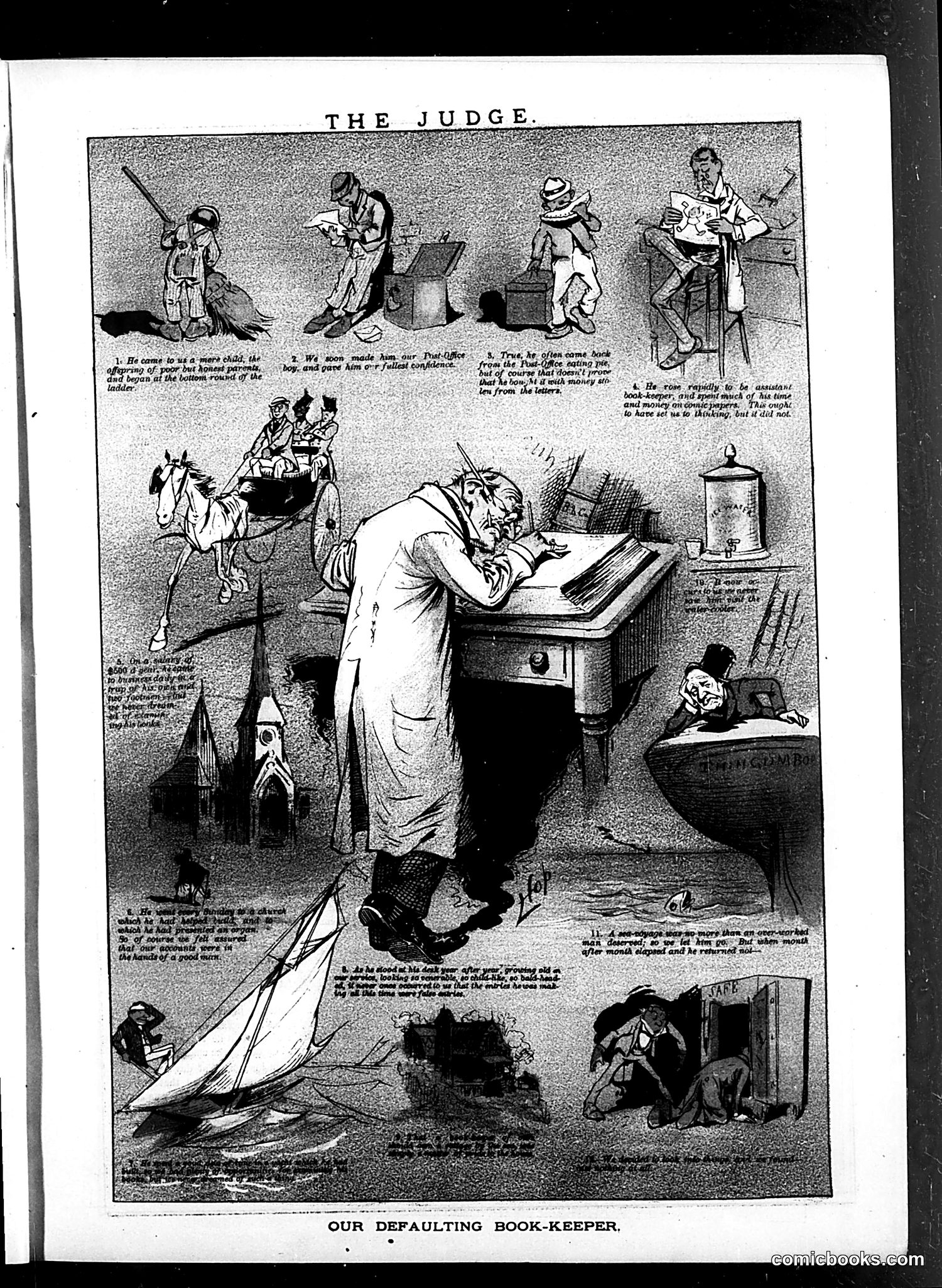
This satirical cartoon critiques a dishonest accountant who embezzles funds. The central figure shows a man at a desk cooking his books—literally depicted as manipulating ledgers. The surrounding vignettes trace his corruption: panels show him starting poor, gradually acquiring wealth through fraud, spending lavishly on entertainment and "comic papers" (frivolous publications), while maintaining a facade of respectability. The satire targets both the defaulting book-keeper's moral failure and the society that enabled it—his spending on comic papers suggests judges and observers ignored obvious warning signs of his misconduct. The title emphasizes accountability failures in business record-keeping, a concern during the Gilded Age when financial fraud and embezzlement were common scandals. Judge magazine here uses humor to expose workplace dishonesty and public complacency toward corporate crime.
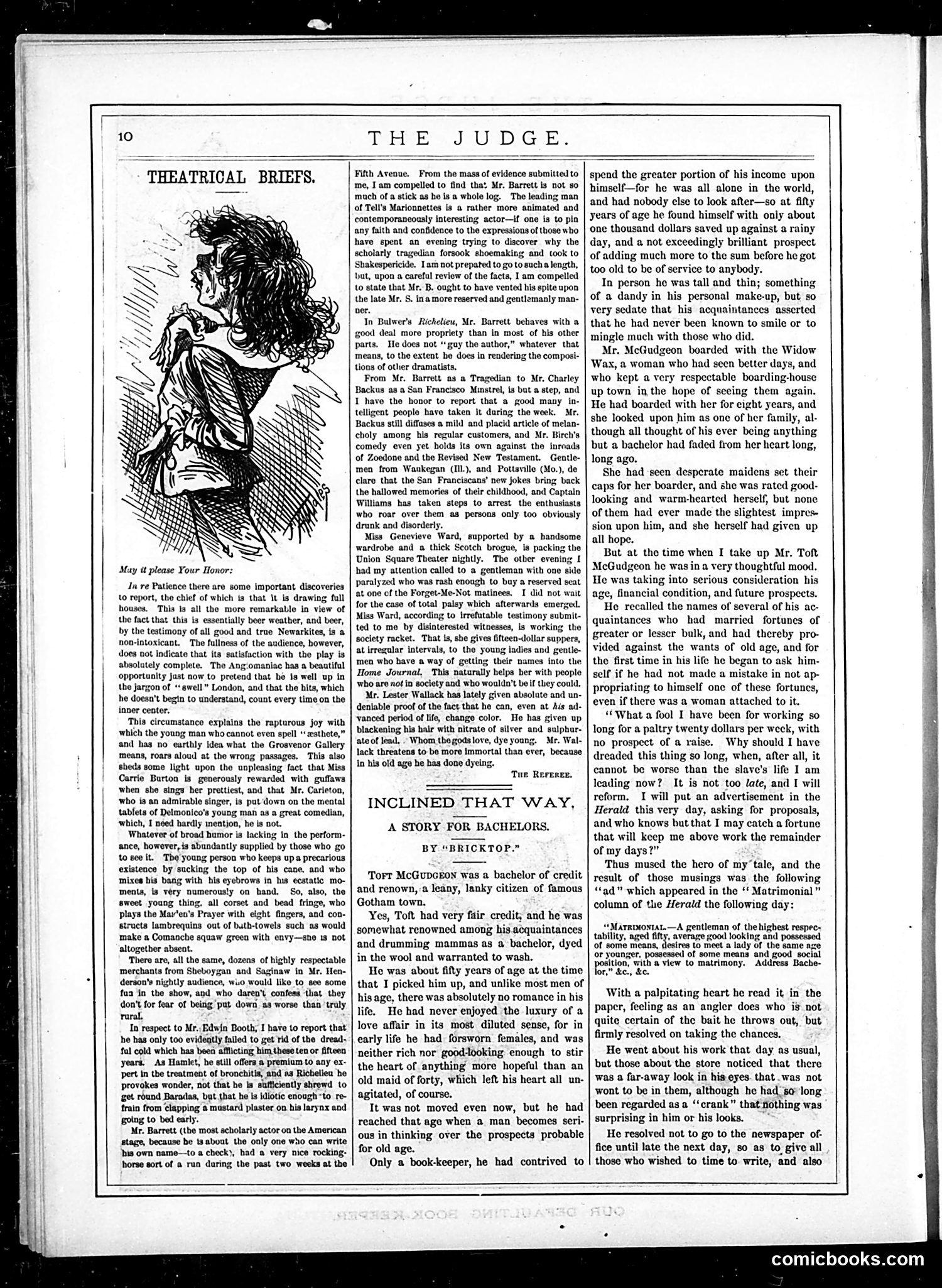
This page contains theatrical reviews rather than political cartoons. The sketch shows an actor in period costume, likely illustrating one of the reviewed performances. The critic (writing as "May it please Your Honor") satirizes both the plays and audiences of 1880s New York theater. Key targets include: **"Patience"** — The critic mocks fashionable "Aesthetes" (references to the Grosvenor Gallery suggest Oscar Wilde's aesthetic movement influence). He ridicules young New York socialites who pretend to understand English "swell" culture while laughing at wrong moments, and notes audiences value pretty performers over genuine talent. **Edwin Booth** — The famous Shakespearean actor is ridiculed for his lingering cold, which hampers his Hamlet and Richelieu performances. **Mr. Barrett** — Described sardonically as "the most scholarly actor" (because he can sign checks), the critic finds his performances wooden and overly dramatic. The satire targets both theatrical mediocrity and the pretentious audiences who support it.
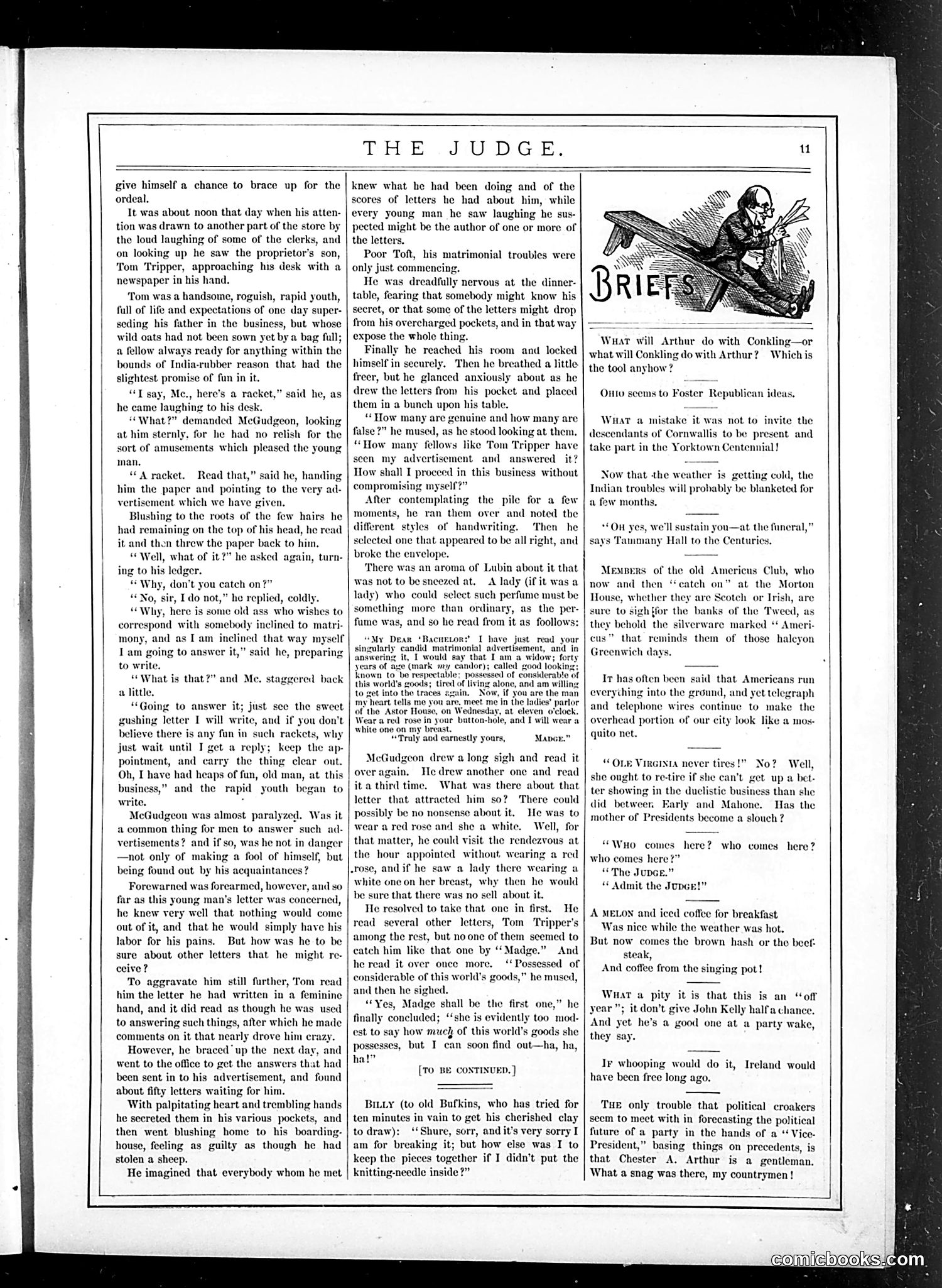
This page from *Judge* magazine contains a serialized humorous story satirizing personal ads and matrimonial correspondence. The narrative mocks a shy, prudish man (McGudgeon) who places a matrimonial advertisement seeking a wife, then becomes mortified when he receives approximately fifty responses. The satire targets Victorian-era anxieties about: - **Public embarrassment** over matrimonial seeking (considered unseemly) - **Gender role confusion** (the protagonist writes in "feminine hand") - **Social propriety** concerns—the fear that acquaintances might discover his secret The young shop employee Tom Tripper represents the modern, irreverent attitude toward such conventions, mocking McGudgeon's prudishness. The humor derives from the protagonist's neurotic conviction that everyone suspects his business, contrasting his internal shame with the mundane reality of common personal advertising practices. The sidebar "BRIEF" section contains unrelated satirical commentary on various political and social topics.
This is a farce mocking New York City police court proceedings, likely from the 1880s-90s. The satire depicts a rigged system where Officer Hoodlum is accused of clubbing citizen Jones, but the Police Commissioner presiding—who should be impartial—is clearly biased in favor of the officer. The joke: Officer Hoodlum's "witnesses" are conveniently other police officers who claim to have seen the incident from impossible locations (one was at a funeral in Jersey City, another at a fire blocks away), yet swear Jones was the aggressor. Their absurd testimonies are taken seriously while an innocent working man (Jones) is intimidated and disbelieved. The satire targets widespread corruption in police courts, where officers routinely escaped accountability through false testimony and institutional bias. The piece critiques both police brutality and the mockery of justice that protected offending officers.
This page from Judge magazine (likely 1880s-90s based on style) contains three satirical pieces targeting different social subjects: **"Quid Fles?" (Why Do You Weep?)**: A mock-serious poem mocking a lovesick junior clerk's melodramatic despair over lost love and failed ambitions. The satire undercuts his self-pity by suggesting his real problem might be "the Liver Complaint"—a period euphemism for alcoholism or digestive illness from excess drinking. **"An Accommodating Road"**: Satirizes railroad customer service by depicting a drunk passenger repeatedly leaving the train to drink, exploiting the accommodating schedule. The humor lies in his escalating intoxication and absurd gratitude toward the railroad's patience. **"A Boy's Vacation"**: A darkly comic letter from a mischievous country boy detailing reckless pranks—destroying farm equipment, injuring playmates in machinery accidents. The satire mocks both the boy's casual amorality and parental negligence allowing such dangerous behavior. All three pieces use exaggeration and irony to critique contemporary social failings: romantic excess, alcoholism, and child safety indifference.
This page is **primarily advertisements** for clothing, hats, shirts, and other goods from New York merchants (Knox Hats, Johnston Shirts, Keep's Shirts, Russian Baths, etc.), typical of Judge's revenue model. The text content consists of **brief humorous anecdotes** scattered among ads: - A judge reprimands a woman for beating her child, exposing class hypocrisy about parenting - A confused sailor mixing up "starboard" and "port" - A sentimental scene where a man's cold nose causes his girlfriend to recoil (she's educated at Vassar, implying intellectual women are overly sensitive) - A joke about Chinese railroad workers and broken English ("Hoopect Yang-tze-kiao") These snippets represent **casual period humor**: gentle domestic comedy, slapstick confusion, mild class commentary, and **ethnic stereotyping** (common in 1880s-90s satire). None appears connected to current events or major political figures. The page demonstrates Judge's format: commercial support funding space for light, digestible humor aimed at middle-class readers.
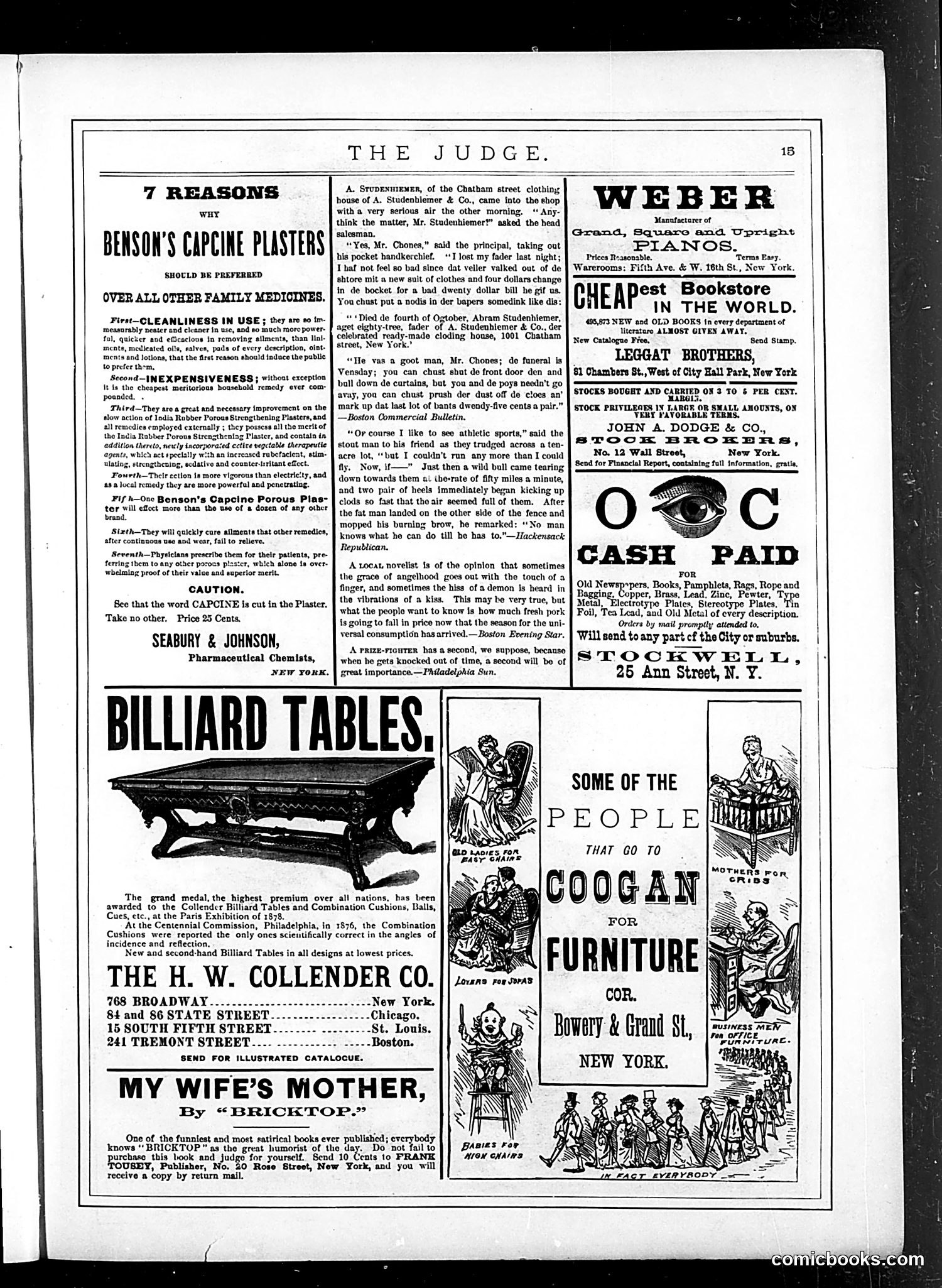
This page is primarily **advertising**, with only brief humorous sketches providing satirical content. The main cartoon content appears to be short anecdotes rather than visual cartoons: 1. **The Studenheimer obituary sketch**: A German-immigrant clothing merchant asks his employee to place a death notice for his father, but casually instructs him to keep the store open and mark up pants prices during the funeral. The satire mocks commercial greed and the callousness of business owners who prioritize profit over mourning. 2. **The fat man and the bull**: A self-important man claims he can't run until forced to do so by danger, satirizing how people overestimate or underestimate their capabilities until necessity proves them wrong. The page's content is dominated by product advertisements (Benson's Capcine Plasters, billiard tables, furniture) typical of Judge's revenue model. The satirical humor is mild and relies on ethnic stereotypes (the German dialect) and common observations about human nature rather than specific political events.
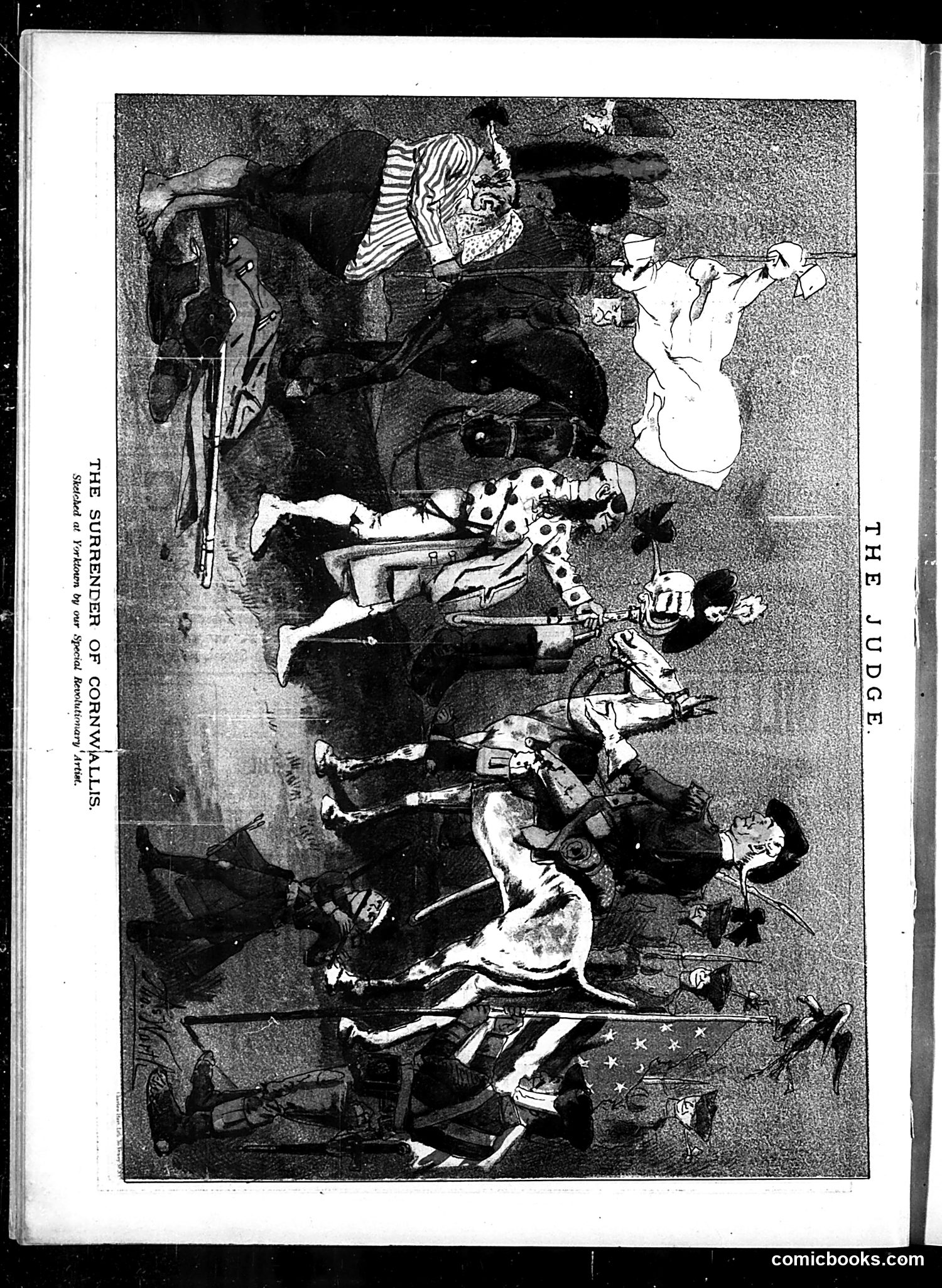
This is a satirical reimagining of the Revolutionary War's Yorktown surrender (1781), reframed as a theatrical comedy. The caption credits a "Special Revolutionary Artist," suggesting Judge magazine is presenting this historical moment as entertainment. The image appears to depict the formal British surrender through comedic figures and exaggerated poses, transforming a significant military defeat into burlesque performance. The central figure wearing striped clothing likely represents British General Cornwallis or British authority generally, surrounded by what appear to be American Revolutionary figures in absurdist positions. By treating this pivotal American victory as slapstick theater, Judge lampoons both the event's historical importance and possibly contemporary attitudes toward patriotic narratives. The satire likely mocks grandiose historical presentations or, alternatively, celebrates American triumph through irreverent humor. The exact political commentary remains unclear without additional context about Judge's editorial stance during this publication period.