
Judge, 1881-10-29 · page 10 of 16
Judge — October 29, 1881 — page 10: what you’re looking at
What you’re looking at
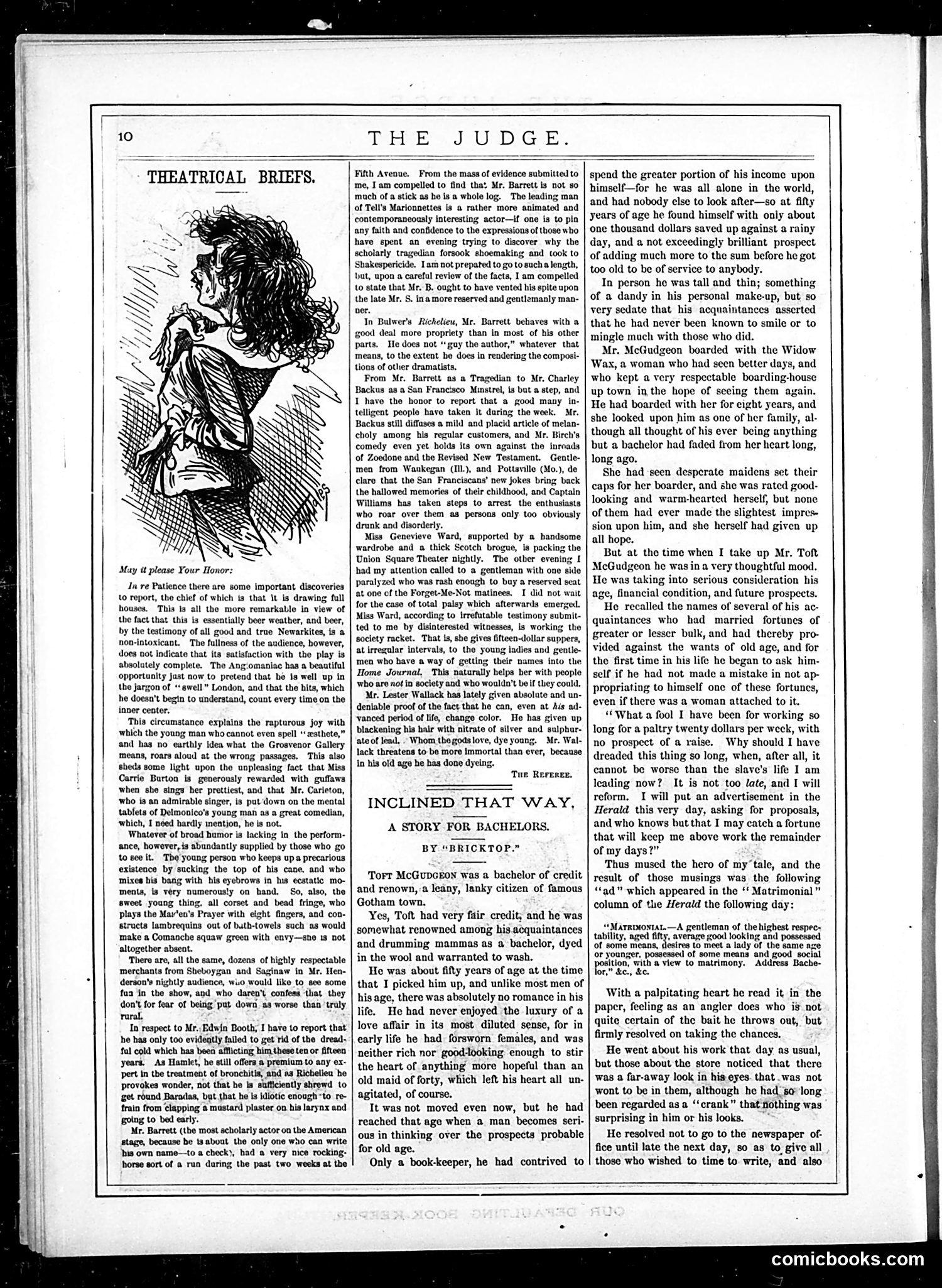
This page contains theatrical reviews rather than political cartoons. The sketch shows an actor in period costume, likely illustrating one of the reviewed performances. The critic (writing as "May it please Your Honor") satirizes both the plays and audiences of 1880s New York theater. Key targets include: **"Patience"** — The critic mocks fashionable "Aesthetes" (references to the Grosvenor Gallery suggest Oscar Wilde's aesthetic movement influence). He ridicules young New York socialites who pretend to understand English "swell" culture while laughing at wrong moments, and notes audiences value pretty performers over genuine talent. **Edwin Booth** — The famous Shakespearean actor is ridiculed for his lingering cold, which hampers his Hamlet and Richelieu performances. **Mr. Barrett** — Described sardonically as "the most scholarly actor" (because he can sign checks), the critic finds his performances wooden and overly dramatic. The satire targets both theatrical mediocrity and the pretentious audiences who support it.
📄 Transcribed text from this page (OCR, searchable)
Machine-transcribed from the original scan — historical spelling and the odd misread are preserved.
10 Tehiek J 307i Geb. May it please Your Honor: In re Patience there are some important discoveries to report, the chief of which ts that it is drawing full houses. This Is all the more remarkable in view of the fact that this is essentially beer weather, and beer, by the testimony of all good and true Newarkites, is a non-intoxicant, The fullness of the audience, however, does not indicate that its satisfaction with the play is absolutely complete. The Ang:omaniac bas a beautiful opportunity jast now to pretend that he 1s well up in the jargon of *‘ swell” London, and that the hits, which he doesn't begin to understand, count every time on the inner center. This circumstance explains the rapturous joy with which the young man who cannot even spell *esthete,” and has no earthly idea what the Grosvenor Gallery means, roars aloud at the wrong passages. This also sheds some light upon the unpleasing fact that Miss Carrie Burton is generously rewarded with guffaws when she sings her prettiest, and that Mr. Carleton, ‘who is an admirable singer, is put down on the mental tabfets of Delmonico’s young man as a great comedian, which, I need hardly inentjon, he is not. Whatever of broad humor is lacking in the perform- ‘ance, however, is abundantly supplied by those who go to see it. The young person who keeps up a precarious existence by sucking the top of his cane. and who mixes bis bang with his eyebrows in his ecstatic mo- ments, is very numerous!y on band. So, also, the sweet young thing, all corset and bead fringe, who plays the May‘en's Prayer with eight fingers, and con- structs lambrequins out of bath-towels such as would make a Comanche squaw green with envy—sne 18 not altogether abseat. ‘There are, all the same, dozens of highly respectable merchants from Sheboygan and Saginaw in Mr, Hen- derson’s nightly audience, wiso would like to see some faa in the show, and who daren’t confess ‘that they don't for fear of being put down as worse than ‘truly rural, x In respect to Mr./Bdwin Booth, I have to report that he has only too evidently failed to get rid of the dread- fal cold which has been afflicting him these ten or fifteen yeara. As Hamlet, he still offers a premium to any ex- pert in the treatment of bronchitis, and as Richeliew he provokes wonder, not that he is sufticiently shrewd to get round Baradas, bat that he is \diotic enough-to re- frain from clapping @ mastard plaster on his larynx and going to bed early. Mr. Barrett (the most scholarly actor on the American stage, because be ts about the only one who can write ‘his own name—to a check), had a very nice rocking- horse sort of a run daring the past two weeks at the Fifth Avenue. From the mass of evidence submitted to me, Iam compelled to find that Mr. Barrett is not so much of a stick as he is a whole log. The leading man of Tell’s Marionettes is a rather more animated and contemporancously interesting actor—if one is to pia any faith and confidence to the expressions of those who have spent an evening trying to discover why the scholarly tragedian forsook shoemaking and took to Shakespericide. Iam not prepated to go to such alength, but, upon a careful review of the facta, I am compelled to state that Mr. B. ought to bave vented his spite upon the late Mr. S. ina more reserved and gentlemanly man- er. In Balwer’s Richelieu, Mr. Barrett behaves with a good deal more propriety than in most of his other parts. He does not guy the author,” whatever that means, to the extent he does in rendering the composi- tions of other dramatists. From Mr. Barrett as a Tragedian to Mr. Charley Backus aa San Francisco Minstrel, is but a step, and I have the honor to report that a good many in- telligent people have taken it during the week. Mr. Backus still diffases a mild and placid article of melan- choly among his regular customers, and Mr. Birch’s comedy even yet holds its own against the inroads of Zoedone and the Revised New Testament, Gentle- men from Waukegan (Iil.), and Pottsuille (Mo.), de clare that the San Franciscans’ new jokes bring back the hallowed memories of their childhood, and Captain Williams has taken steps to arrest the enthusiasts who roar over them as persons only too obviously drunk and disorderly. Miss Genevieve Ward, supported by a handsome wardrobe and a thick Scotch brogue, is packing the Union Square Theater nightly. The other evening f had my attention called to a gentleman with one side paralyzed who was rash enough to buy a reserved seat at one of the Forget-Me-Not matinees. I did not wait for the case of total palsy which afterwards emerged. Miss Ward, according to irrefutable testimony submit- ted to mo by disinterested witnesses, is working the society racket. That is, she gives fifteen-dollar suppers, at irregular intervals, to the young ladies and gentle- men who have a way of getting their names into the Home Journal, This naturally helps ber with people who are not in society and who wouldn't beiif they could. Mr. Lester Wallack has lately given absolate and un- deniable proof of the fact that he can, even at Ais ad- vanced period of life, change color. He has given up blackening his hair with nitrate of silver and sulphar- ateof lead, . Whom thegods love, dye young. Mr. Wal- lack threatens to be more Immortal than ever, because In his old age he has done dyeing. - ‘Tue Revenge. INCLINED THAT WAY, A STORY FOR BACHELORS. BY “BRICKTOP.” Tort McGuDGEON was a bachelor of credit and renown, a leany, lanky citizen of famous Gotham town. Yes, Toft had very fair credit; and he was somewhat renowned among his acquaintances and drumming mammas as a bachelor, dyed in the wool and warranted to wash. He was about fifty years of age at the time that I picked him up, and unlike most men of his age, there was absolutely no romance in his life. He had never enjoyed the luxury of a love affair in its most diluted sense, for in early life he had forsworn females, and was neither rich nor good-looking enough to stir the heart of anything more hopeful than an old maid of forty, which left his heart all un- agitated, of course. It was not moved even now, but he had reached that age when a man becomes seri- ous in thinking over the prospects probable for old age. Only a book-keeper, he had contrived to spend the greater portion of his income upon himself—for he was all alone in the world, and had nobody else to look after—so at fifty years of age he found himself with only about one thousand dollars saved up against a rainy day, and a not exceedingly brilliant prospect of adding much more to the sum before he got too old to be of service to anybody. In person he was tall and thin; something of a dandy in his personal make-up, but so very sedate that his acquaintances asserted that he had never been known to smile or to mingle much with those who did. Mr. McGudgeon boarded with the Widow Wax, a woman who had seen better days, and who kept a very respectable boarding-house up town inthe hope of seeing them again. He had boarded with her for cight years, and she looked upon him as one of her family, al- though all thought of his ever being anything but a bachelor had faded from her heart long, long ago. She had seen desperate maidens set their caps for her boarder, and she was rated good- looking and warm-hearted herself, but none of them had ever made the slightest impres- sion upon him, and she herself had given up all hope. But at the time when I take up Mr. Toft McGudgeon he was ina very thoughtful mood. He was taking into serious consideration his age, financial condition, and future prospects. He recalled the names of several of his ac- quaintances who had married fortunes of greater or lesser bulk, and bad thereby pro- vided against the wants of old age, and for the first time in his life he began to ask him- self if he had not made a mistake in not ap- propriating to himself one of these fortuncs, even if there was a woman attached to it, ‘What a fool I have been for working so long for a paltry twenty dollars per week, with no prospect of a raise. Why should I have dreaded this thing so long, when, after all, it cannot be worse than the slave's life I am leading now? It is not too late, and I will reform. I will put an advertisement in the Herald this very day, asking for proposals, and who knows but that I may catch a fortune that will keep me above work the remainder of my days?” ‘Thus mused the hero of my’tale, and the result of those musings was the following “ad” which appeared in the ‘‘ Matrimonial” column of the Herald the following day: “‘Marmimostar.—A gentleman of thehighest respec- tability, aged fifty, average zood looking and possessed of some means, desires to meet a lady of the same aze or younger, possessed of some means and good social position, with a view to matrimony. Address Bache- lor,” &e., &c. With a palpitating heart he read it in the paper, feeling as an angler does who ig not quite certain of the bait he throws out, but firmly resolved on taking the chances. He went about his work that day as usual, but those about the store noticed that there was a far-away look in his eyes. that was not wont to be in them, although he had. slong been regarded as a “‘crank” that othing was surprising in him or his looks. He resolved not to go to the newspaper of- fice until late the next day, s0 as to give all those who wished to time to write, and also comicbooks.com