
Judge, 1881-10-29 · page 5 of 16
Judge — October 29, 1881 — page 5: what you’re looking at
What you’re looking at
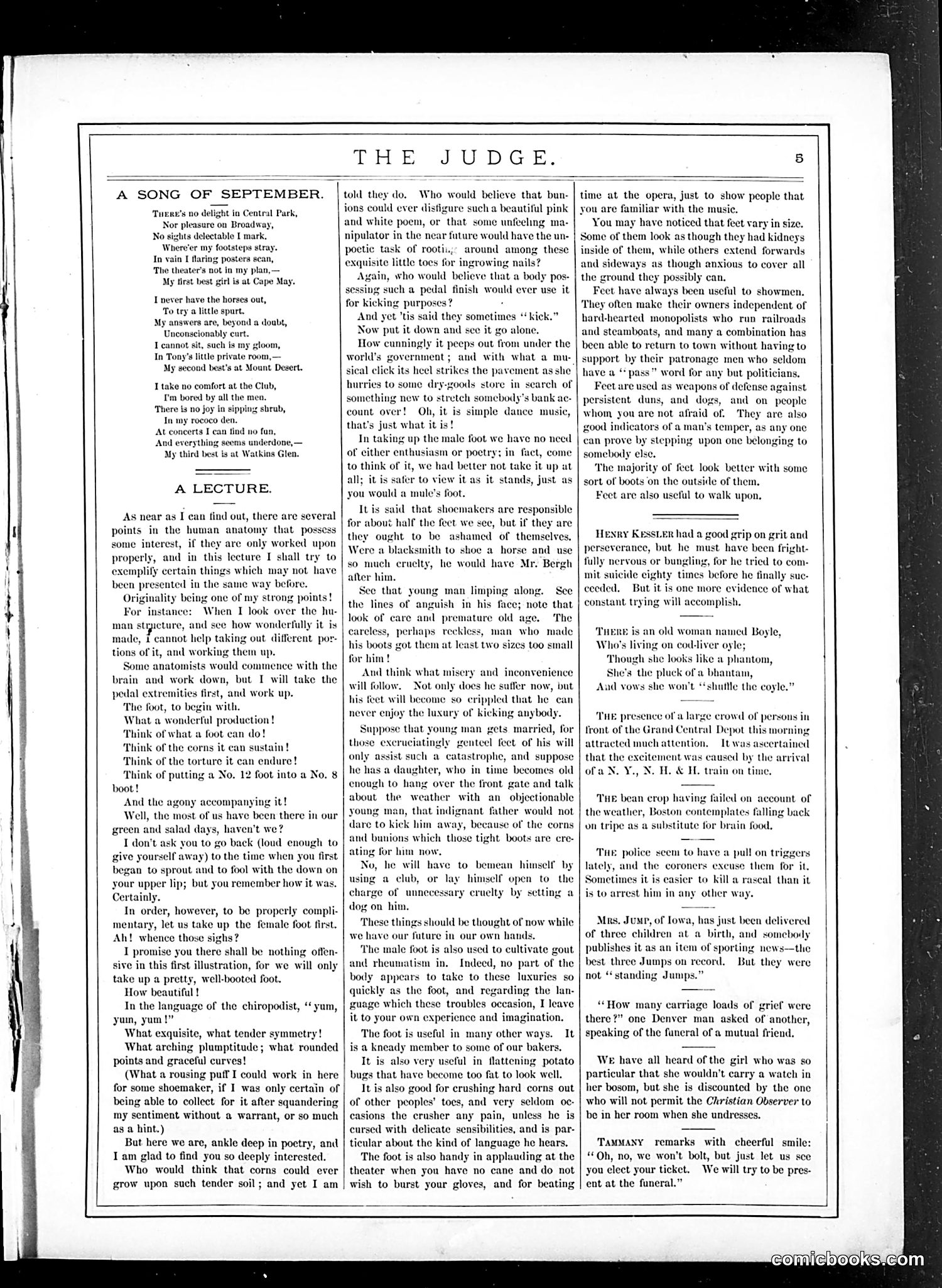
This page contains two unrelated pieces of satirical writing typical of Judge magazine's format. "A Song of September" is a humorous poem about a man distracted from urban pleasures (Central Park, Broadway, theaters, clubs) because his romantic interests are scattered at distant summer destinations (Cape May, Mount Desert, Watkins Glen). The joke is the repetition of "my first/second/third best girl" at each location—satirizing the leisured class's seasonal migration and romantic entanglements. "A Lecture" is a longer comedic monologue by a speaker analyzing human anatomy, focusing on feet. It humorously contrasts the "exquisite" female foot with the utilitarian male foot ("like a mule's foot"), makes jokes about corns and ill-fitting boots, and gently mocks shoemakers and chiropodists. The satire targets vanity, fashion absurdity, and overwrought romantic language about women's bodies. Both pieces satirize upper-class leisure culture and social pretensions of the era.
📄 Transcribed text from this page (OCR, searchable)
Machine-transcribed from the original scan — historical spelling and the odd misread are preserved.
THE JUDGE. A SONG OF SEPTEMBER. ‘Tuere’s no delight in Central Park, Nor pleasure on Broadway, No sights delectable I marl Where'er my footsteps stray. In vain I flaring posters sean, The theater’s not in my play My first best girl is at Cape May. I never have the horses out, To try a little spurt, My answers are, beyond a doubt, Unconscionably curt. I cannot sit, such is my gloom, In Tony's little private room,— My second best’s at Mount Desert, I take no comfort at the Club, I'm bored by all the mea. ‘There is no joy in sipping sbrub, In my rococo de At concerts I can find no fun, And everything seems underdone,— My third best is at Watkins Glen. A LECTURE. $ near as I can find out, there are several in the human anatomy that possess some interest, if they are only worked upon properly, and in this lecture I shall try to exemplify certain things which may not have been presented in the same way before. Originality being one of my strong points! For instance: When I look over the hu- man styicture, and see how wonderfully it is | made, 1 cannot help taking out different por- tions of it, and working them up. ome anatomists would commence with the brain and work down, but I will take the pedal extremities first, and work up. The foot, to begin with. What a wonderful production! Think of what a foot can do! ‘Think of the corns it can sustain! Think of the torture it can endure! Think of putting a No. 12 foot into a No. 8 boot! And the agony accompanying it! Well, the most of us have been there in our green and salad days, haven't we? I don't ask you to go back (loud enough to give yourself away) to the time when you first began to sprout and to fool with the down on your upper lip; but you remember how it was. Certainly. In order, however, to be properly compli- mentary, let us take up the female foot first. Ah! whence those sighs? I promise you there shall be nothing offen- sive in this first illustration, for we will only take up a pretty, well-booted foot. How beautiful ! In the language of the chiropodist, “yum, yun, yum!” What exquisite, what tender symmetry! What arching plumptitude; what rounded points and graceful curves! (What a rousing puff I could work in here for some shoemaker, if I was only certain of being able to collect for it after squandering my sentiment without a warrant, or so much as a hint.) But here we are, ankle deep in poetry, and I am glad to find you so deeply interested. Who would think that corns could ever told they do. Who would believe that bun- ions could ever distigure such a beautiful pink and white poem, or that some unfeeling ma- nipulator in the near future would have the un- poetic task of root around among these exquisite little toes for ingrowing nails? Again, who would believe that a body pos- sing such a pedal finish would ever use it for kicking purpo: And yet ‘tis said they sometimes “kick.” Now put it down and see it go alone, How cunningly it peeps out from under the world’s government ; and with what a mu- sical click its heel strikes the pavement as she hurries to some dry-goods store in search of something new to stretch somebody's bank ac- count over! Oh, it is simple dance mus that’s just what it i In taking up the male foot we have no need of cither enthusiasm or poetry; in fact, come to think of it, we had better not take it up at all; it is safer to view it as it stands, just as you would a mule’s foot. Ivis said that shocmakers are responsible for about half the feet we see, but if the: they ought to be ashamed of themselves, Were a blacksmith to shoe a horse and use so much cruelty, he would have Mr. Bergh after him. See that young man limping along. See the lines of anguish in his face; note that look of care and premature old age. ‘The careless, perhaps reckless, man who made his boots got them at least two sizes too small for him! And think what misery and inconvenience will follow. Not only does he suffer now, but his feet will become so crippled that he can never enjoy the luxury of kicking anybody. Suppose that young man gets married, for those excruciatingly genteel fect of his will only assist such a catastrophe, and suppose he has a daughter, who in time becomes old enough to hang over the front gate and talk about the weather with an objectionable young man, that indignant father would not dare to kick him away, because of the corns and bunions which those tight boots are cre- ating for him now No, he will have to bemean himself by using a club, or lay himself open to the charge of unnecessary cruelty by setting a dog on him, ‘These things should be thought of now while we have our future in our own hands. The male foot is also used to cultivate gout and rheumatism in. Indeed, no part of the body appears to take to these luxuries so quickly as the foot, and regarding the lan- guage which these troubles occasion, I leave it to your own experience and imagination. ‘The foot is useful in many other ways. It is a kneady member to some of our bake It is also very useful in flattening potato bugs that have become too fat to look well. It is also good for crushing hard corns out of other peoples’ toes, and very seldom oc- casions the crusher any pain, unless he is cursed with delicate sensibilities, and is par- ticular about the kind of language he hears. The foot is also handy in applauding at the theater when you have no cane and do not grow upon such tender soil; and yet I am wish to burst your gloves, and for beating time at the opera, just to show people that you are familiar with the music. You may have noticed that feet vary in size. Some of them look as though they had kidneys inside of them, while others extend forwards and s though anxious to cover all the ground they possibly can. Feet have always been useful to showmen. ‘They often make their owners independent of hard-hearted monopolists who run railroads and steamboats, and many a combination has been able to return to town without having to support by their patronage men who seldom have a “pass” word for any but politicians. Feet ure used as weapons of defense against persistent duns, and dogs, and on people whom you are not afraid of. They are also good indicators of a man’s temper, as any one n prove by stepping upon one belonging to somebody else. rity of feet look better with some sort of boots on the outside of them, Feet are also useful to walk upon. SSLER had a good grip on grit and perseverance, but he must have been fr fully nervous or bungling, for he tried to com- mit suicide cighty times before he finally suc. ceeded. But it is one more evidence of what constant trying will accomplish. ‘Tuere is an old woman named Boyle, Who's living on cod-liver oyle; Though she looks like a phantom, She's the pluck of a bhantam, Aud vows she won't “shuille the coyle.” THE presence of a large crowd of persons in front of the Grand Central Depot this morning attracted much attention, It was ascertained that the excitement was caused by the arriv ofa N. Y., N. H. & HL. train on time, THE bean crop having failed on account of the weather, Boston contemplates falling back on tripe as a substitute for brain food, Tue police seem to ha lately, and the coroners excuse them for it, Sometimes it is easier to kill a raseal than it is to arrest him in any other way. 1 pull on triggers Mrs, Jump, of Lowa, has just been delivercd of three children at a birth, and somebody publishes it as an item of sporting news—the best three Jumps on record. But they were not “standing Jumps.” “How many carriage loads of grief were there?” one Denver man asked of another, speaking of the funeral of a mutual friend. We have all heard of the girl who was so particular that she wouldn't carry a watch in her bosom, but she is discounted by the one who will not permit the Christian Observer to be in her room when she undresses. TAMMANY remarks with cheerful smile: “Oh, no, we won't bolt, but just let us sce you elect your ticket. We will try to be pres- ent at the funeral.”