
Judge, 1881-10-29 · page 12 of 16
Judge — October 29, 1881 — page 12: what you’re looking at
What you’re looking at
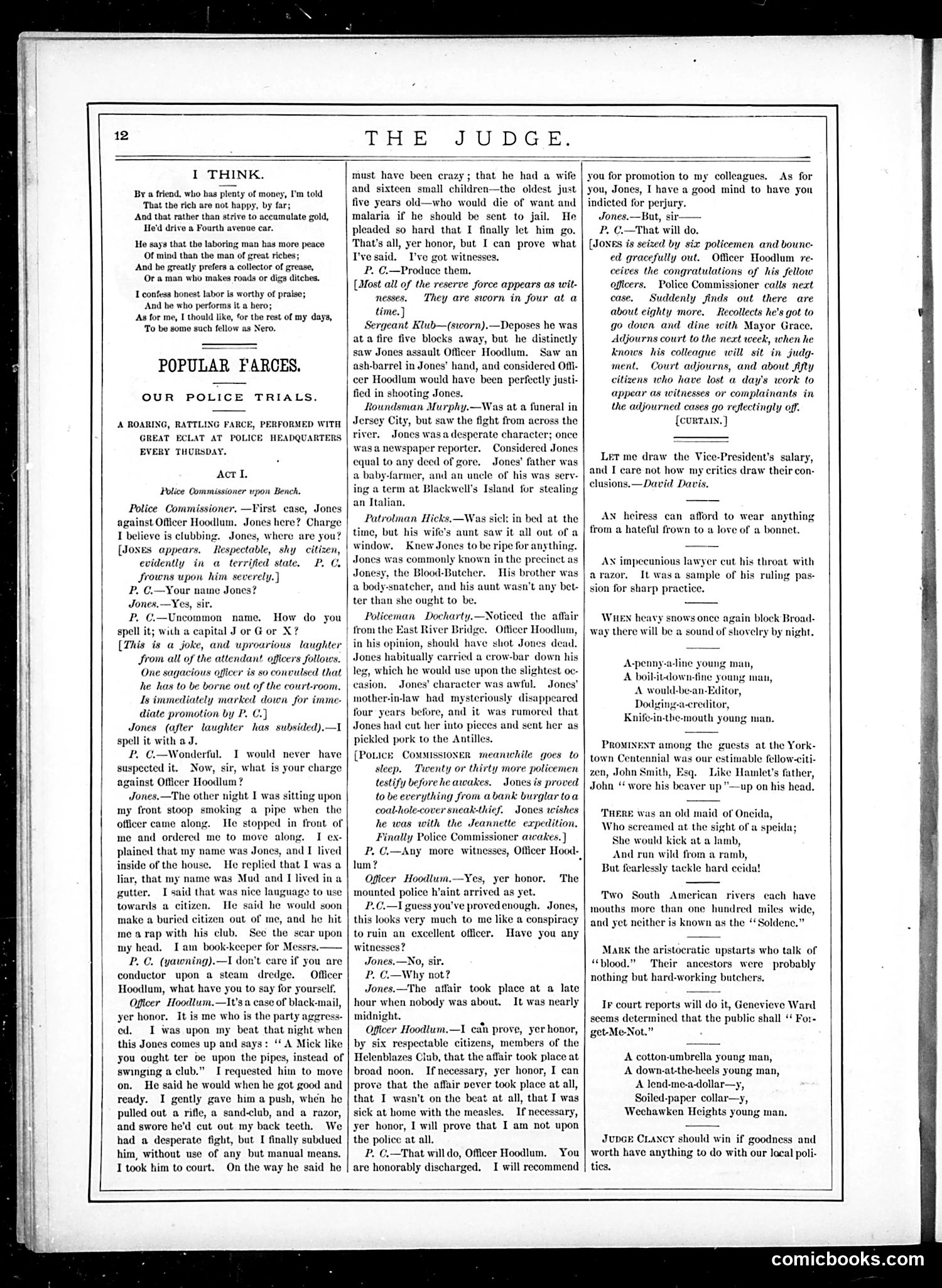
This is a farce mocking New York City police court proceedings, likely from the 1880s-90s. The satire depicts a rigged system where Officer Hoodlum is accused of clubbing citizen Jones, but the Police Commissioner presiding—who should be impartial—is clearly biased in favor of the officer. The joke: Officer Hoodlum's "witnesses" are conveniently other police officers who claim to have seen the incident from impossible locations (one was at a funeral in Jersey City, another at a fire blocks away), yet swear Jones was the aggressor. Their absurd testimonies are taken seriously while an innocent working man (Jones) is intimidated and disbelieved. The satire targets widespread corruption in police courts, where officers routinely escaped accountability through false testimony and institutional bias. The piece critiques both police brutality and the mockery of justice that protected offending officers.
📄 Transcribed text from this page (OCR, searchable)
Machine-transcribed from the original scan — historical spelling and the odd misread are preserved.
THE JUDGE. I THINK. By a friend, who has plenty of mone) ‘That the rich are not happy, by far; And that rather than strive to accumulate gold, He'd drive a Fourth avenue car. I'm told He says that the laboring man has more peace Of mind than the man of great richs And he greatly prefers a collector of grease, Or aman who makes roads or digs ditches. I confess honest labor is worthy of praise; And he who performs it a hero; ‘As for me, I thould like, for the rest of my days, To be some such fellow as Nero. POPULAR FAROES. OUR POLICE TRIALS. A ROARING, RATTLING FARCE, PERFORMED WITH GREAT ECLAT AT POLICE H QUARTERS EVERY THURSDAY. Act I. Police Commissioner upon Bench. Police Commissioner. —Virst ease, Jones against Officer Hoodlum. Jones here? Charge I believe is clubbing. Jones, where are you? [Joxes appears, Respectable, shy citizen, evidently in a terrified state. P. C. frowns upon him severely.] —Your name Jones? neommon name, spell it; wich a capital J or G or X? [This is a joke, and uproarious laughter Srom all of the attendant officers follows. One sagacious officer is so convulsed that he has to be borne out of the court-room, Is immediately marked down for imme: diate promotion by P. C.) Jones (after laughter has subsided).—1 spell it with a J. P. C.—Wonderful. I would never have suspected it. Now, sir, what is your charge against Officer Hoodlum? Jones.—The other night I was sitting upon my front stoop smoking a pipe when the officer came along. He stopped in front of me and ordered me to move along. I plained that my name was Jones, and I Ii inside of the house. He replied that I was a liar, that my name was Mud and I lived in gutter. I said that was nice language to use towards a he would soon make a buried citizen out of me, and he hit me arap with his club, See the scar upon my head. I am book-keeper for Messrs.— P. C. (yawning).—I don't care if you are conductor upon a steam dredge. Officer Hoodlum, what have you to say for yourself. Officer Hoodlum.—It’s a case of black-mail, yer honor. It is me who is the party aggress- ed. I was upon my beat that night when this Jones comes up and says: ‘A Mick like you ought ter be upon the pipes, instead of swinging a club.” I requested hin to move on. He said he would when he got good and ready. I gently gave hima push, whcn he pulled out a rifle, a sand-club, and a razor, and swore he'd cut out my back teeth. We had a desperate fight, but I finally subdued him, without use of any but manual means. I took him to court. On the way he said he How do you | | from the must have been crazy; that he had a w and sixteen small children—the oldest just five years old—who would die of want and malaria if he should be sent to jail. He pleaded so hard that I finally let him go. ‘That’s all, yer honor, but I can prove what I've said. I've got witnesses, P. C.—Produce them, (Most alt of the reserve force appears as wit- nesses, ‘They are sworn in four at a time. eant Klub—(sworn).—Deposes he was ata fire five blocks away, but he distinctly saw Jones assault Officer Hoodlum. Saw an ash-barrel in Jones’ hand, and considered Ofi- cer Hoodlum would have been perfectly justi- fied in shooting Jones. Roundsman Murphy.—Was at a funeral in Jersey City, but saw the fight from across the river, Jones wasa desperate character; once newspaper reporter. Considered Jones equal to any deed of gore. Jones’ father was a baby-farmer, and an uncle of his was serv- ing a term at Blackwell's Island for stealing in bed at the aunt saw it all out of a Knew Jones to be ripe for anything y known in the precinct sy, the Blood-Buteher. His brother was tcher, and his aunt wasn’t any bet- an she ought to be. Docharty.—Noticed the affair it River Bridge. Officer Hoodlum, in his opinion, should have shot Jones dead. Jones habitually carried a crow-bar down hi leg, which he would use upon the slightest oc- casion, Jones’ character was awful. Jones’ mother-in-law had mysteriously disappeared four years before, and it was rumored that Jones had cut her into pieces and sent her as pickled pork to the Antilles. (PoLice Commissioner meanwhile goes to sleep. Twenty or thirty more policemen testify before he awakes. Jones is proved to be everything from abank burglar toa coat-hole-cover sneak-thief, Jones wishes he was with the Jeannette expedition, Finally Police Commissioner awakes.) P, C.—Any more witnesses, Officer Hood- lum? Opicer Hoodlum.—Yes, yer honor. mounted police h’aint arrived as yet. P.C.—I guess you've provedenough. Jones, this looks very much to me like a conspirac to ruin an excellent officer. Have you any witnesses? Jones.—No, sir. P. C.—Why not? Jones.—The atfair took place at a late hour when nobody was about, It was nearly midnight. Oficer Hoodlum.—I can prove, yer honor, by six respectable citizens, members of the Helenblazes Club, that the affair took place at broad noon. If necessary, yer honor, I can prove that the affair pever took place at all, that I wasn’t on the beat at all, that I was sick at home with the measles. If necessary, yer honor, I will prove that I am not upon the police at all. P. C.—That will do, Officer Hoodlum. You are honorably discharged. I will recommend Policeman The you for promotion to my colleagues. As for you, Jones, I have a good mind to have you indicted for perjury Jones.—But, C.—That will do. NES is seized by six policemen and bounc- ed gracefully out. Officer Hoodlum e- ceives the congratulations of his fellow officers. Police Commissioner calls next case. Suddenly jinds out there are about eighty more. Recollects he's got to go down and dine with Mayor Grace. Adjourns court to the next week, when he knows his colleague will sit in judg- ment. Court adjourns, and about fifty citizens who have lost a day's work to appear as witnesses or complainants in the adjourned cases go restectingly off. {curtaiy.] Let me draw the Vice-President’s salary, and I care not how my critics draw their con- clusions. —David Dav AN heiress can afford to wear anything from a hateful frown to a love of a bonnet. AS impecunious lawyer cut his throat with arazor, It wasa sample of his ruling pas- sion for sharp practic WHEN heavy snows once again block Broad- way there will be a sound of shovelry by night. A-penny-a-line young man, A boil-itdown-fine young man, A would-be-an-Editor, Dodging-a-creditor, Knife-in-the-mouth young man. Prosi town Centennia zen, John Smith, John “ wore his be nong the guests at the York- was our estimable fellow-citi- isq. Like Hamlet's father, aver up"—up on his head. ‘THere was an old maid of Oneida, Who screamed at the sight of a speida; She would kick at a lamb, And run wild from a ramb, But fearlessly tackle hard ceida! Two South American rivers each have mouths more than one hundred miles wide, and yet neither is known as the “Soldene.”” Mark the aristocratic upstarts who talk of “blood.” Their ancestors were probably nothing but hard-working butcher Ir court reports will do it, Genevieve Ward seems determined that the public shall « For getMe-Not.” A cotton-umbrella young man, A down-at-the-heels young man, A lend-me-a-dollar—y, Soiled-paper collar—y, Weehawken Heights young man. Jupcr Ciancy should win if goodness and worth have anything to do with our lacal poli- tics. comicbooks.com