
Judge, 1881-10-29 · page 6 of 16
Judge — October 29, 1881 — page 6: what you’re looking at
What you’re looking at
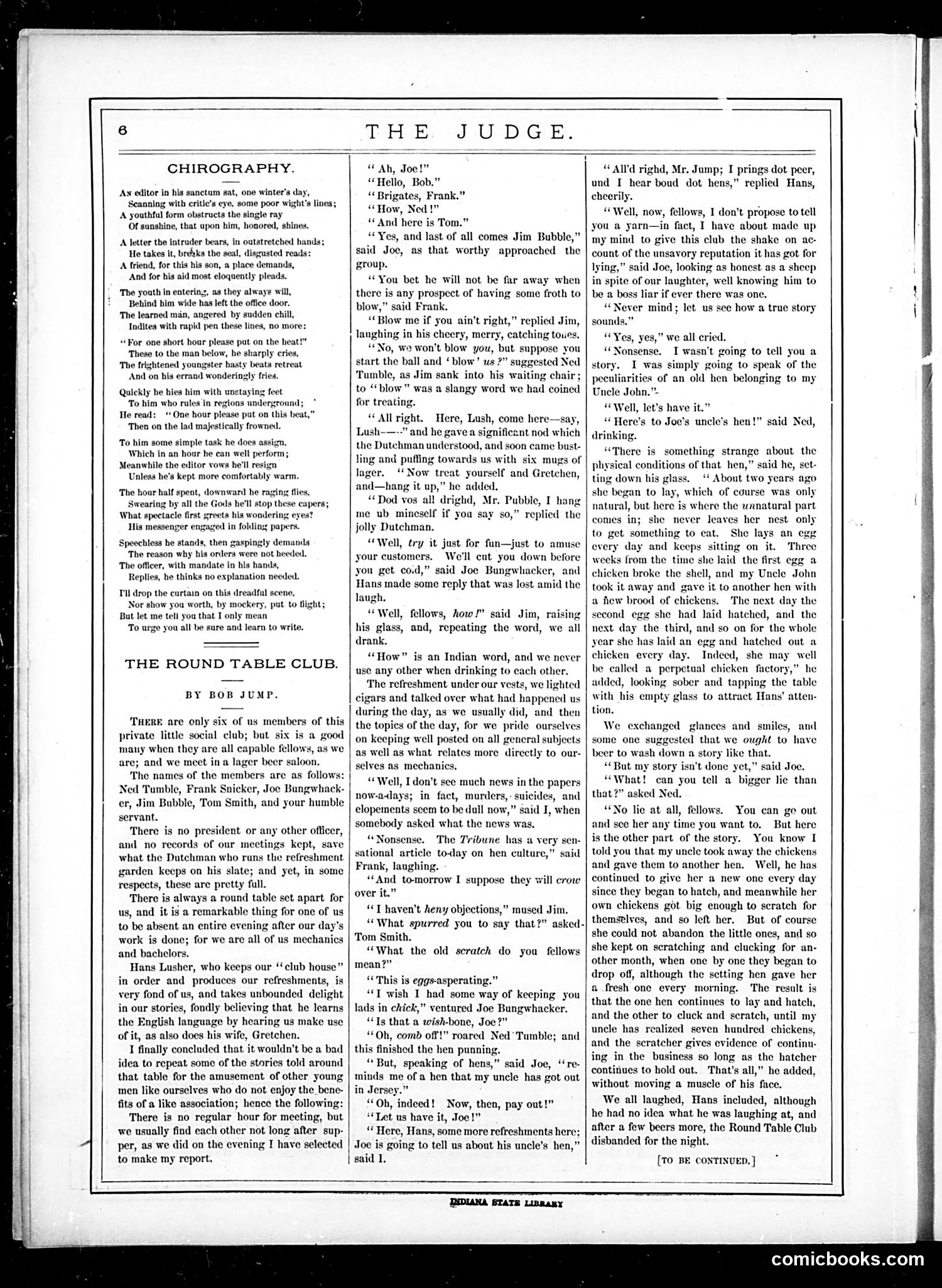
This page contains two pieces of humor content: **"Chirography"** (top): A satirical poem about workplace miscommunication. An editor, annoyed at being cold, writes a curt note to the basement worker: "For one short hour please put on the heat!" The messenger, misinterpreting this as an order to literally apply heat for an hour, ignores his actual duties and focuses on the written instruction. The satire mocks both poor handwriting/unclear written communication and literal-minded obedience to poorly worded orders. The moral warns readers to "learn to write" clearly. **"The Round Table Club"** (bottom): The beginning of a serialized humor story about six working-class mechanics who meet regularly at a German beer saloon (run by Hans Lusher). This appears to be lighthearted social comedy chronicling their conversations and interactions—a slice-of-life narrative for working men. The piece emphasizes their camaraderie and everyday banter, with no apparent political satire intended. Both pieces target middle/working-class audiences with gentle humor about communication mishaps and social club life.
📄 Transcribed text from this page (OCR, searchable)
Machine-transcribed from the original scan — historical spelling and the odd misread are preserved.
rae THE. JUDGE. CHIROGRAPHY. As editor in his sanctum sat, one winter’s day, Scanning with critic’s eye, some poor wight’s lines; ‘A youthfal form obstructs the single ray Of sunshine, that upon him, honored, shines. ‘A letter the intruder bears, in outstretched hands; He takes it, breaks the seal, disgusted reads A friend, for this his son, a place demands, And for bis aid most eloquently pleads, ‘The youth in entering, as they always will, Behind him wide has left the office door. The learned min, angered by sudden chill, Tndites with rapid pen these lines, no more: “For one short hour please put on the heat!” These to the man below, he sharply cries, The frightened youngster hasty beats retreat And on his errand wonderingly fries. Quickly he hies him with unetaying feet To him who rules in regions underg He read: ‘One hour please pat on thi Then on the lad majestically frowned. To him some simple task he does assi Which in an hour he can well perform; Meanwhile the editor vows he'll resign Unless he’s kept more comfortably warm. ‘The hour half spent, downward he ragin ‘Swearing by all the Gods he'll stop th What spectacle first greets his wondering His messenger engaged in folding papers. e capers; res? Speechless he stands, then gaspingly demands ‘The reason why his orlers were not heeded. The officer, with mandate in his hands, Replies, he thinks no explanation needed. Til drop the cartain on this dreadfal scene, Nor show you worth, by mockery, put to flight; Bat let me tell you that T only mean To urge you all be sure and learn to write. THE ROUND TABLE CLUB. BY BOB JUMP. ‘THERE are only six of us members of this private little social club; but six is a good mauy when they are all capable fellows, as we are; and we meet ina lager beer saloon. ‘The names of the members are as follow Ned Tumble, Frank Sni Joe Bungwhacl er, Jim Bubble, Tom Smith, and your humble servant. ‘There is no president or any other officer, and no records of our meetings kept, save what the Dutchman who runs the refreshment garden keeps on his slate; and yet, in some respects, these are pretty full. There is always a round table set apart for us, and it is a remarkable thing for one of us to be absent an entire evening after our day's work is done; for we are all of us mechanics and bachelors. Hans Lusher, who keeps our ‘club house” in order and produces our refreshments, is very fond of us, and takes unbounded delight in our stories, fondly believing that he learns the English language by hearing us make use of it, as also does his wife, Gretchen. I finally concluded that it wouldn't be a bad idea to repeat some of the stories told around that table for the amusement of other young men like ourselves who do not enjoy the bene- fits of a like association; hence the following: There is no regular hour for meeting, but we usually find each other not long after sup- per, as we did on the evening I have selected to make my report. “ Ah, Joe “Hello, Bob.” “ Brigates, Frank.” “How, Ned!” “And here is Tom.” “Yes, and last of all comes Jim Bubble,” said Joe, as that worthy approached the group. “You bet he will not be far away when there is any prospect of having some froth to blow,” said Frank. “Blow me if you ain't right,” replied Jim, laughing in his cheery, merry, catching tou “No, we won't blow you, but suppose you start the ball and ‘blow’ us ?” suggested ) Tumble, as Jim sank into his waiting to “blow” was a slangy word we had coined for treating. “ Allright. Here, Lush, come here- Lush-—--” and he gave a significant nod which the Dutchman understood, and soon came bus ling and puffing towards us with six mugs of lager. ‘Now treat yourself and Gretchen, and—hang it up,” he added. “Dod vos all drighd, Mr. Pubble, I hang me ub mineself if you say so,” replied the jolly Dutchman. “Well, try it just for fun—just to amuse your customers. We'll cut you down before you get cod,” said Joe Bungwhacker, and Hans made some reply that was lost amid the laugh. “Well, fellows, how!” said Jim, raisi his glass, and, repeating the word, we all drank. “How” is an Indian word, and we never use any other when drinking to cach other. The refreshment under our vests, we lighted cigars and talked over what had happened us during the day, as we usually did, and then the topics of the day, for we pride ourselves on keeping well posted on all general subjects as well as what relates more directly to our- selves as mechan “Well, Idon’t see much news in the papers now-a-days; in fact, murders,- suicides, and elopements scem to be dull now,” said I, when somebody asked what the news was. “ Nonse The Tribune has a very sen- sational article to-day on hen culture,” said Frank, laughing. “And to-morrow I suppose they over it.” “T haven't heny objections,” mused Jim. “What spurred you to say that?” asked. Tom Smith. “‘What the old scratch do you fellows mean?” “This is eggs-asperating.” “T wish I had some way of keeping you lads in chick,” ventured Joe Bungwhacker. “Ts that a wish-bone, Joe?” “Oh, comb off!” roared Ned Tumble; and this finished the hen punning. “But, speaking of hens,” said Joe, “re- minds me of a hen that my uncle has got out in Jersey.” “Oh, indeed! Now, then, pay out!” “Let us have it, Joe!” “ Here, Hans, some more refreshments here; Joe is going to tell us about his uncle’s hen,” said I. Il crow “ ald righd, Mr. Jump; I prings dot peer, und I hear boud dot hens,” replied Hans, cheerily. “Well, now, fellows, I don't propose to tell you a yarn—in fact, I have about made up my mind to give this club the shake on ac- count of the unsavory reputation it has got for lying,” said Joe, looking as honest. as a sheep in spite of our laughter, well knowing him to be a boss liar if ever there was one. “Never mind; let us see how a true story sounds,” “Yes, yes,” we all cried. “Nonsense. I wasn't going to tell you a story. I was simply going to speak of the peculiarities of an old hen belonging to my Uncle John.” “Well, let's have it.” “Here's to Joe's uncle’s hen!” said Ned, drinking. “There is something strange about the physical conditions of that hen,” said he, set- ting down his glass,‘ About two years ago she began to lay, which of course was only natural, but here is where the wnnatural part comes in; she never leaves her nest only to get something to cat. She lays an egg every and keeps sitting on it. Three from the time she laid the first egg a chicken broke the shell, and my Uncle John took it away and gave it to another hen with a few brood of chickens. The next day the second egg she had laid hatched, and the next day the third, and so on for the whole year she has laid an egg and hatched out a chicken every day. Indeed, she may well be called a perpetual chicken factory,” he added, looking sober and tapping the table with his empty glass to attract Hans’ atten- tion, We exchanged some one sugg beer to wash down a story like that. “But my story isn’t done yet,” s id Joe. “What! can you tell a bigger lic than that?” asked Ned. “No lie at all, fellows. You can go out and see her any time you want to. But here is the other part of the story. You know I told you that my uncle took away the chickens and gave them to another hen, Well, he has continued to give her a new one every day since they began to hatch, and meanwhile her own chickens got big enough to scratch for themselves, and so left her. But of course she could not abandon the little ones, and so she kept on scratching and clucking for an- other month, when one by one they began to drop off, although the setting hen gave her a fresh one every morning. The result is that the one hen continues to lay and hatch, and the other to cluck and scratch, until my uncle has realized seven hundred chickens, and the scratcher gives evidence of continu- ing in the business so long as the hateher contitiues to hold out. That’s all,” he added, without moving a muscle of his face. We all laughed, Hans included, although he had no idea what he was laughing at, and after a few beers more, the Round Table Club disbanded for the night. [To BE CONTINUED. } comicbooks.com