
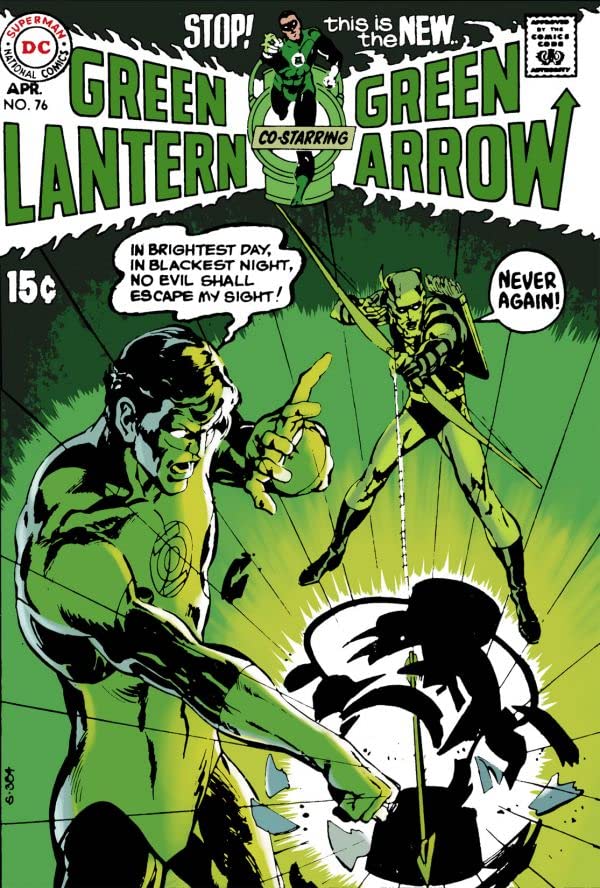
Green Lantern #76
☆ Be the first to review + Add to your collection — Join freeGreen Lantern #76 is the opening shot of what critics and historians broadly regard as the Bronze Age of American comics — the first mainstream superhero title to abandon escapist adventure in favor of direct engagement with poverty, systemic racism, and social injustice in contemporary America. Writer Denny O'Neil deliberately reimagined Hal Jordan as a symbol of establishment authority — a cosmic cop too obedient to his bosses to notice suffering on his own street — then used Oliver Queen's confrontational idealism to force that worldview into crisis, a storytelling engine that made ideological argument the engine of superhero drama rather than a backdrop. The famous scene in which an elderly Black man challenges Green Lantern on why he has helped beings of every alien skin color but never his own planet's Black citizens remains one of the most discussed single pages in DC history. The lead story, 'No Evil Shall Escape My Sight,' won both the Academy of Comic Book Arts Shazam Award and the Goethe Award for Best Individual Story, and the run it launched influenced virtually every 'socially relevant' comic that followed it.
In "No Evil Shall Escape My Sight!", Green Lantern confronts the harsh realities of urban poverty when Green Arrow brings him face-to-face with slumlord Jubal Slade’s victims. After the Guardians of the Universe reprimand Hal for breaking their rules, he defies them to gather proof and bring Slade to justice—only to find himself joined by a new ally, as the Guardians send a representative to guide their mission. Written by Denny O'Neil and brought to life with powerful, expressive art by Neal Adams (pencils and inks), this landmark issue captures a defining moment in the Green Lantern mythos, with a cover by Neal Adams that perfectly frames the story’s intensity.
ComicBooks.com Value
Show all 22 grades ▾
This exact issue on ebay
CGC 9.2 ▾ $2,495–$2,707 2 listings
CGC 8.5 ▾ $1,083–$1,160 3 listings
CGC 7.5 ▾ $654–$1,095 5 listings
CGC 6.5 ▾ $503–$565 2 listings
CGC 5.5 ▾ $389–$842 4 listings
CGC 4 ▾ $280–$500 2 listings
CGC 1.8 ▾ $150–$335 2 listings
Raw — VF ▾ $2.99–$1,100 4 listings
Raw — VERY FINE ▾ $3.99–$7.99 2 listings
Raw — FN ▾ $300–$500 3 listings
Raw — VG ▾ $108–$315 2 listings
Raw / ungraded ▾ $5–$475 11 listings
Read it digitally
Sell my copy
Have this issue — or a whole collection? Get a fair offer from us, skip the marketplace fees and the hassle.
We Buy Collections ▸History
By 1969, Green Lantern's solo title was faltering badly enough that editor Julius Schwartz considered cancellation; instead, he tasked O'Neil — a former journalist with firsthand experience of urban poverty in lower Manhattan — with overhauling the book around real-world issues. O'Neil proposed pairing Hal Jordan with Green Arrow, a character he had already been writing in Justice League of America and found more malleable for political debate; Schwartz approved, and Neal Adams — who had just redesigned Green Arrow's costume and given Oliver Queen his now-signature goatee in Brave and the Bold #85 — was assigned as artist, with Dick Giordano inking much of the run and Julius Schwartz editing throughout. CBR's 2020 retrospective notes that O'Neil was working full script and may not have known Adams had been assigned when he first wrote issue #76, underscoring how organically the partnership formed rather than being engineered from the top down.
Trivia · 8 facts
- Cover-dated April 1970; on sale February 24, 1970 per U.S. Copyright Office filings and a DC house ad.
- First appearance of Appa Ali Apsa — the Guardian of the Universe later known as 'the Old-Timer' — created by Denny O'Neil and Neal Adams; he subsequently joined Hal Jordan and Oliver Queen on their cross-country road trip through issues #76–#89.
- With this issue the cover logo changed to 'Green Lantern Co-Starring Green Arrow,' effectively launching what became known as the 'Hard-Traveling Heroes' era; the indicia retained 'Green Lantern' throughout the run.
- Written by Dennis O'Neil; penciled and cover-drawn by Neal Adams; inked by Frank Giacoia (issue #76 specifically); colored by Cory Adams; lettered by John Costanza; edited by Julius Schwartz.
- The story 'No Evil Shall Escape My Sight' won the 1970 Academy of Comic Book Arts Shazam Award for Best Individual Story and the 1971 Goethe Award for Favorite Comic-Book Story, with both O'Neil and Adams also taking individual craft awards.
- Green Arrow's speech to the Guardians — invoking the deaths of a 'good Black man' in Memphis (Martin Luther King, Jr.) and a 'good white man' in Los Angeles (Robert F. Kennedy) — is the in-story reason Appa Ali Apsa volunteers to experience mortal life, directly catalyzing the road-trip premise of the entire run.
- The issue has been reprinted extensively: in Green Lantern/Green Arrow #1 (1983), DC Silver Age Classics Green Lantern 76 (1992), Millennium Edition: Green Lantern 76 (February 2000), The Green Lantern/Green Arrow Collection (2000/2001), the 2004 and 2012 trade paperback editions, Showcase Presents: Green Lantern Vol. 5 (2011), and Absolute Green Lantern/Green Arrow (2016), among others.
- A notable recoloring occurred in the 1992 Hard-Traveling Heroes collection: the panel depicting Martin Luther King, Jr. and Robert F. Kennedy — originally rendered in black and pale blue — was recolored in a high-contrast red and yellow palette.
Cast · 6 characters
Full credits
Reprints
↩ Reprints Green Lantern #19 (1963)
Reprinted in Groene Lantaarn Classics #2720 (1971), Batman #601 (1971), Green Lantern and Green Arrow #1 (1972), Green Lantern Album #1 (1976), Green Lantern #25 (1978), Gigant #1/1979 (1979), Gigant #1/1979 (1979), Green Lantern / Green Arrow #1 (1983), Heróis em Ação #1 (1984), The Greatest Team-Up Stories Ever Told #[nn] (1989), Secret Origins of the World's Greatest Super-Heroes #[nn] (1990), The Greatest Team-Up Stories Ever Told #[nn] (1990), DC Silver Age Classics Green Lantern 76 #[nn] (1992), Hard-Traveling Heroes: The Green Lantern / Green Arrow Collection Volume One #[nn] (1992), Millennium Edition: Green Lantern 76 #[nn] (2000), Great American Comic Books #[nn] (2001), The Green Lantern / Green Arrow Collection #[nn] (2001), Green Lantern / Green Arrow #1 (2004), Green Lantern / Green Arrow #2 (2004), Showcase Presents: Green Lantern #5 (2011), DC Retroactive: Green Lantern - The '70s #1 (2011), Green Lantern / Green Arrow #[nn] (2012), Alter Ego #123 (2014), Green Lantern: A Celebration of 75 Years #[nn] (2015) + 7 more
Key issues in Green Lantern
Reviews
Reader reviews
No reader reviews yet.