
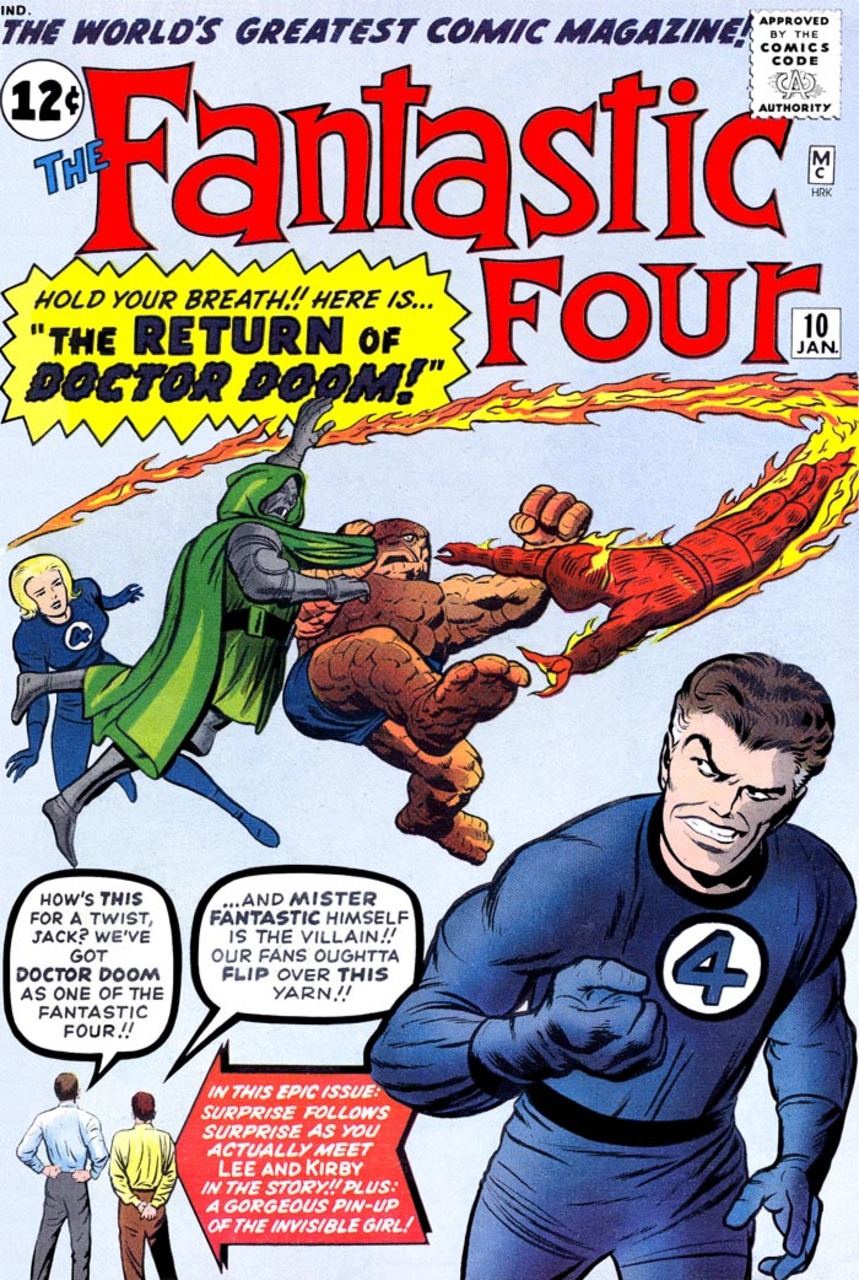
Fantastic Four #10
Fantastic Four #10 is the first comic book in mainstream American superhero publishing in which the real-world creators of the title — writer Stan Lee and artist Jack Kirby — appear as characters inside the story they are producing, casting themselves as the in-universe 'licensed' chroniclers of the FF's adventures. That fourth-wall collapse wasn't merely a gag: it formally established Marvel Comics as a real institution within Earth-616 continuity, a narrative conceit the company would exploit for decades and that later writer-artists such as Grant Morrison would cite as a foundational meta-comics gesture. The issue also deepens Doctor Doom's character significantly: scholar Ben Saunders has called it the best early Doom story, arguing that the body-swap plot reframes Doom as Mister Fantastic's 'Jungian shadow or distorted double,' adding psychological resonance that would define the villain's long-running rivalry with Reed Richards.
In "The Return of Doctor Doom!", the tyrannical Doom makes a shocking comeback, revealing how the Ovoids helped him return to Earth—only to use their technology to swap bodies with Mr. Fantastic. Written by Stan Lee and brought to life by Jack Kirby’s dynamic art, with inks by Dick Ayers and colors by Stan Goldberg, this 1963 classic sees the Fantastic Four face their most cunning foe yet, all under Kirby’s bold cover art.
In this classic 1963 tale from Fantastic Four #10, Doctor Doom makes a dramatic return—not from the battlefield, but from a surreal detour through space, arriving in the real world to confront Jack Kirby and Stan Lee, the creators who brought him to life. With a mix of menace and theatrical flair, he demands they set a trap for the Fantastic Four, blurring the line between fiction and reality in a story that’s as clever as it is unexpected.
In "Part 2 Back from the Dead!" from Fantastic Four #10 (1963), Doctor Doom reveals how the Ovoids brought him back to life, and with their alien technology, he orchestrates a shocking transformation—switching bodies with Mr. Fantastic. The story unfolds with a chilling precision, as Doom’s return sets the stage for a battle of wits and wills between two of Marvel’s most formidable minds.
In "Part 3 The End of Mr. Fantastic?", Doctor Doom returns from a mysterious journey in space, wielding Ovoid technology to swap bodies with Mr. Fantastic. While posing as the leader of the Fantastic Four, Doom demonstrates his new shrinking-ray, but the real Mr. Fantastic—now trapped in Doom’s form—fights to escape. As the team grapples with the deception, the truth of the body swap begins to unravel.
In "Part 4 No Place to Turn!", Doctor Doom returns from a mysterious journey in space with a shocking new plan—using Ovoid technology to swap bodies with Mr. Fantastic, tricking the rest of the team into believing he’s the real Reed Richards. With the Fantastic Four divided and their leader seemingly compromised, Doom’s deception puts the entire team on edge as he wields Mr. Fantastic’s shrinking-ray and sets a trap of his own. The battle for identity and control escalates as the true Mr. Fantastic fights to reclaim his body and stop Doom’s latest scheme—before it’s too late.
In "Part 5 The Real Doctor Doom!", the tyrant returns from his cosmic exile with a plan to outwit the Fantastic Four, using the mysterious Ovoids to engineer a body swap with Mr. Fantastic. Now posing as the team's leader, Doom demonstrates his new shrinking-ray while the real Mr. Fantastic flees from Doom’s castle in his stolen form. As the two battle for their true selves, the line between villain and hero blurs—until one final twist leaves Doom trapped in a size beyond reach.
ComicBooks.com Value
Show all 22 grades ▾
Find on ebay
Read it digitally
Sell my copy
Have this issue — or a whole collection? Get a fair offer from us, skip the marketplace fees and the hassle.
We Buy Collections ▸History
The issue was produced under the collaborative 'Marvel Method' that Lee and Kirby had developed on the Fantastic Four from its very first issue in November 1961 — Lee providing a plot outline or verbal conference, Kirby drawing the full story, and Lee then scripting the dialogue over finished art. The self-insertion premise appears to have grown organically from that working dynamic: a caption inside the story explicitly acknowledges that what readers are seeing is 'as far as Jack Kirby and I got with our story,' directly mirroring the way the two men actually constructed each issue. The issue carries a January 1963 cover date and a release/on-sale date of October 1962, with pencils by Jack Kirby, inks by Dick Ayers, colors by Stan Goldberg, and lettering by Artie Simek — a nearly complete credits record confirmed by the Grand Comics Database and the Marvel Fandom wiki.
Trivia · 8 facts
- Cover date: January 1963; on-sale date: October 1962. Pencils: Jack Kirby. Inks: Dick Ayers. Colors: Stan Goldberg. Letters: Artie Simek. Written and edited by Stan Lee.
- First appearance of Stan Lee and Jack Kirby as characters in the Marvel Universe — depicted as the licensed 'chroniclers' of the Fantastic Four in the in-story offices of Marvel Comics. Per the Official Handbook of the Marvel Universe A-to-Z #4, their appearances are treated as permanent Marvel continuity rather than topical references under the Sliding Timescale.
- Third appearance of Doctor Doom (first in FF #5, July 1962; second in FF #6). Doom's return is explained by his rescue from deep space by an alien race called the Ovoids — the first appearance of the Ovoids in Marvel continuity.
- Doom uses Ovoid mind-transfer technology to swap bodies with Reed Richards — the first use of a body-swap plot in the Fantastic Four series, and one of the earliest in Marvel superhero comics generally.
- Lee and Kirby appear on the cover as small figures alongside Mr. Fantastic — but their faces are never clearly shown inside the story; they are always depicted in shadow or otherwise obscured, a visual convention that continued in their future in-story cameos (e.g., Fantastic Four Annual #3).
- The story's title is 'The Return of Doctor Doom!' and runs 23 pages broken into five parts. An Invisible Girl pin-up by Kirby and Ayers also appears in the issue.
- The issue was first reprinted in Marvel Collectors' Item Classics #8 (April 1967) and has since been collected in Marvel Masterworks: The Fantastic Four Vol. 1 (1987 hardcover, reprinted multiple times), Essential Fantastic Four Vol. 1 (1998, black and white), the Fantastic Four Omnibus Vol. 1 (2005), and the digest-sized Mighty Marvel Masterworks: The Fantastic Four Vol. 1 (2021), among others.
- The Lee-and-Kirby-in-the-Marvel-offices device established by this issue became a recurring element of early Marvel storytelling, later echoed when the duo were famously turned away from Reed and Sue's wedding in Fantastic Four Annual #3 (1965), and was paid homage in the 2025 MCU film The Fantastic Four: First Steps.
Full credits
Reprints
Reprinted in Los 4 Fantásticos #10 (1963), Marvel Collectors' Item Classics #8 (1967), Fantastiske Fire og Edderkoppen #10/1968 (1968), Fantask #4 (1969), Marvel #6 (1970), I Fantastici Quattro #7 (1971), Hit Comics Die fantastischen Vier #230 (1971), The Mighty World of Marvel #11 (1972), The Mighty World of Marvel #20 (1973), The Mighty World of Marvel #21 (1973), Marvel Comics' The Fantastic Four #81445 (1977), Los Cuatro Fantásticos #9 (1980), Fantastic Four #224 (1980), Une Aventure des Fantastiques #24 (1981), Spider-Man #31 (1981), The Marvel Saga the Official History of the Marvel Universe #8 (1986), Marvel Masterworks #2 (1987), Marvel Masterworks: The Fantastic Four #[1] (1997), Marvel Klassik #4 (1998), Essential Fantastic Four #1 (1998), Biblioteca Marvel: Los 4 Fantásticos #02 (1999), Marvel Masterworks: The Fantastic Four #1 (2003), Fantastic Four Omnibus #1 (2005), Marvel Masterworks: The Fantastic Four #1 (2009) + 15 more
Key issues in Fantastic Four
 ★
★ ★
★ ★
★ ★
★ ★
★ ★
★ ★
★ ★
★Variants (1)
Reviews
Reader reviews
No reader reviews yet.