
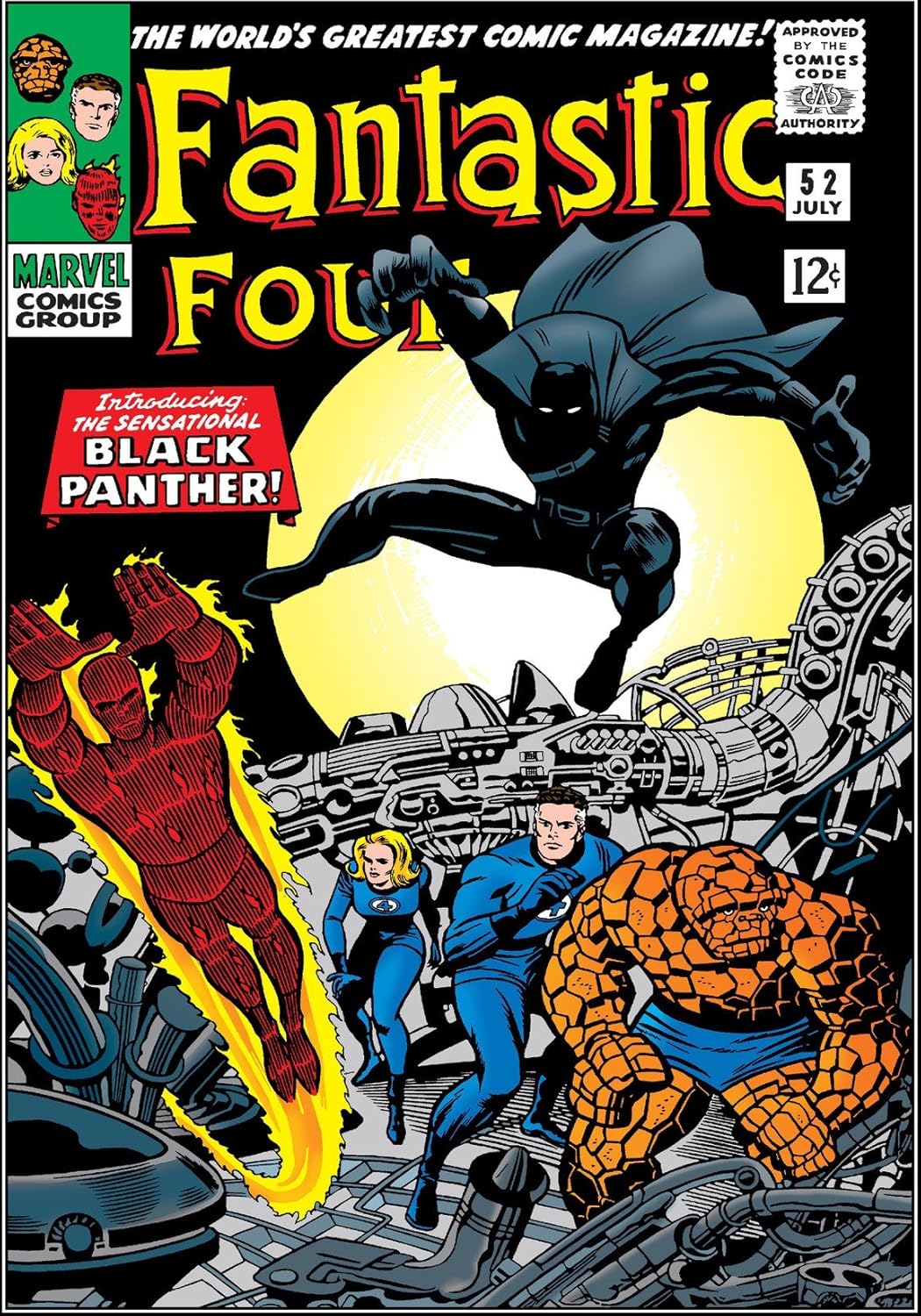
Fantastic Four #52
☆ Be the first to review + Add to your collection — Join freeFantastic Four #52 (July 1966) introduced T'Challa, the Black Panther — widely recognized as the first Black superhero in mainstream American comics — predating contemporaries such as the Falcon (1969), Luke Cage (1972), and DC's John Stewart (1971) by several years. The issue simultaneously debuted Wakanda, a fictional African nation built around advanced technology and the rare ore Vibranium, a concept that deliberately subverted the jungle-adventure stereotypes common to 1960s pop culture. Narratively, Lee and Kirby gave T'Challa one of the most confident introductions in Silver Age comics: he defeats each member of the Fantastic Four individually using intelligence, preparation, and Wakandan technology, establishing from the outset that he is their peer and not merely a guest character. The issue stands as a defining moment of the Marvel Silver Age and had lasting cultural reach, eventually inspiring a blockbuster MCU film franchise.
In "The Black Panther!", the Fantastic Four are summoned to the hidden nation of Wakanda, where they face a formidable challenger in the form of the Black Panther, who tests their strength with a surprise attack. Written by Stan Lee and Jack Kirby, with art by Jack Kirby and inks by Joe Sinnott, this landmark issue introduces one of Marvel’s most enduring figures in a story that blends adventure and mystery. The cover, by Jack Kirby and Joe Sinnott, captures the tension of the moment with striking detail.
ComicBooks.com Value
Show all 22 grades ▾
This exact issue on ebay
CGC 8.5 ▾ $2,900–$4,195 3 listings
CGC 7.5 ▾ $759–$1,660 4 listings
CGC 7 ▾ $1,200–$1,440 2 listings
CGC 6.5 ▾ $854–$3,160 7 listings
CGC 6 ▾ $578–$999 6 listings
CGC 5.5 ▾ $650–$875 4 listings
CGC 5 ▾ $660–$745 4 listings
CGC 4.5 ▾ $325–$600 6 listings
CGC 4 ▾ $376–$580 7 listings
CGC 3.5 ▾ $275–$495 5 listings
CGC 3 ▾ $350–$496 5 listings
CGC 2.5 ▾ $310–$359 3 listings
CBCS ▾ $515–$550 2 listings
Raw — GD ▾ $258–$555 4 listings
Raw / ungraded ▾ $150–$2,500 41 listings
Read it digitally
Sell my copy
Have this issue — or a whole collection? Get a fair offer from us, skip the marketplace fees and the hassle.
We Buy Collections ▸History
Both Stan Lee and Jack Kirby have claimed primary creative credit for Black Panther, and no documentation definitively resolves the dispute; research by journalist Asher Elbein suggests that by 1966 Kirby largely plotted Fantastic Four independently, explaining completed pages to Lee when they arrived at the Marvel offices. Kirby's earliest concept art used the working name 'Coal Tiger,' a swashbuckling character quite different from the published version, while Lee recalled that the final name was partly inspired by a pulp adventure hero whose companion was a black panther. There was measurable editorial hesitation at Marvel about launching a Black superhero — Lee reportedly had second thoughts about how prominent to make the character, previews of the issue omitted the cover entirely, and Kirby's original cover art showing T'Challa's exposed face was revised so that the published version features a full facemask. The creative team on the issue was writer/editor Stan Lee, penciller Jack Kirby, inker Joe Sinnott, colorist Stan Goldberg, and letterer Sam Rosen.
Trivia · 8 facts
- First appearance of T'Challa / Black Panther (Earth-616), the first Black superhero in mainstream American comics, in a story titled 'The Black Panther!' — cover-dated July 1966, on-sale April 12, 1966.
- First appearance of the fictional African nation of Wakanda and its advanced technology, including the Magnetic Wave Rider aircraft sent to the Fantastic Four as an invitation.
- First appearance of Wyatt Wingfoot, Johnny Storm's college friend, who plays a decisive role in the issue by disabling Wakandan communications and freeing the Human Torch, thus ending T'Challa's 'hunt.'
- The Inhumans royal family — Black Bolt, Medusa, Crystal, Karnak, Gorgon, and Maximus — appear in a subplot set within the Great Refuge, continuing the ongoing storyline of their imprisonment behind a Negative Zone barrier.
- Creative credits: script by Stan Lee, pencils by Jack Kirby, inks by Joe Sinnott, colors by Stan Goldberg (uncredited in the original printing), letters by Sam Rosen; Stan Lee also served as editor.
- Kirby's original concept name for the character was 'Coal Tiger'; the published version features a full facemask, revised from Kirby's original cover art that showed T'Challa's face.
- The story concludes on a cliffhanger — T'Challa unmasks and reveals he has invited the FF for a 'grave task' — with his origin and the Vibranium/Klaw backstory deferred to Fantastic Four #53 (August 1966).
- Notable reprints and facsimiles include Marvel's Greatest Comics #39 (November 1972), a True Believers: King in Black – Black Panther #1 one-shot, and multiple Facsimile Edition printings, most recently in January 2026.
Cast · 12 characters
Full credits
Reprints
Reprinted in HIP Comics #1914 (1967), Marvelserien #4 (1967), Hit Comics #14 (1967), Los 4 Fantásticos #79 (1967), Marvel's Greatest Comics #39 (1972), I Fantastici Quattro #48 (1973), Une Aventure des Fantastiques #3 (1974), The Mighty World of Marvel #111 (1974), The Mighty World of Marvel #112 (1974), Fantastic Four Pocket Book #5 (1980), Los Cuatro Fantásticos #50 (1980), Los 4 Fantásticos #29 (1980), Une Aventure des Fantastiques #41 (1986), The Best of Marvel Comics #1 (1987), Marvel Masterworks: The Fantastic Four #[6] (2000), Essential Fantastic Four #3 (2000), Black Panther #36 (2001), Marvel Masterworks: The Fantastic Four #6 (2004), Black Panther by Jack Kirby #1 (2005), Marvel's Greatest Comics: Fantastic Four #52 #[nn] (2006), Fantastic Four : L'intégrale #1966 (2007), Fantastic Four Omnibus #2 (2007), Black Panther: Who Is the Black Panther #[nn] (2009), Marvel Masterworks: The Fantastic Four #6 (2011) + 19 more
Key issues in Fantastic Four
 ★
★ ★
★ ★
★ ★
★ ★
★ ★
★ ★
★ ★
★Variants (1)
Reviews
Reader reviews
No reader reviews yet.