
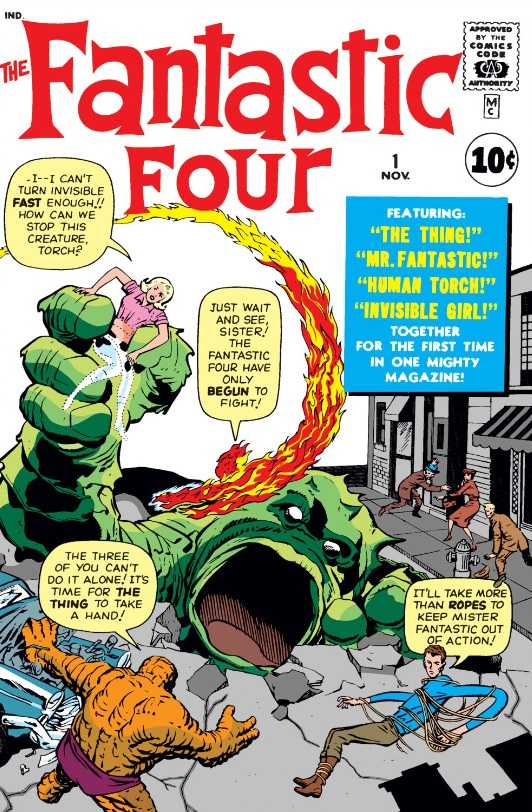
Fantastic Four #1
Fantastic Four #1 is broadly regarded as the opening chapter of what became known as 'the Marvel Age of Comics,' establishing the fictional universe that would eventually encompass Spider-Man, the Avengers, the X-Men, and hundreds of other characters. Where previous superhero teams were collections of idealized paragons, Reed Richards, Sue Storm, Johnny Storm, and Ben Grimm argued, held grudges, and operated without secret identities — a template of flawed, recognizably human characters that reshaped how the entire medium thought about superhero storytelling. The issue also introduced the 'Marvel Method' of production to mainstream comics, a writer-artist collaboration style in which the penciler plotted the action while the writer added dialogue afterward, a workflow that became industry standard within a year. Its success directly persuaded a disillusioned Stan Lee to remain in comics rather than leave the field, a decision without which the Silver Age Marvel Universe might never have been built.
In "The Fantastic Four!", four strangers—Jo, Reed, Sue, and Ben—find themselves drawn together after a mysterious signal from Mr. Fantástico in Central City. Their lives change forever when a secret space flight exposes them to cosmic rays, granting them extraordinary abilities and launching them into a new destiny as the world’s first superhero team.
In "The Fantastic Four Meet the Mole Man!", the team investigates a string of vanished atomic plants, leading them to Monster Isle—where they descend into a hidden underground realm. There, Reed and Johnny are captured by the Mole Man, a tormented, half-blind exile from the surface world who blames humanity for his suffering. As the Mole Man reveals his intentions, Ben and Sue race to save their teammates, setting off a desperate escape from a collapsing underground kingdom.
In "The Moleman's Secret!", the Fantastic Four race to uncover the source behind mysterious atomic plant disappearances, tracking the pattern to the ominous Monster Isle. There, a cave-in plunges Reed and Johnny into the underground world of the Moleman—a tormented, half-blind survivor of the surface who blames humanity for his exile. As he reveals his bitter intentions, the team must find a way to survive his underground domain before he fulfills his final, destructive plan.
ComicBooks.com Value
Show all 21 grades ▾
This exact issue on ebay
Raw / ungraded ▾ $1.99–$69.95 13 listings
More listings for this title
- Samurai Comics · 4 locations8 on eBay ↗
- CollegeComix.com · Athens, GA1 on eBay ↗
- JAF Comics · Bethlehem, PA1 on eBay ↗
- The 616 Comics LLC · Mantua Township, NJ1 on eBay ↗
Read it digitally
Sell my copy
Have this issue — or a whole collection? Get a fair offer from us, skip the marketplace fees and the hassle.
We Buy Collections ▸History
Publisher Martin Goodman directed editor Stan Lee to create a superhero team after noticing strong sales on DC's Justice League of America, which had debuted in 1960. Lee, who had grown creatively restless after two decades at the company and was contemplating leaving comics entirely, decided to write the kind of story he himself would enjoy — resulting in characters who were flawed and emotionally complex rather than archetypal. Jack Kirby, who had prior experience with ensemble adventure books including Challengers of the Unknown at DC, collaborated with Lee using what became the 'Marvel Method': Lee provided a synopsis, Kirby laid out and penciled the pages as co-plotter, and Lee then scripted the dialogue over the finished art. The issue carries a cover date of November 1961 but was released on August 8, 1961, with coloring by Stan Goldberg (a credit not publicly confirmed until 2011) and lettering by Artie Simek; the identity of the inker remains genuinely disputed, with contemporary research pointing to George Klein as primary inker — contradicting a later claim from Jack and Roz Kirby that Artie Simek had inked the issue.
Trivia · 8 facts
- First appearances and origins of all four core team members: Mister Fantastic (Reed Richards), Invisible Girl (Susan Storm), Human Torch (Johnny Storm), and the Thing (Ben Grimm).
- First appearance and origin of the Mole Man (Harvey Elder), the team's inaugural villain, who commands an army of subterranean monsters from Monster Isle.
- First appearance of Giganto, the massive subterranean creature depicted attacking on the cover; the creature is unnamed within this issue — the name 'Giganto' was not applied until a West Coast Avengers story published in 1990.
- Written by Stan Lee, penciled by Jack Kirby, colored by Stan Goldberg, and lettered by Artie Simek; cover date November 1961, on-sale date August 8, 1961.
- The story is structured as three chapters — 'The Fantastic Four!', 'The Fantastic Four Meet the Mole Man!', and 'The Mole Man's Secret!' — and delivers the team's cosmic-ray origin as a flashback within an already-in-progress adventure.
- The Fantastic Four wore blue-and-white flight suits in the original printing; all subsequent reprints and in-story flashbacks depicted the more familiar purple-and-blue suits.
- The origin's framing — Reed racing to beat the Soviets in the space race — reflected real Cold War anxieties of 1961 and has been repeatedly updated or retconned in later retellings to remain accessible to modern readers.
- The issue has been collected in numerous formats including Fantastic Four Annual #7 (1969), Marvel Masterworks: The Fantastic Four Vol. 1 (first edition 1987, fourth edition 2023), Origins of Marvel Comics (1974), and a facsimile Golden Book and Record Set (1966), as well as being included in the Penguin Classics library, signaling its recognition as a work of enduring literary and cultural significance.
Cast · 5 characters
Full credits
Reprints
Reprinted in Los 4 Fantásticos #1 (1962), Fantastic Four Annual #1 (1963), Creepy Worlds #32 (1964), The Fantastic Four #72-111 (1966), The Fantastic Four [Golden Book and Record Set] #[nn] (1966), Supplemento di Linus #[3] (1966), Smash! #28 (1966), Wham! #112 (1966), Fantastiske Fire #1/1968 (1968), Fantask #1 (1969), Los 4 Fantásticos #1 (1969), Fantastic Four Annual #7 (1969), Hit Comics #129 (1969), Marvel #1 (1970), L'Incredibile Devil #4 (1970), I Fantastici Quattro #1 (1971), The Mighty World of Marvel #1 (1972), The Mighty World of Marvel #2 (1972), FOOM Magazine #1 (1973), Une Aventure des Fantastiques #2 (1973), Die Fantastischen Vier #1 (1974), Die Fantastischen Vier #2 (1974), Fantastic Four #1 (1974), Origins of Marvel Comics #[nn] (1974) + 36 more
Key issues in Fantastic Four
 ★
★ ★
★ ★
★ ★
★ ★
★ ★
★ ★
★ ★
★Variants (1)
Reviews
Reader reviews
No reader reviews yet.