
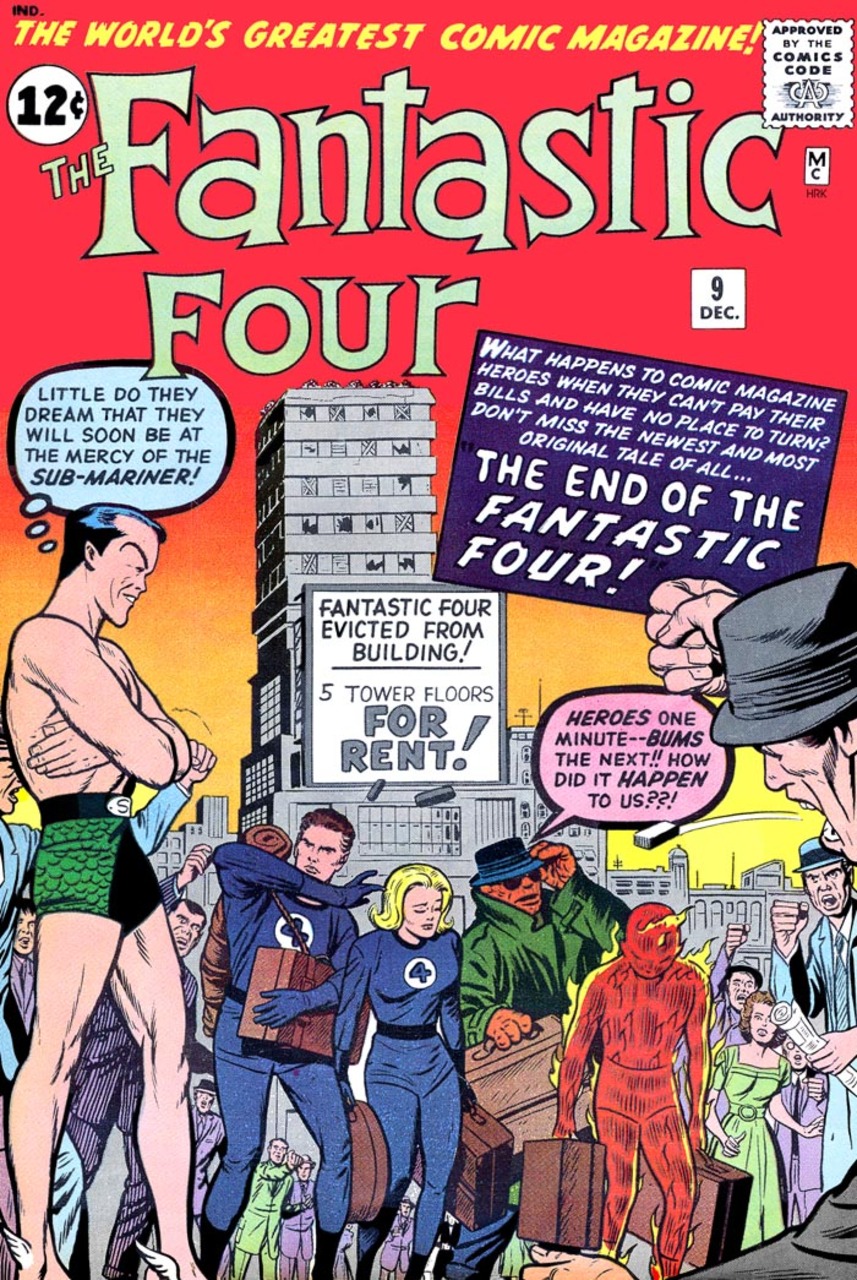
Fantastic Four #9
Fantastic Four #9 is one of the earliest Silver Age comics to treat superheroes as real-world celebrities burdened by actual financial hardship — the team literally declares bankruptcy and has to hitchhike to Hollywood — a tonal innovation that set Marvel apart from the wish-fulfillment heroics of its competitors. The story deepens the Namor-Sue Storm romantic tension that Lee and Kirby had been seeding since issue #4, giving the series its most emotionally layered chapter to that point and cementing the love triangle as a recurring dramatic engine. Beyond the story itself, the issue holds a quiet but consequential place in publishing history: it was the first Fantastic Four issue — and one of the first Marvel comics of the era — to carry full, formal creator credits in print, a small act of transparency that would become the industry norm and is now a touchstone in debates about the Marvel Method and creator attribution. Taken together, these elements make it a genuine turning point in how superhero comics handled character economics, romantic complexity, and professional accountability.
In "The End of The Fantastic Four!", the team faces financial ruin when the Sub-Mariner offers them a million dollars to star in his film—only for Mr. Fantastic and the Human Torch to uncover the scheme behind the camera. As the production unfolds, the Fantastic Four find themselves caught in a web of deception, with the Sub-Mariner's true intentions hidden beneath the spotlight.
In "Part 2 Sub-Mariner Gives the Orders!", the Fantastic Four find themselves broke and desperate—until the Sub-Mariner swoops in with a tempting offer: a million dollars to star in his film. As Mr. Fantastic, Human Torch, and Thing dig into the project, they uncover a web of deception beneath the glittering surface. The film gets made, and though the Sub-Mariner isn’t thrilled, he pays up—leaving the team with more than just cash.
In "Part 3 The Fury of Mr. Fantastic," the Fantastic Four face financial ruin as the Sub-Mariner exploits their desperation, offering a million dollars to star in a film he’s producing. When Mr. Fantastic uncovers the project is a trap, the team must navigate deception and danger—only to find the Sub-Mariner, despite his schemes, ultimately paying up.
In "Part 4 The Flame of Battle," the Fantastic Four, struggling with financial ruin, are approached by the Sub-Mariner with a tempting offer: a million dollars to star in his film. As Mr. Fantastic uncovers the truth behind the project, the team realizes they’ve been drawn into a scheme far more dangerous than a simple cash grab. With the film finally rolling, the Sub-Mariner finds himself forced to pay up—though not before the stakes have been raised in ways no one expected.
In "Vengeance Is Ours! Part 5," Namor defeats the Thing when the creature briefly reverts to his human form. Back at the studio, Namor tries to marry the Invisible Girl, but she rejects him, furious at his deception. As she prepares to face him alone, the rest of the Fantastic Four arrive to avenge her—only for Sue to step forward and defend Namor. He promises the film will be made and their payment secured, then departs for his underwater realm. Weeks later, the Fantastic Four are celebrated for the film’s unexpected success.
ComicBooks.com Value
Show all 22 grades ▾
This exact issue on ebay
CGC 5 ▾ $349–$525 4 listings
CGC 4 ▾ $329–$495 2 listings
Raw / ungraded ▾ $2.67–$589 12 listings
Read it digitally
Sell my copy
Have this issue — or a whole collection? Get a fair offer from us, skip the marketplace fees and the hassle.
We Buy Collections ▸History
Written by Stan Lee and penciled by Jack Kirby with inks by Dick Ayers, the issue went on sale September 4, 1962 and carried a December 1962 cover date — part of the book's early bimonthly schedule. It arrived just nine issues into Marvel's still-fragile superhero revival, when Lee was still actively working out how to differentiate the line from DC's more staid offerings; placing the team in genuine financial peril and shipping them off to a Hollywood con run by Namor was a direct expression of that restless experiment. Notably, it was at this precise moment — publications dated late 1962 — that Lee began regularly including formal story credits in Marvel titles, and Fantastic Four #9 is one of the documented early examples of those credits appearing in print, listing not only script and pencils but also letterer Artie Simek, though colorist Stan Goldberg was still omitted.
Trivia · 8 facts
- Published with a December 1962 cover date; on-sale date was September 4, 1962 — part of the series' original bimonthly shipping schedule.
- Written by Stan Lee, penciled by Jack Kirby, inked by Dick Ayers, colored by Stan Goldberg, and lettered by Artie Simek — the full production team is now documented, but Goldberg's coloring credit was omitted from the printed issue.
- One of the earliest Marvel comics to carry formal, printed story credits listing the creative team by name, a milestone in transparency that comic historians cite as a benchmark in the adoption of creator credits across the industry.
- The story — titled 'The End of the Fantastic Four!' — is the first in the series to place the team in outright financial ruin: creditors repossess their equipment and the heroes are forced to hitchhike to Los Angeles in costume.
- Features the third Silver Age appearance of Namor the Sub-Mariner (following Fantastic Four #4 and #6), here cast as the secretly villainous owner of 'SM Studios,' who funds his Hollywood enterprise with sunken Atlantean treasure.
- First appearance of a creature identified as 'Cyclops' (a Deviant mutate, per later Marvel Saga continuity) and of an unidentified tribe of fire-immune African natives — both debuting as antagonists staged as film opponents.
- Kirby populated the Hollywood studio scenes with caricatures of real 1962 celebrities — including Alfred Hitchcock, Bob Hope, Bing Crosby, Jackie Gleason, James Arness, and Charles Bronson — in one of his most discussed attempts at celebrity likenesses.
- The issue has been reprinted in Marvel Masterworks: Fantastic Four Vol. 1 (first edition 1987), the Fantastic Four Omnibus Vol. 1 (2005), the Fantastic Four Epic Collection Vol. 1 (2014), and the Taschen/TASCHEN-adjacent Marvel Comics Library: Fantastic Four Vol. 1, 1961–1963 oversized edition, among other collections.
Full credits
Reprints
Reprinted in Los 4 Fantásticos #9 (1963), Marvel Collectors' Item Classics #6 (1966), Wham! #139 (1967), Wham! #141 (1967), Fantastiske Fire og Edderkoppen #9/1968 (1968), Fantask #3 (1969), Fantask #4 (1969), Fantask #7 (1969), HIP Classics #19154 (1970), Hit Comics Die fantastischen Vier #223 (1970), Estréia! (1ª Série) [Quarteto Fantástico] #13 (1971), I Fantastici Quattro #6 (1971), The Mighty World of Marvel #10 (1972), The Mighty World of Marvel #18 (1973), The Mighty World of Marvel #19 (1973), The Complete Fantastic Four #26 (1978), Iron Man #[nn] (1980), Los Cuatro Fantásticos #8 (1980), Fantastic Four #224 (1980), Une Aventure des Fantastiques #24 (1981), Une Aventure des Fantastiques #26 (1981), The Marvel Saga the Official History of the Marvel Universe #8 (1986), Marvel Masterworks #2 (1987), Marvel Masterworks #6 (1988) + 23 more
Key issues in Fantastic Four
 ★
★ ★
★ ★
★ ★
★ ★
★ ★
★ ★
★ ★
★Variants (1)
Reviews
Reader reviews
No reader reviews yet.