
Fantastic Four #5
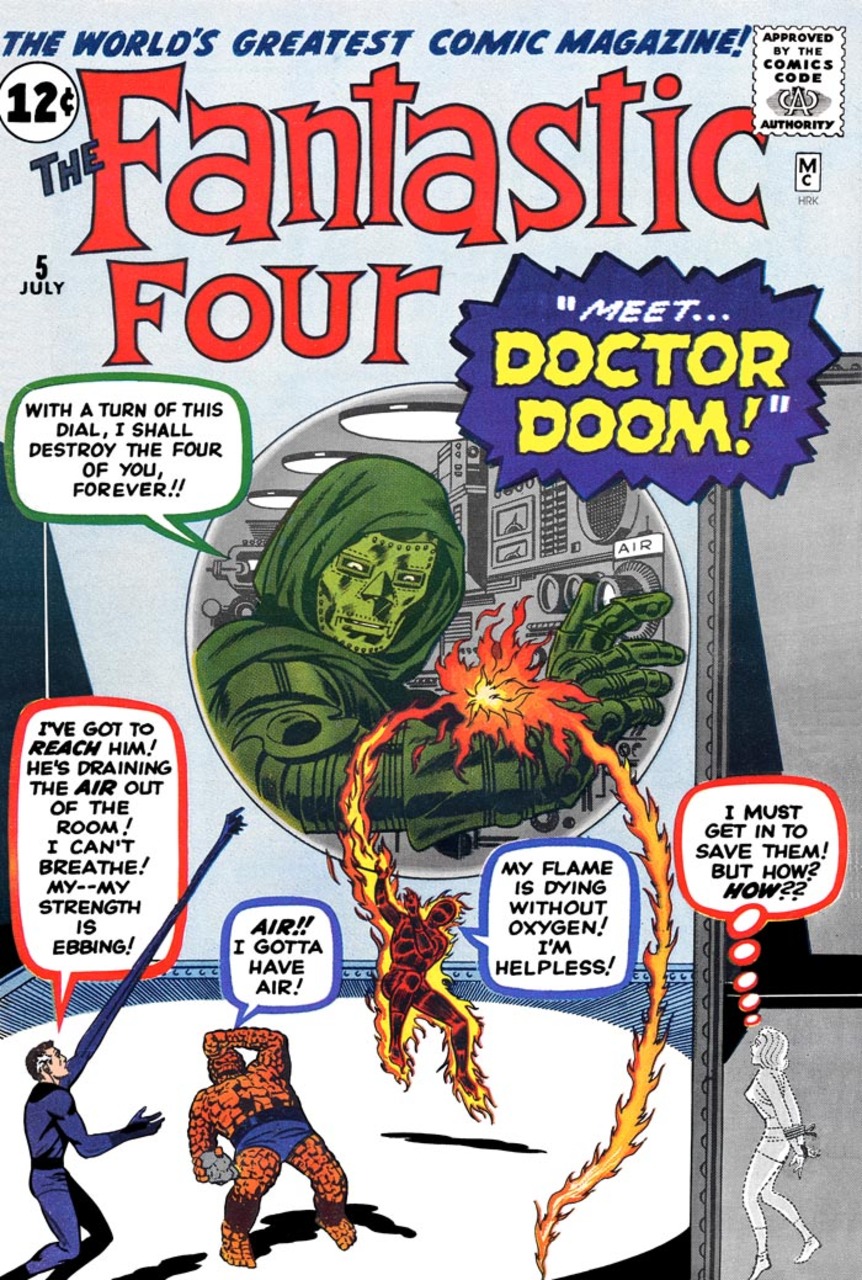
Fantastic Four #5 is the debut of Doctor Doom — Victor Von Doom — who would go on to become not only the Fantastic Four's defining archnemesis but one of the most richly developed villains in the history of superhero comics. By grounding Doom's hatred of Reed Richards in a shared college past and a disfiguring experiment, Stan Lee and Jack Kirby gave the Silver Age a villain whose menace was rooted in personal tragedy and wounded pride rather than simple evil, setting a new template for antagonist complexity. The issue also introduces the first use of Doom's time platform in Marvel storytelling, sending Reed, Johnny, and Ben back to the age of pirates — an audacious genre mashup that demonstrated the Fantastic Four title's appetite for narrative ambition only five issues in. It further deepened Marvel's emerging shared universe by having Johnny Storm read an in-story issue of The Incredible Hulk, a playful continuity flourish that underscored the interconnected world Lee and Kirby were building.
In "Prisoners of Doctor Doom! Part 1," the Fantastic Four find themselves trapped in the tyrant's castle, where Doctor Doom sets them on a wild temporal mission to recover Blackbeard's lost treasure. With Jack Kirby's dynamic art and Stan Lee's sharp storytelling, this pivotal issue kicks off a high-stakes adventure that blends time travel, danger, and the team's unbreakable bond—cover by Kirby and Sinnott.
In "Prisoners of Doctor Doom! Part 1," the Fantastic Four are captured by the cunning Doctor Doom, who holds the Invisible Girl hostage to ensure their cooperation. Trapped in his American fortress, Mister Fantastic, the Thing, and the Human Torch are sent back to the age of piracy to retrieve Blackbeard’s lost treasure, while the Invisible Girl remains behind to face Doom’s schemes. As the team struggles to survive the past and evade Doom’s traps, a daring escape begins—though the villain’s fate remains uncertain.
In "Part 2 Back to the Past!" from Fantastic Four #5 (1962), Doctor Doom traps the Fantastic Four in his American castle stronghold and sends the Torch, the Thing, and Mr. Fantastic hurtling through time to steal Blackbeard’s legendary treasure—before the team can figure out how to stop him.
In "Part 3 On the Trail of Blackbeard," the Fantastic Four are trapped in a fortress by the cunning Le Docteur Fatalis, who holds the Invisible Girl hostage to control them. Sent back to the age of pirates, the Thing, the Human Torch, and Mister Fantastic must navigate treacherous seas and the legend of Blackbeard, with the Thing even taking on the guise of the infamous pirate himself. As the team races to recover the treasure, Fatalis prepares a deadly ambush—only for the Invisible Girl to intervene and foil his plans, forcing him to flee with his jetpack.
In "Part 4 Battle!", the Fantastic Four are trapped in a high-stakes showdown when Le Docteur Fatalis takes the Invisible Girl hostage to control her teammates. Forced into his fortress, the team is split—Mister Fantastic, the Thing, and the Human Torch sent back to pirate-era times to steal Blackbeard’s treasure, while the Invisible Girl fights to stay free. As the past collides with the present, the team must survive the Doctor’s deadly traps, and the Invisible Girl’s courage may be the only thing standing between them and total defeat.
In "Part 5 The Vengeance of Doctor Doom!", Doctor Doom takes the Invisible Girl hostage to force the Fantastic Four to obey him, luring them to his fortress in the United States. He sends the Human Torch, the Thing, and Mister Fantastic back to the age of the pirate Blackbeard to retrieve a legendary treasure, while the Thing assumes Blackbeard’s identity aboard a ship in the 17th century. As Doom prepares to eliminate the team upon their return, the Invisible Girl intervenes to save them—only for Doom to escape using his jetpack.
ComicBooks.com Value
Show all 21 grades ▾
This exact issue on ebay
CGC 7.5 ▾ $7,440–$20,000 2 listings
CGC 7 ▾ $6,299–$27,000 2 listings
CGC 6 ▾ $13,000–$16,495 3 listings
CGC 5 ▾ $7,150–$9,500 4 listings
CGC 4.5 ▾ $6,500–$7,800 2 listings
CGC 4 ▾ $6,465–$8,100 5 listings
CGC 3.5 ▾ $5,000–$8,978 5 listings
CGC 3 ▾ $4,550–$10,100 4 listings
CGC 2.5 ▾ $500–$2,850 2 listings
CGC 2 ▾ $3,900–$4,900 4 listings
CGC 1.8 ▾ $3,999–$4,555 4 listings
CGC 1 ▾ $3,850–$3,950 2 listings
CGC 0.5 ▾ $2,053–$3,499 4 listings
CGC ▾ $1,500–$1,680 2 listings
Raw / ungraded ▾ $2.5–$6,000 13 listings
More listings for this title
Read it digitally
Sell my copy
Have this issue — or a whole collection? Get a fair offer from us, skip the marketplace fees and the hassle.
We Buy Collections ▸History
With the Fantastic Four series performing well, Lee and Kirby deliberately set out to create what they called a 'soul-stirring…super sensational new villain' to elevate the book further. Lee settled on the name 'Doctor Doom' for what he described as its eloquence and implied menace, while Kirby — drawing on Alexandre Dumas's The Man in the Iron Mask — conceived the armored, masked figure as a visual embodiment of approaching death, with the cold steel deliberately erasing all human mercy. Because of the pace of early Silver Age production, the character's background was condensed to just five panels in this debut; a fuller origin tracing his Romani heritage and Latverian monarchy would not arrive until Fantastic Four Annual #2, two years later. The issue was released on April 10, 1962, with a July 1962 cover date, pencilled by Kirby, inked by Joe Sinnott, colored by Stan Goldberg, and lettered by Artie Simek.
Trivia · 8 facts
- First appearance and origin of Doctor Doom (Victor Von Doom), writer/penciler: Stan Lee and Jack Kirby, inker: Joe Sinnott — released April 10, 1962, cover-dated July 1962.
- First appearance of Doctor Doom's time platform, used here to send Reed Richards, Johnny Storm, and Ben Grimm back to the era of Blackbeard the pirate.
- First appearance of a Doombot (a robot duplicate of Doctor Doom), deployed by Doom to deceive the Fantastic Four during their escape attempt.
- The story is split across five titled chapters: 'Prisoners of Doctor Doom!', 'Back to the Past!', 'On the Trail of Blackbeard', 'Battle!', and 'The Vengeance of Doctor Doom!'
- Ben Grimm (The Thing) adopts the disguise and identity of Blackbeard the pirate during the time-travel sequence — a fan-favorite subplot that would be revisited and expanded in later Marvel continuity.
- Johnny Storm is shown reading an issue of The Incredible Hulk at the story's opening, an early example of Marvel's self-referential shared-universe storytelling; the Thing dismisses the Hulk as 'a comic book monster.'
- A letter praising the title's continuity, printed in this issue's letters column, was written by Roy Thomas — who would later become a Fantastic Four writer himself.
- Doom's compressed debut origin — a forbidden university experiment, an explosion, and disfigurement — was substantially expanded in Fantastic Four Annual #2 (1964), which established his Romani heritage, the nation of Latveria, and his self-imposed Tibetan exile. The full story has since been collected in Marvel Masterworks: Fantastic Four Vol. 1 (1987) and the Fantastic Four Omnibus Vol. 1.
Cast · 9 characters
Full credits
Reprints
Reprinted in Los 4 Fantásticos #5 (1963), Creepy Worlds #36 (1964), Fantastic Four Annual #2 (1964), Supplemento di Linus #[5] (1967), Fantastiske Fire #5/1968 (1968), Fantask #1 (1969), Fantask #2 (1969), I Fantastici Quattro #3 (1971), The Mighty World of Marvel #10 (1972), The Mighty World of Marvel #11 (1972), The Mighty World of Marvel #9 (1972), Bring on the Bad Guys: Origins of the Marvel Comics Villains #[nn] (1976), Bring on the Bad Guys: Origins of the Marvel Comics Villains #[nn] (1976), Marvel Comics' The Fantastic Four #81445 (1977), The Fantastic Four #1 (1979), Une Aventure des Fantastiques #22 (1980), Strange Spécial Origines #172 (1984), The Marvel Saga the Official History of the Marvel Universe #3 (1986), Marvel Masterworks #2 (1987), The Very Best of Marvel Comics #[nn] (1991), Marvel Milestone Edition: Fantastic Four #5 #[nn] (1992), Fantastic Four Classic #3 (1993), Marvel Masterworks: The Fantastic Four #[1] (1997), Marvel Klassik #4 (1998) + 34 more
Key issues in Fantastic Four
 ★
★ ★
★ ★
★ ★
★ ★
★ ★
★ ★
★ ★
★Variants (1)
Reviews
Reader reviews
No reader reviews yet.