
A complete issue · 67 pages · 1922
Captain Billy's Whiz Bang #36
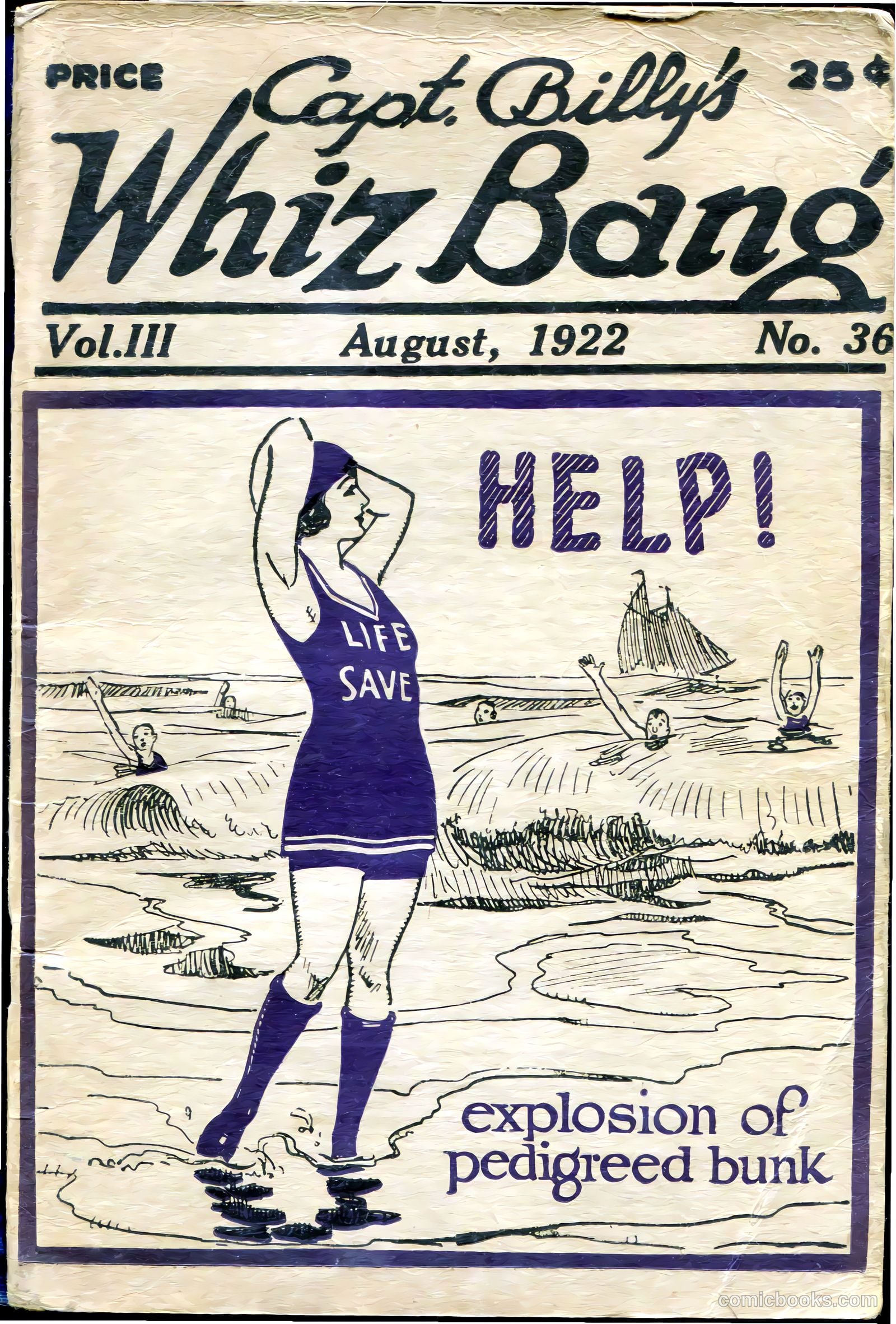
This is the cover of *Captain Billy's Whiz Bang*, an August 1922 satirical magazine. The illustration depicts a female lifeguard in a bathing suit frantically signaling for help on a beach, surrounded by drowning swimmers. The caption reads "explosion of pedigreed bunk," suggesting the cover satirizes exaggerated or false alarm-raising—likely referencing sensationalist media coverage of the era. The lifeguard's dramatic distress ("HELP!") contrasts with the mundane beach scene, implying the satire targets overwrought, manufactured crises or panic-mongering presented as legitimate emergencies. The "pedigreed bunk" phrase suggests mocking false claims presented with authority or respectability. Without additional context, the specific 1922 event or trend being lampooned is unclear, but the magazine's humor relies on exposing hype and dishonest sensationalism.
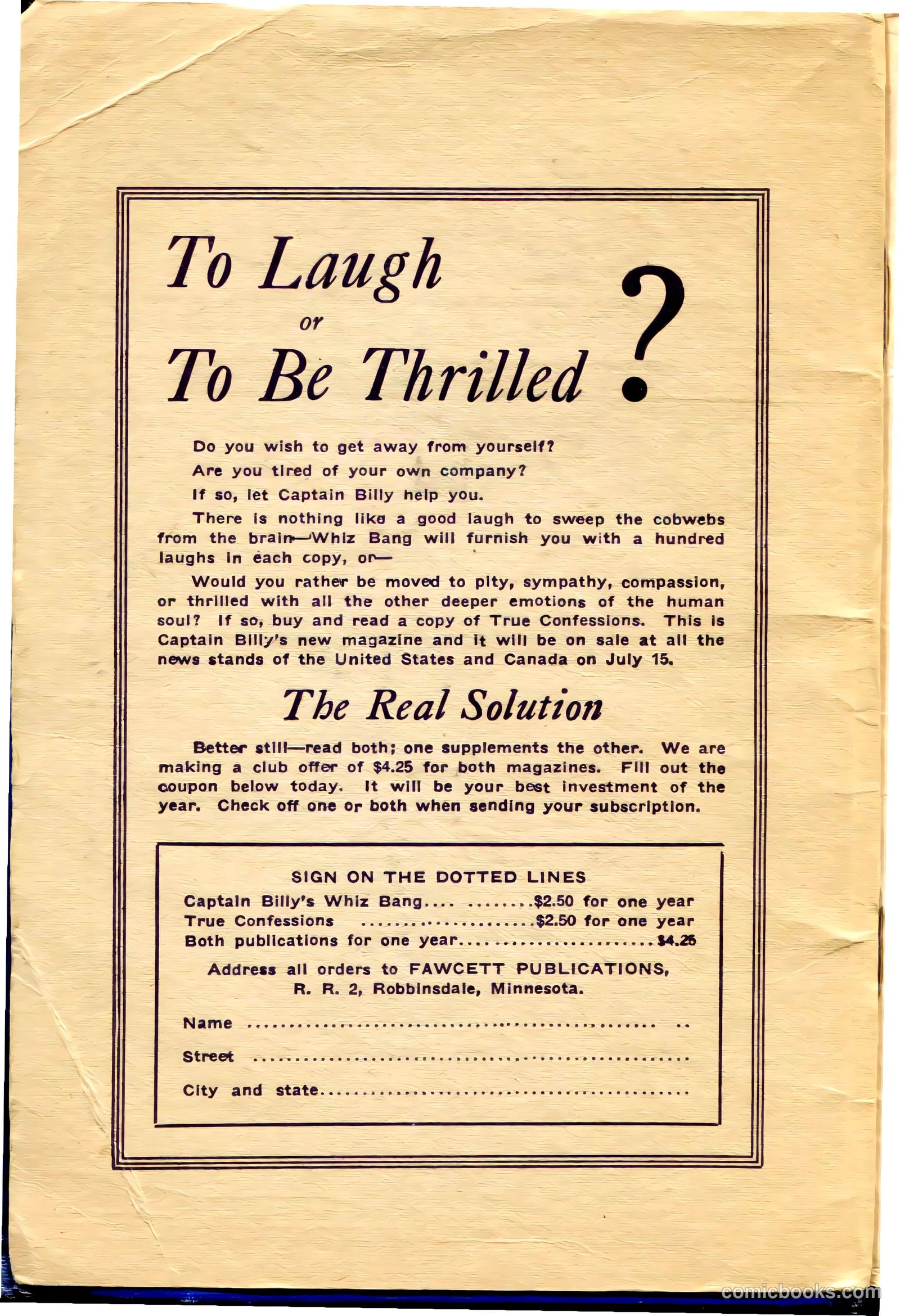
This page is primarily **advertising copy**, not a cartoon. It promotes two magazines published by "Captain Billy" (likely referring to Captain Billy Fawcett, founder of Fawcett Publications): *Whiz Bang* (a humor magazine) and *True Confessions* (a confessional/emotional interest magazine). The pitch presents a false choice to readers: do you want **laughter** or **emotional thrills**? The text suggests both magazines together offer the complete entertainment solution for escaping one's mundane life. A "$4.25 club offer" bundles year-long subscriptions to both publications. The advertisement reflects 1920s-era magazine marketing—emphasizing escapism and emotional gratification as selling points. No specific political satire or cartoon figures appear; this is purely a subscription solicitation page.
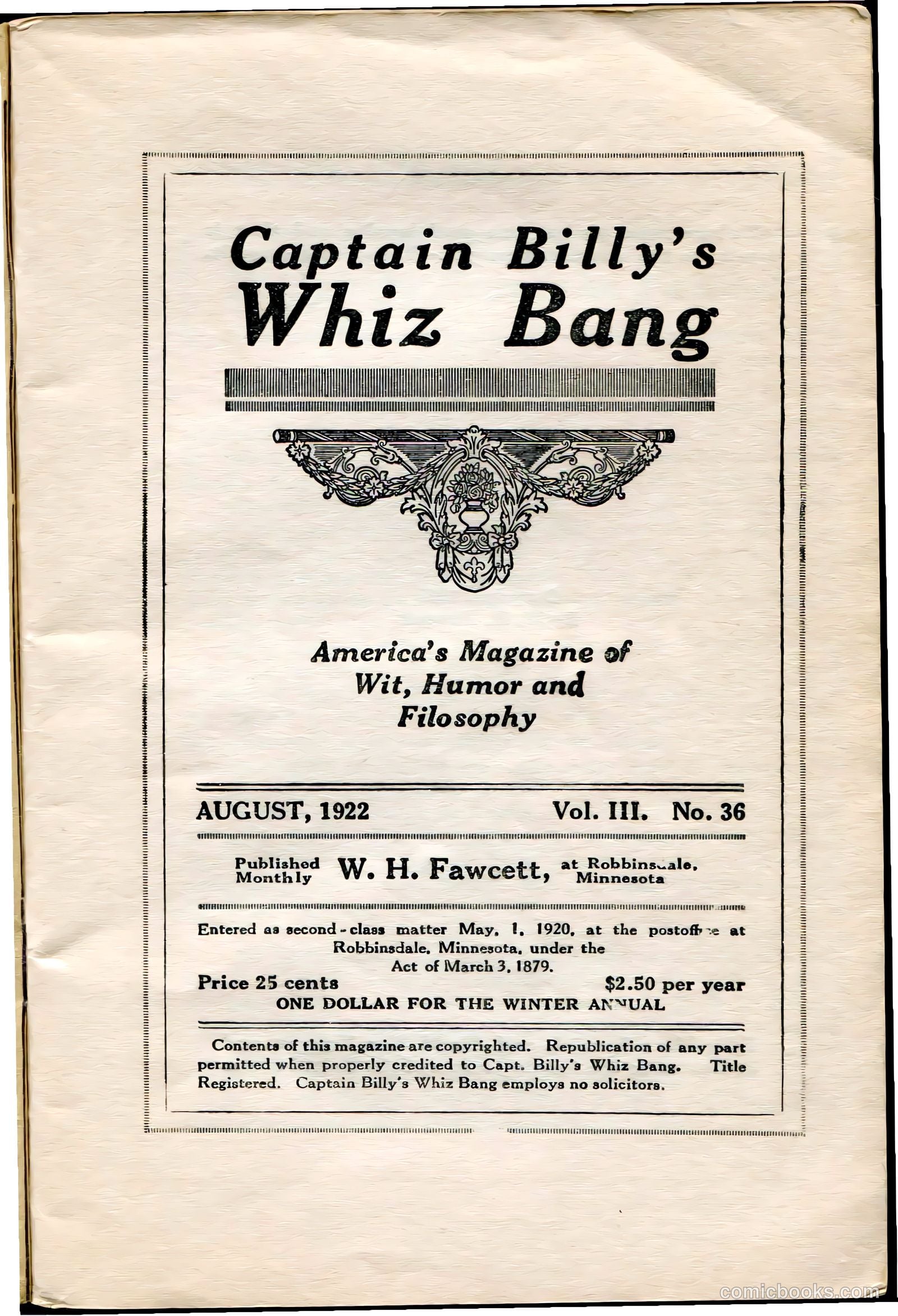
This is the **title page** of Captain Billy's Whiz Bang magazine from August 1922. The page contains no cartoon or satirical content to analyze—it functions solely as front matter. The publication, edited by W.H. Fawcett in Robbinsdale, Minnesota, is described as "America's Magazine of Wit, Humor and Philosophy." The ornamental header design is purely decorative. Notable details: the magazine cost 25 cents per issue or $2.50 yearly, employed no solicitors, and had registered its title. The copyright notice indicates content was strictly controlled. Without seeing the magazine's interior pages, we cannot identify any political or social satire present in this particular issue.
This is a title page from *Whiz-Bang* magazine (1922), a satirical publication. The page features a Theodore Roosevelt quote emphasizing single-minded patriotic loyalty to Americans rather than competing allegiances—likely a jab at immigrants, hyphenated-Americans, or political factions the editor viewed as insufficiently patriotic. The magazine credits W.H. Fawcett as copyright holder and notes the editor is a Spanish-American War and World War I veteran. This framing positions the publication as patriotic and pro-military, suggesting its satire and commentary would reflect nationalist, pro-armed forces perspectives typical of early 1920s American magazines.
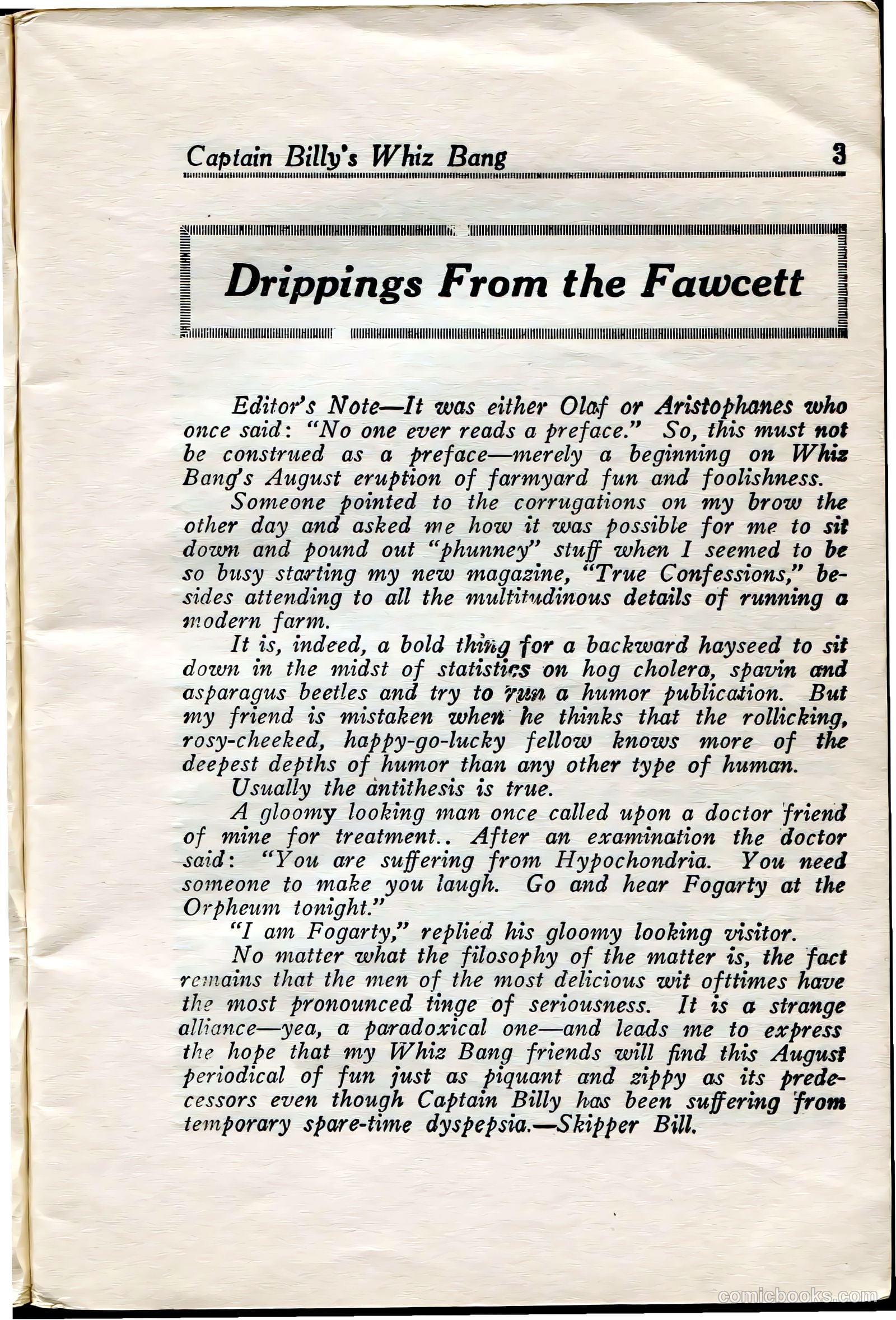
This is a **title page and editor's note** from *Captain Billy's Whiz Bang*, a popular American humor magazine of the 1920s. Rather than containing a cartoon, it features the editor's (Captain Billy Fawcett's) defensive explanation about why he can produce humorous content while managing multiple ventures, including the magazine itself and a new publication called *True Confessions*. The editor uses a self-deprecating persona ("backward hayseed") to preempt criticism about his divided attention. The inserted anecdote about "Fogarty"—likely referencing a real entertainer—illustrates the editor's philosophy: that the funniest people are often serious or melancholic by nature, a paradox meant to explain why he can produce jokes despite his current digestive troubles ("dyspepsia"). The tone is jovial but also somewhat defensive about juggling multiple publishing projects simultaneously.
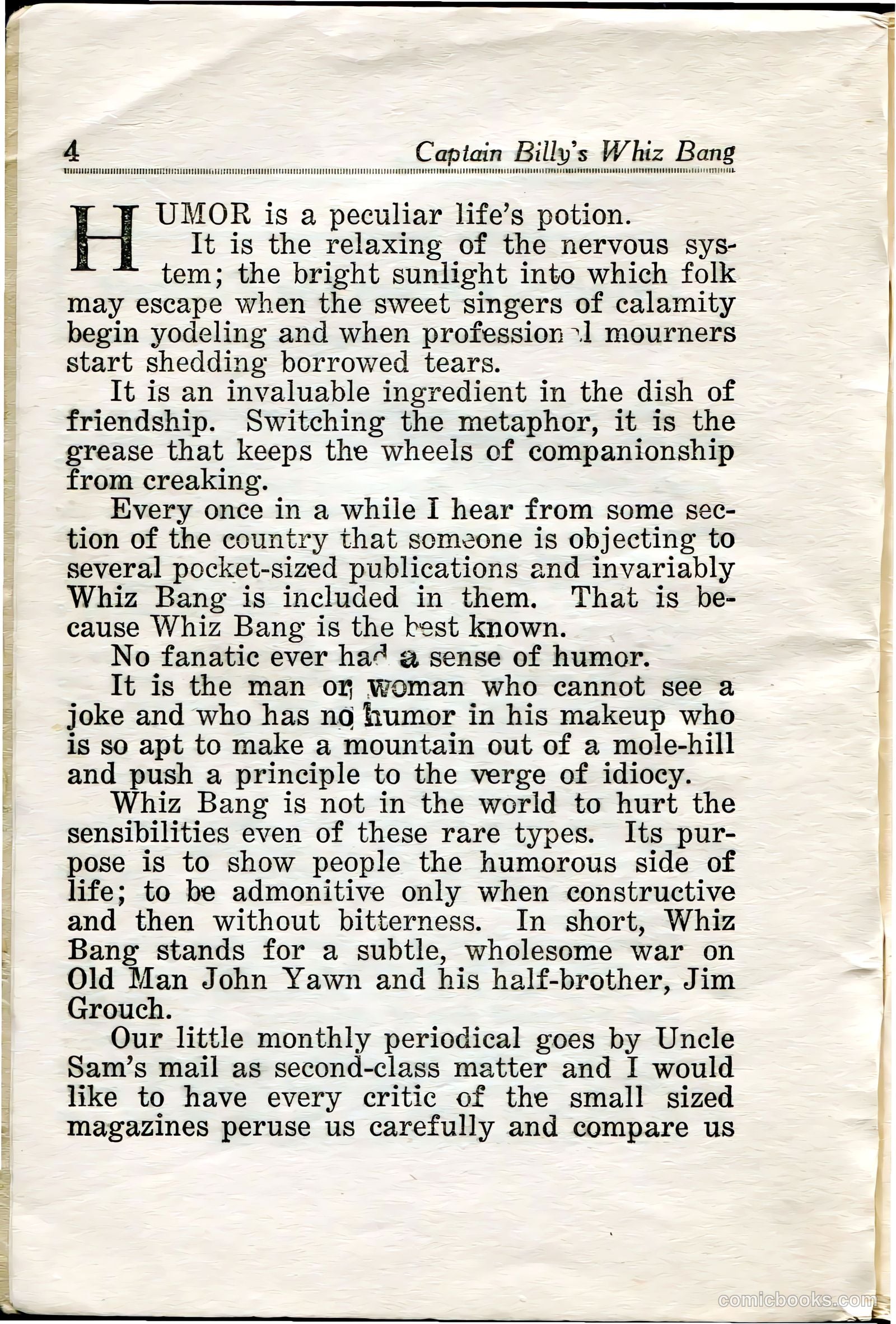
This is an editorial statement defending *Whiz Bang* magazine against censorship attempts. The page contains no cartoon, but rather a prose defense of humor's value. The text argues that humor serves as psychological relief during hardship and strengthens friendship. It acknowledges that *Whiz Bang*—a pocket-sized satirical magazine—is frequently targeted by censors alongside other small publications, attributing this to the magazine's prominence. The author defends the publication's purpose: to highlight life's humorous side without malice or offense, targeting "Old Man John Yawn and his half-brother, Jim Grouch" (personifications of boredom and grumpiness). The editorial takes a dig at "fanatics" who lack humor and overreact to minor issues. Finally, it appeals to critics to examine *Whiz Bang* fairly alongside comparable magazines, noting it qualifies for second-class postal rates.
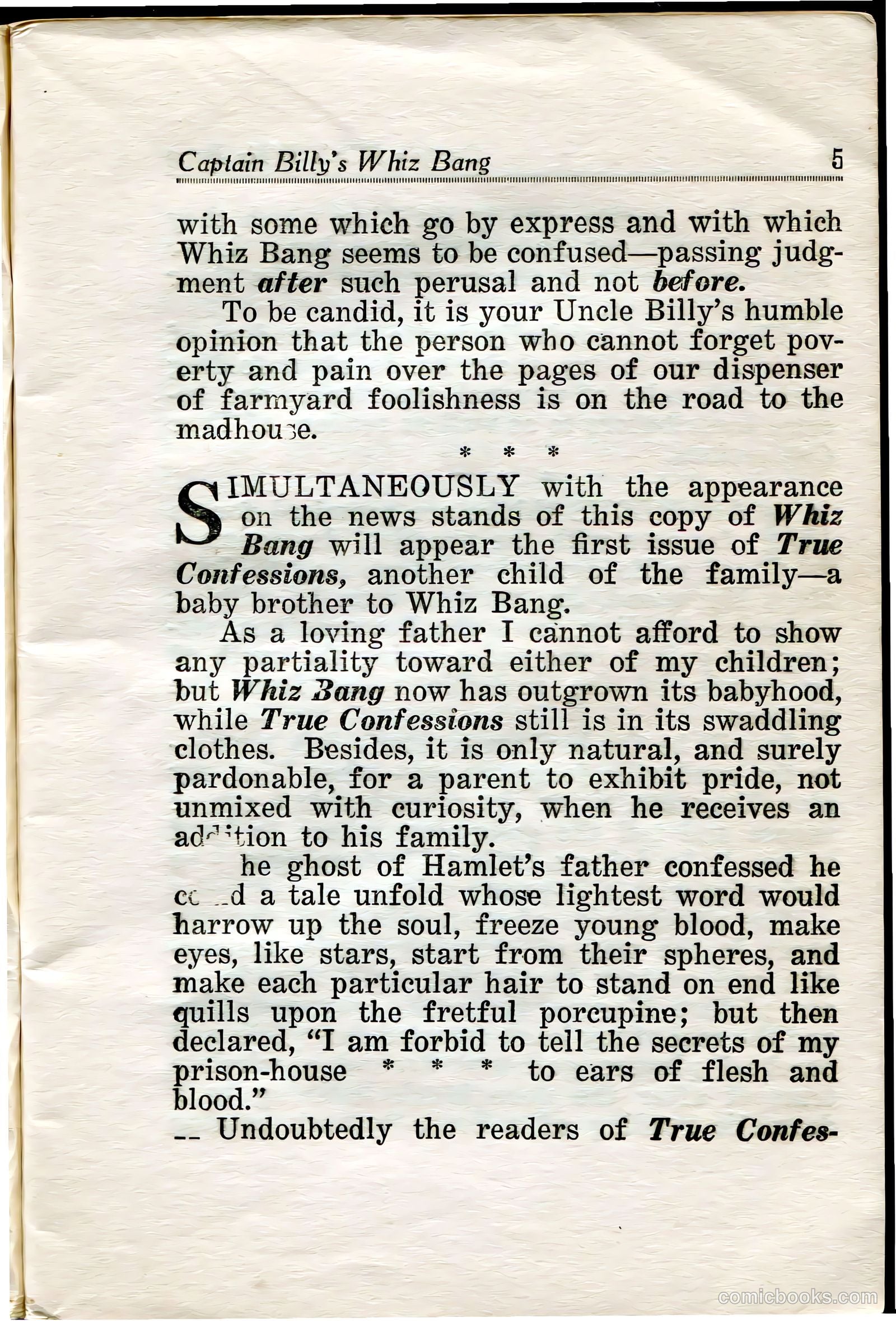
This is an editorial announcement, not a political cartoon. The unnamed author (likely editor "Captain Billy") promotes two magazines under his publishing family: the established *Whiz Bang* (a humor/satire publication) and its new sister magazine *True Confessions*, launching simultaneously. The satire uses a *Hamlet* reference—the ghost's famous speech about unspeakable horrors—to joke about *True Confessions*' sensational content. By comparing the new magazine to Hamlet's father's forbidden secrets, the editor humorously suggests readers will encounter shocking confessions too scandalous to repeat. The point: *Whiz Bang* claims lighthearted "farmyard foolishness" won't depress readers, while *True Confessions* will traffic in darker, more sensational human drama. The Shakespearean allusion adds mock-literary dignity to what was actually pulp magazine marketing.
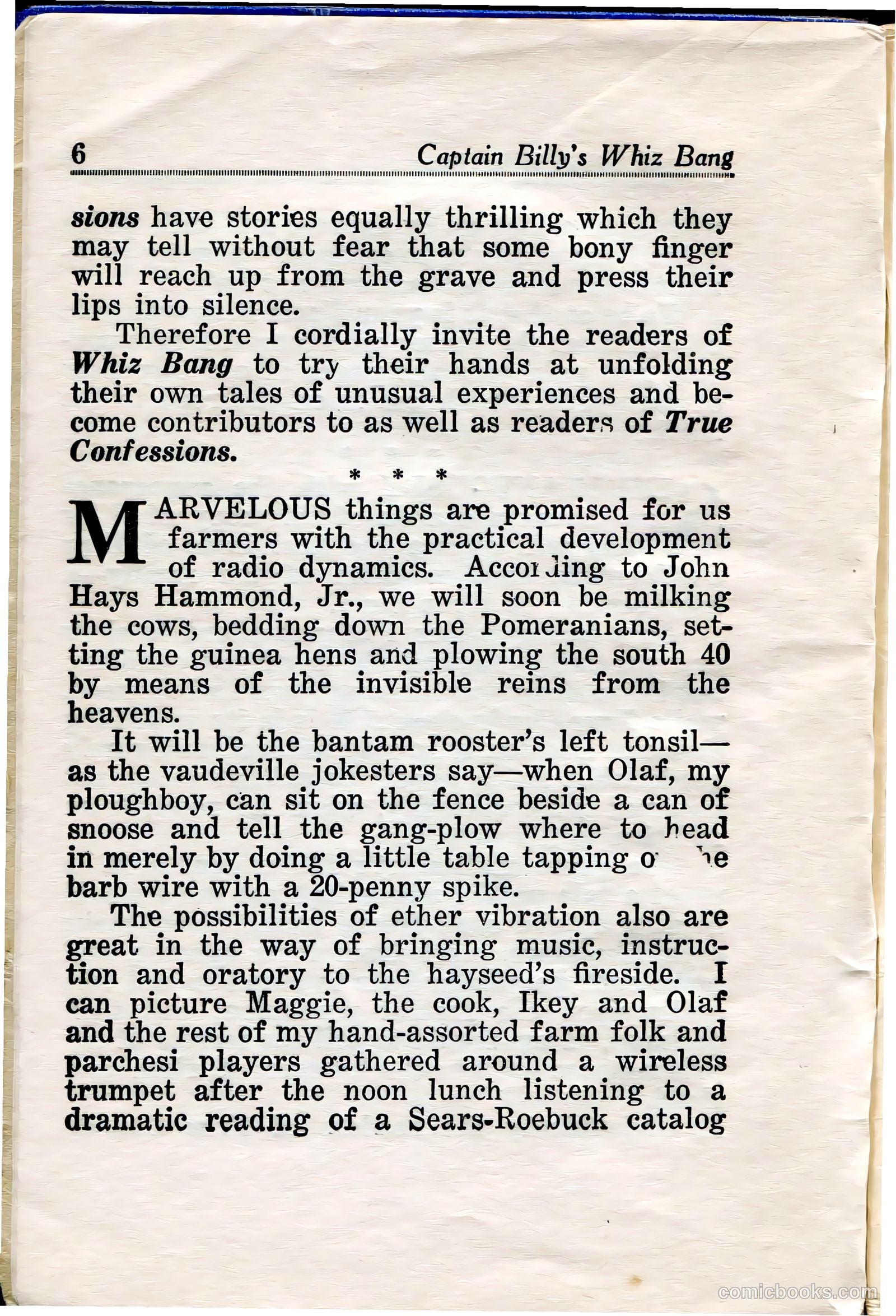
This is a humorous editorial mocking the overhyped promises of early radio technology (circa 1920s). The author sarcastically celebrates John Hays Hammond Jr.'s predictions that radio will revolutionize farming—cows milked, fields plowed, and animals managed remotely via "invisible reins from the heavens." The satire targets both technological utopianism and rural life stereotypes. References to "Olaf" (the ploughboy), "snoose" (snuff tobacco), and farm workers like Maggie the cook invoke the hardscrabble Scandinavian-American farmhand archetype common in period humor. The punchline—farm workers gathering to hear a *Sears-Roebuck catalog* read aloud over a "wireless trumpet"—deflates grand technological promises by imagining the most mundane possible rural use of this miraculous invention. The joke: cutting-edge radio technology will arrive on farms only to deliver the most utterly tedious content imaginable.
This is satirical commentary on early radio technology's promised impact on rural life, circa 1920s. The author mocks both grandiose predictions about wireless revolutionizing farming and the pretensions of wealthy Los Angeles oil magnates. **The satire targets:** - Scientists' overconfidence about radio solving agricultural drudgery - The absurd contrast between humble farm life and ostentatious wealth (Turkish rugs, Pan statues playing saxophones on thermoses) - A character named "Maggie" depicted doing brutal farmwork with brooms **Key references:** - "Paine's ring-tail spasms" (unclear specific reference, likely a period colloquialism for absurdity) - Robert Henderson: an actual oil industry contact of the author - Robbinsdale: the author's rural Minnesota home The humor lies in deflating both technological utopianism and material excess, ultimately asserting humble country values ("home is where your heart is") over conspicuous consumption—a characteristic populist stance for *Whiz Bang*, a working-class humor magazine.
This page from the satirical magazine contains three brief humorous items: 1. **Radio technology satire**: Mocks newfangled radio inventions (radio plowing, radio furnaces, self-cranking ouija boards) as absurd, while acknowledging the nuisance of amateur radio operators' midnight broadcasts. The reference to W.J. Bryan—a populist political figure—suggests criticism of old-fashioned rhetoric in a modern age. 2. **Women's fashion joke**: A quip about women wearing expensive stockings but only displaying the cheaper portion, playing on vanity and the cost of women's clothing during this era. 3. **Native American marriage anecdote**: A stereotype-laden story about an Ojibwe couple from Leech Lake Reservation in Minnesota who marry for practical warmth-sharing rather than romance or property. The humor relies on dated racial caricatures and dialect ("Him got blanket"), presenting Indigenous people as simple or unsentimental. The page reflects 1920s-era humor: technophobic, focused on gender and class, and heavily reliant on ethnic stereotypes now considered offensive.
This is a humorous rural essay with no visible cartoon imagery. The piece satirizes farm life and early-morning country sounds through comedic anecdotes. The narrator encounters his Swedish farmhand Olaf mysteriously listening outside at night. When asked what he's doing, Olaf cryptically replies he's "listening to the cook 'Oo'"—a pun on the cuckoo bird's call. The joke plays on the double meaning: actual cuckoo birds versus the sound itself. The essay then catalogs the cacophony of farmyard dawn—roosters, flickers, blackbirds, wrens, jays, sparrows, and mockingly, "Pedro junior" (likely a bird) "calling to his twenty wives." The final anecdote about Irish farmhand Ikey illustrates the mosquito plague: so distracted by listening to nighttime bird calls he's sleep-deprived and disoriented, absurdly scratching his hot cakes and pouring syrup down his back instead of eating. The satire gently mocks rural life's chaotic sounds and the eccentricities of immigrant farmworkers.
This page from *Captain Billy's Whiz Bang* (a humor magazine) contains a humorous anecdote about "Ikey," a Jewish farm-hand identified by ethnic stereotype ("Hebrew hay handler"). The joke involves: **The Setup:** Ikey is tricked into betting $10 on his game cock against neighbor Sol Markee's eagle. The eagle wins decisively, damaging Ikey's rooster and costing him money. **The Punchline:** Later, at a bridge game, when Ikey plays poorly (fails), his bridge partner asks why. Ikey responds defensively: "Don't drag in business"—meaning, don't blame his bad card play on his recent financial loss. **The Satire:** The humor relies on stereotyping (the "Jewish" character as shrewd but unlucky, the con-artist neighbor), rural Americana (Robbinsdale, game cocks), and wordplay. The magazine's appeal to 1920s American readers involved ethnic humor now considered offensive, though the joke's structure—a man embarrassed about money troubles—remains recognizable.
This is a satirical humor column from *Whiz Bang*, a 1920s American comedy magazine. The page collects brief jokes and observations mocking contemporary social trends: **Jeffries/Ferris joke**: References boxer James J. Jeffries and an associate creating a "liberal religion" allowing wine, tobacco, and dancing. The joke satirizes both the loosening of Prohibition-era restrictions and the commercialization of religion. **Flapper fashion**: Mocks rural readers' unfamiliarity with 1920s women's fashion (the "flapper" bobbed-hair, short-skirt look), suggesting farms were culturally isolated from urban trends. **College money-asking**: Humorously suggests colleges teach young men to extract money from parents so skillfully that parents feel honored to give it. **Hair net**: The final quip compares romantic entanglement to catching fish—a woman's "hair net" (attraction) catches foolish men. Overall, the column reflects *Whiz Bang's* rural American perspective, mixing nostalgia for farm life with gentle mockery of modern urban fashions, religious practices, and generational dynamics.
This page from the satirical magazine contains three brief humorous items with no visible cartoons or caricatures: 1. **A sentimental toast** about friendship's tears, submitted by a female reader. 2. **A joke about Deacon Callahan**, a rural neighbor. When offered advice about New York sightseeing, he cleverly reverses the offer, asking instead what to *avoid*—a witty deflation of tourist guidance. 3. **Commentary on the short skirt controversy**, a major 1920s social debate. The piece cites English sources showing overwhelming preference for short skirts over long ones. Lady Diana Manners's quoted quip—that skirt length depends on intended activity—is presented as clever pragmatism, mocking the earnestness of the debate. The satire suggests the controversy itself is absurd, as practicality should determine fashion, not ideology. The page's humor relies on American rural common sense and gentle mockery of British formality.
This is satirical commentary on summer reading habits and pulp fiction. The opening toast objectifies a woman named Mary, hoping her skirt will reveal her legs—typical of 1920s flapper-era humor. The main article mocks lightweight summer novels, claiming readers don't want to "think" during warm months. It parodies absurd B.V.D. (underwear brand) plot devices with an intentionally ridiculous plot synopsis: a worthless rich boy (Algernon/"Algy") fights an undertaker over whether babies hallucinate milk snakes from drinking, the undertaker falls 243 feet but climbs back up a thread, Algy elopes with a judge's daughter in a taxi, crashes on South Sea islands, finds a marriage license in Cracker Jack, and marries in an airplane while sitting on a beer keg. The satire targets the absurdity and moral looseness of popular cheap fiction aimed at young couples ("flapper's fiancé"), particularly the casual treatment of alcohol, elopement, and scandalous behavior that real society condemned but pulp magazines sensationalized for summer entertainment.
This page from **Captain Billy's Whiz Bang** (a humor magazine) contains several brief satirical pieces: 1. **Opening serial narrative**: A comedic story fragment about hanging someone named "Algernon," interrupted by a battleship (USS Arostook) under "Skipper Douglas," offering absurdist humor typical of the magazine's style. 2. **Kissing advice**: Mock-serious commentary defining proper mouth width for kissing—satirizing relationship advice columns. 3. **Pun on appearance**: A play on words equating cups/mugs with faces, joking about an attractive woman as a "loving cup." 4. **Margot Asquith commentary**: The author discusses British socialite Margot Asquith's American tour memoir with amusement, quoting her description of St. Louis reception including photographers and the mayor—likely poking fun at celebrity worship and self-important memoir-writing. The page exemplifies Whiz Bang's irreverent, pun-heavy humor mixing absurdist fiction with satirical social commentary.
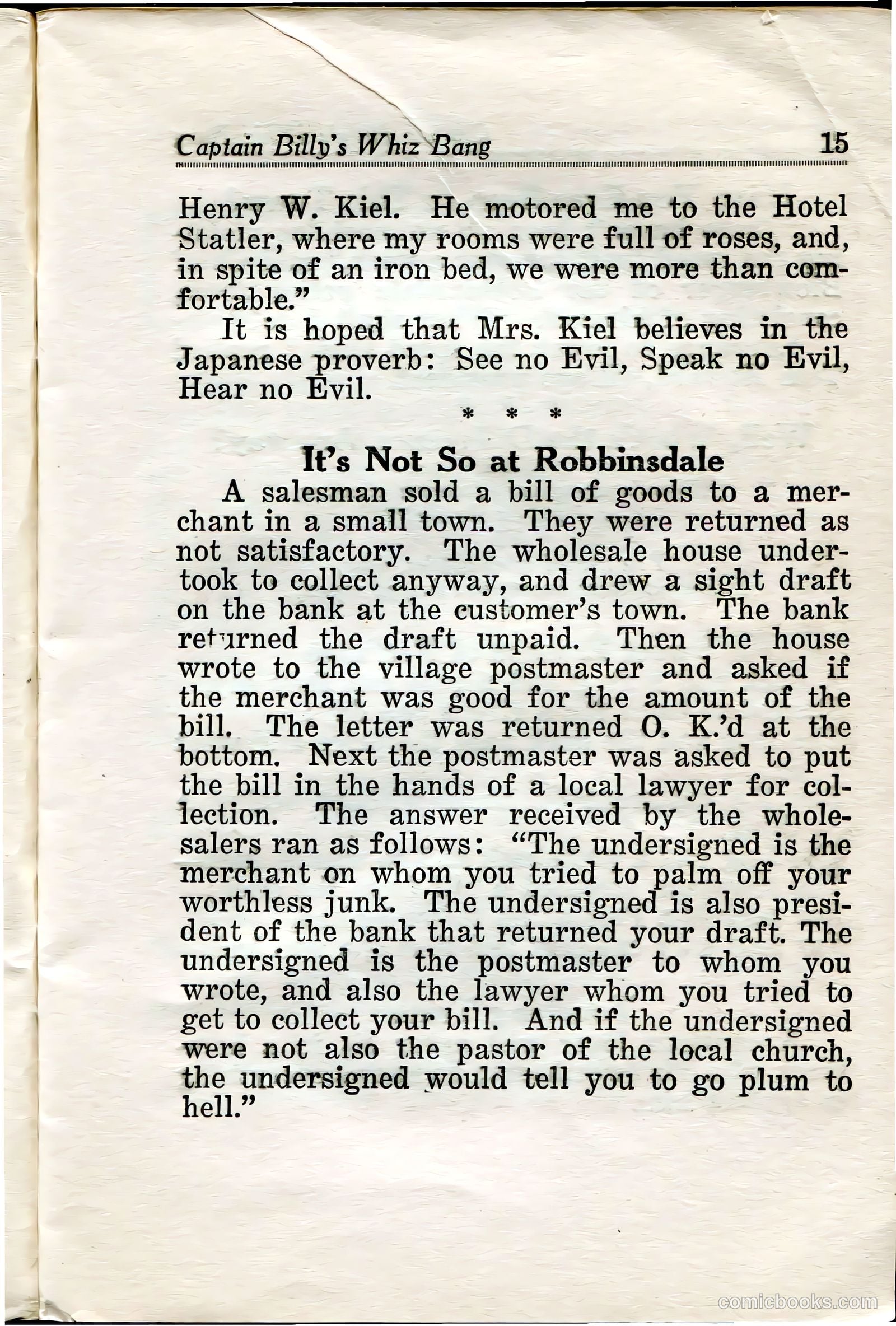
This anecdote satirizes small-town power consolidation and the futility of debt collection against a well-connected merchant. A wholesaler attempts to collect payment for rejected goods through multiple official channels—bank draft, postmaster inquiry, and lawyer—only to discover the merchant IS all those channels: the merchant, bank president, postmaster, lawyer, and church pastor. The joke is that a single person controls every institution that might enforce the debt, making collection impossible. The punchline's near-profanity ("go plum to hell") underscores the merchant's exasperation and dominance. This reflects early 20th-century anxieties about concentrated power in small communities and the vulnerability of outside businesses dealing with local elites who answer to no authority but themselves.
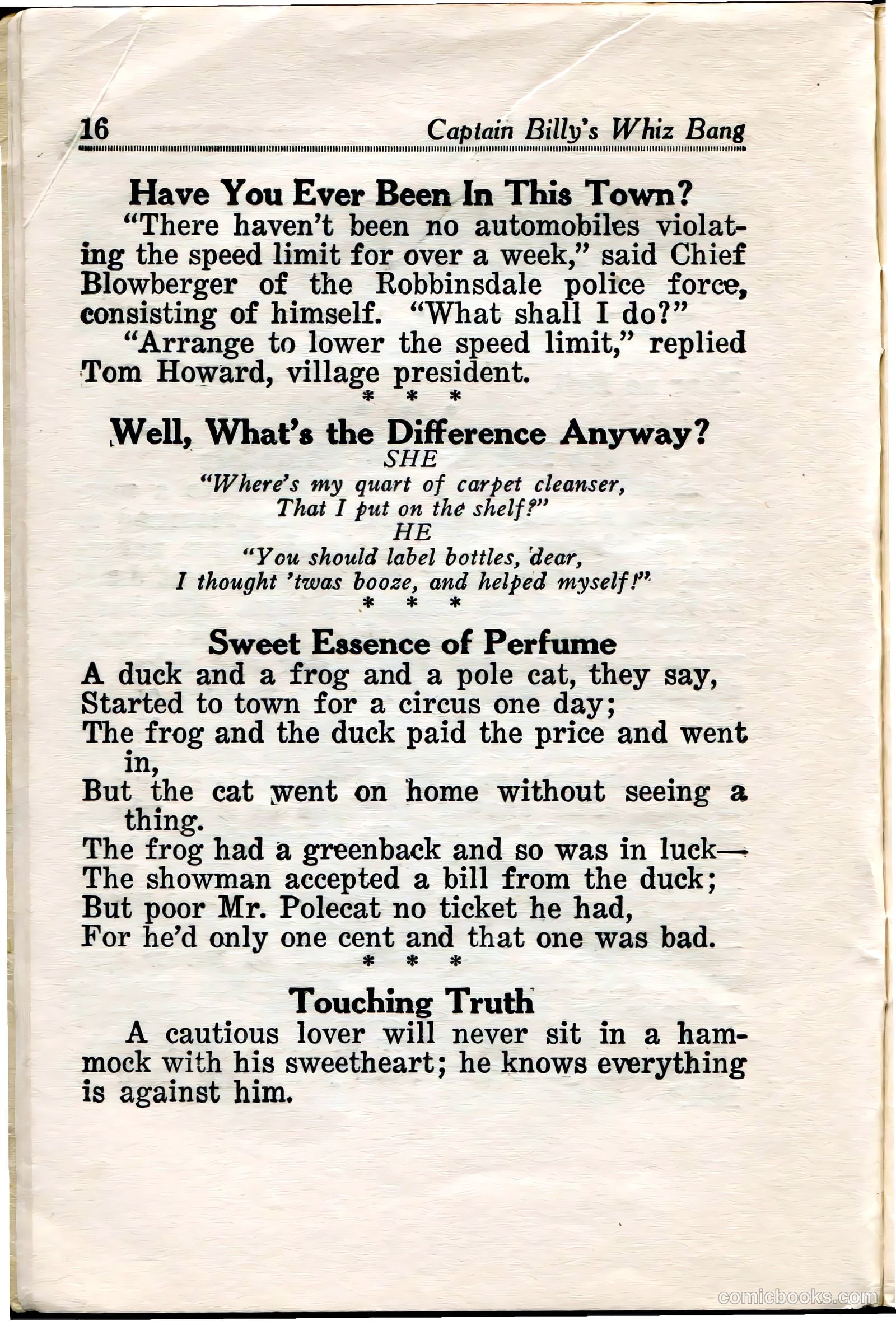
This page contains four humorous short pieces typical of 1920s satirical magazines: **"Have You Ever Been In This Town?"** mocks small-town bureaucratic absurdity: a one-man police force (Chief Blowberger) complains there haven't been speed violations in a week, so the village president suggests *lowering* the speed limit to create violations—circular logic for generating enforcement activity. **"Well, What's the Difference Anyway?"** is a domestic comedy about mistaken identity: a husband drinks carpet cleaner thinking it's alcohol because bottles aren't labeled, satirizing both Prohibition-era drinking and marital miscommunication. **"Sweet Essence of Perfume"** is a nonsense poem using animal characters (duck, frog, polecat) to joke about circus admissions and poverty—the polecat can't afford entry with only a bad penny. **"Touching Truth"** offers romantic advice: a cautious lover avoids hammocks with sweethearts because the furniture's swaying motion works against maintaining composure. These represent typical lightweight, family-friendly humor from the era—puns, domestic situations, and absurdist scenarios.
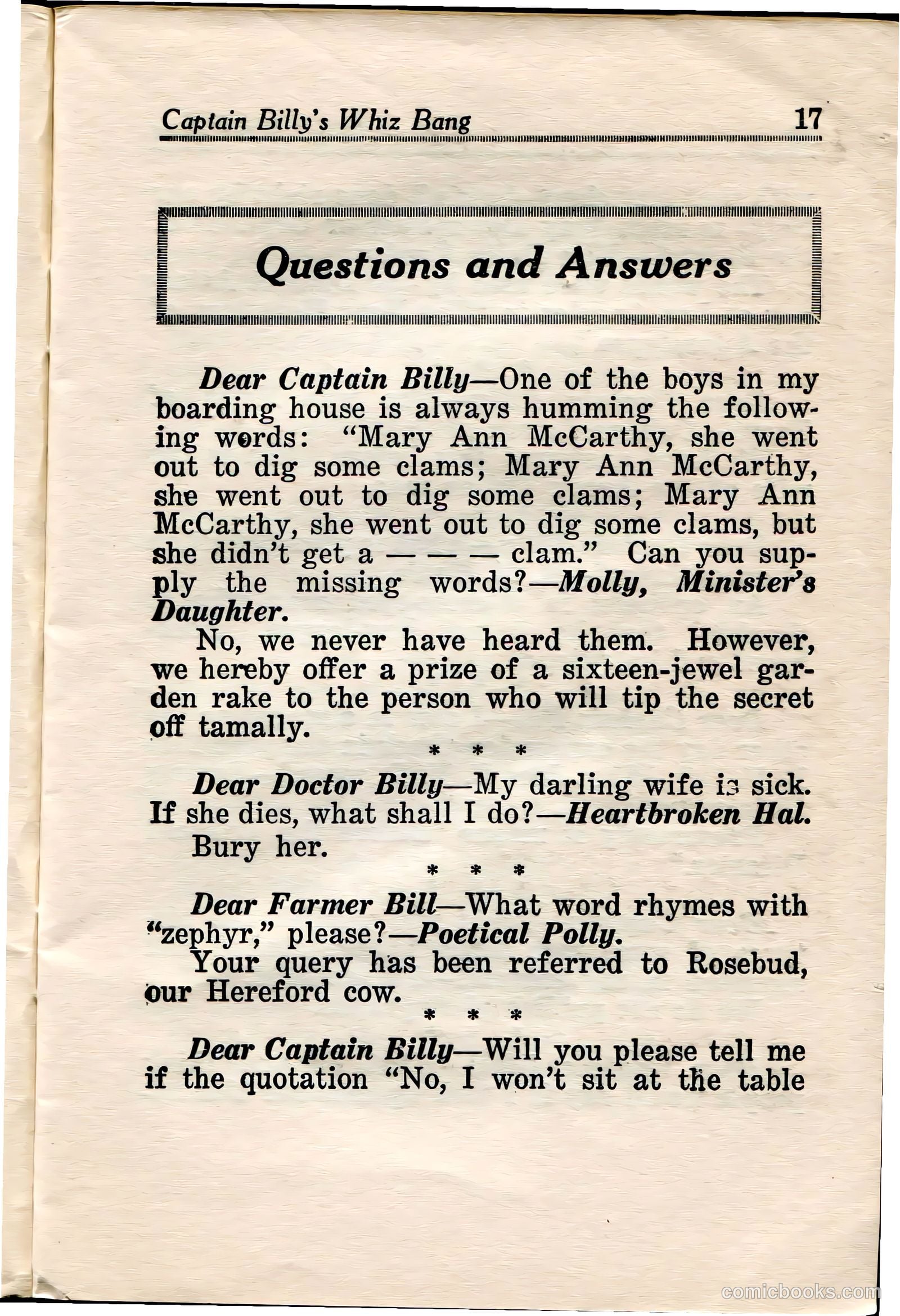
This is a humor advice column from *Captain Billy's Whiz Bang*, a satirical magazine popular in the 1920s-30s known for risqué jokes and irreverent responses. The column features humorous fake Q&A exchanges: 1. **"Mary Ann McCarthy" riddle**: A reader asks for missing words from a song lyric—the format suggests an off-color punchline (typical of the magazine's style), and the editors coyly refuse to supply it while offering a joke prize. 2. **"Heartbroken Hal"**: A man asks what to do if his wife dies; the response is darkly comic: "Bury her"—a deadpan non-answer that plays on the absurdity. 3. **Poetical Polly**: Asked what rhymes with "zephyr," the response absurdly defers to "Rosebud, our Hereford cow"—nonsensical humor typical of the magazine. The satire mocks advice columns by giving deliberately unhelpful, crude, or ridiculous answers. The "Minister's Daughter" and "Poetical Polly" names add to the joke—prim-sounding readers asking for help with dubious or silly questions.
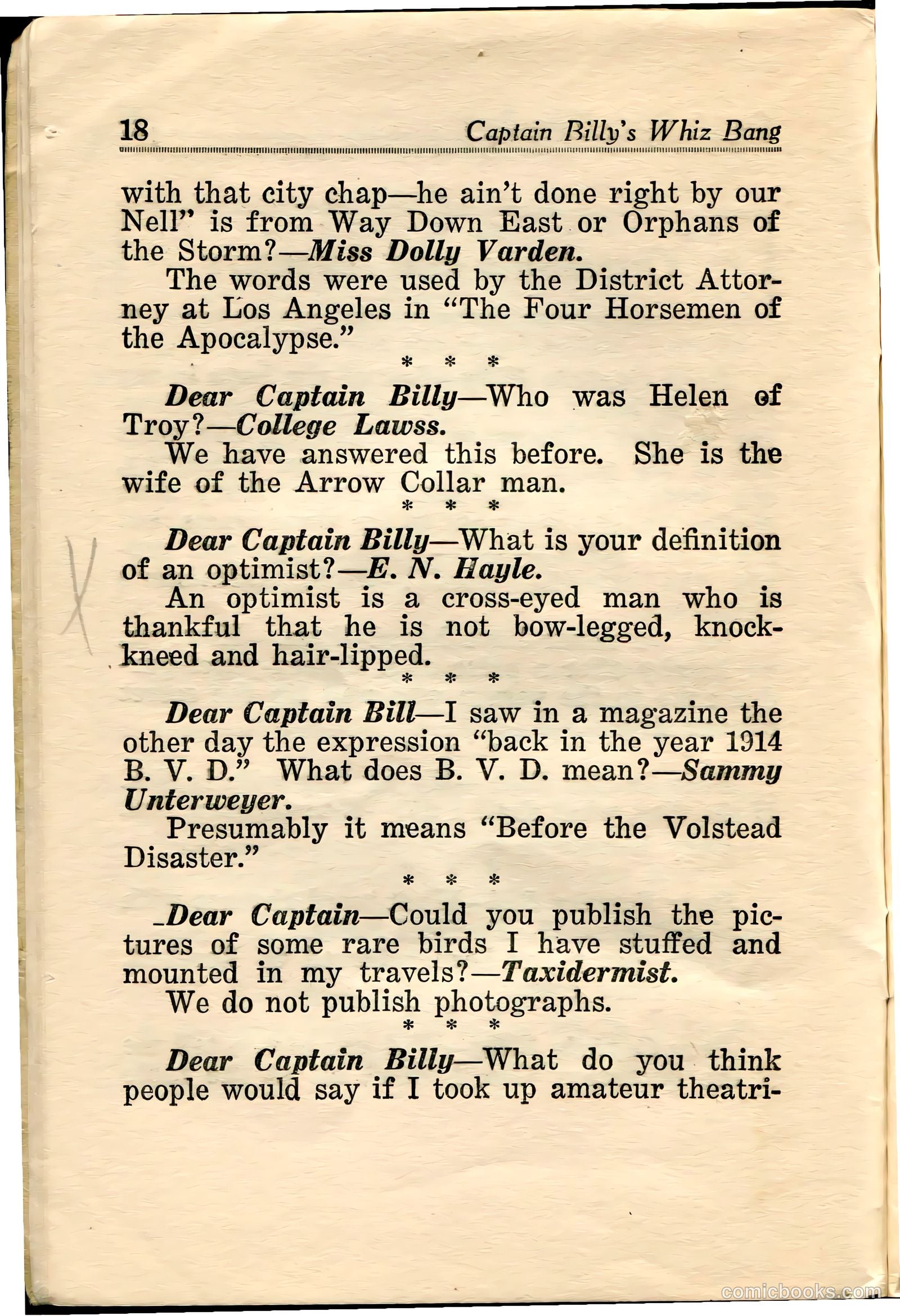
This page is a **Q&A advice column** from an early 20th-century satirical magazine. The humor relies on contemporary cultural references now obscure to modern readers: **Key References:** - "Way Down East" and "Orphans of the Storm" are silent films; the joke assumes readers recognize dramatic plot phrases - "Arrow Collar man" refers to a famous advertising mascot/brand—the answer ironically equates Helen of Troy with a commercial icon - "B.V.D." (a underwear brand) is playfully redefined as "Before the Volstead Disaster"—mocking Prohibition (Volstead Act, 1920) - The optimist joke is pure slapstick absurdism: finding gratitude in physical imperfection **The Magazine's Appeal:** *Whiz Bang* targeted working-class readers with lowbrow humor, puns, and irreverent takes on popular culture. The column format allowed readers to submit questions, creating interactive engagement. The satire is gentle, not politically charged—mostly poking fun at advertising, Prohibition, and cultural pretensions.
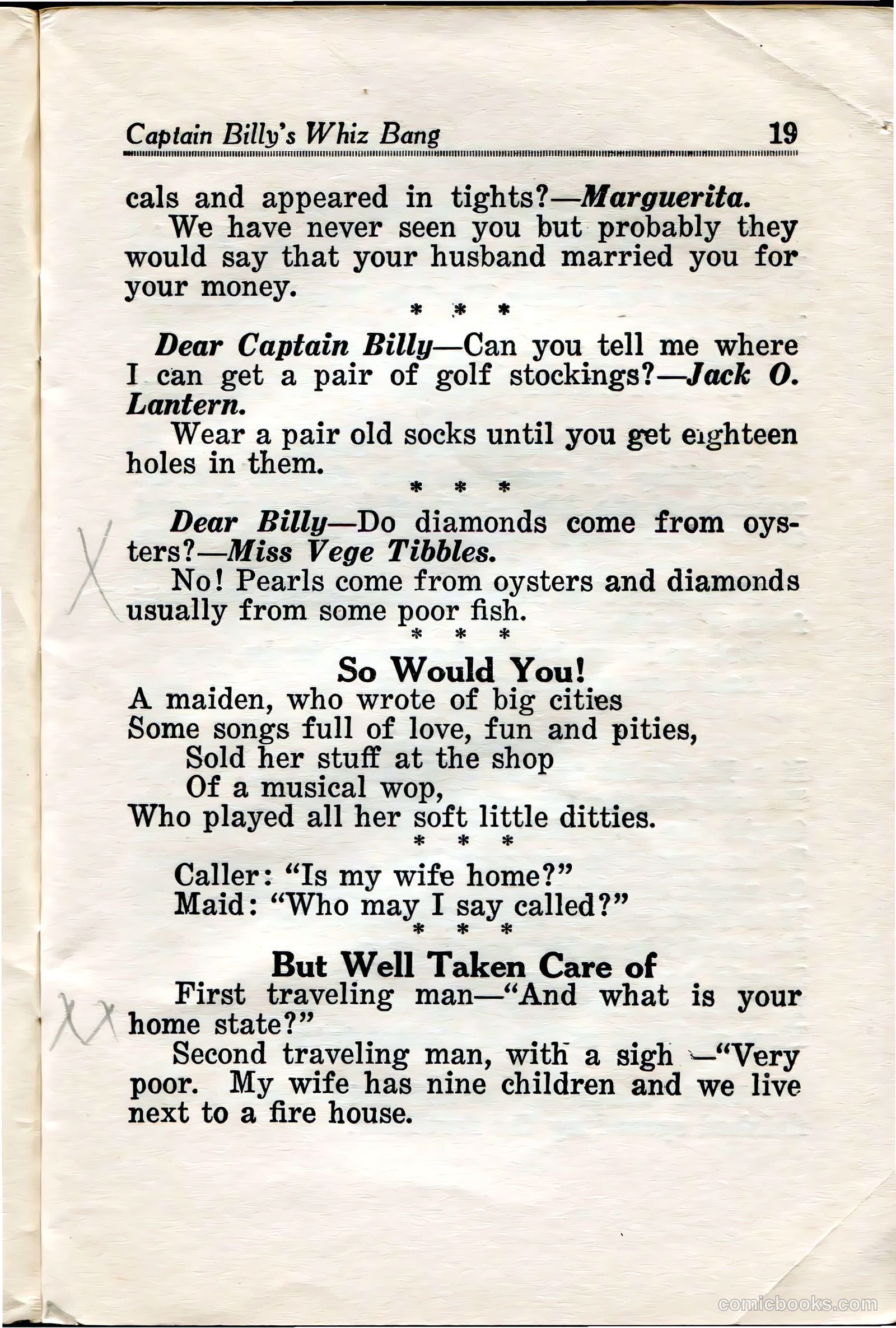
This page from **Captain Billy's Whiz Bang** (a 1920s-era American humor magazine) contains a satirical advice column and humorous poems/jokes. The content reflects period attitudes through ribald humor: **Key elements:** - **"Captain Billy"** appears to be the magazine's advice columnist, answering reader questions with deliberately crude jokes - The jokes traffic in gendered insults (suggesting a woman married for money) and ethnic stereotypes (referring to an Italian music publisher as "a musical wop") - **"So Would You!"** is a limerick mocking a female songwriter who sells her work to a music publisher - The final section ridicules a traveling salesman's poverty, attributing it to having nine children and living near a fire station (implying financial recklessness and lower-class status) The satire targets romantic naivety, female ambition, ethnic minorities, and working-class men. The humor relies on period prejudices now considered offensive, typical of early 20th-century American comedy magazines.
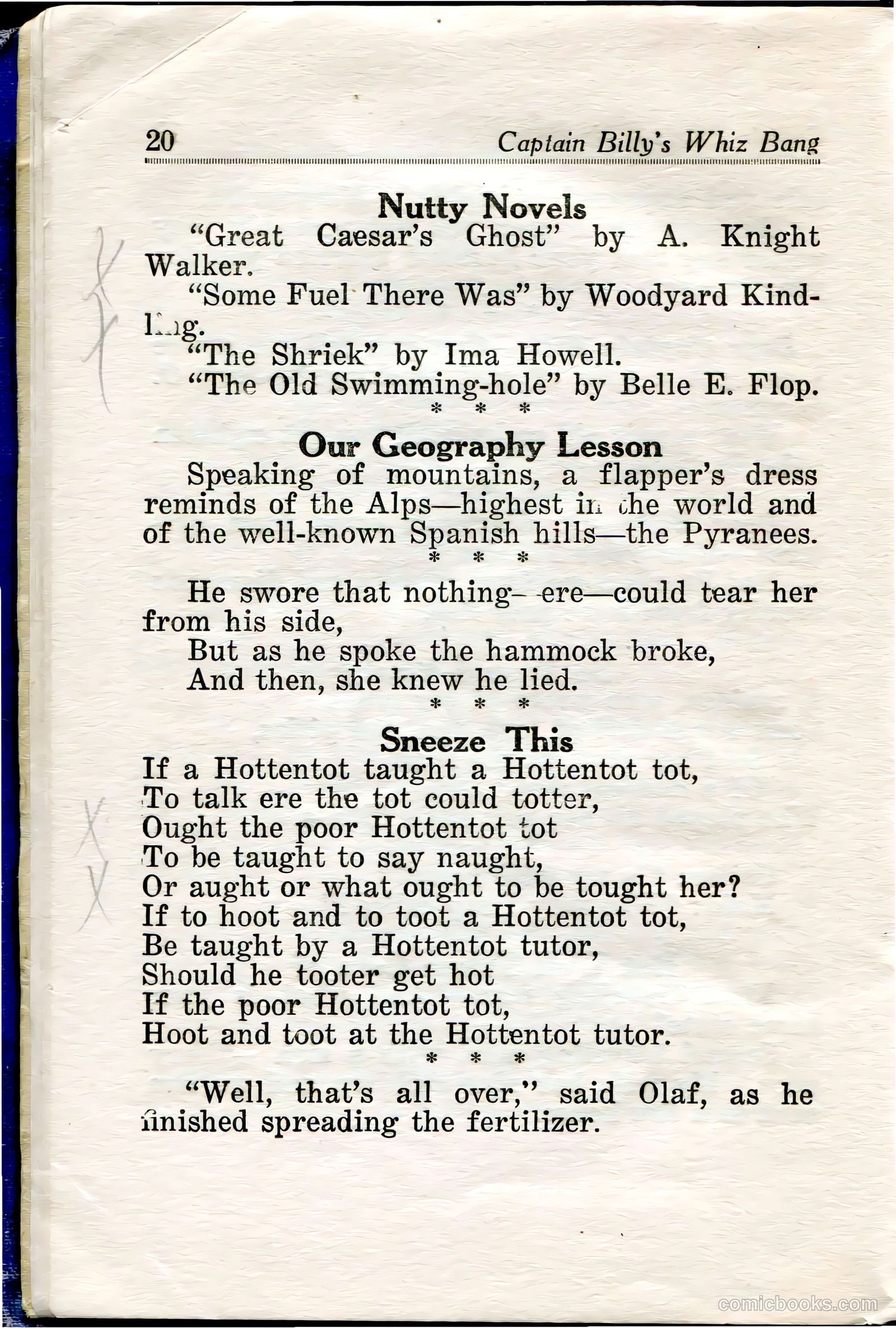
This page collects satirical humor typical of 1920s American magazines. The "Nutty Novels" section mocks literary titles through absurdist author names—puns like "A. Knight Walker" (a nightwalker) and "Ima Howell" (I'm a howell/howl). The "Geography Lesson" makes a risqué joke about 1920s fashion: a flapper's short dress is compared to mountain peaks (Alps, Pyrenees), mocking both women's hemlines and highbrow geography references. The hammock joke satirizes romantic clichés—a man's grand declaration of eternal devotion is literally undermined when the hammock fails, revealing his dishonesty. "Sneeze This" is a tongue-twister using "Hottentot"—contemporary term (now considered offensive) for a South African people—exploiting the word's sound for absurdist wordplay rather than meaningful satire. The final line about Olaf and fertilizer appears to be a setup for a joke, likely crude given the magazine's bawdy reputation.
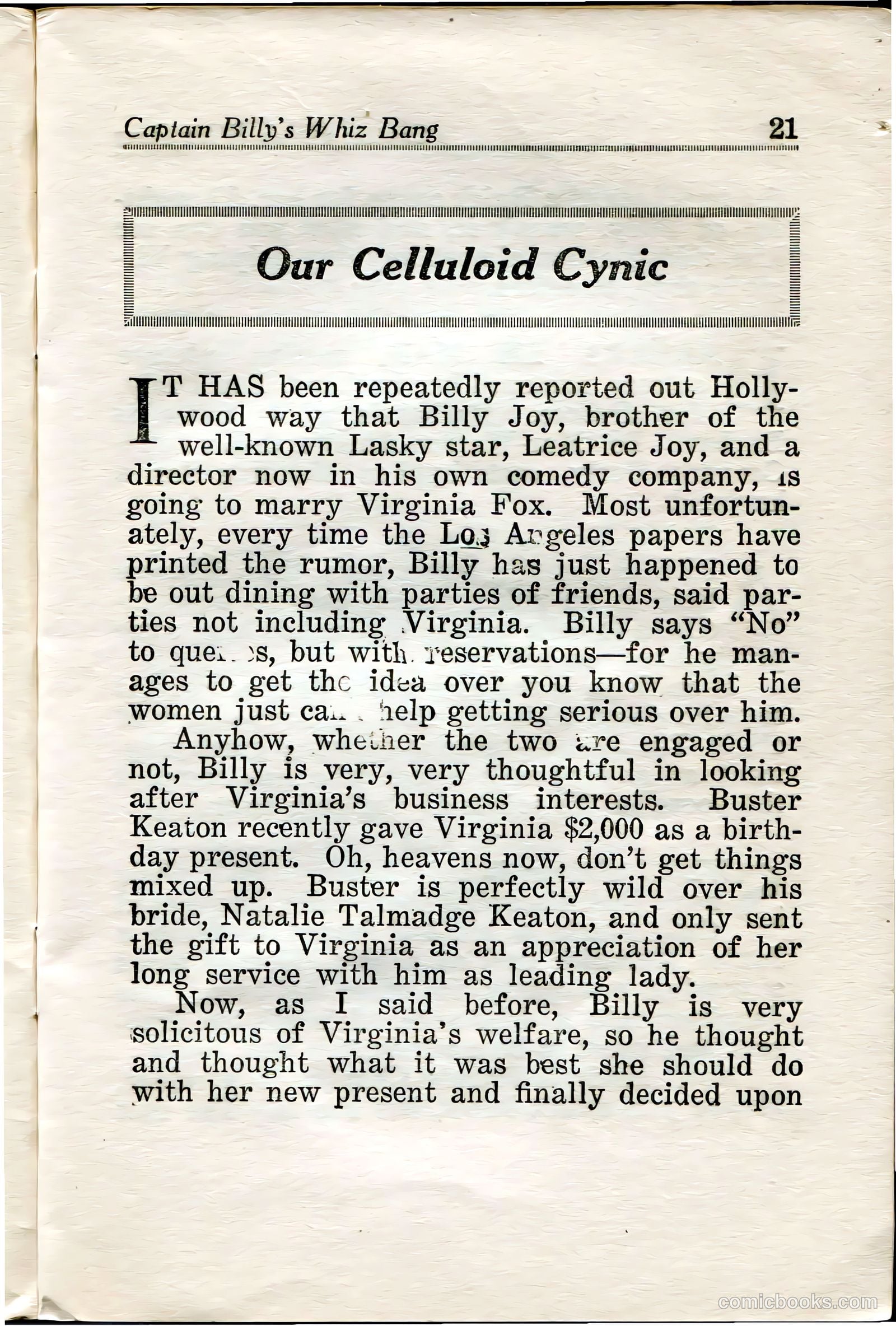
This gossip column mocks Hollywood romance rumors and male behavior. The piece reports on Billy Joy (brother of actress Leatrice Joy), allegedly romantically linked to actress Virginia Fox. The satire targets Joy's coy denials—he publicly says "no" to engagement rumors while strategically dining out with friends (pointedly excluding Virginia), thereby creating the impression women "can't help getting serious over him." The column further ridicules the absurdity of gift-giving etiquette: Buster Keaton gave Virginia Fox $2,000 as a "birthday present," but the narrator must clarify this wasn't romantic—Keaton is devoted to his wife, Natalie Talmadge Keaton. The gift merely acknowledges Fox's professional service as Keaton's leading lady. The "cynic" title suggests the column exposes the performative nature of Hollywood romance and male vanity, where public denials paradoxically confirm rumors, and expensive gifts require elaborate explanations to avoid scandal.
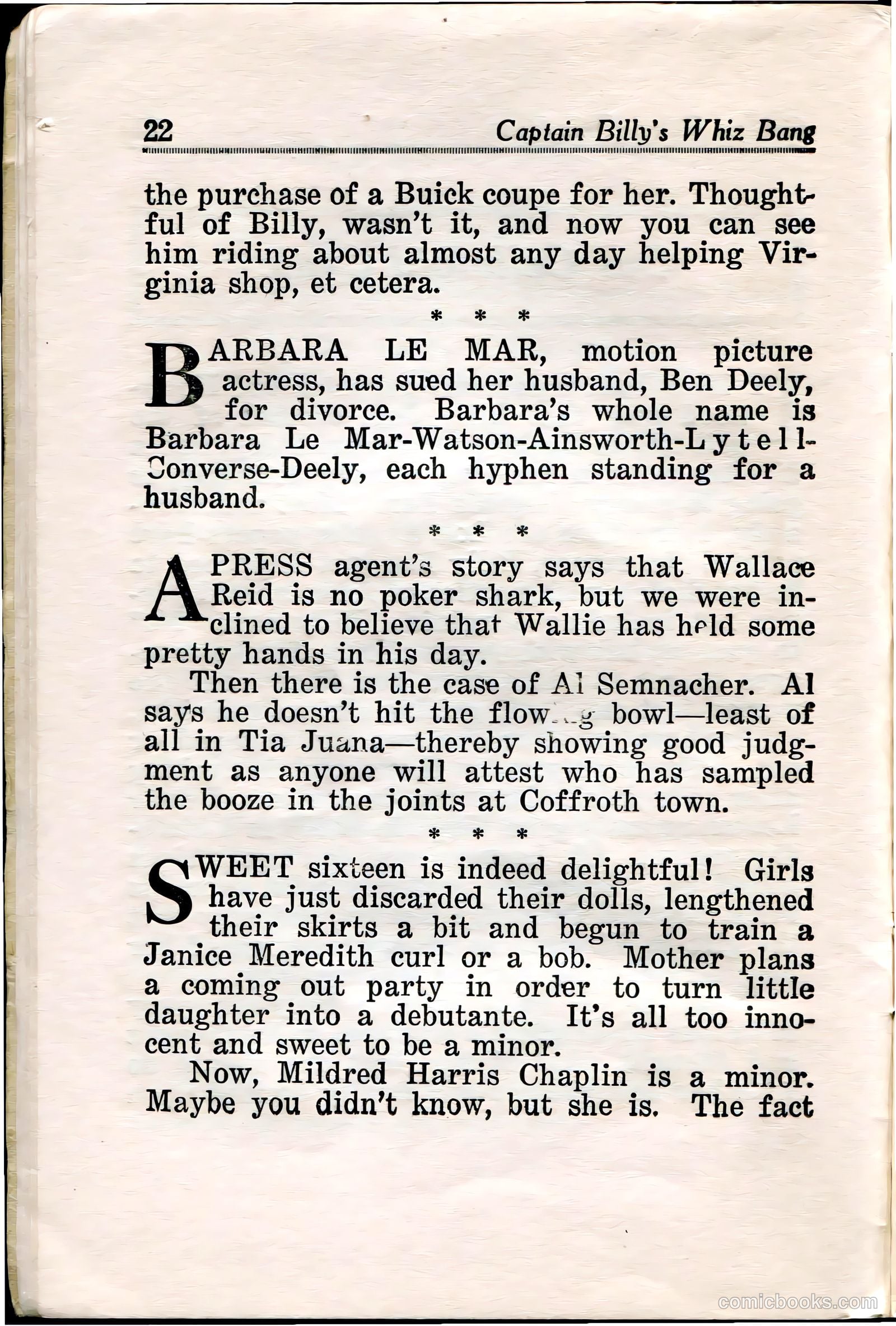
This page contains gossip columns rather than cartoons. The content satirizes entertainment and social figures through humorous commentary: **Barbara Le Mar** - A motion picture actress sued for divorce; the satire jokes that her full hyphenated name (Le Mar-Watson-Ainsworth-Lytell-Converse-Deely) has one hyphen per husband. **Wallace Reid** - Apparently a poker player; the item humorously disputes claims he's skilled at cards. **Al Semnacher** - Referenced regarding avoiding alcohol in Tia Juana (Tijuana), with a satirical jab at local drinking culture. **Mildred Harris Chaplin** - Identified as a minor (underage), likely referencing her marriage to Charlie Chaplin, which scandalized 1920s audiences given the age difference. The humor targets celebrity relationships, scandals, and social conventions of the Jazz Age era.
This page contains gossip items satirizing wealthy socialites and celebrities. The first item mocks "Mildred," a young woman sued by importer Henri Bendel for $2,500 in unpaid clothing from 1920. The satire targets her lawyer's defense: claiming she's a minor and therefore legally exempt from debt—the item's arch tone ("Perfectly simple!") ridicules this apparent loophole allowing the wealthy to evade obligations. The longer piece concerns dancer Isadora Duncan, the famous pioneer of modern dance. It catalogs her scandalous personal life: her long affair with stage designer Gordon Craig (with whom she had three children), the tragic 1913 drowning of two of those children in the Seine, her 1921 involvement in an "alienation of affections" lawsuit (implying she seduced a married man), and her recent marriage to a much-younger Russian poet. The tone is sensationalistic gossip, presenting Duncan's romantic entanglements and family tragedies as fodder for public ridicule.
This page from the satirical *Captain Billy's Whiz Bang* contains celebrity gossip and scandal items targeting 1920s entertainment figures. The content mocks: **Isadora Duncan** — The famous dancer's association with Soviet ideals and Lenin is presented as ridiculous bohemianism (dancing "barefooted and barelegged"). **Rudolph Valentino** — His bigamy charge prompts authorities to investigate other actors, suggesting Hollywood marriage scandals were rampant. **Henry B. Walthall** — Actor criticized for divorcing and immediately remarrying his leading lady—implying opportunistic sexual behavior. **Mollie King** — A former actress desperate for publicity who recklessly accepted conflicting endorsement contracts (Star Vibrator and Diamond Dyes simultaneously), suggesting she'd compromise her reputation for easy money. The magazine's tone is cynical and moralistic, using these items to satirize 1920s celebrity culture as shallow, hypocritical, and scandal-prone.
This page from **Captain Billy's Whiz Bang** contains celebrity gossip rather than political cartoons. The content discusses: 1. **A lawsuit**: Mollie (likely an actress) faces a $2,848.04 breach-of-contract suit from the makers of a film called "The Star," apparently over using her name in advertising. 2. **Harold Lloyd romance**: The column reports on silent film star Harold Lloyd's engagement to actress Mildred Davis, noting gossip about a diamond ring and their social activities in Hollywood and New York. 3. **A financial note**: Brief mention of a new bonding procedure allowing actors/directors protection against contract violations, modeled on cashier bonds. The satire targets Hollywood's theatrical publicity machinery and the public's appetite for celebrity scandal—standard fare for this irreverent 1920s humor magazine.
This page from *Captain Billy's Whiz Bang* (a 1920s humor magazine) contains two satirical pieces: **"Ain't Love Just Grand?"** mocks sentimental romantic dialogue through exaggeration. A young couple share a handkerchief to remove dust from their eyes, then fantasize about sharing the *same dust particle*—treating this mundane moment as profound romance. The satire lies in ridiculing overly precious, affected expressions of love. The ending's reference to a falling "Votes for Women" signboard appears intentionally jarring—likely mocking women's suffrage activism as chaotic or absurd, reflecting the magazine's irreverent tone toward contemporary social movements. **The brief joke at bottom** is a simple pun: "dumb bells" (exercise equipment) vs. "dumb bells" (bells rung by deaf-mute residents)—typical lowbrow wordplay humor of the era. The overall tone is cynical toward both romantic sentimentality and progressive causes.
This is a humor column of disconnected quips and observations rather than a cartoon. The satire targets early 1920s social anxieties: **Automobiles & Morality**: References to cars "committing suicide" after trips to roadhouses mock the era's concern about motor cars enabling moral decay and young people's misbehavior. **Drug Addiction**: Direct jabs at drug use ("dope deferred") and a suggested motto for rehabilitation facilities reflect Prohibition-era anxieties about substance abuse. **Fashion Debates**: Commentary on women's hemlines—"long skirts vs. short skirts"—touches the period's heated cultural argument over modest versus modern dress. Lewis Baumer's quote about "what's in the skirt" is a suggestive double entendre. **General Absurdism**: Jokes about beetles in cars and lazy mule handlers provide lighthearted filler typical of satirical magazines mixing social criticism with nonsense humor. The page captures 1920s concerns: automobiles, drugs, women's changing roles, and moral propriety.
This page contains miscellaneous satirical humor typical of early 20th-century American magazines. The content includes: **"Reel Honor and Real"** – A mock-serious critique of silent film melodrama, satirizing overwrought acting in movies about feminine virtue (actress Muriel Milford in "Her Honor Above Everything"). The satire targets both the film industry's heavy-handed morality tales and actors' exaggerated performances. **"Little Willie"** – A dark nursery rhyme joke about a mischievous child, typical period humor playing on childhood misbehavior. **"Try a Step-Ladder"** – A clean joke about height differences in romance, relying on wordplay. **"Sect Stuff"** – A pointless circular joke about a flea and fly, ending dismissively ("Oh piffle"), likely mocking nonsensical humor itself. **Army Telegram** – Brief satire of military bureaucracy, with a soldier requesting leave extension via A.W.O.L. (Absent Without Leave), humorously framing unauthorized absence as an official request. The page is primarily comedic filler rather than topical satire.
This page from *Captain Billy's Whiz Bang* contains satirical "Calgary Society Notes" and humor pieces rather than political cartoons. The content mocks local Calgary society figures through brief anecdotes: **Oliver T. Musgrove** is ridiculed for climbing a flagpole in Central Park during Sunday church hours—absurd, undignified behavior for a "prominent" businessman. **Miss Susie Colightly** is lampooned for a lawsuit over a pothole and for dropping a bottle of Glen McSquirrel whiskey, suggesting she's clumsy and a drinker. The remaining items are generic jokes about women's contradictions, chorus girls, and crude puns ("That bane a yoke on me"). The humor relies on local gossip and slapstick rather than political commentary. The magazine appears focused on scandalizing minor Calgary figures and publishing lowbrow comedy typical of 1920s men's magazines.
This page from *Whiz Bang* (a 1920s-era men's humor magazine) contains four separate joke items mocking contemporary social behavior: **"Perils of the Bar"** ridicules a lawyer caught in an awkward situation—he must acknowledge acquaintance with a heavily made-up, flashy woman of questionable reputation, implying infidelity or professional misconduct. His nervous admission of knowing her "professionally" becomes a double entendre his wife immediately recognizes. **"Bare Banter"** jokes about imitation exotic dancers—the famous "Dance of the Seven Veils" referenced Salome performances popular in vaudeville; audiences knew these were tame knockoffs. **"Ayes Have It"** complains that immodestly dressed women in public transit distract male passengers from reading newspapers—period satire on changing women's fashion and public behavior. The final items mock mothers warning daughters about displaying themselves at fashionable resorts, and a quip about oversupply (castor oil, marital problems, childbirth). Overall, the page reflects 1920s anxieties about women's increasing public visibility, sexuality, and social freedom during the Jazz Age.
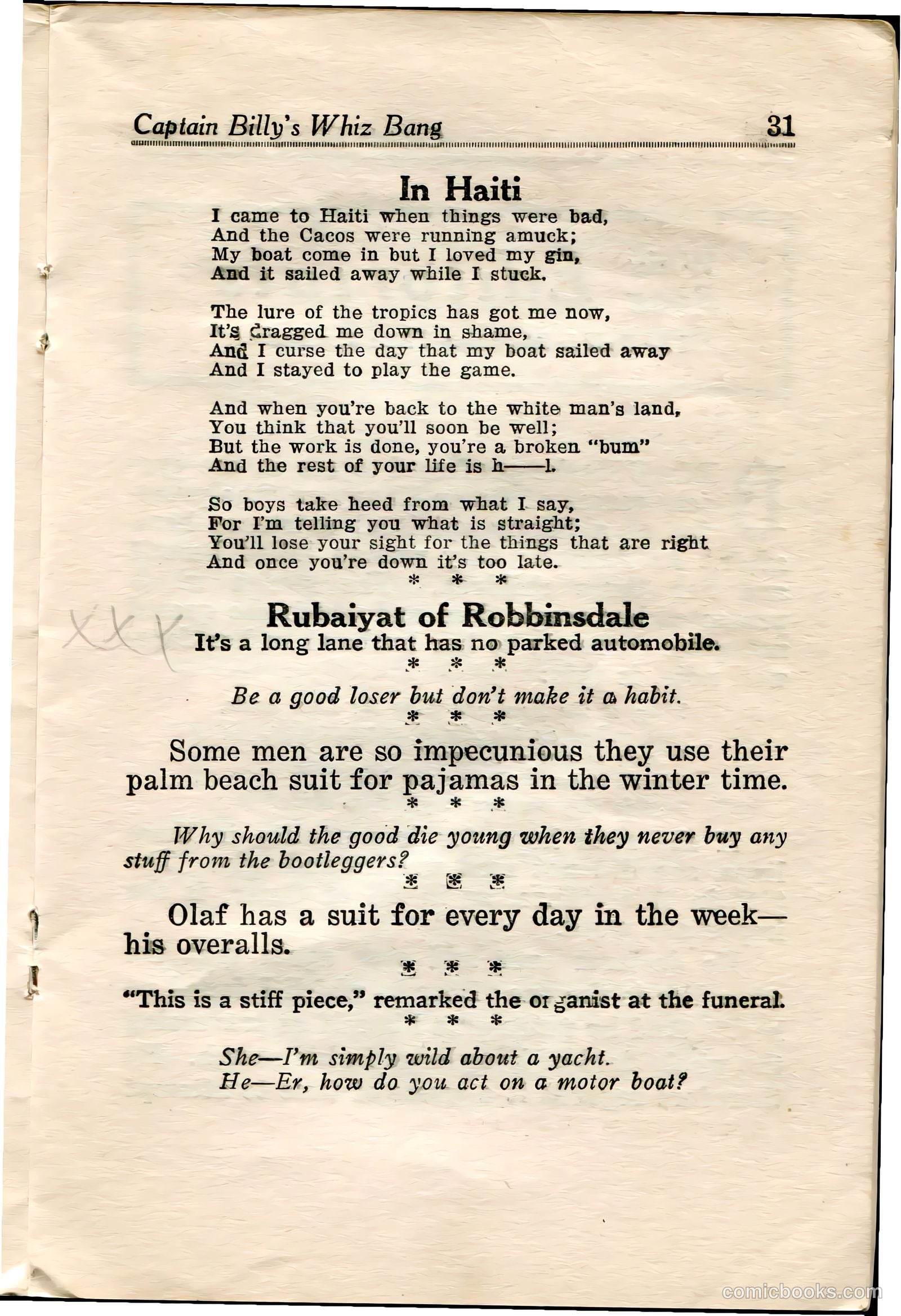
This page contains satirical verses and one-liners from a 1920s humor magazine. The main poem, "In Haiti," warns against the dangers of tropical excess—a man abandons his boat to stay in Haiti, becomes addicted to gin and the "lure of the tropics," and returns home a broken derelict. The moral: temptation leads to ruin. The remaining items are short jokes mocking various social types: the "Rubaiyat of Robbinsdale" parodies poetry with mundane observations (parked cars); others mock poverty ("palm beach suit for pajamas"), Prohibition-era bootlegging, working-class poverty (Olaf's only suit being overalls), and class pretension (the yacht/motorboat exchange). The humor targets both moral decay and social climbing—recurring themes in 1920s satirical magazines.
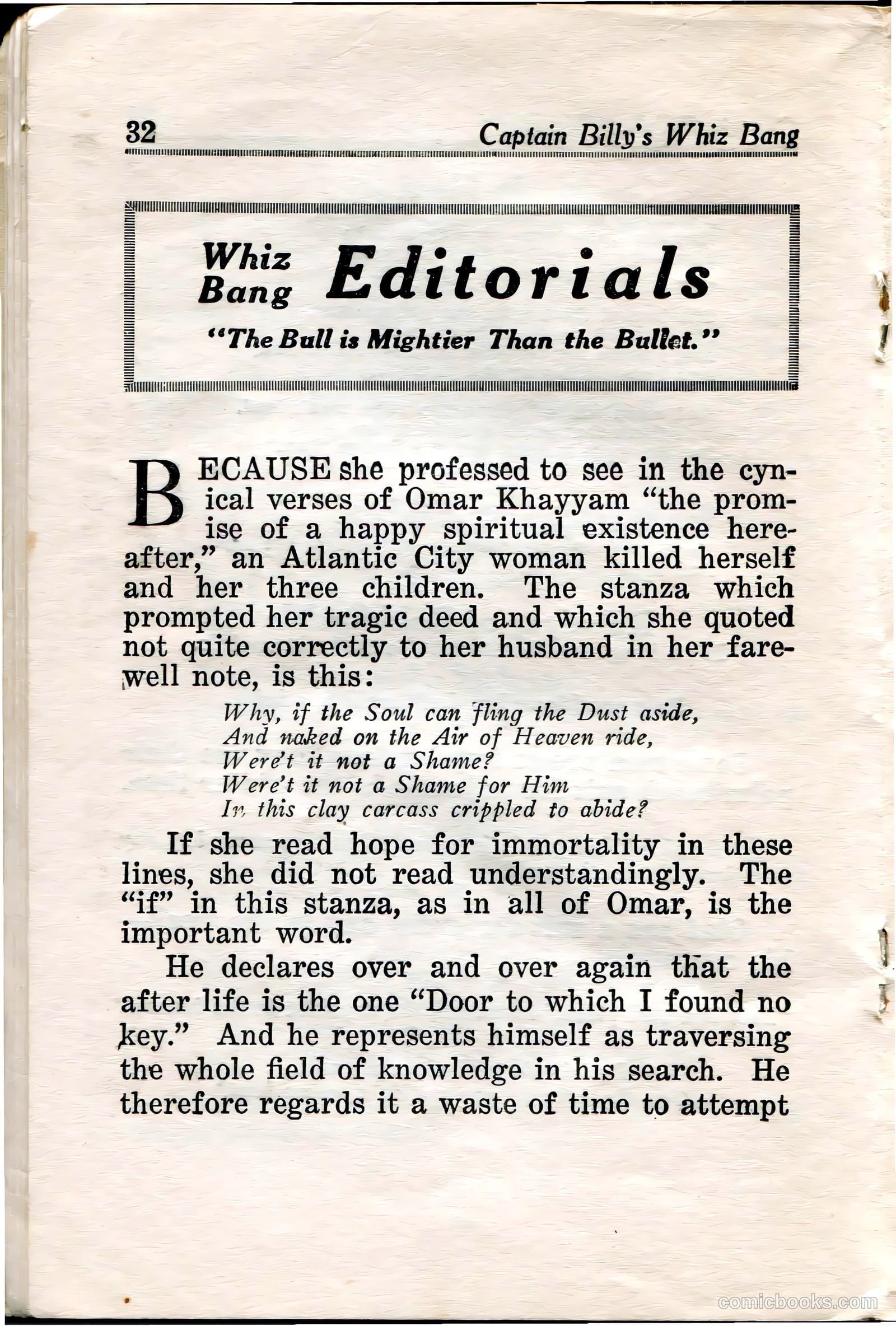
This editorial addresses a real tragedy: an Atlantic City woman killed herself and her three children, citing Omar Khayyam's *Rubaiyat* as inspiration. The satirical magazine uses this case to critique misreading of the Persian poet. The editorial argues the woman misinterpreted Khayyam's philosophy. His repeated theme—that the afterlife remains unknowable ("a Door to which I found no key")—counsels against speculation about immortality, not toward it. The critical word is "if," which signals Khayyam's skepticism, not affirmation. The magazine's title, "The Bull is Mightier Than the Bullet," suggests confronting dangerous ideas with rational argument rather than suppression. The satire targets both the woman's misreading and, implicitly, the romanticization of Eastern fatalism in American culture that made such misinterpretation possible.
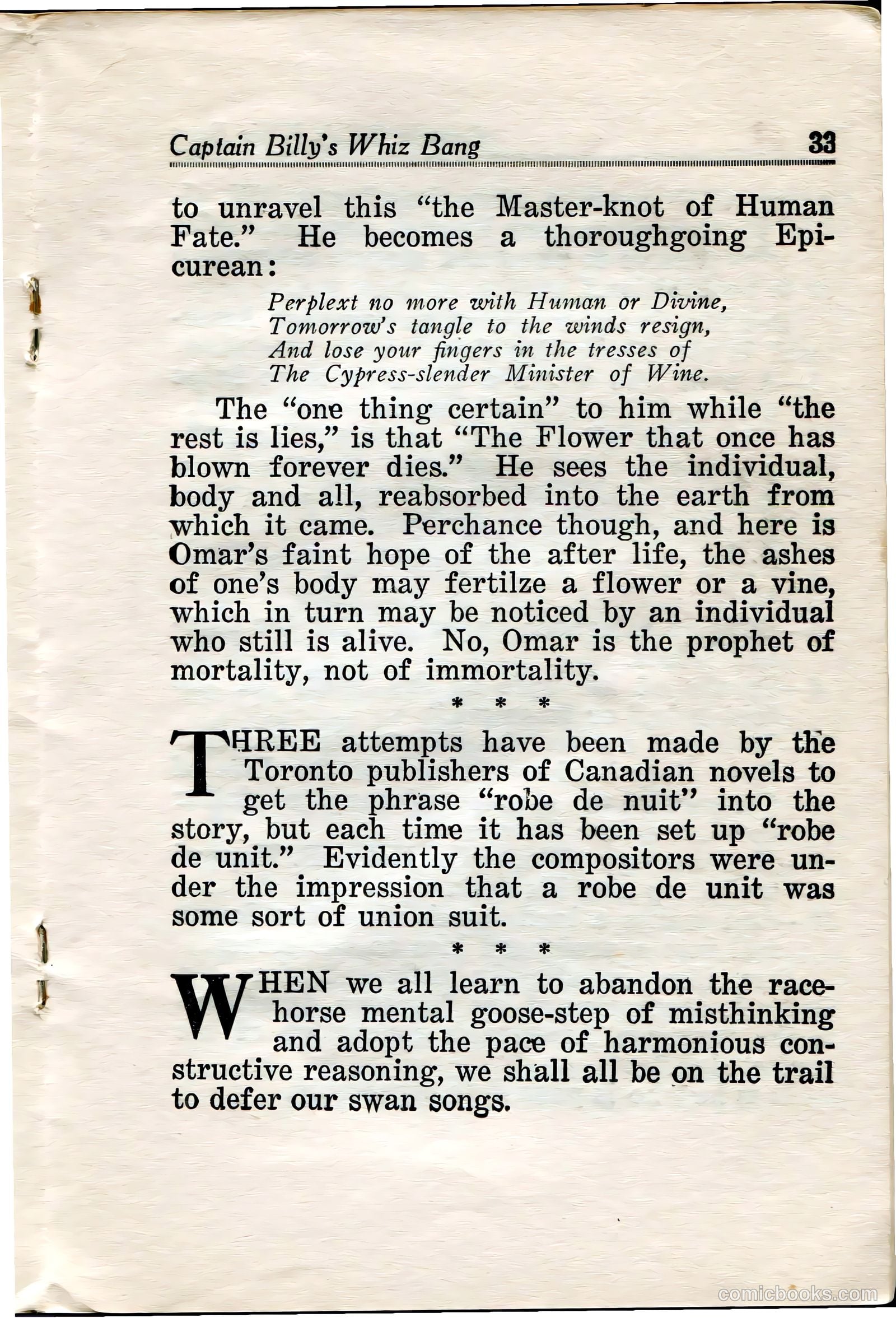
This page contains literary and printing commentary rather than cartoons. The first section discusses Omar Khayyam's *Rubaiyat*, analyzing his philosophy as epicurean pessimism focused on mortality rather than afterlife. The quoted verses reference wine and acceptance of fate—likely referencing the famous Edward FitzGerald translation popular in early 20th-century American culture. The middle anecdote mocks Canadian publishers and compositors for repeatedly setting the French phrase "robe de nuit" (nightgown) as "robe de unit," then incorrectly interpreting it as a "union suit" (long underwear). This is humor at the expense of printers' ignorance and/or the absurdity of publishing errors. The final paragraph uses flowery language to encourage abandoning "race-horse mental goose-step" thinking in favor of "harmonious constructive reasoning"—likely a jab at emotional or irrational public discourse of the era, though the specific target remains unclear.
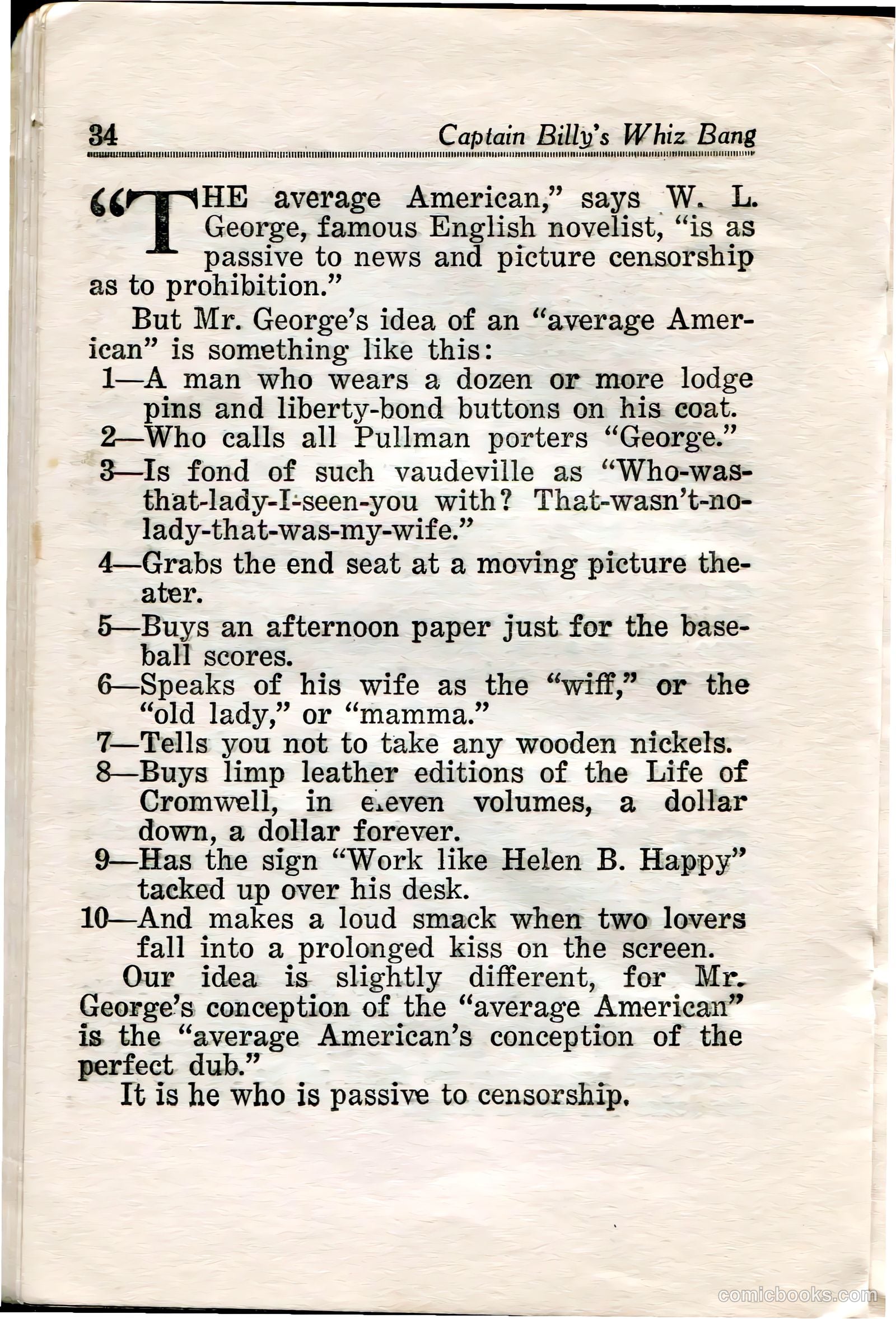
This satirical piece responds to English novelist W.L. George's claim that Americans passively accept censorship. The magazine offers a humorous rebuttal by listing ten stereotypical traits of what George considers the "average American"—a figure depicted as unsophisticated and gullible. The stereotypes include: wearing fraternal lodge pins, casual racism (calling all porters "George"), enjoying lowbrow vaudeville jokes, poor theater etiquette, reading only sports sections, using derogatory terms for wives, falling for scams ("wooden nickels"), and buying dubious mail-order books on installment plans. The satire's punch line: George's "average American" is actually just the average American's idea of a *fool*—someone easily duped. The implication reverses the criticism: it's *this fool* who passively accepts censorship, not the typical American. The piece thus defends ordinary Americans while mocking both George's condescension and the gullible stereotype he describes.
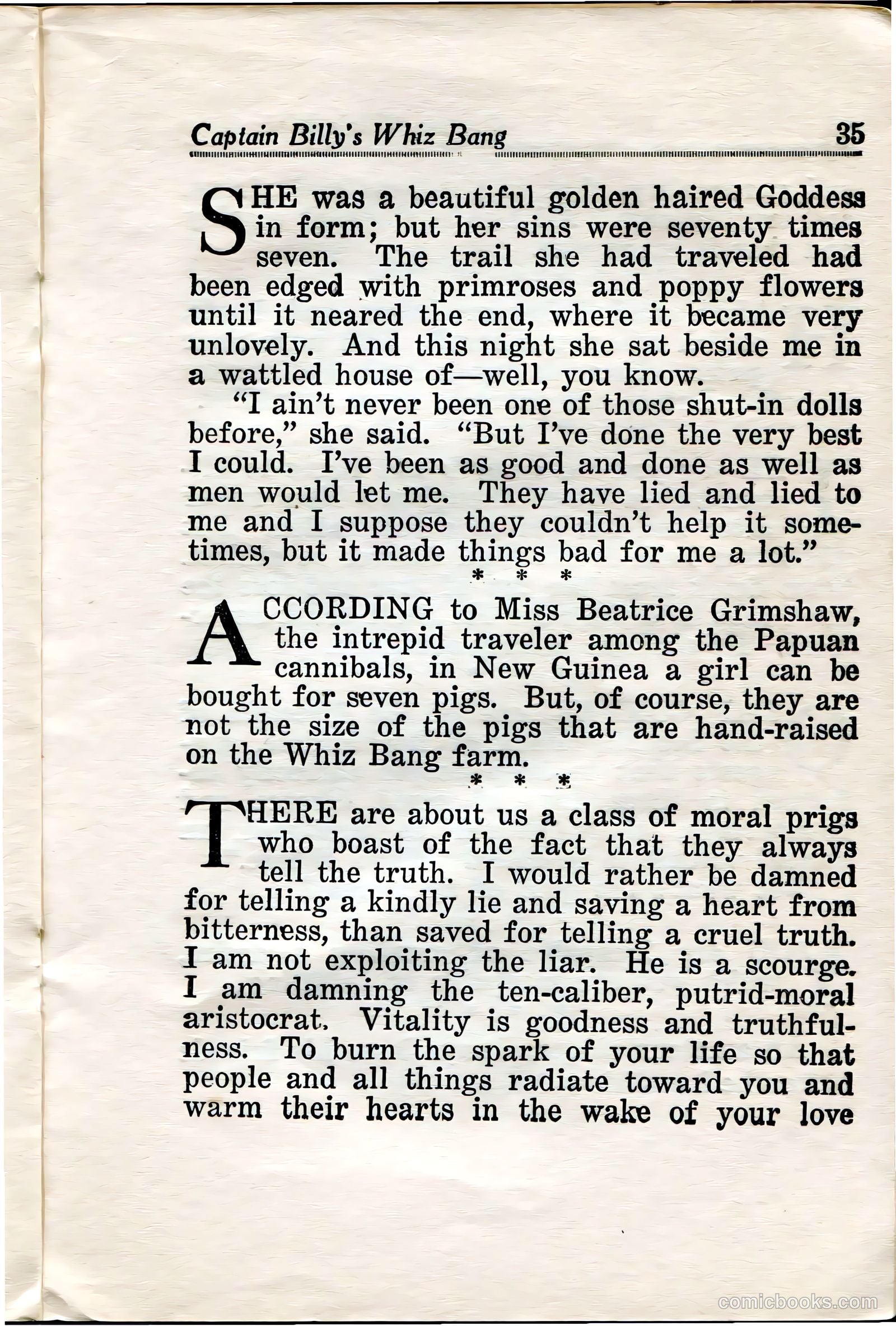
This page from the satirical magazine presents moral commentary through conversational pieces rather than visual cartoons. The opening monologue depicts a fallen woman justifying her life choices, implying she did her best under men's manipulation. The piece critiques double standards—men control women's circumstances yet judge them harshly. A middle section cites travel writer Beatrice Grimshaw's claim that New Guinea women sell for seven pigs, using this to make a crude joke about the magazine's farm and comparative worth. The final section attacks moral self-righteousness. The author argues that "moral prigs" who boast of always telling truth are worse than liars—they weaponize honesty cruelly. Instead, he champions "vitality" and compassion: kindly lies that preserve dignity matter more than brutal truths. The piece defends warmth and generosity as superior moral values to rigid truthfulness. The overall tone is cynical, irreverent, and challenges conventional morality—typical of *Whiz Bang's* provocative satire.
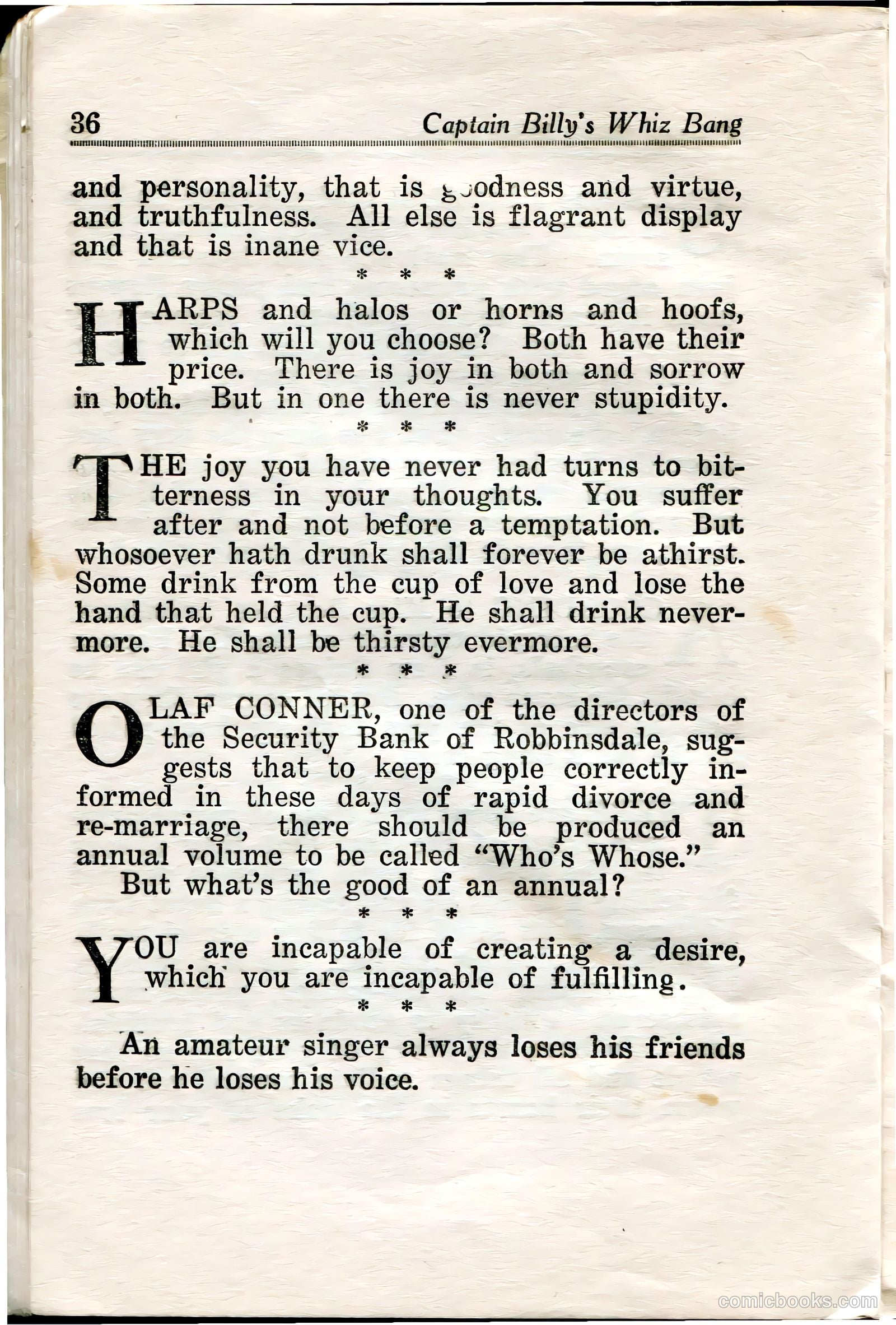
This page contains philosophical aphorisms and social commentary rather than cartoons. The content critiques virtue versus vice, temptation, and modern social problems. The passage about Olaf Conner (a bank director) satirizes the era's high divorce rates by mockingly suggesting an annual publication called "Who's Whose" to track rapid divorces and remarriages—implying the situation is so chaotic it requires constant updating. This reflects 1920s anxieties about loosening marriage bonds. Other aphorisms address desire and fulfillment, with closing commentary on amateur singers losing friends before losing their voices—a light jab at aspiring performers. The tone is moralistic yet witty, typical of *Whiz Bang*, which blended satirical social observation with folk wisdom. The page reflects post-WWI American concern about changing social morality and marital instability.
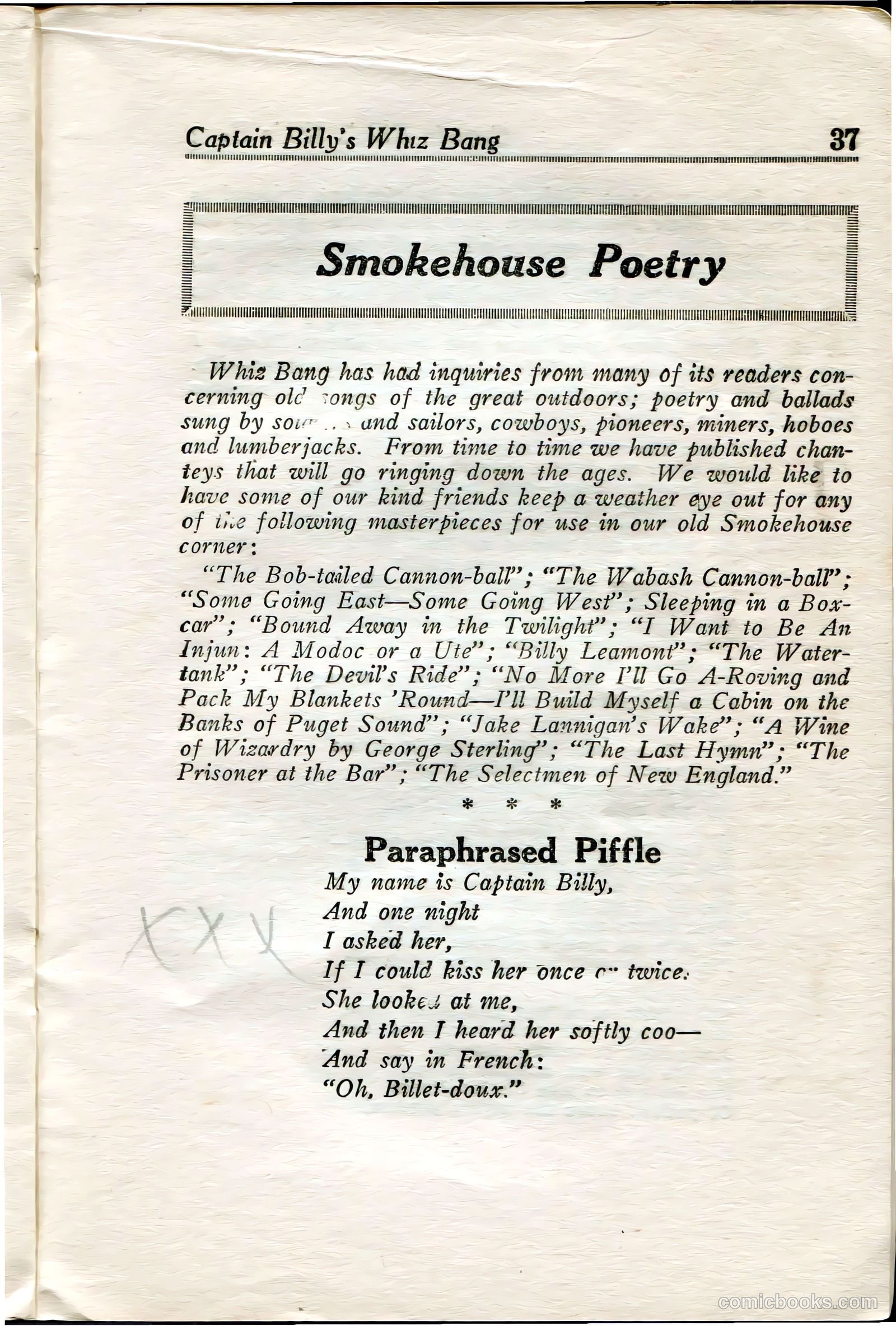
This page contains no cartoons—it's primarily text soliciting reader contributions. The "Smokehouse Poetry" section is an editorial call for folk songs and ballads associated with working-class American life: sailors, cowboys, miners, hoboes, and lumberjacks. These were authentic vernacular songs meant to preserve working-class cultural heritage. The brief "Paraphrased Piffle" poem below is a mild romantic joke: Captain Billy (the magazine's persona) asks a woman for kisses, and she responds coyly in French with "Billet-doux"—a pun playing on the captain's name ("Billy") and the French phrase meaning "love letter." The humor relies on the double meaning: she's making a flirtatious wordplay rather than granting his request. The overall tone is nostalgic and populist, celebrating rough-and-tumble American vernacular culture.
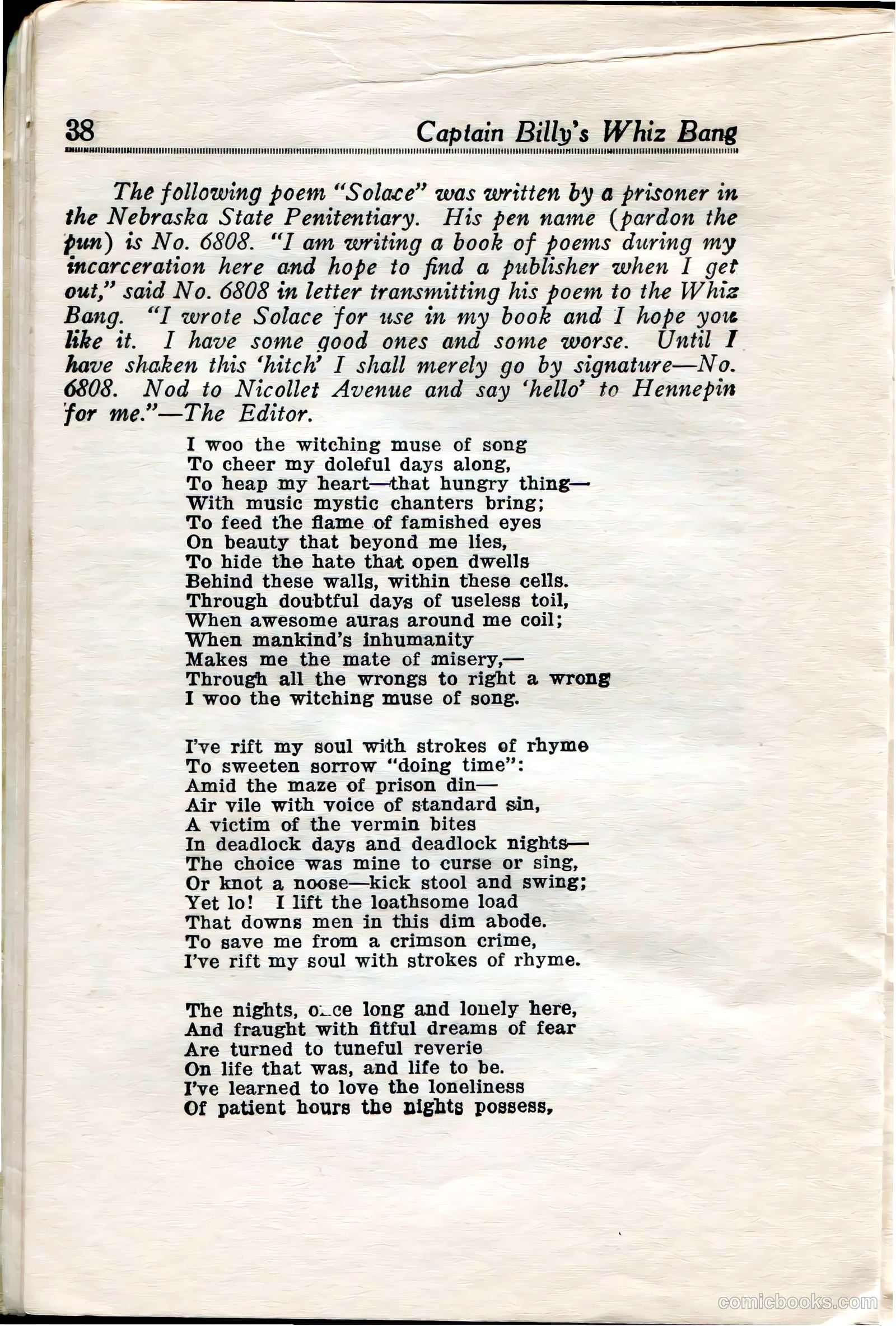
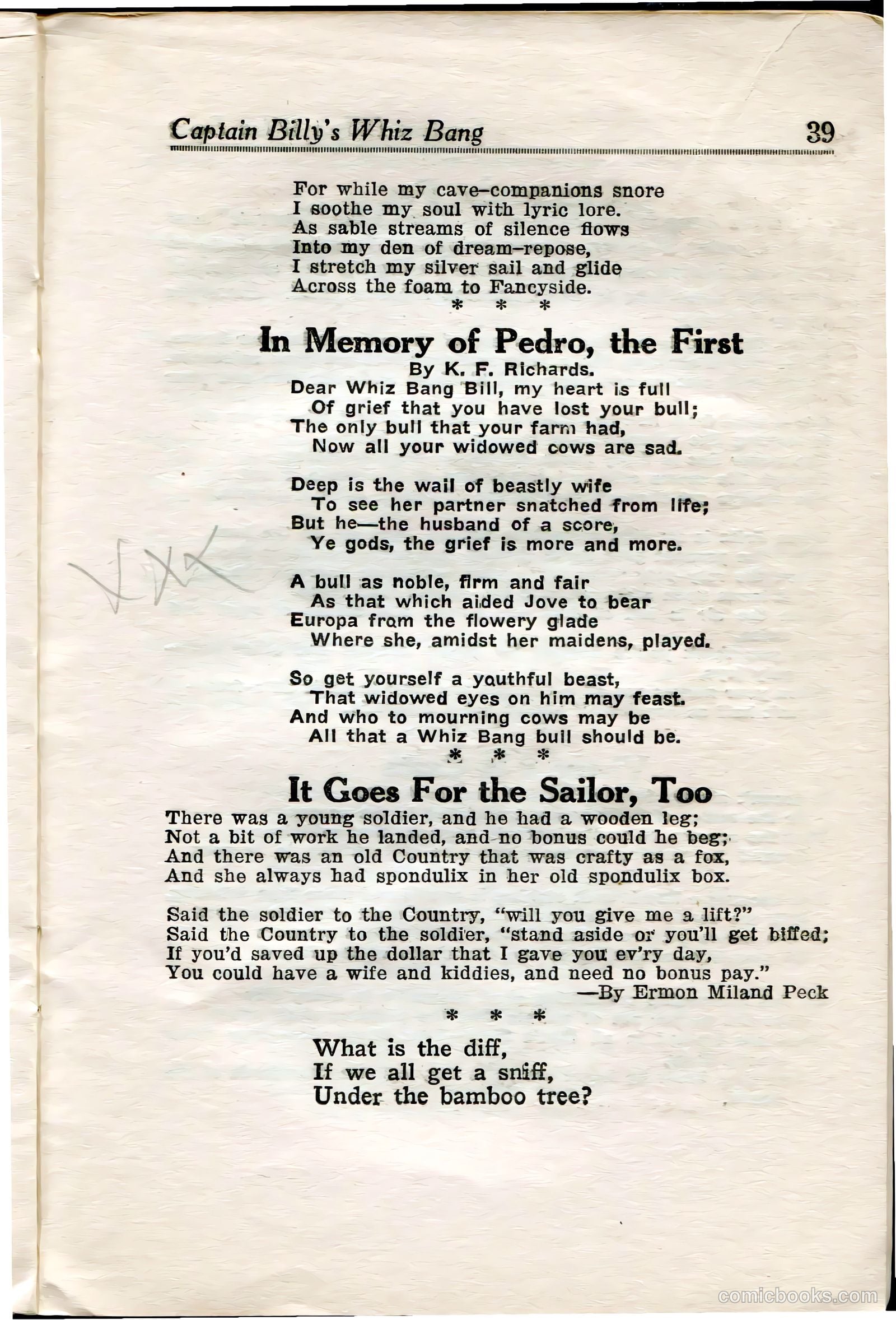
This page from the satirical magazine contains humorous poetry rather than cartoons. The content reflects post-WWI American anxieties: **"In Memory of Pedro, the First"** is a mock-heroic elegy for a dead bull, with classical allusions (comparing the bull to Jove's mythological form). It's absurdist humor treating farm livestock with overwrought dignity. **"It Goes For the Sailor, Too"** is more pointed social commentary. It depicts a disabled veteran with a wooden leg seeking government aid, only to be rebuffed by "the Country" (personified as a stingy woman). The Country blames him for not saving money from his daily wages instead of demanding a "bonus"—likely referencing the heated post-WWI debate over veterans' bonuses. The satire criticizes government stinginess toward disabled soldiers while they struggle financially. The final couplet appears to reference opium smoking ("bamboo tree," "sniff"), possibly critiquing recreational drug use. Overall, the page uses irreverent humor to address serious themes: rural life, veteran neglect, and social inequality.
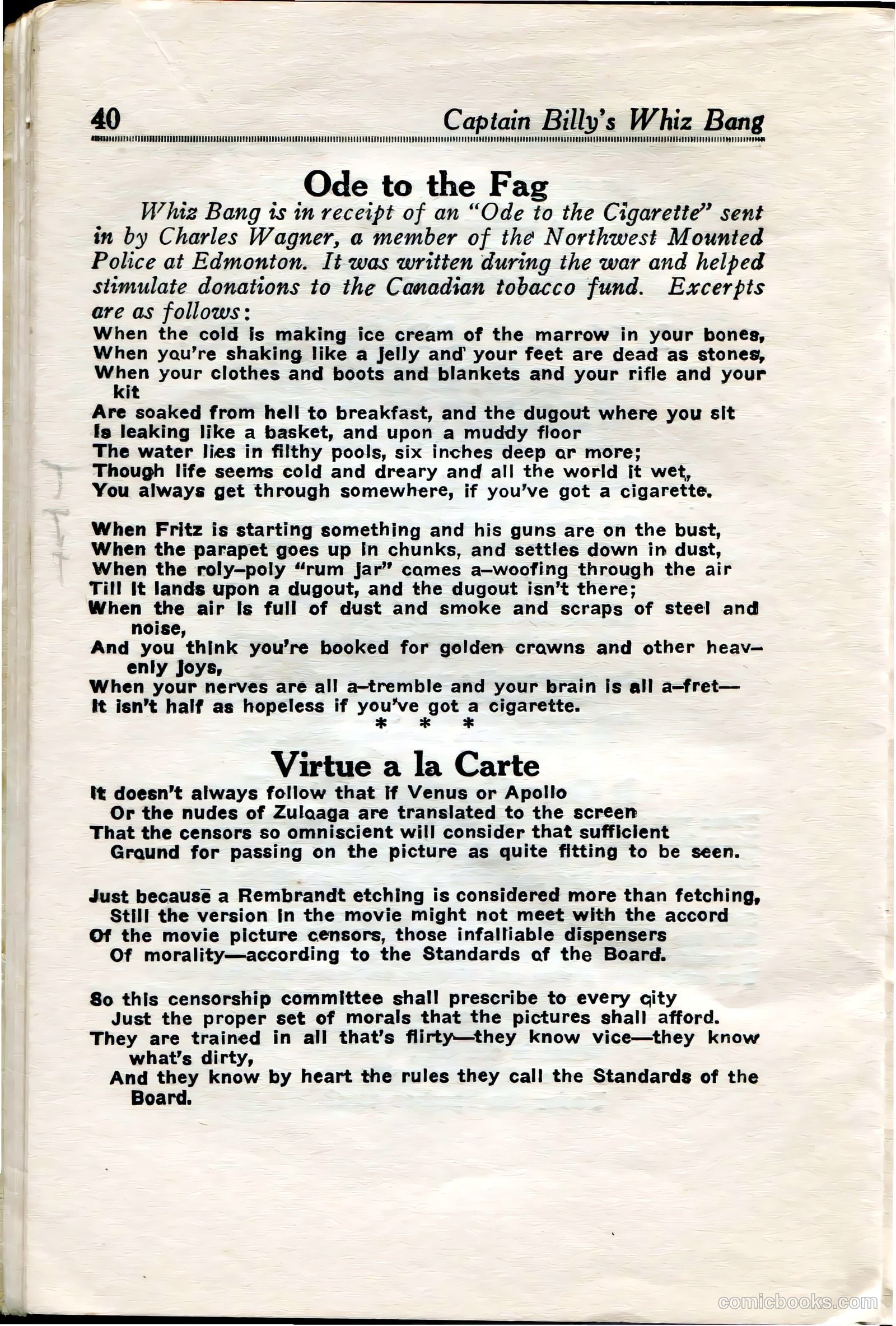
This page contains two satirical poems from *Captain Billy's Whiz Bang*, a post-WWI American humor magazine. **"Ode to the Fag"** (using "fag" as British/Canadian slang for cigarette) celebrates tobacco's morale value for soldiers in WWI trenches. The poem humorously depicts horrific combat conditions—freezing weather, artillery bombardment, near-death experiences—and argues cigarettes provided crucial psychological comfort. It was written by a Canadian Mounted Police officer to encourage tobacco donations to soldiers. **"Virtue a la Carte"** satirizes film censorship boards, particularly the emerging Motion Picture Standards Board. The poem mocks censors' self-appointed moral authority: they claim expertise in detecting vice and immorality, yet inconsistently judge artworks (Rembrandt etchings, classical nudes) by arbitrary "Standards of the Board" rather than consistent principles. The satire suggests censors are hypocrites—trained to obsess over "flirty" content while pretending to uphold objective morality. Both poems reflect 1920s anxieties about state/institutional control over behavior and expression.
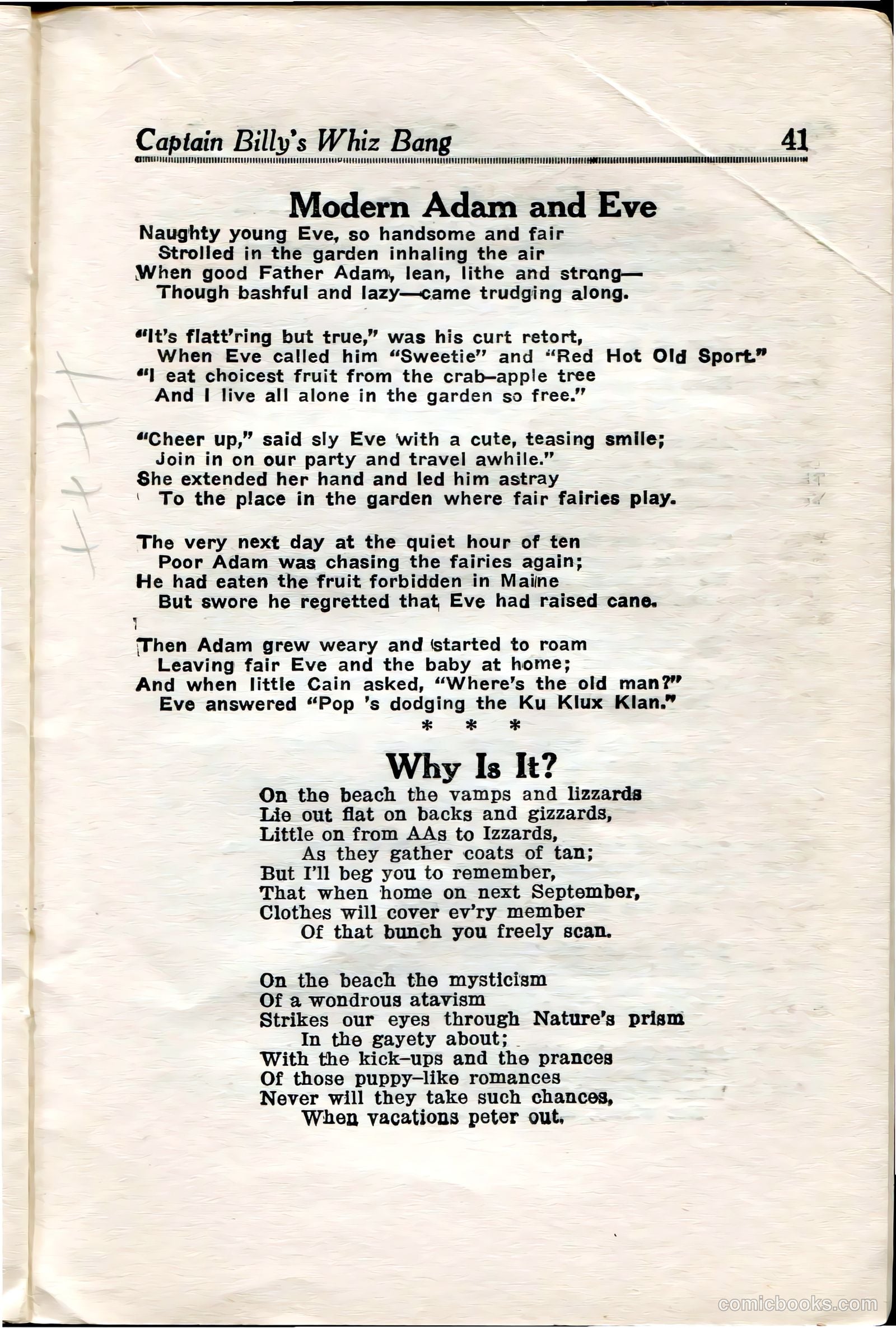
This page contains two satirical poems from *Captain Billy's Whiz Bang*, a 1920s humor magazine. **"Modern Adam and Eve"** updates the biblical creation story with contemporary social commentary. Adam represents the reluctant, work-averse modern man; Eve is the flirtatious "vamp" who tempts him into abandonment of solitary virtue. The satirical punch: Adam abandons his family, and when asked where he is, Eve jokes he's "dodging the Ku Klux Klan"—a topical reference to 1920s Klan activity. This mocks both Adam's cowardice and implies the Klan's prevalence in American life. **"Why Is It?"** sarcastically observes beach culture: women ("vamps and lizzards") expose themselves during summer vacation in scanty bathing suits, but resume modest clothing come September. The poem mocks the hypocrisy and performative nature of vacation behavior versus everyday propriety, suggesting women's liberation is merely seasonal theater. Both poems satirize modern courtship, gender relations, and social hypocrisy of the Jazz Age.
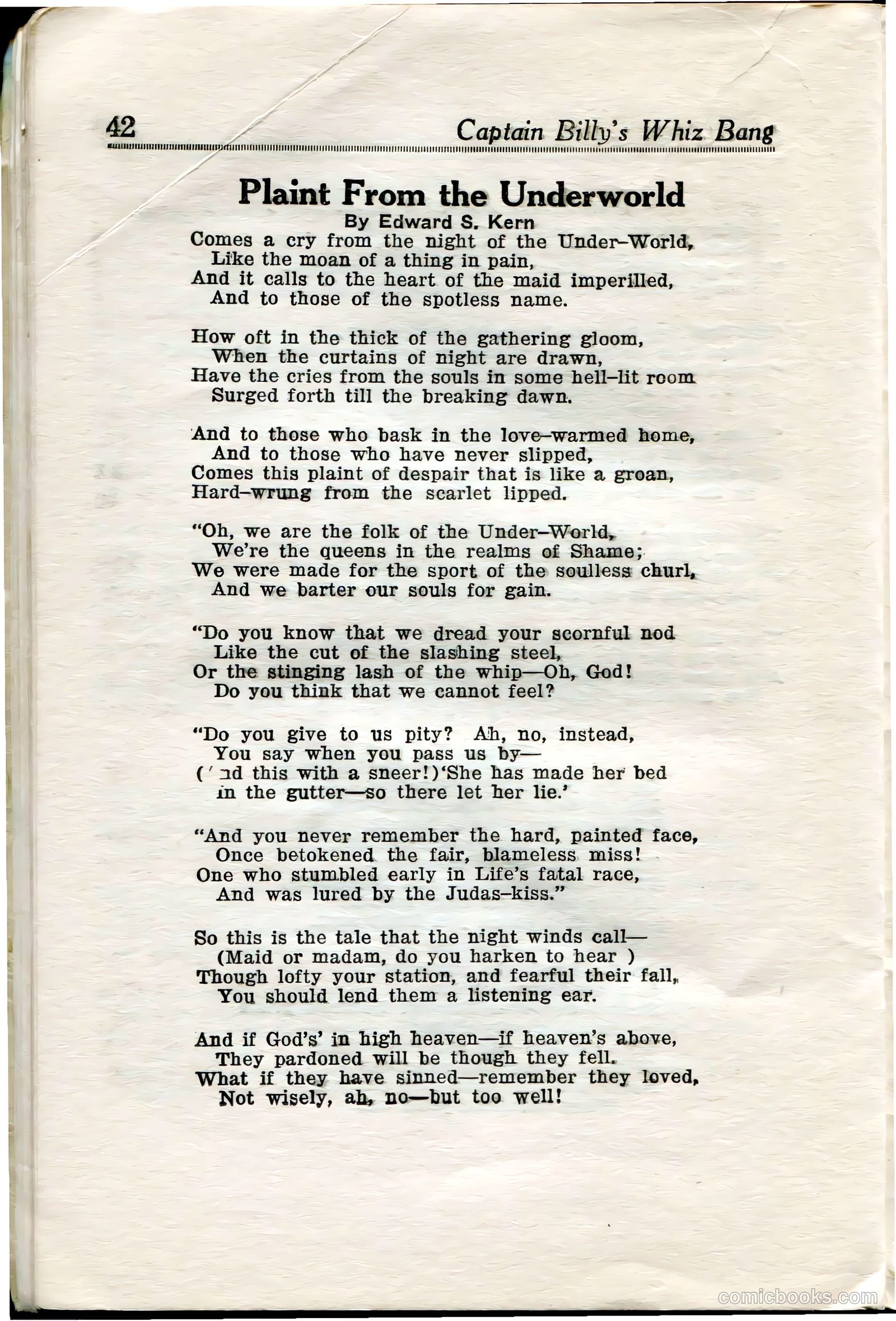
This is a poem, not a cartoon, from *Captain Billy's Whiz Bang*, a satirical magazine. Edward S. Kern's verse addresses the social hypocrisy surrounding "fallen women"—a period euphemism for sex workers or women who'd lost respectability through sexual transgression. The poem gives voice to marginalized women in the "Under-World," pleading for compassion from respectable society. It critiques how the privileged judge harshly ("scornful nod," "sneer") while ignoring circumstances that led these women astray—they "stumbled early in Life's fatal race, / And was lured by the Judas-kiss." The satire targets middle-class moral superiority and indifference. The poem argues these women deserve pity, not condemnation, and invokes divine mercy as superior to human judgment. This reflects Progressive Era social reform discourse questioning Victorian sexual morality and advocating for compassion toward society's most vulnerable members.
This page gossips about a Hollywood love triangle involving three silent-film stars: director Mickey Neilan, actress Blanche Sweet, and actress Gloria Swanson. The satire mocks the dramatic melodrama of their romantic entanglement—Neilan apparently chose Sweet over Swanson, who was traveling to New York when Sweet was heading there instead. The humor lies in the absurdist details: Sweet's casual, witty telegram accepting a marriage proposal ("The heat must be terrific"); the two women literally passing each other in transit; and Swanson sending an extravagantly luxurious parting gift (a diamond-and-platinum watch) before the wedding—a detail that's both petty and ostentatiously generous, mocking Hollywood excess and the performative nature of celebrity romance. The piece treats real people's lives as entertainment fodder, a common practice in 1920s fan magazines.
This page from the satirical magazine satirizes **Hollywood film agents and their unethical business practices** during the silent film era. The text mocks agents' dishonest dealings, using specific examples: one agent fraudulently offers Mary Pickford film rights he doesn't own, buying them from Harold Bolster for $12,000, then immediately reselling them to Pickford for $50,000—pocketing $38,000 in fraudulent profit. When Bolster (a Wall Street financier) hesitates to accept this "favor," the agent desperately reduces his asking price to $15,000. The comparison to Bret Harte's "Heathen Chinee" (an 1870 poem about deception) and the stereotypical description of the agent as "a Jewish gentleman" reflect period prejudices while mocking sharp business tactics. The satire targets **agent greed, fraud, and manipulation** of early Hollywood's major stars like Mary Pickford and Harold Bolster's wife Madge Kennedy.
This page contains two anecdotes mocking **William Randolph Hearst's** extravagant movie production practices. Both stories illustrate his arbitrary power and wasteful spending. The first brief anecdote describes a negotiation where producer Bolster demands $100,000 for his film, causing a studio agent to panic about losing **Mary Pickford's** goodwill—suggesting Hearst's desperation to compete with major stars. The second, longer story shows Hearst casually ordering reshoots of an entire film ("Get-Rich-Quick Wallingford") because he dislikes actor Sam Hardy's grey derby hat. The staff dreads the expense but must comply with his whim. The satire targets Hearst's enormous wealth enabling capricious decision-making that wastefully reshapes productions on personal taste alone—typical 1920s criticism of his lordly attitude toward filmmaking and his willingness to spend fortunes on trivial preferences.
This page satirizes two 1920s trends: **Hardy's Derby:** The joke mocks William Randolph Hearst's extravagance. Hearst reportedly spent $60,000 to remove actor Oliver Hardy's iconic grey derby hat from a film—an absurd expense exceeding even the Kentucky Derby's value. The satire ridicules both Hearst's wasteful power and the emerging film industry's excess. **Bathing Girls Craze:** The text lampoons New York's fad of featuring scantily-clad women ("bathing vamps") in restaurants and cabarets. References include Gilda Grey (famous "shimmie" dancer) and "Kellermanns" (one-piece swimsuits). The satirist notes that actual seaside resorts like Long Beach restrict such displays legally, yet attract crowds seeking to view women in minimal clothing—making it cheaper entertainment than Broadway theater tickets. Both sections mock 1920s consumer culture: the film industry's wasteful spending and the exploitation of women's bodies as commercial spectacle in Jazz Age venues.
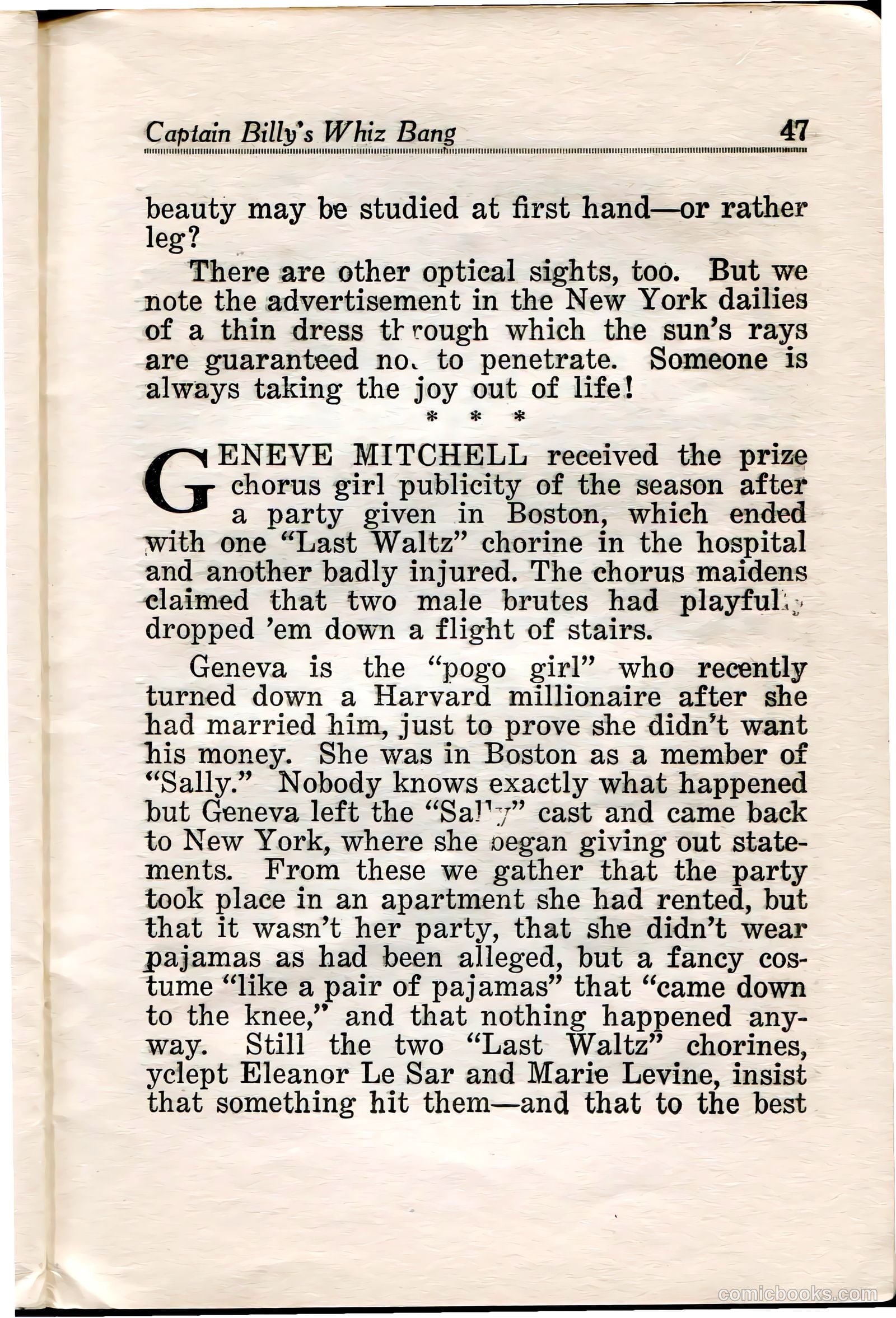
This page from *Captain Billy's Whiz Bang* (a 1920s-era humor magazine) contains no political cartoons—it's primarily gossip column text. The content discusses: **Geneve Mitchell**, described as a "pogo girl" who married then rejected a Harvard millionaire. She was performing in the musical "Sally" in Boston when a party incident occurred, allegedly involving her falling down stairs with two male guests. The piece satirizes conflicting stories: Mitchell's statement that nothing happened versus chorus members Eleanor Le Sar and Marie Levine's insistence "something hit them." The tone is mocking, questioning her credibility and the scandal's true nature—typical of the magazine's gossipy, skeptical humor style. The opening paragraph makes a crude joke about studying female beauty "at first hand—or rather leg," reflecting the era's casual sexism.
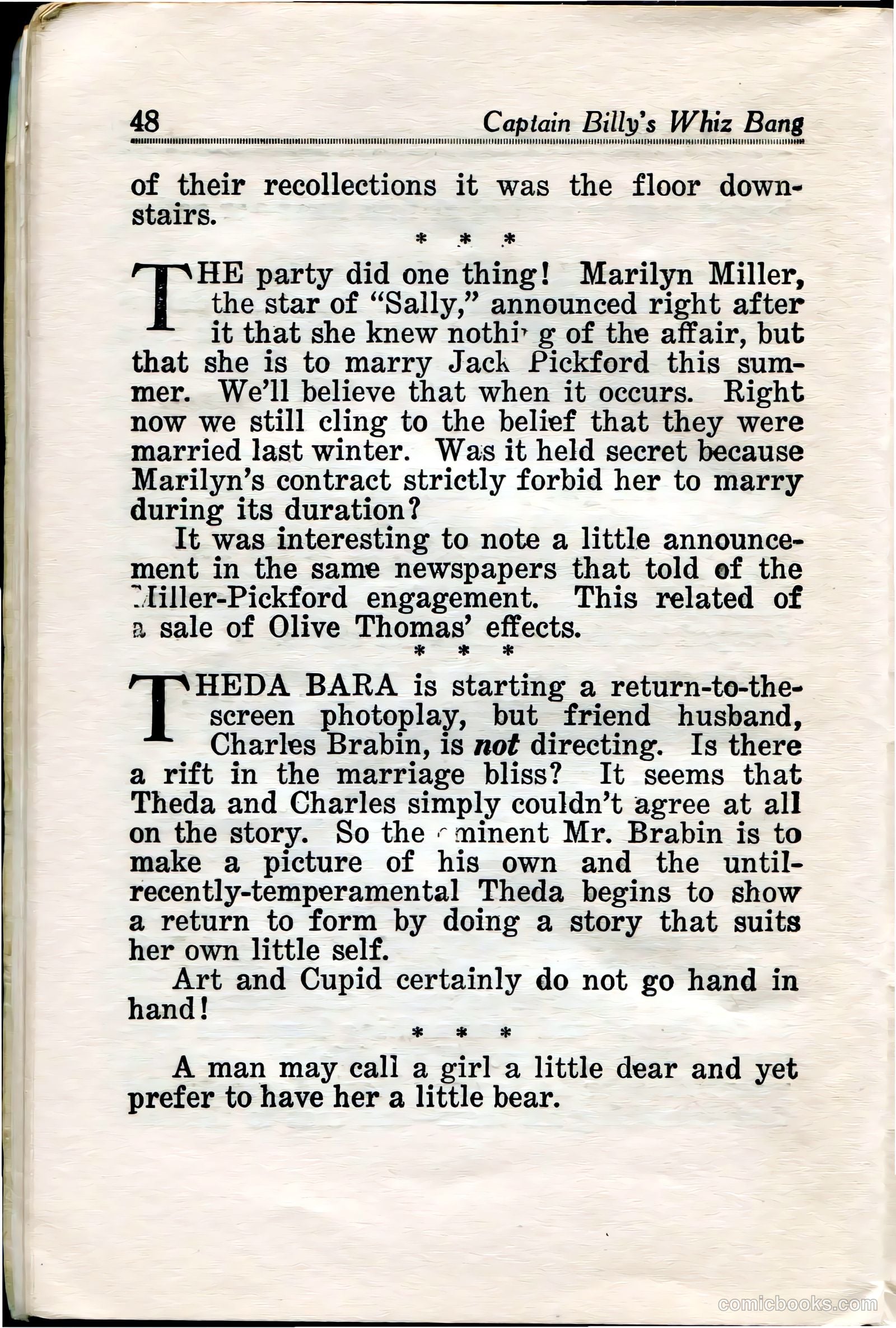
This page from *Captain Billy's Whiz Bang* (a 1920s humor magazine) gossips about Hollywood celebrities and their marital troubles: **Marilyn Miller & Jack Pickford**: The column skeptically reports Miller's claim she knew nothing of an affair, while betting they secretly married last winter—possibly hidden because her contract forbade marriage. **Olive Thomas reference**: A cryptic mention of a deceased actress's estate sale appears adjacent, likely hinting at scandal (Thomas died in 1920 under mysterious circumstances). **Theda Bara & Charles Brabin**: The satire suggests marital discord—they disagreed on her film project, so Brabin is directing his own picture instead while Bara returns to work on her own terms. The joke: artistic collaboration and romance don't mix. **Final quip**: A pun on "dear" versus "bear"—suggesting men prefer less emotional, more docile partners. The satire mocks celebrity hypocrisy, contract violations, and troubled marriages while entertaining readers with insider Hollywood gossip.
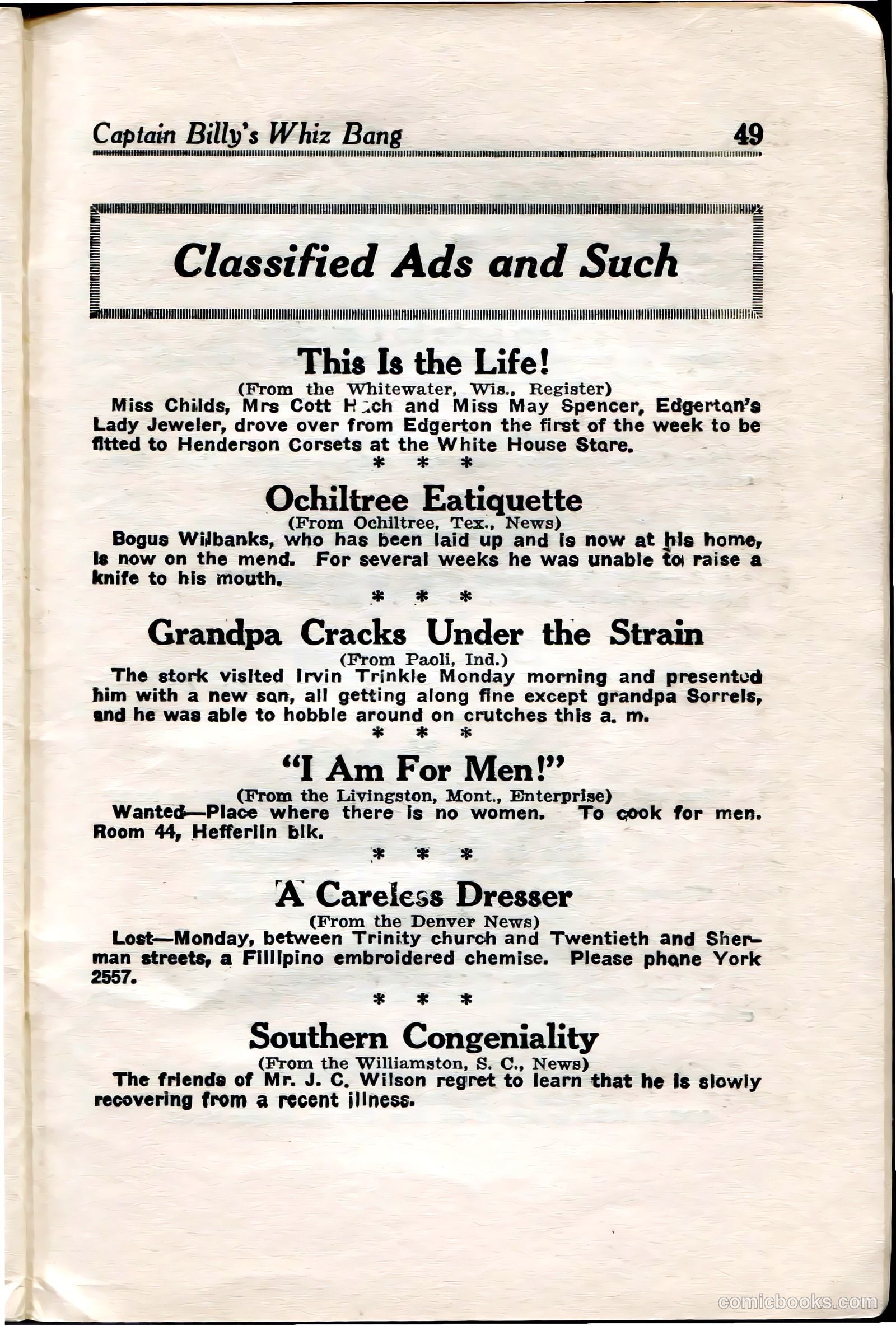
This page contains no cartoons—it's a section of *Whiz Bang*, a 1920s satirical magazine, comprised entirely of humorous classified ads and brief news items reprinted from small-town American newspapers. The satire works by presenting genuinely absurd or unintentionally funny real classifieds and notices. The humor includes: - **"This Is the Life!"**: Women getting fitted for corsets presented as enviable leisure - **"Ochiltree Eatiquette"**: A man unable to eat for weeks (unclear why) presented as casual gossip - **"Grandpa Cracks"**: A newborn causing the grandfather's injury treated matter-of-factly - **"I Am For Men!"**: A misogynistic job posting presented deadpan - **"Careless Dresser"**: A lost undergarment treated with urgent formality - **"Southern Congeniality"**: Backhanded sympathy—regretting someone's *recovery* from illness (unclear intent: sarcasm or genuine rudeness) The magazine's appeal relied on readers finding humor in small-town America's unintentionally bizarre or socially awkward public announcements.
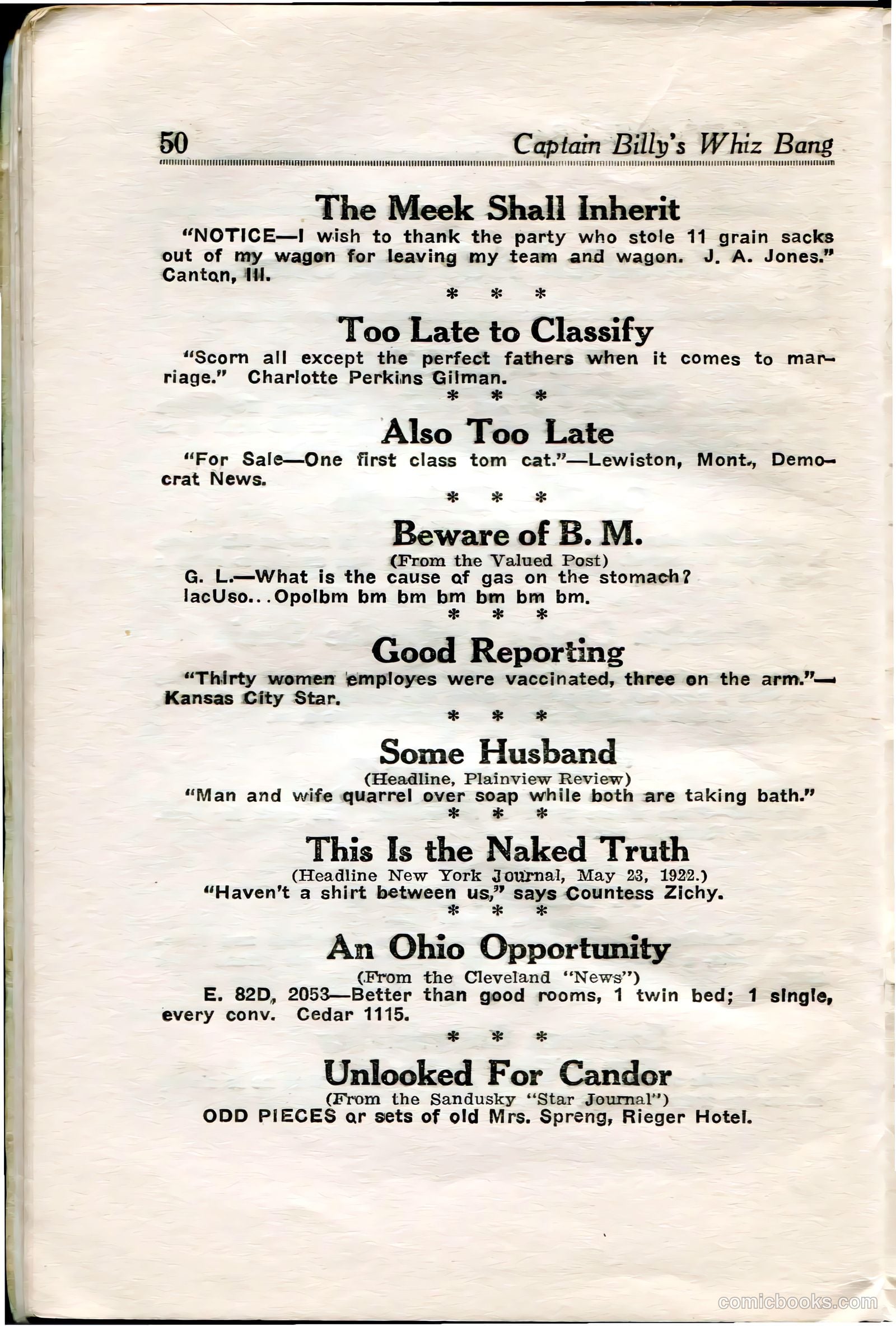
This page from the satirical magazine consists entirely of **humorous newspaper clippings and classified ads** rather than cartoons. The humor works through absurdity and unintended double meanings in real newspaper text. The jokes mock poor editorial choices: - "The Meek Shall Inherit" laughs at a theft victim sarcastically thanking thieves for restraint - "Good Reporting" highlights awkward phrasing ("vaccinated...three on the arm") - "Some Husband" finds dark comedy in couples quarreling during shared bathing - "This Is the Naked Truth" plays on a countess claiming poverty ("no shirt between us") - "Unlooked For Candor" presents oddly phrased property listings that sound suspicious The page exemplifies *Whiz Bang*'s typical format: mining everyday newspapers for unintentional humor through clumsy wording, ambiguous phrasing, and unfortunate juxtapositions. No specific political figures appear—the satire targets American newspapers themselves and their careless editors.
This page from a 1920s satirical magazine contains several brief humorous sketches typical of the era's "men's magazine" humor: **"Any Other Games, Jack-O?"** depicts a young couple's moonlit encounter where a boy makes a bet he can kiss a girl without touching her—then "accidentally" puts his arm around her waist. The joke plays on youthful boldness and the girl's feigned reluctance masking actual willingness. "Lib" likely refers to a liberated modern woman. **The remaining items are short joke sections**: a monthly motto about staying safe around animals and weapons; a farm school poem about "Tillie" (a pun: she's good at soil "culture" but poor at "husbandry"—farming and marriage); philosophy mocking fathers trying to deceive babies; and a "health hint" joking about infidelity. The humor reflects period attitudes toward courtship, rural life, and marital dynamics—generally crude, crude, and assumption-laden by modern standards.
This page from *Captain Billy's Whiz Bang* (a 1920s-era humor magazine) contains short satirical jokes targeting domestic life and gender relations. **"Flooter Wins This Argument"** mocks husbands' grumpiness at breakfast—a common marital complaint—by having the surly Mr. Flooterpush deny he's ever complained, which proves Mrs. Flooterpush's point. **"If General Wood would come to Penn"** appears to reference General Leonard Wood, a prominent political figure of the era, in a light political jab. The remaining items are standard bawdy jokes: a young woman getting dunked in a lake, relationship squabbles, and cynical bachelor humor about marriage. The final aphorism—"A girl is a coward when she won't meet you face to face"—reflects the era's expectations of female directness in courtship. Overall, the page emphasizes domestic disputes and romantic miscommunication through crude humor typical of 1920s men's magazines.
This gossip column from *Captain Billy's Whiz Bang* contains two celebrity items: **Arbuckle item:** Reports that comedian Roscoe "Fatty" Arbuckle is financially ruined, selling luxury cars and deeding his home as collateral. The reference to "trials" likely alludes to his serious legal troubles (he faced manslaughter accusations in the early 1920s). The piece mocks his fallen status. **Fannie Ward item:** This satirizes cosmetic surgery and age-gap relationships. The column notes that actress Fannie Ward, in her fifties, underwent a "face lift" procedure and facial enameling that made her look younger than her much-younger husband Jack Dean (in his twenties). The satire mocks both the artificiality of such procedures and the social spectacle of an older woman appearing rejuvenated enough to seem younger than her youthful spouse. Both items exemplify the magazine's gossipy, sometimes cruel tone toward Hollywood celebrities.
This page from *Captain Billy's Whiz Bang* (a 1920s satirical magazine) contains Hollywood gossip presented as scandalous entertainment. The content mocks silent-film stars and industry practices: **Key targets:** - **Fannie Brice**: Implied to be undergoing cosmetic procedures in Paris - **Connie Talmadge**: Actress rushing her divorce, with a joke suggesting she'll marry European nobility ("hunt a count") - **Valentino**: The text reveals the major studio (Lasky) refused to bail out the troubled star; friends covered costs instead - **Gladys Walton** and **Priscilla Bonner**: Actresses divorcing husbands for infidelity and unemployment **The satire's point:** Hollywood's young stars—particularly women—are morally questionable (cosmetic surgery, multiple marriages, marrying at 17) and studios enable male misbehavior while avoiding responsibility. The tone is prurient gossip dressed as social commentary, typical of 1920s scandal magazines that titillated readers with celebrities' private troubles.
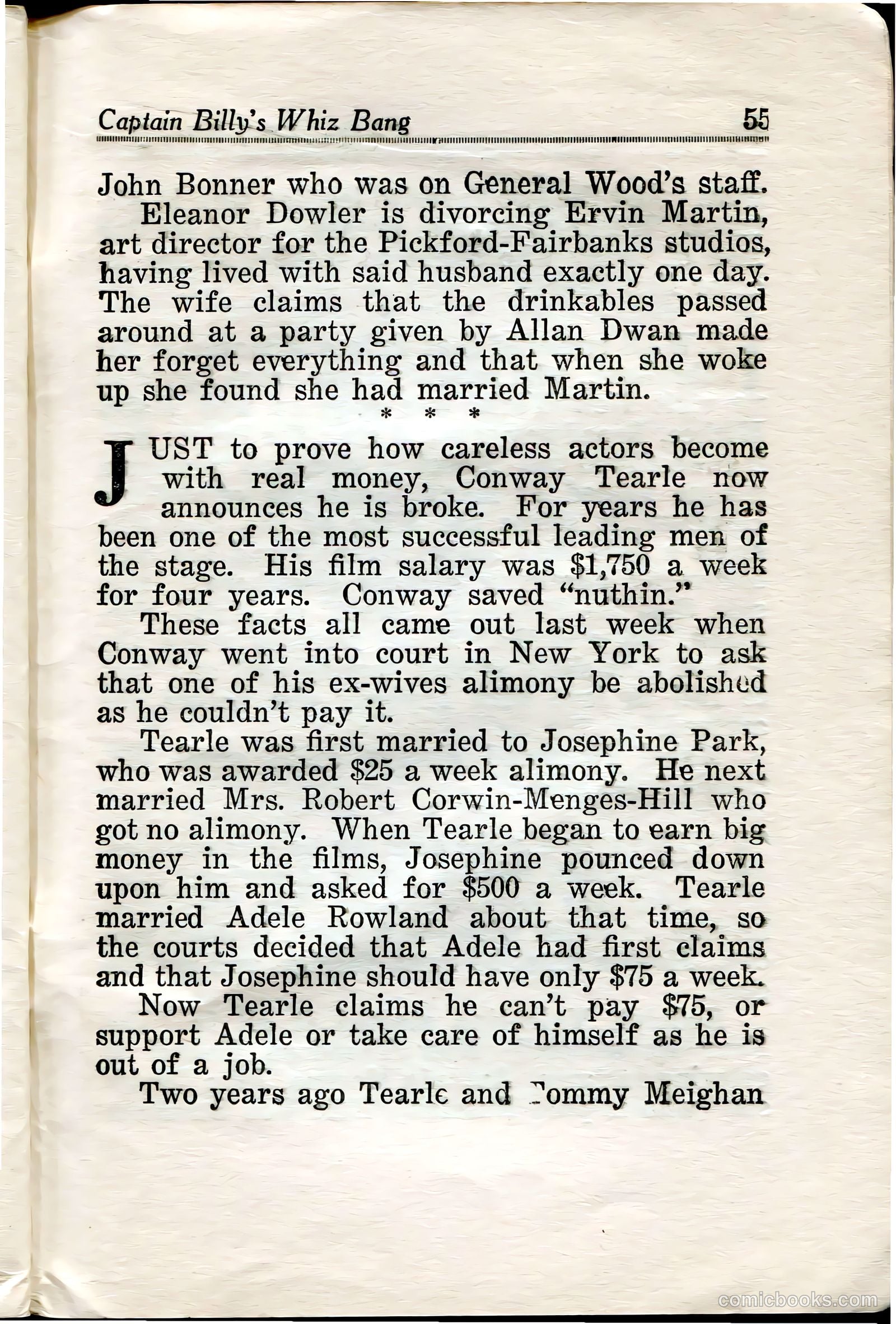
This page from *Captain Billy's Whiz Bang* (a 1920s satirical magazine) contains gossip items mocking Hollywood actors' financial mismanagement and marital chaos. The main target is actor **Conway Tearle**, once earning $1,750 weekly in films but now broke and unable to pay alimony. The satire highlights the absurdity of his situation: despite years of high income, he saved nothing and now faces competing alimony claims from multiple ex-wives (Josephine Park, Adele Rowland). The courts had to arbitrate, reducing Josephine's demand from $500 to $75 weekly. Now unemployed, he claims he cannot pay even that. The shorter item about **Eleanor Dowler** divorcing art director Ervin Martin after one day of marriage—claiming she was too intoxicated at a party to know what she was doing—satirizes Hollywood's reckless lifestyle and impulsive decisions. Both items mock actors as financially irresponsible and emotionally unstable despite their wealth and prominence.
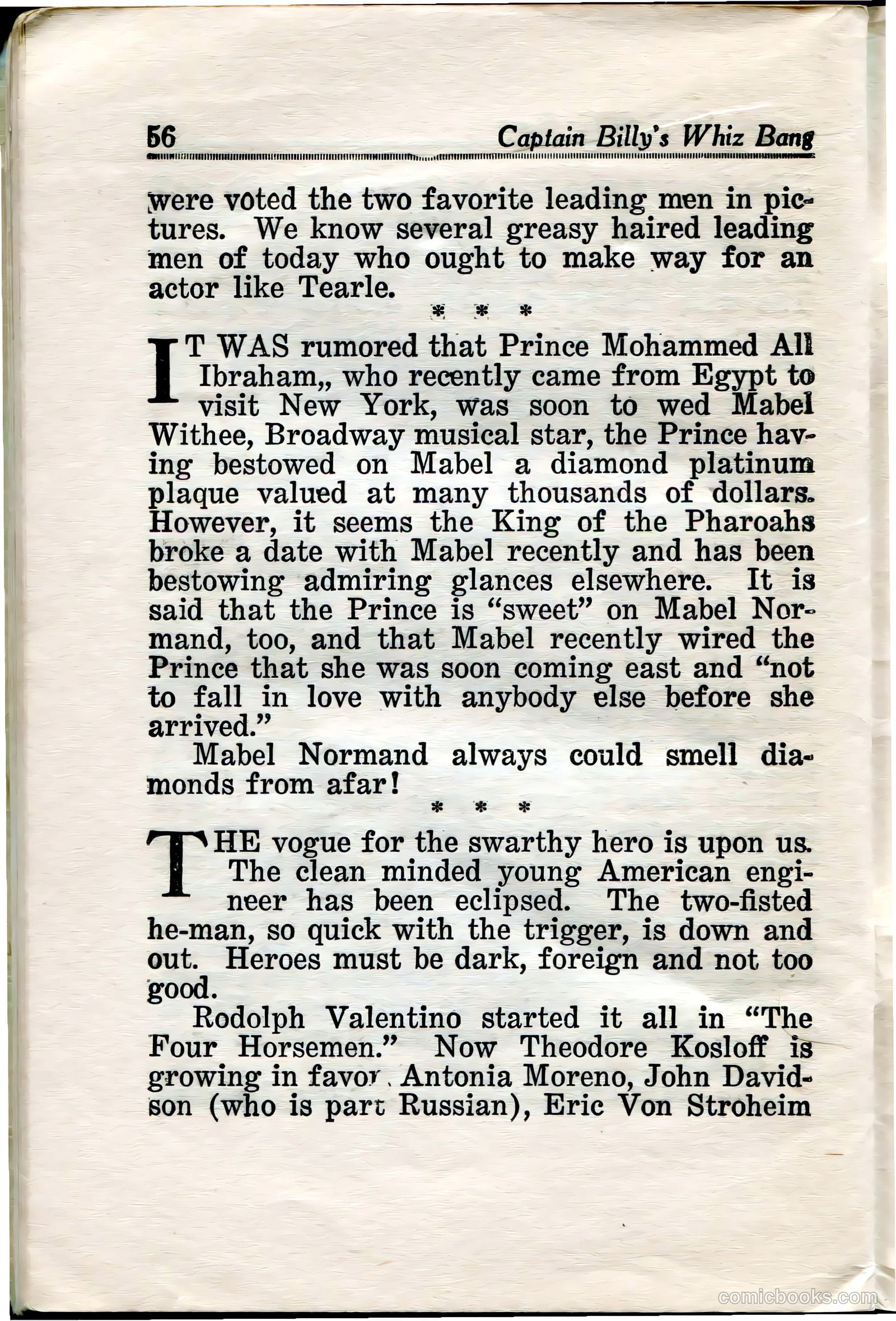
This satirical gossip column mocks 1920s Hollywood trends and personalities. The main targets are: **The Prince Mohammed Ali rumor**: The piece ridicules the tabloid excitement around an Egyptian prince allegedly courting Broadway star Mabel Withee, then switching attention to actress Mabel Normand. The humor lies in suggesting Normand is purely mercenary—she can "smell diamonds from afar"—satirizing both celebrity gold-digging and the era's fascination with foreign royalty. **The "swarthy hero" trend**: The column criticizes a shift in Hollywood leading men from wholesome American types to "dark, foreign" actors. Valentino's success in *The Four Horsemen* sparked this preference. The satire mocks both the industry's fickleness and audience taste for exotic, morally ambiguous foreigners over "clean minded young American engineers." The underlying commentary reflects 1920s anxieties about changing cultural values and American identity during an era of significant European immigration.
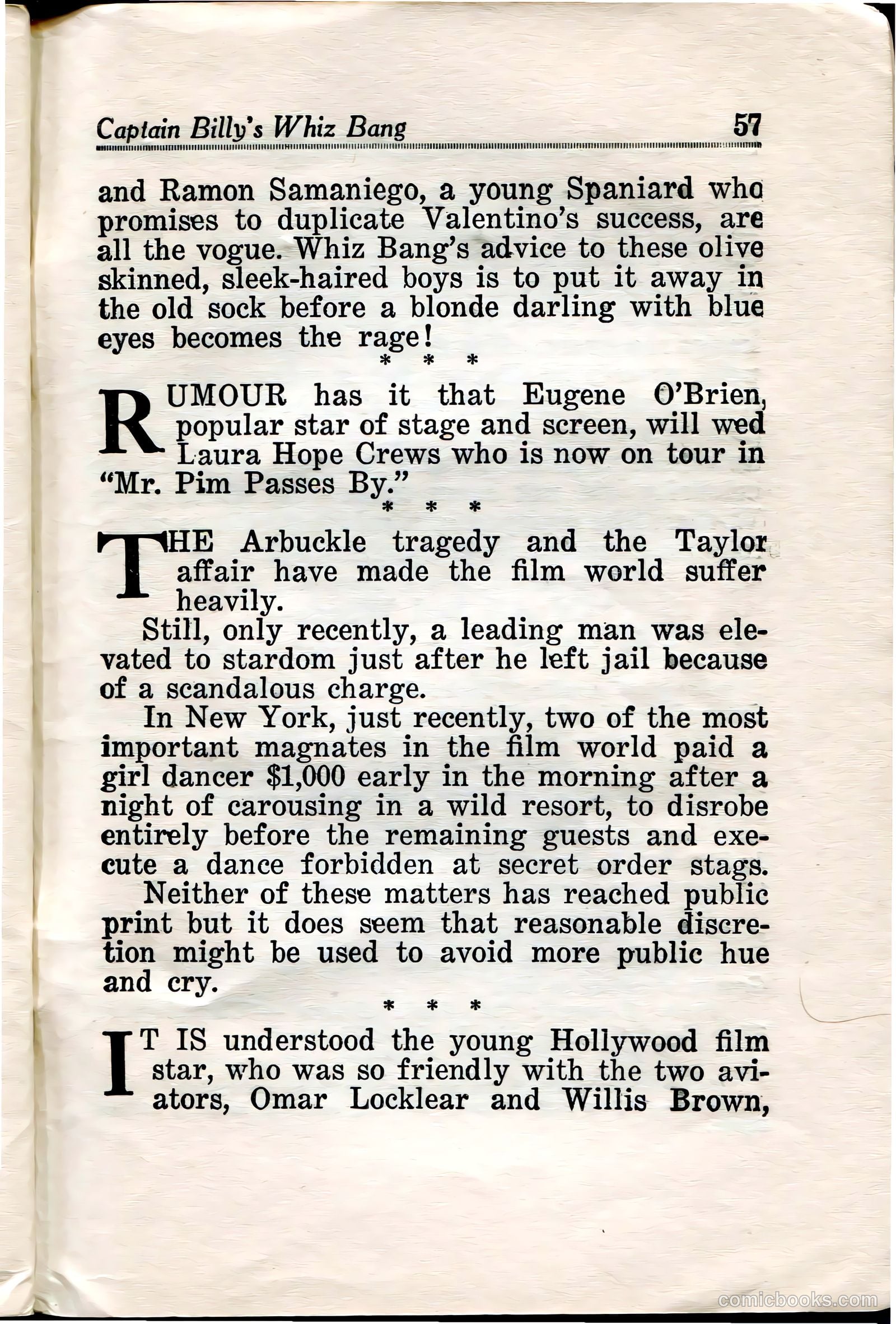
This page from the satirical magazine contains celebrity gossip and scandal commentary rather than cartoons. It references the early 1920s Hollywood scandals that devastated the film industry's reputation. The text alludes to real events: the "Arbuckle tragedy" (Roscoe "Fatty" Arbuckle's 1921 rape accusation) and the "Taylor affair" (director William Desmond Taylor's 1922 murder). The piece critiques Hollywood excess—describing film magnates paying a dancer $1,000 to perform a forbidden striptease at a private party—while noting these scandals haven't reached public print yet. The opening mocks the trend of handsome foreign actors like Valentino, sardonically warning they should "put it away in the old sock" before losing their appeal to blonde actresses. The final paragraph references Omar Locklear and Willis Brown, aviators involved in early aviation stunts. The magazine appears focused on exposing Hollywood's hypocrisy and moral failings to readers.
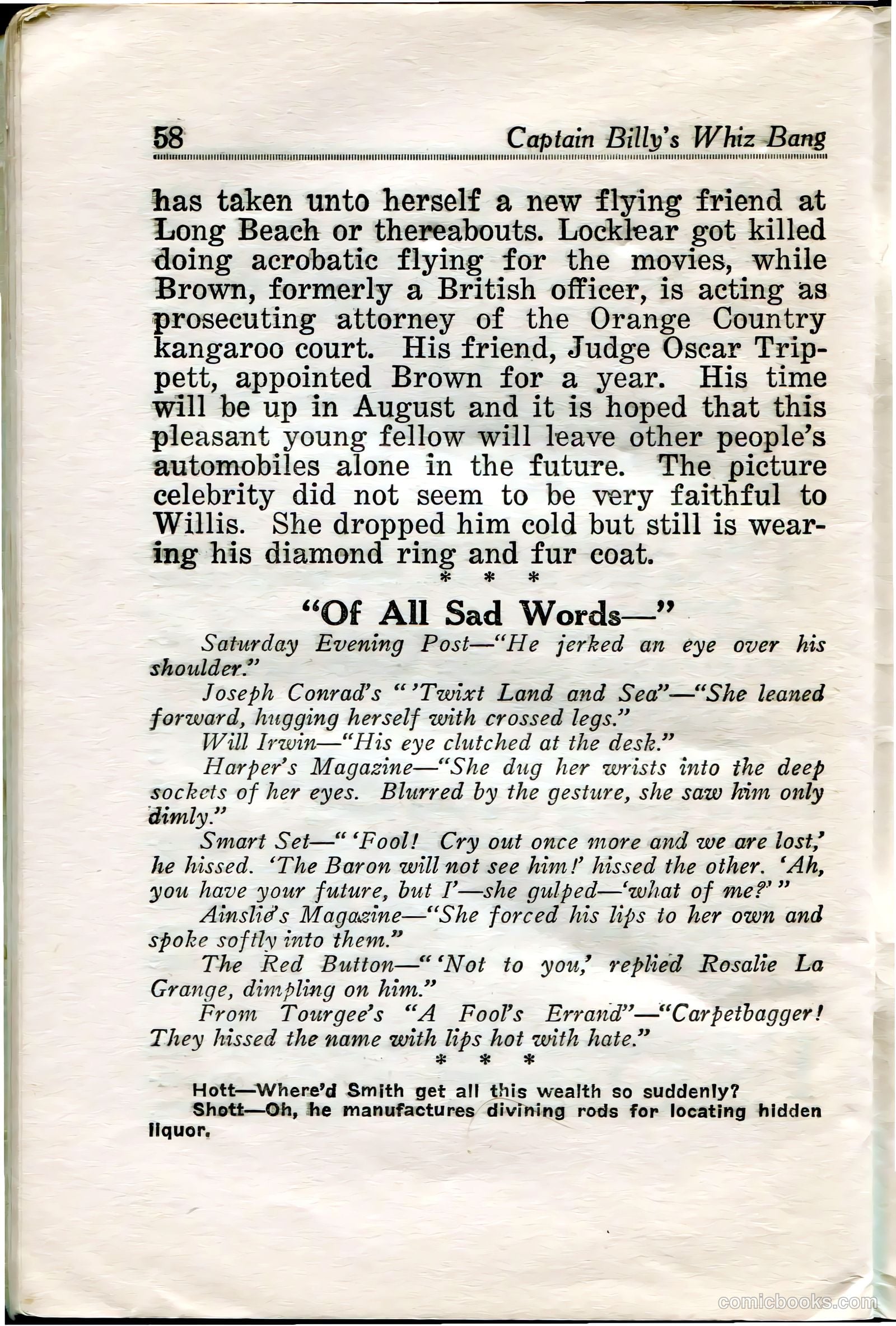
This page contains gossip and literary mockery typical of *Whiz Bang*, a bawdy satirical magazine. **Upper section**: Gossip about a "picture celebrity" at Long Beach who took up with a new "flying friend" after stunt pilot Locklear's fatal accident. The item sarcastically notes she dropped her previous boyfriend (Willis) but kept his diamond ring and fur coat—mocking her infidelity and materialism. **"Of All Sad Words"**: A humorous parody of overwrought literary prose from major magazines (Saturday Evening Post, Harper's, Smart Set, etc.), all describing emotional moments with melodramatic eye-contact imagery. The satire ridicules how different prestigious publications use nearly identical clichéd descriptions of longing and drama. **Bottom joke**: A Prohibition-era gag: a man's sudden wealth comes from selling "divining rods for locating hidden liquor"—mocking both get-rich-quick schemes and the illegal alcohol trade during the 1920s ban. The page's humor relies on readers recognizing contemporary literary pretension and Prohibition-era bootlegging culture.
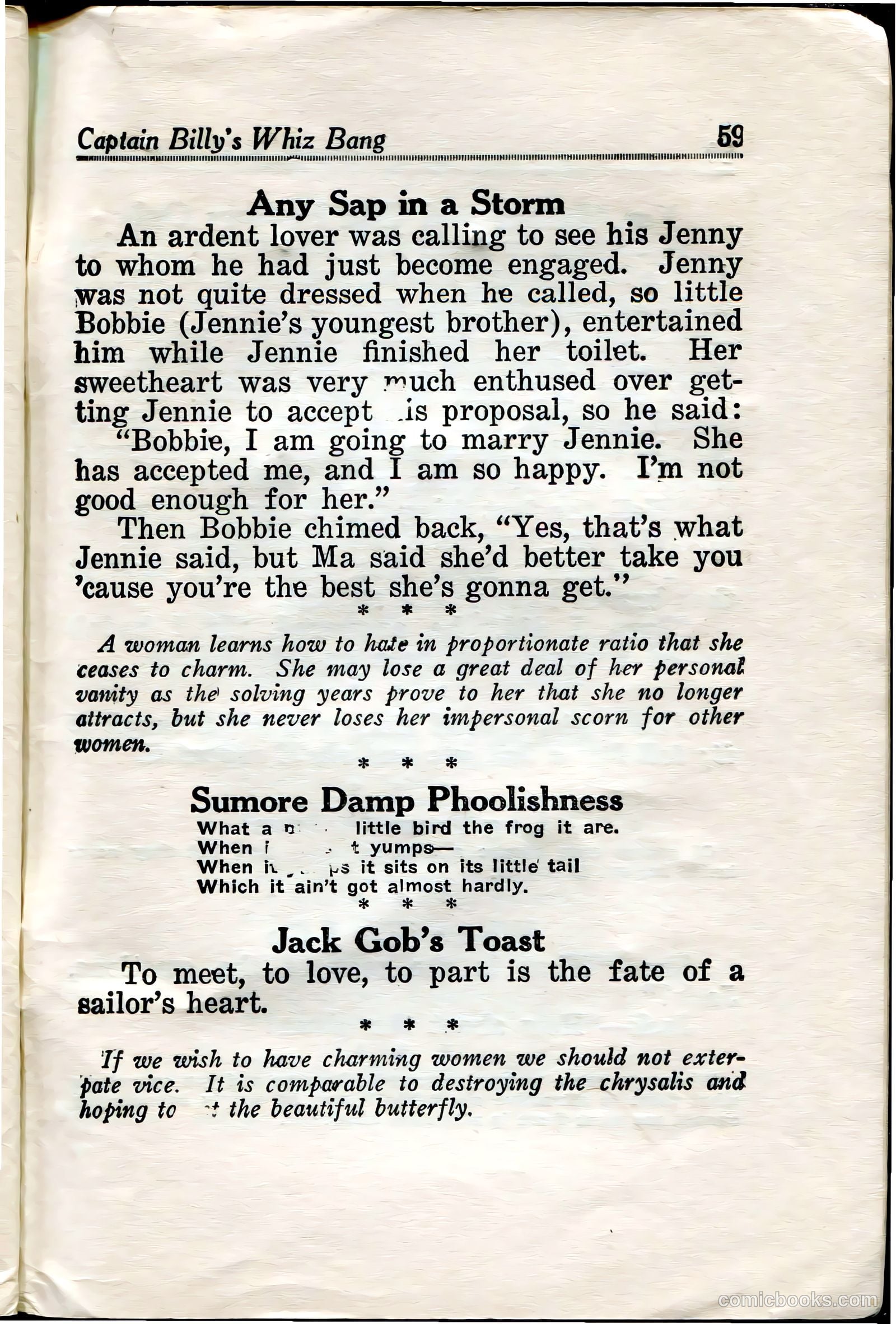
This page from a 1920s satirical magazine contains humorous anecdotes rather than cartoons. "Any Sap in a Storm" is a joke playing on male insecurity in romance: an engaged man self-deprecatingly tells his fiancée's young brother he's "not good enough for her," only to be hilariously deflated when the boy reports that the mother said to accept him because "you're the best she's gonna get"—inverting the compliment into an insult about limited options. The philosophical passage below mocks women's tendency to lose charm as they age but retain cattiness toward other women—social satire on female rivalry. "Sumore Damp Phoolishness" appears to be nonsense verse poking fun at malapropisms or broken English (a frog that "yumps," lacks a tail it "ain't got"). "Jack Gob's Toast" romanticizes sailors' transient love lives, while the final italicized passage uses butterfly/chrysalis metaphor to argue against moral reformation of women—dark social commentary on female nature.
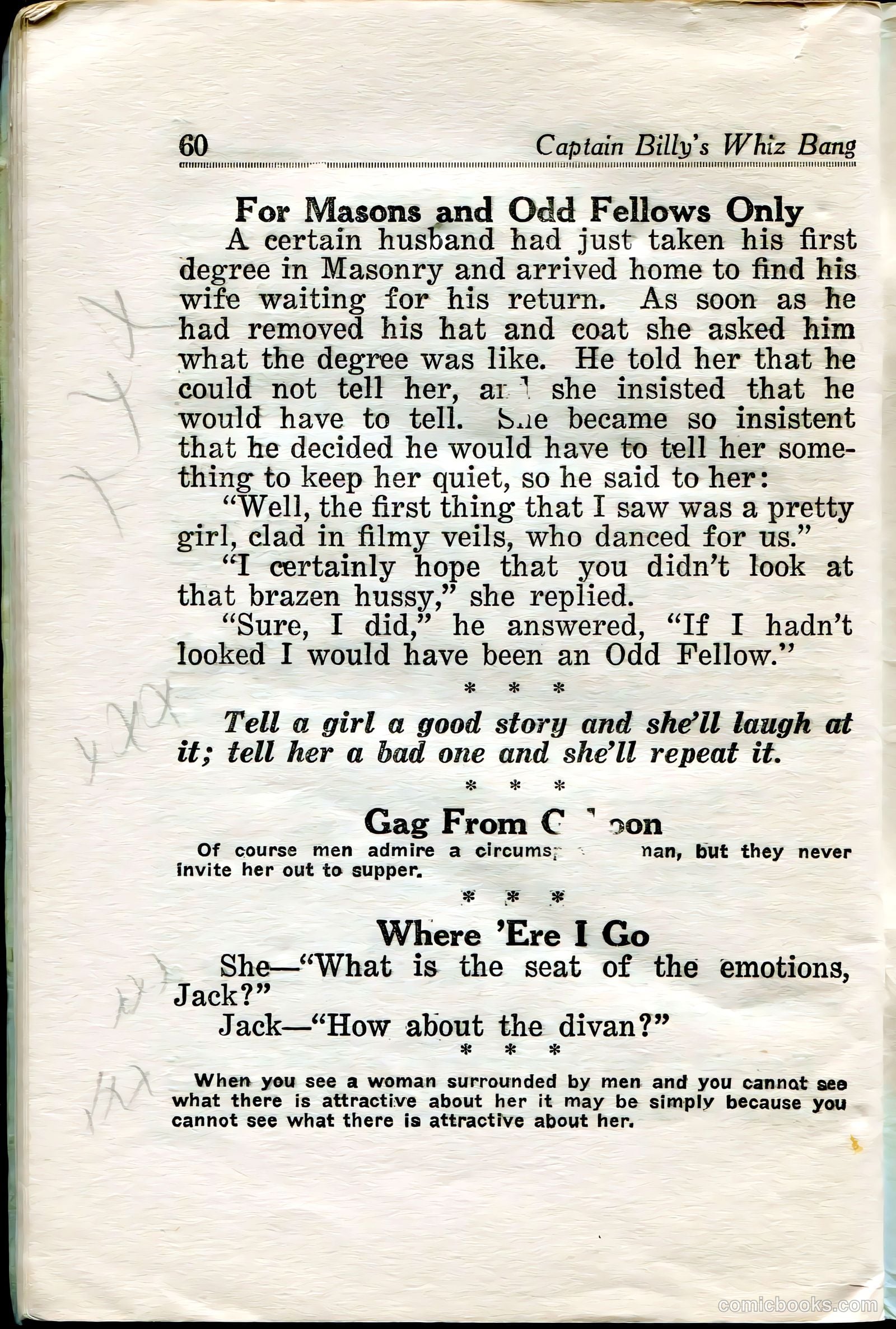
This page from *Captain Billy's Whiz Bang* (a 1920s-era men's humor magazine) collects several short jokes targeting domestic life and gender relations: **Main joke**: A Mason's wife demands he reveal initiation secrets. He fabricates a story about a dancing girl in veils to appease her. His punchline plays on "Odd Fellow" (a fraternal order) as a synonym for someone who *wouldn't* look—implying a real man naturally would, defying his wife's jealous disapproval. **Recurring theme**: Women as nagging, jealous, or illogical (they'll repeat bad stories; they're mysteriously attractive to men for unclear reasons; they're "brazen hussies"). **Context**: The satire targets both Masonic secrecy (which wives supposedly couldn't penetrate) and traditional marriage dynamics where husbands resented female authority. The humor assumes male readers identify with marital conflict and appreciate mockery of female jealousy and nosiness. The magazine catered to men's fraternal organizations, making in-jokes about their secretive rituals and exclusivity central to the comedy.
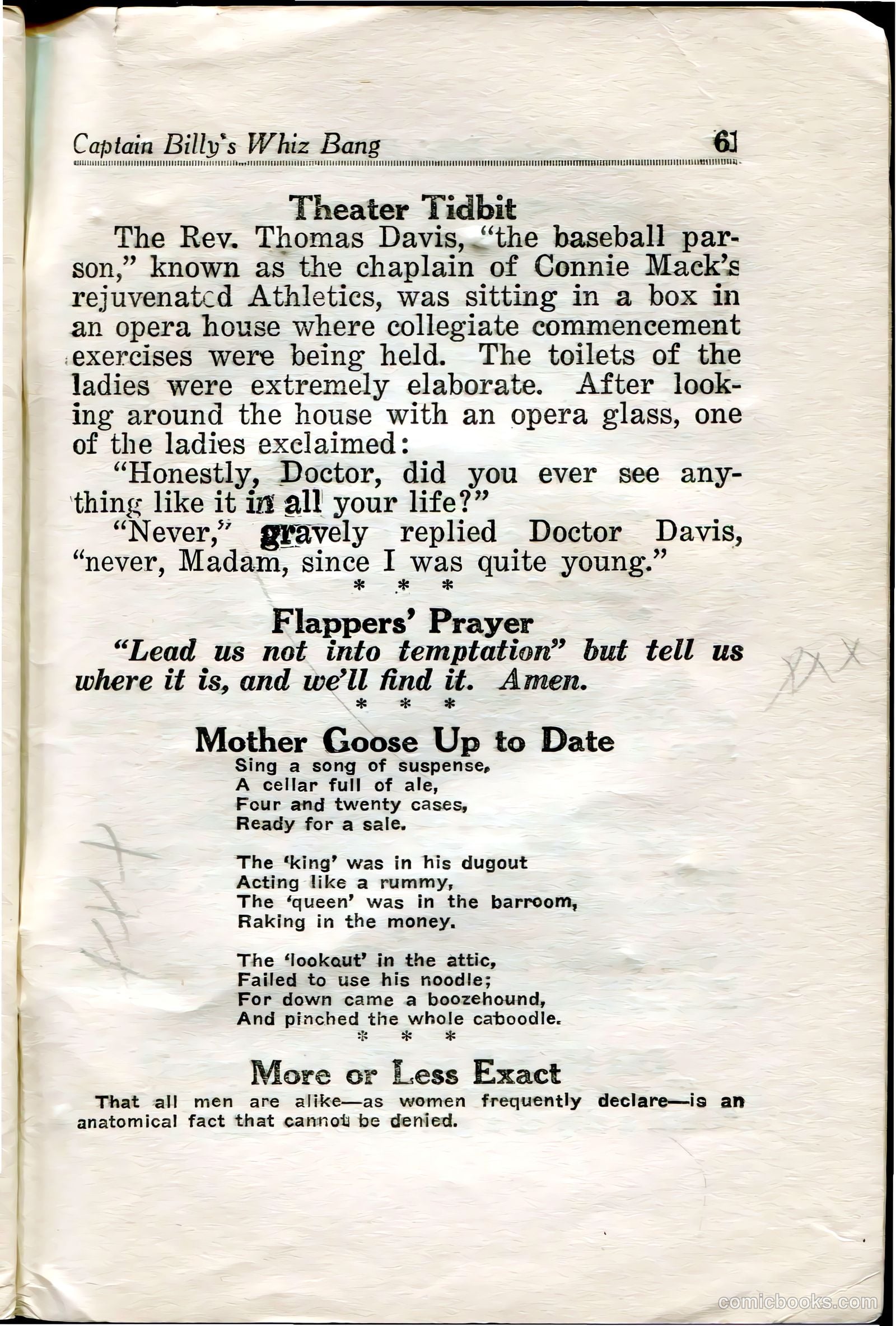
This page contains several satirical pieces reflecting 1920s American culture: **Theater Tidbit**: A mild joke about Rev. Thomas Davis (a real baseball chaplain for Connie Mack's Athletics) commenting on elaborate ladies' restrooms at a commencement. The humor lies in his evasive, genteel response to a woman's exclamation—he hasn't seen such facilities since youth, implying either rural simplicity or the novelty of modern plumbing. **Flappers' Prayer**: Satirizes 1920s young women ("flappers") as reckless and irreverent, joking they want temptation located rather than avoided—reflecting anxieties about post-WWI youth behavior and changing morality. **Mother Goose Up to Date**: This is Prohibition-era satire. The nursery rhyme parodies alcohol smuggling: the "king" (bootlegger), "queen" (seller), and "lookout" are caught when a "boozehound" raids their operation. It mocks both illegal alcohol production and enforcement failure. **More or Less Exact**: A cynical one-liner about male uniformity, presented as women's common complaint—mild gender satire typical of the era.
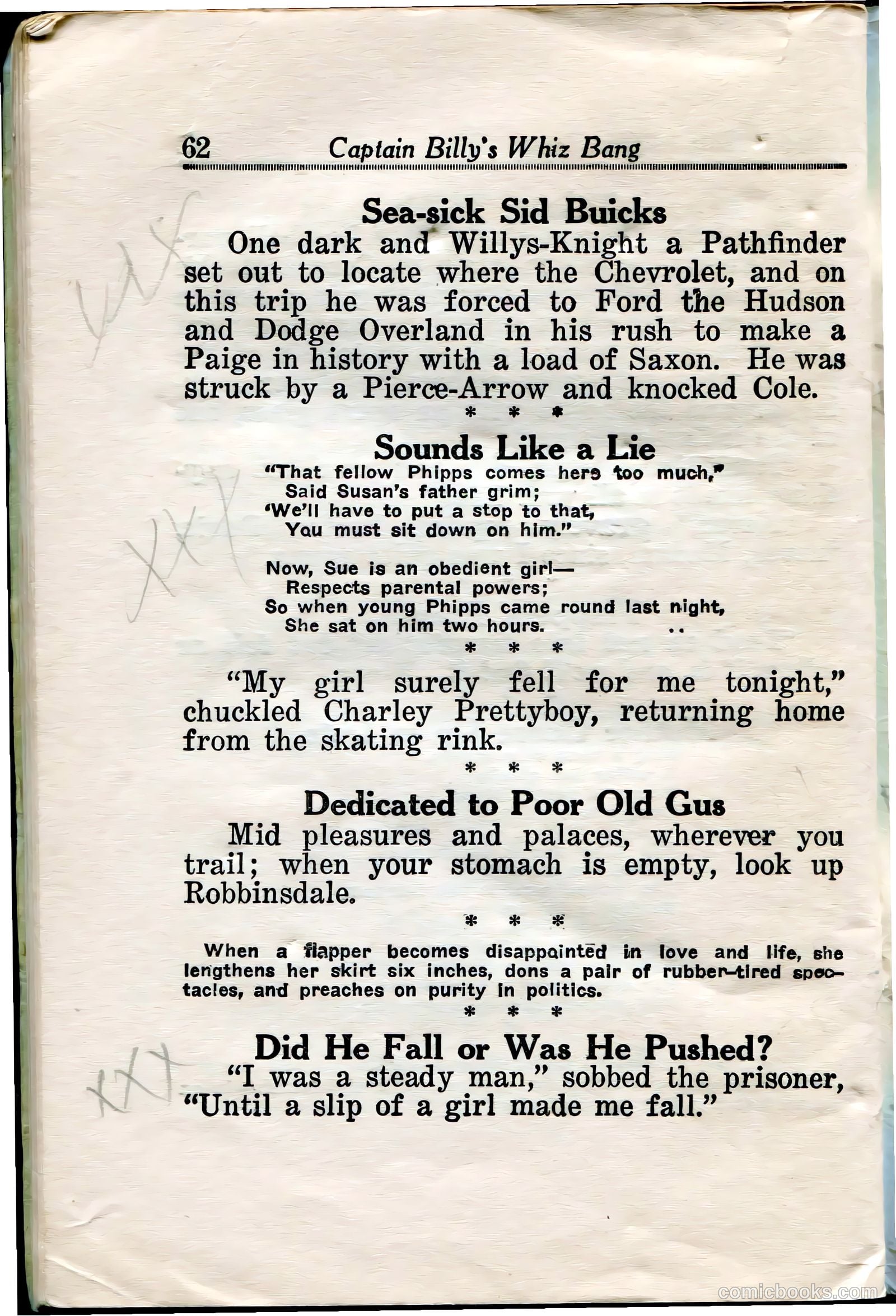
This page contains multiple brief humorous pieces typical of 1920s satirical magazines: **"Sea-sick Sid Buicks"** is a pun-heavy joke where car brand names (Buicks, Willys-Knight, Chevrolet, Ford, Hudson, Dodge, Paige, Saxon, Pierce-Arrow, Cole) are inserted as verbs and nouns into a nonsensical narrative—wordplay that relied on readers' familiarity with contemporary automobile models. **"Sounds Like a Lie"** jokes about parental discipline: a father demands his daughter "sit down on" an overly-attentive suitor; she obeys literally, sitting on him for two hours. The humor derives from the double meaning. **Other brief items** mock 1920s social trends: "Charley Prettyboy" at the skating rink, advice about Robbinsdale (unclear reference), and **flapper culture**—the final piece satirizes young women who, disappointed in romance, adopt conservative dress and moralistic rhetoric about "purity in politics," inverting their earlier modern image. These represent typical Whiz Bang humor: automotive references, innocent double entendres, and generational commentary on postwar youth culture.
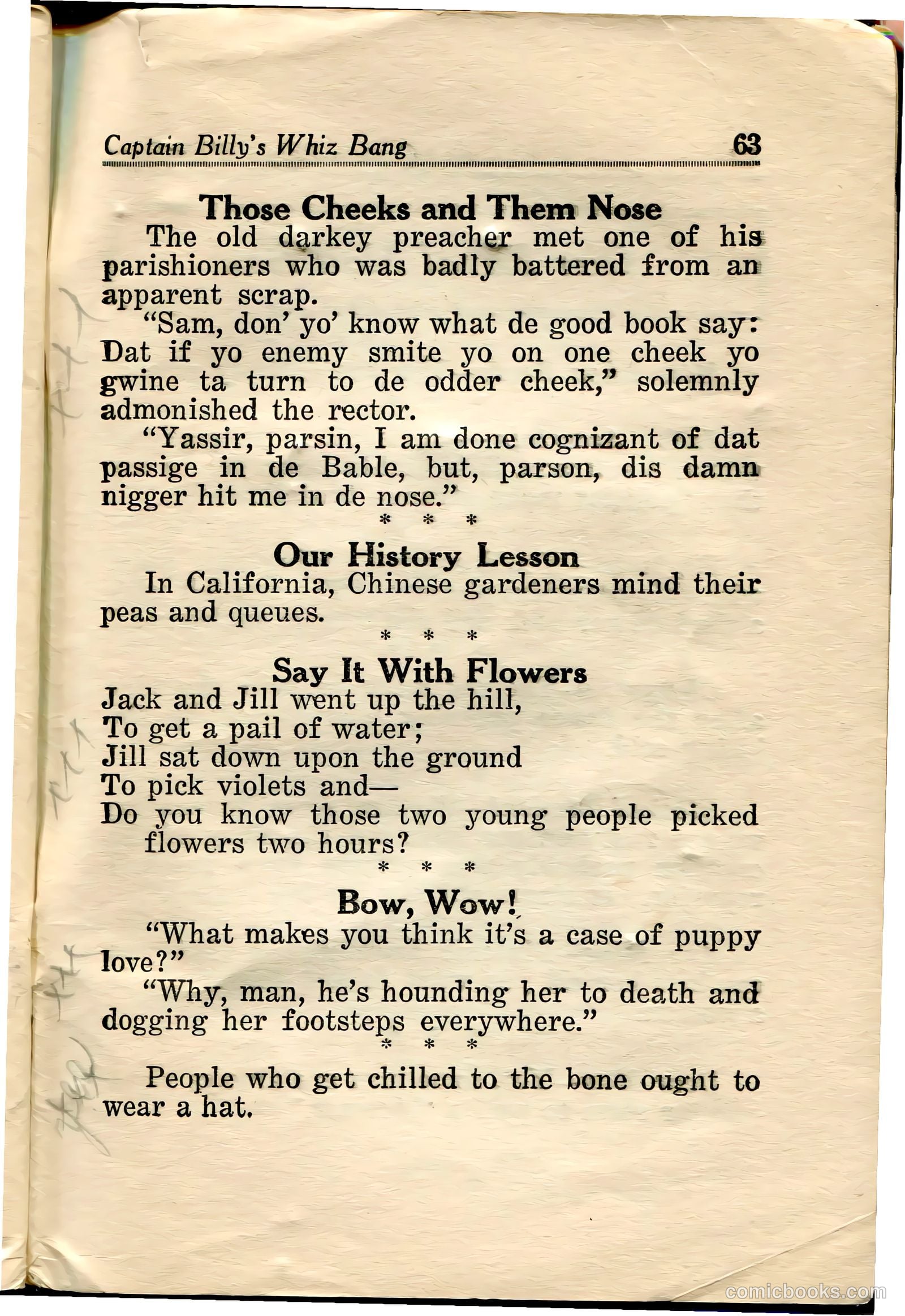
This page from the satirical magazine contains several brief jokes typical of early 20th-century American humor, many relying on ethnic stereotypes now recognized as offensive. **"Those Cheeks and Them Nose"** presents a racist caricature of a Black preacher and parishioner, using exaggerated dialect to create humor from the parishioner's literal misinterpretation of Biblical teaching about turning the other cheek—he was hit in the nose instead. **"Our History Lesson"** is a pun: "Chinese gardeners mind their peas and queues" plays on "peas/peace" and "queues" (the hair braids worn in Qing Dynasty China), likely mocking Chinese immigrants in California. **"Say It With Flowers"** subverts the children's rhyme "Jack and Jill," implying Jack and Jill spent two hours picking flowers together—a sly joke about courting. **"Bow, Wow!"** uses dog metaphors (hounding, dogging) as wordplay for romantic pursuit. The final line is an unrelated quip about cold weather and hats.
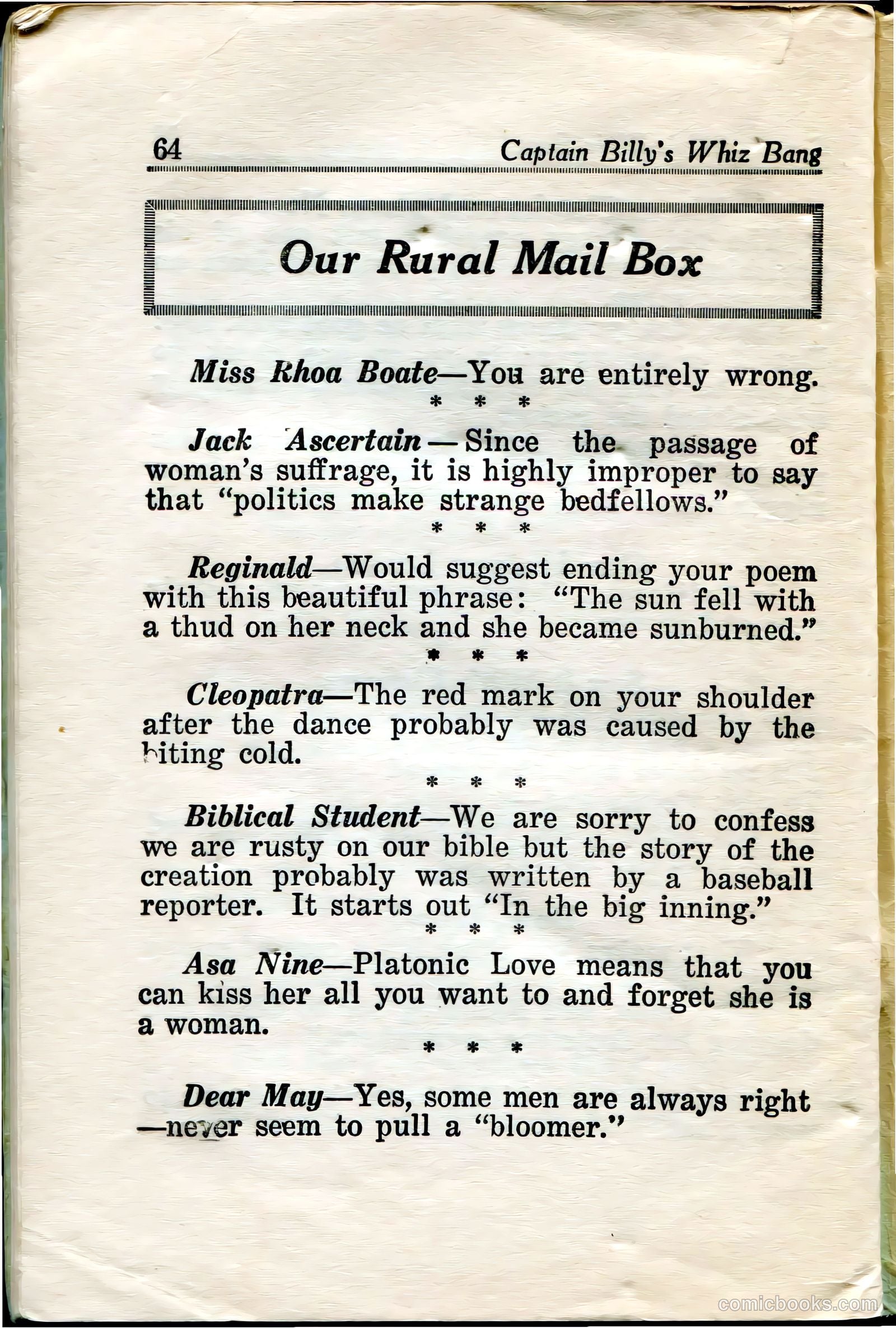
This is a humor column of fake reader responses to submitted letters. The satire targets early 1920s social attitudes: **Woman's suffrage** (Jack Ascertain): Mocks the recent 19th Amendment by suggesting women voters have made "strange bedfellows" phrase obsolete—a political joke about changed social dynamics. **Platonic love** (Asa Nine): Sarcastically defines it as kissing someone while denying her personhood—commentary on men's contradictory attitudes toward women. **Baseball humor** (Biblical Student): A pun suggesting Genesis was written "in the big inning"—wordplay typical of 1920s magazines. **Romantic misadventures** (Cleopatra, Reginald): Joke answers to readers about physical marks from dating—flirtation-era humor. The column's framing as "rural mail box" letters creates satirical distance, allowing the magazine to mock contemporary social pretenses and gender relations under the guise of humorous advice. The tone is lighthearted but gently critical of modern dating and political conventions.
This is primarily an **advertisement/promotional page** for *Whiz Bang* magazine itself, not a cartoon with political or social satire. The page announces distribution channels and pricing for the publication. The only visual element is a **decorative mascot** — a stylized cow or bull head with a mischievous expression, likely serving as the magazine's logo or brand identifier. The content is straightforward marketing: *Whiz Bang* costs 25 cents at newsstands, 30 cents on trains, or can be ordered directly. An annual subscription costs $2.50, while a "Winter Annual" costs $1.00. There is **no apparent satire or political commentary** on this particular page — it's a title/advertising page designed to promote the magazine's availability and encourage subscriptions.