
Captain Billy's Whiz Bang, August 1922 · page 46 of 67
Captain Billy's Whiz Bang #36 — page 46: what you’re looking at
What you’re looking at
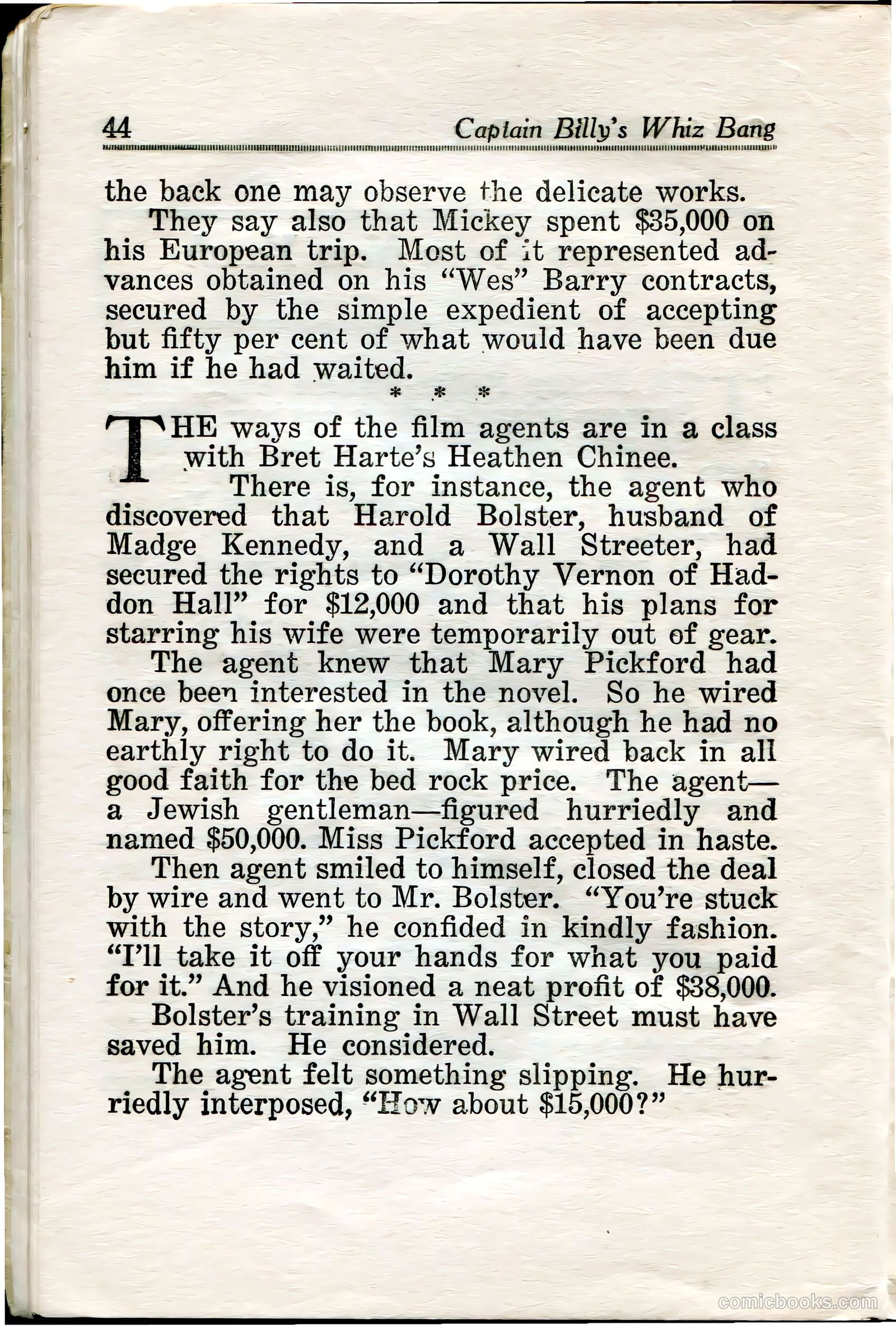
This page from the satirical magazine satirizes **Hollywood film agents and their unethical business practices** during the silent film era. The text mocks agents' dishonest dealings, using specific examples: one agent fraudulently offers Mary Pickford film rights he doesn't own, buying them from Harold Bolster for $12,000, then immediately reselling them to Pickford for $50,000—pocketing $38,000 in fraudulent profit. When Bolster (a Wall Street financier) hesitates to accept this "favor," the agent desperately reduces his asking price to $15,000. The comparison to Bret Harte's "Heathen Chinee" (an 1870 poem about deception) and the stereotypical description of the agent as "a Jewish gentleman" reflect period prejudices while mocking sharp business tactics. The satire targets **agent greed, fraud, and manipulation** of early Hollywood's major stars like Mary Pickford and Harold Bolster's wife Madge Kennedy.
📄 Transcribed text from this page (OCR, searchable)
Machine-transcribed from the original scan — historical spelling and the odd misread are preserved.
44 Captain Billy's Whiz Bang the back one may observe the delicate works. They say also that Mickey spent $35,000 on his European trip. Most of it represented ad- vances obtained on his “Wes” Barry contracts, secured by the simple expedient of accepting but fifty per cent of what would have been due him if he had waited. * * * THE ways of the film agents are in a class with Bret Harte’s Heathen Chinee. There is, for instance, the agent who discovered that Harold Bolster, husband of Madge Kennedy, and a Wall Streeter, had secured the rights to “Dorothy Vernon of Had- don Hall” for $12,000 and that his plans for starring his wife were temporarily out of gear. The agent knew that Mary Pickford had once been interested in the novel. So he wired Mary, offering her the book, although he had no earthly right to do it. Mary wired back in all good faith for the bed rock price. The agent— a Jewish gentleman—figured hurriedly and named $50,000. Miss Pickford accepted in haste. Then agent smiled to himself, closed the deal by wire and went to Mr. Bolster. “You’re stuck with the story,” he confided in kindly fashion. “I’ll take it off your hands for what you paid for it.” And he visioned a neat profit of $38,000. Bolster’s training in Wall Street must have saved him. He considered. The agent felt something slipping. He hur- riedly interposed, “How about $15,000?”