
Captain Billy's Whiz Bang, August 1922 · page 47 of 67
Captain Billy's Whiz Bang #36 — page 47: what you’re looking at
What you’re looking at
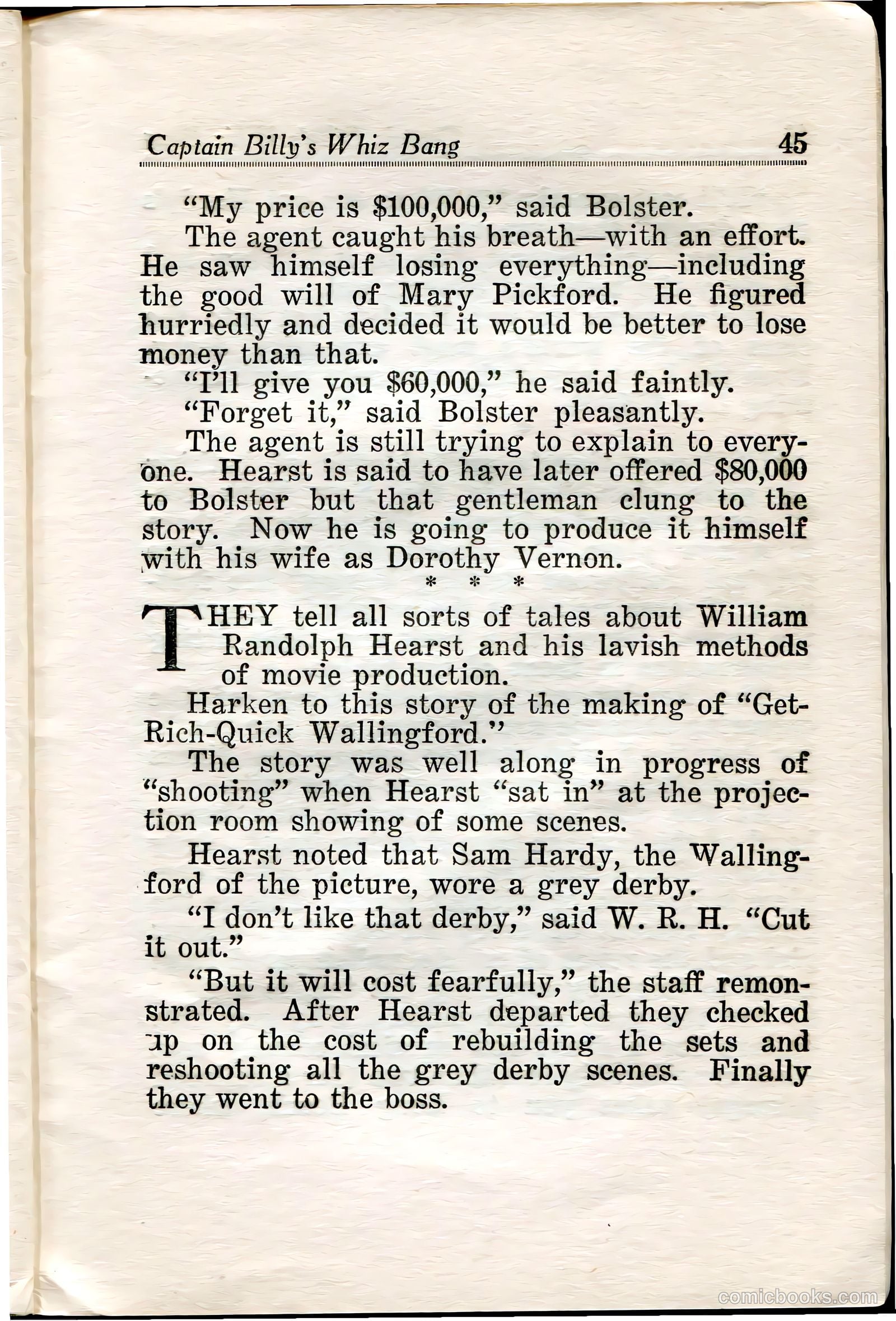
This page contains two anecdotes mocking **William Randolph Hearst's** extravagant movie production practices. Both stories illustrate his arbitrary power and wasteful spending. The first brief anecdote describes a negotiation where producer Bolster demands $100,000 for his film, causing a studio agent to panic about losing **Mary Pickford's** goodwill—suggesting Hearst's desperation to compete with major stars. The second, longer story shows Hearst casually ordering reshoots of an entire film ("Get-Rich-Quick Wallingford") because he dislikes actor Sam Hardy's grey derby hat. The staff dreads the expense but must comply with his whim. The satire targets Hearst's enormous wealth enabling capricious decision-making that wastefully reshapes productions on personal taste alone—typical 1920s criticism of his lordly attitude toward filmmaking and his willingness to spend fortunes on trivial preferences.
📄 Transcribed text from this page (OCR, searchable)
Machine-transcribed from the original scan — historical spelling and the odd misread are preserved.
45 Captain Billy’s Whiz Bang “My price is $100,000,” said Bolster. The agent caught his breath—with an effort. He saw himself losing everything—including the good will of Mary Pickford. He figured hurriedly and decided it would be better to lose money than that. “I’ll give you $60,000,” he said faintly. “Forget it,” said Bolster pleasantly. The agent is still trying to explain to every- one. Hearst is said to have later offered $80,000 to Bolster but that gentleman clung to the story. Now he is going to produce it himself with his wife as Dorothy Vernon. * * * THEY tell all sorts of tales about William Randolph Hearst and his lavish methods of movie production. Harken to this story of the making of “Get- Rich-Quick Wallingford.” The story was well along in progress of “shooting” when Hearst “sat in” at the projec- tion room showing of some scenes. Hearst noted that Sam Hardy, the Walling- ford of the picture, wore a grey derby. “I don’t like that derby,” said W. R. H. “Cut it out.” “But it will cost fearfully,” the staff remon- strated. After Hearst departed they checked up on the cost of rebuilding the sets and reshooting all the grey derby scenes. Finally they went to the boss.