
Captain Billy's Whiz Bang, August 1922 · page 7 of 67
Captain Billy's Whiz Bang #36 — page 7: what you’re looking at
What you’re looking at
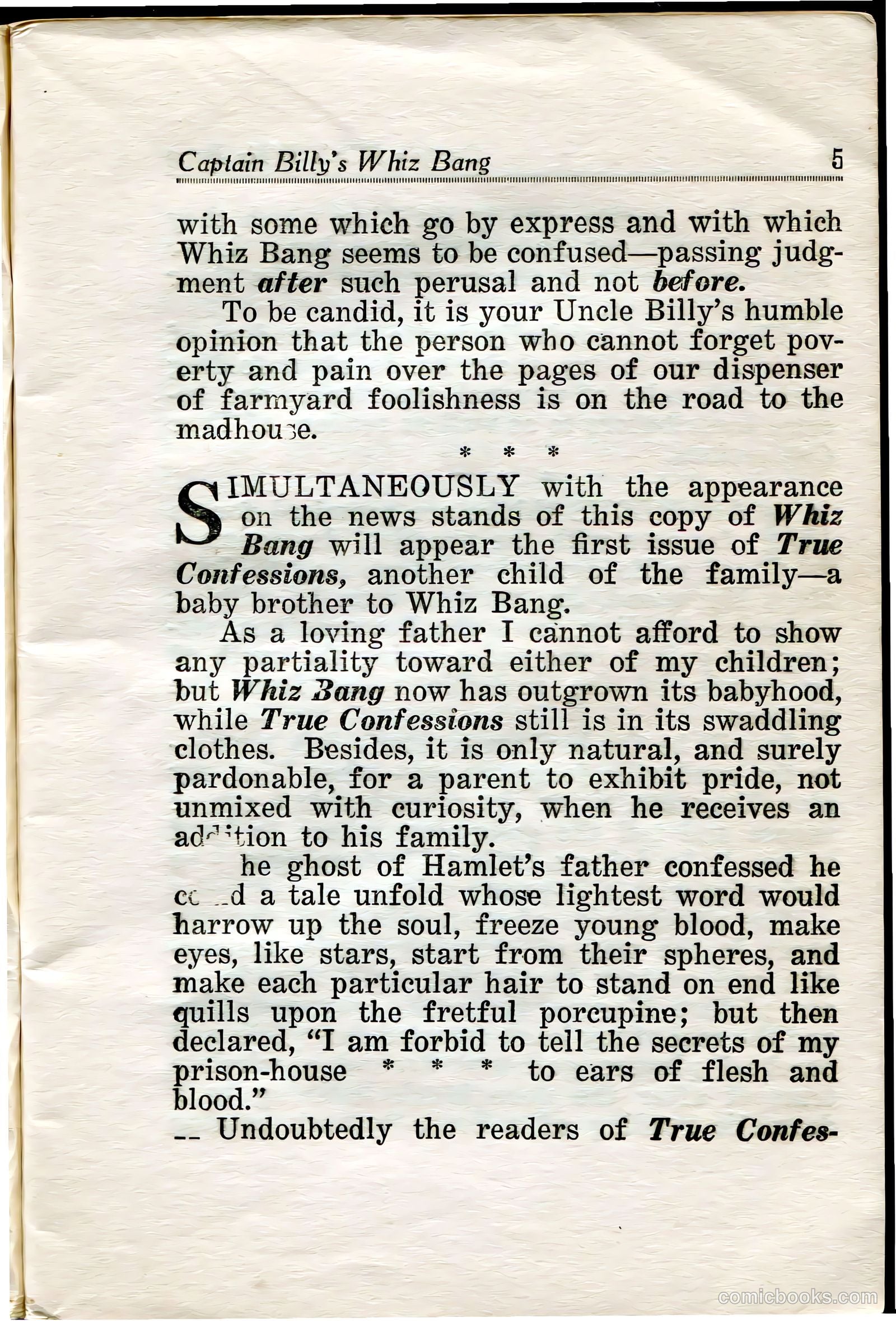
This is an editorial announcement, not a political cartoon. The unnamed author (likely editor "Captain Billy") promotes two magazines under his publishing family: the established *Whiz Bang* (a humor/satire publication) and its new sister magazine *True Confessions*, launching simultaneously. The satire uses a *Hamlet* reference—the ghost's famous speech about unspeakable horrors—to joke about *True Confessions*' sensational content. By comparing the new magazine to Hamlet's father's forbidden secrets, the editor humorously suggests readers will encounter shocking confessions too scandalous to repeat. The point: *Whiz Bang* claims lighthearted "farmyard foolishness" won't depress readers, while *True Confessions* will traffic in darker, more sensational human drama. The Shakespearean allusion adds mock-literary dignity to what was actually pulp magazine marketing.
📄 Transcribed text from this page (OCR, searchable)
Machine-transcribed from the original scan — historical spelling and the odd misread are preserved.
5 Captain Billy's Whiz Bang with some which go by express and with which Whiz Bang seems to be confused—passing judg- ment *after* such perusal and not *before*. To be candid, it is your Uncle Billy’s humble opinion that the person who cannot forget pov- erty and pain over the pages of our dispenser of farmyard foolishness is on the road to the madhouse. * * * SIMULTANEOUSLY with the appearance on the news stands of this copy of *Whiz Bang* will appear the first issue of *True Confessions*, another child of the family—a baby brother to Whiz Bang. As a loving father I cannot afford to show any partiality toward either of my children; but *Whiz Bang* now has outgrown its babyhood, while *True Confessions* still is in its swaddling clothes. Besides, it is only natural, and surely pardonable, for a parent to exhibit pride, not unmixed with curiosity, when he receives an addition to his family. The ghost of Hamlet’s father confessed he could a tale unfold whose lightest word would harrow up the soul, freeze young blood, make eyes, like stars, start from their spheres, and make each particular hair to stand on end like quills upon the fretful porcupine; but then declared, “I am forbid to tell the secrets of my prison-house * * * to ears of flesh and blood.” -- Undoubtedly the readers of *True Confes-