
Captain Billy's Whiz Bang, August 1922 · page 35 of 67
Captain Billy's Whiz Bang #36 — page 35: what you’re looking at
What you’re looking at
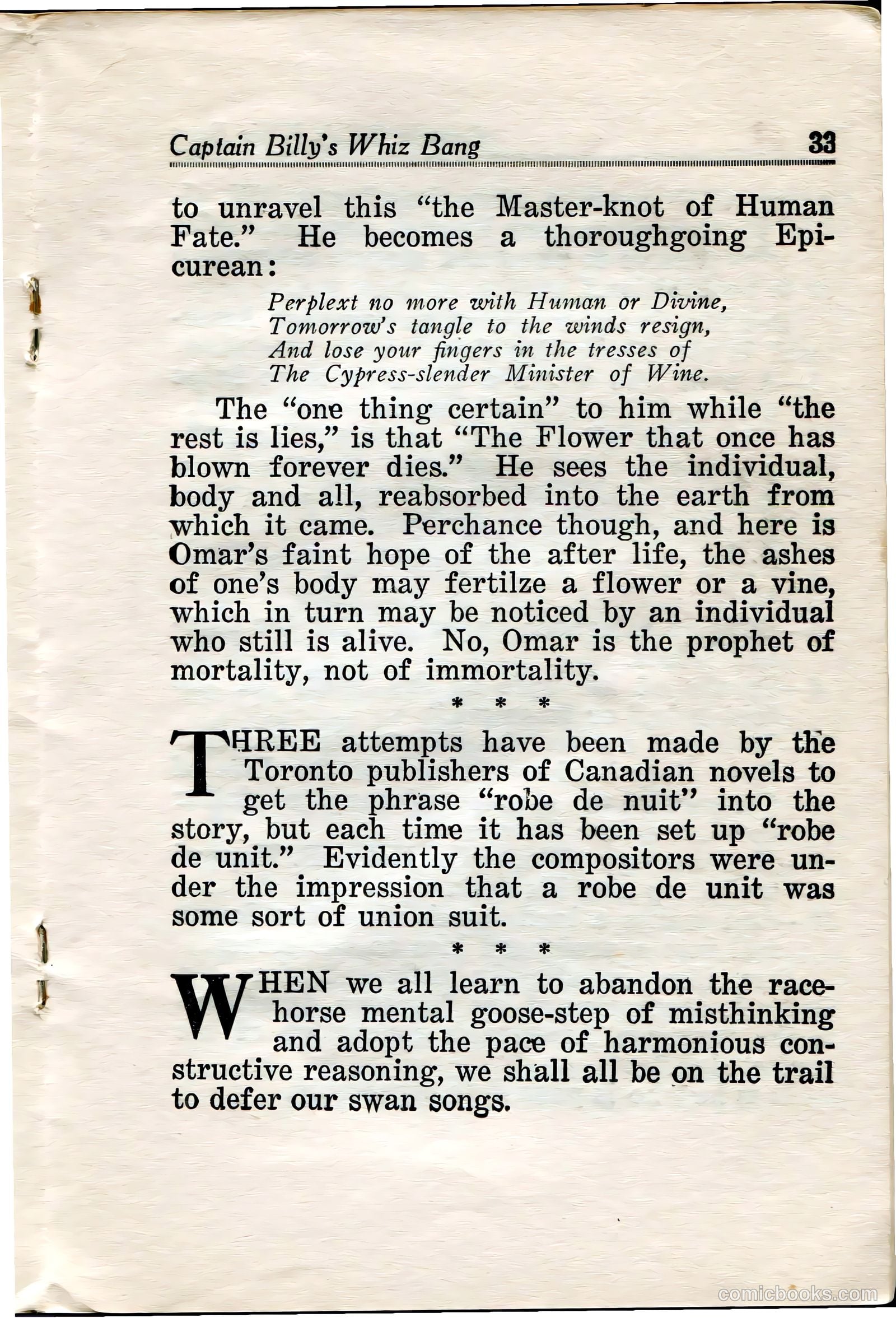
This page contains literary and printing commentary rather than cartoons. The first section discusses Omar Khayyam's *Rubaiyat*, analyzing his philosophy as epicurean pessimism focused on mortality rather than afterlife. The quoted verses reference wine and acceptance of fate—likely referencing the famous Edward FitzGerald translation popular in early 20th-century American culture. The middle anecdote mocks Canadian publishers and compositors for repeatedly setting the French phrase "robe de nuit" (nightgown) as "robe de unit," then incorrectly interpreting it as a "union suit" (long underwear). This is humor at the expense of printers' ignorance and/or the absurdity of publishing errors. The final paragraph uses flowery language to encourage abandoning "race-horse mental goose-step" thinking in favor of "harmonious constructive reasoning"—likely a jab at emotional or irrational public discourse of the era, though the specific target remains unclear.
📄 Transcribed text from this page (OCR, searchable)
Machine-transcribed from the original scan — historical spelling and the odd misread are preserved.
Captain Billy's Whiz Bang 33 to unravel this “the Master-knot of Human Fate.” He becomes a thoroughgoing Epi- curean: Perplext no more with Human or Divine, Tomorrow’s tangle to the winds resign, And lose your fingers in the tresses of The Cypress-slender Minister of Wine. The “one thing certain” to him while “the rest is lies,” is that “The Flower that once has blown forever dies.” He sees the individual, body and all, reabsorbed into the earth from which it came. Perchance though, and here is Omar’s faint hope of the after life, the ashes of one’s body may fertilze a flower or a vine, which in turn may be noticed by an individual who still is alive. No, Omar is the prophet of mortality, not of immortality. * * * THREE attempts have been made by the Toronto publishers of Canadian novels to get the phrase “robe de nuit” into the story, but each time it has been set up “robe de unit.” Evidently the compositors were un- der the impression that a robe de unit was some sort of union suit. * * * WHEN we all learn to abandon the race- horse mental goose-step of misthinking and adopt the pace of harmonious con- structive reasoning, we shall all be on the trail to defer our swan songs.