
Captain Billy's Whiz Bang, August 1922 · page 34 of 67
Captain Billy's Whiz Bang #36 — page 34: what you’re looking at
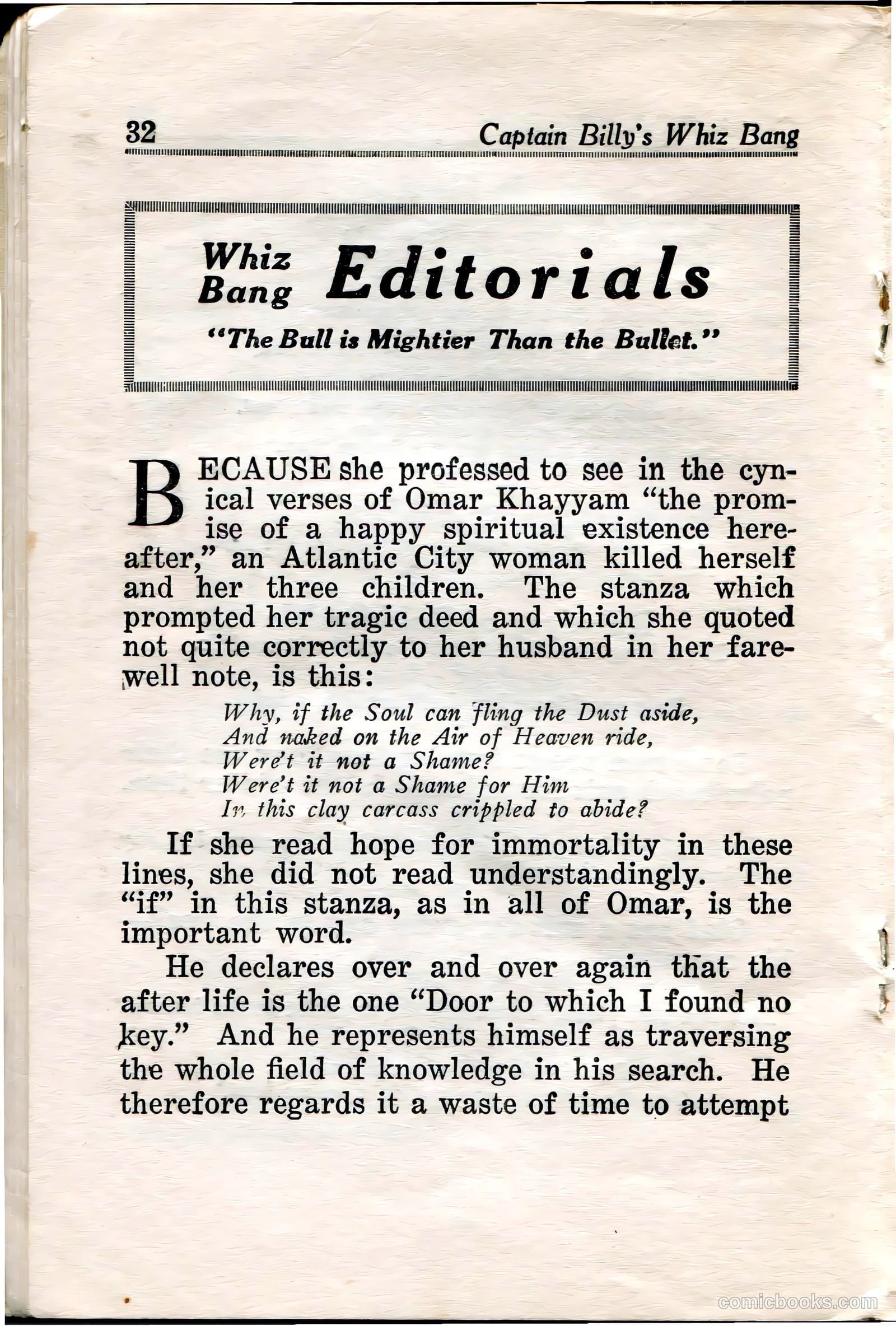
What you’re looking at
This editorial addresses a real tragedy: an Atlantic City woman killed herself and her three children, citing Omar Khayyam's *Rubaiyat* as inspiration. The satirical magazine uses this case to critique misreading of the Persian poet. The editorial argues the woman misinterpreted Khayyam's philosophy. His repeated theme—that the afterlife remains unknowable ("a Door to which I found no key")—counsels against speculation about immortality, not toward it. The critical word is "if," which signals Khayyam's skepticism, not affirmation. The magazine's title, "The Bull is Mightier Than the Bullet," suggests confronting dangerous ideas with rational argument rather than suppression. The satire targets both the woman's misreading and, implicitly, the romanticization of Eastern fatalism in American culture that made such misinterpretation possible.
📄 Transcribed text from this page (OCR, searchable)
Machine-transcribed from the original scan — historical spelling and the odd misread are preserved.
32 Captain Billy's Whiz Bang Whiz Editorials Bang “The Bull is Mightier Than the Bullet.” BECAUSE she professed to see in the cynical verses of Omar Khayyam “the promise of a happy spiritual existence hereafter,” an Atlantic City woman killed herself and her three children. The stanza which prompted her tragic deed and which she quoted not quite correctly to her husband in her farewell note, is this: Why, if the Soul can fling the Dust aside, And naked on the Air of Heaven ride, Were’t it not a Shame? Were’t it not a Shame for Him In this clay carcass crippled to abide? If she read hope for immortality in these lines, she did not read understandingly. The “if” in this stanza, as in all of Omar, is the important word. He declares over and over again that the after life is the one “Door to which I found no key.” And he represents himself as traversing the whole field of knowledge in his search. He therefore regards it a waste of time to attempt