
A complete issue · 68 pages · 1921
Captain Billy's Whiz Bang #28
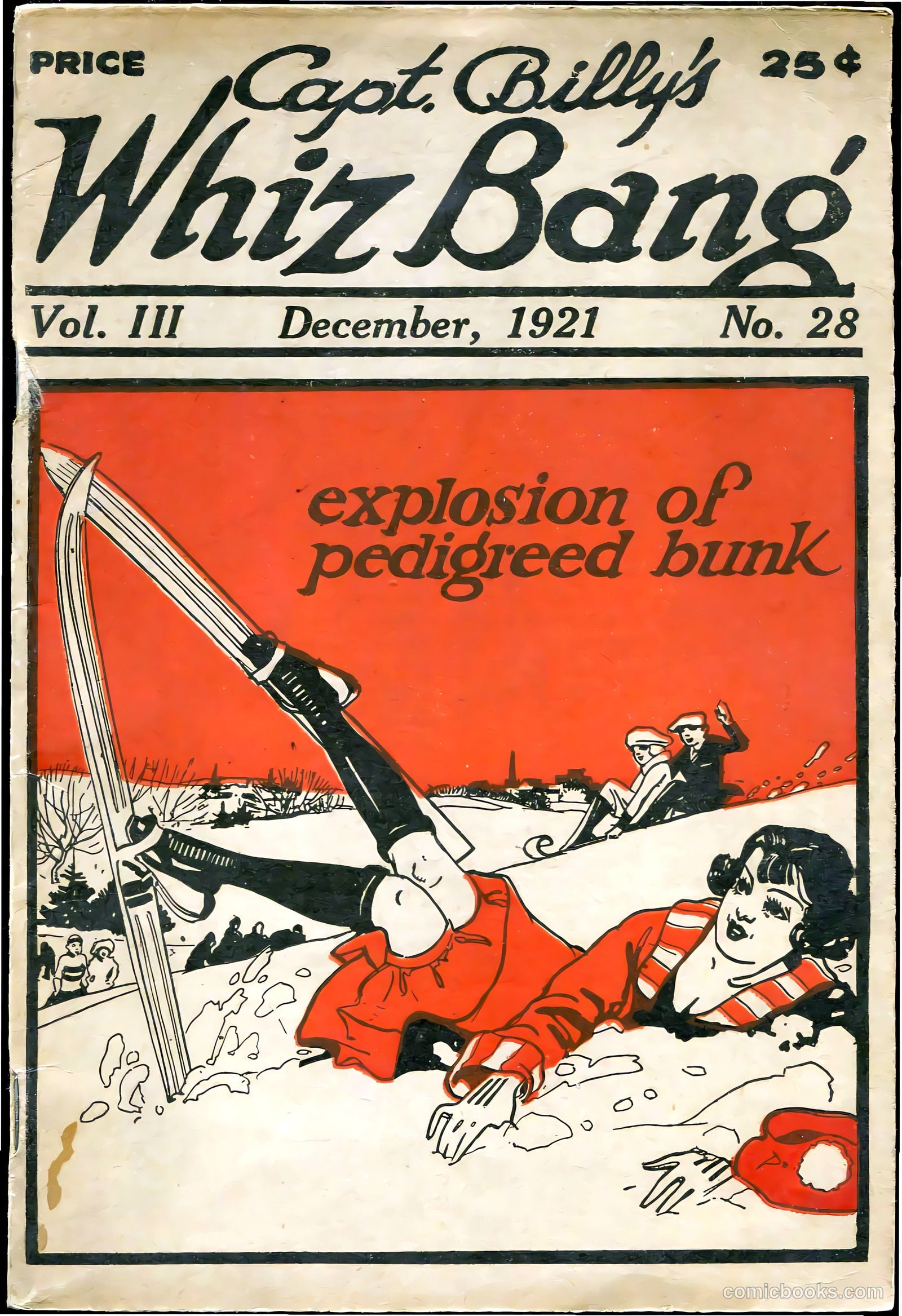
This cover depicts a winter scene where a large artillery shell or bomb has just detonated, sending two figures (a man and woman in red) sprawling in the snow. In the background, observers watch the explosion from a safe distance. The title "explosion of pedigreed bunk" suggests satirical commentary on inflated claims or pretentious nonsense—likely social or political falsehoods being exposed. The military imagery (shell, explosion) implies forceful debunking of some widespread deception. Without additional context, the specific target remains unclear, though 1921 America included post-WWI disillusionment and skepticism toward grand promises. The magazine *Capt. Billy's Whiz Bang* was known for irreverent humor and social satire. The "pedigreed" qualifier suggests the bunk comes from supposedly respectable or authoritative sources—making its explosive destruction particularly satisfying to satirize.
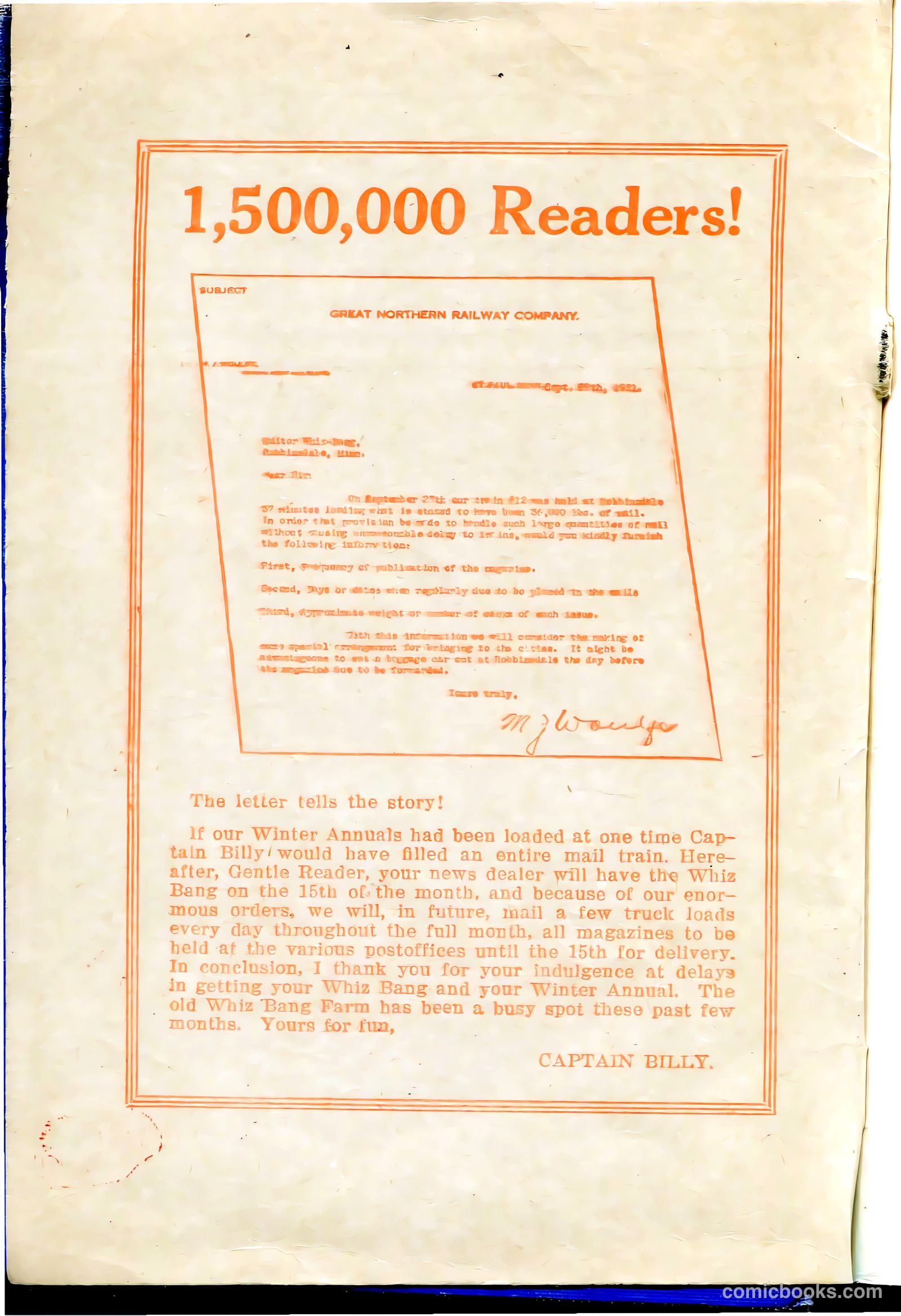
This page celebrates **Whiz Bang magazine's massive circulation** (1,500,000 readers) by reproducing a letter from the Great Northern Railway Company complaining that a single shipment of the magazine weighed 36,000 pounds and delayed a mail train by 57 minutes. The satire is self-promotional: the publisher (Captain Billy) uses the railway's complaint as proof of the magazine's enormous popularity and commercial success. The letter's formal, slightly annoyed tone from the railroad company adds humor—they're asking for scheduling details to accommodate future shipments, treating Whiz Bang like major freight cargo. Captain Billy responds by boasting that Winter Annual issues were so voluminous they could fill an entire mail train, and announces future issues will be distributed gradually throughout the month to avoid overwhelming postal infrastructure. The joke invites readers to marvel at the publication's success: even the railroads can't handle how many copies they're shipping. It's essentially a brag disguised as a logistical explanation.
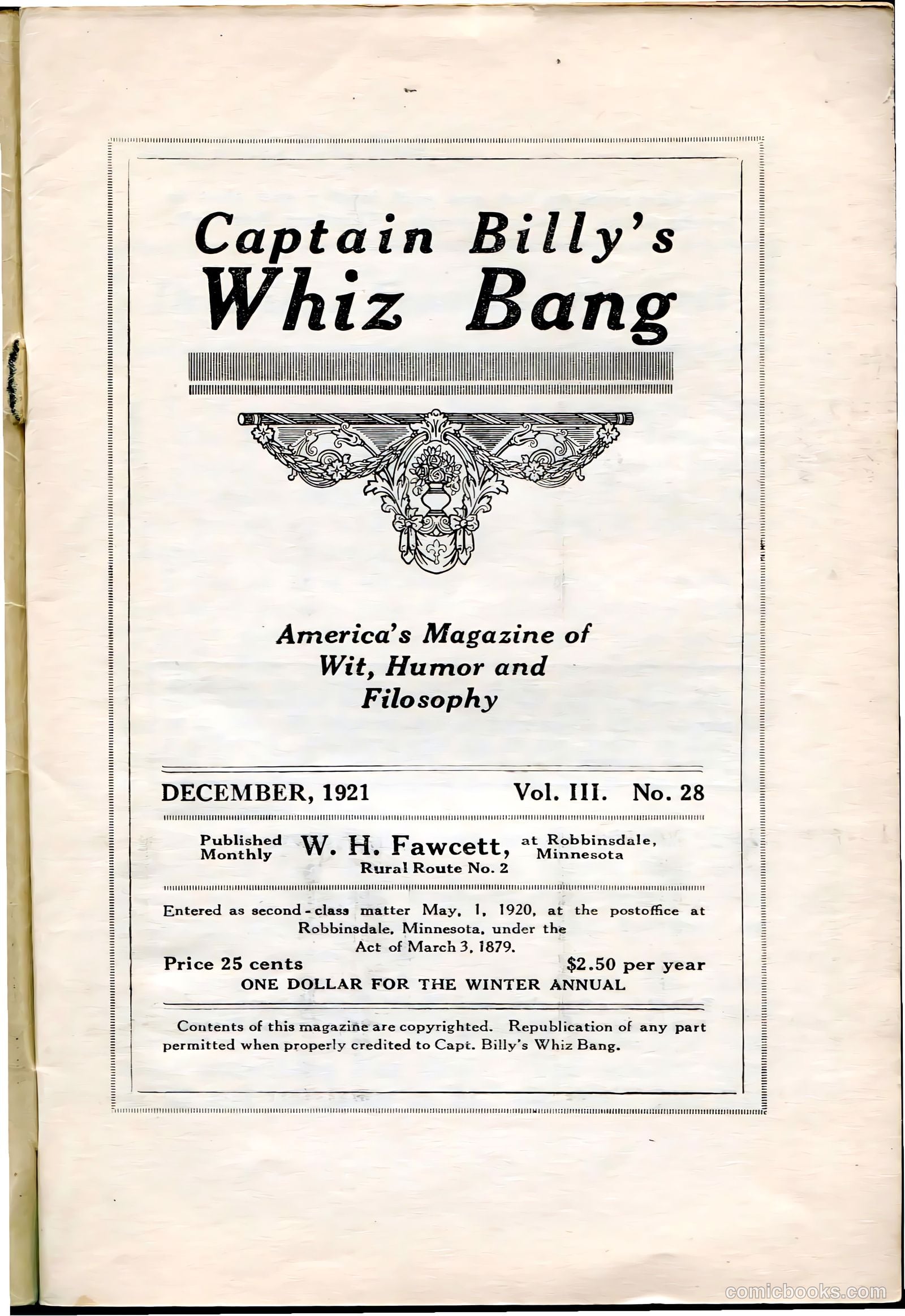
This is a title page for Captain Billy's Whiz Bang, a satirical magazine published in Robbinsdale, Minnesota. The publication describes itself as "America's Magazine of Wit, Humor and Philosophy." Key details visible: - Volume III, No. 28 (December 1921) - Published monthly by W.H. Fawcett - Price: 25 cents per issue; $2.50 per year - Entered as second-class mail in 1920 The page contains no visible cartoons or political content to analyze—it's purely a cover/masthead page establishing the magazine's identity and publication details. The ornamental header design is the only graphic element present.
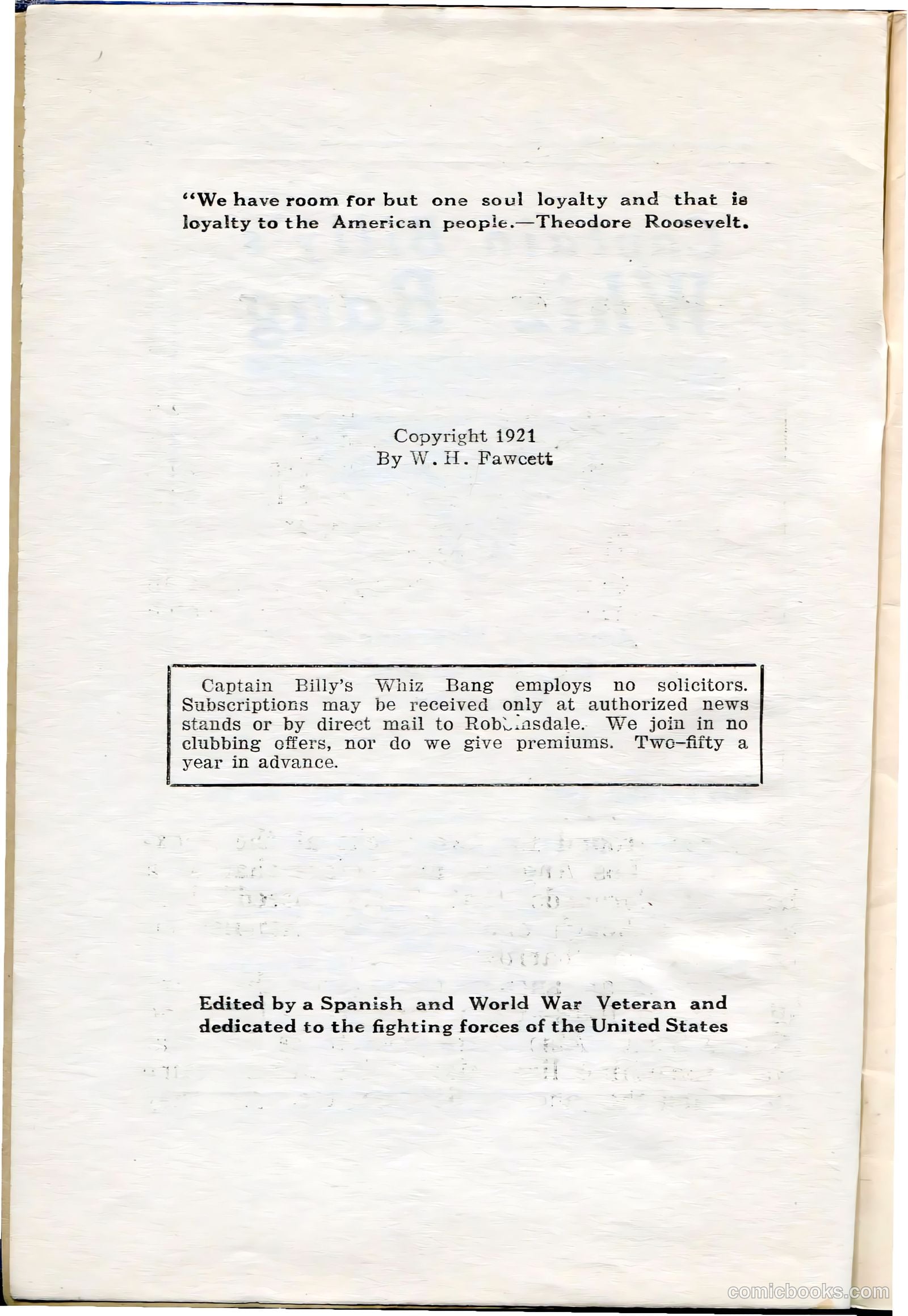
This is a title page rather than a cartoon page. It features: **Key Elements:** - A Theodore Roosevelt quote about "one soul loyalty" to the American people, establishing the magazine's patriotic stance - Copyright notice for 1921 by W.H. Fawcett - A subscription notice for "Captain Billy's Whiz Bang" (the magazine's full title), emphasizing it uses no solicitors and costs $2.50 yearly - A dedication line stating the publication was "Edited by a Spanish and World War Veteran and dedicated to the fighting forces of the United States" This identifies *Whiz Bang* as a post-WWI publication aimed at veterans, positioned as a patriotic American humor magazine. The Roosevelt epigraph signals its conservative, pro-American editorial philosophy during the early 1920s.
This page is primarily text—a humorous travel essay titled "Drippings From the Fawcett," not a political cartoon. The author describes a trip from Minnesota to California, satirizing West Coast stereotypes: movie stars, reformers, and decadent hotels. The satire references "Fatty" Arbuckle, the silent-film comedian whose 1921 scandal (involving a woman's death at his party) made him notorious. The author jokes about staying at San Francisco's St. Francis Hotel, where Arbuckle allegedly tried to "convert into an ice-house"—likely meaning he caused trouble there. The piece mocks California's pretensions and uses period slang ("bullsheviki theosophical," "oozed") for comedic effect. It ends with old mining-era jokes about California settlers. There are no visible cartoons on this page—it's editorial/satirical prose from *Captain Billy's Whiz Bang*, a 1920s humor magazine.
This page contains satirical commentary about Robbinsdale (likely a small farming town) and Los Angeles culture wars. The author humorously defends his rural hometown against dismissive comments, noting that major California news distributors (Egbert Brothers) credit a local publication ("the little old Banger") with strong circulation. The second section mocks Los Angeles reformers and religious "experts" who blamed motion pictures for society's moral decline. The satire suggests these "moonbeam-chasing" preachers absurdly credit Thomas Edison (inventor of the motion picture machine) with creating evil itself. The author ridicules their proposed censorship of all Los Angeles films, characterizing the reformers as overzealous "long hairs" unlikely to succeed. The piece exemplifies 1920s satirical pushback against moral crusaders.
This is a humorous anecdote column, not a political cartoon. The page recounts a visit to Los Angeles and a friend named Dick Ferris, who operates an establishment called the "Ferris Harem." The humor relies on several period jokes: an umbrella story (presented as corny but still effective in small towns like Robbinsdale, Minnesota) about a churchgoer leaving during the Ten Commandments reading to retrieve his umbrella; and a quip about Dick bobbing his hair, joking that if hair equaled brains, "an old-fashioned parlor sofa would be vice president" (unclear reference, possibly a political jab). The piece name-drops various entertainment and sports figures of the era—race driver Roscoe Sarles, actor Julian Eltinge, and others—as patrons of Ferris's establishment, positioning it as a glamorous gathering place for celebrities and working-class people alike.
This is a satirical anecdote page from *Captain Billy's Whiz Bang*, a humor magazine. There are no cartoons visible—only text containing gossipy stories about entertainment-industry figures. The main joke targets **Rev. Wilbur F. Crafts**, a real reformer and anti-vice activist. The satire mocks his moralistic crusade against smoking by having him pompously denounce "cigar suckers," "cigarette suckers," and "pipe suckers" (using slang terms for users). A heckler—apparently a child with a lollipop ("all-day sucker")—interrupts with "Hey, Doc, you ain't going to forget us, are you?"—implying Crafts' rhetoric inadvertently condemns innocent candy-eating children. The joke exposes the reformer's overwrought moralism as absurd overreach. The second anecdote about Dick Ferris and the silk pajamas is lighter fluff—a playful story about an optimistic romantic. For modern readers: this reflects 1920s skepticism toward Prohibition-era moral reformers, portrayed as humorless busybodies.
This page contains no cartoon. It's a written column titled "Captain Billy's Whiz Bang" describing the author's recent travels to Los Angeles. The text discusses visits to motion picture studios (Universal City and Katherine MacDonald's studio), noting sympathetically that young actresses like Miss MacDonald and Bebe Daniels face criticism directed at the film industry itself rather than their work. The author describes filming at Universal under Director Eddie Laemmle in a "wild-west scene," a trip to Tijuana, Mexico, and mentions restrictions on American aircraft crossing the Mexican border due to "booze running"—a reference to Prohibition-era smuggling. The final section mentions meeting Vice Admiral William Shoemaker at a Los Angeles mansion once occupied by silent film stars Mary Pickford and Mary Miles Minter.
This is a humorous personal narrative—not a political cartoon—from *Captain Billy's Whiz Bang*, a satirical magazine. The author recounts visiting Admiral Shoemaker's Pacific fleet and touring the USS *Pennsylvania* battleship at San Pedro dock. The satire targets the author's own naiveté: he assumed a naval "barge" would be ugly (confusing it with his father's grain barges on the Red River), only to be surprised by an elegant launch. He's also humorously shocked that the famous "14-inch guns" are actually 40 feet long. The final reference to cursing "Josephus Daniels" likely alludes to the Secretary of the Navy (1913-1921), known for strict temperance policies that frustrated many. The mention of testing champagne from a cellar earlier suggests Daniels' prohibition-era policies were unpopular with the magazine's readers. The humor lies in self-deprecating rural ignorance meeting military grandeur.
This is a humorous anecdote from an early 20th-century satirical magazine. The text describes a social visit involving an Admiral and sailors from the USS Pennsylvania. The joke centers on the sailors' inability to maintain composure around women—they kept looking "upward" at the female guests boarding the ship, which the author attributes to sailors' habit of chewing "Bull of the Durham" (a tobacco brand), as if the nicotine made them restless and lustful. The secondary anecdote introduces "Gus," a hired hand who conveniently reappears to supply "medicine"—likely alcohol (the author mentions the Admiral visit was notably "dry"). This is presented as a comedic relief story. The humor relies on crude sailor stereotypes and innuendo typical of 1920s-era "gentleman's humor" magazines. No identifiable political figures appear on this page; it's purely social satire about naval life and working-class male behavior.
This page contains narrative text rather than cartoons—it's from "Captain Billy's Whiz Bang," a satirical magazine popular in the 1920s known for off-color humor and irreverent stories. The text describes two anecdotes: First, a farewell to "Gus" (Gustav), a down-on-his-luck worker who's been unemployed since leaving Minnesota and is literally "on the rocks" (broke). The narrator makes a tongue-in-cheek "gentleman's agreement" to only rehire him as an Indian guide at Breezy Point for no wages—only friendship and free flapjacks from the cook Maggie. Second, the narrator attended a stag party (men-only event) at a brewery honoring baseball teams, hosted by Bill Eltinge (a known theatrical performer/female impersonator of the era). Doc Stone managed ceremonies for "two hundred homeless and wifeless old stags" treated royally, though something "marred the entire evening." The humor reflects Depression-era attitudes toward unemployment, working-class life, and theatrical personalities.
This is a humorous essay (not a cartoon) from *Captain Billy's Whiz Bang*, a satirical magazine popular in the 1920s. The author describes a formal dinner party where he was supposed to give a toast but failed to do so. The humor relies on name-dropping: the piece mentions real sports figures (Frank Chance, a famous Cubs manager; Tod Sloan, a celebrated jockey) and entertainment personalities (Julian Eltinge, a renowned female impersonator actor) to establish the event's prestige. The narrator's self-deprecating joke is that he couldn't perform his toastmaster duties because he was intimidated by these luminaries and/or distracted by drinking. The opening metaphor—a "rube farmer" spreading fertilizer in a brewery basement—mocks the absurdity of his situation: an ordinary person (the author) placed among celebrities. The piece's charm comes from its rambling, tipsy tone and admission that alcohol prevented him from fulfilling his duties.
This page contains two satirical pieces referencing Prohibition-era humor and scandals. The first section mocks the narrator's failure to uphold Prohibition principles (named after Andrew Volstead, who sponsored the Volstead Act). The speaker attended a brewery event clutching "near beer" (non-alcoholic substitute) while supposedly following medical orders for milk—a transparent excuse for drinking. The satire targets hypocrisy around Prohibition enforcement. The second section references **Roscoe "Fatty" Arbuckle**, a famous silent-film comedian whose party allegedly became scandalous (likely referring to the 1921 incident where a guest died; Arbuckle was accused but acquitted). The text promises to relay gossip about how party guests "devised" ways to entertain themselves—suggesting illicit activities—though the passage cuts off before specifics appear. Both sections satirize the gap between Prohibition's ideals and actual behavior among the wealthy and famous.
This page is primarily text rather than cartoon. It discusses private ceremonies kept from public audiences and hints at legal troubles involving "restrictive measures" and the Arbuckle counsel—likely referencing the Roscoe "Fatty" Arbuckle scandal of the early 1920s, when the famous comedian faced manslaughter charges. The text then shifts to Captain Al Waddell, who commanded a battery and worked with Clif Durant (son of automotive industrialist W.C. Durant). The passage humorously notes Waddell could profit from writing about the "Durant divorce" but is instead busy selling Perfecto axles for Ford automobiles. The final section jokes that Clif Durant spent six years telling his wife what to do before she apparently left him, suggesting marital discord.
This page from **Captain Billy's Whiz Bang** (a 1920s satirical magazine) contains two separate gossip-style anecdotes mocking wealthy and scandalous figures. **The first story** ridicules a wealthy General Motors executive's son ("Cliff," likely referring to Clifford Durant) whose wife delivers an ultimatum disguised as a "bomb"—demanding half his fortune (valued at $8-10 million). The joke satirizes both marital discord among the ultra-wealthy and the woman's successful financial power play ("made it stick"). **The second story** references a **"Love Nest"** scandal in what appears to be a Minnesota town (possibly Robbinsdale, mentioned explicitly). Police raided this establishment following the "Howard Street Gangsters affair." The piece mocks the legal proceeding where minors were involved in sexual misconduct. The defense's request for a continuance to "bring witnesses—women of..." (text cuts off) suggests an attempt to delay or undermine prosecution through witness testimony. The satire targets sexual hypocrisy, corrupt legal maneuvering, and scandal among the privileged classes—typical Whiz Bang fare.
This page contains two distinct pieces of satirical content: **Upper section**: A critique of a legal case involving "artistic photographers" prosecuted for obscenity. The satire mocks how defendants evaded serious punishment (San Quentin) by claiming their nude photography was "artistic." The quote "every woman seems to feel that she has the form divine" sarcastically suggests the flimsy justification used. The piece ridicules both the legal system's leniency and the transparent hypocrisy of calling exploitative photography "art." **Lower section**: A humorous personal anecdote about reconnecting with two Minneapolis Journal reporters—Jim Callahan and Chris Helin—now working for William Randolph Hearst's San Francisco Examiner. The joke is that these midwesterners have become "back sliders" who evangelize California real estate to visiting friends, having abandoned their Minnesota roots. It's gentle mockery of transplants who adopt local boosterism.
This page contains several brief humorous pieces rather than cartoons. The main content includes: 1. **"My Visit to San Francisco"** — A personal anecdote referencing the 1904 return from the Spanish-American War and San Francisco's post-fire reconstruction. The joke centers on seeing a shop sign "Virtue & Co., Ltd." on Mission Street, replacing what used to be an "unlimited" business on Dupont Street—likely a euphemistic reference to a brothel or similar establishment that disappeared after the 1906 fire. 2. **"Canadian Stuff"** — A brief poem about alcohol (near-beer and ether). 3. **"Times Are Improving"** and **"Fable of a Sap"** — Short joke pieces about economic conditions and foolish behavior. The page is primarily text-based humor typical of early 20th-century satirical magazines.
This is satirical mockery of overwrought, pretentious romantic writing. The piece parodies verbose love letters stuffed with ostentatious vocabulary—"limpid fulgency," "erotic pumping organ," "mellifluous thought," "fraught fulgency"—strung together with little coherence or genuine feeling. The humor relies on the absurd juxtaposition of grandiose language with mundane emotional whiplash: the writer swings between ecstatic fantasy and crushing despair, ending with intrusive, deflating imagery (floating on a pink cloud eating ice cream with violets). The closing line—"It's a strong stomach that has no turning"—delivers the punchline: reading such overwrought nonsense would make anyone nauseous. This mocks both affected romantic posturing and the pseudo-intellectual verbosity common in early 20th-century sentimentality, suggesting that excessive ornamentation masks emotional emptiness.
This page contains three brief humorous pieces with no political cartoons: 1. **"In Good"**: A short joke about a woman named Grace with two suitors—a florist and candy store owner—competing for her affections. 2. **"How Otherwise?"**: A poem joking that Adam and Eve had "no Christmas" because they never experienced the modern trappings (socks, cards, etc.), yet "enjoyed" it anyway—satirizing consumer-driven Christmas commercialism. 3. **"Pat and Mike Stuff"**: A drunk Irishman stereotype humor piece where an inebriated man falls off a trolley car and, upon regaining consciousness, asks if anyone was hurt in "the wreck"—the punchline being his confusion and relief there was no actual wreck. The page reflects early-20th-century American magazine humor conventions.
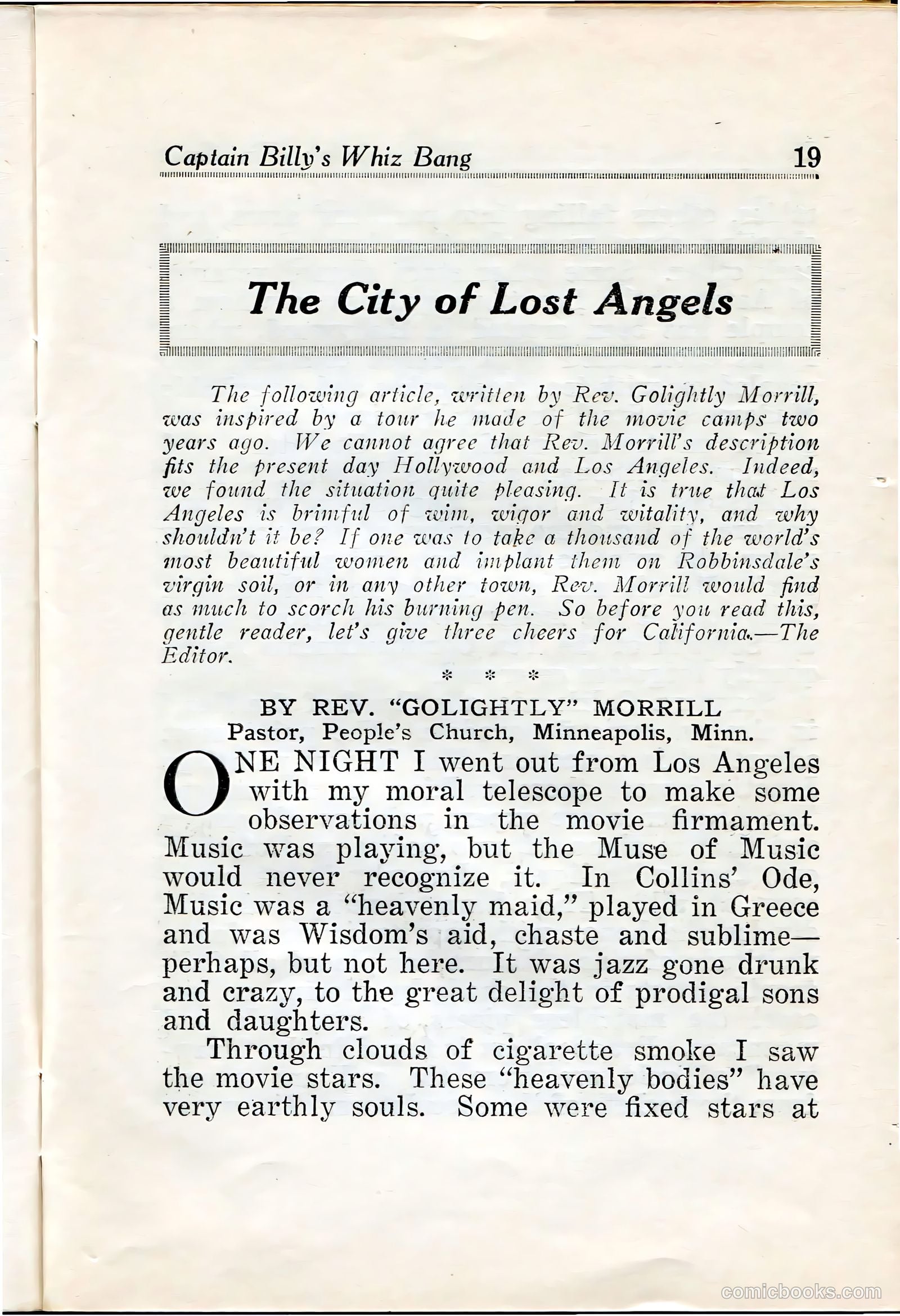
This page is primarily **text content**, not a political cartoon. It's an article by Rev. "Golightly" Morrill critiquing Los Angeles and its movie industry. The piece uses satirical language to mock Hollywood's culture. Morrill describes the music in movie camps as "jazz gone drunk and crazy" rather than the classical, sublime "heavenly maid" that music should be. He dismisses movie stars as "heavenly bodies" with "very earthly souls," suggesting moral corruption beneath glamorous surfaces. The editor's introduction—itself somewhat tongue-in-cheek—notes Morrill would "scorch his burning pen" about Los Angeles's excess. The satire targets Hollywood's perceived decadence, materialism, and moral degradation during the silent film era.
This page contains no visible cartoon—it's satirical prose commentary on Hollywood and Southern California. The author mocks: **Hollywood morality**: The text sarcastically suggests Hollywood is like ancient Sodom ("Daphne Grove"), where the Seventh Commandment (against adultery) is routinely violated. References to "shooting stars" exchanging "love glances" are likely coded allusions to illicit affairs among celebrities. **Hollywood artificiality**: The author ridicules cosmetics as "paint" and notes that "the dearest paintings" are women "walking on the streets"—suggesting actresses are themselves commodities on display. **California's false values**: The piece attacks Southern California's obsession with wealth-extraction ("drawings" of gold and money from speculators' pockets) while claiming natural beauty excuses moral failings. The tone is moralistic satire typical of 1920s American humor magazines criticizing the era's perceived decadence, particularly Hollywood's libertine reputation and California's gold-rush mentality.
This is satirical editorial commentary on 1920s Los Angeles, not a cartoon. The unnamed author critiques the city's rapid modernization and moral decay. **Key targets:** - **Oil wealth**: Mining fortunes surpassing old-master art prices—critiquing nouveau-riche values - **Automobile danger**: Sarcastically blames cars rather than alcohol for accidents ("auto-intoxication"), noting one car per thirteen people causes "unlucky accidents" - **Beach culture**: Mocking the lowbrow crowds—gum-chewers, popcorn vendors, "freaks"—and amusement parks as sites of vice - **Urban corruption**: References "low dives" where "innocent were doped, debauched and robbed" The tone is moralistic disapproval wrapped in exaggerated wit. The author presents Los Angeles as a cautionary tale of American excess: prosperity enabling hedonism, technology enabling danger, and commercialization degrading traditional values. This reflects early-20th-century anxieties about urbanization and modernity.
This satirical text from *Captain Billy's Whiz Bang* mocks modern American beach culture and Los Angeles recreation by comparing them to classical mythology. The piece lists the mundane and chaotic realities of beach visits—trash, crowds, sunburned tourists ("human lobsters")—contrasting with Columbus's voyages to suggest modern "discoveries" are trivial and degrading. The Elysium Park section parodies classical literature, comparing L.A.'s polluted "paradise" to Dante's underworld rivers and Milton's *Paradise Lost*. Where Aeneas saw purple light, visitors see only automobile exhaust smog. The reference to people "star-scattered" acting out the *Rubaiyat* mocks romantic pretense amid reality. The closing pun—"Lost Angeles"—is the joke's payoff: the city deserves its name because it's spiritually lost and morally corrupted by modernity, crowds, and pollution. The satire targets both California's overhyped leisure culture and readers' literary pretensions.
This page contains four brief humorous anecdotes typical of 1920s satirical magazines: 1. **"Dal's Philosophy"** — A poem mocking men who boast about entertaining companions, suggesting true character shows when dealing with demanding partners ("old woman"). 2. **"Oh, I Wisha Wuza Lightnin' Bug!"** — A news item about Mrs. Hazel Hammond being struck by lightning in a storm, with the electrical current following a water pipe through a faucet—absurdist humor based on an actual incident. 3. **"Let's Swell Up and Bust"** — A joke about a husband caught flirting with a waitress; his wife's comeback ("I laughed like hell when I first saw you") delivers the punchline through marital mockery. 4. **"Joys of Matrimony"** — A brief dialogue where a young suitor's question about the parents reveals he's assessing marriage viability—satirizing courtship pragmatism. All feature domestic/romantic humor typical of the era.
This page contains three separate humorous pieces, not political cartoons: 1. **"Scotty's Wail"** - A brief poem mocking women's fashion, specifically short skirts and "piano legs" (a euphemistic term for women's legs), suggesting these inspire inappropriate devotion. 2. **"Did It Ever Happen to You?"** - A comedic anecdote about a date where the woman insults the man after he tries to kiss her, calling him cheap and telling him to leave. 3. **"Answer This One, Girls"** - A riddle/joke where a man poses a trick question to a woman: if she says "yes" it means "no," but if she doesn't answer, he gets a kiss. The punchline is left blank for readers to complete. The humor relies on dating dynamics and gender interactions typical of early 20th-century American comedy magazines.
This page contains three humorous poems rather than political cartoons. **"Gal O' Mine"** is a light romantic comedy about a man who kissed a girl, got drunk ("K.O.'d"), and faced teasing from friends. The humor relies on wordplay and the mild scandal of casual drinking and romance. **"Beware, Oil Men!"** by Casper Y. Homing appears to reference oil field workers, with the speaker joking about avoiding the drilling areas—likely satirizing workplace hazards or the oil industry boom of that era. **"Hibrow Poetry"** is nonsensical verse deliberately using absurd rhymes and descriptions (a petticoat being "georgette blue," a dress being "cheese cloth red") to mock pretentious or avant-garde poetry. These are satirical verses typical of *Whiz Bang*'s irreverent humor, targeting social conventions and artistic pretension rather than specific political figures.
This page contains four humorous short pieces typical of 1920s satirical magazines: 1. **"Courting Up to Date"** — A complaint by Miss Etta Kette that modern women (not demure maidens) actively pursue husbands rather than passively wait. The satire targets changing gender roles in courtship. 2. **"A Sundodger"** — A joke about a baby resembling its father's demanding behavior. 3. **"Crossing the 'Bar'"** — A poem about someone arrested for loitering at a bar, punning on "bar" (drinking establishment vs. legal barrier). 4. **"Knock 'er On the Kiss!"** — A anecdote about a kissing wager between dancers, where the woman claims her loss was unfair and demands a rematch. The humor centers on dating customs, alcohol consumption (Prohibition-era), and women's changing social behavior.
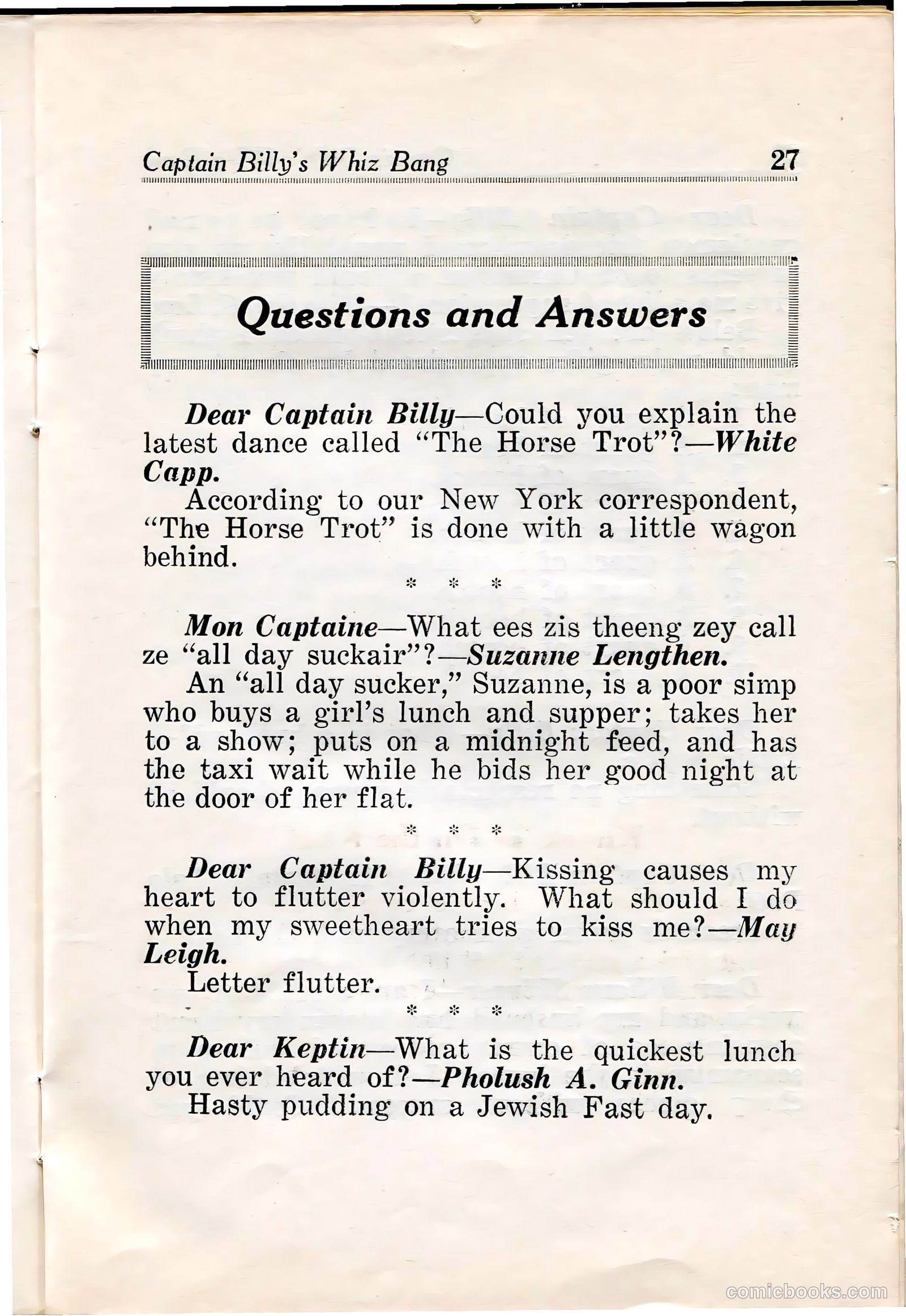
This page features a humor column titled "Captain Billy's Whiz Bang" — a popular satirical magazine section. It consists of four Q&A jokes: 1. A joke about "The Horse Trot" dance, supposedly done with a toy wagon 2. Definition of "all day sucker" — slang for a naive man who spends money on dates 3. A joke about kissing causing heart palpitations, with a pun response 4. A joke about the quickest lunch being "hasty pudding on a Jewish Fast day" — a pun playing on Yom Kippur (the Jewish fast) and the speed of the meal The humor targets dating customs, gender dynamics, and ethnic stereotypes typical of 1920s American comedy. The jokes rely on wordplay and contemporary slang rather than visual gags.
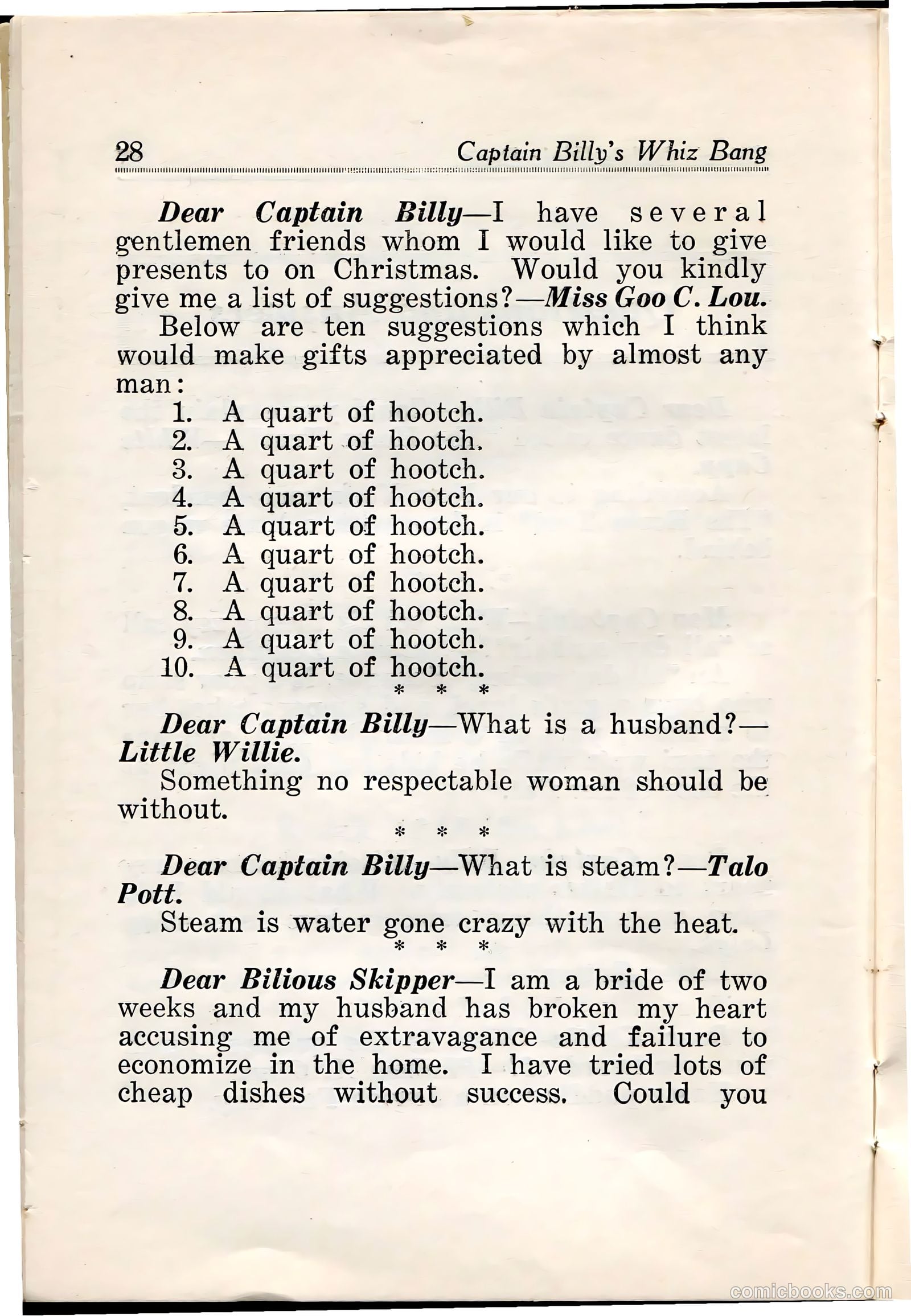
This page consists of a humor advice column featuring "Captain Billy," who answers reader questions with comedic responses. The first item humorously addresses gift suggestions for men: Miss Goo C. Lou asks for Christmas present ideas, and Captain Billy responds with a deliberately repetitive list of "a quart of hootch" ten times—a joke about Prohibition-era illegal alcohol. This satirizes both the difficulty of gift-giving and the widespread disregard for alcohol prohibition laws during the 1920s. The subsequent shorter jokes mock marital dynamics and scientific concepts. A child asks what a husband is; the response stereotypes wives as needing husbands. Another joke defines steam absurdly. The final item addresses a newlywed bride struggling with her husband's accusations of extravagance, satirizing marital conflict and domestic economy expectations of the era.
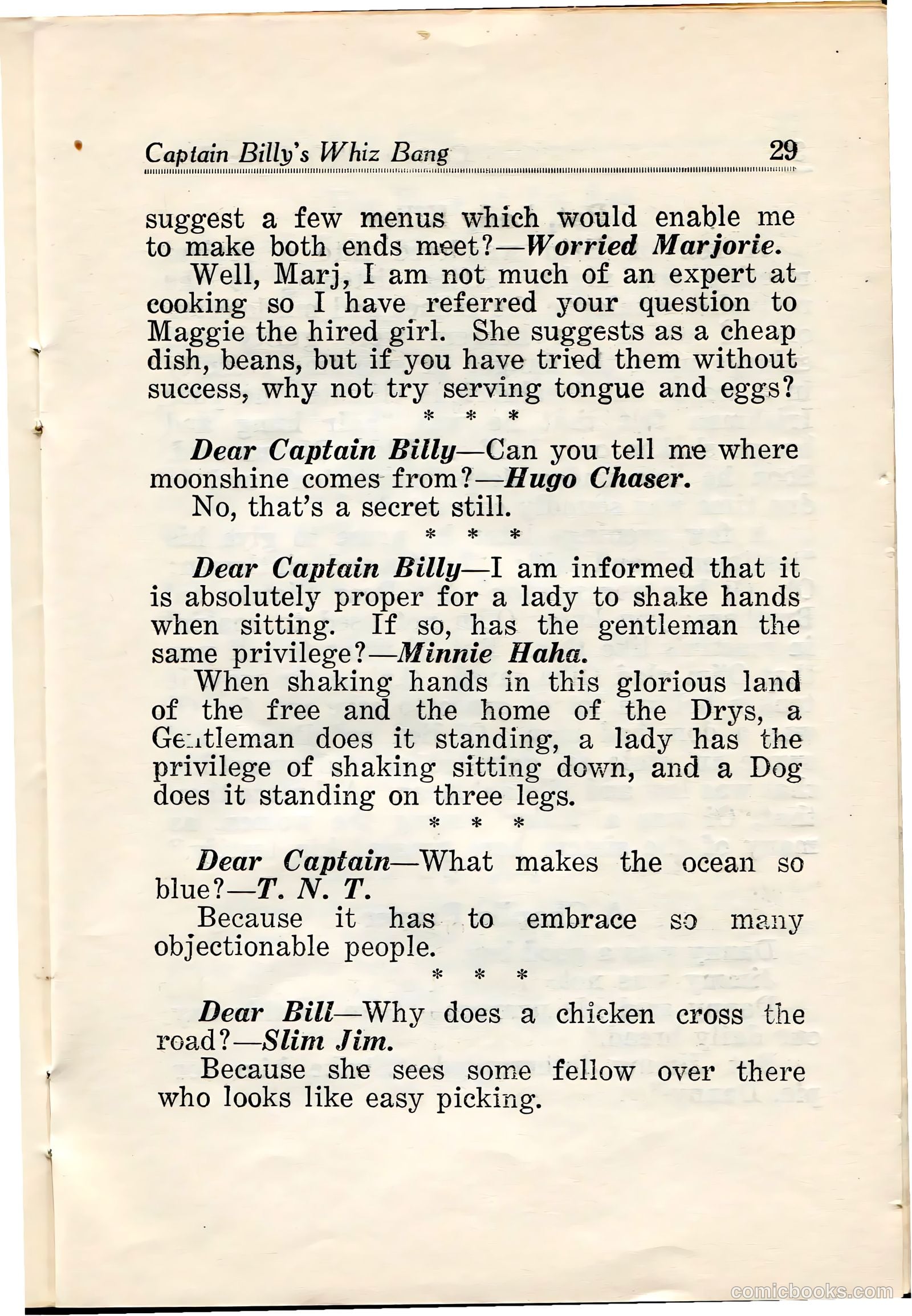
This page contains a humor advice column where "Captain Billy" answers reader questions with jokes. The content reflects 1920s American satirical humor: **Key jokes:** - A suggestion to serve "tongue and eggs" as cheap fare - A joke about moonshine (Prohibition-era illegal alcohol) - Etiquette humor about hand-shaking while sitting (satirizing rigid social rules) - A "why is the ocean blue?" joke mocking people as "objectionable" - The classic "why does a chicken cross the road?" joke with a sexual innuendo punchline about "easy picking" The satire targets social pretension, Prohibition's reality, and dated etiquette rules. The humor is crude and reflects working-class American comedy of the era. The page showcases *Whiz Bang's* characteristic irreverent, populist approach to social commentary through bawdy jokes.
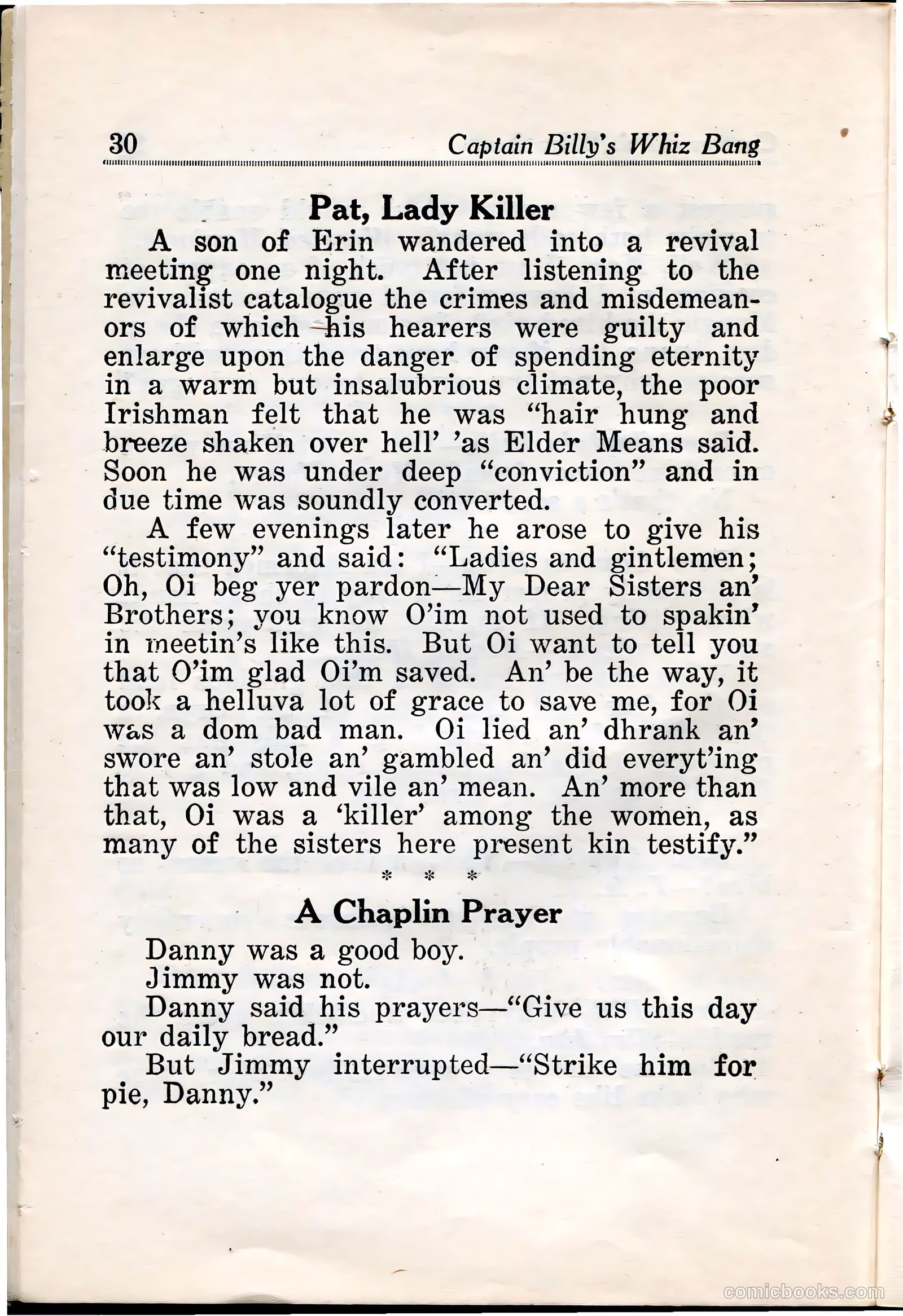
This page from *Captain Billy's Whiz Bang* contains two separate humor pieces: **"Pat, Lady Killer"** mocks Irish immigrant revival converts through ethnic dialect humor. An Irishman undergoes religious conversion at a revival meeting, then testifies to his past sins—boasting he was a "killer among the women." The joke relies on the character's malapropisms and Irish accent ("O'im," "gintlemen," "dom bad") to suggest he's proudly admitting to seducing women while claiming Christian redemption. It satirizes both revival meeting fervor and stereotypes about Irish immigrants and their relationship to respectability. **"A Chaplin Prayer"** is a brief joke contrasting "good boy" Danny, who prays the Lord's Prayer earnestly, with "bad boy" Jimmy, who interrupts with a crude demand to "strike him for pie"—a request for punishment to gain dessert. The satire targets children's morality and the gap between religious teaching and actual behavior. Both pieces use humor to mock working-class and immigrant populations, common in this era's satirical magazines.
This page from *Captain Billy's Whiz Bang* contains two brief humorous anecdotes typical of the magazine's satirical style. The first joke plays on the common insult "Were you raised in a barn?"—used to mock someone's manners. The twist: the man *actually was* raised in a barn, so hearing a donkey's bray makes him nostalgic rather than insulted. The satire mocks both the rude businessman's assumption that rural upbringing equals poor breeding, and the unexpected emotional vulnerability of the working-class victim. The second joke relies on period attitudes about women's fashion. A "table line gown" appears to be an extremely revealing or low-cut dress. The punchline—"I dropped my fork"—relies on the implication that the speaker deliberately looked down to see what wasn't covered, using the fork-drop as a pretense. It's mild by modern standards but reflects period anxieties about women's increasingly daring fashion. Both jokes target social pretension and hypocrisy.
This editorial defends the film industry against moral panic. The "Calamity Janes" refers to sensationalist women who spread rumors that criminals—particularly female ones acquitted of crimes—inevitably get movie deals as a reward for notoriety. The editorial uses the real Beulah Binford case (a Virginia woman who shot her lover's husband circa 1912-1915) to argue this actually doesn't happen. Though Binford was released without prison time and a promoter did attempt to capitalize on her notoriety by offering her a film role, the editorial claims the picture was never completed or released—proving Hollywood doesn't actually star murderers. The satire targets pearl-clutching gossip and unfounded fears about cinema corrupting justice, while simultaneously criticizing the exploitation of crime victims by unscrupulous promoters seeking profit from scandal.
This page from *Captain Billy's Whiz Bang* satirizes the film industry's exploitation of crime and criminals for profit—while simultaneously condemning such exploitation. The text describes three cases where studios or promoters attempted to capitalize on real crimes: Beulah Binford (victim of a crime film), a Wisconsin student who killed his girlfriend, and Marie Edwards (who shot Senator Lyons). The satire's point is the hypocrisy: major film companies publicly claimed moral outrage at "crime exploitation" and refused to distribute such films, yet they simultaneously pursued similar projects for profit. The underlying critique targets both the film industry's mercenary opportunism and the wider public fascination with sensationalized crime. The tone suggests moral judgment on all parties—promoters seeking profit, studios competing while claiming principles, and the public's appetite for such material. No specific cartoons or illustrations are visible on this text-heavy page.
This page contains satirical commentary on Hollywood's treatment of criminals, not a visual cartoon. The satire targets the movie industry's hypocrisy and opportunism. The piece documents several real murder cases from Los Angeles (Louise Peete, Senator New's son, Marie Bailey) where the accused or convicted criminals attempted to leverage their notoriety for film careers. The satire's point: studios initially ignored or rejected these individuals, yet the final cryptic reference to Clara Lamon's unreleased film "Fate" suggests studios might paradoxically profit from crime-related material anyway. The closing line—"Burning kisses always go with sparks"—appears to be a cynical quip implying that scandal and sensationalism (sparks) naturally accompany passionate drama (burning kisses) in Hollywood. The satire exposes Hollywood's pretense of moral standards while acknowledging its actual appetite for scandal-adjacent content.
This is satirical commentary on **Prohibition** (the Volstead Act banning alcohol, 1920-1933). The author argues that a well-organized *minority* successfully imposed alcohol prohibition on the disorganized *majority* through effective propaganda. The piece uses the example of **Georges Carpentier**, a famous French boxer who visited America around 1921, to illustrate how emotions can be manipulated. Society women's enthusiastic response to the celebrity boxer demonstrates how people are easily swayed by passion—and similarly, the public was manipulated into supporting Prohibition through emotional appeals rather than reason. The author's point: organized groups with focused messaging defeat scattered majorities. He's criticizing Prohibition as an illegitimate restriction imposed by a passionate minority, suggesting that emotional propaganda—not genuine public will—created this law. The tone is sardonic, treating Prohibition as an example of how democracy fails when the majority lacks organization.
This satirical magazine page mocks Prohibition (the Volstead Act), which had recently been ratified without public awareness. The author criticizes how supporters sneaked it through legislatures before opponents noticed. The satire targets American hypocrisy: while Prohibition was imposed, wealthy citizens evade it by traveling to Europe and Havana via Cunard steamships ("Cunard addicts"), turning Europe into "America's corner saloon." The piece sarcastically invokes President Woodrow Wilson's preference for wine and beer to undermine prohibitionist morality. The unnamed "Gus" appears to predict Prohibition's failure—that speakeasy signs reading "Wines, Liquors and Segars" will soon reappear openly on storefronts. The final unrelated jokes about songs and a stage contortionist's "double life" suggest typical magazine filler, possibly continuing satirical themes about deception and hidden behaviors.
This page from *Captain Billy's Whiz Bang* (a satirical magazine) features a section called "Smokehouse Poetry" that introduces poems by contributor Budd L. McKillips. The editorial introduces McKillips' new poem "The Girl From Over There" by referencing a recent real-life scandal: actress Zelda Crosby's suicide after being abandoned by a prominent film producer. The satire targets the hypocrisy of Hollywood's "purity crusaders"—reform-minded figures publicly advocating for moral standards in cinema while privately seducing and discarding women. McKillips, a newspaper reporter, draws his poetry from actual events (like a 1920s Minneapolis cabaret raid), making his work contrast with sentimental "armchair" verse. The page then reprints a melancholic poem titled "The Spirit of Mortal," emphasizing life's transience—a thematic echo of Crosby's tragedy. This juxtaposition of morality-preaching hypocrisy against inevitable human mortality forms the satirical commentary.
This page contains no cartoons or illustrations—it's a lengthy philosophical poem about human mortality and the cyclical nature of existence. The text presents a memento mori meditation: regardless of social station (king, priest, peasant, beggar), all humans face death and fade into obscurity. The poem emphasizes that successive generations repeat their fathers' experiences—same thoughts, same fears, same joys—yet this knowledge doesn't diminish mortality's inevitability. It argues against human pride, noting life's brevity ("wink of an eye") and the swift transition from health to death. For *Whiz Bang* readers, this appears to be serious verse rather than satire, possibly reflective of post-WWI sentiment about mortality and human insignificance. The magazine, known for ribald humor, here offers somber philosophical content—suggesting either editorial range or this being a special commemorative piece.
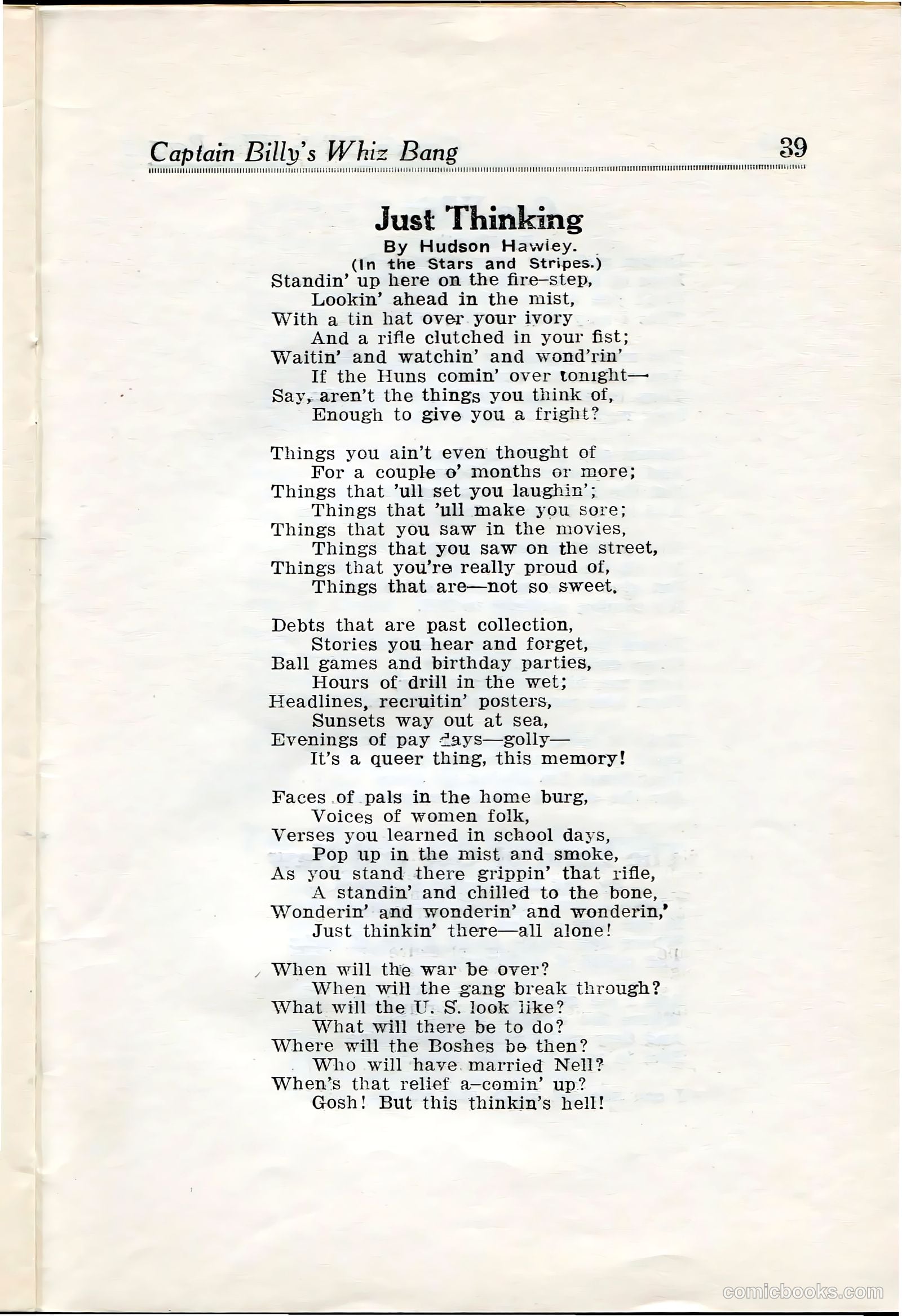
This is a poem by Hudson Hawley (published in *Stars and Stripes*, the military newspaper) depicting a soldier on night watch in the trenches during World War I. The speaker stands alone on the fire-step, rifle in hand, waiting for a German ("Hun") attack. The poem captures the psychological experience of trench warfare—how boredom and anxiety trigger intrusive, wandering thoughts. The soldier's mind cycles through mundane memories (movies, pay days, school verses), personal worries (unpaid debts, whether his girlfriend Nell will marry someone else), and existential questions about the war's end and postwar life. "Gosh! But this thinkin's hell!" is the punchline: the real torment of combat isn't necessarily combat itself, but the exhausting mental spiraling of waiting, watching, and worrying alone in the dark.
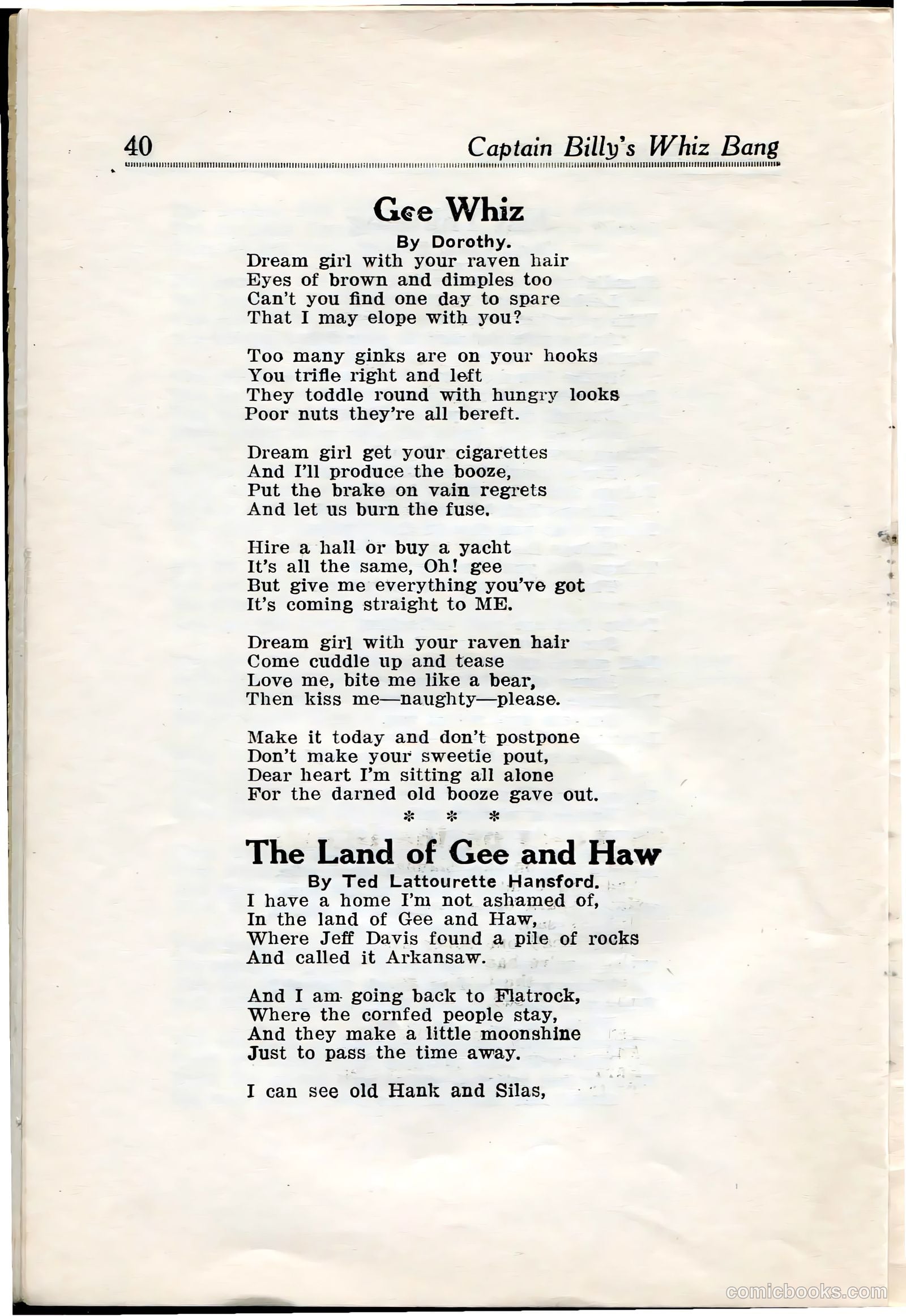
This page contains two poems from *Captain Billy's Whiz Bang*, a satirical magazine popular in the 1920s. **"Gee Whiz"** by Dorothy is a flirtatious poem where a male speaker pursues a woman ("dream girl"), offering cigarettes, alcohol ("booze"), and expensive entertainments (hired halls, yachts) to convince her to elope with him. The satire mocks post-WWI youth culture—specifically the carefree, hedonistic "flapper" era when young people openly discussed dating, drinking (illegal during Prohibition), and premarital romance. **"The Land of Gee and Haw"** by Ted Lattourette Hansford appears to be rural/agrarian satire. "Gee" and "haw" are commands to horses. The poem nostalgically references Arkansas and rural communities ("cornfed people"), while casually mentioning illegal moonshine production. The Jeff Davis reference (unclear without more context) and the folksy tone suggest mockery of rural American simplicity versus urban sophistication. Both poems reflect 1920s class and cultural tensions between urban modernity and rural tradition.
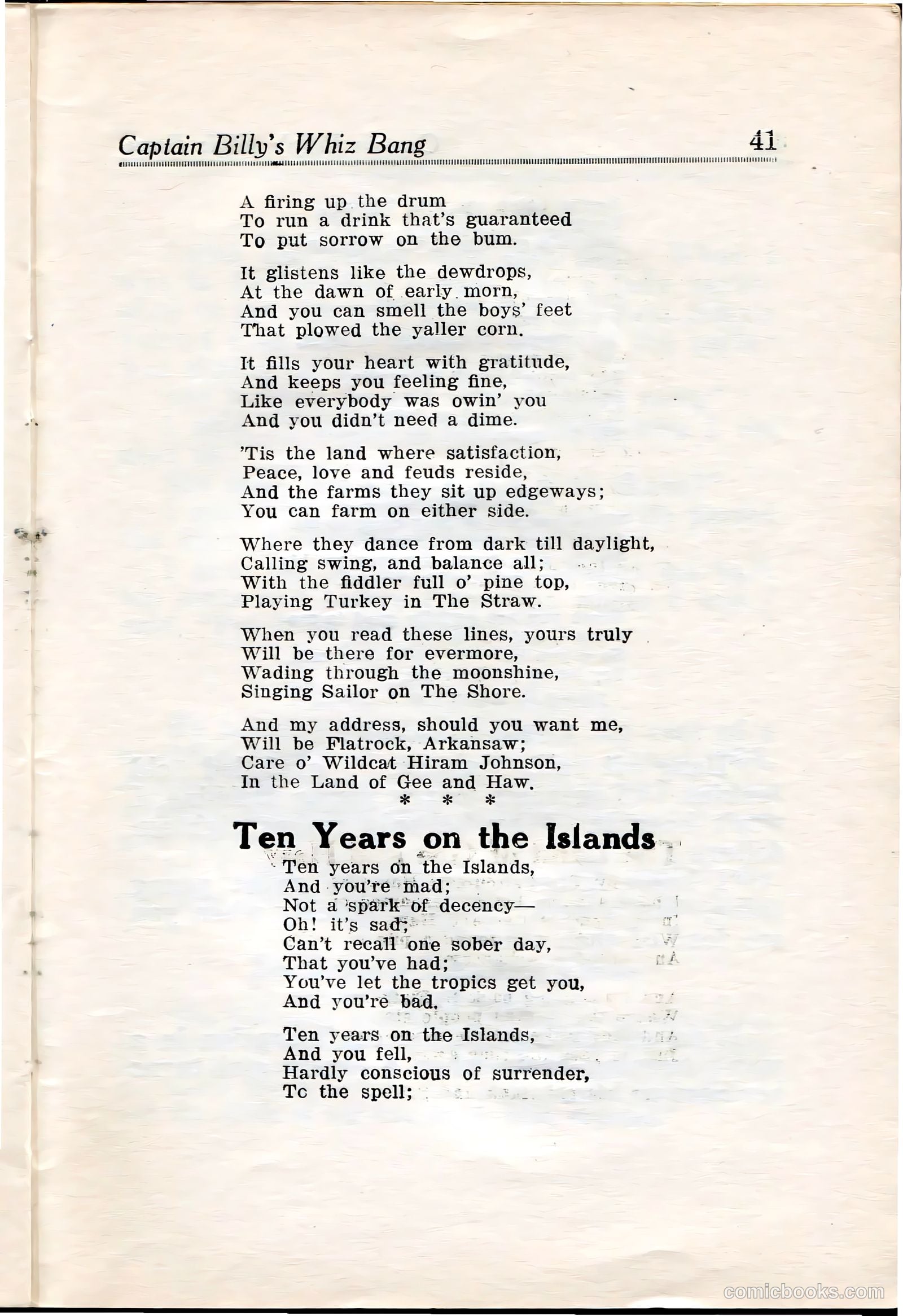
This page contains two humorous poems from *Captain Billy's Whiz Bang*, a satirical magazine known for ribald humor. The first poem celebrates rural American farm life and moonshine whiskey with folksy charm—referencing fiddle music, country dancing, and illicit alcohol ("moonshine"). It's nostalgic Americana with a wink about illegal drinking during Prohibition. The second poem, "Ten Years on the Islands," satirizes the opposite: tropical colonial life that allegedly corrupts and destroys character. The speaker warns that extended time in island territories (likely referring to American colonial possessions like Hawaii or the Philippines) leads to moral decay, alcoholism, and loss of decency. Together, the poems contrast idealized American rural virtue with the corrupting influence of tropical colonialism—a common anxiety of the era about how overseas imperial expansion affected American character and values.
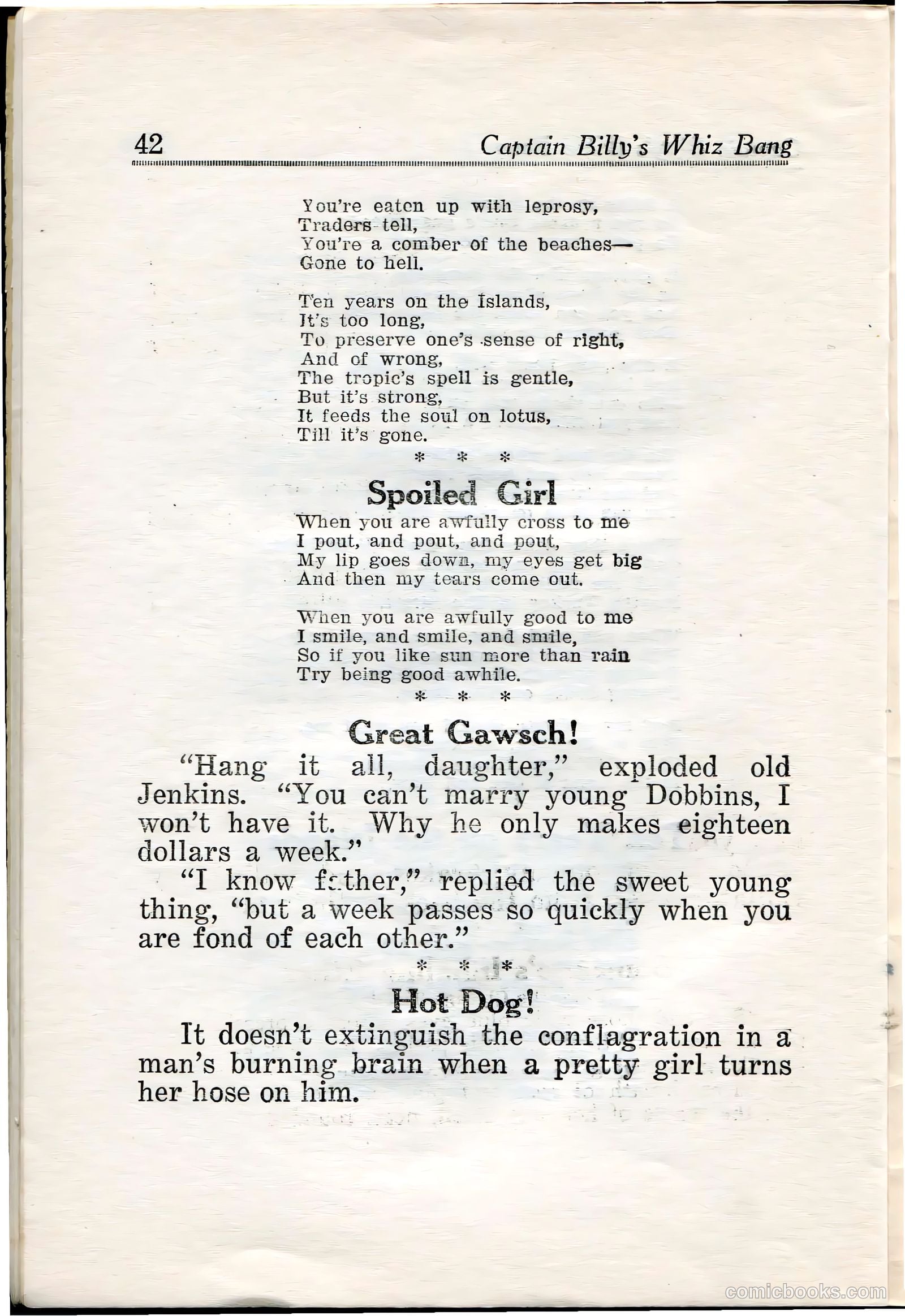
This page contains four short pieces of satirical verse and prose typical of 1920s humor magazines: 1. **Untitled opening poem**: References tropical island life corrupting Western morality—likely alluding to colonial traders or sailors succumbing to disease and moral decay in exotic locales. 2. **"Spoiled Girl"**: Mocks manipulative femininity, depicting a young woman using tears and smiles to control her boyfriend's behavior—common satirical target of the era. 3. **"Great Gawsch!"**: Jokes about class anxiety through a father opposing his daughter's marriage to a poor man (earning $18/week), while she romanticizes their love. The humor relies on her naïve dismissal of financial concerns. 4. **"Hot Dog!"**: Sexual innuendo—a girl's attractiveness cannot calm a man's sexual desire, regardless of other distractions. The magazine's humor targets romantic relationships, gender dynamics, and social pretensions typical of early-twentieth-century satirical publications aimed at young male readers.
This page contains three separate humorous anecdotes typical of 1920s satirical magazines: **"How to Get Tips"**: A joke about visiting a female barber in Bartlesville (likely Oklahoma, known for oil). The humor relies on the novelty and slight scandal of female barbers at this time, plus a misunderstanding about tipping—the protagonist reflexively says "Put it in the piano" (a common phrase for tipping musicians) instead of properly tipping the barber. **"Those Flivvers Again"**: A brief gag about Ford Model T automobiles ("flivvers"). A man overhears a sentimental couple in a car ahead, apparently reconciling, and assumes they're having intimate relations—so he backs away to give them privacy. **"Someone's Inhaling Ether"**: A flowery literary excerpt from the Chicago Tribune describing a woman's beauty in overwrought prose, likely satirizing sentimental or melodramatic newspaper fiction. All three pieces reflect 1920s attitudes toward new social phenomena: working women, automobile culture, and popular literature styles.
This page contains three brief humorous pieces typical of 1920s American satirical magazine content: **"Just Like the Army"** jokes about over-drilling—a mother rehearses her daughter's responses to a visiting pastor's standard questions, but the child, over-prepared, blurts all four answers at once, ending with "go to hell, sir." The humor comes from innocent chaos and the girl's accidental profanity. **"Blank Verse"** references *The Gold Diggers*, likely the 1923 film, as a pun: the writer sought literal gold at a rainbow's end but found "gold diggers" instead—women who pursue men for money. The Boston reference suggests regional variations in this behavior. **"Sneeze Hearty"** is a simple pun-based joke: the Hay Fever Club president proposes a toast but sneezes mid-sentence, turning "Here's looking at you" into "Here's looking at—choo!" All three are gentle, wordplay-driven humor targeting everyday situations—parental training, romantic deception, and allergies—with no apparent political content.
This page contains three gossip items targeting 1920s Hollywood celebrities: 1. **"Bull" Montana**: A boxer/actor rumored to marry. The joke mocks Douglas Fairbanks's wife Mary for considering Montana "declasse" (lowbrow)—suggesting social climbing by the wealthy Fairbanks family. 2. **Viola Dana & aviators**: Speculates on why actress Viola Dana stopped appearing publicly with aviator Earl Daugherty after her friend Orma Locklear (a famous pilot) died. The item insinuates romantic or scandalous involvement. 3. **Elinor Glyn**: English romance novelist attending a Hollywood event. The satire targets her affectation of eating dinner in long white gloves—mocking her pretensions to aristocratic elegance while struggling with practical dining (olives, corn, asparagus). The incomplete final sentence suggests gossip about her male companion. The column ridicules celebrities for pretension, scandal, and social posturing typical of 1920s gossip magazines.
This page from *Captain Billy's Whiz Bang* (a 1920s satirical magazine) is a Hollywood gossip column mocking silent film stars' romantic entanglements and social behavior. The humor targets: 1. **Dana Todd's ambiguous love life** with actresses Gloria Swanson and Elinor—poking fun at unclear romantic intentions. 2. **Lois Wilson and Mildred Harris** competing for wealthy suitors, satirizing actresses' marriage-hunting. 3. **Mabel Normand's weight loss farm** and mysterious older gentleman—implying vain self-improvement and questionable companion choice. 4. **Bessie Love's constant maternal chaperon**—sarcastically asking if she "lost her hunting license," implying she's unable to date independently. 5. **Clara Kimball Young's awkward dance floor moment**—her new beau (Harry Garson) causes her to literally fall onto her ex-husband (Jimmy Young), creating social embarrassment despite her expensive jewelry display. The satire mocks Hollywood's superficiality, romantic instability, and status-obsession.
This page from the satirical magazine consists entirely of Hollywood gossip items—no cartoons are visible. The content mocks silent-era film celebrities' romantic lives and social activities. The humor operates on multiple levels: it reports trivial celebrity sightings (Ruth Renick's fainting spell, various actors "stepping about together") with mock-serious tone. The final item's sarcasm is sharpest—it celebrates married couples like Bill Desmond and Mary McIvor simply *dancing together* as noteworthy gossip, sarcastically suggesting this was scandalous or unusual behavior for the era. The earlier anecdote about "Jimmy" and "Clara" appears to be a setup about romantic jealousy at a dance. The satire targets both Hollywood's obsession with celebrity romance and the era's social conventions around public behavior. By treating mundane activities as headline material, the magazine ridicules gossip columnists and readers' appetite for celebrity scandal.
This page contains three brief satirical anecdotes rather than cartoons. The **Evelyn Nesbit** item references a real scandal: Nesbit was a famous actress/model involved in a notorious 1906 murder case (her husband Harry Thaw killed her lover Stanford White). The anecdote mocks her by suggesting she uses her notoriety to weaponize minor incidents—yelling "fire" to draw police attention over a minor street altercation. **"Can We Forgive Him?"** satirizes ethnic prejudice and absurd identity claims. A sailor beats another sailor for calling him Irish, then bizarrely claims his mother was Mexican and his father consisted of "two marines"—a nonsensical, impossible lineage offered as serious justification. The joke mocks both casual ethnic slurs and the ridiculous "logic" used to defend honor. **"Pithole Filosofy"** is a brief insult-exchange joke between an adult and child, playing on folk-wisdom comebacks (comparing the adult's anger to brass, the child's retort to sap/stupidity). All three target human vanity, absurd reasoning, and social hypocrisy through humor.
This page contains four brief humorous sketches satirizing various social situations: **"Wails of a Wolstead Victim"** references Prohibition (the "Volstead Act"), mocking someone who wants to drink excessively but lacks the physical capacity. **"Giving Him Fair Warning"** jokes about mind-reading in romance—a woman threatens to scream if her date thinks about her inappropriately, creating absurdist humor. **"Way of a Lad With a Lass"** depicts a courtship negotiation through grunts and moans, ending with "Smack!"—presumably a slap, mocking both romantic persistence and female resistance as physical comedy. **"Modern Literature"** parodies contemporary sentimental romantic fiction by subverting reader expectations: the woman's passionate declarations about "how handsome" turn out to apply to *furniture*, not her male companion—a joke about overly florid literary prose and romantic sentimentality. The page exemplifies *Whiz Bang*'s style: brief, punchy jokes targeting Prohibition, courtship customs, and literary pretension.
This page contains four humor pieces typical of 1920s satirical magazines: **"Flapper Blues"** mocks the melancholic mood of young women of the Jazz Age era, expressing existential disappointment. **"Djever Hear This One?"** jokes about mistaken identity with prominent political figures—Lloyd George (British Prime Minister) and President Wilson. The punchline relies on Paddy (an Irish character stereotype) claiming someone thought he was someone important, with the pun "Great God, is that you?" implying he's unrecognizable or unremarkable. **"Pink Pills for Pale People"** parodies Lydia Pinkham's Vegetable Compound, a real patent medicine advertised heavily to women. The love letter uses elaborate vegetable puns ("carrot," "beets," "canteloupe lettuce") to mock both the product and flowery romantic language. **"Lovely Calves We're Having!"** is a visual double-entendre joke: "calves" (young cows) are confused with "bullets" (weapons)—likely referencing WWI's recent conclusion or prohibition-era violence. The humor is broadly populist, targeting politicians, commercialism, and current social anxieties.
This page contains no political cartoons—only humorous short jokes and quips typical of 1920s American satirical magazines. The humor relies on wordplay and mild social commentary: **Key jokes:** - A stranger mistakes the narrator for a doctor; the joke implies easy access to illegal alcohol (Prohibition era context). - Women blush from "the druggist"—another Prohibition reference, suggesting women buy alcohol from pharmacists. - Restaurant insult joke: the narrator asks if they serve food "fit for a hog," implying poor quality. - Marriage joke: wives control husbands through their hair—a domestic power dynamic gag. - Barber pun: "scraping acquaintance" plays on the scraping motion of barbering while suggesting barbers meet many people. The humor is crude, topical to Prohibition and 1920s gender roles, and entirely dependent on now-obscure references readers of that era would immediately recognize.
This page from *Captain Billy's Whiz Bang* is a humor magazine containing brief jokes and quips rather than cartoons. The content reflects early 20th-century American humor: **"Essence of Sweet Peas"** uses vegetable puns (lettuce/let us, spinach/spin-ach, carrot/car) typical of period wordplay. **The Philadelphia reader joke** mocks the reader's wit by suggesting his jokes are so transparent they need tissue paper—implying they're obvious or unfunny. **"May Have Better Luck"** reports a local anecdote about failed chicken incubation, presented as humorous news. **The Mary/calf poem** jokes about women's newly shortened skirts of the 1920s-30s era, considered scandalous, making an anatomical pun (calf/leg visibility). **"The Latest Song"** parodies sentimental popular songs about baseball season and romance. **The final item** punts on "catch" (a musical round) with a weak business joke about teddy bears. The magazine traded in accessible, sometimes groan-worthy humor for mass audiences.
This page from the satirical magazine contains several brief humor pieces reflecting early 20th-century American attitudes: **"We Expect a Free Can For This!"** jokes about a bashful girl requesting a female clerk to buy Arbuckle's coffee—implying embarrassment about commercial transactions, playing on period gender conventions. **"The Happy Ham"** is a pun: smokers become "inured" (accustomed) to vice, but a "ham" (amateur actor or showoff) can be "cured" through smoking—a wordplay on food preservation. **The automobile joke** reflects anxiety about unmarried couples unchaperoned in cars—a modern dating concern of the era. **"The old inhabitant" piece** nostalgically contrasts modern women's looser clothing with stiffly starched petticoats that announced a lady's presence audibly—lamenting changing fashion and social propriety. **"Naughty Egg"** is crude bathroom humor about a child getting splattered. The page demonstrates typical satirical magazine content: wordplay, social commentary on changing morality, and juvenile pranks—aimed at male readers finding humor in gender relations and propriety shifts.
This page contains a collection of satirical one-liners and brief comic verses typical of 1920s humor magazines. The jokes target common social anxieties and behaviors: **"The Diamond Queen"** mocks wealthy women's vanity—having money but physical flaws. **"The Hootch Hound's Lament"** references Prohibition-era drinking culture, joking that staying sober is harder than staying drunk. **Love/housekeeping joke** ridicules young men's romantic delusions about managing independent domestic life. **"St. Paul Blues"** appears to be a folk-style blues verse about dying, with suggestive undertones about "the girls." **The garter joke** is sexual innuendo—a double entendre about a garter's curve as it fits around a leg during intimate moments. **The final joke** plays on "bored" (annoyed) versus "pierced" (literally punctured), suggesting women endure tedious conversation from uninteresting men. These reflect 1920s attitudes toward gender, drinking, and courtship with casual irreverence.
This page from the satirical magazine contains two gossip items about Hollywood scandals, likely from the early 1920s. The first item mocks a "heart-balm" lawsuit where Mrs. Juanita Cohen sued actress Jackie Saunders for $50,000, claiming Saunders stole her husband's affection. The satire lies in Jackie's clever legal defense: she argued Mr. Cohen had no love for his wife to steal in the first place—therefore nothing was taken. The writer applauds this rhetorical dodge. The second item references "the Arbuckle affair" (likely Roscoe "Fatty" Arbuckle's 1921 rape scandal), noting that Hollywood stars now pointedly drink alcohol at parties "with defiance" to prove they're responsible drinkers, not like Arbuckle. The satire suggests Prohibition has made this performative moderation necessary—before the law, such careful drinking would've seemed overly cautious. The implication is that Hollywood excess contributed to Prohibition's passage.
This page from **Captain Billy's Whiz Bang** satirizes 1920s Hollywood excess and hypocrisy. The text references the **Arbuckle scandal** (involving silent film star Roscoe "Fatty" Arbuckle and actress Virginia Rappe's death), criticizing Prohibition-era drinking laws that forced alcohol into private hotel rooms rather than public spaces. The satire mocks Hollywood's moral pretense: after the Arbuckle tragedy, film industry figures attended dinner parties where they drank "with decorum," while wealthy non-celebrities got drunk without professional reputations to lose. A planned yacht party with "orchid and rose suites" was rejected by prominent stars but proceeded with "fast folk" from society. The piece also covers the **Kenyon divorce case**—a playwright's dissolution devolving into mutual desertion accusations. The "Alphonse and Gaston" reference (a comic strip about overly polite Frenchmen) suggests absurd courtroom politeness masking real marital conflict. The overall tone critiques Hollywood's selective morality and celebrity scandal culture.
This page contains three gossip items typical of this 1920s satirical magazine: 1. **The Kenyon Divorce**: A humorous marital dispute where both parties claim the other deserted them—he says she was unbearable; she says his leaving was his only "manly act." The joke highlights the absurdity of their conflicting narratives. Mrs. Kenyon's history of multiple divorces adds to the mockery. 2. **H. Waters Incident**: A Hollywood scandal brief: a scenario writer found unconscious and bleeding outside a hotel after a party. Names are withheld—typical of the era's gossip columns protecting "picture folk" (film industry figures). 3. **Navy Fleet Complaint**: Satirizes government overreach. A Pacific Fleet docked in LA harbor since September undergoes federal inspection, forcing hosts to maintain decorum ("keep the milk on the table and cover the Victrola")—meaning no wild parties. The writer mocks this as overly restrictive. These items reflect 1920s celebrity scandal culture and anti-government sentiment.
This page from the satirical magazine contains several distinct pieces mocking post-WWI social and political issues: **Charlie Chaplin Criticism**: The opening mocks Chaplin's 1921 return to England after his American success. British press attacked him for criticizing Londoners' "sadness" while he'd remained in Los Angeles during WWI—implying he avoided wartime hardship. **Prohibition Satire** ("Going, Going, Gone!"): References American Prohibition (1920-1933), mocking the disappearance of alcohol—"gin in Holland," "home brew knocked sky-high," "milk weed going dry"—as liquor sources vanish. **French Family Bonuses**: Critiques France's post-war "bonuses for babies" policy by satirizing its funding method: taxing bachelors to subsidize large families, a controversial program meant to boost population after war losses. **Latin Nonsense**: The "nox/nix" section appears to be playful pseudo-Latin wordplay with minimal satirical content. The overall tone targets wartime profiteers, government overreach, and cultural hypocrisy common to 1920s humor.
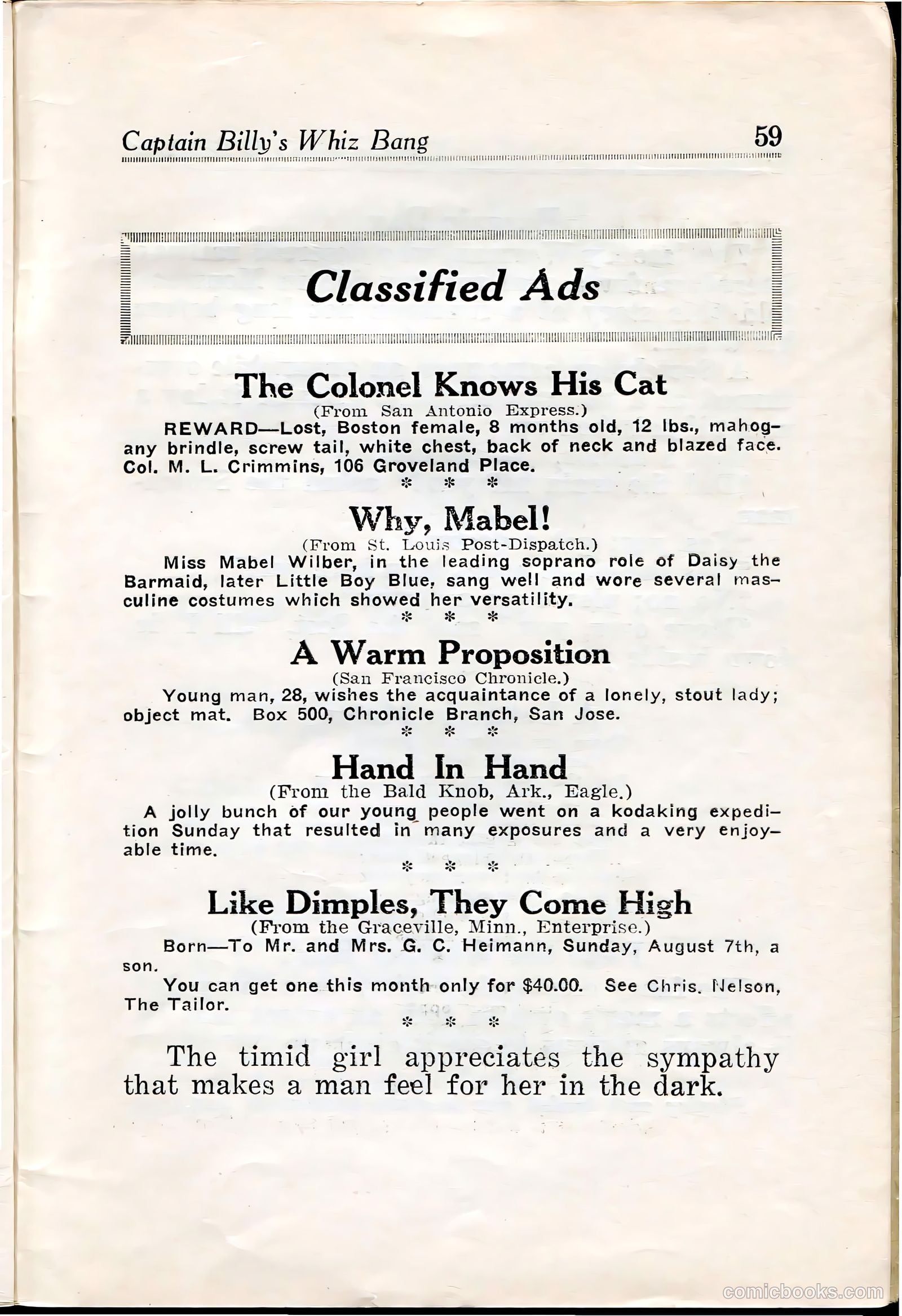
This page contains humorous fake classified ads—a common satire format. The jokes exploit double meanings and unintended innuendo in real newspaper listings: **"The Colonel Knows His Cat"** presents a straightforward lost-pet notice. **"Why, Mabel!"** plays on the phrase "masculine costumes," suggesting gender-ambiguous appearance. **"A Warm Proposition"** satirizes lonely-hearts ads with obvious opportunism. **"Hand In Hand"** puns on "exposures"—photography terminology with sexual implications. **"Like Dimples, They Come High"** jokes that a newborn son costs $40 (via tailor Chris Nelson), treating childbirth like a commodity purchase. The closing aphorism about "the timid girl" and "the dark" carries flirtatious, suggestive undertones. These represent *Whiz Bang*'s characteristic style: bawdy, cheeky humor mining newspapers for accidental double entendres—risqué entertainment for post-WWI audiences seeking irreverent fun.
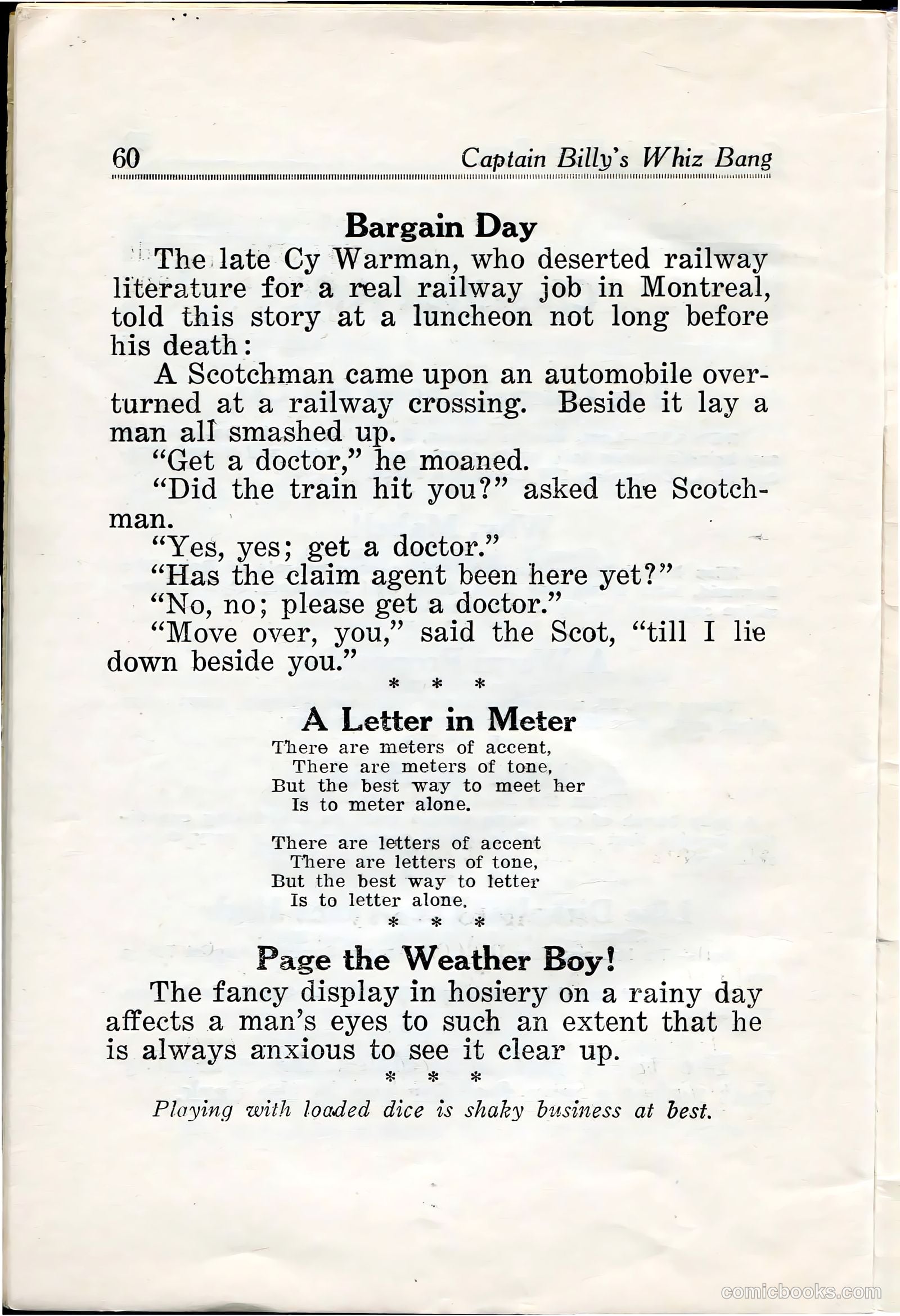
This page from *Captain Billy's Whiz Bang* contains three separate humorous pieces: **"Bargain Day"** features a Scotsman stereotype known for frugality. The joke: a Scottish man finds an accident victim pleading for a doctor, but instead keeps asking if a railway claim agent has arrived—suggesting he wants to profit from the accident. His final line, lying down beside the injured man to "bargain," implies he's seeking to be compensated as a fellow victim, treating tragedy as a business opportunity. The satire targets Scottish miserliness, a common ethnic stereotype of the era. **"A Letter in Meter"** is a playful pun using homophones: "meter/meet her" and "letter/let her," essentially repeating the same advice ("be alone") in different word forms. **"Page the Weather Boy"** makes a crude innuendo: men display interest in women's hosiery on rainy days when such displays are visible, wanting the weather to "clear up" so they can continue viewing legs through transparent stockings. The final line about loaded dice serves as a standalone aphorism about risky behavior.
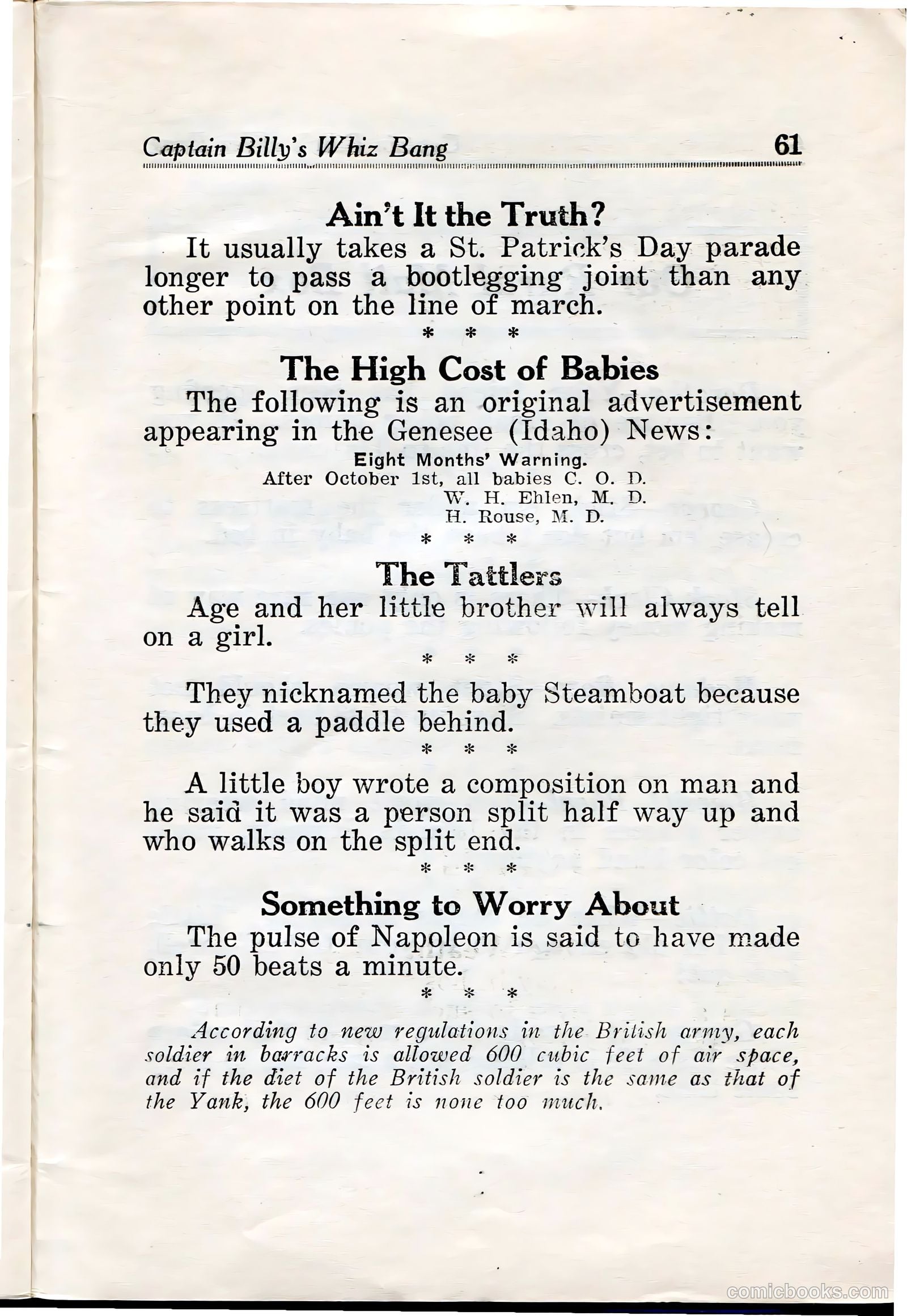
This is a humor column from an American satirical magazine, likely from the 1920s Prohibition era. The jokes reflect period concerns: **"Ain't It the Truth?"** mocks the hypocrisy of St. Patrick's Day parades passing bootleg joints—illegal alcohol dealers—suggesting parade-goers stopped there longer than elsewhere. **"High Cost of Babies"** reprints a genuine newspaper ad from Idaho doctors offering "C.O.D." (cash-on-delivery) babies after October 1st, satirizing medical costs and birth expenses. **"The Tattlers"** contains mild jokes about gossiping and children's innocent observations. **"Something to Worry About"** compares Napoleon's famously low pulse rate (medically notable) with British Army regulations allowing soldiers 600 cubic feet of barracks space—joking that American soldiers eat so much they'd need even more space. This reflects American-British stereotypes about diet and body size. The column trades in topical satire, period-specific anxieties, and mild social commentary typical of 1920s American humor magazines.
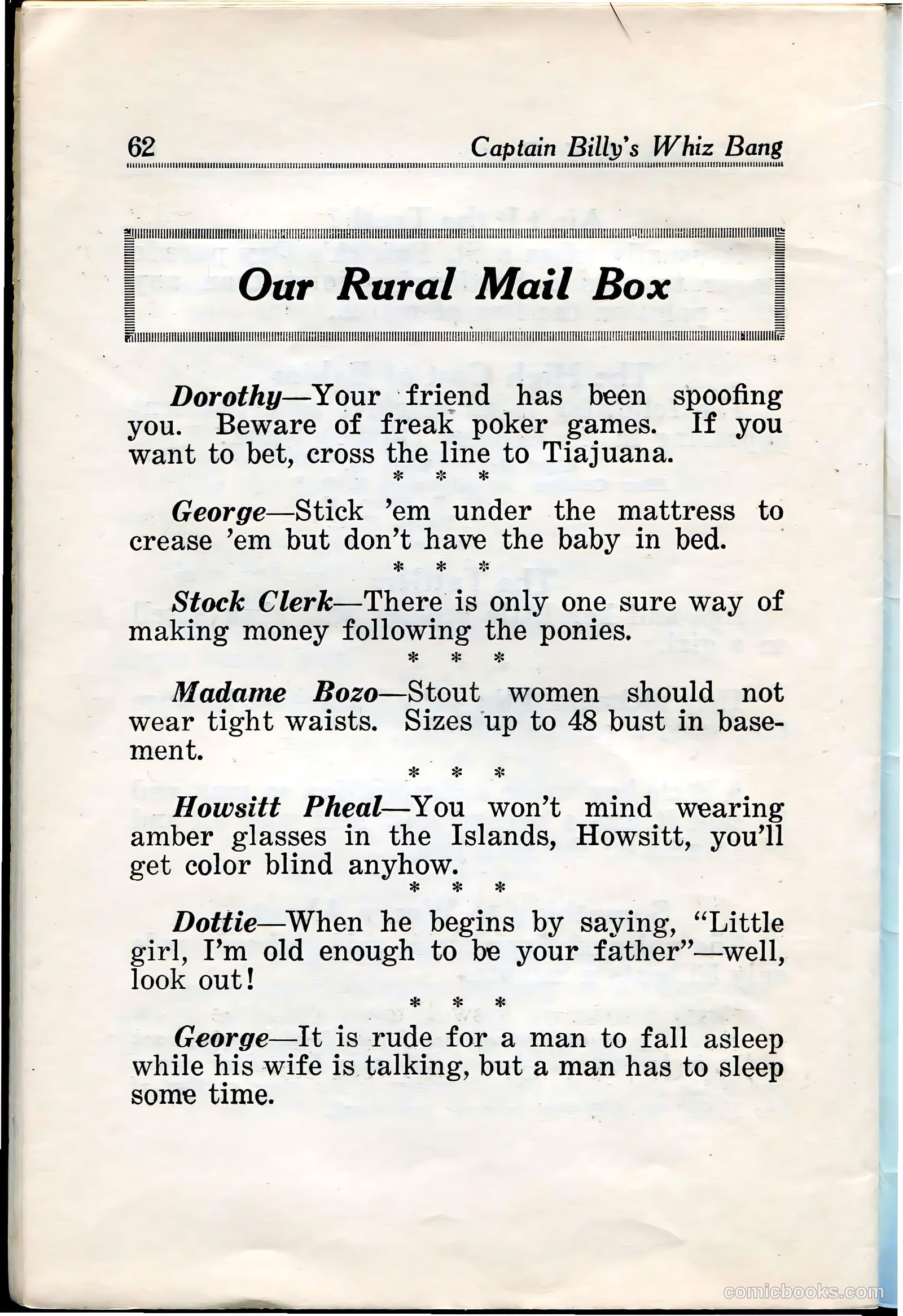
This is a humor column from *Captain Billy's Whiz Bang*, a satirical magazine popular in the 1920s-30s. The page contains brief, comedic advice letters to fictional readers, reflecting contemporary concerns and stereotypes: **Key jokes and references:** - **Dorothy/poker/Tijuana**: References Prohibition-era gambling and Mexico as a lawless destination for vice - **George/mattress**: Likely about hiding money during economic uncertainty - **Stock Clerk/ponies**: "Following the ponies" means horse racing; the joke implies gambling is unreliable - **Madame Bozo**: Body-shaming humor about overweight women's clothing - **Howsitt Pheal/amber glasses**: A pun about tropical travel and vision loss - **Dottie**: Warns against seduction lines from older men - **George (again)**: Marital humor—wives talk too much, husbands need sleep The humor is crude, sexist, and centered on drinking, gambling, and domestic friction—typical of the magazine's working-class male audience.
This page contains reader letters with editorial responses—a common magazine feature where editors humorously reject or critique submissions. The "Captain Billy's" masthead indicates this is from a popular American humor magazine known for ribald, working-class comedy. The responses mock contributors through absurdist jokes: a fake explanation of a "Whuzzat" (a made-up tobacco-chewing railroad dog), crude advice about getting false teeth (kick a bull dog), and sarcastic restaurant criticism. The humor targets common people's manners and speech—blowing on hot coffee, spitting tobacco, poor dancing ability—reflecting period anxieties about etiquette and social class. Most are simple insult jokes typical of early-20th-century comic magazines. The editor rejects one submission as "not clean," suggesting content standards even for a magazine known for coarse humor. The tone is working-class, irreverent satire aimed at ordinary readers.
This page is **not a cartoon or satirical content** — it's a **direct-mail advertisement** for Whiz Bang magazine's annual collection. Whiz Bang was an early 20th-century humor magazine featuring jokes, stories, and "smokehouse poetry" (bawdy humor). This ad promotes their 1921-22 Winter Annual: a 256-page bound book sold for one dollar. The sales pitch uses scarcity marketing — claiming last year's smaller annual sold out within days across the Pacific Coast and couldn't be found nationwide within ten days. The urgency ("First Come will be First Served!") and the unusual payment method ("PIN A DOLLAR BILL" to the coupon) suggest either novelty marketing or practical concerns about mail security in the early 1920s. For modern readers: this represents pre-internet direct marketing, where magazines drummed up subscriptions and merchandise sales through print ads, relying on postal delivery and personal payment methods.
This is a **title/advertisement page**, not a cartoon page. It announces "Our Winter Annual" for *Captain Billy's Whiz Bang*, a satirical humor magazine. The page promises a $1 collection ("Pedigreed Follies of 1921-22") containing jokes, poetry, and humorous stories—including pieces titled "Johnnie and Frankie," "The Face on the Barroom Floor," and "The Shooting of Dan McGrew." The reference to "red-blooded poetry" and the listed content suggest this was populist, working-class humor—saloon culture, romantic melodrama, and ribald comedy typical of early 1920s American magazines aimed at male readers. The order form at bottom was standard mail-order publishing practice of the era. There are **no political figures or specific satirical commentary** visible on this page.
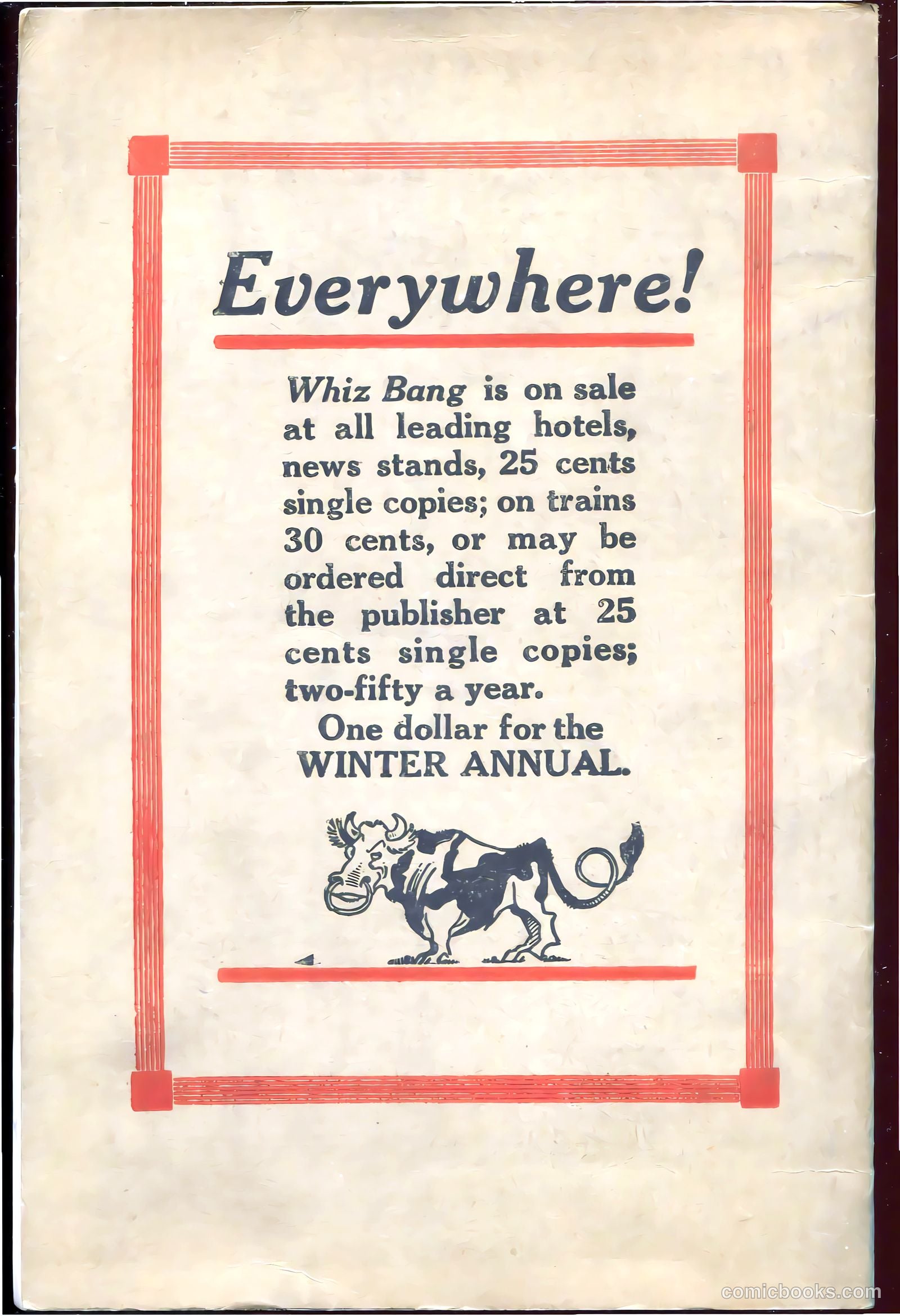
This is a **title/advertising page** rather than satirical content. It announces the availability and pricing of *Whiz Bang* magazine across distribution channels (hotels, newsstands, trains, direct mail). The page features a **cartoon cow mascot** wearing what appears to be decorative clothing, serving as a visual brand identifier for the publication. For modern context: *Whiz Bang* was an early-20th-century American humor magazine known for risqué jokes and satirical content. The pricing structure reflects the era—25 cents at retail, cheaper direct subscription ($2.50/year), with premium pricing ($1) for the Winter Annual special edition. The cow mascot's purpose remains unclear without additional context about the magazine's branding strategy.