
Captain Billy's Whiz Bang, December 1921 · page 22 of 68
Captain Billy's Whiz Bang #28 — page 22: what you’re looking at
What you’re looking at
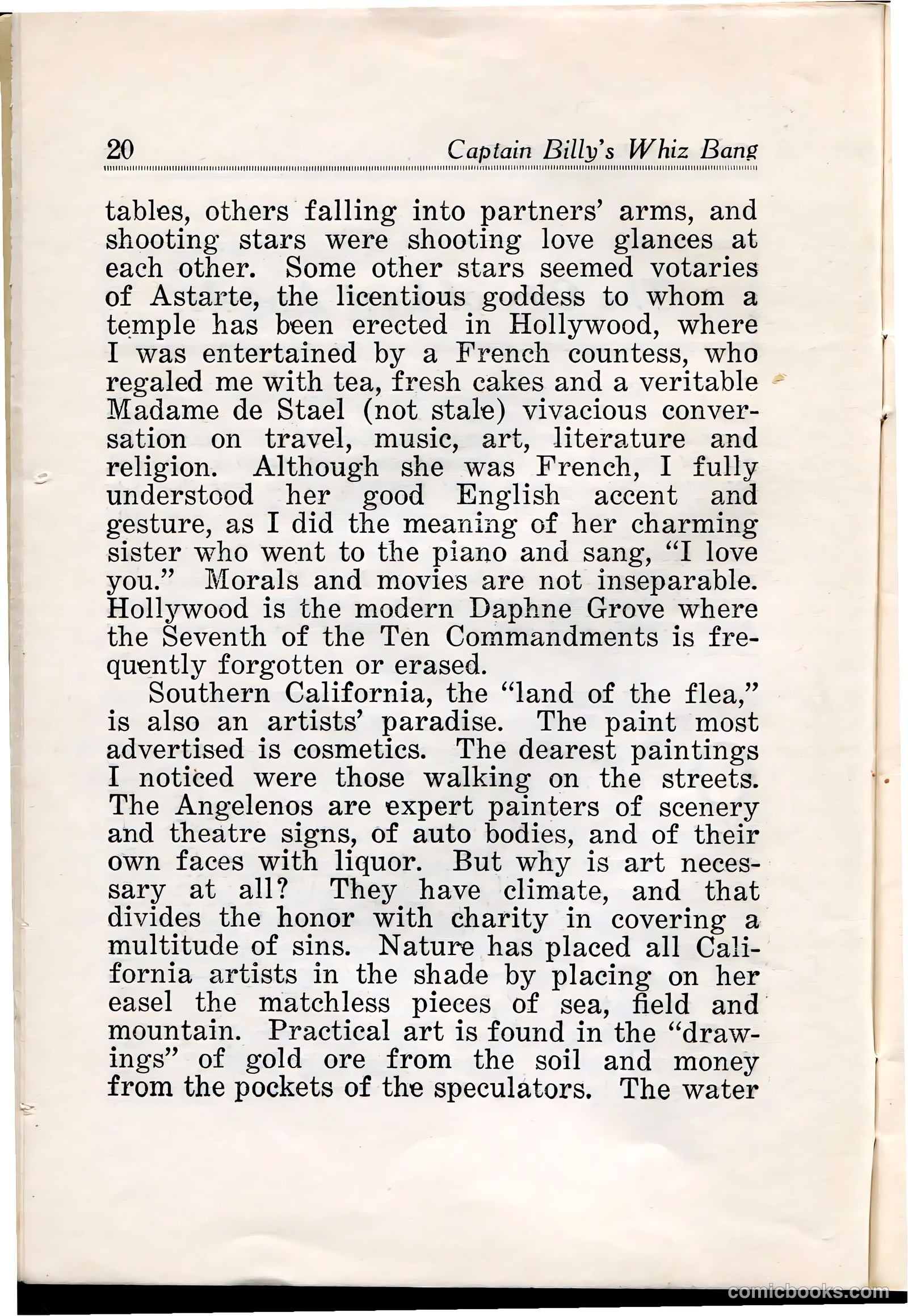
This page contains no visible cartoon—it's satirical prose commentary on Hollywood and Southern California. The author mocks: **Hollywood morality**: The text sarcastically suggests Hollywood is like ancient Sodom ("Daphne Grove"), where the Seventh Commandment (against adultery) is routinely violated. References to "shooting stars" exchanging "love glances" are likely coded allusions to illicit affairs among celebrities. **Hollywood artificiality**: The author ridicules cosmetics as "paint" and notes that "the dearest paintings" are women "walking on the streets"—suggesting actresses are themselves commodities on display. **California's false values**: The piece attacks Southern California's obsession with wealth-extraction ("drawings" of gold and money from speculators' pockets) while claiming natural beauty excuses moral failings. The tone is moralistic satire typical of 1920s American humor magazines criticizing the era's perceived decadence, particularly Hollywood's libertine reputation and California's gold-rush mentality.
📄 Transcribed text from this page (OCR, searchable)
Machine-transcribed from the original scan — historical spelling and the odd misread are preserved.
20 Captain Billy's Whiz Bang tables, others falling into partners' arms, and shooting stars were shooting love glances at each other. Some other stars seemed votaries of Astarte, the licentious goddess to whom a temple has been erected in Hollywood, where I was entertained by a French countess, who regaled me with tea, fresh cakes and a veritable Madame de Stael (not stale) vivacious conver- sation on travel, music, art, literature and religion. Although she was French, I fully understood her good English accent and gesture, as I did the meaning of her charming sister who went to the piano and sang, “I love you.” Morals and movies are not inseparable. Hollywood is the modern Daphne Grove where the Seventh of the Ten Commandments is fre- quently forgotten or erased. Southern California, the “land of the flea,” is also an artists’ paradise. The paint most advertised is cosmetics. The dearest paintings I noticed were those walking on the streets. The Angelenos are expert painters of scenery and theatre signs, of auto bodies, and of their own faces with liquor. But why is art neces- sary at all? They have climate, and that divides the honor with charity in covering a multitude of sins. Nature has placed all Cali- fornia artists in the shade by placing on her easel the matchless pieces of sea, field and mountain. Practical art is found in the “draw- ings” of gold ore from the soil and money from the pockets of the speculators. The water