
Captain Billy's Whiz Bang, December 1921 · page 40 of 68
Captain Billy's Whiz Bang #28 — page 40: what you’re looking at
What you’re looking at
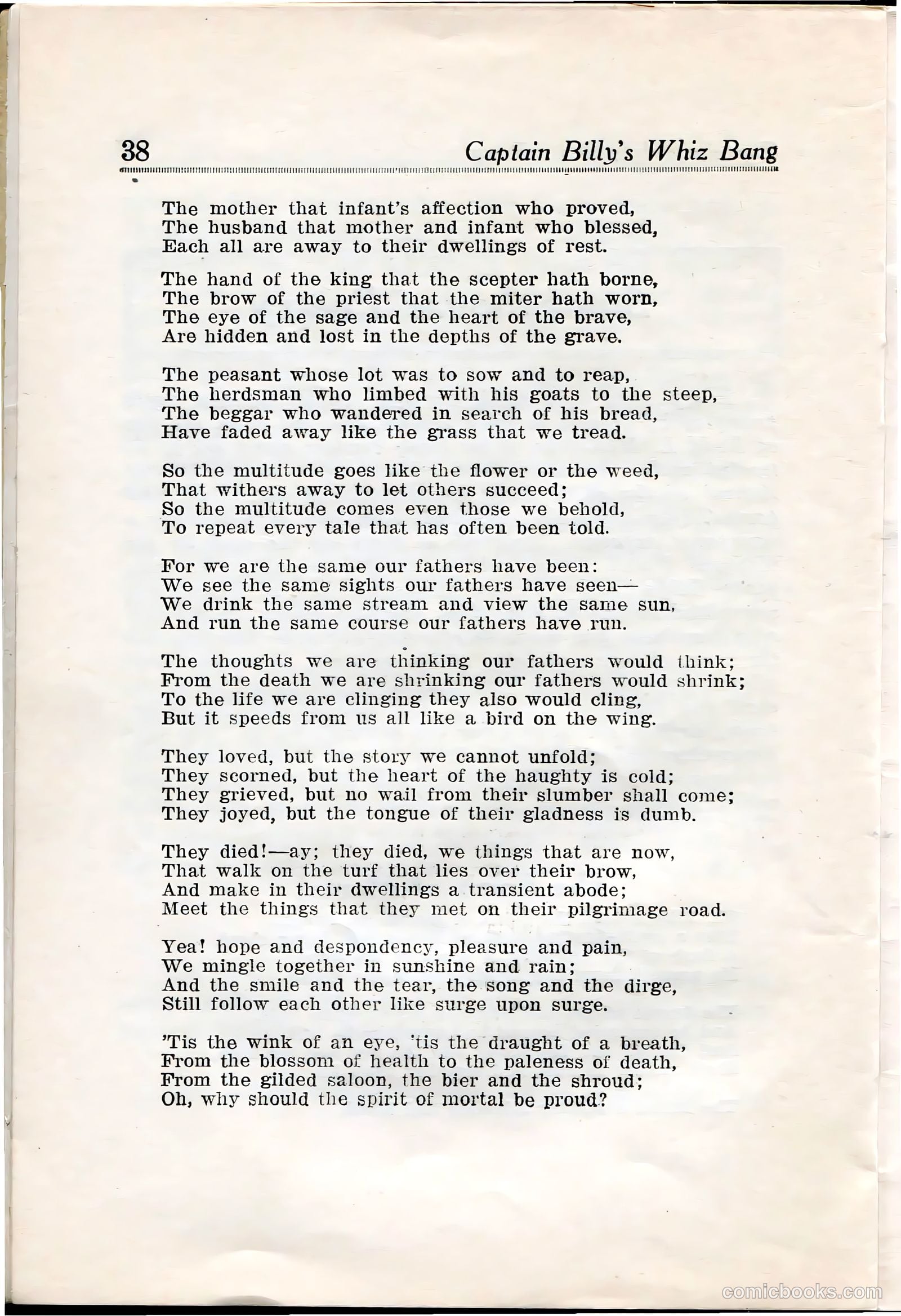
This page contains no cartoons or illustrations—it's a lengthy philosophical poem about human mortality and the cyclical nature of existence. The text presents a memento mori meditation: regardless of social station (king, priest, peasant, beggar), all humans face death and fade into obscurity. The poem emphasizes that successive generations repeat their fathers' experiences—same thoughts, same fears, same joys—yet this knowledge doesn't diminish mortality's inevitability. It argues against human pride, noting life's brevity ("wink of an eye") and the swift transition from health to death. For *Whiz Bang* readers, this appears to be serious verse rather than satire, possibly reflective of post-WWI sentiment about mortality and human insignificance. The magazine, known for ribald humor, here offers somber philosophical content—suggesting either editorial range or this being a special commemorative piece.
📄 Transcribed text from this page (OCR, searchable)
Machine-transcribed from the original scan — historical spelling and the odd misread are preserved.
38 Captain Billy's Whiz Bang The mother that infant's affection who proved, The husband that mother and infant who blessed, Each all are away to their dwellings of rest. The hand of the king that the scepter hath borne, The brow of the priest that the miter hath worn, The eye of the sage and the heart of the brave, Are hidden and lost in the depths of the grave. The peasant whose lot was to sow and to reap, The herdsman who limbed with his goats to the steep, The beggar who wandered in search of his bread, Have faded away like the grass that we tread. So the multitude goes like the flower or the weed, That withers away to let others succeed; So the multitude comes even those we behold, To repeat every tale that has often been told. For we are the same our fathers have been: We see the same sights our fathers have seen— We drink the same stream and view the same sun, And run the same course our fathers have run. The thoughts we are thinking our fathers would think; From the death we are shrinking our fathers would shrink; To the life we are clinging they also would cling, But it speeds from us all like a bird on the wing. They loved, but the story we cannot unfold; They scorned, but the heart of the haughty is cold; They grieved, but no wail from their slumber shall come; They joyed, but the tongue of their gladness is dumb. They died!—ay; they died, we things that are now, That walk on the turf that lies over their brow, And make in their dwellings a transient abode; Meet the things that they met on their pilgrimage road. Yea! hope and despondency, pleasure and pain, We mingle together in sunshine and rain; And the smile and the tear, the song and the dirge, Still follow each other like surge upon surge. 'Tis the wink of an eye, 'tis the draught of a breath, From the blossom of health to the paleness of death, From the gilded saloon, the bier and the shroud; Oh, why should the spirit of mortal be proud?